- 3D Geometry Class 12 Important Questions PDF Download
- Class 12 Maths Chapter 11 Three-Dimensional Geometry Important Topics
- Three-Dimensional Geometry Class 12 All Important Formulas
- Difference Between Parallel, Intersecting and Skew Lines in 3D Geometry
- 3D Geometry Class 12 Important Questions with Solutions
- Shortest Distance Between Two Lines Class 12 Important Questions
- 3D Geometry Class 12 MCQs with Answers
- 3D Geometry Class 12 Case Study Questions with Solutions
- Three-Dimensional Geometry Class 12 Previous Year Questions (PYQs)
- Important NCERT Questions for Three-Dimensional Geometry Class 12
- Common Mistakes to Avoid in Three-Dimensional Geometry Class 12 Questions
- How to Prepare 3D Geometry for CBSE Class 12 Board Exam 2027
- Related Class 12 Maths Important Questions
- FAQs on 3D Geometry Class 12 Important Questions
3D Geometry Class 12 Important Questions with Solutions PDF
By Rohit RP
|
Updated on 25 Nov 2026, 16:15 IST
Three-Dimensional Geometry Class 12 important questions help students understand the mathematical representation of points, vectors and straight lines in three-dimensional space. Chapter 11 of NCERT Class 12 Mathematics covers important concepts such as direction ratios, direction cosines, vector and Cartesian equations of lines, angles between two lines, skew lines and the shortest distance between two lines.
Infinity Learn's 3D Geometry Class 12 important questions with solutions are designed to help students prepare effectively for the CBSE Class 12 Mathematics Board Examination 2027. The question collection includes conceptual questions, solved numericals, multiple-choice questions and competency-based problems aligned with the CBSE 2026–27 syllabus.
Students should focus on understanding the relationship between vectors and straight lines in three-dimensional space rather than simply memorising formulas. Regular practice of important questions, NCERT exercises and Class 12 3D Geometry previous year questions can help students improve their mathematical reasoning, calculation accuracy and problem-solving skills.
3D Geometry Class 12 Important Questions PDF Download
The Three-Dimensional Geometry Class 12 important questions PDF provides a structured resource for chapter-wise revision and board examination preparation. Students can use this study material to practise different types of questions and understand the step-by-step methods required to solve three-dimensional geometry problems.
The study material covers:
- Direction ratios and direction cosines questions.
- Vector and Cartesian equations of straight lines.
- Angle between two lines numericals.
- Parallel, perpendicular, intersecting and skew lines questions.
- Shortest distance between two lines with solutions.
- Important formulas and labelled mathematical diagrams.
- MCQs and competency-based questions.
- Detailed mathematical explanations and revision tips.
| Study Material | Download PDF |
| 3D Geometry Class 12 Important Questions with Solutions | Download PDF |
Class 12 Maths Chapter 11 Three-Dimensional Geometry Important Topics
Before solving Class 12 Maths Chapter 11 important questions, students should understand the fundamental concepts prescribed in the CBSE Mathematics syllabus. Three-Dimensional Geometry builds upon Vector Algebra and extends the study of straight lines from two-dimensional coordinate geometry to three-dimensional space.
Loading PDF...
| Important topic | Concepts to prepare |
| Direction ratios | Finding values proportional to the direction cosines of a line |
| Direction cosines | Calculating the cosines of angles made by a line with the coordinate axes |
| Direction ratios of a line joining two points | Finding the differences between corresponding coordinates |
| Vector equation of a line | Representing a straight line using a position vector and direction vector |
| Cartesian equation of a line | Expressing a line using its coordinates and direction ratios |
| Angle between two lines | Calculating angles using the scalar product of direction vectors |
| Parallel lines | Identifying proportional direction vectors |
| Perpendicular lines | Applying the zero dot product condition to direction vectors |
| Skew lines | Identifying non-parallel and non-intersecting lines |
| Shortest distance between skew lines | Applying the scalar triple product expression in the prescribed shortest-distance formula |
| Shortest distance between parallel lines | Calculating perpendicular distance using the cross product |
Students should give particular attention to equations of straight lines and shortest-distance problems because these concepts require the combined application of several formulas and vector operations.
Three-Dimensional Geometry Class 12 All Important Formulas
Learning the important formulas of Three-Dimensional Geometry helps students solve numerical questions efficiently. However, students must also understand the conditions under which each formula is applicable.
| Concept | Formula |
| Relationship between direction cosines | l² + m² + n² = 1 |
| Direction ratios of a line joining A and B | (x₂ − x₁, y₂ − y₁, z₂ − z₁) |
| Direction cosine l | a/√(a² + b² + c²) |
| Direction cosine m | b/√(a² + b² + c²) |
| Direction cosine n | c/√(a² + b² + c²) |
| Vector equation of a line | r = a + λb |
| Cartesian equation of a line | (x − x₁)/a = (y − y₁)/b = (z − z₁)/c |
| Acute or right angle between two lines | cos θ = |b₁ · b₂| / (|b₁||b₂|) |
| Condition for parallel lines | b₁ × b₂ = 0 |
| Condition for perpendicular directions | b₁ · b₂ = 0 |
| Shortest distance between skew lines | d = |(a₂ − a₁) · (b₁ × b₂)| / |b₁ × b₂| |
| Shortest distance between parallel lines | d = |(a₂ − a₁) × b| / |b| |
In these formulas, a₁ and a₂ represent position vectors of points on the respective lines, while b₁ and b₂ represent their direction vectors.
The symmetric Cartesian equation assumes non-zero direction ratios in its denominators. If a direction ratio is zero, express the corresponding coordinate as a constant instead.

Difference Between Parallel, Intersecting and Skew Lines in 3D Geometry
Understanding the relationship between two straight lines is essential before calculating the angle or shortest distance between them.
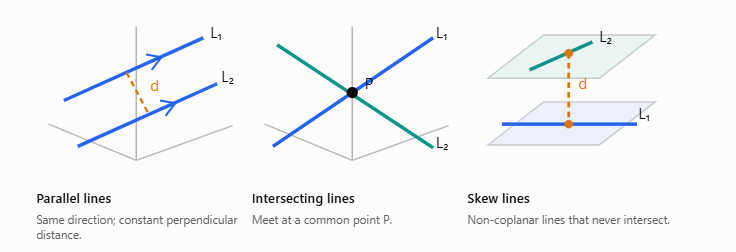
Parallel lines
Best Courses for You

JEE

NEET

Foundation JEE

Foundation NEET

CBSE
Same direction; constant perpendicular distance.
Intersecting lines
Meet at a common point P.
Skew lines
Non-coplanar lines that never intersect.
| Basis of comparison | Parallel lines | Intersecting lines | Skew lines |
| Direction vectors | Proportional | Non-proportional | Non-proportional |
| Common point | None for distinct parallel lines | One | None |
| Coplanar | Yes | Yes | No |
| Shortest distance | Constant and positive for distinct lines | Zero | Positive |
When solving 3D Geometry Class 12 important questions, students should first identify the relationship between the given lines and then select the appropriate formula.
3D Geometry Class 12 Important Questions with Solutions
The following original board-style important questions cover essential concepts from Chapter 11 of NCERT Class 12 Mathematics. Each question includes a detailed solution to help students understand the mathematical method, formula application and intermediate calculations.
Direction Cosines and Direction Ratios Important Questions
Question 1. Find the direction cosines of a line whose direction ratios are 2, −3 and 6.
Suggested marks: 2
Solution:
Given direction ratios:
a = 2, b = −3, c = 6
Step 1: Calculate the magnitude of the direction vector.
√(a² + b² + c²)
= √[2² + (−3)² + 6²]
= √(4 + 9 + 36)
= √49
= 7
Step 2: Calculate the direction cosines.
l = a/7 = 2/7
m = b/7 = −3/7
n = c/7 = 6/7
Step 3: Verify the relationship between direction cosines.
l² + m² + n² = 4/49 + 9/49 + 36/49
= 49/49 = 1
Final Answer: The direction cosines are (2/7, −3/7, 6/7) for the indicated direction.
Question 2. If the direction cosines of a line are l = 1/2, m = 1/2 and n, find the possible values of n.
Suggested marks: 2
Solution:
We know that the sum of the squares of the direction cosines of a line is equal to 1.
l² + m² + n² = 1
Substituting the given values:
(1/2)² + (1/2)² + n² = 1
1/4 + 1/4 + n² = 1
1/2 + n² = 1
n² = 1 − 1/2
n² = 1/2
Taking the square root:
n = ±1/√2
Final Answer: n = ±1/√2.
Question 3. Find the direction ratios and direction cosines of the line joining A(2, 3, 4) and B(5, 7, 16).
Suggested marks: 3
Solution:
Step 1: Calculate the direction ratios of the line joining A and B.
Direction ratios = (x₂ − x₁, y₂ − y₁, z₂ − z₁)
= (5 − 2, 7 − 3, 16 − 4)
= (3, 4, 12)
Step 2: Find the magnitude of the direction vector AB.
|AB| = √(3² + 4² + 12²)
= √(9 + 16 + 144)
= √169
= 13
Step 3: Divide each direction ratio by the magnitude.
l = 3/13
m = 4/13
n = 12/13
Final Answer:
Direction ratios = (3, 4, 12)
Direction cosines = (3/13, 4/13, 12/13), in the direction from A to B.
Vector Equation of a Line Important Questions
Question 4. Find the vector equation of a line passing through the point (2, −1, 3) and parallel to the vector 3î + 4ĵ − 2k̂.
Suggested marks: 2
Solution:
The vector equation of a line passing through a point with position vector a and parallel to direction vector b is:
r = a + λb
Given point:
A(2, −1, 3)
Therefore, its position vector is:
a = 2î − ĵ + 3k̂
The direction vector is:
b = 3î + 4ĵ − 2k̂
Substituting into the standard equation:
r = (2î − ĵ + 3k̂) + λ(3î + 4ĵ − 2k̂)
Here, λ is a real parameter representing different points on the straight line.
Final Answer:
r = (2î − ĵ + 3k̂) + λ(3î + 4ĵ − 2k̂).
Question 5. Find the vector equation of the line passing through the points A(1, 2, 3) and B(4, 6, 8).
Suggested marks: 3
Solution:
Step 1: Write the position vectors of A and B.
a = î + 2ĵ + 3k̂
b = 4î + 6ĵ + 8k̂
Step 2: Determine the direction vector AB.
AB = b − a
= (4 − 1)î + (6 − 2)ĵ + (8 − 3)k̂
= 3î + 4ĵ + 5k̂
Step 3: Apply the vector equation of a line passing through two points.
r = a + λ(b − a)
Substituting the values:
r = (î + 2ĵ + 3k̂) + λ(3î + 4ĵ + 5k̂)
When λ = 0, the equation gives point A. When λ = 1, it gives point B.
Final Answer:
r = (î + 2ĵ + 3k̂) + λ(3î + 4ĵ + 5k̂).
Cartesian Equation of a Line Important Questions
Question 6. Convert the vector equation r = (2î + 3ĵ − k̂) + λ(4î − 2ĵ + 5k̂) into Cartesian form.
Suggested marks: 3
Solution:
The given vector equation is:
r = (2î + 3ĵ − k̂) + λ(4î − 2ĵ + 5k̂)
Step 1: Express the position vector r in terms of Cartesian coordinates.
r = xî + yĵ + zk̂
Step 2: Compare the coefficients of î, ĵ and k̂.
x = 2 + 4λ
y = 3 − 2λ
z = −1 + 5λ
Step 3: Rearrange each equation to obtain λ.
λ = (x − 2)/4
λ = (y − 3)/(−2)
λ = (z + 1)/5
Step 4: Equate the three expressions.
Final Answer:
(x − 2)/4 = (y − 3)/(−2) = (z + 1)/5.
Question 7. Find the Cartesian equation of a line passing through the points (1, 2, 3) and (3, 5, 7).
Suggested marks: 3
Solution:
Step 1: Find the direction ratios of the line.
Direction ratios = (3 − 1, 5 − 2, 7 − 3)
= (2, 3, 4)
Step 2: Use the Cartesian equation of a line passing through (x₁, y₁, z₁).
(x − x₁)/a = (y − y₁)/b = (z − z₁)/c
Step 3: Substitute the coordinates of the first point and the direction ratios.
Final Answer:
(x − 1)/2 = (y − 2)/3 = (z − 3)/4.
Angle Between Two Lines Class 12 Important Questions
Question 8. Find the angle between two lines having direction ratios (1, 1, 0) and (1, 0, 1).
Suggested marks: 3
Solution:
Let the direction vectors of the given lines be:
b₁ = î + ĵ
b₂ = î + k̂
Step 1: Calculate the dot product.
b₁ · b₂ = (1)(1) + (1)(0) + (0)(1)
= 1
Step 2: Calculate the magnitudes of both vectors.
|b₁| = √(1² + 1² + 0²) = √2
|b₂| = √(1² + 0² + 1²) = √2
Step 3: Apply the angle formula.
cos θ = |b₁ · b₂| / (|b₁||b₂|)
cos θ = 1/(√2 × √2)
cos θ = 1/2
θ = cos⁻¹(1/2)
Final Answer: θ = 60°.
Question 9. Find the value of λ if two lines having direction ratios (2, λ, 3) and (1, −2, 4) have perpendicular directions.
Suggested marks: 2
Solution:
When the directions of two lines are perpendicular, the dot product of their direction vectors is equal to zero.
Therefore:
(2, λ, 3) · (1, −2, 4) = 0
Expanding the scalar product:
2(1) + λ(−2) + 3(4) = 0
2 − 2λ + 12 = 0
14 − 2λ = 0
2λ = 14
λ = 7
Verification:
2(1) + 7(−2) + 3(4)
= 2 − 14 + 12
= 0
Final Answer: λ = 7.
Parallel and Intersecting Lines Important Questions
Question 10. Determine whether the lines with direction ratios (2, 4, 6) and (1, 2, 3) have parallel directions.
Suggested marks: 2
Solution:
Two lines have parallel directions when their direction ratios are proportional.
Given direction ratios:
First line = (2, 4, 6)
Second line = (1, 2, 3)
Comparing the corresponding components:
2/1 = 2
4/2 = 2
6/3 = 2
Therefore:
(2, 4, 6) = 2(1, 2, 3)
Since the direction vectors are scalar multiples of each other, they have parallel directions.
Final Answer: The lines have parallel directions. Their position vectors would be required to determine whether they are distinct parallel lines or coincident lines.
Question 11. Determine whether the following lines intersect:
L₁: r = (î + ĵ) + λ(î + ĵ + k̂)
L₂: r = (2î + 2ĵ + k̂) + μ(î − ĵ + k̂)
Suggested marks: 3
Solution:
Step 1: Express the coordinates of a general point on each line.
For L₁:
x = 1 + λ
y = 1 + λ
z = λ
For L₂:
x = 2 + μ
y = 2 − μ
z = 1 + μ
Step 2: Equate the corresponding coordinates.
1 + λ = 2 + μ — Equation (1)
1 + λ = 2 − μ — Equation (2)
λ = 1 + μ — Equation (3)
Step 3: Solve Equations (1) and (2).
2 + μ = 2 − μ
2μ = 0
μ = 0
Substituting μ = 0 into Equation (1):
1 + λ = 2
λ = 1
Step 4: Verify Equation (3).
1 = 1 + 0
The equation is satisfied.
Step 5: Find the point of intersection.
Substituting λ = 1 into L₁:
x = 2, y = 2, z = 1
Final Answer: The lines intersect at (2, 2, 1).
Shortest Distance Between Two Lines Class 12 Important Questions
The shortest distance between two straight lines is the minimum distance between any point on the first line and any point on the second line. The method of calculating this distance depends on whether the lines are parallel, intersecting or skew.
For skew lines, the shortest distance is measured along their common perpendicular. For distinct parallel lines, the perpendicular distance remains constant, while intersecting lines have a shortest distance of zero.
Question 12. Find the shortest distance between the lines:
L₁: r = (î + 2ĵ + 3k̂) + λ(î + ĵ)
L₂: r = (2î + ĵ + 5k̂) + μ(î − ĵ)
Suggested marks: 3
Solution:
Step 1: Identify the position vectors and direction vectors.
a₁ = (1, 2, 3)
a₂ = (2, 1, 5)
b₁ = (1, 1, 0)
b₂ = (1, −1, 0)
Step 2: Find the difference between the position vectors.
a₂ − a₁ = (2 − 1, 1 − 2, 5 − 3)
= (1, −1, 2)
Step 3: Calculate the cross product of the direction vectors.
b₁ × b₂ = (1, 1, 0) × (1, −1, 0)
= (0, 0, −2)
Step 4: Calculate its magnitude.
|b₁ × b₂| = √[0² + 0² + (−2)²]
= 2
Step 5: Calculate the numerator.
(a₂ − a₁) · (b₁ × b₂)
= (1, −1, 2) · (0, 0, −2)
= 0 + 0 − 4
= −4
Step 6: Apply the shortest-distance formula.
d = |−4|/2
d = 4/2
Final Answer: The shortest distance between the two skew lines is 2 units.
Question 13. Find the shortest distance between two parallel lines:
L₁: r = (î + ĵ + k̂) + λ(2î + ĵ + 2k̂)
L₂: r = (3î + 2ĵ + 4k̂) + μ(2î + ĵ + 2k̂)
Suggested marks: 3
Solution:
Step 1: Identify the given position vectors and common direction vector.
a₁ = (1, 1, 1)
a₂ = (3, 2, 4)
b = (2, 1, 2)
Since both lines have the same direction vector, the parallel-line shortest-distance formula applies.
Step 2: Calculate the difference between the position vectors.
a₂ − a₁ = (3 − 1, 2 − 1, 4 − 1)
= (2, 1, 3)
Step 3: Calculate the cross product.
(a₂ − a₁) × b
= (2, 1, 3) × (2, 1, 2)
= (2 − 3, 6 − 4, 2 − 2)
= (−1, 2, 0)
Step 4: Find the magnitude of the cross product.
|(a₂ − a₁) × b| = √(1 + 4 + 0)
= √5
Step 5: Find the magnitude of the common direction vector.
|b| = √(2² + 1² + 2²)
= √9 = 3
Step 6: Apply the formula.
d = |(a₂ − a₁) × b| / |b|
Final Answer: The shortest distance is √5/3 units.
Question 14. Find the shortest distance between the x-axis and the line r = (2ĵ + 3k̂) + λî.
Suggested marks: 3
Solution:
The vector equation of the x-axis is:
r = μî
Step 1: Identify the position vectors of both lines.
a₁ = (0, 0, 0)
a₂ = (0, 2, 3)
Both lines have the same direction vector:
b = (1, 0, 0)
Therefore, the lines are parallel.
Step 2: Find the difference between their position vectors.
a₂ − a₁ = (0, 2, 3)
Step 3: Calculate the cross product.
(0, 2, 3) × (1, 0, 0)
= (0, 3, −2)
Step 4: Calculate the magnitude.
√(0² + 3² + 4)
= √13
Step 5: Apply the shortest-distance formula.
d = √13/1
Final Answer: The shortest distance between the two lines is √13 units.
3D Geometry Class 12 MCQs with Answers
Multiple-choice questions from Three-Dimensional Geometry assess students' conceptual knowledge, formula application and ability to perform quick calculations. Students should practise these questions before attempting lengthy board examination numericals.
Question 15. If l, m and n are the direction cosines of a line, which of the following relationships is correct?
- l + m + n = 1
- l² + m² + n² = 1
- lmn = 1
- l² + m² + n² = 0
Correct Answer: B
Explanation: Direction cosines represent the components of a unit vector along the three coordinate axes. Since the magnitude of a unit vector is 1, the sum of the squares of its components must also be equal to 1.
Question 16. The direction cosines of the positive x-axis are:
- (0, 1, 0)
- (0, 0, 1)
- (1, 0, 0)
- (1, 1, 1)
Correct Answer: C
Explanation: The positive x-axis makes an angle of 0° with itself and an angle of 90° with both the positive y-axis and z-axis.
Therefore:
l = cos 0° = 1
m = cos 90° = 0
n = cos 90° = 0
Hence, the direction cosines are (1, 0, 0).
Question 17. If two straight lines intersect, the shortest distance between them is:
- 1 unit
- Zero
- Infinite
- Always positive
Correct Answer: B
Explanation: Intersecting lines have a common point. Since this point belongs to both lines, the minimum possible distance between them is zero.
Question 18. Which condition indicates that two non-zero direction vectors are perpendicular?
- b₁ × b₂ = 0
- b₁ · b₂ = 1
- b₁ · b₂ = 0
- b₁ = b₂
Correct Answer: C
Explanation: The scalar product of two vectors is given by:
b₁ · b₂ = |b₁||b₂| cos θ
For perpendicular directions, θ = 90°.
Since cos 90° = 0, the scalar product is zero.
Question 19. Two non-parallel lines that do not intersect and do not lie in the same plane are called:
- Coincident lines
- Parallel lines
- Skew lines
- Coplanar lines
Correct Answer: C
Explanation: Skew lines exist in three-dimensional space and are neither parallel nor intersecting. Unlike two intersecting lines, they cannot be contained within a single plane.
3D Geometry Class 12 Case Study Questions with Solutions
Competency-based questions require students to apply mathematical concepts to practical situations. Three-Dimensional Geometry case studies may involve navigation, construction, transportation, robotics or the movement of objects in three-dimensional space.
Case Study 1: Drone Navigation Using Three-Dimensional Geometry
A drone moves in three-dimensional space from point A(1, 2, 3) to point B(4, 6, 15). Its path is assumed to be a straight line.
Question A. Find the direction ratios of the drone's path.
Solution:
Direction ratios = (4 − 1, 6 − 2, 15 − 3)
= (3, 4, 12)
Answer: (3, 4, 12).
Question B. Calculate the distance travelled by the drone.
Solution:
AB = √[(4 − 1)² + (6 − 2)² + (15 − 3)²]
= √(9 + 16 + 144)
= √169
Answer: 13 units.
Question C. Find the direction cosines of the drone's path.
Solution:
Divide each direction ratio by the magnitude of AB.
l = 3/13
m = 4/13
n = 12/13
Answer: (3/13, 4/13, 12/13).
Question D. Write the vector equation representing the drone's path.
Solution:
Position vector of A = î + 2ĵ + 3k̂
Direction vector AB = 3î + 4ĵ + 12k̂
Using r = a + λb:
Answer:
r = (î + 2ĵ + 3k̂) + λ(3î + 4ĵ + 12k̂), where 0 ≤ λ ≤ 1 represents the journey from A to B.
Case Study 2: Parallel Pipelines in an Industrial Plant
Two straight pipelines are represented by the following vector equations:
L₁: r = (î + 2ĵ + 3k̂) + λ(î + 2ĵ + 2k̂)
L₂: r = (3î + 2ĵ + 3k̂) + μ(î + 2ĵ + 2k̂)
An engineer needs to determine their relationship and minimum separation.
Question A. Determine whether the pipelines are parallel.
Solution:
Both pipelines have the same direction vector:
b = (1, 2, 2)
Since their direction vectors are identical, the pipelines have parallel directions. The difference between their given position vectors is (2, 0, 0), which is not proportional to the direction vector, so the lines are distinct.
Answer: The pipelines are parallel.
Question B. Calculate the magnitude of their common direction vector.
Solution:
|b| = √(1² + 2² + 2²)
= √(1 + 4 + 4)
= √9
Answer: 3.
Question C. Find the shortest distance between the pipelines.
Solution:
Difference between position vectors:
a₂ − a₁ = (3 − 1, 2 − 2, 3 − 3)
= (2, 0, 0)
Calculate the cross product:
(2, 0, 0) × (1, 2, 2)
= (0, −4, 4)
Magnitude of the cross product:
√(0 + 16 + 16) = √32 = 4√2
Using the shortest-distance formula:
d = 4√2/3
Answer: The shortest distance between the pipelines is 4√2/3 units.
Three-Dimensional Geometry Class 12 Previous Year Questions (PYQs)
Solving 3D Geometry Class 12 previous year questions is an effective way to understand how CBSE tests mathematical concepts in board examinations. Previous-year question papers provide students with exposure to actual examination questions, different numerical formats and expected levels of mathematical reasoning.
While practising Three-Dimensional Geometry PYQs, students should focus on questions involving direction cosines, equations of lines, angles between lines and shortest distance between skew or parallel lines.
| PYQ practice area | Recommended preparation approach |
| Direction ratios and cosines | Practise normalisation and coordinate-based calculations |
| Equation of a straight line | Practise conversion between vector and Cartesian forms |
| Angle between two lines | Revise scalar products and direction vector magnitudes |
| Parallel and perpendicular directions | Practise proportionality and zero dot product conditions |
| Shortest distance between lines | Revise separate formulas for parallel and skew lines |
| Competency-based questions | Practise converting practical situations into mathematical equations |
Students can access actual board examination papers through Infinity Learn's CBSE Class 12 Maths Previous Year Question Papers collection.
When solving older question papers, students should ensure that the questions are relevant to the current CBSE syllabus. The solved practice questions on this page are original board-style questions rather than authenticated previous-year board examination questions.
Important NCERT Questions for Three-Dimensional Geometry Class 12
NCERT exercises are an important starting point for preparing Three-Dimensional Geometry for the CBSE Class 12 Mathematics board examination. Students should complete the prescribed NCERT exercises before moving to advanced question banks and previous-year papers.
Start with questions involving direction ratios and direction cosines, as these concepts form the foundation for understanding equations of straight lines.
After completing the foundational questions, practise vector and Cartesian equations, angles between lines and shortest-distance problems. Selected miscellaneous exercise questions can help students combine multiple concepts within a single problem.
Students should particularly practise NCERT questions that require them to:
- Determine direction cosines from given direction ratios.
- Find the equation of a line passing through two points.
- Convert vector equations into Cartesian equations.
- Calculate angles between two straight lines.
- Determine the relationship between given lines.
- Calculate the shortest distance using vector products.
Instead of memorising individual NCERT solutions, students should understand the mathematical principles used in each question so that they can solve similar problems with different numerical values.
Common Mistakes to Avoid in Three-Dimensional Geometry Class 12 Questions
Three-Dimensional Geometry numerical questions often involve multiple calculations. Even when students understand the correct concept, errors in vector operations, signs or formula selection can lead to incorrect answers.
| Common mistake | Correct approach |
| Confusing direction ratios with direction cosines | Divide direction ratios by their combined magnitude to obtain direction cosines. |
| Subtracting coordinates in an inconsistent order | Use the same point order for all three coordinate differences. |
| Incorrectly converting vector equations into Cartesian form | Compare individual vector components and eliminate the parameter carefully. |
| Using the wrong shortest-distance formula | First determine whether the lines are parallel, intersecting or skew. |
| Forgetting the magnitude in the distance formula | Use the absolute value of the numerator and the magnitude of the denominator. |
| Confusing dot product and cross product | Use the dot product for angles and the cross product for perpendicular directions and distance calculations. |
| Incorrect determinant signs | Follow the positive, negative, positive sign pattern when expanding a cross product. |
| Assuming perpendicular direction vectors guarantee intersection | Check whether the lines actually share a common point. |
| Ignoring the final unit | Express calculated distances in the appropriate units. |
Students should verify their intermediate calculations before writing the final answer. For example, direction cosines must satisfy l² + m² + n² = 1, and the shortest distance between two lines cannot be negative.
How to Prepare 3D Geometry for CBSE Class 12 Board Exam 2027
Three-Dimensional Geometry becomes easier when students develop a strong understanding of Vector Algebra and practise questions in a systematic order.
1. Revise Vector Algebra Before Starting 3D Geometry
Vector addition, subtraction, scalar products, vector products and magnitudes are essential prerequisites for Three-Dimensional Geometry. Students should revise these concepts before attempting line-equation and shortest-distance problems.
2. Understand Direction Ratios and Direction Cosines
Practise questions involving the conversion of direction ratios into direction cosines. Understanding the difference between these two quantities helps students solve more complex questions involving straight lines.
3. Practise Both Vector and Cartesian Equations
Students should be comfortable representing the same straight line in different mathematical forms. Regular practice of conversions between vector, parametric and Cartesian equations can improve calculation accuracy.
4. Learn How to Identify the Relationship Between Two Lines
Before applying any distance formula, determine whether the lines are parallel, intersecting or skew. This step is especially important in long-answer numerical questions involving shortest distance.
5. Prepare a Formula Revision Sheet
Create a concise revision sheet containing direction cosine formulas, equations of lines, angle formulas and shortest-distance formulas. Include the conditions under which each formula is applicable.
6. Solve NCERT Questions and Previous Year Papers
Complete the prescribed NCERT exercises and then practise chapter-wise previous-year board questions. Compare your solutions with the corresponding marking schemes wherever available to improve mathematical presentation.
7. Practise Writing Complete Step-by-Step Solutions
In the CBSE board examination, students should present the relevant formula, given values, intermediate calculations and final answer clearly. Avoid skipping important vector calculations or directly writing numerical answers.
Related Class 12 Maths Important Questions
course
No courses found
FAQs on 3D Geometry Class 12 Important Questions
What are the most important topics in Three-Dimensional Geometry Class 12?
The important topics in Three-Dimensional Geometry Class 12 include direction ratios, direction cosines, vector and Cartesian equations of straight lines, angles between two lines, skew lines and shortest distance between two lines.
Students should pay particular attention to line-equation conversions and shortest-distance problems because these questions require the application of multiple Vector Algebra concepts. However, students should prepare all topics prescribed in the CBSE Mathematics syllabus.
What is the difference between direction ratios and direction cosines?
Direction ratios are any three numbers proportional to the components of a direction vector. Direction cosines are the cosines of the angles made by a directed line with the positive x-axis, y-axis and z-axis.
Direction ratios do not necessarily satisfy a² + b² + c² = 1. However, direction cosines always satisfy:
l² + m² + n² = 1
Students can obtain direction cosines by dividing each direction ratio by the magnitude of the direction vector.
How do you find the equation of a line passing through two points in 3D Geometry?
To find the equation of a line passing through two points, first determine the direction vector by subtracting the coordinates of one point from the corresponding coordinates of the other point.
If a and b are the position vectors of the two points, the vector equation is:
r = a + λ(b − a)
For Cartesian form, use the coordinates of either point along with the calculated direction ratios. This method can be applied to any two distinct points in three-dimensional space.
How do you convert the vector equation of a line into Cartesian form?
To convert a vector equation into Cartesian form, express the position vector r as xî + yĵ + zk̂ and compare the coefficients of the corresponding unit vectors.
For example:
r = (î + 2ĵ + 3k̂) + λ(2î + 3ĵ + 4k̂)
Comparing the components:
x = 1 + 2λ
y = 2 + 3λ
z = 3 + 4λ
Eliminating λ gives:
(x − 1)/2 = (y − 2)/3 = (z − 3)/4
This is the required Cartesian equation of the line.
What is the formula for the shortest distance between two skew lines?
The shortest distance between two skew lines is calculated using their position vectors and direction vectors.
For two lines represented by:
r = a₁ + λb₁
r = a₂ + μb₂
The shortest-distance formula is:
d = |(a₂ − a₁) · (b₁ × b₂)| / |b₁ × b₂|
This formula measures the perpendicular separation between two non-parallel lines. Students should ensure that the cross product of the direction vectors is non-zero before applying this formula.
How do you calculate the angle between two lines in Three-Dimensional Geometry?
The angle between two straight lines can be calculated using the scalar product of their direction vectors.
If b₁ and b₂ represent the direction vectors of the two lines, the acute or right angle between them is given by:
cos θ = |b₁ · b₂| / (|b₁||b₂|)
Calculate the dot product, determine the magnitude of each vector and substitute the values into the formula. Finally, apply the inverse cosine function to obtain the angle.
Are equations of planes included in the CBSE Class 12 Three-Dimensional Geometry syllabus 2026–27?
Equations of planes are not listed in the prescribed CBSE Class 12 Mathematics Three-Dimensional Geometry syllabus for the academic session 2026–27.
Students preparing for the CBSE Board Examination 2027 should focus on direction ratios, direction cosines, equations of straight lines, angles between lines, skew lines and shortest distance between two lines.
While practising older NCERT questions and previous-year papers, students should avoid spending excessive preparation time on topics that are outside the current prescribed syllabus.
How do you identify whether two lines are parallel, intersecting or skew?
First, compare the direction vectors of the two lines. If the direction vectors are proportional, the lines are either parallel or coincident.
If the direction vectors are not proportional, equate the coordinates of the two lines and solve for their respective parameters. If a consistent solution exists, the lines intersect at a common point.
If no common point exists and the direction vectors are not proportional, the lines are skew. Identifying this relationship correctly is essential for selecting the appropriate shortest-distance formula.
Is Three-Dimensional Geometry difficult for Class 12 students?
Three-Dimensional Geometry can initially appear challenging because it involves spatial relationships, vector calculations and multiple coordinate equations. However, students with a clear understanding of Vector Algebra generally find the chapter more manageable.
Practising direction ratios, line equations and vector products in a systematic order can help students develop confidence before attempting complex shortest-distance questions.
Where can I practise 3D Geometry Class 12 important questions with solutions?
Students can practise 3D Geometry Class 12 important questions with detailed step-by-step solutions on this Infinity Learn page. The collection covers direction ratios, direction cosines, vector equations, Cartesian equations, angles between lines, shortest-distance numericals, MCQs and competency-based case studies.
