













Banner 0
Banner 1
Banner 2
Banner 3
Banner 4
Banner 5
Banner 6
Banner 7
Banner 8
Banner 9

Q.

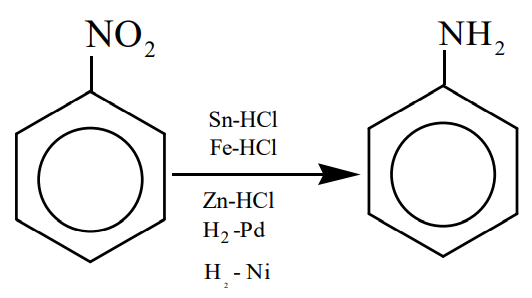
The total number of reagents from those given below, that can convert nitrobenzene into aniline is ______ (integer answer)

(I) Sn-HCl            (II) Sn-NH4OH          (III) Fe-HCl                 (IV) Zn-HCl             (V) H2-Pd                (VI) H2 –Raney nickel

see full answer

High-Paying Jobs That Even AI Can’t Replace — Through JEE/NEET

🎯 Hear from the experts why preparing for JEE/NEET today sets you up for future-proof, high-income careers tomorrow.
An Intiative by Sri Chaitanya

(Unlock A.I Detailed Solution for FREE)

Best Courses for You

JEE

JEE

NEET

NEET

Foundation JEE

Foundation JEE

Foundation NEET

Foundation NEET

CBSE

CBSE

Detailed Solution

We want to convert nitrobenzene (C₆H₅NO₂) → aniline (C₆H₅NH₂).

This is a reduction reaction, where the –NO₂ (nitro group) is reduced to a –NH₂ (amino group).

So, we are looking for reagents that can reduce a nitro group to an amine.
I) Sn + HCl (Tin + Hydrochloric acid)

YES – This is a classic reducing agent used in labs to reduce nitro compounds to amines. It forms SnCl₂ in situ, which acts as the reducing species.

Reaction: C₆H₅NO₂ + 6[H] → C₆H₅NH₂ + 2H₂O

II) Sn + NH₄OH (Tin + Ammonium hydroxide)

NO – Tin without acidic conditions (like HCl) is not effective for reducing nitrobenzene. NH₄OH provides basic medium, which doesn't work well here. Reduction requires an acidic environment.

III) Fe + HCl (Iron + Hydrochloric acid)

YES – This is another commonly used reagent to reduce nitrobenzene to aniline. Fe is cheaper and works similarly to Sn.

IV) Zn + HCl (Zinc + Hydrochloric acid)

YES – Zinc in acidic medium is also a good reducing agent for nitro groups. Zn gets oxidized and reduces the nitro group to amine.

V) H₂ + Pd (Hydrogen gas + Palladium catalyst)

YES – This is a catalytic hydrogenation method. Nitrobenzene is reduced to aniline using hydrogen gas in the presence of a metal catalyst like Pd.

VI) Raney Nickel

NO (but tricky) – Raney Ni can be used in catalytic hydrogenation, but only in presence of H₂ gas. On its own, it's just a catalyst, not a reducing agent.

In the absence of H₂, Raney Ni won’t work. Since no hydrogen gas is mentioned here, this is not effective as written.

Final Count:

Reagents that can reduce nitrobenzene to aniline:

Total = 4

Correct Answer: 4
To reduce a nitro group to an amine, you need a strong reducing environment, usually acidic metal reductions or catalytic hydrogenation with H₂.

Question Image

Watch 3-min video & get full concept clarity

score_test_img

courses

No courses found

Ready to Test Your Skills?

Check your Performance Today with our Free Mock Test used by Toppers!

Take Free Test

Get Expert Academic Guidance – Connect with a Counselor Today!

whats app icon