CBSE Class 10 Maths Previous Year Questions with Step-by-Step Solutions
By Ankit Gupta
|
Updated on 28 Sep 2026, 14:15 IST
Stepping into the CBSE Class 10 Board Exam hall can feel intimidating, especially when it is time for the Mathematics paper. The secret to transforming that pre-exam anxiety into absolute confidence lies in how you prepare. While completing your textbook is a good start, practicing Previous Year Questions (PYQs) is the real game-changer.
Think of past papers as a direct preview of your actual exam. They reveal the exact patterns the board favors, the way marks are distributed, and the topics that appear year after year. By studying papers from the last five years, you stop guessing what might be on the test and start practicing the commonly tested problem formats you will face. This guide covers the highest-yield question patterns across the Class 10 syllabus, complete with clear, step-by-step solutions to help you maximize your board exam score.
Number Systems and Real Numbers
The foundational chapter of Class 10 focuses on the fundamental traits of integers and rational numbers. One of the most frequently tested questions asks students to prove the irrationality of numbers such as √2, √3, or √5.
Solved PYQ: Irrationality Proof (Highly Repeated — 3 Marks)
Question: Prove that √5 is an irrational number.
Step 1: The Contrary Assumption
Let us assume the opposite: suppose √5 is a rational number. This means we can write it in the form of a fraction:
√5 = a/b
Here, a and b are co-prime integers (meaning they share no common factors other than 1), and b ≠ 0.

Step 2: Squaring and Rearranging
Squaring both sides of the equation gives us:
Best Courses for You

JEE

NEET

Foundation JEE

Foundation NEET

CBSE
5 = a²/b²
Multiplying both sides by b² gives:
a² = 5b²
Because a² equals 5 times b², it means 5 divides a² completely. By mathematical theorem, if a prime number divides a², it must also divide a. Therefore, 5 divides a.
Step 3: Substituting the Common Value
Since 5 divides a, we can rewrite a as 5 times another integer, let us call it c:
a = 5c
Now, substitute this new expression for a back into the equation a² = 5b²:
(5c)² = 5b² → 25c² = 5b²
Dividing both sides by 5 simplifies it to:
b² = 5c²
This tells us that 5 also divides b² completely. Following the same rule, if 5 divides b², then 5 must divide b as well.
Step 4: Finding the Contradiction
Look at our results from Step 2 and Step 3. We discovered that 5 divides both a and b. This means a and b share a common factor of 5.
However, this completely contradicts our very first assumption that a and b are co-prime numbers with no common factors. Because our original assumption led to a contradiction, it must be false.
Final Answer: Therefore, √5 is an irrational number.
Algebra: Polynomials, Linear Equations, Quadratic Equations, and Arithmetic Progressions (AP)
Algebra accounts for a massive chunk of your total marks. Questions in this section usually test your ability to work with formulas, identify system properties, and apply arithmetic progressions to real-world scenarios.
Solved PYQ 1: Linear Equations (2 Marks)
Question: Find the value of k for which the system of linear equations kx + 3y = 1 and 12x + ky = 2 has infinitely many solutions.
Step 1: Identify the Coefficients
Write the equations in standard form (a₁x + b₁y + c₁ = 0 and a₂x + b₂y + c₂ = 0):
a₁ = k, b₁ = 3, c₁ = −1 a₂ = 12, b₂ = k, c₂ = −2
Step 2: Apply the Condition for Infinitely Many Solutions
For a system to have infinitely many solutions, the ratios of the coefficients must satisfy:
a₁/a₂ = b₁/b₂ = c₁/c₂
Step 3: Substitute and Solve for k
Substitute the values into the ratio:
k/12 = 3/k = 1/2
Equating the first two parts, 3/k = 1/2 gives k = 6. Equating the second and third parts to verify, k/12 = 1/2 also gives k = 6, confirming the result.
Final Answer: The value of k for which the system has infinitely many solutions is 6.
Solved PYQ 2: Quadratic Equations (3 Marks)
Question: Find the value of k for which the quadratic equation 2x² + kx + 3 = 0 has two equal real roots.
Step 1: Identify the Coefficients
Compare the given equation with the standard quadratic equation form (ax² + bx + c = 0):
a = 2, b = k, c = 3
Step 2: Apply the Condition for Equal Roots
For a quadratic equation to have two equal real roots, its discriminant (D) must equal exactly zero:
D = b² − 4ac = 0
Step 3: Substitute and Solve
Plug the values of a, b, and c into the discriminant formula:
k² − 4(2)(3) = 0 → k² = 24
Simplifying the radical gives us:
k = ±√24 = ±2√6
Final Answer: The values of k are 2√6 and −2√6.
Solved PYQ 3: Arithmetic Progression Application (5 Marks)
Question: The sum of the 4th and 8th terms of an AP is 24, and the sum of the 6th and 10th terms is 44. Find the first three terms of the AP.
Step 1: Set Up the Formulas
Let the first term of the AP be a and the common difference be d. The general formula for the n-th term is aₙ = a + (n−1)d.
Step 2: Translate the First Condition
The sum of the 4th and 8th terms is 24:
(a + 3d) + (a + 7d) = 24 → 2a + 10d = 24
Divide the entire equation by 2 to make it simpler:
a + 5d = 12 ... (Equation 1)
Step 3: Translate the Second Condition
The sum of the 6th and 10th terms is 44:
(a + 5d) + (a + 9d) = 44 → 2a + 14d = 44
Divide by 2 to simplify:
a + 7d = 22 ... (Equation 2)
Step 4: Solve the System of Equations
Subtract Equation 1 from Equation 2 to eliminate a:
2d = 10 → d = 5
Now, substitute d = 5 back into Equation 1 to find a:
a + 5(5) = 12 → a = −13
Step 5: Write Down the First Three Terms
- First term (a₁) = −13
- Second term (a₂) = a + d = −13 + 5 = −8
- Third term (a₃) = a + 2d = −13 + 2(5) = −3
Final Answer: The first three terms of the AP are −13, −8, and −3.
Common Mistake to Avoid: when simplifying linear equations by dividing, remember to divide every single term on both sides of the equals sign, not just the variables.
Geometry: Triangles and Circles
Geometry questions focus heavily on core theorems. To get full marks, you need to state the exact theorem you are using to justify your steps.
Solved PYQ: Circle Tangent Theorem (3 Marks)
Question: Prove that the lengths of tangents drawn from an external point to a circle are equal.
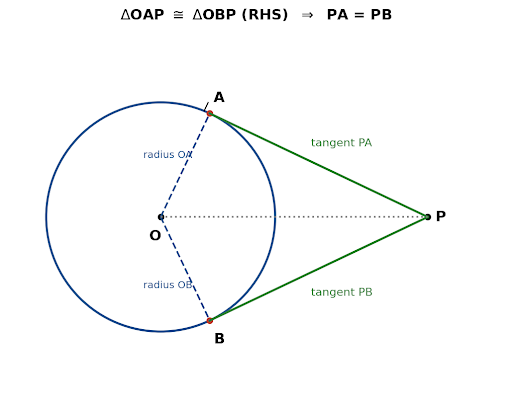
Figure 1: Tangents PA and PB, with radii OA and OB drawn to the points of contact.
Step 1: State What Is Given and What to Prove
Given: a circle with center O and an external point P. Two tangents, PA and PB, are drawn from point P to touch the circle at points A and B.
To Prove: PA = PB
Step 2: Add Construction Lines
Join the center point O to points A, B, and P. This creates two triangles: ΔOAP and ΔOBP.
Step 3: Prove Congruence
Compare ΔOAP and ΔOBP:
- OA = OB (these are both radii of the same circle).
- ∠OAP = ∠OBP = 90° (radius drawn to the point of contact of a tangent is perpendicular to the tangent).
- OP = OP (this is a shared side common to both triangles).
Because these three conditions match, ΔOAP is congruent to ΔOBP by the Right angle-Hypotenuse-Side (RHS) congruence rule.
Step 4: Apply CPCT
Since the two triangles are perfectly congruent, all their corresponding parts must be equal by Corresponding Parts of Congruent Triangles (CPCT), giving PA = PB directly.
Final Answer: Hence, PA = PB.
Trigonometry: Ratios, Identities, and Heights/Distances
Trigonometry problems usually come in two variations: proving algebraic identities or solving real-world height and distance problems using right-angled triangles.
Solved PYQ: Height and Distance Application (5 Marks)
Question: An observer from the top of a 75-meter-high lighthouse looks down at two ships approaching it. The angles of depression of the ships are 30° and 45°. If one ship is directly behind the other on the same side of the lighthouse, find the distance between the two ships.
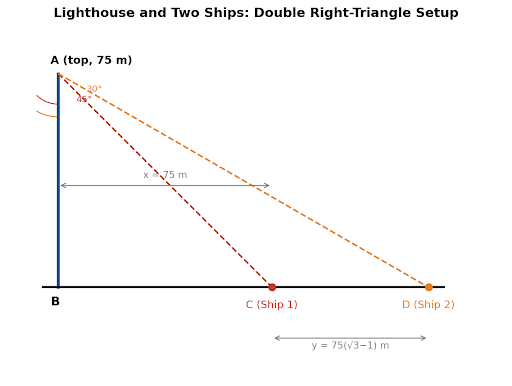
Figure 2: The angle of depression from the top equals the angle of elevation from each ship (alternate angles).
Step 1: Visualize and Label the Diagram
Let AB represent the lighthouse, so AB = 75 m. Let C and D be the positions of the two ships. The angle of elevation from Ship 1 (C) to the top is 45°, and from Ship 2 (D) to the top is 30°. Let the distance from the lighthouse base to the first ship be BC = x, and the distance between the two ships be CD = y.
Step 2: Analyze the First Right-Angled Triangle (ΔABC)
Using the tangent ratio (tanθ = Opposite / Adjacent):
tan 45° = AB/BC = 75/x
Since tan 45° = 1, we can substitute the values:
1 = 75/x → x = 75
Step 3: Analyze the Second Right-Angled Triangle (ΔABD)
Now look at the larger triangle, where the total base distance is BD = x + y:
tan 30° = AB/BD = 75/(x+y)
Since tan 30° = 1/√3, we substitute our values:
1/√3 = 75/(x+y)
Cross-multiplying gives:
x + y = 75√3
Step 4: Calculate the Distance Between the Ships (y)
Substitute the value of x = 75 that we found in Step 2 into this new equation:
75 + y = 75√3 → y = 75√3 − 75
Factor out 75 to get the final exact answer:
y = 75(√3 − 1)
Final Answer: The distance between the two ships is 75(√3 − 1) meters, or roughly 54.9 meters if you substitute √3 ≈ 1.732.
Mensuration: Areas, Surface Areas, and Volumes
Mensuration problems frequently involve complex shapes created by combining or modifying solid objects. Success here depends on tracking your calculation steps carefully.
Solved PYQ: Combined Solids (5 Marks)
Question: A solid toy is in the form of a hemisphere surmounted by a right circular cone. The height of the cone is 2 cm and the diameter of the base is 4 cm. Determine the volume of the toy. (Take π = 3.14).
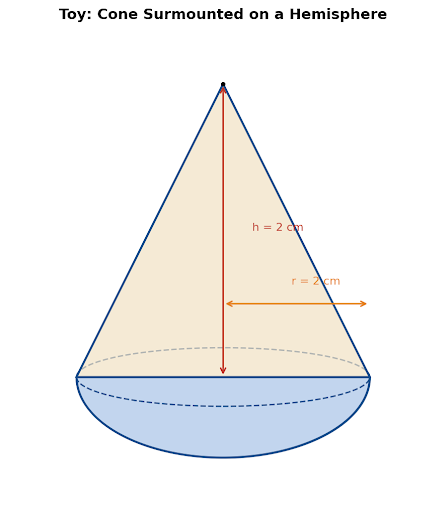
Figure 3: The toy's total volume is the cone's volume plus the hemisphere's volume, sharing the same radius.
Step 1: Extract the Dimensions
The base diameter of both the cone and the hemisphere is 4 cm, which means the shared radius is r = 4/2 = 2 cm. The height of the cone component is h = 2 cm.
Step 2: Write Down the Volume Formulas
The total volume of the toy is the sum of the volume of the cone and the volume of the hemisphere:
V = (1/3)πr²h + (2/3)πr³
Step 3: Factor the Expression to Simplify Calculations
Instead of calculating each part separately with decimals, factor out the common terms first to minimize arithmetic mistakes:
V = (πr²/3)(h + 2r)
Step 4: Substitute the Values
Plug in our dimensions (r = 2, h = 2, π = 3.14):
V = (3.14 × 4 / 3)(2 + 4) = (3.14 × 4 / 3)(6)
Cancel out the 3 and the 6:
V = 3.14 × 4 × 2 = 25.12
Final Answer: The total volume of the toy is 25.12 cm³.
Statistics and Probability
This section provides an excellent opportunity to score quick, reliable marks. All you need to do is apply standard formulas and tracking criteria accurately.
Solved PYQ 1: Calculating the Median (4 Marks)
Question: Find the median marks for the following frequency distribution.
| Marks | Number of Students (Frequency) |
| 0–10 | 5 |
| 10–20 | 15 |
| 20–30 | 30 |
| 30–40 | 8 |
| 40–50 | 2 |
Step 1: Create a Cumulative Frequency (CF) Table
| Marks | Frequency (f) | Cumulative Frequency (cf) |
| 0–10 | 5 | 5 |
| 10–20 | 15 | 5 + 15 = 20 |
| 20–30 | 30 | 20 + 30 = 50 |
| 30–40 | 8 | 50 + 8 = 58 |
| 40–50 | 2 | 58 + 2 = 60 |
Step 2: Identify the Total Frequency and Median Class
Total number of observations (N) = 60. Calculate N/2 = 60/2 = 30. Look down the cumulative frequency column to find the first value greater than or equal to 30. That value is 50, which places our calculations within the 20–30 class interval.
Median Class = 20–30
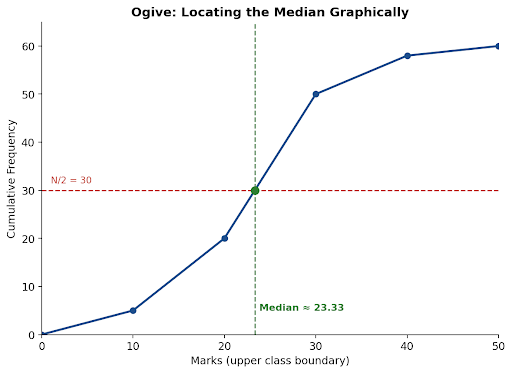
Figure 4: The ogive gives the same median graphically as the interpolation formula does algebraically.
Step 3: Extract the Class Formula Components
- Lower limit of median class (l) = 20
- Frequency of median class (f) = 30
- Cumulative frequency of the preceding class (cf) = 20
- Class width (h) = 10
Step 4: Apply the Median Formula
Median = l + [(N/2 − cf)/f] × h
Substitute your values into the equation:
Median = 20 + [(30 − 20)/30] × 10 = 20 + 3.33
Final Answer: The median mark for the students is 23.33.
Solved PYQ 2: Probability Concepts (2 Marks)
Question: One card is drawn from a well-shuffled deck of 52 cards. Find the probability of getting a king of red color.
Step 1: Total Number of Outcomes
The total number of possible outcomes is equal to the total number of cards in the deck: 52.
Step 2: Number of Favorable Outcomes
A standard deck contains two red suits (Hearts and Diamonds). Each suit has exactly one King. Therefore, the number of red kings is 2.
Step 3: Calculate Probability
Using the standard probability formula:
P(red king) = 2/52 = 1/26
Final Answer: The probability of drawing a red king is 1/26.
Most Repeated Questions: Summary Table
The table below breaks down the high-probability patterns analyzed from recent board papers, helping you direct your study time to high-priority sections.
| Chapter / Unit | Most Common Question Type | Marks Trend | Priority |
| Real Numbers | Proving numbers like √3 or √5 are irrational | 3 Marks | High |
| Linear Equations | Finding unknown values for specific system conditions | 2–3 Marks | Medium |
| Quadratic Equations | Finding unknown values using the equal roots condition | 3–5 Marks | High |
| Arithmetic Progression | Solving word problems involving aₙ and Sₙ equations | 4–5 Marks | High |
| Circles | Proving the external tangent length theorem | 3 Marks | Medium |
| Heights and Distances | Double triangle problems with 30°, 45°, or 60° angles | 5 Marks | High |
| Surface Areas & Volumes | Finding the volume or melting capacity of combined solids | 5 Marks | High |
| Statistics & Probability | Computing missing frequencies or card and dice possibilities | 2–4 Marks | High |
How Infinity Learn Helps with CBSE Board PYQ Practice
Mastering mathematics requires structured, intentional practice rather than passive reading. Infinity Learn helps streamline your board exam preparation through targeted digital tools:
- Chapter-by-Chapter Mock Drills: step away from bulky past paper books. Use the platform to filter past board exam questions by specific chapters, letting you practice a topic immediately after learning it in class.
- Step-by-Step Video Solutions: if you get stuck on a tough algebra problem or a geometric proof, watch clear, step-by-step video solutions that break down the exact logical process needed to solve it.
- Personal Progress Tracker: the analytical dashboard pinpoints your strengths and highlights areas where you might be losing marks, helping you optimize your study time before exam day.
Conclusion
Excelling in your CBSE Class 10 Maths exam comes down to consistent, deliberate practice. High-weightage topics like Algebra, Trigonometry applications, Mensuration, and Statistics make up the core of the test. Mastering these areas gives you a massive advantage.
During the final 60 days before your board exam, organize your study calendar around past papers. Use your morning hours to master core formulas and geometric theorems. In the afternoon, sit in a quiet room, set a timer for three hours, and solve a complete previous year paper from start to finish. Once the timer goes off, grade your work strictly against the official CBSE marking scheme. Use your mistakes to guide your next study session, and practice the steps you missed until they become second nature.
course
No courses found
FAQs on CBSE Class 10 Maths Previous Year Questions with Step-by-Step Solutions
Where can I find CBSE Class 10 Maths PYQs with solutions?
You can download official past papers from the CBSE academic website. For a more organized approach, Infinity Learn offers a complete collection of past questions arranged cleanly by chapter, along with detailed step-by-step answers.
Which chapters are most important for CBSE Class 10 Maths?
Algebra (including Linear Equations, Quadratic Equations, and AP), Trigonometry applications (Heights and Distances), Surface Areas and Volumes, and Statistics carry the highest marks weightage and should be your top priorities.
How many years of past papers should I solve for Class 10?
Practicing the last five years of board exam papers is ideal. This gives you a clear understanding of recent question trends and matches the current, modern layout of the CBSE curriculum.
Do past questions repeat in CBSE board exams?
While the exact numbers and names in word problems are usually changed, similar concepts and question patterns appear frequently across consecutive years.
How do I score 95+ in Class 10 Maths using past papers?
Focus on writing down your steps clearly, as the board awards marks for every correct step you complete. Solve at least five past papers under strict three-hour exam conditions, analyze your mistakes immediately, and master the exact language required for geometric proofs.
How should a student handle a PYQ solution that uses a slightly different method than the one taught in class?
Both methods are usually valid as long as each step is mathematically justified, since CBSE marking schemes typically award marks for correct logic and process rather than requiring one specific approach, especially in algebra and mensuration problems that often have multiple valid solving routes. It's worth comparing the two methods to understand why both arrive at the same answer, since this comparison often deepens understanding more than sticking rigidly to a single memorised method. For geometry proofs specifically, where exact theorem naming and sequence matter more for marking, sticking closer to the standard taught method is safer than improvising an alternate proof structure.
What is the value of attempting a PYQ under timed conditions versus solving it untimed with the book open?
Untimed, open-book attempts are useful early in preparation for building initial familiarity with a question type and understanding the solving logic without pressure, but they don't train the specific skill of retrieving the right method quickly under exam conditions. Timed attempts, especially once a topic feels reasonably familiar, reveal whether a student can actually execute the solution at the pace a three-hour paper demands, which is a different skill from simply knowing how to solve the problem. As the exam approaches, shifting the balance toward more timed practice and less untimed reading builds the specific readiness a board exam actually tests.
How can a student tell if they've understood a geometry proof or just memorized the sequence of steps?
A genuine test is trying to prove a closely related but not identical result, such as proving a different tangent property using similar construction logic, and checking whether the reasoning can be adapted rather than just reproduced verbatim. If a student can explain why each construction line was added, such as why joining the center to the external point specifically enables the congruence argument, rather than simply reciting that it was added, that's a stronger sign of real understanding. Students who can only reproduce a proof exactly as memorised, and get stuck when a diagram is drawn slightly differently or labelled with different letters, likely haven't internalised the underlying logic yet.
Should a student prioritise solving new PYQs or re-solving previously attempted ones closer to the exam?
Earlier in preparation, working through a wide range of new PYQs across all chapters builds broad familiarity with question patterns and helps identify which topics need more attention. Closer to the exam, re-solving previously attempted questions, particularly ones that were originally difficult or answered incorrectly, is generally more valuable than continuing to introduce entirely new problems, since the goal shifts from exposure to reinforcement and speed. A reasonable split is spending the majority of early preparation time on new PYQs, then flipping that ratio in the final few weeks toward revisiting a curated set of previously challenging questions.
