Important Chemistry Formulas for NEET: Physical & Organic Chemistry
By rohit.pandey1
|
Updated on 24 Jul 2026, 15:16 IST
Revising Chemistry a week before NEET Exam can feel overwhelming. Physical Chemistry alone has dozens of equations, while Organic Chemistry expects you to remember reagents, conversions, and reaction patterns. Instead of searching through multiple textbooks, this chapter-wise revision guide brings together the formulas and shortcuts you are most likely to use during your final prep.
To help you stay focused, this guide balances the formula-intensive chapters of Physical Chemistry with the high-yield structural patterns and reagent pathways of Organic Chemistry.
Physical Chemistry Formulas
Physical Chemistry is one of the most scoring parts of NEET Chemistry, but success depends on choosing the right formula and applying it with the correct units.
Mole Concept and Stoichiometry
n = w/M = N/Nₐ = PV/RT
Molarity (M) = moles of solute / volume of solution (L)
Molality (m) = moles of solute / mass of solvent (kg)
Revision Tip: Molarity changes with temperature because solution volume expands or contracts. Molality stays constant because mass is independent of temperature.
Ideal Gas Equation and Gas Laws
| Law | Equation |
| Ideal Gas Equation | PV = nRT |
| Boyle's Law (constant T, n) | P₁V₁ = P₂V₂ |
| Charles's Law (constant P, n) | V₁/T₁ = V₂/T₂ |
| Gay-Lussac's Law (constant V, n) | P₁/T₁ = P₂/T₂ |
| Graham's Law of Diffusion | r₁/r₂ = √(M₂/M₁) |
Solutions and Colligative Properties
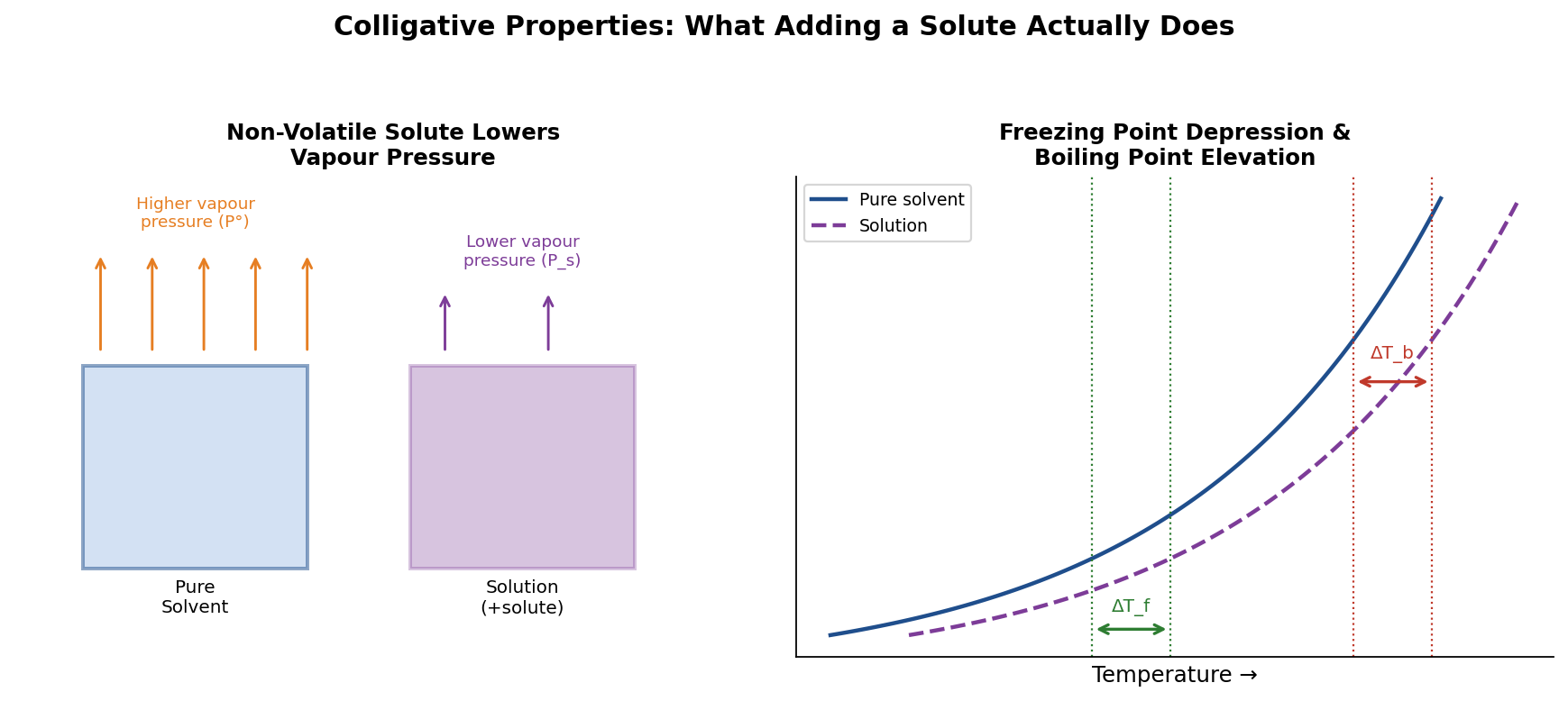
Figure 1: How a non-volatile solute lowers vapour pressure, depresses freezing point, and elevates boiling point.

| Property | Formula |
| Raoult's Law (volatile solutes) | P_total = P°ₐ xₐ + P°_B x_B |
| Relative lowering of vapour pressure | (P° − P_s) / P° = x_solute |
| Elevation of boiling point | ΔT_b = i K_b m |
| Depression of freezing point | ΔT_f = i K_f m |
| Osmotic pressure | π = i C R T |
Revision Tip: Always look at the nature of the solute first. For strong electrolytes like NaCl or CaCl_2, use the Van 't Hoff factor (i) to account for dissociation, which changes your final colligative value.
Chemical Kinetics
Zero-Order: [A]ₜ = [A]₀ − kt
Best Courses for You

JEE

NEET

Foundation JEE

Foundation NEET

CBSE
First-Order: k = (2.303/t) log([A]₀/[A]ₜ)
Arrhenius Equation: k = A e^(−Eₐ/RT)
Revision Tip: The unit of the rate constant (k) changes based on the reaction order. Check the units given in the question to confirm the order before selecting your equation.
Chemical Equilibrium
K_p = K_c (RT)^Δn₉
Revision Tip: When calculating ∆ ng, count only the coefficients of gaseous products and reactants. Ignore pure solids and liquids entirely.
Le Chatelier's Principle: increasing pressure shifts the equilibrium toward the side with fewer gaseous moles, while temperature changes shift it based on whether the reaction is exothermic or endothermic.
Thermodynamics
First Law: ΔU = q + w
Enthalpy Change: ΔH = ΔU + Δn₉RT
Gibbs Free Energy: ΔG = ΔH − TΔS
Revision Tip: Always convert ∆H and ∆S into the same energy units (usually Joules) before calculating ∆G.
Electrochemistry
Nernst Equation (at 298 K): E_cell = E°_cell − (0.0591/n) log Q
Faraday's First Law: w = (E × I × t) / 96500
Revision Tip: Use the simplified 0.0591 value in the Nernst equation only if the experimental temperature is explicitly 298 K.
Common Formula Mistakes in NEET
Many students lose marks not because they forgot the formula, but because they fell into these unit traps:
- Using Celsius instead of Kelvin: in gas laws, thermodynamics, and kinetics equations, temperature must always be in Kelvin (K = °C + 273.15).
- Choosing the wrong R value: use R = 8.314 J/mol·K for energy calculations, but switch to R = 0.0821 L·atm/mol·K when dealing with pressure and volume equations.
- Mixing Joules and Kilojoules: ΔH is usually given in kJ, while ΔS is given in J/K.
Organic Chemistry Formula & Reagent Guide
Organic Chemistry questions test your ability to track how functional groups change and how carbon chains are modified by specific reagents.
Structure and Priority Rules
Degree of Unsaturation (DoU) = (2C + 2 + N − H − X) / 2
Where C = Carbon, H = Hydrogen, X = Halogen, N = Nitrogen.
IUPAC functional group priority sequence: Carboxylic acid > Anhydride > Ester > Acid halide > Amide > Nitrile > Aldehyde > Ketone > Alcohol > Amine > Ether.
Core Reagent and Conversion Guide
| Initial Functional Group | Target Product | Preferred Reagent |
| Primary Alcohol | Aldehyde | Pyridinium Chlorochromate (PCC) |
| Primary Alcohol | Carboxylic Acid | Alkaline KMnO₄ |
| Nitrobenzene | Aniline | Sn / HCl or Fe / HCl |
| Carboxylic Acid | Primary Alcohol | Lithium Aluminium Hydride (LiAlH₄) |
| Alkene | Alkane | H₂ with Pd, Pt, or Ni |
Grignard Reagent (RMgX) Conversions
Nucleophilic addition using Grignard reagents changes the carbon skeleton length while yielding specific alcohol grades:
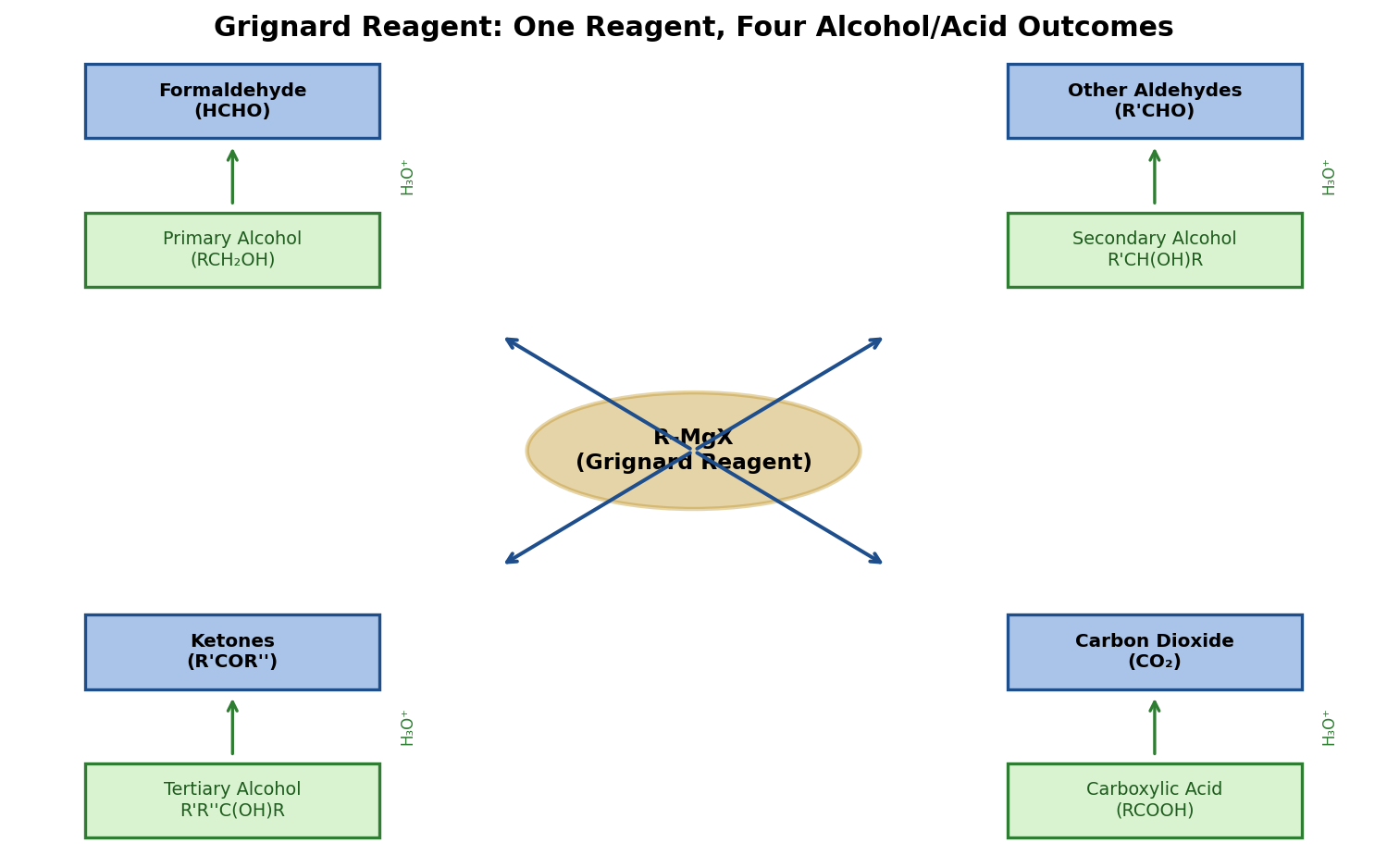
Figure 2: The same Grignard reagent gives four different products depending on what it reacts with.
| Starting Material | Product After Hydrolysis |
| Formaldehyde (HCHO) | Primary Alcohol (RCH₂OH) |
| Other Aldehydes (R'CHO) | Secondary Alcohol, R'CH(OH)R |
| Ketones (R'COR'') | Tertiary Alcohol, R'R''C(OH)R |
| Carbon Dioxide (CO₂) | Carboxylic Acid (RCOOH) |
Memory Tricks and Shortcuts
Periodic Table Trends Summary
Instead of juggling multiple conflicting phrases, rely on a straightforward directional layout:
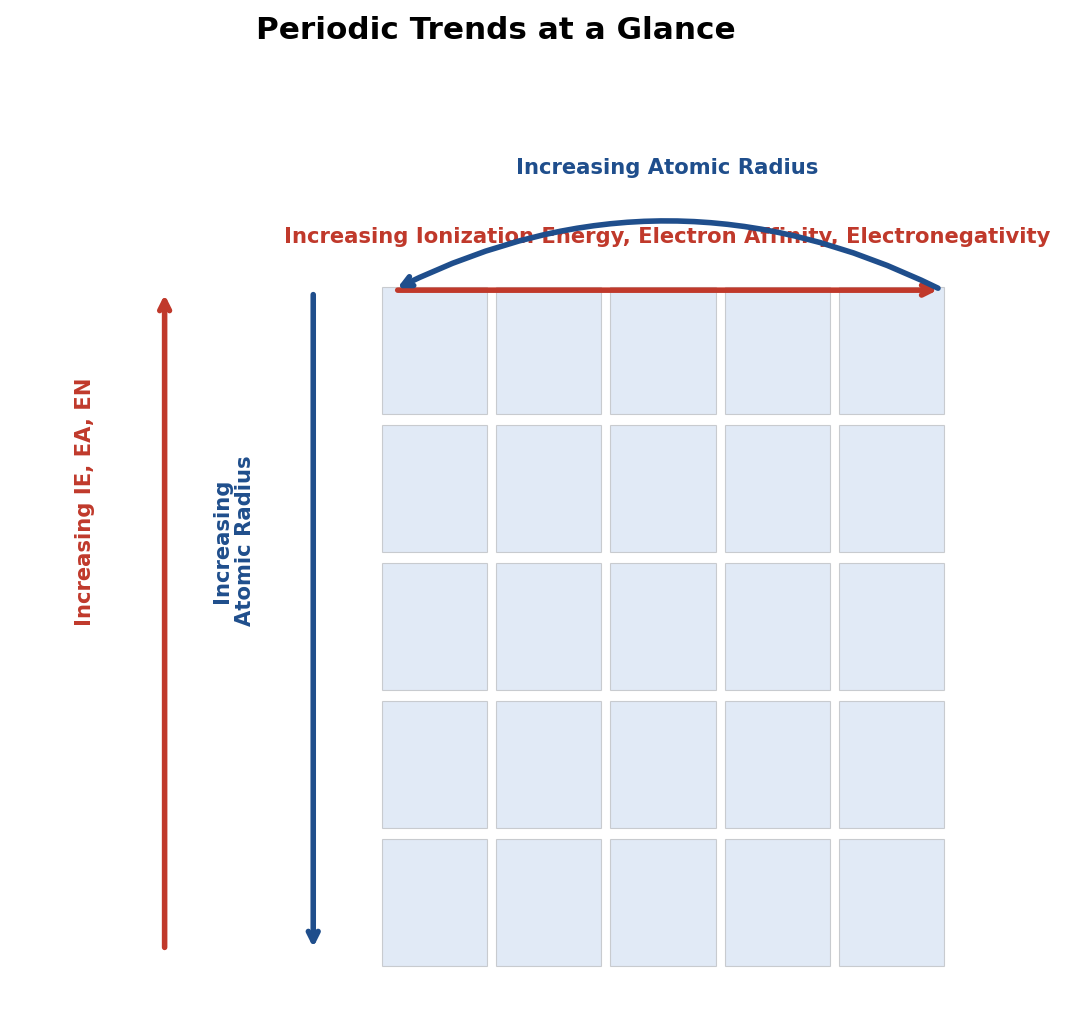
Figure 3: Atomic radius and reactivity trends move in opposite directions across the periodic table.
- Atomic Radius increases down a group and decreases left-to-right across a period.
- Ionization Energy, Electron Affinity, and Electronegativity decrease down a group and increase left-to-right across a period.
The n-Factor Cross-Multiplication Trick
When balancing redox reactions under timed conditions, find the net change in oxidation state for the oxidising and reducing agents. Cross-multiply these two numbers directly as coefficients for your opposing reactants to balance the electron transfer without writing separate half-reactions.
Molecular Weight Shortcuts
Skip long mathematical steps with these direct mass relationships:
Molar Mass = 2 × Vapour Density
Equivalent Mass = Molar Mass / n-factor
Average Molar Mass (mixture) = (n₁M₁ + n₂M₂ + ...) / (n₁ + n₂ + ...)
Ideal Gas Molar Volume Shortcut
At STP (273.15 K and 1 atm), 1 mole of any ideal gas occupies exactly 22.4 L. You can use this standard value directly to skip manual PV = nRT calculations for gas volumes at standard conditions.
Fast Gas Constant Options
When working through thermodynamics problems, using R ≈ 25/3 J/mol·K or R ≈ 2 cal/mol·K makes manual division much faster.
One-Page Final Week Revision Sheet
Keep this high-yield table nearby during your final revision sessions to verify your command over crucial constants and boundary conditions.
| Chapter | Core Equation | Constant / Boundary Warning |
| Solutions | π = iCRT | R = 0.0821 L·atm/mol·K |
| Chemical Kinetics | k = (2.303/t) log([A]₀/[A]ₜ) | First-order rate constant units are independent of concentration. |
| Electrochemistry | ΔG° = −nFE°_cell | F = 96500 C/mol (output is in Joules). |
| Structure of Atom | 1/λ = R_H [1/n₁² − 1/n₂²] | Rydberg Constant (R_H) ≈ 1.097 × 10⁷ m⁻¹ |
How Infinity Learn Helps with NEET Chemistry Formulas
Regular revision works better than trying to memorise every formula in a single sitting. Infinity Learn supports this through specific toolsets designed for daily practice:
- Formula Revision Flashcards: digital, chapter-wise sets that let you test your memory of specific units and experimental conditions anywhere.
- Video Application Lessons: focused video solutions that demonstrate exactly how to unpack variables from complex question descriptions.
- Targeted Mock Testing: exam-mode question modules structured to check your speed and calculation accuracy under real test parameters.
This guide brings together the most important Physical Chemistry equations, Organic Chemistry reagents, and exam shortcuts into a single revision resource. Mastering these equations gives you a direct mathematical advantage during the exam. To make sure you can recall them instantly under stress, block out 15 minutes every morning to read through one specific chapter from your revision sheet. Follow this up immediately by solving 10 numerical questions from that exact topic. This routine moves the equations from passive memory into reliable exam-day recall.
course
No courses found
FAQs; Important Chemistry Formulas for NEET
Which chemistry formulas are most important for NEET?
The most heavily tested equations include the Nernst Equation from Electrochemistry, the First-Order Integrated Rate Law from Kinetics, the Kp/Kc link from Equilibrium, Colligative Property equations from Solutions, and the Degree of Unsaturation formula for structural organic chemistry.
How do I memorise physical chemistry formulas?
Avoid just reading through lists. Write out the formulas in your own handwriting, note down the specific units for every single variable, and practice applying them across multiple problem variations.
Where can I get a downloadable NEET chemistry formula sheet?
You can access structured, syllabus-aligned formula sheets and problem banks directly through the Infinity Learn digital platform.
What are the key organic chemistry name reactions for NEET?
Focus closely on Aldol Condensation, Cannizzaro Reaction, Hoffmann Bromamide Degradation, Reimer-Tiemann Reaction, Sandmeyer Reaction, and Clemmensen Reduction.
How do I revise chemistry formulas before the exam?
Maintain a central formula log throughout your preparation. Use your weekly mock tests to audit your calculations, paying specific attention to where you might have missed a unit conversion.