Download Pdf
AI Mentor
Book Online Demo
Try Test
personalised 1:1 online tutoring

SCORE Online 2026 Class 11 JEE Sample Paper with Answers

By Rohit RP

|

Updated on 13 Nov 2026, 16:30 IST

The SCORE Online 2026 Class 11 JEE sample paper helps students practise objective questions before Infinity Learn's online scholarship assessment. This worked practice set contains 24 questions: eight in Mathematics, eight in Physics and eight in Chemistry. Each question has four options, a marked answer and an explanation.

Students looking for an Infinity Learn SCORE Class 11 JEE sample paper with answers can attempt the questions first, then compare their steps with the solutions. This is an edited study resource based on the user-provided 24-question paper, not a complete official SCORE 2026 question paper or official answer key.

Fill out the form for expert academic guidance
+91
Student
Parent / Guardian
Teacher
submit

SCORE 2026 Class 11 JEE Sample Paper – Overview

Sample paper detailsInformation
ExamSCORE Online 2026 scholarship assessment
OrganizerInfinity Learn
CategoryClass 11 JEE pathway
SubjectsMathematics, Physics and Chemistry
Questions in this solved practice set24 (8 per subject)
Practice scoring+4 correct, −1 incorrect, 0 unattempted
Maximum score for this practice set96 marks (24 × 4)

SCORE 2026 Class 11 JEE Maths Sample Questions with Solutions

The following eight mathematics questions cover number operations, algebra, sequences, coordinate geometry, trigonometry, probability and mensuration. They are part of the supplied practice set; check the current SCORE syllabus for the full test scope.

Question 1 · If the prime factorisation of 2025 is 3m × 5n, find m + n.
  1. 3
  2. 5
  3. 6
  4. 8
Correct answer: Option 3 — m + n = 6

Step-by-step solution

  1. Separate 2025 into convenient factors: 2025 = 81 × 25.
  2. Write each factor as a prime power: 81 = 3⁴ and 25 = 5². Therefore, 2025 = 3⁴ × 5².
  3. Compare with 3ᵐ × 5ⁿ: m = 4 and n = 2. Hence m + n = 4 + 2 = 6.

Remember: The exponents count how many times each prime factor occurs.
Unlock the full solution & master the concept
Get a detailed solution and exclusive access to our masterclass to ensure you never miss a concept
Question 2 · If α and β are the zeroes of p(y) = y² − 5y + 3, find α⁴β³ + α³β⁴.
  1. 128
  2. 135
  3. 144
  4. 164
Correct answer: Option 2 — 135

Step-by-step solution

  1. For ay² + by + c, the sum of zeroes is −b/a and the product is c/a. Here α + β = 5 and αβ = 3.
  2. Factor the expression: α⁴β³ + α³β⁴ = α³β³(α + β) = (αβ)³(α + β).
  3. Substitute the known values: 3³ × 5 = 27 × 5 = 135.

Remember: There is no need to calculate α and β individually.

Question 3 · The ratio of the 10th term to the 30th term of an AP is 1 : 3, and the sum of its first six terms is 42. Find its first term and common difference.
  1. First term = 1; common difference = 2
  2. First term = 2; common difference = 1
  3. First term = 2; common difference = 2
  4. First term = 1; common difference = 1
Correct answer: Option 3 — First term a = 2; common difference d = 2

Step-by-step solution

  1. Let the first term be a and the common difference be d. The nth term is aₙ = a + (n − 1)d.
  2. Use the ratio: (a + 9d)/(a + 29d) = 1/3. Cross-multiplying gives 3a + 27d = a + 29d, so 2a = 2d and a = d.
  3. Use Sₙ = n[2a + (n − 1)d]/2. Thus S₆ = 3(2a + 5d) = 42, giving 2a + 5d = 14.
  4. Substitute a = d: 7d = 14. Therefore d = 2 and a = 2.
  5. Check: the first six terms are 2, 4, 6, 8, 10, 12, whose sum is 42. The 10th and 30th terms are 20 and 60, so their ratio is 1 : 3.
Question 4 · The midpoint of the line segment joining A(3, 4) and B(k, 6) is P(x, y). If x + y − 10 = 0, find k.
  1. k = 5
  2. k = 6
  3. k = 7
  4. k = 8
Correct answer: Option 3 — k = 7

Step-by-step solution

  1. Apply the midpoint formula: P = ((3 + k)/2, (4 + 6)/2). Hence x = (3 + k)/2 and y = 5.
  2. Substitute into x + y − 10 = 0: (3 + k)/2 + 5 − 10 = 0.
  3. Therefore (3 + k)/2 = 5, so 3 + k = 10 and k = 7.
  4. Check: the midpoint of (3, 4) and (7, 6) is (5, 5), which satisfies 5 + 5 − 10 = 0.
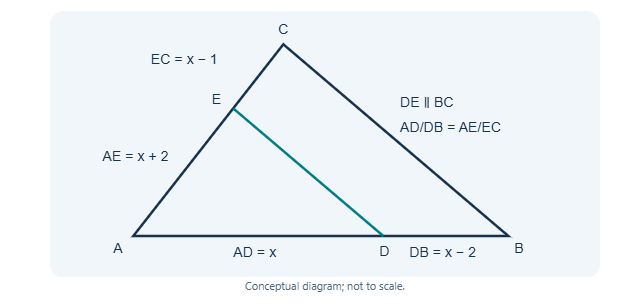
Question 5 · In triangle ABC, D lies on AB and E lies on AC, with DE ∥ BC. If AD = x, DB = x − 2, AE = x + 2 and EC = x − 1, find x.

ABCDEAD = xDB = x − 2AE = x + 2EC = x − 1DE ∥ BCAD/DB = AE/EC

SCORE Online 2026 Class 11 JEE Sample Paper with Answers

Loading PDF...

Triangle ABC with line DE parallel to BC, showing segments AD = x, DB = x - 2, AE = x + 2, and EC = x - 1
Conceptual diagram; not to scale.
  1. 2
  2. 3
  3. 5
  4. 4
Correct answer: Option 4 — x = 4

Step-by-step solution

  1. Because DE ∥ BC, the basic proportionality theorem gives AD/DB = AE/EC.
  2. Insert the lengths: x/(x − 2) = (x + 2)/(x − 1). All lengths must be positive, so x > 2.
  3. Cross-multiply: x(x − 1) = (x + 2)(x − 2). Thus x² − x = x² − 4.
  4. Cancel x² from both sides: −x = −4, so x = 4.
  5. Check: AD = 4, DB = 2, AE = 6 and EC = 3. Both ratios are 2, and all lengths are positive.
Question 6 · Find the value of 6 tan²θ − 6/cos²θ, where cos θ ≠ 0.
  1. 1
  2. −6
  3. 0
  4. 6
Correct answer: Option 2 — −6

Step-by-step solution

  1. Use 1/cos²θ = sec²θ. The expression becomes 6(tan²θ − sec²θ).
  2. The identity sec²θ = 1 + tan²θ gives tan²θ − sec²θ = −1.
  3. Therefore the expression equals 6(−1) = −6.
Question 7 · One card is drawn at random from a well-shuffled standard pack of 52 playing cards. Find the probability that it is neither a red card nor a queen.
  1. 5/13
  2. 1/13
  3. 6/13
  4. 3/13
Correct answer: Option 3 — 6/13

Step-by-step solution

  1. “Neither a red card nor a queen” means the card must be black and must not be a queen.
  2. There are 26 black cards. Two of these are queens: the queen of spades and the queen of clubs.
  3. Favourable outcomes = 26 − 2 = 24. Therefore P = 24/52 = 6/13.
  4. Alternative check: red cards or queens = 26 + 4 − 2 = 28, subtracting the two red queens counted twice. The complement contains 52 − 28 = 24 cards.

Remember: “Neither A nor B” is the complement of “A or B”.

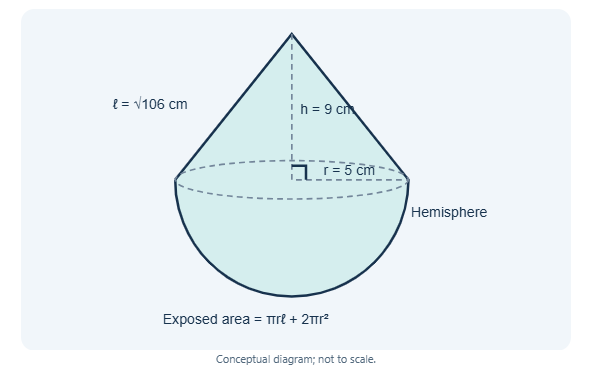
Question 8 · A toy consists of a cone mounted on a hemisphere with the same circular base. The base diameter is 10 cm and the cone’s height is 9 cm. Find the total exposed surface area, to one decimal place. h = 9 cmr = 5 cmℓ = √106 cmHemisphereExposed area = πrℓ + 2πr²
 
Triangle ABC with line DE parallel to BC, showing segments AD = x, DB = x - 2, AE = x + 2, and EC = x - 1
Conceptual diagram; not to scale.
  1. 390 cm²
  2. 318.8 cm²
  3. 332.33 cm²
  4. 320.4 cm²
Correct answer: Option 2 — 5π(√106 + 10) cm² ≈ 318.8 cm²

Step-by-step solution

  1. Find the common radius: r = 10/2 = 5 cm. The perpendicular height of the cone is h = 9 cm.
  2. Use Pythagoras to find the slant height: ℓ = √(r² + h²) = √(5² + 9²) = √106 ≈ 10.2956 cm.
  3. Only the curved surfaces are exposed. The common circular base is internal, so do not add its area.
  4. Exposed surface area = curved area of cone + curved area of hemisphere = πrℓ + 2πr².
  5. Substitute: A = 5π√106 + 50π = 5π(√106 + 10) ≈ 318.803 cm². Rounded to one decimal place, A = 318.8 cm².

Remember: Use the cone’s slant height in πrℓ, not its vertical height.

Ready to Test Your Skills?
Check Your Performance Today with our Free Mock Tests used by Toppers!
Take Free Test

SCORE 2026 Class 11 JEE Physics Sample Questions with Answers

These eight solved Physics MCQs include electricity, optics, refraction and circuit calculations. Some are foundational questions, so use them for revision alongside the current Class 11 SCORE syllabus.

Question 9 ·In the NCERT school-textbook convention used in this sample paper, the potential difference between the live and neutral wires in India is approximately:
  1. 110 V
  2. 50 V
  3. 220 V
  4. None of these
Correct answer: Option 3 — 220 V (the textbook answer)

Step-by-step solution

  1. The question asks for the potential difference, or voltage, between live and neutral—not for the frequency of the supply.
  2. The NCERT domestic-electric-circuits treatment gives the textbook value as 220 V. Thus the expected choice in this paper is option 3.
  3. This AC voltage is an RMS (effective) value. Do not confuse it with 50 Hz, which describes the number of AC cycles per second.

Remember: Treat 220 V as the convention for this exam question, rather than a claim that every actual supply measures exactly 220 V.

cta3 image
create your own test
YOUR TOPIC, YOUR DIFFICULTY, YOUR PACE
start learning for free
Question 10 · For a spherical mirror, which relation connects magnification m, image distance v and focal length f?
  1. m = (f − v)/f
  2. m = f/(f − v)
  3. m = +f/(v − f)
  4. m = (f + v)/f
Correct answer: Option 1 — m = (f − v)/f

Step-by-step solution

  1. Use the mirror formula with the Cartesian sign convention: 1/f = 1/v + 1/u, where u is the object distance.
  2. Rearrange: 1/u = 1/f − 1/v = (v − f)/(fv).
  3. For a spherical mirror, magnification is m = −v/u. Substitute the expression for 1/u: m = −v × (v − f)/(fv).
  4. Simplify: m = −(v − f)/f = (f − v)/f.

Remember: Keep the minus sign in m = −v/u; distances are signed quantities.

Question 11 · 

Assertion: Two wires of the same length and material can have different cross-sectional areas.
Reason: At the same temperature, the wire with the smaller cross-sectional area has lower resistivity.

Best Courses for You

JEE

JEE

NEET

NEET

Foundation JEE

Foundation JEE

Foundation NEET

Foundation NEET

CBSE

CBSE

  1. Both Assertion and Reason are true, and Reason correctly explains Assertion.
  2. Both Assertion and Reason are true, but Reason does not correctly explain Assertion.
  3. Assertion is true, but Reason is false.
  4. Assertion is false, but Reason is true.
Correct answer: Option 3 — Assertion is true; Reason is false

Step-by-step solution

  1. Length and thickness are independent geometrical properties. Two wires made of the same material can have the same length but different cross-sectional areas. The assertion is therefore true.
  2. For a uniform wire, resistance R = ρL/A, where ρ is resistivity. In the school-level model, resistivity depends on the material and temperature, not the wire’s dimensions.
  3. At the same temperature, the two wires have the same resistivity. A smaller area gives a larger resistance, not a lower resistivity. The reason is false.
  4. Therefore the correct assertion–reason combination is option 3.

Remember: Resistance R is measured in ohms (Ω); resistivity ρ is measured in ohm-metres (Ω m).

Question 12 · An electrical circuit has a voltage of 120 V and a current of 10 A. What is its power?
  1. 130 W
  2. 12 W
  3. 110 W
  4. 1200 W
Correct answer: Option 4 — 1200 W

Step-by-step solution

  1. Use the school-level power relation P = VI.
  2. Insert V = 120 V and I = 10 A: P = 120 × 10 = 1200 W.
  3. Since 1000 W = 1 kW, this is also 1.2 kW.

Remember: Power is the rate of transfer of electrical energy; 1200 W means 1200 joules per second.

Ready to Test Your Skills?
Check Your Performance Today with our Free Mock Tests used by Toppers!
Take Free Test
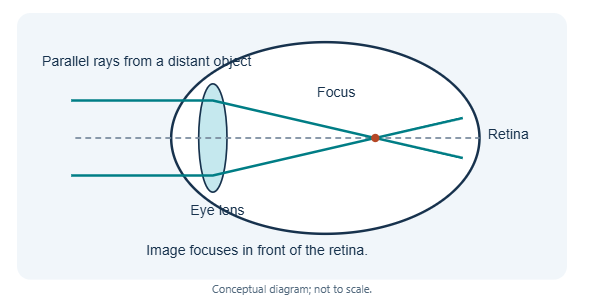
Question 13 · Which of the following is a possible cause of myopia (short-sightedness)?

Parallel rays from a distant object. Eye lens. Focus. Retina. Image focuses in front of the retina.

Triangle ABC with line DE parallel to BC, showing segments AD = x, DB = x - 2, AE = x + 2, and EC = x - 1
Conceptual diagram; not to scale.
  1. Excessive curvature of the eye lens
  2. The focal length of the eye lens is too long
  3. Decrease in the size of the eye lens
  4. Minimal curvature of the eye
Correct answer: Option 1 — Excessive curvature of the eye lens

Step-by-step solution

  1. A myopic eye forms the image of a distant object in front of the retina, so distant objects appear blurred.
  2. Excessive curvature of the eye lens can increase its converging power and shorten its focal length. Parallel rays then converge too early.
  3. Thus excessive curvature of the eye lens is the correct listed cause. An elongated eyeball is another possible cause, although it is not listed.
  4. A concave (diverging) lens corrects myopia by making incoming rays diverge slightly before entering the eye, allowing the eye to focus them on the retina.

Remember: A focal length that is too long gives insufficient convergence—the opposite of the cause described here.

cta3 image
create your own test
YOUR TOPIC, YOUR DIFFICULTY, YOUR PACE
start learning for free
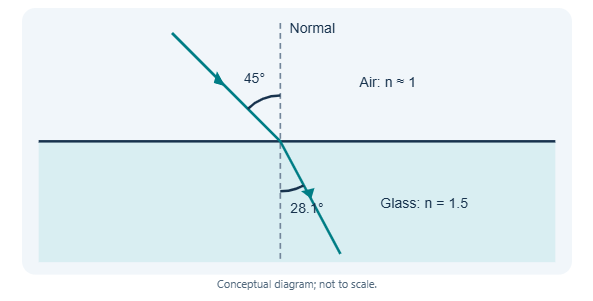
Question 14 · A ray travels from air into glass at an angle of incidence of 45°. If the refractive index of glass is 1.5, find the angle of refraction (take the refractive index of air as 1).

45°28.1°Air: n ≈ 1Glass: n = 1.5Normal

Triangle ABC with line DE parallel to BC, showing segments AD = x, DB = x - 2, AE = x + 2, and EC = x - 1
Conceptual diagram; not to scale.
  1. 18°
  2. 28°
  3. 32°
  4. 38°
Correct answer: Option 2 — r ≈ 28°

Step-by-step solution

  1. Apply Snell’s law: n₁ sin i = n₂ sin r. Here n₁ = 1, n₂ = 1.5 and i = 45°.
  2. Hence sin r = sin 45°/1.5 = (1/√2)/(3/2) = √2/3 ≈ 0.4714.
  3. Take the inverse sine: r = sin⁻¹(0.4714) ≈ 28.13°. The closest option is 28°.
  4. Check the direction: glass is optically denser than air, so the ray bends towards the normal. Accordingly, r < i.

Remember: Both incidence and refraction angles are measured from the normal, not from the surface.

Question 15 · Which statement is true?
  1. A convex lens of power +4 D has a focal length of −0.25 m.
  2. A convex lens of power −4 D has a focal length of +0.25 m.
  3. A concave lens of power +4 D has a focal length of −0.25 m.
  4. A concave lens of power −4 D has a focal length of −0.25 m.
Correct answer: Option 4 — A concave lens with P = −4 D has f = −0.25 m

Step-by-step solution

  1. For a thin lens, P = 1/f when f is expressed in metres. Therefore f = 1/P.
  2. A concave lens in air is diverging, so both its focal length and power are negative. For P = −4 D, f = 1/(−4) = −0.25 m.
  3. Option 4 has the correct lens type, sign and magnitude. A convex lens of +4 D would have f = +0.25 m, so option 1 is false; options 2 and 3 also have inconsistent signs.

Remember: Convert centimetres to metres before using P = 1/f.

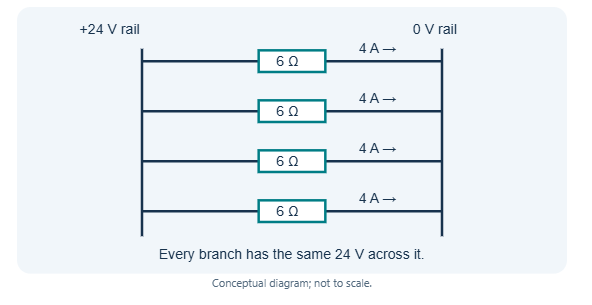
Question 16 · A potential difference of 24 V is applied across four 6 Ω resistors connected in parallel. Find the current through each resistor.

6 Ω4 A →6 Ω4 A →6 Ω4 A →6 Ω4 A →+24 V rail0 V railEvery branch has the same 24 V across it.

Triangle ABC with line DE parallel to BC, showing segments AD = x, DB = x - 2, AE = x + 2, and EC = x - 1
Conceptual diagram; not to scale.
  1. 1 A
  2. 4 A
  3. 16 A
  4. 36 A
Correct answer: Option 2 — 4 A through each resistor

Step-by-step solution

  1. In a parallel circuit, each branch is connected across the same two supply terminals. Therefore every resistor has the full 24 V across it.
  2. Apply Ohm’s law to one branch: I = V/R = 24/6 = 4 A. All four resistors are identical, so each carries 4 A.
  3. Check: total current = 4 × 4 = 16 A, and equivalent resistance = 6/4 = 1.5 Ω. Then 24/1.5 = 16 A, as expected.

Remember: The question asks for the current in each resistor, not the total current from the source.

SCORE 2026 Class 11 JEE Chemistry Sample Questions with Answers

Practise these eight Chemistry MCQs on chemical equations, reaction types, ions and compounds. Read each explanation before attempting a similar problem.

Question 17 · In K₂Cr₂O₇ + x H₂SO₄ + y SO₂ → K₂SO₄ + Cr₂(SO₄)₃ + z H₂O, find x, y and z.
  1. 1, 3, 1
  2. 4, 1, 4
  3. 3, 2, 3
  4. 2, 1, 2
Correct answer: Option 1 — x = 1, y = 3, z = 1

Step-by-step solution

  1. Potassium and chromium are already balanced: two K atoms and two Cr atoms occur on each side.
  2. Balance hydrogen: the left side has 2x H atoms and the right side has 2z, so z = x.
  3. Balance sulphur: there are x + y S atoms on the left and 1 + 3 = 4 on the right. Thus x + y = 4.
  4. Balance oxygen: 7 + 4x + 2y = 4 + 12 + z = 16 + z. Substitute z = x and y = 4 − x: 7 + 4x + 2(4 − x) = 16 + x.
  5. Simplify: 15 + 2x = 16 + x, so x = 1. Therefore y = 3 and z = 1.
  6. Balanced equation: K₂Cr₂O₇ + H₂SO₄ + 3SO₂ → K₂SO₄ + Cr₂(SO₄)₃ + H₂O. Check: K = 2, Cr = 2, H = 2, S = 4 and O = 17 on each side.
Question 18 · When baking soda is heated, which equation correctly represents its decomposition?
  1. 2NaHCO₃ → Na₂CO₃ + H₂O
  2. 2NaHCO₃ → Na₂CO₃ + H₂O + CO₂
  3. Na₂CO₃ + 2H₂O → NaHCO₃ + CO₂
  4. Na₂CO₃ + CO₂ → 2NaHCO₃
Correct answer: Option 2 — 2NaHCO₃ → Na₂CO₃ + H₂O + CO₂ (on heating)

Step-by-step solution

  1. Baking soda is sodium hydrogen carbonate (sodium bicarbonate), NaHCO₃.
  2. On heating, it decomposes into sodium carbonate, water and carbon dioxide.
  3. The balanced equation is 2NaHCO₃(s) → Na₂CO₃(s) + H₂O(g) + CO₂(g), with heat supplied.
  4. Check atom counts: Na = 2, H = 2, C = 2 and O = 6 on each side. Option 1 omits CO₂, while options 3 and 4 do not describe the required balanced decomposition.

Remember: A decomposition reaction breaks one compound into two or more products.

Question 19 · Consider BaCl₂(aq) + Na₂SO₄(aq) → BaSO₄(s) + 2NaCl(aq). Which reaction types apply?
(a) Displacement (b) Precipitation (c) Combination (d) Double displacement
  1. (a) and (b)
  2. (a), (b) and (c)
  3. (b) and (c)
  4. (b) and (d)
Correct answer: Option 4 — Precipitation and double displacement: (b) and (d)

Step-by-step solution

  1. The ions exchange partners: Ba²⁺ combines with SO₄²⁻, while Na⁺ and Cl⁻ remain in solution. This exchange is a double-displacement reaction.
  2. Barium sulphate is insoluble and separates as a white solid. Formation of this solid makes the reaction a precipitation reaction as well.
  3. The net ionic equation is Ba²⁺(aq) + SO₄²⁻(aq) → BaSO₄(s). Na⁺ and Cl⁻ are spectator ions.
  4. It is not a single-displacement reaction, and it is not a combination reaction producing a single product. Therefore the answer is (b) and (d), option 4.
Question 20 · A solution reacts with crushed eggshells to produce a gas that turns limewater milky. Which substance does the solution contain?
  1. NaCl
  2. HCl
  3. LiCl
  4. KCl
Correct answer: Option 2 — HCl

Step-by-step solution

  1. Eggshells consist mainly of calcium carbonate, CaCO₃. An acid reacts with a carbonate to release carbon dioxide.
  2. Among the options, HCl is the acid. The reaction is CaCO₃(s) + 2HCl(aq) → CaCl₂(aq) + H₂O(l) + CO₂(g).
  3. The gas is CO₂. It reacts with limewater, Ca(OH)₂(aq), forming a white calcium carbonate precipitate: CO₂(g) + Ca(OH)₂(aq) → CaCO₃(s) + H₂O(l).
  4. This suspended precipitate causes the milky appearance. The listed chloride salts do not produce the same acid–carbonate reaction under these conditions.

Remember: With excess CO₂, the milkiness can disappear as soluble calcium hydrogen carbonate forms.

Question 21 · Which compound is a non-electrolyte and does not produce mobile ions to conduct electricity in solution?
  1. Lithium chloride
  2. Ammonium chloride
  3. Calcium chloride
  4. Carbon tetrachloride
Correct answer: Option 4 — Carbon tetrachloride (CCl₄)

Step-by-step solution

  1. Electrical conduction through an electrolyte solution requires mobile ions.
  2. The three salts produce ions in water: LiCl → Li⁺ + Cl⁻; NH₄Cl → NH₄⁺ + Cl⁻; CaCl₂ → Ca²⁺ + 2Cl⁻. Their aqueous solutions conduct electricity.
  3. Carbon tetrachloride is a molecular covalent compound. It does not ionise to supply mobile ions, so it is the intended non-electrolyte: option 4.
  4. CCl₄ is also essentially insoluble in water. It should not be described as forming an ordinary aqueous solution like the three salts.

Remember: The important distinction is the presence of mobile ions, not merely whether a substance is called a compound.

Question 22 · Complete the statement: “During respiration, glucose combines with oxygen in the cells of our body and X a large amount of energy. Hence, respiration is a Y process.”
  1. X = releases; Y = endothermic
  2. X = releases; Y = exothermic
  3. X = absorbs; Y = exothermic
  4. X = absorbs; Y = endothermic
Correct answer: Option 2 — X = releases; Y = exothermic

Step-by-step solution

  1. During aerobic respiration, glucose is oxidised using oxygen, producing carbon dioxide and water.
  2. The overall school-level equation is C₆H₁₂O₆ + 6O₂ → 6CO₂ + 6H₂O + energy. Some released energy is captured in ATP, and some is released as heat.
  3. An energy-releasing process is described here as exothermic; an endothermic process absorbs heat. Therefore X = releases and Y = exothermic, giving option 2.

Remember: Aerobic respiration occurs through a sequence of enzyme-controlled reactions; the equation summarises the overall change.

Question 23 · What is the chemical formula of iron(III) sulphide?
  1. Fe₂S₃
  2. FeS
  3. Fe₃S₂
  4. FeS₃
Correct answer: Option 1 — Fe₂S₃

Step-by-step solution

  1. The Roman numeral III means that the iron ion is Fe³⁺. The sulphide ion is S²⁻.
  2. The compound must be electrically neutral. The least common multiple of 3 and 2 is 6, so use two Fe³⁺ ions (+6 total) and three S²⁻ ions (−6 total).
  3. The simplest whole-number ratio Fe : S is therefore 2 : 3. The formula is Fe₂S₃.

Remember: FeS corresponds to iron(II) sulphide, because a single Fe ion must balance S²⁻.

Question 24 · When ethanol reacts with acetic anhydride in the presence of a catalyst, which listed compound is formed?
  1. Ethyl benzoate
  2. Ethyl acetate
  3. Ethyl chloride
  4. Ethyl bromide
Correct answer: Option 2 — Ethyl acetate (ethyl ethanoate)

Step-by-step solution

  1. Ethanol is C₂H₅OH, and acetic anhydride is (CH₃CO)₂O. An alcohol reacts with an acid anhydride to form an ester and a carboxylic acid.
  2. The balanced reaction is (CH₃CO)₂O + C₂H₅OH → CH₃COOC₂H₅ + CH₃COOH. A suitable acid catalyst can be used.
  3. The ester contains the ethyl group from ethanol and the acetate (ethanoate) part from acetic anhydride. It is therefore ethyl acetate. Acetic acid is the other product.
  4. Ethyl benzoate would require a benzoyl source; neither ethyl chloride nor ethyl bromide is the ester formed in this reaction.

Remember: Unlike ethanol reacting with acetic acid, the anhydride reaction produces acetic acid as the coproduct, not water.

SCORE 2026 Class 11 JEE Exam Pattern and Marking Scheme

According to Infinity Learn's published SCORE 2026 exam-pattern guide, the full Class 11 JEE assessment has 60 questions, with 20 each from Mathematics, Physics and Chemistry. A correct response earns 4 marks, while an incorrect response deducts 1 mark. Students should follow the instructions displayed for their selected test.

SubjectFull SCORE 2026 JEE patternThis solved practice set
Mathematics20 questions8 questions
Physics20 questions8 questions
Chemistry20 questions8 questions
Total60 questions24 questions

Refer to the SCORE Exam Pattern 2026 for the current marking rules and exam instructions. The 96-mark total on this page applies only to the shorter practice set; it is not the maximum for the full SCORE assessment.

SCORE 2026 Class 11 JEE Syllabus – Physics, Chemistry and Maths

The SCORE Class 11 JEE pathway covers Physics, Chemistry and Mathematics. The official syllabus guide lists selected topics within each subject rather than the entire JEE Main syllabus:

  • Mathematics: Sets, Relations and Functions, Trigonometric Functions, Sequences and Series, Straight Lines, Limits and Derivatives.
  • Physics: Physical World, Units and Measurements, Motion in a Straight Line, Motion in a Plane, Laws of Motion, Work, Energy and Power, and rotational-motion concepts.
  • Chemistry: Basic Concepts of Chemistry, Structure of Atom, Periodicity, Chemical Bonding and Thermodynamics.

Check the latest SCORE Class 11 JEE syllabus before final revision. Because this supplied sample also tests prerequisites, use it as additional practice rather than as a complete syllabus checklist.

SCORE 2026 Class 11 JEE Sample Paper PDF – How to Save for Practice

You can use your browser's Print command and select Save as PDF to keep this solved SCORE Class 11 JEE practice paper for offline revision. The printable version includes all 24 questions and their explanations.

Do not confuse this practice resource with a newly issued official SCORE 2026 PDF or a previous-year examination paper. For authentic updates, visit Infinity Learn SCORE Online 2026.

How to Prepare for SCORE Online 2026 Class 11 JEE

  1. Check the current syllabus: Match your revision topics to the published Class 11 JEE pathway.
  2. Attempt before viewing answers: Work through each question without opening its explanation.
  3. Use the marking scheme: Award +4 for correct answers and −1 for wrong answers when scoring this practice set.
  4. Review errors by subject: Identify whether your mistakes were due to concepts, calculations or misreading.
  5. Try a full-length test: The official pattern has 60 questions, so practise a full test separately after this shorter set.

SCORE Class 11 JEE Sample Paper vs Online Mock Test

A sample paper helps you inspect and solve practice questions with answers. A SCORE online mock test is an interactive attempt that can help you get used to timing and the test interface. Use both types of practice where available, but follow the official exam instructions during the real assessment.

This SCORE Online 2026 Class 11 JEE sample paper with solutions provides 24 practice MCQs across Maths, Physics and Chemistry. Solve each question, check the answer key and revise the methods behind incorrect answers. For the complete examination structure and topic list, use Infinity Learn's current SCORE syllabus and pattern pages.

course

No courses found

FAQs on SCORE 2026 Class 11 JEE Sample Paper

Where can I find the SCORE Online 2026 Class 11 JEE sample paper?

The 24-question solved practice paper is available on this page. It includes eight questions each from Mathematics, Physics and Chemistry, with answers and explanations.

Does this SCORE Class 11 JEE sample paper include solutions?

Yes. Every question in this edited practice set includes a marked answer and a step-by-step explanation. Corrections to the supplied study material are disclosed near the answer key.

How many questions are in the SCORE Class 11 JEE exam 2026?

The published full Class 11 JEE pattern contains 60 questions: 20 Maths, 20 Physics and 20 Chemistry. This page is a shorter 24-question practice set.

Is there negative marking in SCORE Online 2026 for JEE students?

The current Class 11 JEE pathway awards +4 for a correct answer and deducts 1 mark for an incorrect answer. Check the final on-screen instructions when taking the assessment.

Is SCORE 2026 the same as JEE Main?

No. SCORE Online 2026 is Infinity Learn's scholarship and academic assessment. Its Class 11 JEE pathway covers relevant Physics, Chemistry and Mathematics, but it is not the JEE Main examination.

Can I download the SCORE Class 11 JEE sample paper as a PDF?

Use your browser's Print or Save as PDF option to save this practice article. This does not make the article an official SCORE question-paper PDF.

What subjects should I study for SCORE Class 11 JEE?

Prepare Mathematics, Physics and Chemistry according to the current SCORE Class 11 JEE syllabus. Do not assume that every topic in the general JEE syllabus is included in this particular scholarship assessment.