- Download NCERT Solutions for Class 8 Science Chapter 2 The Invisible Living World: Beyond Our Naked Eye - Free PDF 2026-27
- The Invisible Living World: Beyond Our Naked Eye Class 8 Question Answer (InText)
- NCERT Class 8 Science Chapter 2 Question Answer The Invisible Living World: Beyond Our Naked Eye (Exercise)
- Key Features and Benefits of NCERT Solutions for Class 8 Science Chapter 2
- FAQs on NCERT Solutions for Class 8 Science Chapter 2
NCERT Solutions for Class 8 Science Chapter 2 The Invisible Living World: Beyond Our Naked Eye
By Karan Singh Bisht
|
Updated on 21 Jul 2026, 13:21 IST
NCERT Solutions for Class 8 Science Curiosity Chapter 2: The Invisible Living World - Beyond Our Naked Eye are prepared to help students understand the chapter in a simple, clear, and exam-focused way for the 2026-27 academic session. This content is written for students who want easy explanations, accurate question answers, MCQs, diagrams, and examples to revise the chapter effectively.
The solution is based on the latest NCERT Class 8 Science Curiosity textbook and the important topics covered in Chapter 2. The solutions are written in student-friendly language so that learners can understand microscopic organisms, their structure, uses, harmful effects, and role in daily life without confusion.
This chapter introduces students to the invisible world of microorganisms such as bacteria, fungi, protozoa, and viruses. It explains how these tiny organisms cannot be seen with the naked eye but play an important role in nature, health, food production, medicine, and the environment. Students also learn about cells, useful microorganisms, disease-causing microbes, fermentation, immunity, and the importance of scientific instruments in studying the microscopic world.
These solutions are useful for Class 8 students, teachers, and parents. Students can use them for homework, class tests, MCQ practice, revision, and annual exam preparation. Teachers can use them for classroom explanation, while parents can use them to support children during self-study.
The Class 8 Science Chapter 2 Question Answers are available in Hindi and English Medium to make learning easier for all students. With step-by-step answers, simple explanations, diagrams, examples, and practice questions, these NCERT Solutions help students build concept clarity and prepare confidently for exams.
Download NCERT Solutions for Class 8 Science Chapter 2 The Invisible Living World: Beyond Our Naked Eye - Free PDF 2026-27
This section gives students easy access to the The Invisible Living World: Beyond Our Naked Eye Class 8 Solutions PDF for quick revision and offline study. Students can use the PDF to review textbook questions, understand important concepts, and practice answers before class tests and exams.
Loading PDF...
At Infinity Learn, the NCERT Solutions for Class 8 Science Chapter 2 are prepared and reviewed by subject experts to ensure accuracy, clarity, and alignment with the latest CBSE syllabus. The answers are written in simple, student-friendly language so learners can understand microorganisms, cells, fermentation, useful microbes, and harmful microbes without confusion.
The Invisible Living World: Beyond Our Naked Eye Class 8 Question Answer (InText)
Question 1. Have you ever wondered what you might see if the invisible world around you became visible?
Answer: Yes, it would be very interesting to see the tiny organisms that are present all around us but cannot be seen with the naked eye. We might see microorganisms such as bacteria, fungi, protozoa, and viruses in the air, water, soil, food, and even inside our body. Seeing this invisible world would help us understand the importance of cleanliness, hygiene, health, and the role of microorganisms in nature.
Question 2. How do you think your observation of this hidden world might change the way you think about size, complexity, or even what counts as ‘living’?

Answer: Observing this hidden world would help us understand that even very tiny organisms can have complex life processes. Many microorganisms can move, grow, reproduce, respond to their surroundings, and form colonies. This would change the way we think about life. It shows that living things do not need to be large to be complex or important. Even microscopic organisms play an important role in the environment, health, food production, and natural processes.
Question 3. Have you thought about how these tiny living beings interact with each other?
Best Courses for You

JEE

NEET

Foundation JEE

Foundation NEET

CBSE
Answer: Yes, microorganisms interact with one another and with their surroundings in many ways. Some microorganisms live together and help each other, while others compete for food, space, or other resources. For example, some bacteria help in digestion inside our body, while some bacteria can cause diseases. Fungi help break down dead plants and animals, returning nutrients to the soil. These interactions are important because they support many natural processes and help maintain balance in the environment.
NCERT Class 8 Science Chapter 2 Question Answer The Invisible Living World: Beyond Our Naked Eye (Exercise)
Keep the curiosity alive
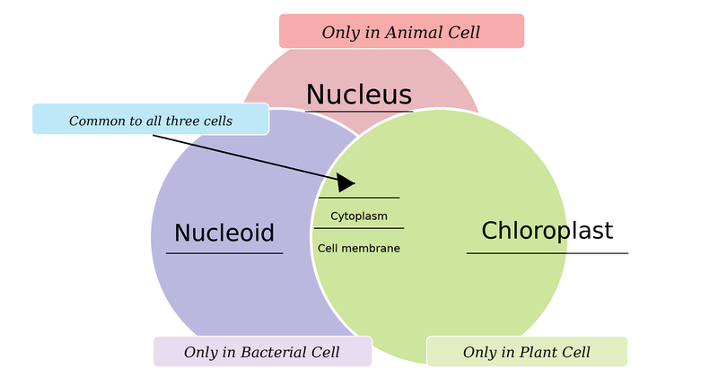
1. Various parts of a cell are given below. Write them in the appropriate places in the following diagram.
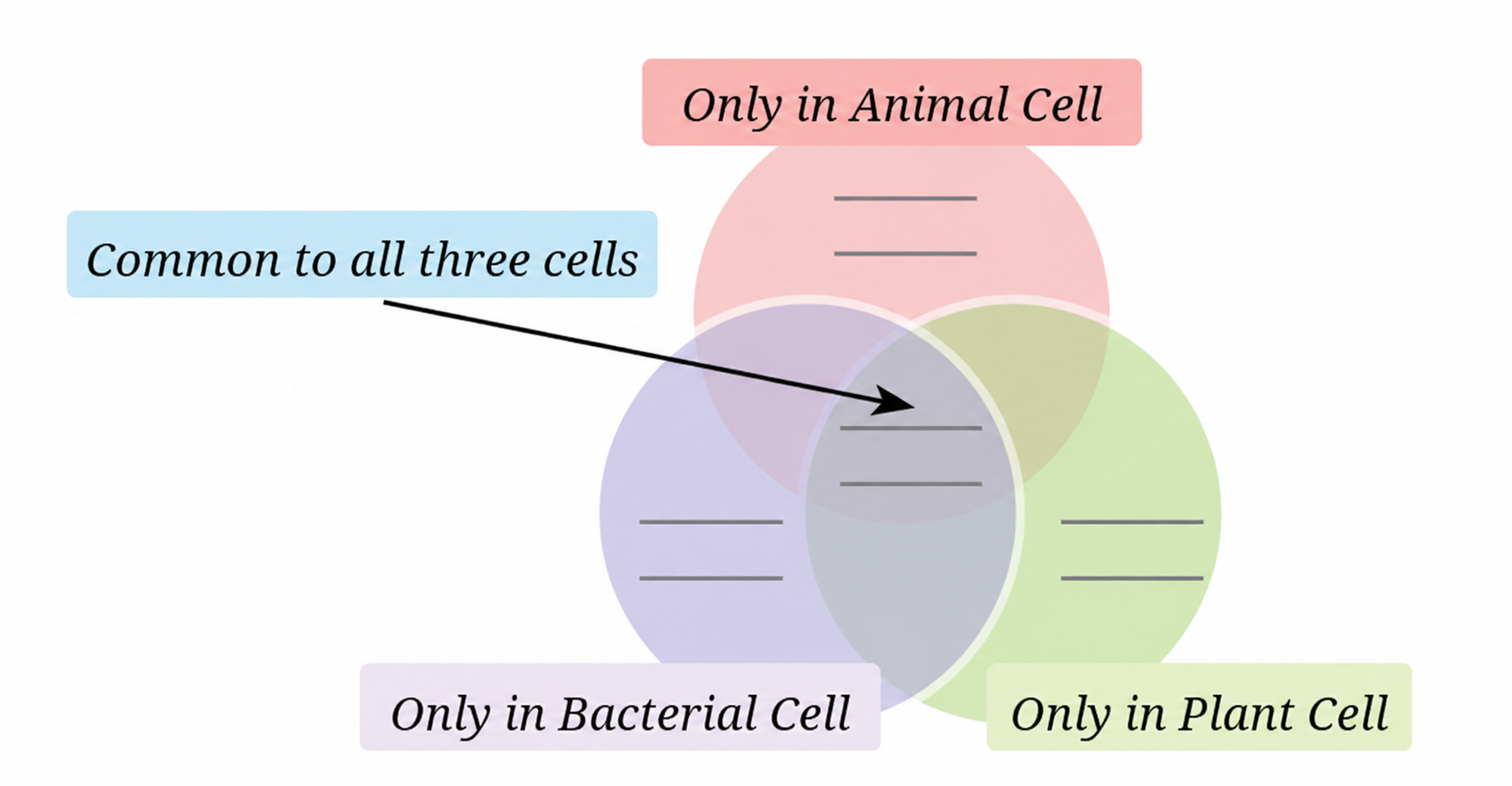
Answer:
2. Aanandi took two test tubes and marked them A and B. She put two spoon full of sugar solution in each of the test tubes. In test tube B, she added a spoonful of yeast. Then she attached two incompletely inflated balloons to the mouth of each test tube. She kept the set-up in a warm place, away from sunlight.
(i) What do you predict will happen after 3-4 days? She observed that the balloon attached to test tube B was inflated. What can be a possible explanation for this?
(a) Water evaporated in test tube B and filled the balloon with the water vapour.
(b) The warm atmosphere expanded the air inside the test tube B, which inflated the balloon.
(c) Yeast produced a gas inside the test tube B which inflated the balloon.
(d) Sugar reacted with warm air, which produced gas, eventually inflating the balloon.
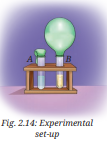
(ii) She took another test tube, 1/4 filled with lime water. She removed the balloon from test tube B in such a manner that the gas inside the balloon did not escape. She attached the balloon to the test tube with lime water and shook it well. What do you think she wants to find out?
Answer:
(i) Correct Option: (c) Yeast produced a gas inside test tube B which inflated the balloon. Yeast uses sugar and produces carbon dioxide gas during fermentation. This gas collects in the balloon and makes it inflate.
(ii) She wants to find out whether the gas produced by yeast is carbon dioxide. When carbon dioxide is passed through lime water, the lime water turns milky.
3. A farmer was planting wheat crops in his field. He added nitrogen-rich fertiliser to the soil to get a good yield of crops. In the neighbouring field, another farmer was growing bean crops, but she preferred not to add nitrogen fertiliser to get healthy crops. Can you think of the reasons?
Answer: Bean plants do not need extra nitrogen-rich fertiliser because they are leguminous plants. Their roots have small nodules that contain helpful bacteria called Rhizobium.
Rhizobium bacteria take nitrogen from the air and change it into a form that plants can use. This process is called nitrogen fixation. It improves the soil and helps bean plants grow well without artificial nitrogen fertiliser.
Wheat plants do not have such root nodules, so they cannot fix nitrogen in this way. That is why the farmer growing wheat added nitrogen-rich fertiliser for a better yield.
4. Snehal dug two pits, A and B, in her garden. In pit A, she put fruit and vegetable peels and mixed it with dried leaves. In pit B, she dumped the same kind of waste without mixing it with dried leaves. She covered both the pits with soil and observed after 3 weeks. What is she trying to test?
Answer: Snehal is trying to test whether adding dried leaves helps in the composting process.
In pit A, fruit and vegetable peels provide moist, nitrogen-rich waste, while dried leaves provide carbon-rich material. Together, they create better conditions for microorganisms to break down the waste and turn it into manure.
In pit B, dried leaves were not added, so the waste may decompose more slowly. By comparing both pits after 3 weeks, Snehal can understand how dried leaves affect the speed and quality of compost formation.
5. Identify the following microorganisms:
(i) I live in every kind of environment, and inside your gut.
Answer: Bacteria
(ii) I make bread and cakes soft and fluffy.
Answer: Yeast
(iii) I live in the roots of pulse crops and provide nutrients for their growth.
Answer: Rhizobium
6. Devise an experiment to test that microorganisms need optimal temperature, air, and moisture for their growth.
Answer: Experiment to test the conditions needed for microbial growth
Materials Required:
4 slices of bread, 4 clean transparent plastic or zip-lock bags, water, and labels A, B, C and D.
Steps:
- Label four bread slices as A, B, C and D.
- Keep Slice A dry and place it in a warm place.
- Sprinkle a little water on Slice B and keep it in a warm place.
- Sprinkle a little water on Slice C and keep it in a cold place, such as a refrigerator.
- Put Slice D in an air-tight bag with a few drops of water and keep it in a warm place.
Observation:
Leave all the slices undisturbed for 3-5 days. Then observe mould growth, change in colour, smell, or any other sign of microbial activity.
Expected Results:
- Slice B, which has moisture, warmth, and air, will show maximum microbial growth.
- Slice A will show little or no growth because it is dry.
- Slice C will show slow or no growth because it is kept in a cold place.
- Slice D will show reduced or no growth because air is not available.
Conclusion:
Microorganisms grow best when moisture, warmth, and air are present. Their growth slows down or stops when any one of these conditions is missing.
7. Take 2 slices of bread. Place one slice in a plate near the sink. Place the other slice in the refrigerator. Compare after three days. Note your observations. Give reasons for your observations.
Answer:
Observation:
- The bread slice kept near the sink may show mould after three days. It may have green, black, or white patches and may smell bad.
- The bread slice kept in the refrigerator will show little or no mould growth.
Reason:
- The area near the sink is usually warm and moist, which helps microorganisms like mould grow quickly.
- The refrigerator is cold, so microbial growth becomes very slow or may stop.
Conclusion: Mould grows faster in warm and moist conditions and grows very slowly in cold conditions.
8. A student observes that when curd is left out for a day, it becomes more sour. What can be two possible explanations for this observation?
Answer:
- Increased growth of bacteria: Curd contains Lactobacillus bacteria. At room temperature, these bacteria multiply and convert lactose, the sugar in milk, into lactic acid. This makes the curd sour.
- Longer fermentation time: When curd is left outside for a longer time, fermentation continues. More lactic acid is formed, so the curd becomes more acidic and tastes more sour.
9. Observe the set-up given in Fig. 2.15 and answer the following questions.
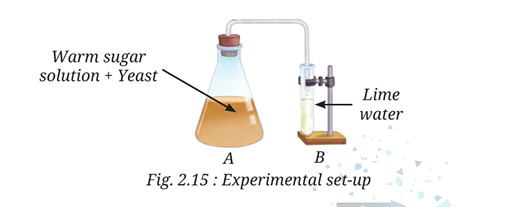
(i) What happens to the sugar solution in flask A?
(ii) What do you observe in test tube B after four hours? Why do you think this happened?
(iii) What would happen if yeast was not added in flask A?
Answer:
(i) What happens to the sugar solution in flask A?
- Yeast ferments the sugar present in the warm sugar solution.
- During fermentation, yeast breaks down sugar and releases carbon dioxide (CO₂) gas.
(ii) What do you observe in test tube B after four hours? Why do you think this happened?
- The lime water in test tube B turns milky.
- This happens because the carbon dioxide gas produced in flask A passes into the lime water. It forms calcium carbonate, which makes the lime water appear milky.
Reaction:
CO₂ + Ca(OH)₂ → CaCO₃ (milky) + H₂O
(iii) What would happen if yeast was not added in flask A?
- No fermentation would take place, so carbon dioxide gas would not be produced.
- As a result, the lime water in test tube B would remain clear and would not turn milky.
Key Features and Benefits of NCERT Solutions for Class 8 Science Chapter 2
- Strengthens Basic Concepts: Helps students understand invisible organisms and their importance in daily life.
- Improves Answer Writing: Guides students on how to write clear, accurate, and well-structured Science answers.
- Makes Revision Easier: Simple explanations help students remember important concepts for exams.
- Supports Self-Study: Allows students to practise questions and check answers on their own.
- Builds Exam Confidence: Helps students prepare better for school tests, revisions, and exams.
- Encourages Scientific Thinking: Builds curiosity about microscopic life and its role in health, food, nature, and the environment.
course
No courses found
FAQs on NCERT Solutions for Class 8 Science Chapter 2
Which topic best illustrates the invisible world?
The topic microorganisms best illustrates the invisible world because it includes tiny living organisms such as bacteria, fungi, protozoa, and viruses that cannot be seen with the naked eye. These microorganisms affect health, food, environment, and daily life.
What is Chapter 2 of NCERT Science Class 8?
Chapter 2 of NCERT Science Class 8 Curiosity is The Invisible Living World: Beyond Our Naked Eye. This chapter explains microorganisms, their types, their useful and harmful roles, and how they influence nature and human life.
What is the invisible living world Class 8?
The invisible living world Class 8 refers to the world of tiny organisms that are present around us but cannot be seen without a microscope. It includes microorganisms such as bacteria, fungi, protozoa, and viruses. The chapter helps students understand how these organisms help in food making, decomposition, medicine, and also how some can cause diseases.
Where can I download The Invisible Living World Class 8 question answer PDF?
Students can download The Invisible Living World Class 8 question answer PDF from Infinity Learn for easy revision and offline study. The PDF includes textbook-based questions, simple answers, and exam-focused explanations.
What is included in NCERT Solutions for Class 8 Science Chapter 2 PDF?
The NCERT Solutions for Class 8 Science Chapter 2 PDF includes answers to textbook questions from The Invisible Living World: Beyond Our Naked Eye. It covers microorganisms, bacteria, fungi, protozoa, viruses, fermentation, useful microbes, harmful microbes, and their role in daily life.
Are Class 8 Science NCERT Solutions helpful for exams?
Yes, Class 8 Science NCERT Solutions are helpful for exams because they explain concepts in simple language and help students practise answer writing. Infinity Learn provides clear and syllabus-based solutions to support homework, revision, and school exam preparation.
Can I get Class 8 Science Curiosity Chapter 2 question answer PDF for free?
Yes, students can access the Class 8 Science Curiosity Chapter 2 question answer PDF on Infinity Learn for quick revision and self-study. It helps learners understand the chapter better and prepare confidently for tests and exams.
Who can use The Invisible Living World Class 8 question answer PDF?
The PDF is useful for Class 8 students, teachers, and parents. Students can use it for homework and revision, teachers can use it for classroom support, and parents can use it to help children during study.
Why should students use Infinity Learn for NCERT Solutions for Class 8 Science Chapter 2 PDF?
Students can use Infinity Learn because the solutions are written in student-friendly language and aligned with the latest NCERT Class 8 Science syllabus. The answers help students understand concepts clearly and revise the chapter effectively.
