- Governance and Public Policy Class 9 Notes – Chapter Overview
- Introduction to Governance and Public Policy
- What Is Governance?
- Difference Between Government and Governance
- Download Governance And Public Policy Class 9 Notes PDF
- Evolution of Governance in India
- Features of Good Governance
- Challenges to Good Governance
- What Is E-Governance?
- What Is Public Policy?
- Important Stages of Public Policy-Making
- Participants in Public Policy-Making
- Difference Between Policy, Programme and Scheme
- Role of Citizens in Good Governance
- Important Definitions for Quick Revision
- Governance and Public Policy Class 9 Notes FAQs
Governance and Public Policy Class 9 Notes
By Karan singh ildefaultfield
|
Updated on 16 Nov 2026, 16:19 IST
Governance and Public Policy Class 9 Notes help students understand how governments make decisions, solve public problems, and provide important services to citizens. Chapter 4 of the NCERT Class 9 Social Science textbook Understanding Society: India and Beyond, Part 2, explains the meaning of governance, the features of good governance, and the process of making public policies.
These notes cover important concepts such as government and governance, e-governance, public policy, policy-making stages, and the role of citizens. Students can use these Class 9 Social Science Notes for chapter revision, homework, and exam preparation.
Governance and Public Policy Class 9 Notes – Chapter Overview
| Particulars | Details |
| Chapter Name | Governance and Public Policy |
| Class | 9 |
| Subject | Social Science |
| Book | Understanding Society: India and Beyond |
| Part | 2 |
| Chapter Number | 4 |
| Academic Session | 2026-27 |
| Main Topics | Governance, Good Governance, E-Governance, Public Policy, Policy-Making |
| Main Message | Good governance requires cooperation between the government and citizens. |
Students should also refer to NCERT Books Class 9 to read the complete chapter and understand its examples and activities.
Introduction to Governance and Public Policy
Governance and public policy help us understand how decisions are made and how governments work to improve people's lives. For example, when roads are damaged, schools need better facilities, or hospitals require improvements, different government departments and citizens must work together to solve these problems.
- Governance explains how decisions are made, implemented, and monitored.
- Public policy refers to the plans and actions adopted by the government to solve public problems.
- Good governance ensures that decisions are fair, transparent, effective, and focused on people's welfare.
What Is Governance?
Governance is the process through which decisions are made, implemented, and monitored for the welfare of people. It explains how public institutions and citizens work together to manage a country, state, city, village, school, or organisation. For example, imagine that a town experiences heavy rainfall and flooding. Different departments must work together to manage the situation:
- The municipal corporation clears blocked drains.
- The Public Works Department repairs damaged roads.
- The police manage traffic.
- Health workers help prevent diseases.
- Citizens report problems and help people in need.
Difference Between Government and Governance
| Government | Governance |
| Refers to institutions that exercise political authority. | Refers to the process of decision-making and implementation. |
| Includes the Legislature, Executive, and Judiciary. | Includes the government, citizens, media, civil society, and private organisations. |
| Focuses on who governs. | Focuses on how governing is carried out. |
| Example: A municipal corporation is responsible for street lighting. | Example: Planning, installing, maintaining, and collecting feedback about streetlights. |
Download Governance And Public Policy Class 9 Notes PDF
Students can download Governance and Public Policy Class 9 Notes PDF for easy revision and exam preparation. These notes are based on NCERT Class 9 Social Science chapter 4, Understanding Society: India and Beyond, Part 2. They cover important topics such as good governance, e-governance, public policy, policy-making stages, and the role of citizens.
Loading PDF...
The Governance and Public Policy Class 9 Notes PDF includes simple explanations, key definitions, important points, and examples to help students understand the chapter better. Students can save the PDF for offline study, quick revision, and preparation for their Class 9 Social Science examinations.
Evolution of Governance in India
The chapter explains how governance in India has developed through historical traditions and modern democratic institutions.
| Concept | Important Information |
| Sabha and Samiti | Institutions mentioned in the Rigveda where matters of governance and public welfare were discussed. |
| Rajadharma | The duty of a ruler to protect people, uphold righteousness, and promote public welfare. |
| Ram Rajya | An ideal of governance associated with justice, compassion, honesty, and public welfare. |
| Arthashastra | Kautilya's text emphasises that the ruler's welfare is connected with the happiness of the people. |
| Satyameva Jayate | India's national motto, drawn from the Mundaka Upanishad, meaning “Truth alone triumphs.” |
| Yato Dharmastato Jayah | Motto of the Supreme Court of India, meaning “Where there is Dharma, there is victory.” |
| Sengol | A traditional symbol associated with righteous governance, placed in the new Parliament building in 2023. |
After Independence in 1947, India established a modern democratic system guided by the Constitution while continuing to draw on traditional values of governance.
Features of Good Governance
The textbook identifies seven important features of good governance.

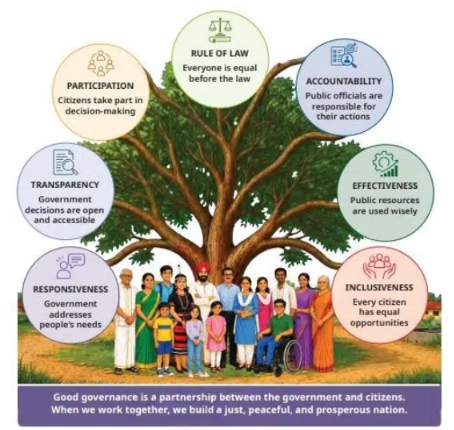
- Participation: Citizens take part in decision-making.
- Transparency: Government decisions are open and accessible.
- Accountability: Public officials are responsible for their actions.
- Rule of Law: Everyone is equal before the law.
- Responsiveness: Government addresses people's needs.
- Effectiveness: Public resources are used wisely.
- Inclusiveness: Every citizen has equal opportunities.
Challenges to Good Governance
The chapter discusses several problems that can prevent effective governance:
Best Courses for You

JEE

NEET

Foundation JEE

Foundation NEET

CBSE
- Poor Coordination: Government departments may fail to work together effectively.
- Unequal Access: Some communities may not receive essential public services.
- Misuse of Public Office: Malpractices can prevent resources from reaching the people who need them.
- Misinformation: Fake news can create confusion and reduce public trust.
- Changing Public Needs: Institutions must respond to the changing expectations of society.
These challenges require responsible officials, effective institutions, and active citizen participation.
What Is E-Governance?
E-governance means using information and communication technology to provide government services, share information, receive feedback, and improve administration.
Benefits of E-Governance
- Makes government services more accessible and convenient.
- Reduces paperwork and the need to visit government offices.
- Improves transparency and communication.
- Helps people access services more quickly.
- Supports efficient public service delivery across large geographical areas.
Important E-Governance Initiatives
The textbook identifies the following initiatives for students to explore:
| Initiative | Main Purpose |
| UMANG | Provides access to various government services through a digital platform. |
| Aadhaar | Provides a unique identification system for residents. |
| GeM (Government e-Marketplace) | Supports online procurement of goods and services by government organisations. |
| DigiLocker | Enables digital storage and access to documents. |
| CPGRAMS | Allows citizens to submit public grievances online. |
| APAAR | Provides a student-focused academic identification system. |
What Is Public Policy?
Public policy is a course of action adopted by the government to solve public problems, meet people's needs, and promote society's welfare. Public policies influence many aspects of daily life, including education, healthcare, roads, drinking water, sanitation, transport, and public safety.
Main Features of Public Policy
- It addresses issues affecting society.
- It is formulated by the government.
- It is intended to promote public welfare.
- It often uses public resources, including tax revenue.
- Citizens can participate by giving suggestions and feedback.
Difference Between Policy and Public Policy
| Policy | Public Policy |
| May be created by a school, company, or organisation. | Is formulated by the government. |
| Usually applies to a particular group or organisation. | Addresses issues affecting society on a wider scale. |
| Example: A company's work-from-home policy. | Example: A government programme providing safe drinking water. |
| Example: A housing society's visitor rules. | Example: Free vaccination for children introduced by the government. |
Important Stages of Public Policy-Making
The textbook's policy cycle includes seven stages.
- Policy Desirability: Identify the public problem or need that must be addressed.
- Prioritising Policy: Decide which issues need immediate or greater attention.
- Policy Formulation: Consult stakeholders, prepare a draft, and assess financial feasibility.
- Policy Adoption: Approve the policy and establish the necessary laws, rules, or guidelines.
- Policy Implementation: Put the approved policy into action through government departments and other participants.
- Policy Monitoring: Track progress, identify problems, and ensure accountability.
- Policy Evaluation: Assess results, study the policy's impact, collect feedback, and make improvements.
Participants in Public Policy-Making
| Participants | Role in Public Policy |
| Citizens | Identify problems, vote, give suggestions, and provide feedback. |
| Elected Representatives | Raise public concerns, participate in law-making, and approve budgets. |
| Government Officials and Departments | Prepare, implement, coordinate, and monitor public programmes. |
| NGOs, Experts, Researchers, and Media | Study problems, raise awareness, recommend solutions, and monitor progress. |
| Private Sector | Provides technical knowledge, innovation, resources, and expertise. |
| International Organisations | Offer international experience, technical assistance, and financial support. |
Difference Between Policy, Programme and Scheme
| Term | Meaning | Example from the Textbook |
| Policy | Sets the overall direction and goals. | National Health Policy 2017 |
| Programme | Translates policy goals into strategies and action areas. | Strengthening healthcare systems and preventive healthcare |
| Scheme | Provides specific services and benefits to the intended groups. | Ayushman Bharat PM-JAY, Janani Suraksha Yojana, Mission Indradhanush |
In simple words, a policy gives direction, a programme provides the plan, and a scheme puts that plan into action.
Role of Citizens in Good Governance
Citizens are important participants in a democracy. They can support good governance by:
- Voting and choosing responsible representatives.
- Following laws and respecting others' rights.
- Reporting public problems to the relevant authorities.
- Participating in community activities.
- Sharing suggestions and feedback on government services.
- Helping protect public property and resources.
- Raising awareness about important social issues.
Students can also contribute by reducing waste, conserving water, following school rules, and participating in community improvement activities.
Important Definitions for Quick Revision
| Term | Simple Definition |
| Governance | The process of making, implementing, and monitoring decisions for people's welfare. |
| Government | Institutions that exercise political authority. |
| Good Governance | Governance based on fairness, transparency, accountability, and participation. |
| Accountability | Being responsible for decisions and actions. |
| Transparency | Making decisions and information open and accessible. |
| Rule of Law | The principle that everyone is equal before the law. |
| Inclusiveness | Ensuring equal opportunities and access for all. |
| E-Governance | Using digital technology to improve government services. |
| Public Policy | Government action designed to solve public problems. |
| Policy Implementation | Putting approved policies into practice. |
| Policy Monitoring | Checking a policy's progress and identifying problems. |
| Policy Evaluation | Assessing a policy's results and overall impact. |
| Stakeholders | People or organisations involved in or affected by a policy. |
course
No courses found
Governance and Public Policy Class 9 Notes FAQs
What is governance?
Governance is the process of making, implementing, and monitoring decisions for people's welfare
What is the main aim of good governance?
The main aim is to provide fair, transparent, and effective administration that meets people's needs.
Name any two features of good governance.
Transparency and accountability.
What is e-governance?
E-governance means using digital technology to improve government services and communication.
