- JEE Main Physics Experimental Skills Important Questions PDF Download
- What Is Experimental Skills in JEE Main Physics?
- JEE Main Physics Experimental Skills Syllabus 2027
- Most Important Experimental Skills Questions for JEE Main Physics with Solutions
- Experimental Skills JEE Main PYQs with Solutions
- JEE Main Physics Experimental Skills: Additional Practice MCQs
- Important Experimental Skills Formulas for JEE Main Physics
- Important Experimental Graphs for JEE Main Physics
- JEE Main Experimental Skills Chapter Weightage
- Common Mistakes to Avoid in Experimental Skills Questions
- How to Prepare Experimental Skills for JEE Main 2027
- Benefits of Solving Experimental Skills Important Questions from Infinity Learn
- FAQs on JEE Main Physics Experimental Skills
Experimental Skills: Most Important Questions for JEE Main Physics – PDF Download
By Rohit RP
|
Updated on 24 Nov 2026, 11:59 IST
JEE Main Physics Experimental Skills is an important unit that evaluates students’ understanding of practical physics, measuring instruments, laboratory experiments, data interpretation and error analysis. Unlike purely theoretical Physics topics, Experimental Skills questions require students to apply scientific principles to practical situations.
Infinity Learn’s Experimental Skills important questions for JEE Main Physics include concept-based MCQs, numerical questions and experiment-based problems with step-by-step solutions. From calculating the least count of a screw gauge and vernier caliper to determining unknown resistance using a metre bridge, these questions help students revise essential practical Physics concepts for JEE Main 2027.
JEE Main Physics Experimental Skills Important Questions PDF Download
The Experimental Skills Physics JEE PDF is designed as a convenient revision resource for laboratory-based questions and numerical problems. The study material covers the following topics:
- Important questions with detailed solutions
- Vernier caliper and screw gauge questions
- Least count, zero error and measurement accuracy
- Metre bridge, Ohm’s law and galvanometer experiments
- Young’s modulus, surface tension and viscosity experiments
- Resonance tube, optical experiments and semiconductor devices
- Important formulas and practice MCQs
What Is Experimental Skills in JEE Main Physics?
Experimental Skills in JEE Main Physics deals with the practical applications of physical laws, laboratory instruments, experimental procedures and interpretation of scientific observations. It helps students understand how length, diameter, resistance, surface tension, viscosity and speed of sound are measured experimentally.
- Identify the working principles of measuring instruments.
- Calculate least count and corrected instrument readings.
- Interpret graphs and experimental observations.
- Apply formulas to laboratory-based numerical problems.
- Identify sources of error and necessary precautions.
A strong understanding of practical physics for JEE Mains also supports preparation for Units and Measurements, Current Electricity, Properties of Solids and Liquids, and Waves.
JEE Main Physics Experimental Skills Syllabus 2027
The Experimental Skills unit includes the following 18 laboratory activities. Students should understand the principles, procedures and observations associated with each experiment. Refer to the official JEE Main website for the applicable syllabus.
Loading PDF...
| S.No. | Experiment | Important concepts |
| 1 | Vernier calipers | Least count, diameter, depth and zero error |
| 2 | Screw gauge | Pitch, thickness and circular scale reading |
| 3 | Simple pendulum | Energy dissipation and amplitude-squared graph |
| 4 | Metre scale | Principle of moments |
| 5 | Young’s modulus experiment | Stress, strain and elasticity |
| 6 | Surface tension experiment | Capillary rise and effect of detergents |
| 7 | Viscosity experiment | Stokes’ law and terminal velocity |
| 8 | Resonance tube experiment | Resonance length and speed of sound |
| 9 | Specific heat capacity | Calorimetry and method of mixtures |
| 10 | Metre bridge | Resistance and resistivity |
| 11 | Ohm’s law | Resistance and voltage-current graph |
| 12 | Galvanometer | Figure of merit and half-deflection method |
| 13 | Mirrors and convex lens | Focal length and parallax method |
| 14 | Triangular prism | Angle of incidence and deviation |
| 15 | Travelling microscope | Refractive index of a glass slab |
| 16 | P-N junction diode | Forward and reverse bias characteristics |
| 17 | Zener diode | Reverse breakdown voltage |
| 18 | Electronic components | Identification of diode, LED, resistor and capacitor |
Also revise significant figures, SI units, percentage errors and measurement uncertainty.
Most Important Experimental Skills Questions for JEE Main Physics with Solutions
The following 24 original JEE Main-style questions cover important experimental concepts, numerical problems and application-based MCQs. They are practice questions, not verbatim previous-year questions.
1. Vernier Caliper Questions for JEE Main
Vernier calipers measure external diameter, internal diameter and depth. For a standard direct vernier caliper,
Least count = 1 MSD − 1 VSD,

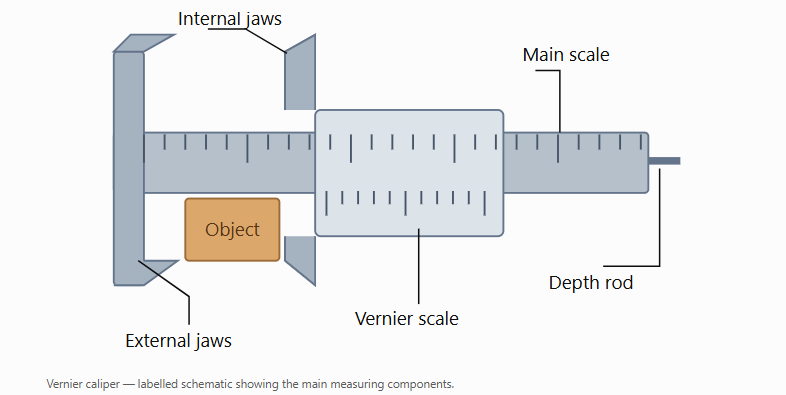
where MSD and VSD represent main scale and vernier scale divisions.
Question 1. A vernier caliper has 10 vernier divisions equal to 9 main scale divisions. If 1 MSD = 1 mm, calculate the least count.
Solution:
Best Courses for You

JEE

NEET

Foundation JEE

Foundation NEET

CBSE
1 VSD = 9/10 = 0.9 mm
Least count = 1 − 0.9 = 0.1 mm
Answer: 0.1 mm or 0.01 cm.
Question 2. The main scale reading is 2.4 cm. The sixth vernier division coincides with a main scale mark. If the least count is 0.01 cm, find the measured length.
Solution:
Reading = MSR + (VSR × LC)
Reading = 2.4 + (6 × 0.01) = 2.46 cm
Answer: 2.46 cm.
Question 3. A vernier caliper measures a cylinder’s diameter as 3.56 cm with a positive zero error of 0.03 cm. Find the actual diameter.
Solution:
Correct reading = Observed reading − Zero error
Correct reading = 3.56 − 0.03 = 3.53 cm
Answer: 3.53 cm.
Common mistake: Subtract positive zero error and add the magnitude of negative zero error.
2. Screw Gauge Questions for JEE Main Physics
A screw gauge measures small dimensions such as wire diameter and sheet thickness.
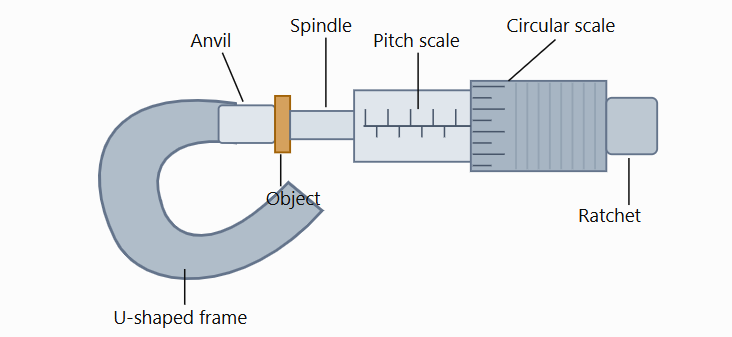
Pitch = Distance moved / Number of rotations.
The screw gauge least count is pitch divided by the number of circular scale divisions.
Question 4. A screw gauge has a pitch of 0.5 mm and 50 circular scale divisions. Find its least count.
Solution:
Least count = Pitch / Circular scale divisions
LC = 0.5 / 50 = 0.01 mm
Answer: 0.01 mm.
Question 5. A screw gauge has a main scale reading of 1.5 mm, circular scale reading of 32 divisions and least count of 0.01 mm. Find the wire diameter.
Solution:
Diameter = MSR + (CSR × LC)
Diameter = 1.5 + (32 × 0.01) = 1.82 mm
Answer: 1.82 mm.
Question 6. A screw gauge shows 2.48 mm with a zero error of −0.04 mm. Calculate the corrected reading.
Solution:
Correct reading = 2.48 − (−0.04) = 2.52 mm
Answer: 2.52 mm.
Common mistake: Pitch is the distance moved in one rotation; least count is the distance corresponding to one circular scale division.
3. Meter Bridge Questions for JEE Main
A metre bridge (also spelled meter bridge) determines unknown resistance using the balanced Wheatstone bridge principle.
When unknown resistance X is in the left gap and known resistance R is in the right gap,
X/R = l/(100 − l), where l is the balance length in centimetres from the left end.
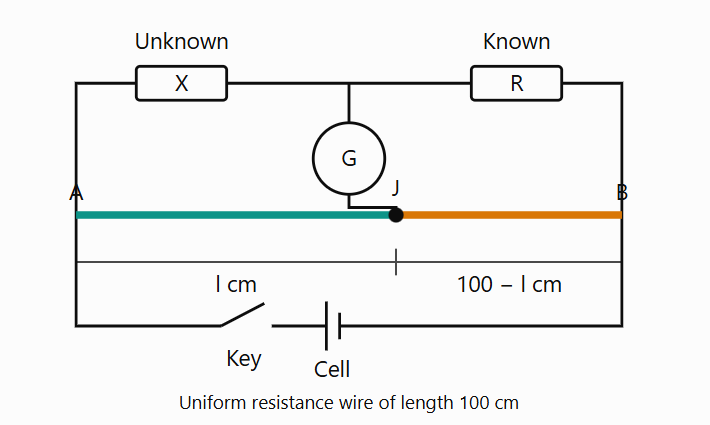
Question 7. A known resistance of 6 Ω is in the right gap. The balance point is 40 cm from the left end. Calculate the unknown resistance.
Solution:
X/6 = 40/(100 − 40)
X = 6 × 40/60 = 4 Ω
Answer: 4 Ω.
Question 8. A metre bridge balances at 60 cm from the left end. What is the new balance point after interchanging the resistances in an ideal bridge?
Solution:
New balance length = 100 − 60 = 40 cm
Answer: 40 cm.
Question 9. At which balance point is a metre bridge generally most sensitive? (A) 10 cm (B) 25 cm (C) 50 cm (D) 90 cm
Solution:
Sensitivity is generally best when the two wire segments are nearly equal and the gap resistances are comparable.
Answer: C. 50 cm.
4. Galvanometer Figure of Merit and Half-Deflection Method Questions
The galvanometer figure of merit is the current required to produce one scale division of deflection: k = I/θ. The half-deflection method determines galvanometer resistance using a shunt. For negligible cell internal resistance, G = RS/(R − S), where R is series resistance and S is the shunt resistance producing half the original deflection.
Question 10. In a half-deflection experiment, R = 1,000 Ω and S = 50 Ω. Calculate galvanometer resistance assuming negligible cell internal resistance.
Solution:
G = RS/(R − S)
G = (1000 × 50)/(1000 − 50) = 52.63 Ω
Answer: Approximately 52.63 Ω.
Question 11. A current of 60 μA produces 30 divisions of deflection. Find the figure of merit.
Solution:
k = I/θ = 60/30 = 2 μA/division
Answer: 2 μA per division.
5. Young’s Modulus Experiment Questions
Young’s modulus is the ratio of longitudinal stress to strain. For a wire of diameter d, Y = 4FL/(πd2ΔL).
Question 12. A 2 m wire with cross-sectional area 1 × 10⁻⁶ m² extends by 1 mm under a force of 100 N. Calculate Young’s modulus.
Solution:
Y = FL/(AΔL)
Y = (100 × 2)/(10−6 × 10−3)
Answer: 2 × 10¹¹ Pa.
Question 13. The maximum percentage error in wire diameter is 2%. Find its contribution to the maximum percentage error in Young’s modulus.
Solution:
Y is proportional to 1/d2.
Percentage error contribution = 2 × 2% = 4%.
Answer: 4%.
6. Surface Tension Experiment Questions
Surface tension can be measured using capillary rise: T = hrρg/(2 cos θ), where h is rise, r is radius, ρ is density and θ is contact angle.
Question 14. Water rises 3 cm in a capillary tube of radius 0.5 mm. Calculate surface tension for zero contact angle, density 1,000 kg/m³ and g = 9.8 m/s².
Solution:
T = (0.03 × 0.0005 × 1000 × 9.8)/2
Answer: 0.0735 N/m.
Question 15. What happens to surface tension when detergent is added? (A) Increases (B) Decreases (C) Remains constant (D) Becomes infinite
Solution:
Detergents contain surface-active substances that reduce the surface tension of water.
Answer: B. Decreases.
7. Viscosity Experiment Questions
The viscosity experiment determines the coefficient of viscosity from the terminal velocity of a sphere under Stokes’ law conditions. η = 2r2(ρs − ρl)g/(9vt).
Question 16. If the radius of a sphere falling through a viscous liquid doubles, how does terminal velocity change, assuming Stokes’ law remains valid?
Solution:
Terminal velocity is proportional to r2.
New velocity = 22 × original velocity.
Answer: Four times the original value.
8. Resonance Tube Experiment Questions
A resonance tube measures the speed of sound in air. For successive first and second resonance lengths, v = 2f(L2 − L1).
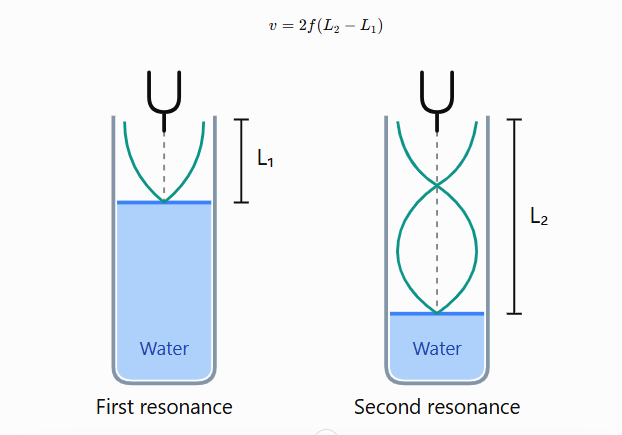
Question 17. A 512 Hz tuning fork gives first and second resonance lengths of 16 cm and 49 cm. Calculate the speed of sound.
Solution:
v = 2 × 512 × (0.49 − 0.16) = 337.92 m/s
Answer: Approximately 338 m/s.
Question 18. The first and second resonance lengths are 17 cm and 53 cm. Find the end correction.
Solution:
Wavelength = 2(53 − 17) = 72 cm
First resonance: L1 + e = λ/4
17 + e = 18
Answer: 1 cm.
9. Other Important Experimental Physics Questions for JEE Mains
Question 19. Simple pendulum: If amplitude decreases to half its initial value, what fraction of initial mechanical energy remains?
Solution:
For small oscillations, E is proportional to A2.
E′/E = (1/2)2 = 1/4.
Answer: 25% of the initial energy.
Question 20. Principle of moments: A 100 g mass hangs 30 cm left of a pivot and an unknown mass hangs 20 cm right. Find the mass assuming the scale’s weight produces no torque.
Solution:
Clockwise moment = Anticlockwise moment
100 × 30 = m × 20
Answer: 150 g.
Question 21. Ohm’s law: A potential difference of 6 V produces 0.5 A current. Find resistance.
Solution:
R = V/I = 6/0.5
Answer: 12 Ω.
Question 22. Specific heat: A 200 g metal block absorbs 4,200 J and warms by 20°C. Find its specific heat capacity.
Solution:
c = Q/(mΔT) = 4200/(0.2 × 20)
Answer: 1050 J kg−1 K−1.
Question 23. Convex lens: An object is 30 cm in front of a convex lens and its real image is 60 cm on the opposite side. Find focal length.
Solution:
Using Cartesian signs, u = −30 cm and v = 60 cm.
1/f = 1/v − 1/u = 1/60 + 1/30 = 1/20
Answer: 20 cm.
Question 24. Zener diode: Which region is used for voltage regulation? (A) Forward cut-off (B) Reverse breakdown (C) Forward breakdown (D) Zero bias
Solution:
A Zener diode maintains approximately constant voltage in reverse breakdown with suitable current limiting.
Answer: B. Reverse breakdown.
Experimental Skills JEE Main PYQs with Solutions
Practising Experimental Skills JEE Main previous-year questions helps students understand how laboratory concepts are tested. Focus on instrument readings, error propagation and interpretation of observations. The following PYQ-style examples illustrate common question patterns; exact year and shift attribution should be verified against official papers before labelling them as actual PYQs.
PYQ-style Example 1: Screw Gauge Least Count
Question: A screw gauge moves 2.5 mm in five complete rotations and has 100 circular scale divisions. Determine the least count.
Solution:
Pitch = 2.5/5 = 0.5 mm
Least count = 0.5/100 = 0.005 mm
Answer: 0.005 mm.
PYQ-style Example 2: Screw Gauge Zero Error
Question: A screw gauge has a pitch of 0.1 mm and 100 circular scale divisions. Its positive zero error corresponds to five divisions. The main scale reading is 5 mm and circular scale reading is 50 divisions. Find the corrected diameter.
Solution:
Least count = 0.1/100 = 0.001 mm
Zero error = 5 × 0.001 = 0.005 mm
Observed reading = 5 + 50 × 0.001 = 5.050 mm
Corrected reading = 5.050 − 0.005
Answer: 5.045 mm.
JEE Main Physics Experimental Skills: Additional Practice MCQs
1. Which instrument is most suitable for measuring the diameter of a thin wire?
- Metre scale
- Screw gauge
- Measuring cylinder
- Stopwatch
2. A vernier caliper has 20 VSD = 19 MSD and 1 MSD = 1 mm. What is its least count?
- 0.5 mm
- 0.1 mm
- 0.05 mm
- 0.01 mm
3. What is the SI unit of dynamic viscosity?
- N/m
- Pa·s
- N/m²
- kg/m³
4. What does the slope of a voltage versus current graph for an Ohmic conductor represent?
- Conductance
- Resistance
- Power
- Resistivity
5. Which principle is used in a metre bridge?
- Bernoulli’s principle
- Archimedes’ principle
- Wheatstone bridge principle
- Pascal’s law
6. What is the difference between successive resonance lengths in a resonance tube?
- λ/4
- λ/2
- λ
- 2λ
7. What is the unit of galvanometer figure of merit?
- Volt/division
- Ohm/division
- Ampere/division
- Watt/division
8. At minimum deviation in a triangular prism, the angle of incidence is:
- Equal to the angle of emergence
- Always zero
- Twice the angle of emergence
- Equal to 90°
9. A glass slab has real thickness 6 cm and apparent thickness 4 cm. What is its refractive index?
- 1.2
- 1.5
- 2.0
- 2.5
10. Which component emits light when suitably forward-biased?
- Resistor
- Capacitor
- LED
- Zener diode
Experimental Skills MCQ Answer Key
| Question | Answer | Concept |
| 1 | B | Screw gauge |
| 2 | C | Least count |
| 3 | B | Viscosity |
| 4 | B | Ohm’s law |
| 5 | C | Metre bridge |
| 6 | B | Resonance tube |
| 7 | C | Galvanometer |
| 8 | A | Prism |
| 9 | B | Travelling microscope |
| 10 | C | Electronic components |
Important Experimental Skills Formulas for JEE Main Physics
| Experiment | Formula |
| Vernier caliper least count | LC = 1 MSD − 1 VSD |
| Vernier caliper reading | MSR + VSR × LC |
| Screw gauge pitch | Distance moved / Rotations |
| Screw gauge least count | Pitch / Circular scale divisions |
| Screw gauge reading | MSR + CSR × LC |
| Zero correction | −Zero error |
| Corrected reading | Observed reading − Zero error |
| Metre bridge | X = Rl/(100 − l) |
| Resistivity | ρ = RA/L |
| Ohm’s law | V = IR |
| Galvanometer figure of merit | k = I/θ |
| Half-deflection method | G = RS/(R − S) |
| Young’s modulus | Y = FL/(AΔL) |
| Surface tension | T = hrρg/(2 cos θ) |
| Viscosity | η = 2r2(ρs − ρl)g/(9vt) |
| Resonance tube | v = 2f(L2 − L1) |
| End correction | e = (L2 − 3L1)/2 |
| Specific heat capacity | Q = mcΔT |
| Principle of moments | m1d1 = m2d2 |
| Simple pendulum energy | E ∝ A2 |
| Convex lens | 1/f = 1/v − 1/u |
| Spherical mirror | 1/f = 1/v + 1/u |
| Prism refractive index | μ = sin[(A + δm)/2]/sin(A/2) |
| Glass slab refractive index | Real thickness / Apparent thickness (near-normal viewing) |
Important Experimental Graphs for JEE Main Physics
| Graph | Interpretation |
| Voltage vs current | Slope = resistance for an Ohmic conductor |
| Stress vs strain | Slope = Young’s modulus in the linear region |
| Pendulum amplitude squared vs time | Amplitude squared decreases as energy is dissipated |
| Prism deviation vs incidence | Lowest point represents minimum deviation |
| Diode current vs voltage | Shows forward conduction and reverse-bias behaviour |
JEE Main Experimental Skills Chapter Weightage
NTA does not prescribe a fixed number of questions or guaranteed chapter-wise marks for Experimental Skills in every shift. Questions can also combine concepts from other Physics units. Prepare instrument readings, numerical questions, graphs, experimental principles and error analysis rather than relying solely on predicted weightage.
Common Mistakes to Avoid in Experimental Skills Questions
| Common mistake | Correct approach |
| Confusing pitch and least count | Divide pitch by circular scale divisions. |
| Adding positive zero error | Subtract positive zero error. |
| Incorrect metre bridge ratio | Check the positions of known and unknown resistance. |
| Mixing centimetres and metres | Convert to consistent units. |
| Confusing radius and diameter | Use the quantity specified by the formula. |
| Using the wrong graph slope | Identify both axes before calculating. |
| Ignoring end correction | Apply it where required in resonance questions. |
| Forgetting powers in error calculations | Multiply the relative error by the absolute power for maximum error estimates. |
How to Prepare Experimental Skills for JEE Main 2027
Understand instrument principles
Learn the construction, uses and reading methods of vernier calipers, screw gauges, metre bridges and galvanometers.
Prepare a formula revision sheet
Write down formulas, SI units, instrument readings and zero correction rules.
Practise experiment-wise questions
Start with screw gauge and vernier caliper questions before progressing to metre bridge and resonance tube experiments.
Solve JEE Main previous-year questions
Practise questions from multiple shifts to understand different formats.
Revise experimental graphs and precautions
Understand graph slopes, null points, resonance conditions and sources of error.
Attempt mock tests
Include experimental questions in timed Physics tests to improve speed and accuracy.
Benefits of Solving Experimental Skills Important Questions from Infinity Learn
- Strengthen practical Physics concepts.
- Improve numerical problem-solving skills.
- Learn step-by-step calculation methods.
- Revise important experimental formulas and measurement errors.
- Practise examination-oriented MCQs and numerical questions.
- Combine experimental revision with previous-year papers and mock tests.
JEE Main Physics Experimental Skills connects theoretical Physics with practical applications. Regular practice of screw gauge questions, vernier caliper questions, metre bridge numericals, galvanometer problems and resonance tube experiment questions can improve conceptual clarity and numerical accuracy. Practise Infinity Learn’s Experimental Skills important questions with solutions to strengthen your preparation for JEE Main 2027.
course
No courses found
FAQs on JEE Main Physics Experimental Skills
What are the important topics in JEE Main Physics Experimental Skills?
Vernier calipers, screw gauges, metre bridges, galvanometers, Young’s modulus, viscosity, surface tension, resonance tubes, calorimetry, optical experiments and semiconductor devices are important topics. Also prepare least count, zero error and experimental graphs.
How can I calculate the least count of a vernier caliper?
For a standard direct vernier caliper, LC = 1 MSD − 1 VSD. If 10 vernier divisions equal 9 main scale divisions and 1 MSD = 1 mm, the least count is 0.1 mm or 0.01 cm.
How do you read a vernier caliper?
Note the main scale reading immediately before the vernier zero. Multiply the coinciding vernier division by the least count and add it to the main scale reading. Apply zero correction if necessary.
What is pitch in a screw gauge, and how is its least count calculated?
Pitch is the distance travelled by the screw in one complete rotation. Least count = Pitch / Number of circular scale divisions. For a pitch of 0.5 mm and 50 divisions, the least count is 0.01 mm.
What is the principle of a metre bridge?
A metre bridge works on the balanced Wheatstone bridge principle. At null deflection, the ratio of gap resistances equals the ratio of the corresponding wire segment resistances.
What is the balance point in a metre bridge, and when is it most sensitive?
The balance point is the position where the galvanometer shows zero deflection. A metre bridge is generally most sensitive near 50 cm when the gap resistances are comparable.
What is the end error in a metre bridge?
End error arises from additional resistance associated with the connecting strips, contacts and end connections. Interchanging the resistances and appropriately averaging the readings can help reduce its effect.
Where can I download Experimental Skills JEE Main important questions with solutions PDF?
Use the PDF download link near the beginning of this Infinity Learn page once the file has been attached. The study material is designed to include solved numericals, MCQs and important formulas.
