- Class 10 Science Important Diagrams: Overview
- Class 10 Biology Important Diagrams with Labels
- Life Processes Class 10 Important Diagrams
- Control and Coordination Important Diagrams
- How Do Organisms Reproduce? Important Diagrams
- Our Environment Diagrams and Visual Questions
- Class 10 Physics Important Diagrams and Ray Diagrams
- Light – Reflection and Refraction Ray Diagrams
- The Human Eye and the Colourful World Important Diagrams
- Electricity Important Circuit Diagrams
- Magnetic Effects of Electric Current Diagrams
- Class 10 Chemistry Important Diagrams and Experimental Setups
- Chemical Reactions and Equations Experimental Diagrams
- Acids, Bases and Salts Visuals
- Metals and Non-Metals Diagrams
- Carbon and Its Compounds Important Structures
- Important Practical Diagrams for Class 10 Science
- Diagram Priority by the CBSE 2026–27 Syllabus
- Formative-Only and Lower-Priority Diagrams
- Diagram-Based Questions from Official Sample Papers
- How CBSE Marks Diagram Questions
- How to Draw and Label Class 10 Science Diagrams Neatly
- Common Diagram Mistakes That Cost Students Marks
- FAQs: Class 10 Science Important Diagrams
CBSE Class 10 Science Important Diagrams 2026–27: Chapter-Wise List with Labels and Exam Tips
By rohit.pandey1
|
Updated on 29 Jul 2026, 15:09 IST
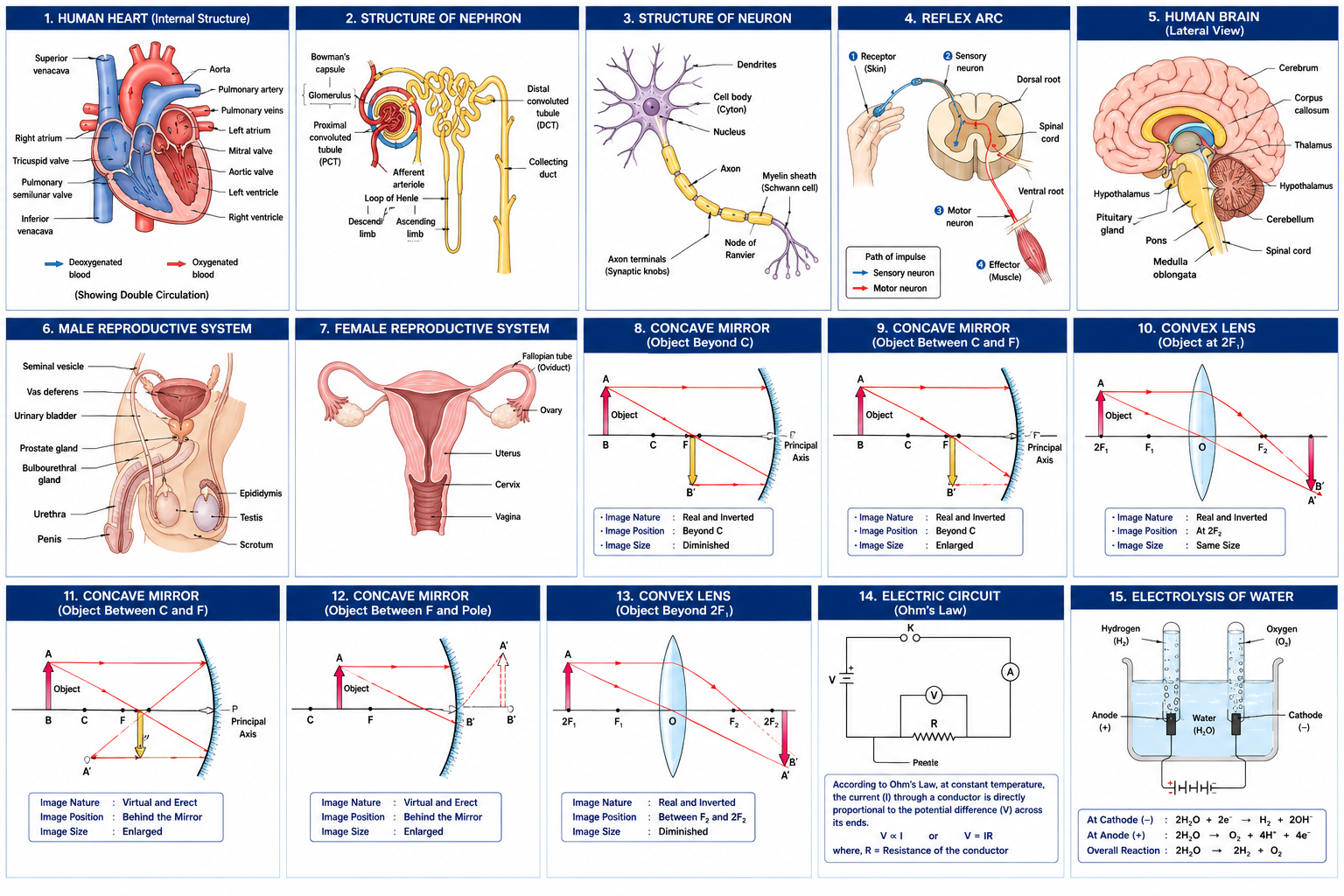
The most important Class 10 Science diagrams include the neuron, human alimentary canal, heart and blood circulation, nephron, stomata, reproductive systems, mirror and lens ray diagrams, vision defects, electric circuits, magnetic field lines, electron-dot structures and selected experimental setups. Students should prepare these visuals not only for drawing questions but also for labelling, correcting, completing and interpreting figures.
This chapter-wise guide covers CBSE Class 10 Science important diagrams for the 2026–27 session, their current syllabus status, the task students should practise, common errors, practical diagrams, official sample-paper examples and downloadable worksheet opportunities.
Class 10 Science Important Diagrams: Overview
The highest-priority diagrams are those that are part of the current syllabus and can be tested through more than one task, such as drawing, labelling, interpretation, correction or application.
CBSE’s Class 10 Science 2026–27 Syllabus allocates 25 marks each to Chemical Substances and World of Living, 12 marks to Natural Phenomena, 13 marks to Effects of Current and 5 marks to Natural Resources. These are unit weights, not guaranteed diagram marks.
| Chapter or unit | Diagram or visual | What to practise |
| Life Processes | Human alimentary canal | Identify organs, label parts and explain digestion |
| Human heart and double circulation | Label chambers and vessels; show blood-flow direction | |
| Human excretory system and nephron | Draw, label and explain filtration | |
| Stomata and guard cells | Draw, identify and connect to transpiration | |
| Control and Coordination | Neuron and synapse | Draw, label and explain impulse transmission |
| Reflex arc | Label and explain the response pathway | |
| Human brain | Identify major regions and functions | |
| Reproduction | Male and female reproductive systems | Label and explain the role of each part |
| Flower and pollen-tube growth | Label and interpret fertilisation | |
| Binary fission and budding | Identify stages and compare processes | |
| Our Environment | Food chain and food web | Construct and interpret energy flow |
| Light | Concave-mirror ray diagrams | Draw rays and state image position, size and nature |
| Convex-lens ray diagrams | Draw rays and state image position, size and nature | |
| Human Eye | Myopia and hypermetropia correction | Identify the defect and draw correcting rays |
| Natural Phenomena/practical | Prism and glass-slab ray paths | Trace, label and interpret refraction |
| Electricity | Circuit symbols and Ohm’s law circuit | Draw correct connections and read instruments |
| Series and parallel circuits | Interpret circuits and calculate resistance/current | |
| Magnetic Effects | Magnetic field lines | Draw patterns and mark direction correctly |
| Chemistry | Electronic or electron-dot structures | Draw and infer bonding or valency |
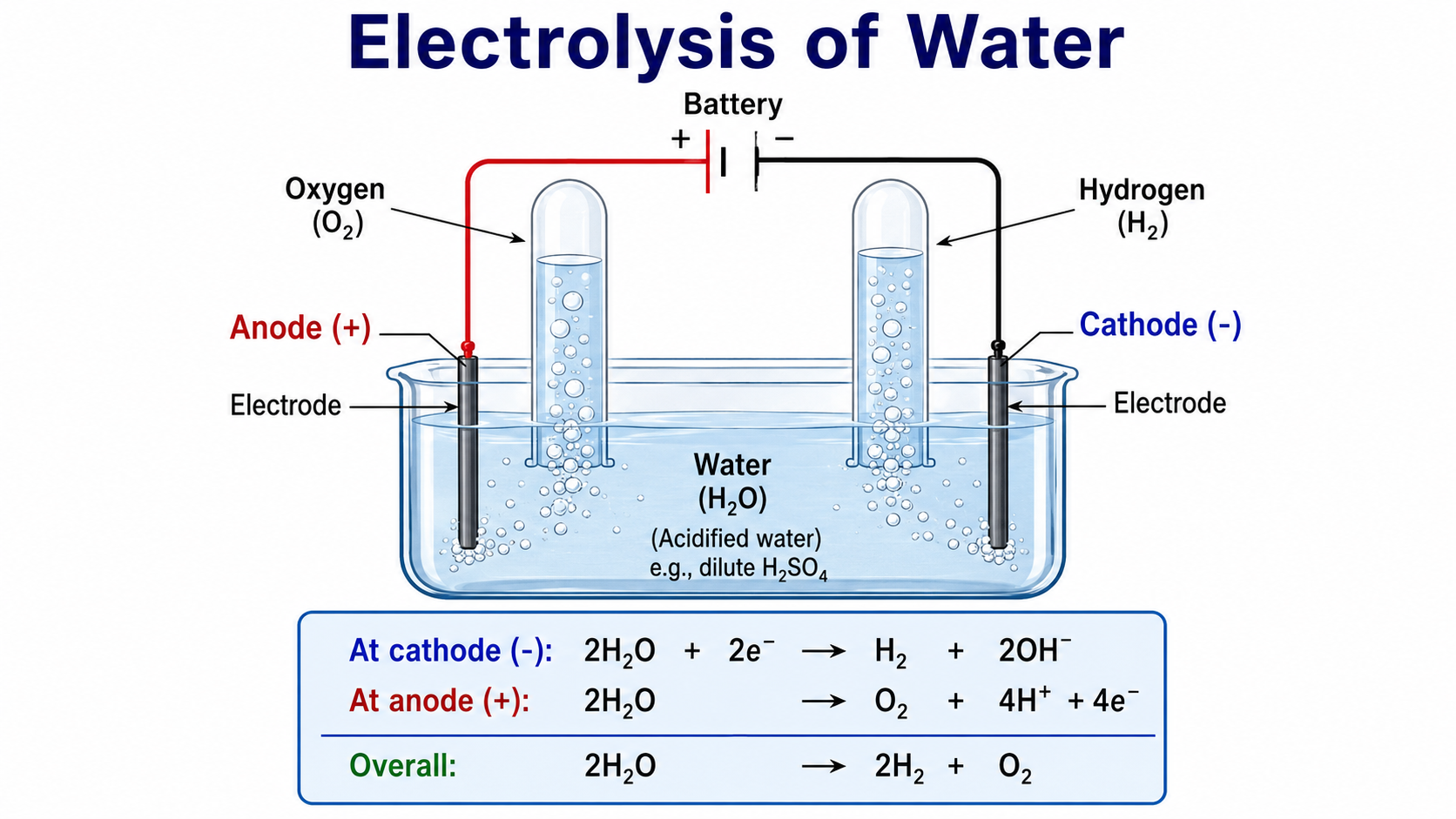
| Chemical Reactions | Electrolysis of water setup | Identify electrodes, products and conditions |
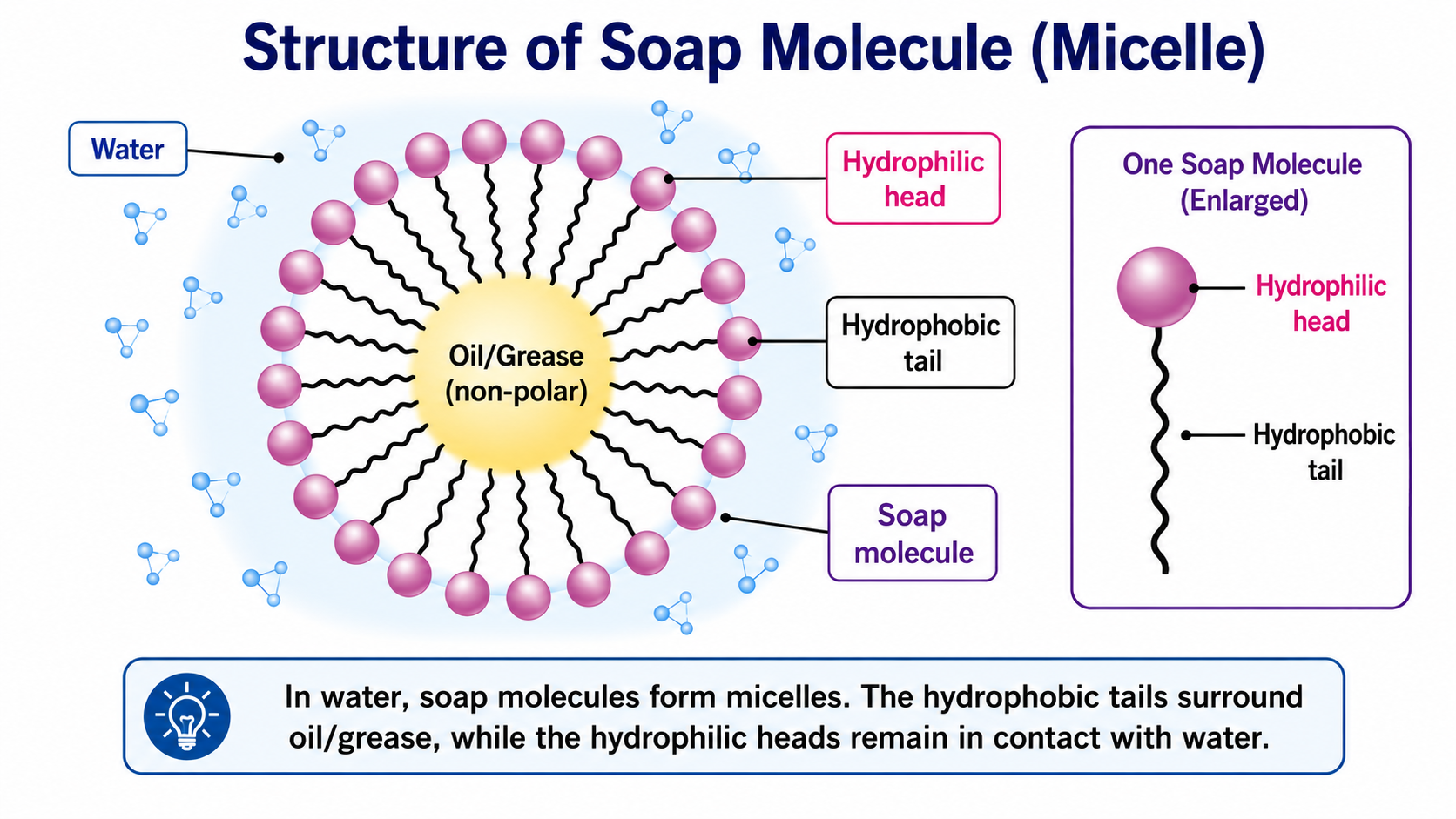
| Carbon and Its Compounds | Soap micelle | Draw, label and explain cleansing action |
| Chemical Substances | Chemistry practical apparatus | Identify apparatus, observation and reaction |
The current NCERT Class 10 Science textbook is marked “Reprint 2026–27” and contains 13 chapters, from Chemical Reactions and Equations to Our Environment.
Top 15 diagrams for last-minute revision
Students with limited revision time should begin with these 15 visual groups:
- Neuron and synapse
- Human alimentary canal
- Human heart and double circulation
- Human excretory system and nephron
- Stomata
- Reflex arc and human brain
- Male and female reproductive systems
- Concave-mirror ray diagrams
- Convex-lens ray diagrams
- Myopia and hypermetropia correction
- Electric circuits with ammeter and voltmeter
- Series and parallel resistor arrangements
- Magnetic field around a conductor, coil and solenoid
- Electronic structures and electron-dot structures
- Prism, glass slab and common practical setups
This list prioritises exam usefulness rather than artistic complexity. A simple circuit or electronic structure may generate more marks through interpretation and calculation than a large biological illustration.
Do Students Have to Draw Diagrams in the Class 10 Science Board Exam?
Every year, students asked to draw diagrams in the Class 10 Science Board Exam. However, diagram-based questions are not always limited to drawing. Students may also need to label, identify, complete, correct or interpret a given figure.

Previous years’ CBSE Class 10 Science papers and sample papers have included a variety of visual questions, such as drawing and explaining the structure of a neuron, identifying parts of the alimentary canal, constructing ray diagrams for vision defects, interpreting electric circuit diagrams, correcting magnetic field-line patterns and analysing lens-based schematics.
Therefore, students should practise both drawing neat, labelled diagrams and answering questions based on supplied figures.
Best Courses for You

JEE

NEET

Foundation JEE

Foundation NEET

CBSE
Draw-and-label questions
A draw-and-label question explicitly asks the student to create a scientific diagram.
Typical instructions include:
- Draw a labelled diagram.
- Draw a ray diagram.
- Show the path of an impulse.
- Represent the magnetic field.
- Draw the electronic structure.
- Draw the experimental setup.
The official 2025–26 sample paper, for example, asks students to “draw and explain” how nerve cells transmit impulses. Its marking scheme uses the neuron and neuromuscular junction figures alongside the required explanation.
Label a supplied diagram
A supplied figure may test whether students recognise structures without reproducing the entire image.
Possible tasks include:
- Label the stomach, small intestine or large intestine.
- Identify a chamber or blood vessel in the heart.
- Name the dendrite, axon or cell body.
- Identify anode and cathode.
- Mark the focus, optical centre or principal axis.
- Identify an ammeter or voltmeter.
- Name a reproductive organ.
The latest official CBSE Class 10 Sample Paper includes a supplied alimentary-canal figure and asks which part contains the maximum amount of digested food after digestion is complete.
Identify or interpret a diagram
Interpretation questions ask what a figure means rather than how accurately it can be copied.
Students may be asked to:
- Explain the function of a labelled part.
- Predict the result of changing a connection.
- Identify the image formed by a lens.
- Explain why field lines are closer in one region.
- State which gas forms at each electrode.
- Determine whether a vision defect is myopia or hypermetropia.
- Calculate resistance, current, focal length or magnification from a schematic.
CBSE’s current paper design assigns 30% to application and 20% to formulating, analysing, evaluating and creating. Visual interpretation therefore deserves as much practice as memorised drawing.
Redraw, complete or correct a diagram
Correction tasks test scientific conventions.
Common examples are:
- Add the missing direction arrows.
- Complete two standard rays.
- Correct the placement of an ammeter.
- Redraw a voltmeter in parallel.
- Correct field lines that cross.
- Extend virtual rays with dotted lines.
- Add a normal to a refracting surface.
In the official sample paper, students must redraw magnetic field lines and mark their direction. The corresponding marking scheme says the arrows should run correctly from north to south outside the magnet.
Practical and experimental diagrams
Practical figures test apparatus, method, observation and scientific reasoning.
Students should be able to identify:
- What each apparatus item does
- How components are connected
- Which variable is changed
- What is observed
- Which equation or principle explains the result
- Which safety or procedural error affects the experiment
Class 10 Biology Important Diagrams with Labels
The most important Class 10 Biology diagrams come from Life Processes, Control and Coordination, Reproduction and Our Environment.
For every Biology diagram, the final published page should provide:
Life Processes Class 10 Important Diagrams
Life Processes diagrams should be learned as functional systems, with special attention to movement, direction and the relationship between structures.
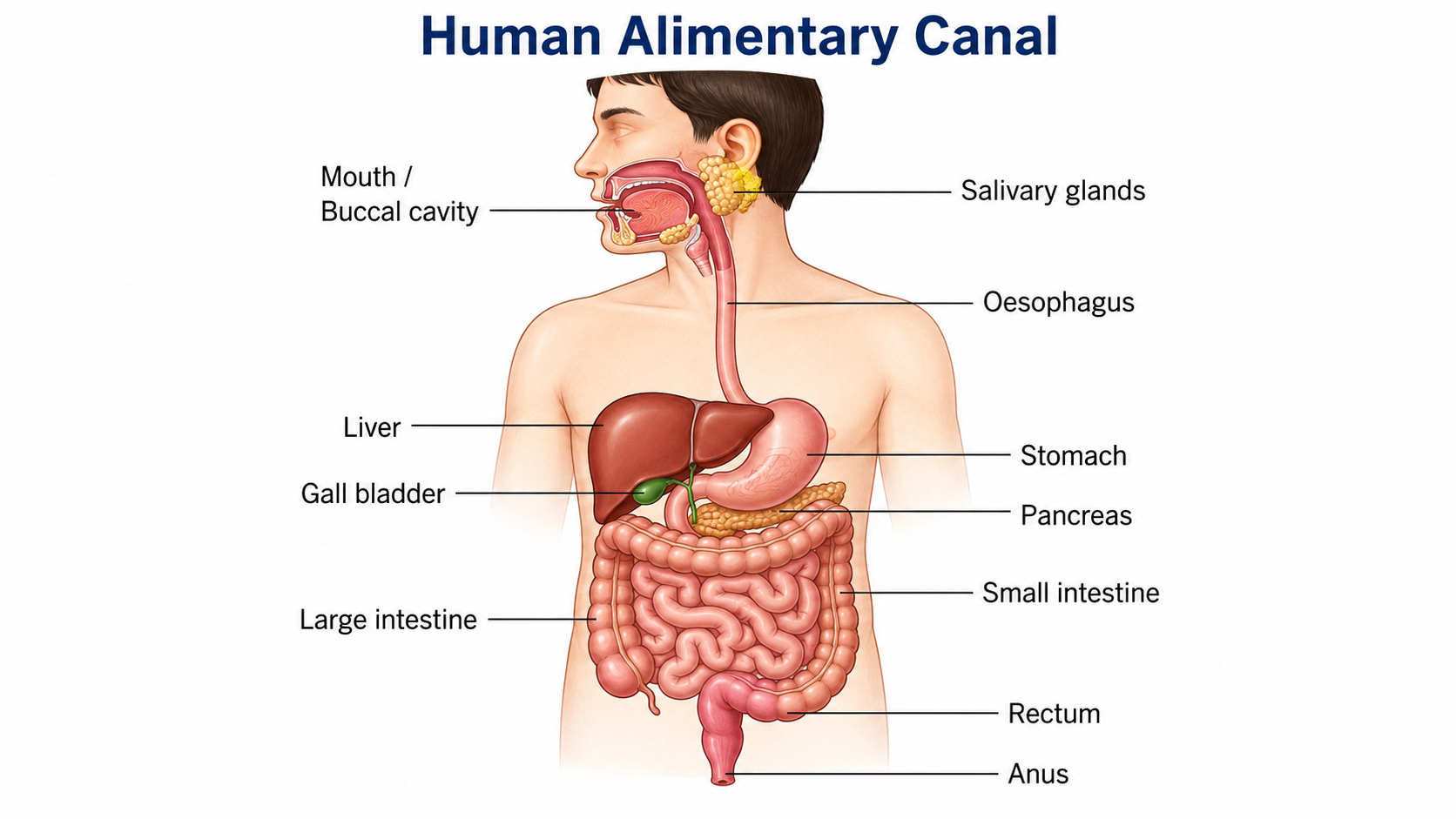
Human alimentary canal
What to prepare: Identify the mouth, oesophagus, stomach, liver, gall bladder, pancreas, small intestine, large intestine, rectum and anus.
Likely tasks:
- Label selected digestive organs.
- State where protein, fat or starch digestion begins.
- Identify where digestion is completed.
- Explain why the small intestine is suited for absorption.
- Connect an organ to its secretion or enzyme.
Common mistake: Pointing to the large intestine when the question asks where most digested food is absorbed.
Also Check: Life Processes Class 10 notes
Intestinal villi
What to prepare: Finger-like projection, thin wall, blood capillaries and lacteal.
What the diagram explains: Villi increase the surface area available for absorption.
Common mistake: Describing villi as digestive glands rather than absorption structures.
Human respiratory system and alveoli
What to prepare: Nostrils, nasal passage, trachea, bronchi, lungs, bronchioles, alveoli and diaphragm.
What the diagram explains: Air travels to alveoli, where gases diffuse between air and blood.
Likely tasks:
- Label respiratory organs.
- Explain why alveoli have thin walls and a large surface area.
- Show the movement of oxygen and carbon dioxide with arrows.
- Compare inhalation and exhalation.
Common mistake: Reversing the directions of oxygen and carbon dioxide exchange.
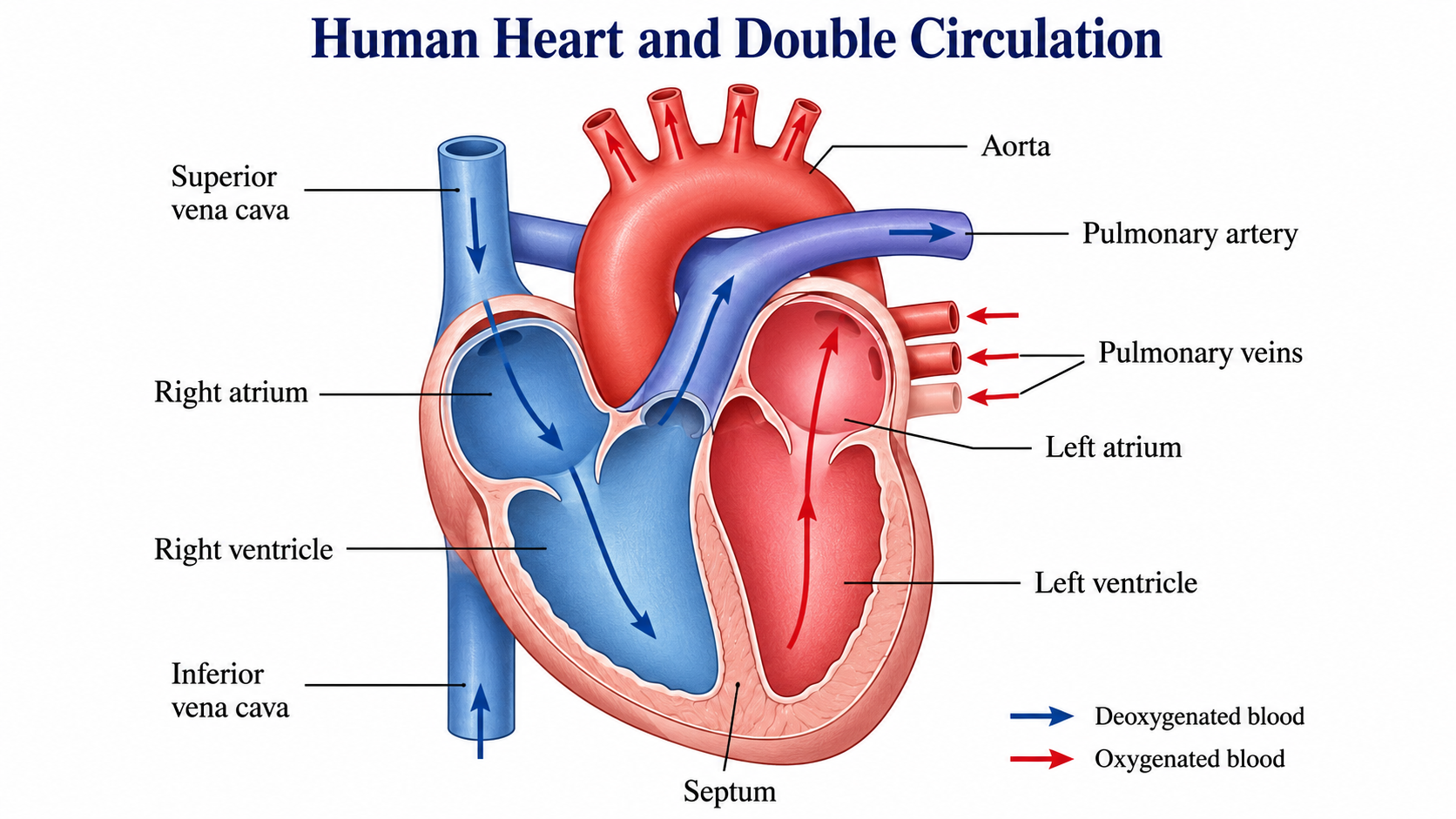
Human heart and double circulation
What to prepare: Right atrium, right ventricle, left atrium, left ventricle, vena cava, pulmonary artery, pulmonary vein, aorta and septum.
What the diagram explains: Blood passes through the heart twice during one complete circulation—once through the pulmonary route and once through the systemic route.
Drawing rule: Use arrows to distinguish the path of oxygenated and deoxygenated blood. The scientific direction is more important than decorative colour.
| Blood-flow stage | Route |
| Deoxygenated blood enters heart | Body → vena cava → right atrium |
| Blood travels to lungs | Right ventricle → pulmonary artery → lungs |
| Oxygenated blood returns | Lungs → pulmonary vein → left atrium |
| Blood travels to body | Left ventricle → aorta → body |
Common mistakes:
- Showing the pulmonary artery carrying oxygenated blood
- Showing the pulmonary vein carrying deoxygenated blood
- Omitting the septum
- Drawing arrows in both directions in one vessel
The latest official sample paper also tests the number of chambers in fish and human hearts and the prevention of mixing in humans, showing that heart visuals should be connected to explanation rather than memorised alone.
Xylem and phloem
What to prepare: Root, stem and leaf pathway, with separate arrows for water/minerals and prepared food.
What the diagram explains:
- Xylem: Mainly carries water and minerals upward from roots.
- Phloem: Transports food from source regions to parts that require or store it.
Common mistake: Showing both transport systems as strictly upward.
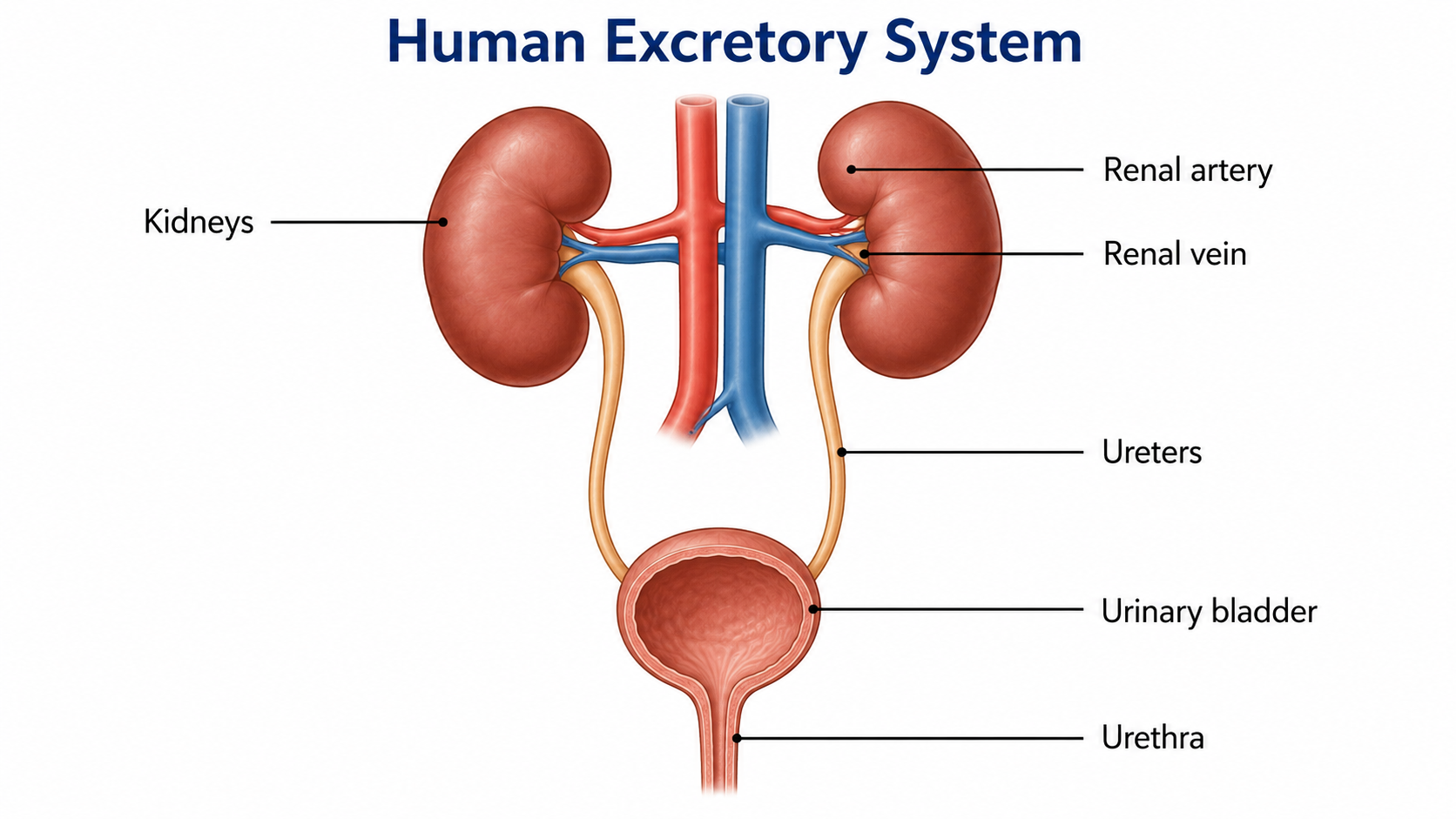
Human excretory system
What to prepare: Kidneys, ureters, urinary bladder, urethra and major blood vessels.
What the diagram explains: Kidneys filter blood, urine travels through the ureters and is stored in the bladder.
Likely tasks:
- Label the organs.
- State the function of a kidney or ureter.
- Connect the system to the nephron.
- Explain urine formation.
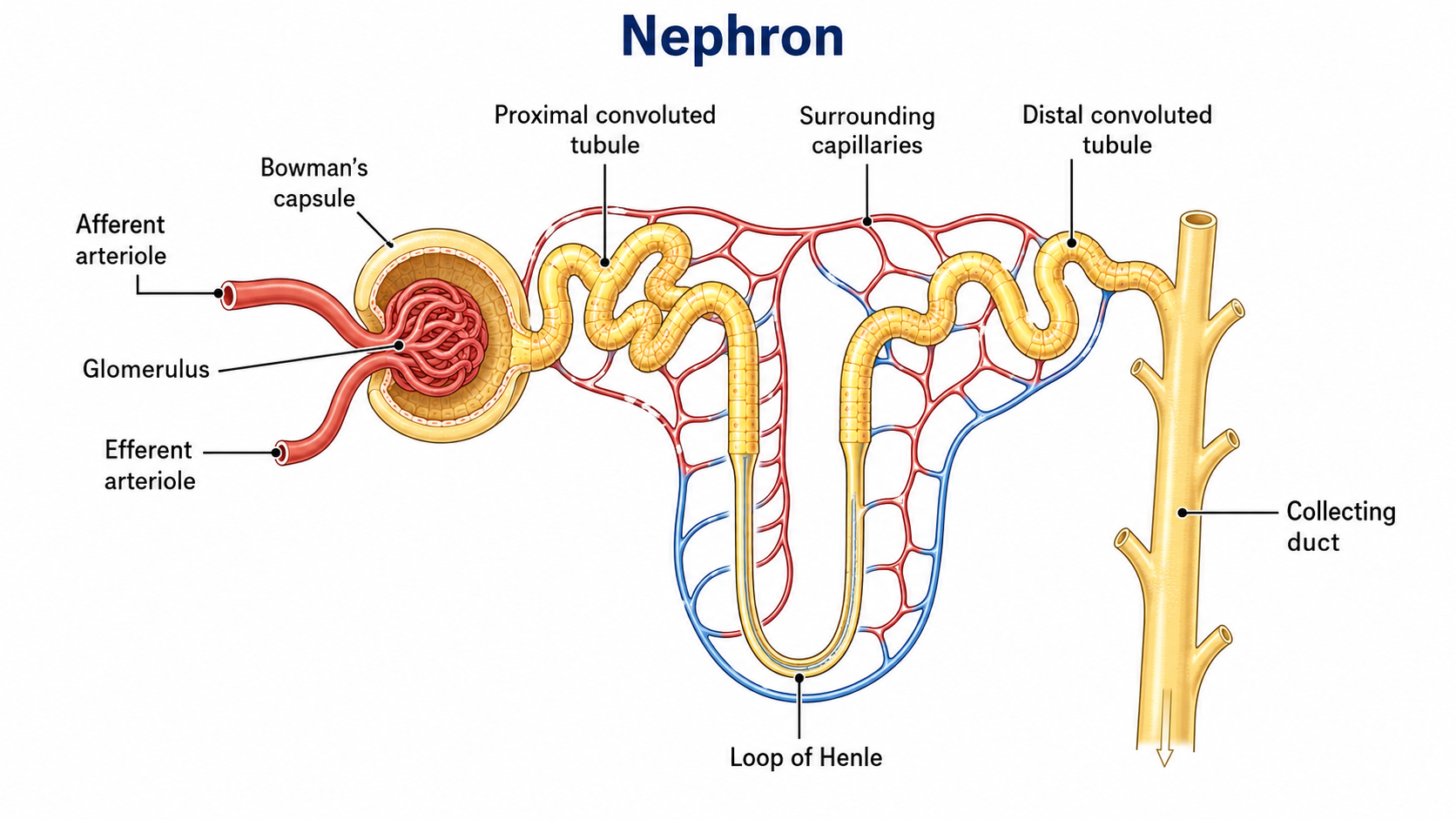
Structure of a nephron
What to prepare: Bowman’s capsule, glomerulus, renal tubule, loop region, collecting duct and associated blood vessels.
What the diagram explains: Filtration begins at the glomerulus; useful substances and water are selectively reabsorbed along the tubule.
Common mistakes:
- Labelling Bowman’s capsule as the glomerulus
- Showing filtration from the capsule into the blood
- Omitting the collecting duct
- Drawing the tubule as an unexplained coil without labels
Stomata and guard cells
What to prepare: Stomatal pore, two guard cells, surrounding epidermal cells and chloroplasts where shown.
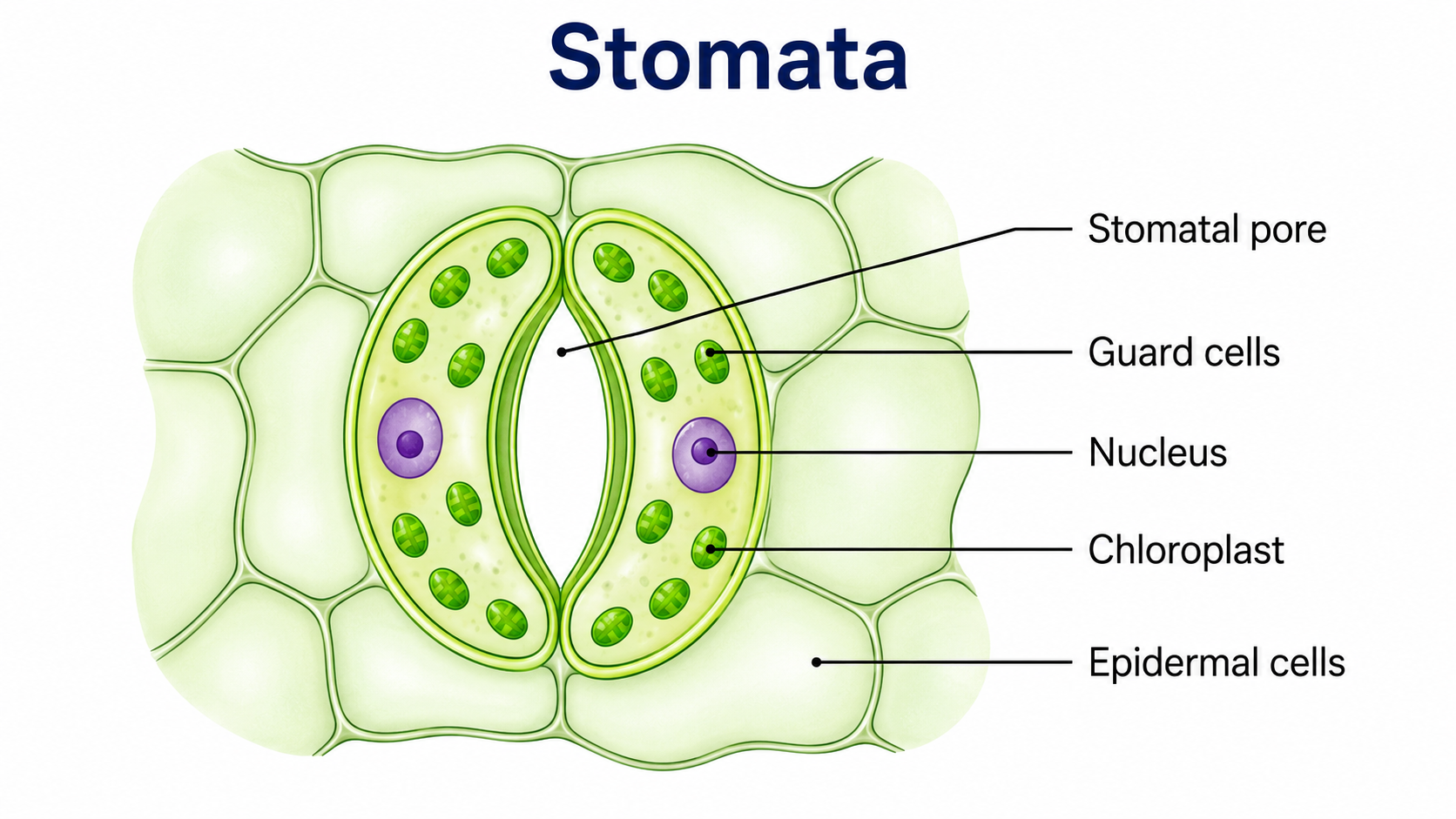
What the diagram explains: Stomata permit gas exchange and regulate water loss.
The CBSE 2026–27 practical list specifically includes preparing a temporary mount of a leaf peel to show stomata.
Common mistake: Drawing a stomatal pore without showing the two guard cells around it.
Control and Coordination Important Diagrams
Control and Coordination diagrams should show the direction of information and the role of each nervous-system structure.
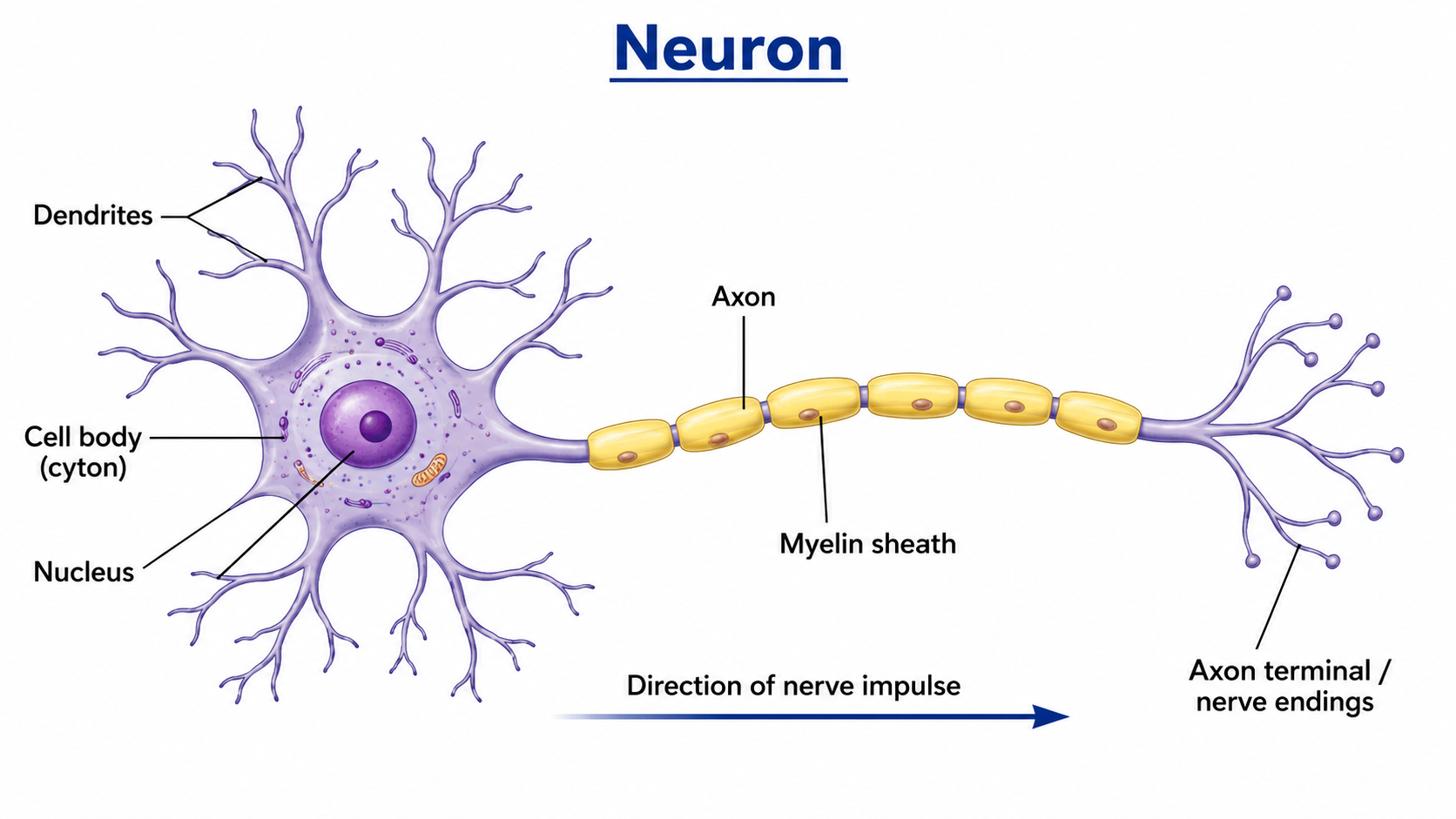
Structure of a neuron
What to prepare: Dendrites, cell body, nucleus, axon and nerve endings.
Direction to remember:
Dendrite → cell body → axon → nerve ending → synapse
The official sample marking scheme explains that an impulse begins at a dendritic tip, passes through the cell body and axon, and triggers chemical release at the axon ending.
Common mistakes:
- Labelling dendrites as nerve endings
- Drawing the impulse arrow toward the dendrites
- Omitting the long axon
- Treating the synapse as part of a single continuous cell
Synapse
What to prepare: Axon ending of the first neuron, gap, chemical signal and dendrite of the next neuron.
What the diagram explains: Chemicals released from one neuron cross the synaptic gap and initiate an electrical impulse in the next neuron.
Reflex arc
What to prepare: Receptor, sensory neuron, spinal cord or relay neuron, motor neuron and effector.
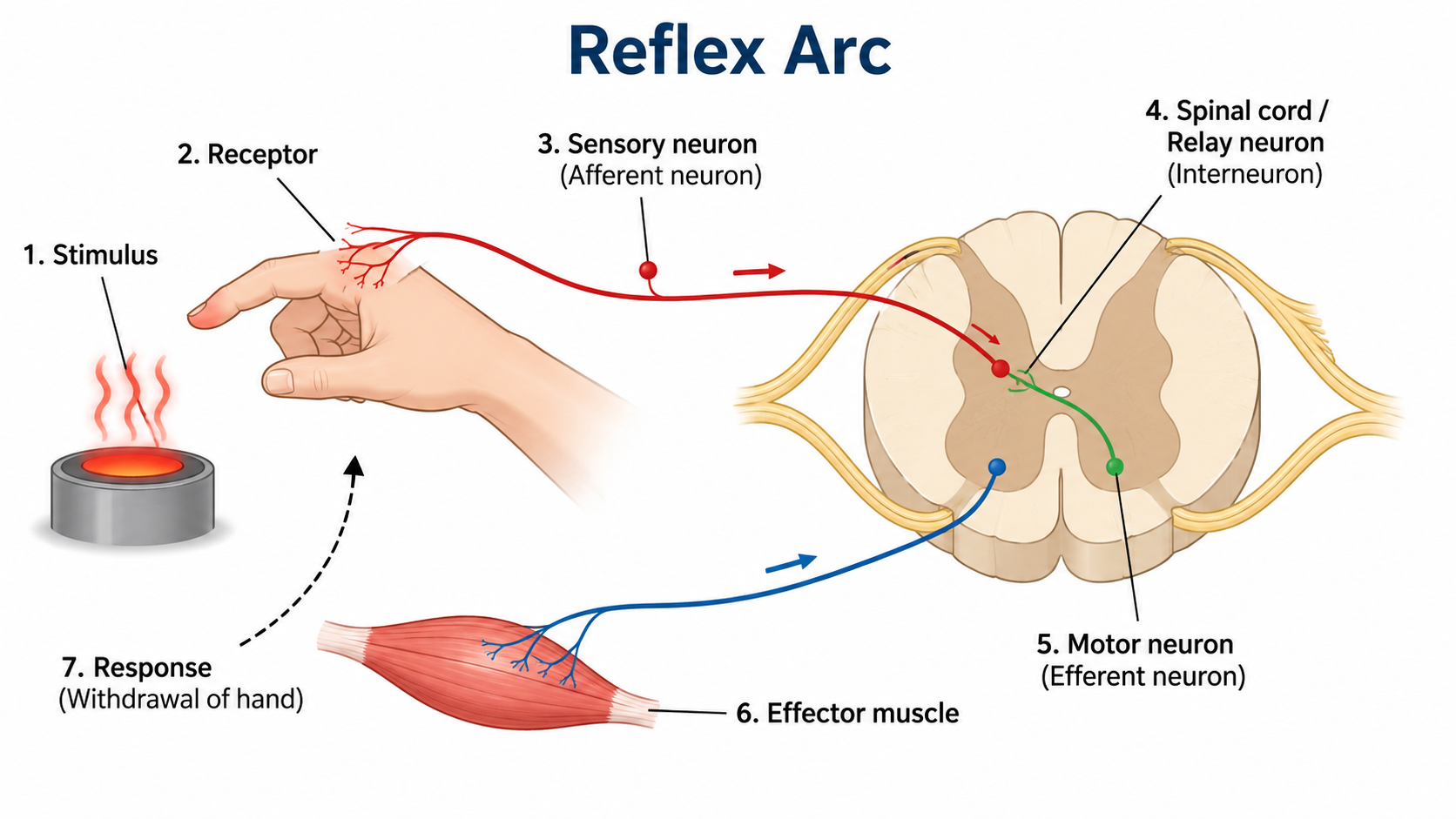
Sequence:
- A receptor detects a stimulus.
- A sensory neuron carries the impulse to the spinal cord.
- The spinal cord passes the signal through a relay pathway.
- A motor neuron carries the response.
- A muscle or gland acts as the effector.
Common mistake: Showing the brain as the first processing point in a rapid reflex response.
Human brain
What to prepare: Forebrain/cerebrum, midbrain, cerebellum, medulla and spinal cord at the level required by NCERT.
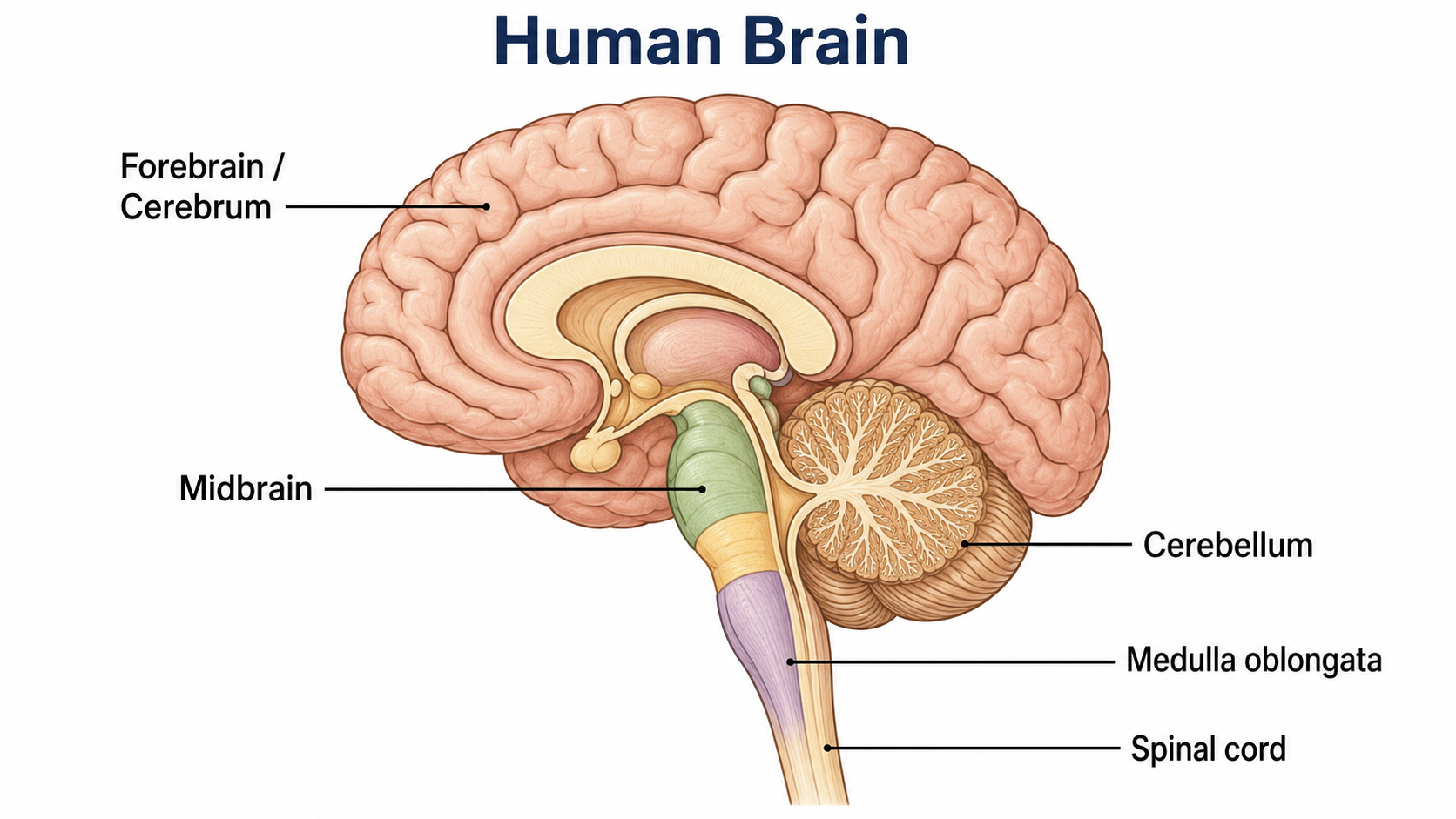
Likely tasks:
- Match a brain region to a function.
- Label major regions.
- Explain balance, posture, involuntary actions or thinking.
- Distinguish voluntary and involuntary control.
Common mistake: Assigning posture and balance to the cerebrum instead of the cerebellum.
Also Check: CBSE Class 10 Important Question for Science
Plant tropisms
What to prepare: Shoots bending toward light, roots responding to gravity and directional arrows showing the stimulus.
What the diagram explains: Plant growth responses depend on the direction of a stimulus.
Use arrows labelled light or gravity; an unexplained bent stem is not a complete scientific diagram.
How Do Organisms Reproduce? Important Diagrams
Reproduction diagrams should be prepared for identification, labelling, sequencing and explanation rather than memorised only as large drawings.
Male reproductive system
Required labels: Testes, scrotum, sperm duct, seminal vesicle, prostate gland, urethra and penis.
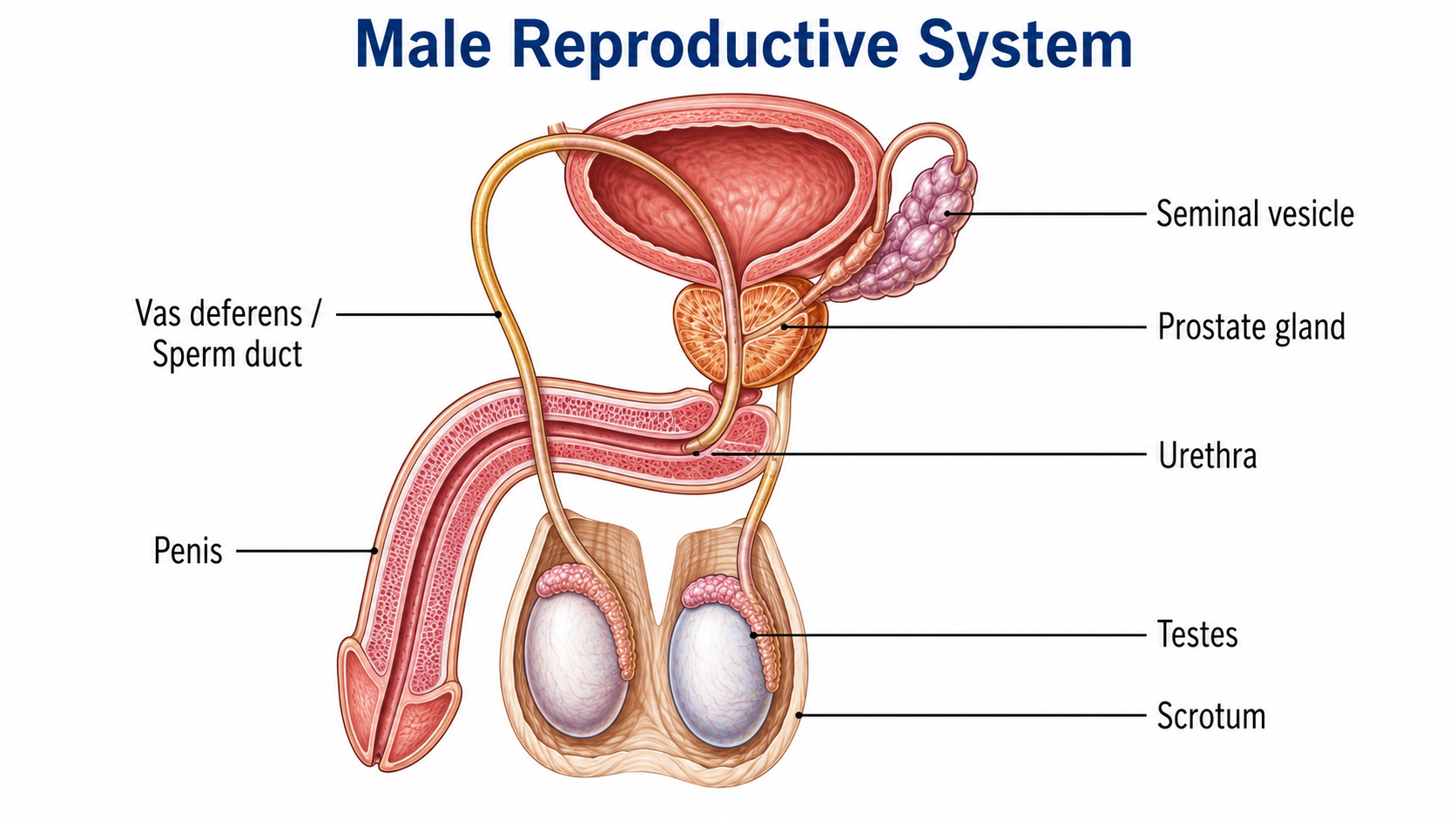
Likely tasks:
- Identify where sperm are produced.
- Explain why the testes are located in the scrotum.
- Trace the path of sperm.
- Label accessory glands.
Female reproductive system
Required labels: Ovaries, fallopian tubes/oviducts, uterus, cervix and vagina.
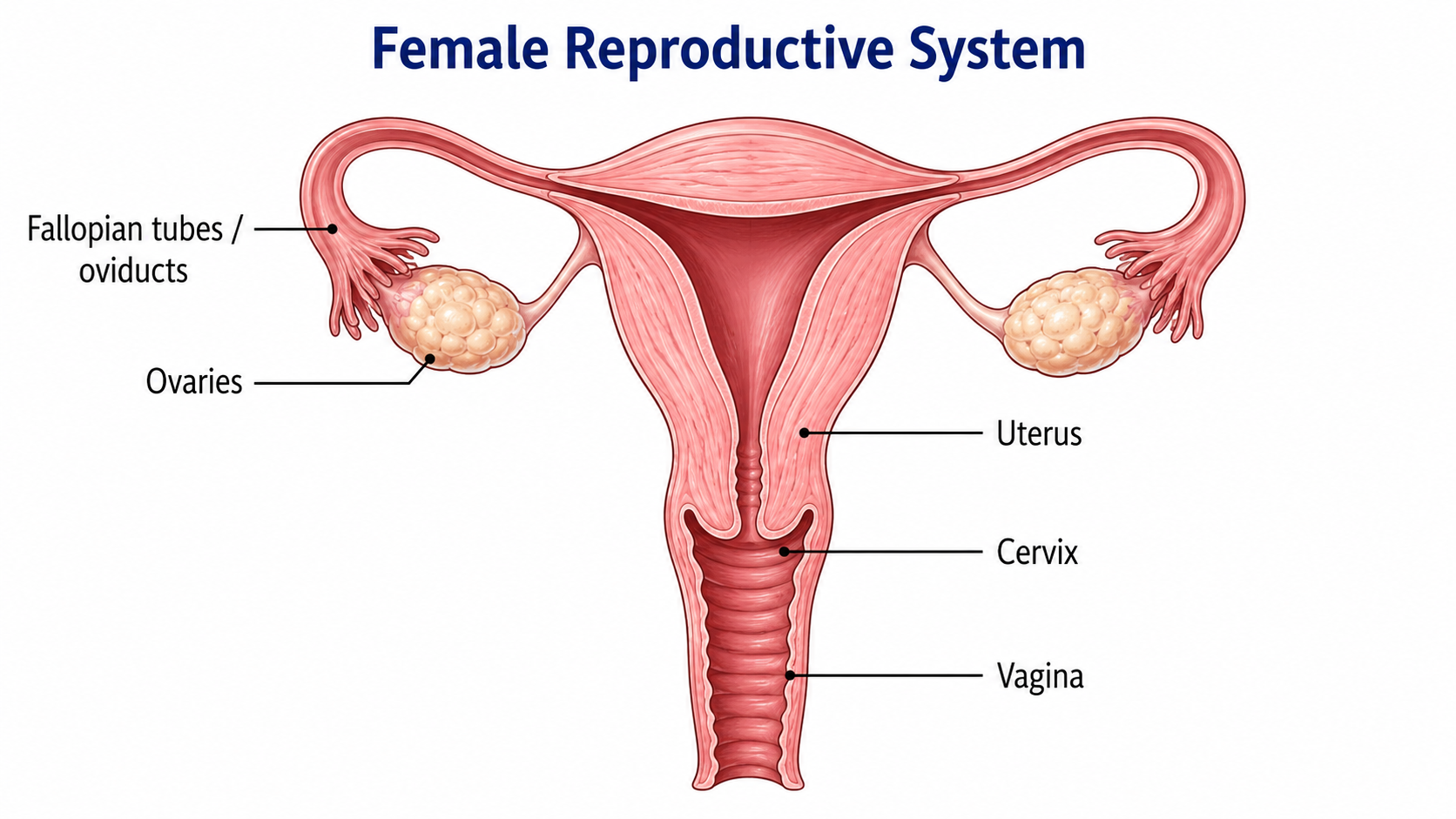
Likely tasks:
- Identify the site of fertilisation.
- Identify where an embryo implants.
- Trace the movement of an egg.
- Label the major organs.
Common mistake: Marking the uterus as the normal site of fertilisation; fertilisation generally occurs in the oviduct.
Longitudinal section of a flower
Required labels: Sepal, petal, anther, filament, stigma, style, ovary and ovule.
What the diagram explains: The flower contains male and female reproductive structures involved in pollination and fertilisation.
Pollen-tube growth
What to prepare: Pollen grain, stigma, style, pollen tube, ovary and ovule.
Likely task: Explain how the male gamete reaches the ovule after pollination.
Binary fission in Amoeba
What to prepare: Parent cell, dividing nucleus, constriction and two daughter cells.
Budding in yeast or Hydra
What to prepare: Parent organism, bud growth and separation.
CBSE’s current practical list includes prepared-slide study of binary fission in Amoeba and budding in yeast and Hydra.
| Feature | Binary fission | Budding |
| Number of main offspring | Usually two | A smaller bud develops |
| Parent division | Parent divides into daughter cells | Bud grows from parent |
| Common example | Amoeba | Yeast or Hydra |
Dicot-seed embryo
What to prepare: Cotyledons, plumule and radicle.
Identification of the parts of a dicot embryo is also included in the official practical list.
Also Check: How Do Organisms Reproduce notes
Our Environment Diagrams and Visual Questions
Our Environment is more likely to use constructed or interpreted visuals such as food chains and food webs than detailed anatomical drawings.
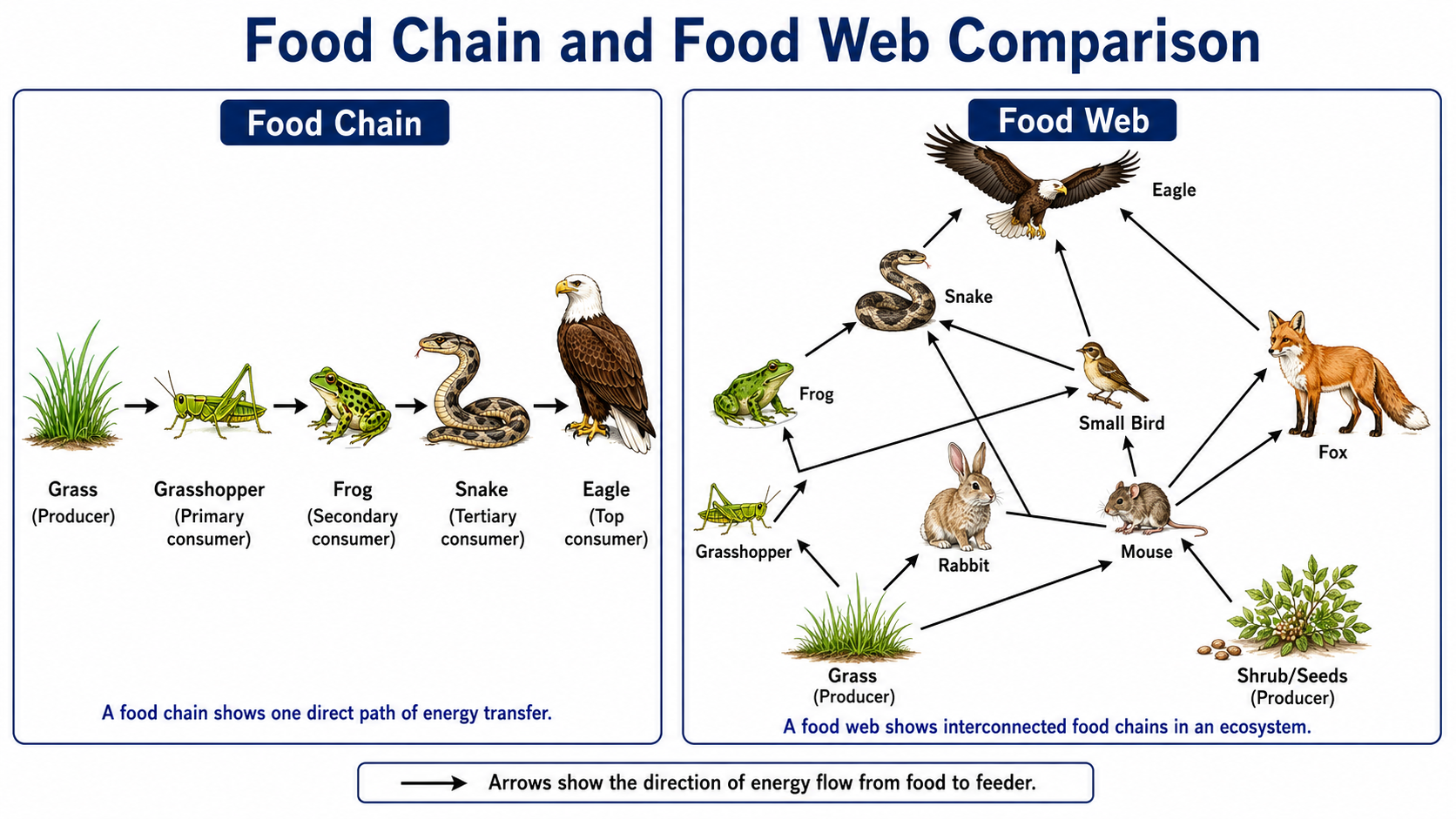
Food chain
What to prepare: Producer, primary consumer, secondary consumer and higher consumer.
Arrows should show the direction of energy transfer—from the organism being eaten toward the organism that receives the energy.
Food web
What to prepare: Two or more connected food chains sharing organisms.
The official sample paper asks students to create a food web using organisms listed in a natural reserve. Its marking scheme accepts two food chains joined at a common organism.
Common mistakes:
- Reversing energy arrows
- Using a consumer as the starting producer
- Drawing two chains that do not connect
- Treating a food web as a straight chain
Class 10 Physics Important Diagrams and Ray Diagrams
The most important Class 10 Physics diagrams are ray diagrams, electrical circuits and magnetic-field patterns because they combine drawing conventions with conceptual or numerical reasoning.
Light – Reflection and Refraction Ray Diagrams
Students should practise the standard rays first, then use them to construct complete mirror and lens diagrams.
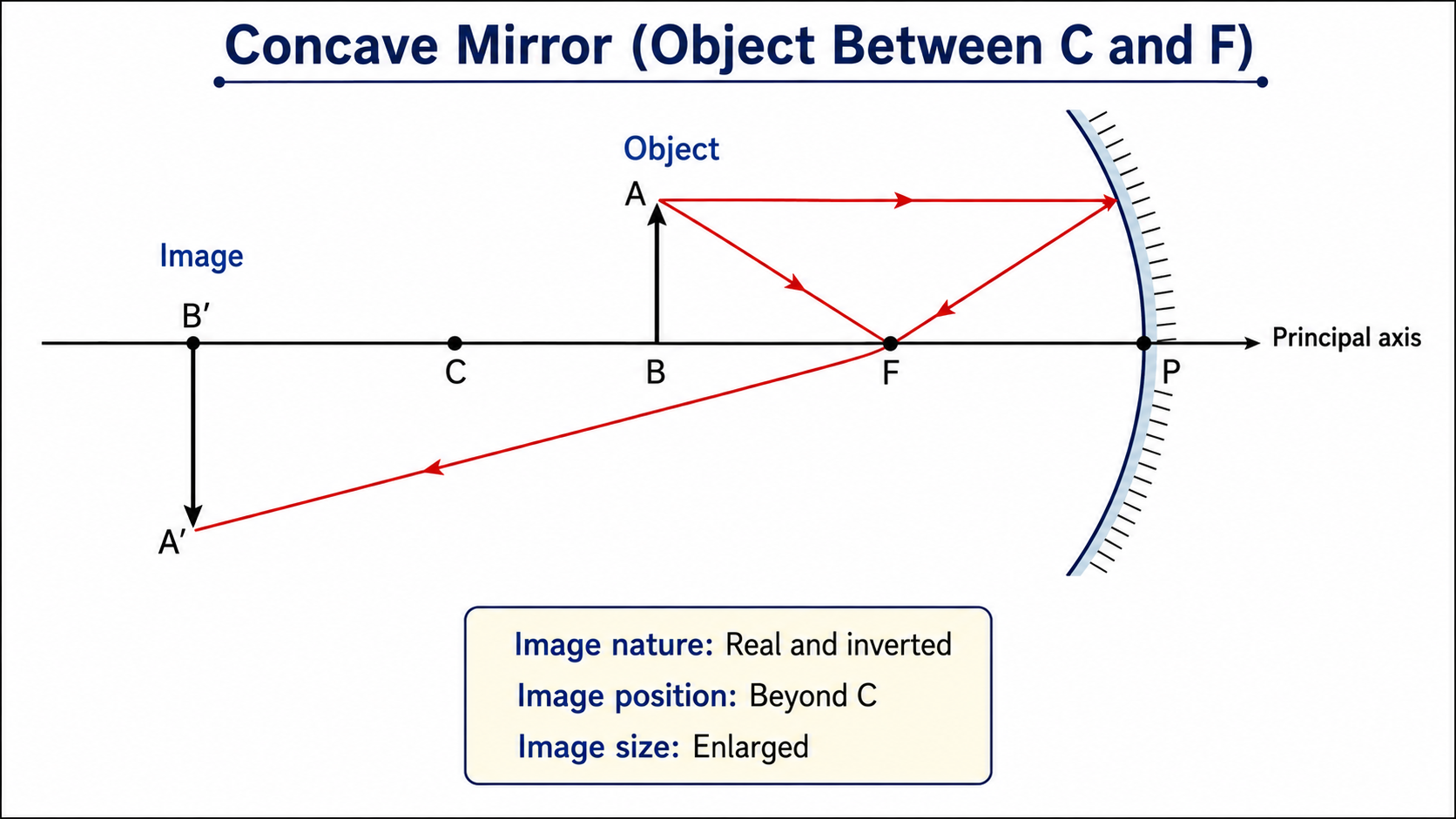
Concave-mirror ray diagrams
For a concave mirror, learn these standard rays:
- A ray parallel to the principal axis reflects through the principal focus.
- A ray passing through the principal focus reflects parallel to the axis.
- A ray passing through the centre of curvature retraces its path.
- A ray striking the pole follows the law of reflection.
| Object position | Image position | Nature and size |
| Beyond C | Between C and F | Real, inverted, diminished |
| At C | At C | Real, inverted, same size |
| Between C and F | Beyond C | Real, inverted, enlarged |
| At F | At infinity | Real, highly enlarged |
| Between F and P | Behind mirror | Virtual, erect, enlarged |
Common mistakes:
- Starting rays from different points on the object
- Reflecting a parallel ray toward C instead of F
- Drawing a virtual image with solid extensions
- Forgetting arrowheads
Convex-mirror diagram
A convex mirror produces a virtual, erect and diminished image behind the mirror for an object placed in front of it.
Required points: Pole, focus and centre of curvature behind the mirror.
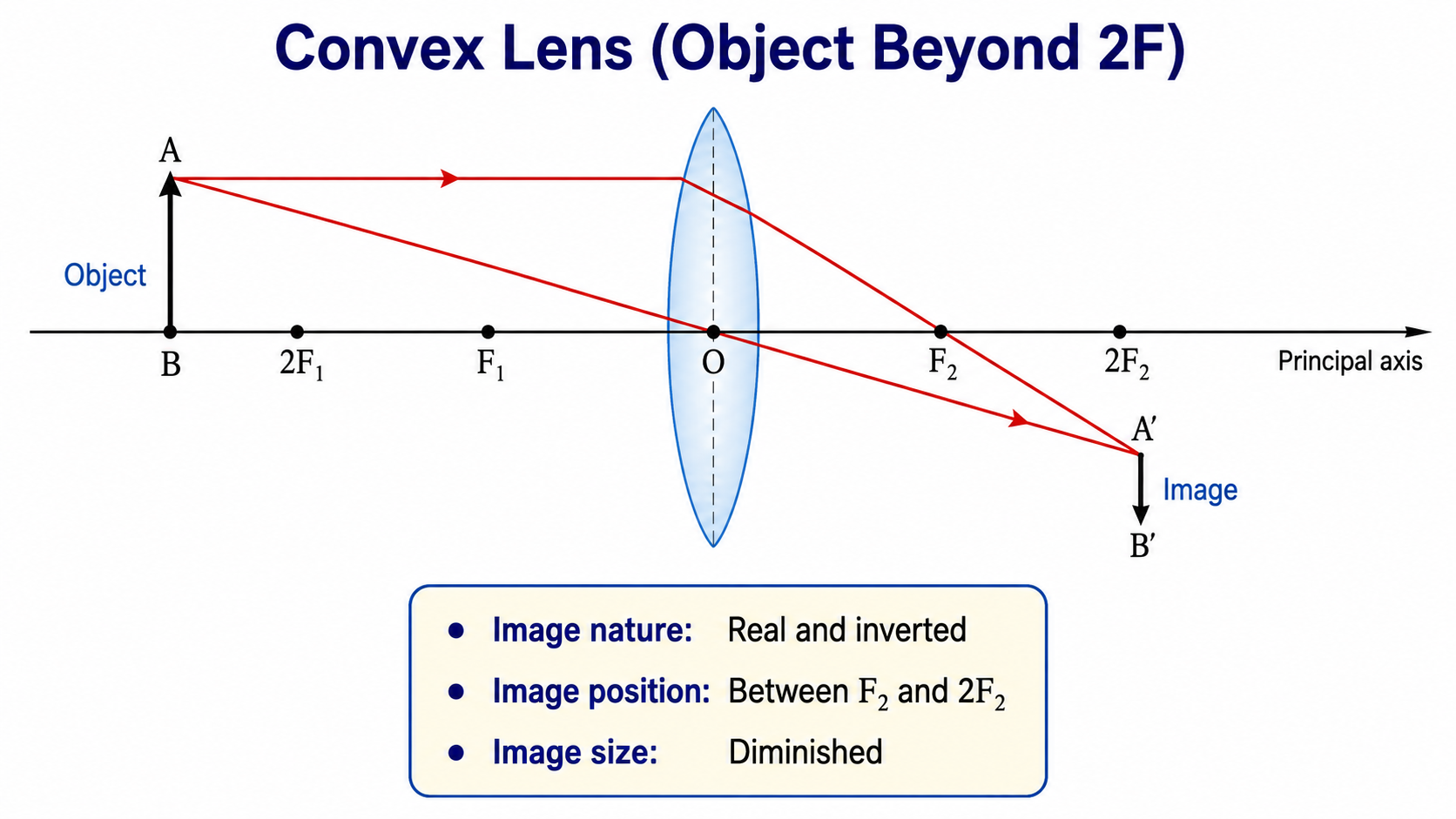
Convex-lens ray diagrams
For a convex lens, learn these standard rays:
- A ray parallel to the principal axis refracts through the focus on the opposite side.
- A ray through the optical centre passes approximately undeviated.
- A ray through the near focus emerges parallel to the principal axis.
| Object position | Image position | Nature and size |
| Beyond 2F₁ | Between F₂ and 2F₂ | Real, inverted, diminished |
| At 2F₁ | At 2F₂ | Real, inverted, same size |
| Between F₁ and 2F₁ | Beyond 2F₂ | Real, inverted, enlarged |
| At F₁ | At infinity | Real, highly enlarged |
| Between F₁ and optical centre | Same side as object | Virtual, erect, enlarged |
Concave-lens diagram
A concave lens produces a virtual, erect and diminished image between the optical centre and focus on the object side.
The latest official sample paper uses lens schematics to test identification, image nature, focal length and real-world camera applications.
Concave mirror versus convex lens
| Feature | Concave mirror | Convex lens |
| Main action | Reflection | Refraction |
| Central point | Pole | Optical centre |
| Main references | P, F and C | O, F₁, F₂, 2F₁ and 2F₂ |
| Parallel ray | Reflects through F | Refracts through opposite F |
| Common error | Wrong reflection direction | Using the wrong focus |
The Human Eye and the Colourful World Important Diagrams
Students should prepare the structure of the eye, common vision defects, correcting lenses and prism-based refraction.
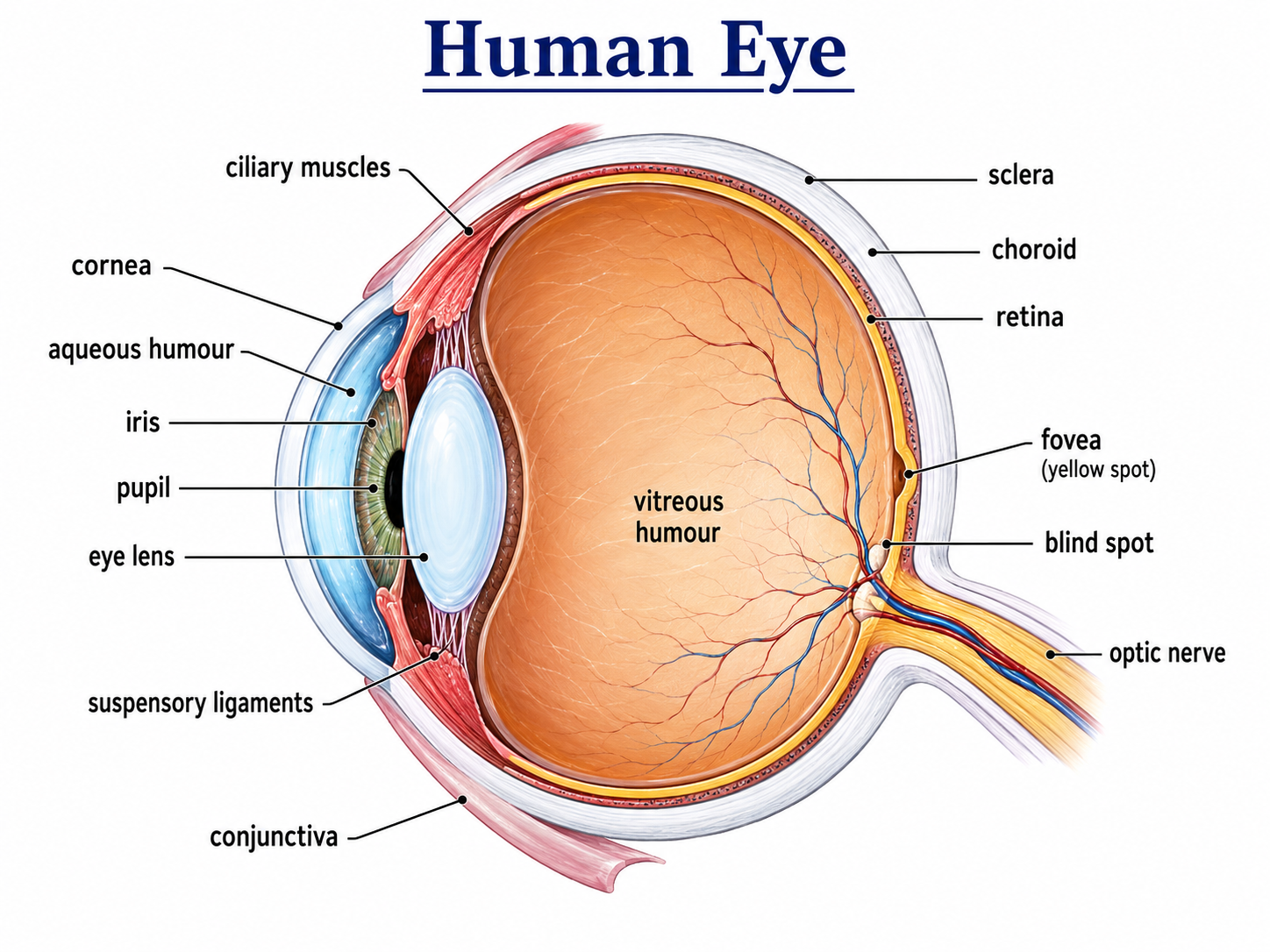
Structure of the human eye
Required labels: Cornea, iris, pupil, eye lens, ciliary muscles, retina and optic nerve.
What the diagram explains: Light is refracted and focused on the retina, while ciliary muscles help change the focal length of the eye lens.
Myopia and its correction
Myopia: A distant object is not seen clearly because its image forms in front of the retina.
Correction: A concave lens diverges incoming rays so that the eye focuses them on the retina.
Hypermetropia and its correction
Hypermetropia: A nearby object is not seen clearly because its image would form behind the retina.
Correction: A convex lens converges incoming rays before they enter the eye.
The official sample paper supplies a corrective figure, asks students to identify the defect and correcting lens, and then requires a labelled ray diagram showing the uncorrected defect.
| Vision defect | Image position without correction | Correcting lens |
| Myopia | In front of retina | Concave |
| Hypermetropia | Behind retina | Convex |
| Presbyopia | Near-point difficulty due to reduced accommodation | Depends on the person’s combined need |
Common mistake: Drawing the correcting lens correctly but showing the original defect on the wrong side of the retina.
Refraction through a prism
Required labels: Incident ray, refracted ray, emergent ray, normals and angle of deviation where required.
Dispersion of white light
What the diagram explains: Different colours deviate by different amounts while passing through a prism, producing a spectrum.
Common mistake: Reversing the order of red and violet deviation.
Also Check: Human Eye Class 10 notes
Electricity Important Circuit Diagrams
Electricity diagrams must use standard symbols and correct series or parallel connections.
Circuit symbols to memorise
Students should recognise and draw:
- Electric cell
- Battery
- Connecting wire
- Open and closed switch
- Resistor
- Variable resistor
- Ammeter
- Voltmeter
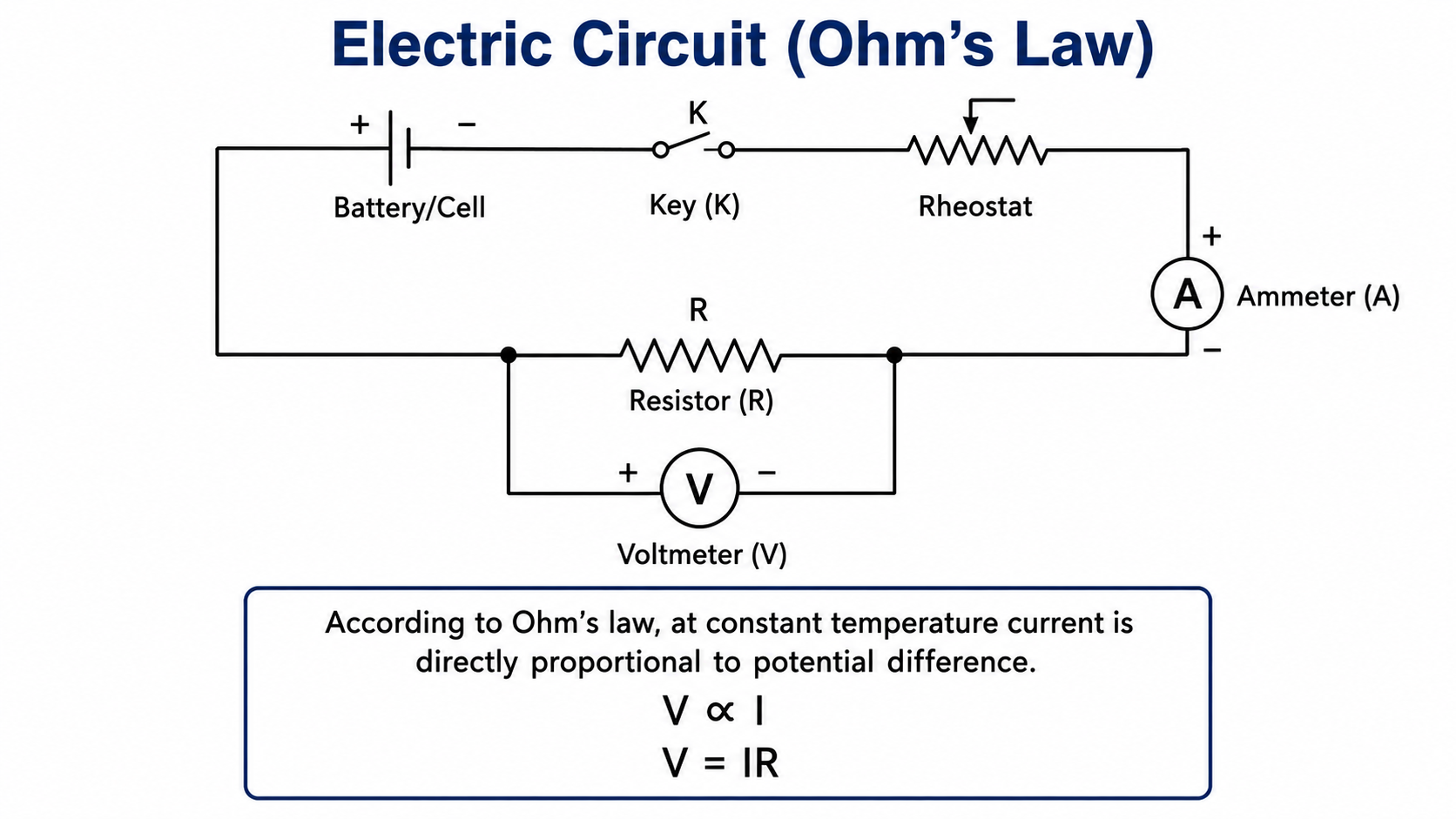
Ohm’s law circuit
Correct arrangement:
- Connect the ammeter in series.
- Connect the resistor in series with the source.
- Connect the voltmeter in parallel across the resistor.
- Use a key or switch to open and close the circuit.
- Show correct terminal polarity when it matters.
Common errors:
- Ammeter in parallel
- Voltmeter in series
- Voltmeter connected across the complete battery rather than the tested resistor
- Broken circuit at an unintended point
- Non-standard resistor symbol
Series and parallel resistors
| Feature | Series | Parallel |
| Current | Same through each resistor | Divides among branches |
| Potential difference | Divides across resistors | Same across branches |
| Equivalent resistance | Greater than each individual value | Less than the smallest branch resistance |
| Diagram cue | One continuous path | Two or more branches |
The official sample paper includes circuit figures requiring students to calculate effective resistance, current and ammeter readings.
V–I graph
What to prepare: Voltage on one axis, current on the other, labelled units and a straight-line relationship for an ohmic conductor under constant physical conditions.
Domestic electric circuit
What to prepare: Live, neutral and earth wires; fuse or protective device; parallel appliance connections; and the role of earthing.
Only include details that match the current NCERT and CBSE syllabus rather than older expanded versions of the chapter.
Magnetic Effects of Electric Current Diagrams
Magnetic Effects diagrams should show the shape, spacing and direction of magnetic field lines.
Field around a straight current-carrying conductor
What to draw: Concentric circles centred on the conductor.
Direction rule: Apply the right-hand thumb rule—the thumb indicates current and curled fingers indicate magnetic-field direction.
Field around a circular coil
What to draw: Field lines around each part of the loop combining into a stronger pattern near its centre.
Field around a solenoid
What to draw: A bar-magnet-like field, with approximately parallel lines inside the solenoid and curved lines outside.
Field lines around a bar magnet
Rules:
- Outside the magnet, arrows run from north to south.
- Inside the magnet, the field completes the loop from south to north.
- Field lines do not cross.
- Closer field lines represent a stronger field.
The latest official marking scheme specifically connects closer field lines with greater field strength and requires north-to-south direction outside the magnet.
Force on a current-carrying conductor
Practise a simple diagram showing:
- Magnetic-field direction
- Current direction
- Force or motion direction
Use Fleming’s left-hand rule to relate the three directions.
Current syllabus caution: motor and generator
The 2026–27 curriculum places the motor, electromagnetic induction and electric generator in a box stating that they will be assessed only formatively rather than through summative assessment. Older diagram lists that treat the motor and generator as top board-exam drawings may therefore be outdated.
Students may still study these topics for classroom learning, portfolios or internal assessment, but they should not replace the current year-end priorities: field lines, conductors, coils, solenoids, force, Fleming’s left-hand rule, AC/DC and domestic circuits.
Class 10 Chemistry Important Diagrams and Experimental Setups
Class 10 Chemistry visuals include electronic structures, electron-dot structures, molecular representations, process diagrams and experimental setups.
Chemical Reactions and Equations Experimental Diagrams
Students should understand what each apparatus arrangement demonstrates and what observation confirms the reaction.
Heating ferrous sulphate crystals
What to label: Test tube, ferrous sulphate crystals, burner and gas or observation region where shown.
What to know: The change is studied as a decomposition reaction.
Action of water on quicklime
What to prepare: Container, quicklime, added water and heat indication.
Iron nail in copper sulphate solution
What to prepare: Before-and-after test tubes, iron nail, solution and deposited copper.
Sodium sulphate and barium chloride
What to prepare: Two solutions, mixing stage and precipitate.
These reactions appear in CBSE’s prescribed practical list for observing and classifying combination, decomposition, displacement and double-displacement reactions.
Electrolysis of water
Required labels: Water or electrolyte, electrodes, battery, anode, cathode and gas-collection tubes.
What to understand:
- Hydrogen is expected at the cathode.
- Oxygen is expected at the anode.
- Distilled water alone is a poor conductor, so an electrolyte may be added.
The latest official sample paper uses an electrolysis setup to ask which gases form, why a bulb does not glow with distilled water and what can be added to make electrolysis occur.
Acids, Bases and Salts Visuals
The most useful visuals in Acids, Bases and Salts are pH representations, indicator observations and practical apparatus.
pH scale
A pH scale is a data representation rather than a traditional drawing.
Students should know:
- Values below 7 are acidic.
- A value of 7 is neutral.
- Values above 7 are basic.
- The pH of a solution must be interpreted alongside its context.
Indicator-testing setup
What to prepare: Sample solution, indicator or pH paper and recorded colour/result.
The current practical list includes finding the pH of specified samples and studying reactions of hydrochloric acid and sodium hydroxide with litmus, zinc and sodium carbonate.
Metals and Non-Metals Diagrams
Students should focus on electronic representation, ionic compound formation and practical reaction setups.
Electronic structure and ionic bonding
What to practise:
- Draw shells clearly.
- Place the correct number of electrons.
- Identify valence electrons.
- Show electron transfer.
- Write the resulting ions and compound formula.
The latest official sample paper uses electronic structures of two unknown atoms and asks students to infer bond type, formula and chemical properties.
Electrolytic refining
Prepare this only at the depth required by the current syllabus and NCERT treatment.
Typical labels: Impure metal anode, pure-metal cathode, electrolyte, deposited metal and anode mud.
Avoid presenting it as the single most important Chemistry diagram unless verified paper-frequency data supports that ranking.
Carbon and Its Compounds Important Structures
Carbon representations are frequently tested as structures rather than large labelled diagrams.
Electron-dot structures
Students should practise structures of syllabus-relevant simple compounds and hydrocarbons.
Drawing rules:
- Show only the required valence electrons.
- Use shared electron pairs consistently.
- Check the valency of each atom.
- Do not mix structural-line and electron-dot notation accidentally.
The official sample paper includes a five-mark option asking students to draw an electron-dot structure as part of a wider carbon-compounds problem.
Structural formulae
Prepare:
- Single, double and triple bonds
- Straight-chain hydrocarbons
- Relevant functional groups
- Conversion between molecular and structural representations
Soap micelle
Required labels: Hydrophilic head, hydrophobic tail, grease or oil and surrounding water.
What the diagram explains: Hydrophobic tails collect around grease while hydrophilic heads face the surrounding water, allowing oily dirt to be carried away.
The CBSE practical list also includes comparing the cleaning capacity of soap in soft and hard water.
Also Check: Carbon and Its Compounds notes
Important Practical Diagrams for Class 10 Science
Important practical diagrams include apparatus arrangements, biological specimens, ray-tracing layouts and electric circuits from the official 2026–27 experiment list.
Biology practical diagrams
| Practical | Visual to prepare | Main skill |
| Leaf peel | Stomata and guard cells | Identify and label |
| Respiration | CO₂-release setup | Explain observation |
| Binary fission | Amoeba stages | Identify sequence |
| Budding | Yeast and Hydra stages | Identify process |
| Dicot seed | Embryo parts | Label cotyledon, plumule and radicle |
Physics practical diagrams
| Practical | Visual to prepare | Main skill |
| V–I relationship | Circuit and graph | Correct connection and plotting |
| Equivalent resistance | Series and parallel circuits | Connect and calculate |
| Focal length | Concave mirror and convex lens setup | Position screen and image |
| Glass slab | Incident, refracted and emergent rays | Trace and measure angles |
| Prism | Incident and emergent rays | Trace deviation |
Chemistry practical diagrams
| Practical | Visual to prepare | Main skill |
| pH testing | Samples and indicator | Record and compare |
| Reaction classification | Test-tube setups | Observe and classify |
| Metal reactivity | Metals in salt solutions | Compare displacement |
| Ethanoic acid | Reaction apparatus | Connect property to observation |
| Soap comparison | Hard- and soft-water samples | Compare lather or cleaning |
CBSE prescribes 14 practical activities for the session and allocates 5 of the 20 internal-assessment marks to Subject Enrichment (Practical Work).
Theory exam versus practical assessment
| Category | What students should prepare |
| Theory diagram | Labels, arrows, scientific meaning and related explanation |
| Practical setup | Apparatus, procedure, observation and inference |
| Formative-only topic | Concept for school assessment or portfolio |
| Supplied visual | Identification, correction, calculation or interpretation |
A practical setup can still support a theory question, so students should not treat practical diagrams as separate from written-exam preparation.
Diagram Priority by the CBSE 2026–27 Syllabus
Diagram revision should follow the current five-unit structure instead of assuming equal marks for Biology, Chemistry and Physics.
| Unit | Marks | Main visual priorities |
| Chemical Substances—Nature and Behaviour | 25 | Electronic structures, carbon structures, micelle and experiment setups |
| World of Living | 25 | Life processes, nervous system, reproduction and biological practicals |
| Natural Phenomena | 12 | Mirrors, lenses, human eye, prism and glass slab |
| Effects of Current | 13 | Circuits, V–I graphs, field lines, coil, solenoid and domestic circuits |
| Natural Resources | 5 | Food chains, food webs and environmental interpretation |
The 80-mark theory paper is accompanied by 20 marks of internal assessment.
Important: A 25-mark unit does not guarantee 25 marks of diagram questions. Unit weight indicates the overall share of theory content, while actual visual tasks can appear as one-mark identification, short answers, case-based questions or longer integrated problems.
Formative-Only and Lower-Priority Diagrams
Students should not give the same board-revision priority to topics explicitly marked for formative assessment.
The 2026–27 curriculum clearly places these topics in formative-only boxes:
- Periodic Classification of Elements
- Evolution
- Motor
- Electromagnetic Induction
- Electric Generator
Periodic table diagrams
Older guides may list the modern periodic table as a major Class 10 board diagram. The current curriculum places Periodic Classification of Elements under formative assessment, so it should not displace year-end Chemistry priorities such as bonding, carbon structures and experimental interpretation.
Evolution visuals
Evolution diagrams, fossils and evolutionary relationships may remain useful for internal assessment, but Evolution appears in the formative-only box.
Motor and generator diagrams
Motor, electromagnetic induction and generator diagrams may still be taught for conceptual continuity or portfolio work, but the current curriculum identifies them as formative-only.
Important wording caution
The curriculum’s topic-level boxes and its later “Note for Teachers” are not perfectly aligned: the note uses broader phrases including “Heredity and Evolution” and “Electric Effects of Electric Current.” Students and editors should check later CBSE notices or school instructions before making broad claims about an entire chapter.
Diagram-Based Questions from Official Sample Papers
Official sample material shows that Class 10 diagram preparation must include drawing, labelling, interpretation, correction and calculation.
The latest official Class X Science sample paper currently available on CBSE Academic is for the 2025–26 examination session. It is evidence of question format, not a prediction of the exact diagrams that will appear in 2026–27.
| Official sample-paper example | Skill tested |
| Draw and explain a neuron | Drawing plus process explanation |
| Interpret an alimentary-canal figure | Identification and application |
| Draw the uncorrected vision defect | Ray construction and labelling |
| Study resistor circuits | Visual interpretation plus calculation |
| Redraw magnetic field lines | Correction and direction |
| Interpret a DSLR camera schematic | Real-world lens application |
| Analyse electrolysis apparatus | Experimental reasoning |
| Interpret electronic structures | Bonding and formula inference |
| Create a food web | Constructing a scientific visual |
What previous-year frequency can tell students
A verified PYQ dataset can help identify:
- Frequently repeated diagram families
- Common command words
- Typical mark ranges
- Whether questions supply the figure
- Which labels or explanations recur
What frequency cannot prove
Past frequency cannot guarantee that the same visual will appear again. Current syllabus status and conceptual understanding should carry more weight than an old question-count list.
[DATA PLACEHOLDER: Verified Class 10 Science diagram PYQ table]
Recommended dataset fields:
| Field | Example |
| Year | 2025 |
| Paper/set | Official set identifier |
| Question number | Q13 |
| Diagram | Neuron |
| Task | Draw and explain |
| Marks | 3 |
| Internal choice | Yes/No |
| Source | Official paper and marking scheme |
Also Check: Class 10 Science previous-year papers
How CBSE Marks Diagram Questions
CBSE diagram marks depend on the exact question and marking scheme; there is no reliable universal rule that every diagram receives one mark for drawing and two marks for labels.
What may earn credit
Depending on the question, marks may be attached to:
- Correct scientific structure
- Correct labels
- Correct direction arrows
- Accurate ray construction
- Correct circuit connection
- Correct identification
- Explanation of function
- Calculation based on the figure
- Interpretation or inference
The official sample marking scheme awards question-specific value points. For example, its neuron response combines the process of impulse transmission with relevant figures, while its magnetic-field response requires the relationship between field-line density and strength plus correct arrow direction.
Does neatness carry marks?
Scientific clarity matters more than artistic beauty. A clean diagram helps the examiner understand labels and arrows, but students should not assume that “neatness” always carries a separate mark unless the question-specific marking scheme says so.
Can students receive partial marks?
Partial credit may be available when a response satisfies some marking-scheme value points but not others. The amount depends on the exact question, so there is no universal partial-mark formula.
Do extra diagrams earn extra marks?
An additional diagram does not automatically increase the score. Add one only when it answers the command, clarifies a process or supports an explanation without wasting time.
How many labels are needed?
Use every label specifically requested in the question. For an open instruction such as “draw a labelled neuron,” include the major structures needed to explain the concept rather than filling the page with unnecessary detail.
How to Draw and Label Class 10 Science Diagrams Neatly
A high-scoring Science diagram should be large enough to read, scientifically accurate and labelled with clear, non-crossing lines.
Use pencil, pen and ruler carefully
- Draw the main figure with a sharp pencil.
- Keep the outline light enough to correct.
- Use a ruler for straight label lines and circuit connections.
- Follow examination instructions and school guidance for whether label text should be in pen or pencil.
- Avoid relying on colour to communicate essential information.
Choose a useful size
Use roughly one-third to one-half of the available answer space for a medium diagram when the question requires several labels. A tiny image creates crossed labels; an oversized one wastes time.
Place labels correctly
- Point each line to the exact structure.
- Keep label lines horizontal where practical.
- Avoid crossing lines.
- Write labels outside the main figure.
- Check spelling.
- Do not use arrowheads for ordinary label lines unless direction is intended.
Use direction arrows where science requires them
Arrows are essential in:
- Blood circulation
- Nerve impulses
- Food chains
- Ray diagrams
- Magnetic fields
- Current direction
- Gas movement
- Transport in plants
A figure can look neat but remain scientifically incomplete if the direction is missing.
Simplify complex biological diagrams
A simplified scientific schematic can be better than a realistic drawing.
Human heart: Prioritise four chambers, main vessels, septum and blood direction.
Neuron: Prioritise dendrites, cell body, axon, endings and impulse direction.
Nephron: Prioritise filtration region, tubule and collecting duct.
Reproductive systems: Prioritise the organs and their connections rather than anatomical shading.
Build ray diagrams in a fixed order
- Draw the principal axis.
- Mark the optical component.
- Mark F, C or 2F accurately.
- Place the object.
- Draw the first standard ray.
- Draw the second standard ray.
- Locate the intersection or virtual extension.
- Draw and label the image.
- State its position, nature and size.
Use standard circuit symbols
Do not replace circuit symbols with pictures of bulbs, batteries or meters. Circuit diagrams communicate electrical relationships, not physical appearance.
Seven-day diagram practice plan
| Day | Focus |
| 1 | Alimentary canal, heart, nephron and stomata |
| 2 | Neuron, reflex arc, brain and tropisms |
| 3 | Reproductive systems, flower, fission and budding |
| 4 | Concave mirror and convex lens |
| 5 | Human eye, vision defects, prism and glass slab |
| 6 | Circuits, graphs, field lines and Chemistry setups |
| 7 | Blank-diagram test, error correction and rapid revision |
Common Diagram Mistakes That Cost Students Marks
The most serious diagram mistakes change the science: wrong arrows, wrong connections, wrong ray paths or incorrect labels.
Biology mistakes
- Reversing oxygenated and deoxygenated blood flow
- Pointing a label between two organs
- Confusing axon and dendrites
- Showing the reflex response travelling to the brain first
- Labelling the uterus as the normal site of fertilisation
- Drawing stomata without guard cells
- Omitting the collecting duct from a nephron
Ray-diagram mistakes
- Drawing rays from different points on the object
- Marking F and C in the wrong order
- Making a parallel ray bend before reaching the lens
- Using solid lines for backward virtual extensions
- Omitting arrowheads
- Drawing the final image without showing how rays locate it
- Stating an image is erect when the drawing is inverted
Circuit mistakes
- Ammeter connected in parallel
- Voltmeter connected in series
- Incorrect battery polarity
- Unconnected branches
- Confusing series and parallel combinations
- Using informal component drawings instead of symbols
- Reading a meter that is not connected across the correct component
Magnetic-field mistakes
- Field lines crossing
- No arrows
- Arrows running south to north outside the magnet
- Equally spaced lines everywhere despite differing field strengths
- Wrong right-hand-thumb-rule direction
- Drawing straight lines around a straight conductor instead of circles
Chemistry mistakes
- Reversing anode and cathode
- Showing the wrong product at an electrode
- Drawing atoms with the wrong number of valence electrons
- Omitting the hydrophilic or hydrophobic parts of a micelle
- Giving an apparatus diagram without stating the observation
- Treating a pH scale as a decorative colour strip without numerical values
[IMAGE PLACEHOLDER: Ten incorrect-versus-correct diagram examples]
course
No courses found
FAQs: Class 10 Science Important Diagrams
What are the most important diagrams for Class 10 Science?
The most important diagrams include the neuron, alimentary canal, heart, nephron, stomata, reproductive systems, mirror and lens ray diagrams, vision defects, circuits, magnetic field lines and electronic structures. Prioritise current-syllabus visuals that can be tested through multiple question types.
Which diagrams are asked in the CBSE Class 10 Science board exam?
CBSE can use biological figures, ray diagrams, circuits, magnetic-field patterns, electronic structures and experimental setups. The exact selection changes, so students should prepare diagram families and question types rather than depend on predictions.
Do students have to draw diagrams in the Class 10 Science board exam?
Yes, some questions explicitly require drawing, but others supply a figure for labelling, correction, interpretation or calculation. The latest available official sample paper contains examples of all these formats.
Are diagrams important for scoring marks in Class 10 Science?
Yes. Diagrams can form the whole task or support an explanation, numerical problem, case-based question or practical interpretation.
Which Biology diagrams should I practise for Class 10 boards?
Start with the alimentary canal, heart, nephron, stomata, neuron, reflex arc, brain, reproductive systems, flower and asexual-reproduction stages. Also practise food chains and food webs as constructed visuals.
Which ray diagrams are important for Class 10 Science?
Practise all standard concave-mirror and convex-lens object positions, the concave-lens case and correction of myopia and hypermetropia. Prism and glass-slab ray tracing are also important for practical preparation.
Are Chemistry diagrams important in Class 10?
Chemistry tests electronic structures, electron-dot structures, micelles, reaction apparatus and experimental interpretation, even when these are called structures or setups rather than diagrams.
Should Science diagrams be drawn with a pencil or pen?
Use a sharp pencil for the figure and follow your examination or school instructions for label text. A ruler is useful for label lines, circuit wires, axes and optical diagrams.
Does diagram neatness carry marks?
Scientific clarity can help secure the available marks, but there is no universal separate “neatness mark.” Correct labels, directions, connections and explanations matter more than artistic detail.
How many labels are needed for full marks?
Include every label requested and the main structures necessary to answer the question. Unnecessary labels do not compensate for a missing required label.
How can I learn difficult Science diagrams quickly?
Break each diagram into three to six shapes, practise the drawing without labels, add labels from memory and then answer one function-based question. Retrieval from a blank diagram is more useful than repeatedly tracing a completed image.
Are electric motor and generator diagrams included in the 2026–27 board syllabus?
The current curriculum places the motor, electromagnetic induction and electric generator under formative-only assessment. They may still matter for school learning or internal assessment but should not displace year-end diagram priorities.
