- The Human Eye and the Colourful World Class 10: Overview
- The Human Eye and the Colourful World Class 10 Notes PDF Download
- Human Eye Class 10 Notes
- Structure of Human Eye Class 10
- Functions of Important Parts of Human Eye
- How is Image Formed in the Human Eye?
- Power of Accommodation Class 10
- Near Point and Far Point of Eye Class 10
- Least Distance of Distinct Vision Class 10
- Persistence of Vision Class 10
- Defects of Vision Class 10 Notes
- Myopia Class 10: Causes and Correction
- Hypermetropia Class 10: Causes and Correction
- Presbyopia Class 10
- Bifocal Lens Class 10
- Astigmatism Class 10
- Cataract Class 10
- Difference Between Myopia and Hypermetropia
- Difference Between Myopia, Hypermetropia and Presbyopia
- Human Eye Numericals Class 10 with Solutions
- Myopia Numerical Class 10 Solved
- Hypermetropia Numerical Class 10 Solved
- The Colourful World Class 10 Notes
- Refraction Through Prism Class 10
- Dispersion of Light Class 10
- VIBGYOR Class 10
- Why Violet Bends Most and Red Bends Least?
- Recombination of Spectrum into White Light
- Rainbow Formation Class 10
- Atmospheric Refraction Class 10
- Twinkling of Stars Class 10
- Why Stars Twinkle But Planets Do Not?
- Difference Between Twinkling of Stars and Planets
- Advance Sunrise and Delayed Sunset Class 10
- Scattering of Light Class 10
- Tyndall Effect Class 10
- Why is the Sky Blue Class 10?
- Why Does the Sky Appear Dark to Astronauts?
- Why Are Danger Signals Red?
- Why Does the Sun Appear Red at Sunrise and Sunset?
- Dispersion vs Scattering of Light
- Important Diagrams for The Human Eye and Colourful World Class 10
- Human Eye and Colourful World Formula Sheet
- Human Eye and Colourful World Class 10 Important Questions
- Human Eye and Colourful World Class 10 MCQ with Answers
- Assertion-Reason Questions
- Case Study Question 1: Eye Defects
- Case Study Question 2: Colourful World
- Case Study Question 3: Scattering of Light
- Common Mistakes Students Should Avoid
- FAQs on The Human Eye and the Colourful World Class 10
The Human Eye and the Colourful World Class 10 CBSE Notes
By rohit.pandey1
|
Updated on 1 Jul 2026, 16:24 IST
The Human Eye and the Colourful World Class 10 CBSE Notes explain how the human eye forms images, how we see colours, how defects of vision are corrected, and how natural phenomena such as dispersion, rainbow formation, twinkling of stars, blue sky and scattering of light occur.
This chapter is important for CBSE Class 10 Science Notes because it combines ray optics, biological structure of the eye, defects of vision, prism-based dispersion, atmospheric refraction and scattering of light.
The Human Eye and the Colourful World Class 10: Overview
The Human Eye and the Colourful World Class 10 is an important CBSE Science chapter that explains how the human eye works and how light creates different natural phenomena around us. This chapter is divided into two major parts: the structure and working of the human eye, and the colourful effects of light such as dispersion, scattering and atmospheric refraction.
In the first part, students learn about the human eye as a natural optical instrument. The chapter explains the functions of the cornea, iris, pupil, eye lens, ciliary muscles, retina, rods, cones and optic nerve. It also covers important concepts such as power of accommodation, near point, far point, least distance of distinct vision and persistence of vision. These topics help students understand how the eye focuses on nearby and distant objects.
The Human Eye and the Colourful World Class 10 Notes PDF Download
Students can download The Human Eye and the Colourful World Class 10 Notes PDF for quick revision before school exams, pre-boards and board exams. The PDF should include human eye diagrams, defects of vision ray diagrams, formula-based numericals, dispersion through prism, scattering of light, atmospheric refraction, MCQs, assertion-reason questions and case-study practice.
The human eye works like a natural optical instrument. It uses the cornea, eye lens, iris, pupil and retina to focus light and form a real, inverted image on the retina. The brain interprets this image so that we see objects correctly. The colourful world around us is explained by dispersion, atmospheric refraction and scattering of light.
Loading PDF...
Human Eye Class 10 Notes
The human eye is a natural optical instrument that helps us see objects by detecting light. It forms an image on the retina, and the optic nerve carries the signal to the brain. The brain processes this signal and helps us understand the size, shape, colour and position of objects.
The human eye works in a way similar to a camera. The eye lens focuses light on the retina, just as a camera lens focuses light on the sensor or film.
Human Eye Class 10 Diagram
For this section, add a labelled diagram of the human eye with the following parts:
- Cornea
- Iris
- Pupil
- Eye lens
- Ciliary muscles
- Retina
- Optic nerve
- Aqueous humour
- Vitreous humour
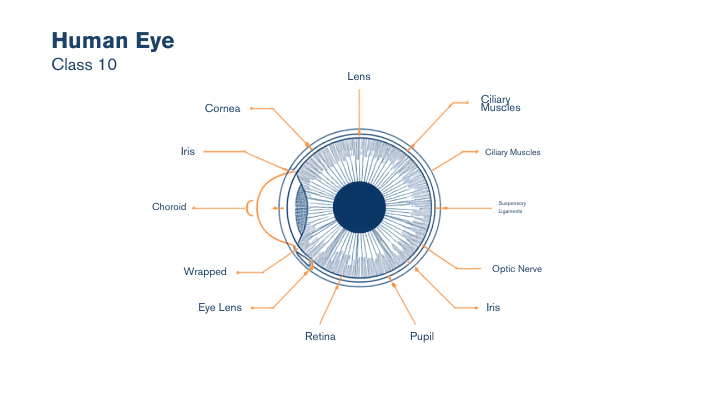
Structure of Human Eye Class 10
The human eye is nearly spherical in shape and is protected by the skull. Its main parts work together to focus light on the retina.

| Part of Human Eye | Function |
| Cornea | Transparent front surface that allows light to enter and helps in refraction |
| Iris | Coloured muscular part that controls the size of the pupil |
| Pupil | Opening through which light enters the eye |
| Eye lens | Convex lens that focuses light on the retina |
| Ciliary muscles | Change the curvature of the eye lens for focusing |
| Retina | Light-sensitive screen where image is formed |
| Rods | Photoreceptor cells that help in dim light vision |
| Cones | Photoreceptor cells responsible for colour vision |
| Optic nerve | Carries visual signals from retina to brain |
| Aqueous humour | Transparent fluid between cornea and lens |
| Vitreous humour | Gel-like fluid between lens and retina |
Functions of Important Parts of Human Eye
Cornea
The cornea is the transparent, curved front surface of the eye. It allows light to enter the eye and performs most of the initial refraction of light.
Iris
The iris is the coloured part of the eye. It controls the size of the pupil by contracting or relaxing.
Best Courses for You

JEE

NEET

Foundation JEE

Foundation NEET

CBSE
Pupil
The pupil is the small opening in the centre of the iris. It regulates the amount of light entering the eye.
In bright light, the pupil becomes smaller. In dim light, the pupil becomes larger.
Eye Lens
The eye lens is a transparent convex lens. It focuses light on the retina. Its focal length changes with the help of ciliary muscles.
Ciliary Muscles
Ciliary muscles hold the eye lens and change its curvature. When we look at nearby objects, the lens becomes thicker. When we look at distant objects, the lens becomes thinner.
Retina
The retina is the light-sensitive layer at the back of the eye. It acts like a screen where the image is formed.
Rods and Cones
Rods and cones are light-sensitive cells present in the retina.
| Photoreceptor | Function |
| Rods | Help in vision in dim light |
| Cones | Help in colour vision and bright light vision |
Optic Nerve
The optic nerve carries electrical signals from the retina to the brain. The brain interprets these signals and forms the final visual experience.
How is Image Formed in the Human Eye?
Light rays from an object enter the eye through the cornea and pupil. These rays are refracted by the eye lens and focused on the retina. The image formed on the retina is real, inverted and diminished. The retina converts this image into electrical signals, which are carried by the optic nerve to the brain. The brain interprets the signals so that we see the object upright.
Image Formation in Human Eye
| Feature | Description |
| Lens used | Convex lens |
| Image formed on | Retina |
| Nature of image | Real and inverted |
| Size of image | Diminished |
| Final interpretation | Brain makes us perceive it upright |
Power of Accommodation Class 10
Power of accommodation is the ability of the eye lens to adjust its focal length to see nearby and distant objects clearly.
The eye lens changes its curvature with the help of ciliary muscles. When we look at a distant object, the ciliary muscles relax and the lens becomes thin. When we look at a nearby object, the ciliary muscles contract and the lens becomes thick.
How Accommodation Works
| Object Position | Ciliary Muscles | Eye Lens | Focal Length |
| Distant object | Relax | Thin | Increases |
| Nearby object | Contract | Thick | Decreases |
Quick Answer: What is Power of Accommodation?
Power of accommodation is the ability of the eye lens to change its focal length so that images of objects at different distances can be focused clearly on the retina.
Near Point and Far Point of Eye Class 10
Near Point of Eye
The near point is the minimum distance at which an object can be seen clearly without strain.
For a normal human eye, the near point is:
25 cm
This distance is also called the least distance of distinct vision.
Far Point of Eye
The far point is the farthest point up to which the eye can see objects clearly.
For a normal human eye, the far point is:
Infinity
Range of Vision
For a normal eye, the range of vision is from:
25 cm to infinity
Least Distance of Distinct Vision Class 10
The least distance of distinct vision is the minimum distance at which the eye can see an object clearly without strain. For a normal human eye, it is 25 cm.
This is why books and notebooks are usually held at around 25 cm from the eyes while reading.
Persistence of Vision Class 10
Persistence of vision is the ability of the eye to retain an image for about 1/16th of a second after the object is removed.
This principle is used in movies and animation. A sequence of still images shown rapidly appears as continuous motion because the previous image remains in the eye for a very short time.
Defects of Vision Class 10 Notes
Defects of vision occur when the eye cannot focus light properly on the retina. These defects may occur due to changes in the shape of the eyeball, changes in the focal length of the eye lens, weakening of ciliary muscles or loss of flexibility of the lens.
The main defects of vision studied in Class 10 are:
- Myopia
- Hypermetropia
- Presbyopia
- Astigmatism
- Cataract
Myopia Class 10: Causes and Correction
Myopia, or short-sightedness, is a defect of vision in which a person can see nearby objects clearly but cannot see distant objects clearly.
In myopia, the image of a distant object is formed in front of the retina instead of on the retina.
Causes of Myopia
Myopia may occur due to:
- Excessive curvature of the eye lens
- Elongation of the eyeball
- Decrease in focal length of the eye lens
Symptoms of Myopia
A person with myopia:
- Can see nearby objects clearly
- Cannot see distant objects clearly
- May have difficulty reading from a blackboard or seeing distant signs
Correction of Myopia Class 10
Myopia is corrected using a concave lens of suitable power. A concave lens diverges the incoming light rays before they enter the eye. This helps the eye lens focus the image on the retina.
Myopia Ray Diagram Class 10
Add two diagrams:
- Myopic eye: image formed in front of retina
- Myopia correction: concave lens shifts image onto retina
Quick Answer: Which Lens Corrects Myopia?
Myopia is corrected by using a concave lens because it diverges light rays and helps form the image on the retina.
Hypermetropia Class 10: Causes and Correction
Hypermetropia, or long-sightedness, is a defect of vision in which a person can see distant objects clearly but cannot see nearby objects clearly.
In hypermetropia, the image of a nearby object is formed behind the retina instead of on the retina.
Causes of Hypermetropia
Hypermetropia may occur due to:
- Focal length of the eye lens becoming too large
- Eyeball becoming too short
- Weakening of ciliary muscles
Symptoms of Hypermetropia
A person with hypermetropia:
- Can see distant objects clearly
- Cannot see nearby objects clearly
- May have difficulty reading books at normal distance
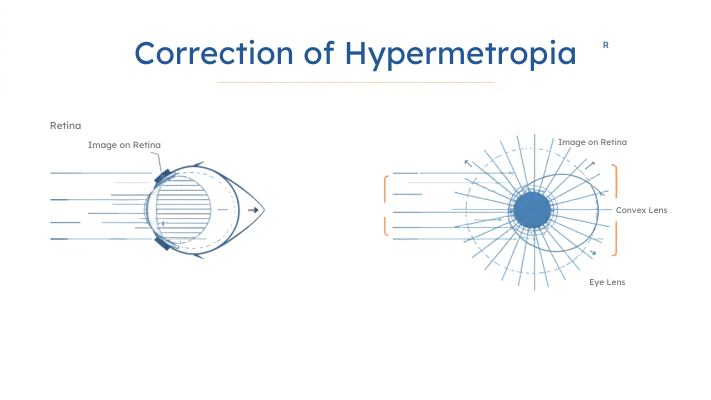
Correction of Hypermetropia Class 10
Hypermetropia is corrected using a convex lens of suitable power. A convex lens converges light rays before they enter the eye, helping the image form on the retina.
Hypermetropia Ray Diagram Class 10
Add two diagrams:
- Hypermetropic eye: image formed behind retina
- Hypermetropia correction: convex lens shifts image onto retina
Image alt text: correction of hypermetropia ray diagram class 10
Quick Answer: Which Lens Corrects Hypermetropia?
Hypermetropia is corrected by using a convex lens because it converges light rays and helps focus the image on the retina.
Presbyopia Class 10
Presbyopia is an age-related defect of vision in which a person finds it difficult to see nearby objects clearly.
It occurs because the ciliary muscles become weak and the eye lens loses flexibility with age. Due to this, the eye cannot adjust its focal length properly.
Correction of Presbyopia
Presbyopia is corrected using suitable convex lenses. Some people may suffer from both myopia and hypermetropia with age. In such cases, bifocal lenses may be used.
Bifocal Lens Class 10
A bifocal lens has two parts:
| Part of Bifocal Lens | Function |
| Upper part | Concave lens for distant vision |
| Lower part | Convex lens for near vision |
Bifocal lenses are commonly used by people who have both near-vision and distant-vision problems.
Astigmatism Class 10
Astigmatism is a defect of vision caused by uneven curvature of the cornea or eye lens. A person with astigmatism may not see horizontal and vertical lines equally clearly.
It is corrected using cylindrical lenses of suitable power.
Cataract Class 10
Cataract is a condition in which the eye lens becomes cloudy or opaque, causing blurred vision. It commonly occurs with age. Cataract is different from myopia and hypermetropia because it is not corrected simply by ordinary concave or convex lenses. It is usually treated medically, often through lens replacement surgery by qualified eye specialists.
Difference Between Myopia and Hypermetropia
| Basis | Myopia | Hypermetropia |
| Also called | Short-sightedness | Long-sightedness |
| Nearby objects | Seen clearly | Not seen clearly |
| Distant objects | Not seen clearly | Seen clearly |
| Image forms | In front of retina | Behind retina |
| Cause | Eyeball too long or lens too curved | Eyeball too short or lens has large focal length |
| Corrective lens | Concave lens | Convex lens |
| Lens power | Negative | Positive |
Difference Between Myopia, Hypermetropia and Presbyopia
| Defect | Main Problem | Cause | Correction |
| Myopia | Distant objects not clear | Elongated eyeball or high lens curvature | Concave lens |
| Hypermetropia | Nearby objects not clear | Short eyeball or weak converging power | Convex lens |
| Presbyopia | Nearby vision weak with age | Weak ciliary muscles and less flexible lens | Convex or bifocal lens |
Human Eye Numericals Class 10 with Solutions
Defect-of-vision numericals are usually based on the lens formula and power of lens.
Use:
1/f = 1/v - 1/u
and
P = 1/f
where f is measured in metres for power calculation.
Myopia Numerical Class 10 Solved
Question
A myopic person cannot see objects clearly beyond 80 cm. Find the power of the lens required to correct this defect.
Solution
For a myopic person, the far point is 80 cm. To see distant objects clearly, the corrective lens should form a virtual image of an object at infinity at the person’s far point.
Given:
u = -∞
v = -80 cm = -0.80 m
Using lens formula:
1/f = 1/v - 1/u
Since u = -∞, 1/u = 0
1/f = 1/(-0.80) - 0
1/f = -1.25
f = -0.80 m
Power:
P = 1/f
P = 1/(-0.80)
P = -1.25 D
Answer
The person needs a concave lens of power -1.25 D.
Hypermetropia Numerical Class 10 Solved
Question
A hypermetropic person has a near point of 1 m. Find the power of the lens required so that the person can read at 25 cm.
Solution
For normal reading, the object should be at 25 cm. The corrective lens should form a virtual image at the person’s near point, which is 1 m.
Given:
u = -25 cm
v = -100 cm
Using lens formula:
1/f = 1/v - 1/u
1/f = 1/(-100) - 1/(-25)
1/f = -1/100 + 1/25
1/f = -0.01 + 0.04
1/f = 0.03 cm⁻¹
f = 33.3 cm = 0.333 m
Power:
P = 1/f
P = 1/0.333
P = +3 D
Answer
The person needs a convex lens of power approximately +3 D.
The Colourful World Class 10 Notes
The “Colourful World” part of the chapter explains how light produces colours and why several natural phenomena occur in the atmosphere.
Important topics include:
- Refraction through a prism
- Dispersion of white light
- VIBGYOR spectrum
- Recombination of spectrum into white light
- Rainbow formation
- Atmospheric refraction
- Twinkling of stars
- Advance sunrise and delayed sunset
- Scattering of light
- Tyndall effect
- Blue colour of sky
Refraction Through Prism Class 10
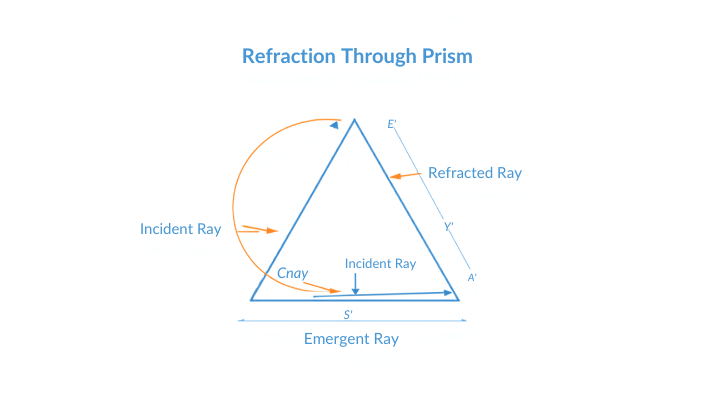
A glass prism is a transparent optical object with triangular faces. When a ray of light passes through a prism, it bends twice: first when entering the prism and second when leaving it.
The emergent ray bends away from the original direction of the incident ray. This bending is called deviation.
Angle of Deviation Prism Class 10
The angle between the direction of the incident ray and the emergent ray is called the angle of deviation.
Prism Diagram Labels
A prism diagram should include:
- Incident ray
- Refracted ray
- Emergent ray
- Angle of incidence
- Angle of refraction
- Angle of emergence
- Angle of deviation
- Glass prism
Dispersion of Light Class 10
Dispersion of light is the splitting of white light into its seven constituent colours when it passes through a glass prism.
White light consists of seven colours. When it passes through a prism, different colours bend by different amounts due to their different wavelengths. This produces a band of colours called the spectrum.
VIBGYOR Class 10
The seven colours of the spectrum are remembered using the word VIBGYOR.
| Letter | Colour |
| V | Violet |
| I | Indigo |
| B | Blue |
| G | Green |
| Y | Yellow |
| O | Orange |
| R | Red |
Which Colour Deviates the Most in a Prism?
Violet deviates the most because it has the shortest wavelength among the visible colours and slows down the most in glass.
Which Colour Deviates the Least in a Prism?
Red deviates the least because it has the longest wavelength among the visible colours and slows down the least in glass.
Why Violet Bends Most and Red Bends Least?
Different colours of light travel at different speeds in glass. Violet light has a shorter wavelength and experiences a higher refractive index in glass, so it bends the most. Red light has a longer wavelength and experiences a lower refractive index, so it bends the least.
Recombination of Spectrum into White Light
When the spectrum produced by one prism is passed through a second identical prism placed in an inverted position, the seven colours recombine to form white light.
This shows that white light is made up of seven colours.
Rainbow Formation Class 10
A rainbow is formed due to dispersion, refraction and internal reflection of sunlight by tiny water droplets present in the atmosphere.
Steps of Rainbow Formation
- Sunlight enters a water droplet and gets refracted.
- White light disperses into seven colours.
- The dispersed light undergoes internal reflection inside the droplet.
- The light refracts again while coming out of the droplet.
- A spectrum of colours is seen as a rainbow.
Quick Answer: How is a Rainbow Formed?
A rainbow is formed when sunlight is refracted, dispersed and internally reflected by water droplets in the atmosphere. The droplets act like tiny prisms and split white sunlight into seven colours.
Atmospheric Refraction Class 10
Atmospheric refraction is the bending of light as it passes through layers of the Earth’s atmosphere having different optical densities.
The Earth’s atmosphere is not uniform. Its density changes with height. As light passes through different layers of the atmosphere, it bends continuously.
Atmospheric refraction explains:
- Twinkling of stars
- Apparent position of stars
- Advance sunrise
- Delayed sunset
Twinkling of Stars Class 10
Stars twinkle due to atmospheric refraction. Stars are very far away and behave like point sources of light. As starlight passes through different layers of the atmosphere, it bends continuously. The amount of bending keeps changing because the atmosphere is unstable. As a result, the apparent position and brightness of the star keep changing, making it appear to twinkle.
Quick Answer: Why Do Stars Twinkle?
Stars twinkle because their light undergoes continuous atmospheric refraction through layers of air with changing density. Since stars act as point sources of light, small changes in the path of light cause noticeable changes in brightness.
Why Stars Twinkle But Planets Do Not?
Stars are very far away and appear as point sources of light. Planets are much closer and appear as extended sources of light. The light coming from different points of a planet averages out the fluctuations caused by atmospheric refraction. Therefore, stars twinkle but planets usually do not.
Difference Between Twinkling of Stars and Planets
| Basis | Stars | Planets |
| Distance from Earth | Very far | Comparatively closer |
| Source type | Point source | Extended source |
| Effect of atmospheric refraction | Strong visible fluctuation | Fluctuations average out |
| Twinkling | Yes | Usually no |
Advance Sunrise and Delayed Sunset Class 10
Due to atmospheric refraction, the Sun appears above the horizon even when it is actually slightly below the horizon. This makes sunrise appear earlier and sunset appear later than the actual time.
Quick Answer: Why Do We See the Sun Before Actual Sunrise?
We see the Sun before actual sunrise because sunlight bends due to atmospheric refraction. This bending makes the Sun appear above the horizon even when it is still below the horizon.
Scattering of Light Class 10
Scattering of light is the phenomenon in which light rays get redirected in different directions after striking tiny particles present in a medium.
Scattering explains many natural phenomena, such as:
- Blue colour of sky
- Red colour of danger signals
- Tyndall effect
- Dark sky seen by astronauts
Tyndall Effect Class 10
Tyndall effect is the scattering of light by colloidal particles.
When a beam of light passes through a colloidal solution or a medium containing very fine particles, its path becomes visible due to scattering. This is called the Tyndall effect.
Examples of Tyndall Effect
| Example | Explanation |
| Sunlight entering a dusty room | Dust particles scatter light |
| Headlight beam in fog | Fog droplets scatter light |
| Light passing through colloidal solution | Colloidal particles scatter light |
| Projector beam in a cinema hall | Dust particles make the path visible |
Why is the Sky Blue Class 10?
The sky appears blue because sunlight is scattered by tiny molecules and particles in the atmosphere. Blue light has a shorter wavelength than red light, so it is scattered more strongly. This scattered blue light reaches our eyes from all directions, making the sky appear blue.
Quick Answer: Why is the Sky Blue?
The sky appears blue because blue light has a shorter wavelength and is scattered more by air molecules in the atmosphere. This scattered blue light reaches our eyes from different directions.
Why Does the Sky Appear Dark to Astronauts?
The sky appears dark to astronauts because space has no atmosphere to scatter sunlight. Since there are no air molecules to scatter blue light, the sky appears black or dark.
Why Are Danger Signals Red?
Danger signals are red because red light has the longest wavelength among visible colours. It is scattered the least by fog, dust and smoke, so it can travel a longer distance and be seen clearly from far away.
Why Does the Sun Appear Red at Sunrise and Sunset?
At sunrise and sunset, sunlight travels a longer distance through the atmosphere. Most of the shorter wavelength colours such as blue and violet are scattered away. The longer wavelength red and orange light reaches our eyes, making the Sun appear reddish.
Syllabus note: The current CBSE 2026–27 curriculum mentions scattering of light and applications in daily life, but specifically excludes the colour of the Sun at sunrise and sunset from summative assessment. It can still be useful for conceptual clarity, older NCERT-based material and general understanding.
Dispersion vs Scattering of Light
| Basis | Dispersion | Scattering |
| Meaning | Splitting of white light into seven colours | Redirection of light by small particles |
| Cause | Different colours bend by different amounts | Light interacts with tiny particles |
| Medium | Prism or water droplets | Atmosphere, colloids, fog, dust |
| Example | Rainbow, prism spectrum | Blue sky, Tyndall effect |
| Wavelength role | Different wavelengths refract differently | Shorter wavelengths scatter more |
| Result | Spectrum is formed | Light spreads in different directions |
Important Diagrams for The Human Eye and Colourful World Class 10
Students should practise the following diagrams:
| Diagram | Why Important |
| Human eye labelled diagram | Common diagram-based question |
| Myopia and its correction | Important defect of vision diagram |
| Hypermetropia and its correction | Important defect of vision diagram |
| Refraction through prism | Needed for dispersion explanation |
| Dispersion of white light | Explains VIBGYOR spectrum |
| Rainbow formation | Stepwise natural phenomenon |
| Atmospheric refraction | Explains twinkling and sunrise/sunset |
| Tyndall effect | Explains scattering in colloids |
Human Eye and Colourful World Formula Sheet
| Concept | Formula / Value |
| Least distance of distinct vision | 25 cm |
| Far point of normal eye | Infinity |
| Persistence of vision | 1/16 second |
| Lens formula | 1/f = 1/v - 1/u |
| Power of lens | P = 1/f |
| Unit of power | Dioptre D |
| Concave lens power | Negative |
| Convex lens power | Positive |
Human Eye and Colourful World Class 10 Important Questions
One-mark Questions
- What is the function of the retina?
- What is the near point of a normal eye?
- What is the far point of a normal eye?
- What is power of accommodation?
- Which lens is used to correct myopia?
- Which lens is used to correct hypermetropia?
- What is dispersion of light?
- What is VIBGYOR?
- What is Tyndall effect?
- Why is danger signal red?
Two-mark Questions
- Differentiate between myopia and hypermetropia.
- Write two functions of the iris.
- What is the role of ciliary muscles?
- Why do stars twinkle?
- Why do planets not twinkle?
- Why does the sky appear blue?
- What is atmospheric refraction?
- Explain the correction of myopia with a ray diagram.
Three-mark Questions
- Explain the structure and working of the human eye.
- Explain myopia, its causes and correction.
- Explain hypermetropia, its causes and correction.
- Explain dispersion of white light through a prism.
- Explain rainbow formation.
- Explain scattering of light with examples.
Five-mark Questions
- Draw a labelled diagram of the human eye and explain the function of its parts.
- Explain defects of vision and their correction.
- Explain atmospheric refraction and its applications.
- Explain dispersion, VIBGYOR and rainbow formation.
- Explain scattering of light, Tyndall effect, blue sky and red danger signals.
Human Eye and Colourful World Class 10 MCQ with Answers
1. The image formed on the retina is:
A. Virtual and erect
B. Real and inverted
C. Virtual and enlarged
D. Real and erect
Answer: B. Real and inverted
2. The least distance of distinct vision for a normal eye is:
A. 10 cm
B. 15 cm
C. 25 cm
D. 50 cm
Answer: C. 25 cm
3. Myopia is corrected using:
A. Convex lens
B. Concave lens
C. Plane mirror
D. Prism
Answer: B. Concave lens
4. Hypermetropia is corrected using:
A. Concave lens
B. Convex lens
C. Cylindrical mirror
D. Glass slab
Answer: B. Convex lens
5. The splitting of white light into seven colours is called:
A. Scattering
B. Dispersion
C. Reflection
D. Absorption
Answer: B. Dispersion
6. The colour that deviates the most in a prism is:
A. Red
B. Yellow
C. Green
D. Violet
Answer: D. Violet
7. Stars twinkle due to:
A. Reflection
B. Atmospheric refraction
C. Dispersion
D. Magnetic effect
Answer: B. Atmospheric refraction
8. The sky appears blue due to:
A. Dispersion
B. Scattering
C. Total internal reflection
D. Absorption
Answer: B. Scattering
9. The SI unit of power of lens is:
A. Metre
B. Dioptre
C. Newton
D. Joule
Answer: B. Dioptre
10. Tyndall effect is shown by:
A. True solution
B. Colloidal solution
C. Pure water only
D. Vacuum
Answer: B. Colloidal solution
Assertion-Reason Questions
Question 1
Assertion: Stars appear to twinkle.
Reason: Starlight undergoes atmospheric refraction through layers of air with changing density.
Answer: Both Assertion and Reason are true, and Reason is the correct explanation of Assertion.
Question 2
Assertion: Myopia is corrected using a concave lens.
Reason: A concave lens diverges light rays before they enter the eye.
Answer: Both Assertion and Reason are true, and Reason is the correct explanation of Assertion.
Question 3
Assertion: The sky appears blue.
Reason: Blue light is scattered more than red light by particles in the atmosphere.
Answer: Both Assertion and Reason are true, and Reason is the correct explanation of Assertion.
Question 4
Assertion: Violet light deviates more than red light in a prism.
Reason: Violet light has a shorter wavelength than red light.
Answer: Both Assertion and Reason are true, and Reason is the correct explanation of Assertion.
Question 5
Assertion: Planets usually do not twinkle.
Reason: Planets behave as extended sources of light, so brightness fluctuations average out.
Answer: Both Assertion and Reason are true, and Reason is the correct explanation of Assertion.
Case Study Question 1: Eye Defects
A student sitting in the last row of the classroom is unable to read the writing on the board clearly, but the student can read a book kept nearby without difficulty. The eye doctor explains that the image of distant objects is forming in front of the retina and prescribes a suitable lens.
Questions
- Which defect of vision does the student have?
- Where is the image formed in this defect?
- Which lens is used for correction?
- What is the nature of the corrective lens?
- Write one possible cause of this defect.
Answers
- The student has myopia.
- The image is formed in front of the retina.
- A concave lens is used.
- The corrective lens is diverging in nature.
- It may occur due to elongation of the eyeball or excessive curvature of the eye lens.
Case Study Question 2: Colourful World
A student observes that when white light passes through a glass prism, it splits into seven colours. The student also notices that violet colour bends more than red colour.
Questions
- What is the splitting of white light called?
- What is the band of seven colours called?
- Write the order of colours.
- Which colour bends the most?
- Which colour bends the least?
Answers
- It is called dispersion of light.
- The band of seven colours is called spectrum.
- The order is VIBGYOR.
- Violet bends the most.
- Red bends the least.
Case Study Question 3: Scattering of Light
During a foggy morning, a student notices that the beam of a vehicle’s headlight becomes visible. The teacher explains that tiny water droplets in fog scatter light, making the path of light visible.
Questions
- Which phenomenon is shown here?
- What is the scattering of light by colloidal particles called?
- Give one more example of this phenomenon.
- Why are danger signals red?
- Why does the sky appear blue?
Answers
- Scattering of light is shown.
- It is called the Tyndall effect.
- Sunlight entering a dusty room is another example.
- Red light is scattered the least and can travel longer distances.
- The sky appears blue because blue light is scattered more by air molecules.
Common Mistakes Students Should Avoid
| Mistake | Correct Concept |
| Writing myopia is corrected by convex lens | Myopia is corrected by concave lens |
| Writing hypermetropia is corrected by concave lens | Hypermetropia is corrected by convex lens |
| Forgetting sign of concave lens power | Concave lens power is negative |
| Confusing dispersion and scattering | Dispersion splits white light; scattering redirects light |
| Writing planets twinkle like stars | Planets usually do not twinkle |
| Forgetting near point of normal eye | Near point is 25 cm |
| Forgetting persistence of vision value | Image remains for about 1/16 second |
| Writing red deviates most | Violet deviates most; red deviates least |
The Human Eye and the Colourful World is an important Class 10 Science Syllabus because it connects the working of the human eye with real-life optical phenomena. Students should focus on the structure of the human eye, power of accommodation, defects of vision, correction of myopia and hypermetropia, dispersion of light, VIBGYOR, rainbow formation, atmospheric refraction, twinkling of stars, scattering of light and Tyndall effect.
For scoring well, practise labelled diagrams, ray diagrams for vision defects, comparison tables, direct “why” questions, formula-based numericals, MCQs, assertion-reason questions and case-study questions.
course
No courses found
FAQs on The Human Eye and the Colourful World Class 10
What is The Human Eye and the Colourful World Class 10 about?
The Human Eye and the Colourful World Class 10 explains the structure and working of the human eye, defects of vision and their corrections, dispersion of light, atmospheric refraction, scattering of light, Tyndall effect and natural optical phenomena.
Which chapter is The Human Eye and the Colourful World in Class 10?
In many updated Class 10 Science resources, The Human Eye and the Colourful World is referred to as Chapter 10. In older NCERT editions and many existing notes, it appears as Chapter 11. Students should follow the chapter number used in their school textbook.
What is the function of the retina?
The retina acts as a light-sensitive screen at the back of the eye. It contains rods and cones and converts the image formed by the eye lens into electrical signals.
What is power of accommodation?
Power of accommodation is the ability of the eye lens to adjust its focal length to see nearby and distant objects clearly.
What is the near point of a normal eye?
The near point of a normal eye is 25 cm. It is also called the least distance of distinct vision.
What is the far point of a normal eye?
The far point of a normal eye is infinity. A normal eye can see very distant objects clearly.
What is myopia?
Myopia is a defect of vision in which a person can see nearby objects clearly but cannot see distant objects clearly. It is corrected using a concave lens.
What is hypermetropia?
Hypermetropia is a defect of vision in which a person can see distant objects clearly but cannot see nearby objects clearly. It is corrected using a convex lens.
What is presbyopia?
Presbyopia is an age-related defect of vision in which the eye gradually loses its power of accommodation. It is commonly corrected using convex or bifocal lenses.
What is rainbow formation?
A rainbow is formed when sunlight undergoes refraction, dispersion and internal reflection inside water droplets present in the atmosphere.
What is atmospheric refraction?
Atmospheric refraction is the bending of light as it passes through layers of the atmosphere with different densities.
Why are danger signals red?
Danger signals are red because red light has the longest wavelength and is scattered the least, so it can be seen from a long distance.
What is Tyndall effect?
Tyndall effect is the scattering of light by colloidal particles. It makes the path of a light beam visible in a colloid, fog or dusty air.
What is VIBGYOR?
VIBGYOR is the order of colours in the spectrum: Violet, Indigo, Blue, Green, Yellow, Orange and Red.
Why do planets not twinkle?
Planets do not usually twinkle because they are closer to Earth and appear as extended sources of light. The fluctuations from different points average out.
Why do stars twinkle?
Stars twinkle because their light undergoes continuous atmospheric refraction through layers of air with changing density.
