Top 50 Physics Derivations Every JEE Aspirant Must Know
By rohit.pandey1
|
Updated on 24 Jul 2026, 15:52 IST
Can you rebuild the escape velocity formula from scratch, right now, without glancing at a formula sheet? Most JEE aspirants can recite v = √(2GM/R) in their sleep. Far fewer can walk through why that square root shows up, or what happens to the answer if the examiner swaps R for 2R halfway through the question. That gap between memorising and understanding decides a surprising share of the Physics score every single year.
Derivation-based questions rarely announce themselves as derivations. JEE Main and JEE Advanced hide them inside numerical problems: a question that looks like a straightforward substitution often needs you to rebuild one step of a derivation on scratch paper first, because the given values do not match any standard formula directly. Miss that hidden step and the whole answer collapses, even if your arithmetic afterward is flawless.
This guide compiles 50 derivations spanning the full JEE Physics syllabus, organised chapter by chapter exactly the way NCERT and most coaching modules sequence them. Eight get the full treatment here: complete, worked derivations with diagrams. The remaining forty-two are listed with a one-line description and a difficulty rating, so you know precisely where to spend your revision hours and where a quick formula glance will do. Use the chapter tables as a checklist. Tick off each derivation once you can reproduce it cold, on paper, without peeking.
Mechanics Derivations
Mechanics opens almost every JEE Physics paper, and its derivations form the backbone for everything that follows, since rotational dynamics, gravitation, and even parts of thermodynamics lean on the same calculus tools introduced here.
| # | Derivation | Difficulty |
| 1 | Equations of motion: v = u + at | Easy |
| 2 | Equations of motion: s = ut + ½at² | Easy |
| 3 | Equations of motion: v² = u² + 2as | Easy |
| 4 | Work-Energy Theorem (W_net = ΔKE) | Easy |
| 5 | Conservation of linear momentum | Easy |
| 6 | Moment of inertia of standard bodies (ring, disc, rod, sphere, cylinder) | Medium |
| 7 | Parallel axis theorem | Medium |
| 8 | Perpendicular axis theorem | Easy |
| 9 | Rolling motion on an incline (acceleration) | Hard |
| 10 | Kepler's third law (T² ∝ r³) | Medium |
| 11 | Orbital velocity of a satellite | Easy |
| 12 | Escape velocity | Medium |
FULL DERIVATION: Escape Velocity
A projectile launched from a planet's surface needs just enough kinetic energy to cancel its negative gravitational potential energy at infinity. Setting total mechanical energy at infinity to zero (the minimum condition to just barely escape):
½mv_e² − GMm/R = 0
Rearranging for v_e:
v_e = √(2GM/R)

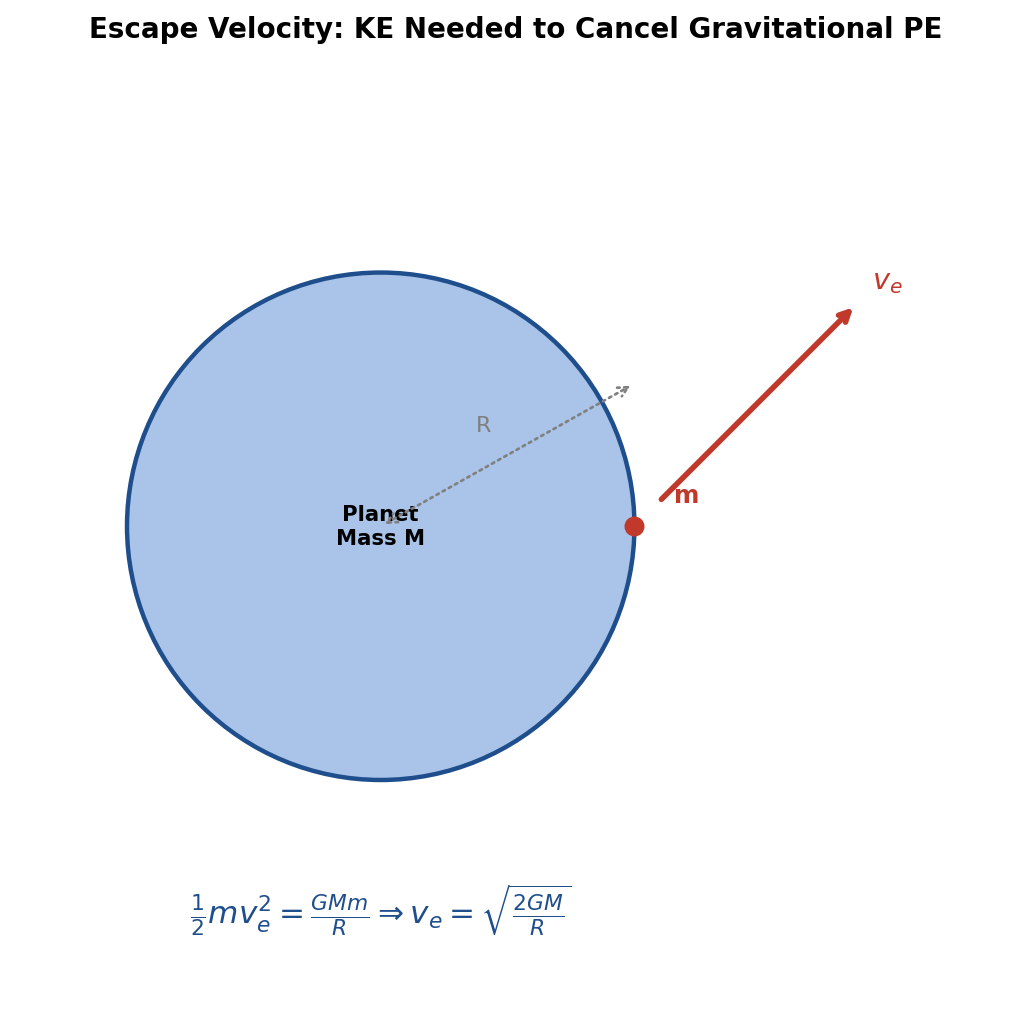
Figure 1: Escape velocity depends only on the planet's mass and radius, never on the projectile's own mass.
For Earth, substituting G = 6.674×10⁻¹¹ N·m²/kg², M = 5.972×10²⁴ kg, and R = 6.371×10⁶ m gives v_e ≈ 11.2 km/s, a number worth memorising directly since JEE frequently asks for ratios or scaled versions of this exact result on other planets.
Best Courses for You

JEE

NEET

Foundation JEE

Foundation NEET

CBSE
Notice the direct link to orbital velocity: since v_orbital = √(GM/R), the two formulas differ by exactly a factor of √2, meaning v_e = √2 × v_orbital always, regardless of which planet you're standing on.
Waves and Oscillations Derivations (Derivations 13–20)
This chapter rewards students who can move fluidly between force equations and energy equations, since JEE alternates unpredictably between asking for a time period and asking for an energy value at a specific displacement.
| # | Derivation | Difficulty |
| 13 | SHM time period: spring-mass system | Medium |
| 14 | SHM time period: simple pendulum | Medium |
| 15 | Energy in SHM (total energy = ½kA²) | Medium |
| 16 | Doppler effect: source moving toward observer | Medium |
| 17 | Doppler effect: observer moving toward source | Medium |
| 18 | Standing waves in a stretched string (harmonics) | Medium |
| 19 | Standing waves in organ pipes (open vs closed) | Medium |
| 20 | Beats phenomenon (beat frequency = |f₁ − f₂|) | Easy |
FULL DERIVATION: SHM Time Period: Spring and Pendulum
For a mass m attached to a spring of stiffness k, Hooke's law gives the restoring force F = −kx. Applying Newton's second law:
ma = −kx ⇒ a = −(k/m)x
Comparing this to the defining SHM equation a = −ω²x gives ω² = k/m, and since T = 2π/ω:
T = 2π√(m/k)
For a simple pendulum of length L displaced by a small angle θ, the tangential restoring force is −mg sinθ. For small angles, sinθ ≈ θ, and since the arc length is x = Lθ:
a = −(g/L)x ⇒ ω² = g/L ⇒ T = 2π√(L/g)
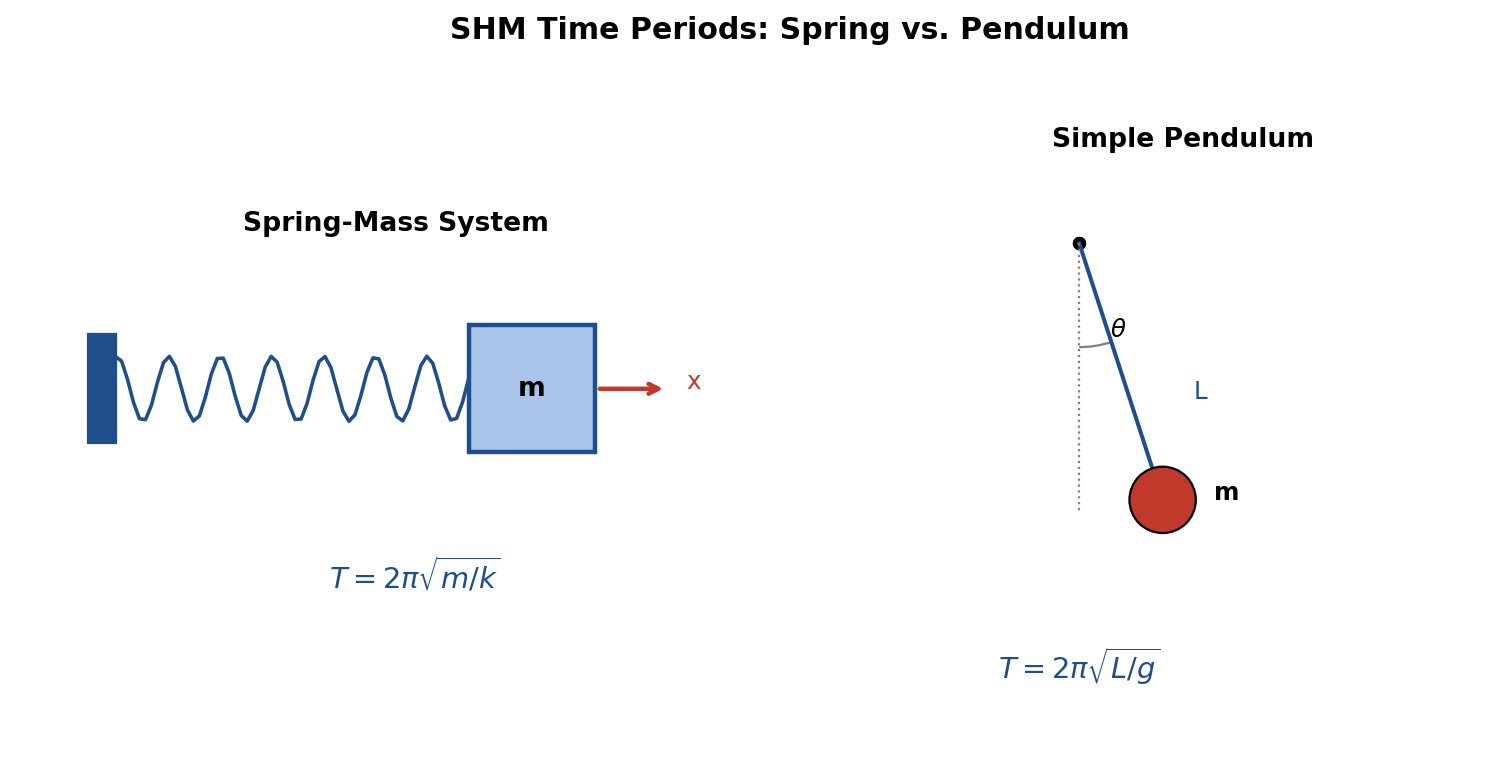
Figure 2: Both systems reduce to the same a = −ω²x form, just with different physical sources for ω².
The small-angle approximation is the detail examiners test directly: it only holds for θ under about 10°, and JEE occasionally asks what happens to the period when this approximation breaks down at larger amplitudes.
Thermodynamics Derivations (Derivations 21–28)
Thermodynamics derivations lean heavily on the ideal gas equation and calculus-based work integrals, and the Carnot cycle in particular tends to show up as a multi-part question rather than a single numerical.
| # | Derivation | Difficulty |
| 21 | First law of thermodynamics: isochoric process | Easy |
| 22 | First law: isobaric process, work done W = PΔV | Easy |
| 23 | Carnot engine efficiency (η = 1 − T₂/T₁) | Hard |
| 24 | Adiabatic process relation (PV^γ = constant) | Hard |
| 25 | Isothermal process work done | Medium |
| 26 | Kinetic theory of gases: pressure of an ideal gas | Hard |
| 27 | Kinetic theory: average KE and temperature relation | Medium |
| 28 | Specific heats of gases: Mayer's relation (Cp − Cv = R) | Medium |
FULL DERIVATION: Carnot Engine Efficiency
A Carnot engine runs through four reversible stages: isothermal expansion at T₁ absorbing heat Q₁, adiabatic expansion, isothermal compression at T₂ releasing heat Q₂, and adiabatic compression back to the start.
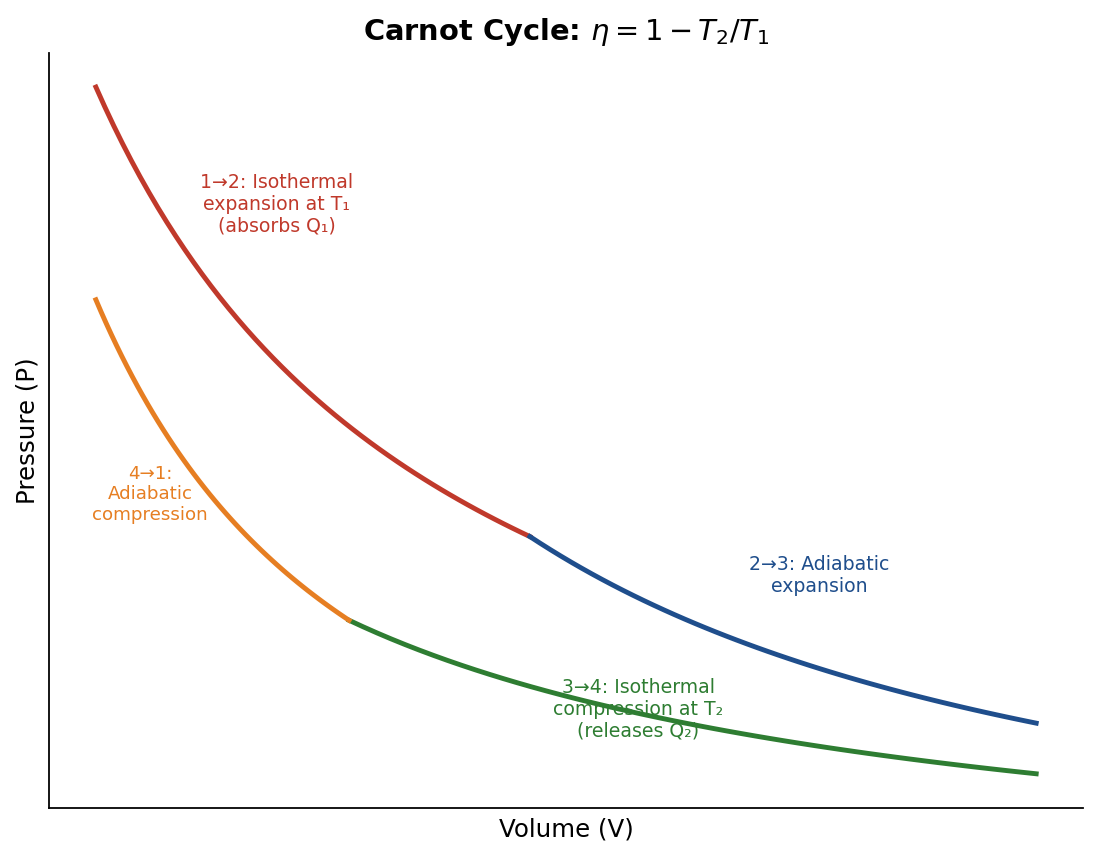
Figure 3: The area enclosed by the P-V loop equals the net work output of the engine.
During the isothermal expansion (1→2), the heat absorbed equals the work done, since ΔU = 0 for an isothermal process on an ideal gas:
Q₁ = nRT₁ ln(V₂/V₁)
Similarly, during isothermal compression (3→4):
Q₂ = nRT₂ ln(V₃/V₄)
The two adiabatic legs connect these volumes through PV^γ = constant, and working through that relation shows V₂/V₁ = V₃/V₄ exactly, which lets the logarithms cancel when you form the ratio Q₂/Q₁:
Q₂/Q₁ = T₂/T₁
Efficiency is defined as net work output over heat input, and since net work equals Q₁ − Q₂ by energy conservation over the full cycle:
η = 1 − Q₂/Q₁ = 1 − T₂/T₁
This result is temperature-only, with no dependence on the working substance at all, which is exactly why Carnot efficiency sets the theoretical ceiling for every real heat engine.
Electrostatics and Current Electricity Derivations (Derivations 29–38)
Gauss's Law problems and circuit-analysis derivations dominate this chapter's question count, and both reward the same underlying skill: picking the right symmetry or the right loop before touching any algebra.
| # | Derivation | Difficulty |
| 29 | Gauss's Law: field due to an infinite line charge | Medium |
| 30 | Gauss's Law: field due to a uniformly charged sphere | Medium |
| 31 | Gauss's Law: field due to an infinite plane sheet | Easy |
| 32 | Capacitance of a parallel plate capacitor | Easy |
| 33 | Energy stored in a charged capacitor | Medium |
| 34 | Wheatstone bridge balance condition | Medium |
| 35 | Kirchhoff's current law (junction rule) application | Easy |
| 36 | Kirchhoff's voltage law (loop rule) application | Medium |
| 37 | RC circuit: charging (q = CV(1 − e^(−t/RC))) | Hard |
| 38 | RC circuit: discharging (q = Q₀e^(−t/RC)) | Medium |
FULL DERIVATION: Wheatstone Bridge Balance Condition
Four resistors P, Q, R, and S form a bridge between points A and C, with a battery across that diagonal and a galvanometer across the other diagonal, B to D.
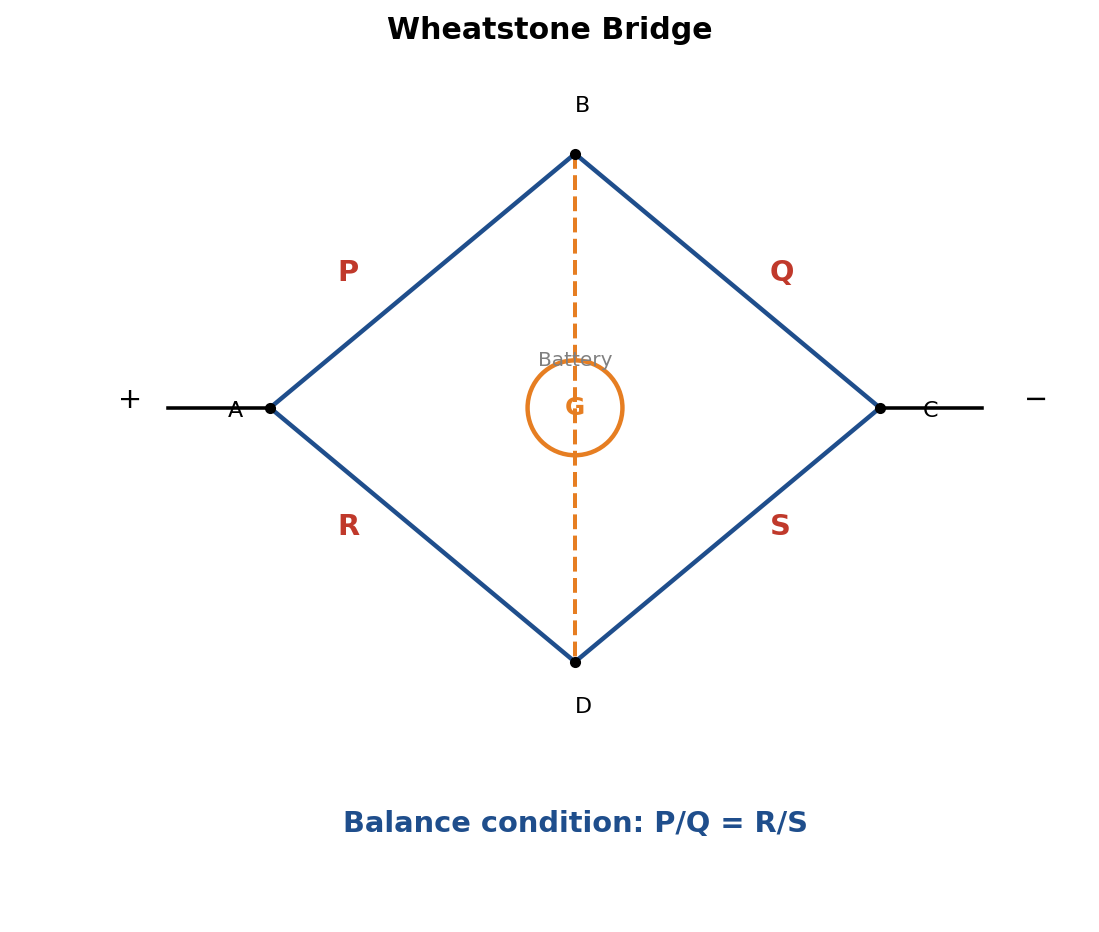
Figure 4: At balance, no current flows through the galvanometer, meaning B and D sit at exactly the same potential.
At balance, the galvanometer carries zero current, so the same current I₁ flows straight through both P and Q, while current I₂ flows through both R and S. Since VB = VD at balance:
VA − VB = VA − VD ⇒ I₁P = I₂R ...(i)
VB − VC = VD − VC ⇒ I₁Q = I₂S ...(ii)
Dividing equation (i) by equation (ii) cancels both currents entirely:
P/Q = R/S
This single ratio is why the Wheatstone bridge can measure an unknown resistance so precisely: you only need to find the point where the galvanometer reads zero, never its actual current-voltage response.
Magnetism and Electromagnetic Induction Derivations (Derivations 39–44)
This is the chapter where JEE most often demands you set up an integral from scratch, since Biot-Savart and Ampere's law problems rarely match a textbook geometry exactly.
| # | Derivation | Difficulty |
| 39 | Biot-Savart Law: field due to a straight current-carrying wire | Hard |
| 40 | Biot-Savart Law: field at the centre of a circular loop | Medium |
| 41 | Ampere's Circuital Law: field due to a solenoid | Medium |
| 42 | Faraday's Law of electromagnetic induction (EMF = −dΦ/dt) | Medium |
| 43 | Self and mutual inductance of a solenoid | Medium |
| 44 | LR circuit: growth and decay of current | Hard |
FULL DERIVATION: Self-Inductance of a Solenoid
For a long solenoid with n turns per unit length carrying current I, Ampere's circuital law gives a uniform field inside:
B = μ₀nI
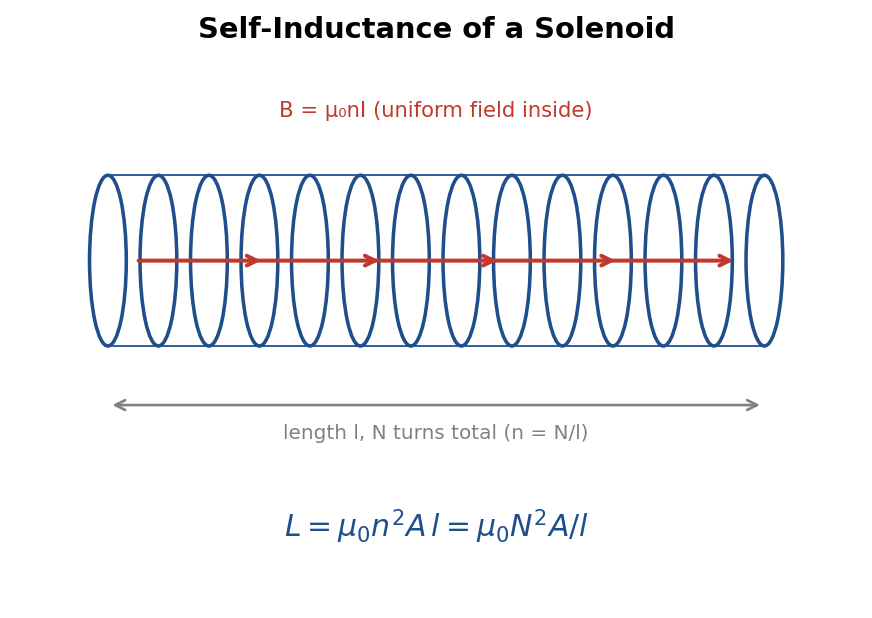
Figure 5: Every one of the N turns links the same flux, so the total flux linkage multiplies by N.
The flux through a single turn of cross-sectional area A is Φ = BA. With N = nl total turns (where l is the solenoid's length), the total flux linkage is:
NΦ = (nl)(μ₀nI)(A) = μ₀n²AlI
Since self-inductance is defined through NΦ = LI, dividing through by I gives:
L = μ₀n²Al = μ₀N²A/l
Notice the N² dependence: doubling the number of turns on a fixed-length solenoid quadruples its inductance, not just doubles it, a detail JEE likes to test through ratio-based questions between two differently wound coils.
Optics and Modern Physics Derivations (Derivations 45–50)
The final stretch of the syllabus blends geometric optics with early quantum mechanics, and JEE Advanced in particular likes combining a lens or interference derivation with a modern physics numerical in the same question.
| # | Derivation | Difficulty |
| 45 | Lens maker's formula | Hard |
| 46 | Thin lens formula (1/v − 1/u = 1/f) | Medium |
| 47 | Young's Double Slit Experiment: fringe width | Medium |
| 48 | de Broglie wavelength (λ = h/mv) | Easy |
| 49 | Bohr model: energy levels of hydrogen | Hard |
| 50 | Radioactive decay law (N = N₀e^(−λt)) | Medium |
FULL DERIVATION: Lens Maker's Formula
Refraction at a single spherical surface, going from medium n₁ to medium n₂ with radius of curvature R, follows the relation n₂/v − n₁/u = (n₂ − n₁)/R. A thin lens has two such surfaces, so this formula is applied twice in sequence.
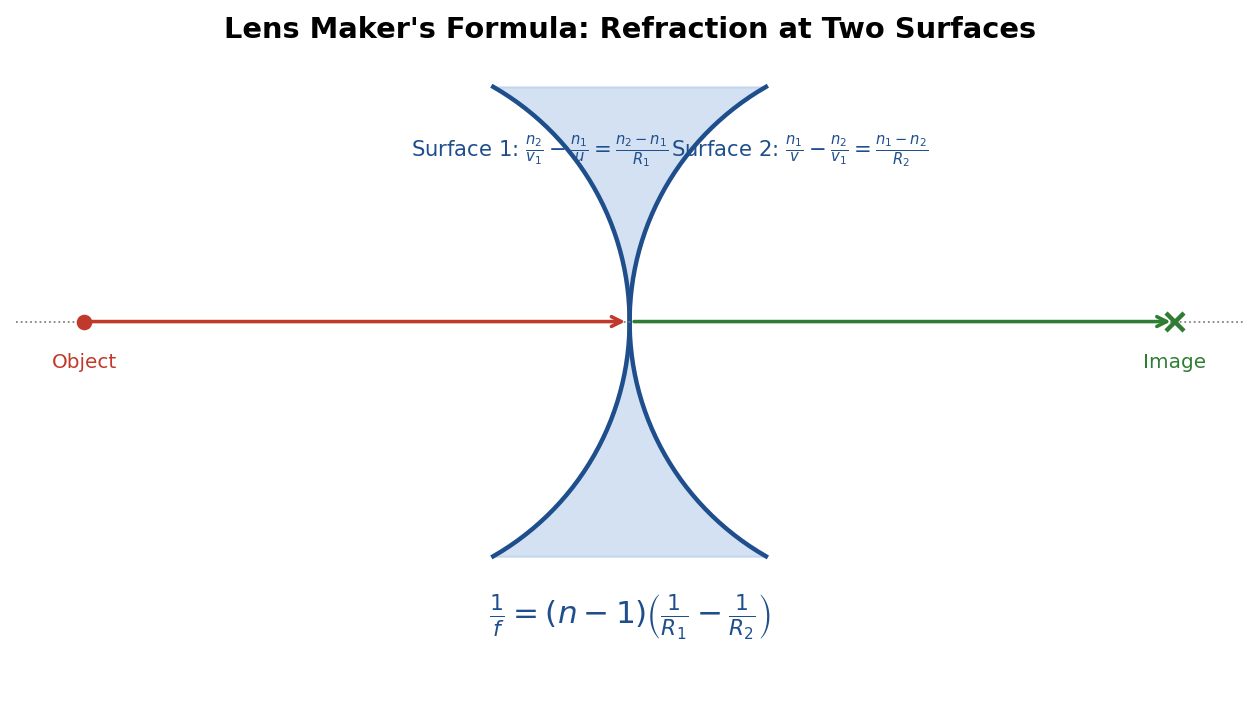
Figure 6: The image formed by the first surface becomes the object for the second surface.
For the first surface (air to lens material n, radius R₁), with the image from this surface forming virtually at v₁:
n/v₁ − 1/u = (n − 1)/R₁
For the second surface (lens material n back to air, radius R₂), the image from surface 1 becomes the object for surface 2:
1/v − n/v₁ = (1 − n)/R₂
Adding these two equations makes the n/v₁ terms cancel completely, leaving:
1/v − 1/u = (n − 1)(1/R₁ − 1/R₂)
Since 1/f = 1/v − 1/u by definition of focal length, the lens maker's formula follows directly:
1/f = (n − 1)(1/R₁ − 1/R₂)
FULL DERIVATION: Bohr Model: Energy Levels of Hydrogen
Bohr's model balances the Coulomb attraction against the centripetal force requirement for a stable circular orbit, then quantises angular momentum in units of h/2π:
mvr = nh/2π
Combining this with ke²/r² = mv²/r (Coulomb force supplying centripetal force) and solving simultaneously for the orbit radius gives:
r_n = n²h²/(4π²mke²) ∝ n²/Z
Total energy is kinetic plus potential energy, and substituting the orbit radius back in produces the famous quantised result:
E_n = −13.6 Z²/n² eV
Figure 7: Each transition between levels releases or absorbs a photon of exactly ΔE = E_final − E_initial.
For hydrogen (Z = 1), the ground state sits at exactly −13.6 eV, and every higher level crowds progressively closer to zero, which is why ionisation energy calculations almost always reduce to a single subtraction between two n-values.
Downloadable PDF and Difficulty Rating Table
Below is the complete chapter-wise breakdown of all 50 derivations from this guide, with a difficulty rating for each one. Use it as a revision checklist: work through the Hard-rated derivations first, since those carry the highest risk of a half-remembered step costing you marks.
| Chapter | Derivation Count | Hard-Rated Count |
| Mechanics | 12 | 1 (Rolling motion on an incline) |
| Waves and Oscillations | 8 | 0 |
| Thermodynamics | 8 | 3 (Carnot efficiency, adiabatic relation, kinetic theory pressure) |
| Electrostatics and Current Electricity | 10 | 1 (RC charging) |
| Magnetism and EMI | 6 | 2 (Biot-Savart straight wire, LR growth/decay) |
| Optics and Modern Physics | 6 | 2 (Lens maker's formula, Bohr energy levels) |
A downloadable, printable PDF version of this full 50-derivation checklist, formatted for quick daily revision, is available through the Infinity Learn platform alongside the video walkthroughs referenced in the next section.
How Infinity Learn Helps with Derivations
Reading a derivation once rarely makes it stick. Infinity Learn builds its Physics support around repeated, active practice instead:
- Animated derivation videos: watch each step build visually, from the free-body diagram or circuit setup through to the final formula, instead of jumping straight to the algebra.
- Step-by-step guided solutions: get unstuck at the exact line where a derivation broke down, whether that's a sign error in Kirchhoff's law or a missed factor in the Carnot cycle proof.
- Derivation practice tests: timed drills that ask you to reproduce a derivation from a blank page, mirroring exactly how JEE Advanced tests this skill inside longer numerical problems.
Conclusion
Fifty derivations sounds like a lot until you notice how few genuinely new ideas they rest on. Newton's second law drives nearly all of Mechanics. Gauss's Law and Ampere's Law drive most of Electrostatics and Magnetism. Energy conservation, in one disguise or another, resurfaces in SHM, Thermodynamics, and Bohr's model alike. Learn the handful of underlying principles properly and the fifty formulas stop looking like fifty separate things to memorise.
A workable 50-day study plan: one derivation a day, in the chapter order used here, spending the first ten minutes rederiving yesterday's result from memory before starting today's. By day fifty you will have touched every high-yield JEE Physics derivation at least twice, and the second pass is where these formulas actually move from short-term memory into something you can produce under exam pressure.
course
No courses found
FAQs: Top 50 Physics Derivations Every JEE Aspirant Must Know
Which physics derivations are most important for JEE Main?
Equations of motion, the Work-Energy Theorem, Gauss's Law applications, the parallel plate capacitor, Wheatstone bridge balance, and the Bohr model energy levels see the most direct testing in JEE Main specifically, since Main favours single-concept numericals over the multi-step combinations JEE Advanced prefers.
How do I memorise long derivations for JEE?
Don't memorise the final formula in isolation. Rebuild the logical chain instead: identify the starting physical law, the one substitution or geometric insight that simplifies it, and the final algebraic step. Most "long" derivations, like the Carnot efficiency or lens maker's formula, are really two short derivations stitched together, and recognising that split makes each half far easier to hold in memory.
Are derivation-based questions asked in JEE Advanced?
Yes, frequently, though rarely as a standalone "derive this formula" question. JEE Advanced tends to bury a derivation step inside a numerical, expecting you to rebuild part of a formula for a non-standard geometry or a modified boundary condition rather than quote it directly from memory.
Where can I find a downloadable PDF of JEE Physics derivations?
A structured, chapter-wise PDF covering all 50 derivations in this guide, along with video walkthroughs for each one, is available through the Infinity Learn platform.
How many derivations should I practise daily?
One full derivation per day, worked from a blank page rather than copied from notes, is enough to cover this entire list in under two months. Pair each new derivation with a two-minute recall of the previous day's, since that spaced repetition is what actually moves a formula from short-term memory into exam-ready recall.