- Key Concepts Covered in Class 12 Math Chapter 2 – Inverse Trigonometric Functions
- Chapter Overview and Important Results
- Step-by-Step NCERT Solutions for Class 12 Chapter
- Key Features of Infinity Learn NCERT Solutions for Class 12 Math Chapter 2
- Why Use NCERT Solutions for Inverse Trigonometric Functions?
- Study Class 12 Math with Infinity Learn
- FAQs: NCERT Solutions for Inverse Trigonometric Functions
NCERT Solutions for Class 12 Math Chapter 2 – Inverse Trigonometric Functions
By Rohit RP
|
Updated on 14 Sep 2026, 14:48 IST
Inverse Trigonometric Functions is an important Class 12 Math chapter that builds on the trigonometric concepts students learned in earlier classes. The chapter introduces inverse functions such as sin⁻¹x, cos⁻¹x, and tan⁻¹x, along with their domains, ranges, principal values, and key properties.
NCERT Solutions for Class 12 Math Chapter 2 Inverse Trigonometric Functions can help students work through textbook exercises with clear, step-by-step methods. Practicing these questions regularly makes it easier to understand identities, simplify expressions, and solve problems accurately.
These NCERT Solutions for Class 12 Maths are also useful for quick revision before school tests and board exams, especially when students want to review formulas and common problem-solving approaches.
Key Concepts Covered in Class 12 Math Chapter 2 – Inverse Trigonometric Functions
The chapter covers the following important concepts:
- Why trigonometric functions need a restricted domain before they can be inverted
- Domains and ranges of the six inverse trigonometric functions
- Principal value branches
- Finding the principal value of an inverse trigonometric expression
- Graphs of the inverse trigonometric functions
- The self-adjusting property, such as sin(sin⁻¹ x) = x
- Simplifying expressions by substituting x = tan θ or x = cos θ
- Triple angle results such as 3 sin⁻¹ x = sin⁻¹ (3x − 4x³)
- Evaluating sin⁻¹(sin x), cos⁻¹(cos x) and tan⁻¹(tan x) when x lies outside the principal branch
- Combining two inverse ratios into one using the right triangle method
- Solving equations involving inverse trigonometric functions
Chapter Overview and Important Results
Why a Principal Value is Needed
The value sin θ = ½ is produced by π/6, by 5π/6, by 13π/6 and by infinitely many other angles. So "the angle whose sine is ½" has no single answer until we agree on a range. That agreed range is the principal value branch, and the answer taken from it is the principal value.
This is the single most common source of lost marks in the chapter. An answer outside the branch is marked wrong even when the arithmetic is correct.
Domains and Principal Value Branches

| Function | Domain | Principal value branch |
| sin⁻¹ x | [−1, 1] | [−π/2, π/2] |
| cos⁻¹ x | [−1, 1] | [0, π] |
| tan⁻¹ x | all real numbers | (−π/2, π/2) |
| cosec⁻¹ x | x ≤ −1 or x ≥ 1 | [−π/2, π/2] excluding 0 |
| sec⁻¹ x | x ≤ −1 or x ≥ 1 | [0, π] excluding π/2 |
| cot⁻¹ x | all real numbers | (0, π) |
Learn this table first. Almost every question in Exercise 2.1 is answered by reading the correct row.
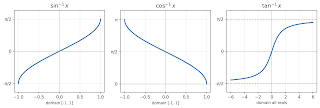
Figure 1: Graphs of sin⁻¹ x, cos⁻¹ x and tan⁻¹ x over their principal value branches
Best Courses for You

JEE

NEET

Foundation JEE

Foundation NEET

CBSE
Properties Used in Exercise 2.2
sin⁻¹(−x) = −sin⁻¹ x tan⁻¹(−x) = −tan⁻¹ x
cos⁻¹(−x) = π − cos⁻¹ x cot⁻¹(−x) = π − cot⁻¹ x
sin⁻¹ x + cos⁻¹ x = π/2 tan⁻¹ x + cot⁻¹ x = π/2
3 sin⁻¹ x = sin⁻¹ (3x − 4x³) 3 cos⁻¹ x = cos⁻¹ (4x³ − 3x)
2 tan⁻¹ x = tan⁻¹ (2x / (1 − x²)), when |x| < 1
The Right Triangle Method
Many proofs become short if the inverse ratio is turned into an angle in a right triangle. If θ = sin⁻¹(3/5), draw a right triangle with opposite side 3 and hypotenuse 5. Pythagoras gives the adjacent side as 4, so every other ratio of θ can now be read straight off the triangle.
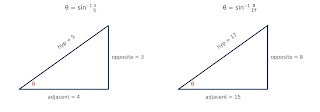
Figure 2: Turning an inverse sine into a right triangle so all other ratios can be read off
NCERT Solutions for Class 12 Math Chapter 2 Inverse Trigonometric Functions
The chapter includes Exercise 2.1, which consists of 14 questions, Exercise 2.2, with 15 questions, and a Miscellaneous Exercise, also comprising 14 questions. The 18 questions below are taken from all three so that every concept in the chapter is covered.
| Q | Source | Concept covered |
| 1 | Ex 2.1 Q1 | Principal value of an inverse sine with a negative input |
| 2 | Ex 2.1 Q2 | Principal value of an inverse cosine |
| 3 | Ex 2.1 Q3 | Principal value of an inverse cosecant |
| 4 | Ex 2.1 Q6 | Principal value of an inverse tangent |
| 5 | Ex 2.1 Q11 | Combining several principal values |
| 6 | Ex 2.1 Q13 | Objective question on the range of inverse sine |
| 7 | Ex 2.1 Q14 | Objective question mixing tangent and secant |
| 8 | Ex 2.2 Q1 | Triple angle property for inverse sine |
| 9 | Ex 2.2 Q3 | Simplest form using the substitution x = tan θ |
| 10 | Ex 2.2 Q4 | Simplest form using half-angle identities |
| 11 | Ex 2.2 Q6 | Simplest form with a square root in the denominator |
| 12 | Ex 2.2 Q10 | sin⁻¹(sin x) when x lies outside the branch |
| 13 | Ex 2.2 Q11 | tan⁻¹(tan x) when x lies outside the branch |
| 14 | Ex 2.2 Q13 | Objective question on cos⁻¹(cos x) |
| 15 | Misc. Q1 | cos⁻¹(cos x) for an angle beyond one full turn |
| 16 | Misc. Q3 | Proving a double-angle result |
| 17 | Misc. Q5 | Adding two inverse cosines |
| 18 | Misc. Q13 | Objective question using the triangle method |
Step-by-Step NCERT Solutions for Class 12 Chapter
Q1. Ex 2.1 Q1: Find the principal value of sin⁻¹ (−½).
Step 1. Let sin⁻¹ (−½) = y. Then sin y = −½.
Step 2. The principal value branch of sin⁻¹ is [−π/2, π/2], so y must lie in that interval.
Step 3. We know sin(π/6) = ½. Since sine is negative for negative angles, sin(−π/6) = −½.
Step 4. Check that −π/6 lies in [−π/2, π/2]. It does.
Answer: −π/6.
Q2. Ex 2.1 Q2: Find the principal value of cos⁻¹ (√3/2).
Step 1. Let cos⁻¹ (√3/2) = y, so cos y = √3/2.
Step 2. The principal value branch of cos⁻¹ is [0, π].
Step 3. cos(π/6) = √3/2, and π/6 lies in [0, π].
Answer: π/6.
Q3. Ex 2.1 Q3: Find the principal value of cosec⁻¹ (2).
Step 1. Let cosec⁻¹ (2) = y, so cosec y = 2, which means sin y = ½.
Step 2. The principal value branch of cosec⁻¹ is [−π/2, π/2] with 0 removed.
Step 3. sin(π/6) = ½, and π/6 lies in the branch.
Answer: π/6.
Remember: convert cosec to sin, and sec to cos, before looking for the angle. It is easier than working with the reciprocal ratio directly.
Q4. Ex 2.1 Q6: Find the principal value of tan⁻¹ (−1).
Step 1. Let tan⁻¹ (−1) = y, so tan y = −1.
Step 2. The principal value branch of tan⁻¹ is the open interval (−π/2, π/2).
Step 3. tan(π/4) = 1, so tan(−π/4) = −1. And −π/4 lies inside the branch.
Answer: −π/4.
Remember: 3π/4 also has tangent −1, but it is outside the branch, so it is not the principal value.
Q5. Ex 2.1 Q11: Find the value of tan⁻¹(1) + cos⁻¹(−½) + sin⁻¹(−½).
Step 1. tan⁻¹(1) = π/4, since tan(π/4) = 1 and π/4 is in (−π/2, π/2).
Step 2. For cos⁻¹(−½), use cos⁻¹(−x) = π − cos⁻¹ x. Since cos⁻¹(½) = π/3, we get π − π/3 = 2π/3.
Step 3. For sin⁻¹(−½), use sin⁻¹(−x) = −sin⁻¹ x. Since sin⁻¹(½) = π/6, we get −π/6.
Step 4. Add the three results.
π/4 + 2π/3 − π/6 = (3π + 8π − 2π)/12 = 9π/12 = 3π/4
Answer: 3π/4.
Remember: the minus sign behaves differently for sine and cosine. It comes straight out for sin⁻¹ and tan⁻¹, but for cos⁻¹ and cot⁻¹ it becomes π minus the value.
Q6. Ex 2.1 Q13: If sin⁻¹ x = y, then which option is correct?
The options give four possible intervals for y. This is asking for the range of sin⁻¹, which is its principal value branch. That branch is [−π/2, π/2], and the endpoints are included because sin⁻¹(−1) = −π/2 and sin⁻¹(1) = π/2 are both defined.
Answer: −π/2 ≤ y ≤ π/2.
Q7. Ex 2.1 Q14: tan⁻¹ √3 − sec⁻¹ (−2) is equal to which option?
Step 1. tan⁻¹ √3 = π/3, since tan(π/3) = √3.
Step 2. For sec⁻¹(−2), use sec⁻¹(−x) = π − sec⁻¹ x. Since sec⁻¹(2) = π/3, we get π − π/3 = 2π/3.
Step 3. Subtract: π/3 − 2π/3 = −π/3.
Answer: −π/3.
Q8. Ex 2.2 Q1: Prove that 3 sin⁻¹ x = sin⁻¹ (3x − 4x³), for x in [−½, ½].
Step 1. Put x = sin θ, so that θ = sin⁻¹ x.
Step 2. Recall the triple-angle identity from Class 11.
sin 3θ = 3 sin θ − 4 sin³ θ
Step 3. Substituting sin θ = x gives sin 3θ = 3x − 4x³.
Step 4. Taking the inverse sine on both sides, 3θ = sin⁻¹ (3x − 4x³).
Step 5. Since θ = sin⁻¹ x, this is 3 sin⁻¹ x = sin⁻¹ (3x − 4x³). Proved.
Remember: the restriction x in [−½, ½] is there so that 3θ stays inside the principal branch. Without it the identity would fail.
Q9. Ex 2.2 Q3: Write tan⁻¹ ((√(1 + x²) − 1)/x) in simplest form, x ≠ 0.
Step 1. Put x = tan θ, so θ = tan⁻¹ x.
Step 2. Then 1 + x² = 1 + tan² θ = sec² θ, so √(1 + x²) = sec θ.
Step 3. The expression becomes (sec θ − 1)/tan θ.
Step 4. Write everything in sine and cosine. This is (1/cos θ − 1) divided by (sin θ/cos θ), which simplifies to (1 − cos θ)/sin θ.
Step 5. Use 1 − cos θ = 2 sin²(θ/2) and sin θ = 2 sin(θ/2) cos(θ/2).
(2 sin²(θ/2)) / (2 sin(θ/2) cos(θ/2)) = tan(θ/2)
Step 6. So the whole expression is tan⁻¹(tan(θ/2)) = θ/2.
Answer: ½ tan⁻¹ x.
Q10. Ex 2.2 Q4: Write tan⁻¹ √((1 − cos x)/(1 + cos x)) in simplest form, for 0 < x < π.
Step 1. Use the half-angle identities 1 − cos x = 2 sin²(x/2) and 1 + cos x = 2 cos²(x/2).
Step 2. The fraction inside the root becomes sin²(x/2) / cos²(x/2) = tan²(x/2).
Step 3. Taking the square root gives tan(x/2), which is positive because 0 < x < π puts x/2 in the first quadrant.
Step 4. So the expression is tan⁻¹(tan(x/2)) = x/2.
Answer: x/2.
Q11. Ex 2.2 Q6: Write tan⁻¹ (x / √(a² − x²)) in simplest form, |x| < a.
Step 1. Put x = a sin θ, so θ = sin⁻¹(x/a).
Step 2. Then a² − x² = a² − a² sin² θ = a² cos² θ, so √(a² − x²) = a cos θ.
Step 3. The expression becomes tan⁻¹ ((a sin θ)/(a cos θ)) = tan⁻¹(tan θ) = θ.
Answer: sin⁻¹ (x/a).
Remember: choose the substitution to match the expression. A term a² − x² suggests x = a sin θ; a term 1 + x² suggests x = tan θ.
Q12. Ex 2.2 Q10: Find the value of sin⁻¹ (sin (2π/3)).
Step 1. The answer is not 2π/3, because 2π/3 is larger than π/2 and so lies outside the branch [−π/2, π/2].
Step 2. Find an angle inside the branch with the same sine. Use sin(π − θ) = sin θ.
sin(2π/3) = sin(π − 2π/3) = sin(π/3)
Step 3. Now π/3 does lie in [−π/2, π/2], so sin⁻¹(sin(π/3)) = π/3.
Answer: π/3.
Remember: sin⁻¹(sin x) equals x only when x is already inside the branch. Otherwise, rewrite the angle first.
Q13. Ex 2.2 Q11: Find the value of tan⁻¹ (tan (3π/4)).
Step 1. 3π/4 is not inside (−π/2, π/2), so the answer is not 3π/4.
Step 2. Tangent repeats every π, so subtract π to find an equivalent angle.
tan(3π/4) = tan(3π/4 − π) = tan(−π/4)
Step 3. Now −π/4 lies inside the branch, so the value is −π/4.
Answer: −π/4.
Q14. Ex 2.2 Q13: cos⁻¹ (cos (7π/6)) is equal to which option?
Step 1. The branch of cos⁻¹ is [0, π]. Since 7π/6 is greater than π, the answer is not 7π/6.
Step 2. Use cos(2π − θ) = cos θ, so cos(7π/6) = cos(2π − 7π/6) = cos(5π/6).
Step 3. Now 5π/6 lies in [0, π].
Answer: 5π/6.
Q15. Miscellaneous Q1: Find the value of cos⁻¹ (cos (13π/6)).
Step 1. 13π/6 is more than one full turn, since a full turn is 2π = 12π/6.
Step 2. Subtract 2π to bring it into the first turn.
13π/6 − 2π = 13π/6 − 12π/6 = π/6
Step 3. Cosine repeats every 2π, so cos(13π/6) = cos(π/6). And π/6 lies in [0, π].
Answer: π/6.
Q16. Miscellaneous Q3: Prove that 2 sin⁻¹ (3/5) = tan⁻¹ (24/7).
Step 1. Let θ = sin⁻¹(3/5), so sin θ = 3/5.
Step 2. Draw a right triangle with opposite 3 and hypotenuse 5. Pythagoras gives the adjacent side as √(25 − 9) = 4. So tan θ = 3/4.
Step 3. We need 2θ, so use the double-angle formula for tangent.
tan 2θ = 2 tan θ / (1 − tan² θ)
Step 4. Substitute tan θ = 3/4. The numerator is 2 × 3/4 = 3/2. The denominator is 1 − 9/16 = 7/16.
tan 2θ = (3/2) ÷ (7/16) = (3/2) × (16/7) = 24/7
Step 5. So 2θ = tan⁻¹(24/7), which is 2 sin⁻¹(3/5) = tan⁻¹(24/7). Proved.
Q17. Miscellaneous Q5: Prove that cos⁻¹ (4/5) + cos⁻¹ (12/13) = cos⁻¹ (33/65).
Step 1. Let A = cos⁻¹(4/5) and B = cos⁻¹(12/13). So cos A = 4/5 and cos B = 12/13.
Step 2. Build the triangles. For A, adjacent 4 and hypotenuse 5 give opposite 3, so sin A = 3/5. For B, adjacent 12 and hypotenuse 13 give opposite 5, so sin B = 5/13.
Step 3. Use the cosine addition formula.
cos(A + B) = cos A cos B − sin A sin B
Step 4. Substitute the four values.
cos(A + B) = (4/5)(12/13) − (3/5)(5/13) = 48/65 − 15/65 = 33/65
Step 5. Therefore, A + B = cos⁻¹(33/65), which is the required result. Proved.
Q18. Miscellaneous Q13: sin (tan⁻¹ x), where |x| < 1, is equal to which option?
Step 1. Let θ = tan⁻¹ x, so tan θ = x, which we can read as opposite x over adjacent 1.
Step 2. By Pythagoras the hypotenuse is √(1 + x²).
Step 3. Now read off the sine, which is opposite over hypotenuse.
sin θ = x / √(1 + x²)
Answer: x / √(1 + x²).
Remember: any expression of the form sin(tan⁻¹ x), cos(sin⁻¹ x) and so on can be read straight off a right triangle. It is faster than using identities.
Key Features of Infinity Learn NCERT Solutions for Class 12 Math Chapter 2
- Covers 18 selected questions from Exercise 2.1, Exercise 2.2 and the Miscellaneous Exercise.
- Each question is mapped to the concept it tests, so revision can be targeted.
- Every solution is broken into clear steps with the reason given at each stage.
- The principal value branch is stated and checked in every principal value question.
- Includes the domain and branch table that most questions in Exercise 2.1 depend on.
- Prepared in line with the current rationalized NCERT textbook.
Why Use NCERT Solutions for Inverse Trigonometric Functions?
Most errors in this chapter are not calculation errors. They happen when a correct angle is reported from outside the principal value branch, or when a substitution is chosen that does not match the expression. Both are avoidable once the habit is fixed.
Students can use these solutions to:
- Learn the domain and principal value branch of each of the six functions.
- Check the branch before writing down any principal value.
- Choose the right substitution for a given expression.
- Handle sin⁻¹(sin x), cos⁻¹(cos x) and tan⁻¹(tan x) when the angle lies outside the branch.
- Use the right triangle method to shorten proofs.
Inverse Trigonometric Functions rewards two habits. The first is checking the principal value branch before writing any answer, which is what separates a correct value from a plausible one. The second is choosing a substitution that matches the shape of the expression, which turns most simplification questions into one or two lines.
Work through the 18 questions above, cover each solution, and rebuild the steps from memory, including the branch check. Once these feel comfortable, move on to Chapter 3, Matrices, which begins the algebra section of the syllabus.
Study Class 12 Math with Infinity Learn
Infinity Learn provides NCERT Solutions for every chapter of the current Class 12 Math syllabus, with step-by-step working, proofs written in the order the CBSE marking scheme expects, and clear labeling of the topics removed in the rationalization, so no time is spent on material that is no longer examined.
Practice chapter by chapter, check your method against the worked solutions, and revise the key results before your board examination. Start with the questions on this page, then continue through the rest of the syllabus with Infinity Learn.
course
No courses found
FAQs: NCERT Solutions for Inverse Trigonometric Functions
How many exercises are there in NCERT Class 12 Math Chapter 2?
The current chapter has Exercise 2.1 with 14 questions, Exercise 2.2 with 15 questions and a Miscellaneous Exercise with 14 questions.
What is a principal value branch?
A trigonometric function takes the same value at infinitely many angles, so it cannot be inverted as it stands. The domain is therefore restricted to one interval on which the function takes each value exactly once. That interval is the principal value branch, and the answer taken from it is the principal value.
Why is sin⁻¹(sin x) not always equal to x?
Because sin⁻¹ always returns an angle in [−π/2, π/2]. If x already lies in that interval, the answer is x. If not, the angle must first be rewritten as an equivalent angle inside the branch, as in Question 12 above.
What is the range of cos⁻¹ x?
The range, which is also its principal value branch, is [0, π]. The domain is [−1, 1].
Which substitution should I use to simplify an expression?
Match the substitution to the algebra. A term 1 + x² suggests x = tan θ, a term a² − x² suggests x = a sin θ, and an expression containing 1 − cos x or 1 + cos x is usually handled with the half-angle identities.
How does the right triangle method work?
Turn the inverse ratio into an angle in a right triangle. If θ = sin⁻¹(3/5), draw a triangle with opposite 3 and hypotenuse 5, find the third side by Pythagoras, then read off any other ratio of θ directly.
How many marks does Chapter 2 carry in the CBSE Class 12 Math examination?
Chapter 2 sits in Unit I, Relations and Functions, together with Chapter 1. The unit carries 8 marks in the theory paper. The syllabus does not give a separate figure for Chapter 2 on its own.
