NCERT Solutions for Class 12 Math Chapter 4 – Determinants
By Rohit RP
|
Updated on 14 Sep 2026, 16:08 IST
Determinants take matrix concepts a step further and show how a single numerical value can be used to solve several mathematical problems. Class 12 Math Chapter 4 covers determinants of different orders, minors, cofactors, properties of determinants, area of triangles, and solutions of linear equations.
NCERT Solutions for Class 12 Math Chapter 4 Determinants provide step-by-step answers to textbook exercises so students can understand each calculation clearly. The solutions are especially useful for learning how determinant properties can shorten otherwise lengthy problems. Practicing NCERT Solutions questions also helps students become more accurate with signs, expansions, and cofactors.
Key Concepts Covered in Class 12 Math Chapter 4 – Determinants
The chapter covers the following important concepts:
- Determinant of a square matrix of order 2 and order 3
- Expanding a determinant along a row or a column
- The determinant of a scalar multiple of a matrix
- Solving for an unknown from a determinant equation
- Area of a triangle using the coordinates of its vertices
- Testing whether three points are collinear
- Finding the equation of a line through two points
- Minors and cofactors of the elements of a determinant
- Evaluating a determinant using cofactors
- Adjoint of a matrix
- Inverse of a matrix, and the condition for it to exist
- Singular and non-singular matrices
- Consistency of a system of linear equations
- Solving a system of linear equations by the matrix method
NCERT Solutions for Class 12 Math Chapter 4 – Determinants: Chapter Overview
Determinant of a 2 x 2 Matrix
Every square matrix has a single number attached to it, called its determinant. For a 2 x 2 matrix, it is found by cross-multiplying.
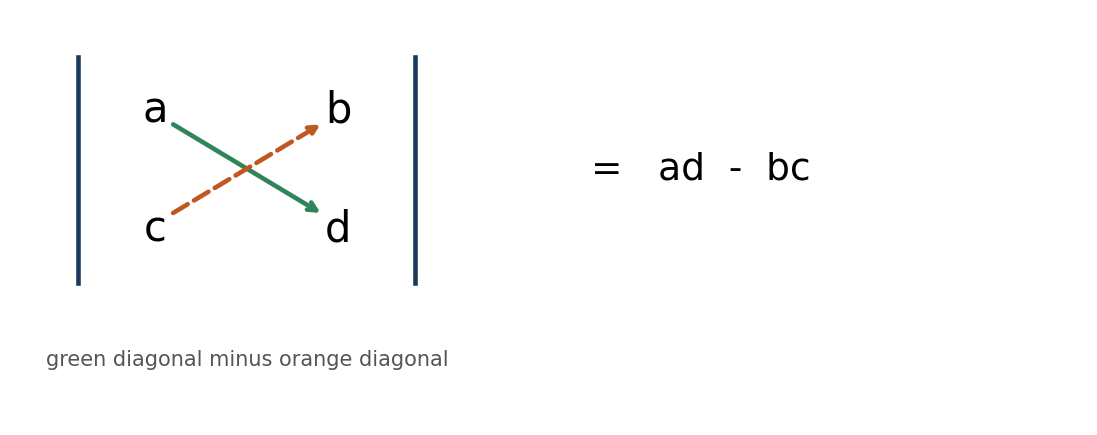
Figure 1: The determinant of a 2 x 2 matrix is ad minus bc
Determinant of a 3 x 3 Matrix
A 3 x 3 determinant is expanded along any one row or column. Each element is multiplied by its cofactor, and the results are added. Choosing a row or column that already contains zeros saves a lot of work.

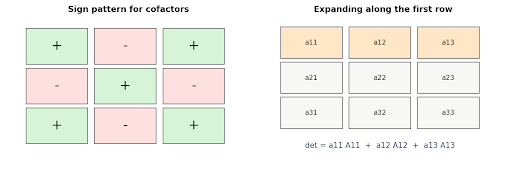
Figure 2: The sign pattern for cofactors and expansion along the first row
The minor of an element is the determinant left after deleting that element’s row and column. The cofactor is the minor with the sign from the pattern applied.
Best Courses for You

JEE

NEET

Foundation JEE

Foundation NEET

CBSE
Aᵢⱼ = (−1)^(i+j) x Mᵢⱼ
Some Useful Results
For a square matrix of order n: |kA| = kⁿ |A|
|adj A| = |A|ⁿ⁻¹ (so |A|¹ for order 2, |A|² for order 3)
A is invertible only when |A| ≠ 0, and then A⁻¹ = (1/|A|) adj A
A matrix with determinant 0 is called singular and has no inverse. A matrix with a non-zero determinant is non-singular.
Area of a Triangle
If a triangle has vertices at (x₁, y₁), (x₂, y₂) and (x₃, y₃), its area comes from a determinant.
| x1 y1 1 |
Area = ½ | x2 y2 1 |
| x3 y3 1 |
Area is always taken as positive, so if the determinant comes out negative, take its absolute value. If the determinant is exactly 0, the three points do not enclose any area, which means they lie on one straight line.
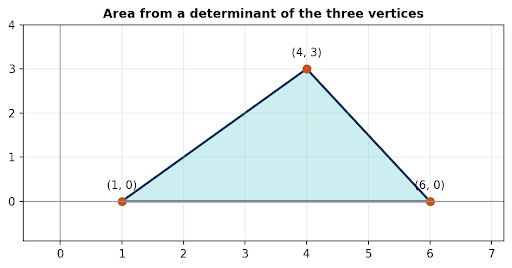
Figure 3: The triangle from Exercise 4.3, with vertices (1, 0), (6, 0) and (4, 3)
Solving Linear Equations
A system of equations can be written as AX = B, where A holds the coefficients, X the unknowns, and B the constants.
If |A| ≠ 0, the system has a unique solution given by X = A⁻¹B
If |A| = 0, the system has either no solution or infinitely many, and the system is then called inconsistent or dependent accordingly.
Note on Exercise 4.2. That exercise covers the properties of determinants, which several sources list among the topics reduced in the rationalization. None of the 18 questions below depends on it, so this set stays valid either way. Please confirm against a current printed copy before publishing.
Step-by-Step NCERT Solutions for Class 12 Maths Chapter 4
Concept A: Evaluating Determinants
Q1. Evaluate the determinant of [2, 4 ; −5, −1].
Step 1. For a 2 x 2 determinant, multiply the main diagonal and subtract the other diagonal.
det = (2)(−1) − (4)(−5) = −2 + 20 = 18
Answer: 18.
Remember: two negatives multiply to a positive. Writing −2 − 20 instead of −2 + 20 is the usual slip here.
Q2. Evaluate the determinant of [cos θ, −sin θ ; sin θ, cos θ].
Step 1. Apply the same cross-multiplication.
det = (cos θ)(cos θ) − (−sin θ)(sin θ) = cos² θ + sin² θ
Step 2. Use the identity cos² θ + sin² θ = 1.
det = 1
Answer: 1. The answer does not depend on θ at all.
Q3. Evaluate the determinant of [3, −4, 5 ; 1, 1, −2 ; 2, 3, 1].
Step 1. Expand along the first row, using the signs plus and minus.
Step 2. For the first term, cover row 1 and column 1. What is left is [1, −2 ; 3, 1], whose value is (1)(1) − (−2)(3) = 1 + 6 = 7. Multiply by 3 to get 21.
Step 3. For the second term, cover row 1 and column 2, leaving [1, −2 ; 2, 1], whose value is 1 + 4 = 5. The element is −4, and the sign is minus, so the term is −(−4)(5) = +20.
Step 4. For the third term, cover row 1 and column 3, leaving [1, 1 ; 2, 3], whose value is 3 − 2 = 1. Multiply by 5 to get 5.
det = 21 + 20 + 5 = 46
Answer: 46.
Remember: the middle term of a first-row expansion always carries a minus sign from the pattern, on top of whatever sign the element itself has.
Concept B: Determinant of a Scalar Multiple
Q4. If A = [1, 2 ; 4, 2], show that |2A| = 4|A|.
Step 1. Find |A|. (1)(2) − (2)(4) = 2 − 8 = −6.
Step 2. Find 2A by doubling every entry, giving [2, 4 ; 8, 4].
Step 3. Find |2A|. (2)(4) − (4)(8) = 8 − 32 = −24.
Step 4. Compare. 4|A| = 4(−6) = −24, which matches |2A|.
|2A| = 4|A| = −24
Remember: the factor is 2² = 4 because the matrix is order 2, not simply 2. Each of the 2 rows contributes a factor of 2.
Q5. If A is a square matrix of order 3 x 3, then |kA| is equal to (A) k|A| (B) k²|A| (C) k³|A| (D) 3k|A|.
Step 1. Multiplying the whole matrix by k multiplies every one of its 3 rows by k.
Step 2. Each row contributes one factor of k to the determinant, so three rows contribute k x k x k.
|kA| = k³ |A| for a 3 x 3 matrix
Answer: option (C).
Concept C: Finding an Unknown from a Determinant
Q6. Find x if the determinant of [2, 4 ; 5, 1] equals the determinant of [2x, 4 ; 6, x].
Step 1. Left side. (2)(1) − (4)(5) = 2 − 20 = −18.
Step 2. Right side. (2x)(x) − (4)(6) = 2x² − 24.
Step 3. Set them equal and solve. 2x² − 24 = −18 gives 2x² = 6, so x² = 3.
x = ±√3
Q7. If det[x, 2 ; 18, x] = det[6, 2 ; 18, 6], then x equals (A) 6 (B) ±6 (C) −6 (D) 0.
Step 1. Left side. x² − 36. Right side. 36 − 36 = 0.
Step 2. So x² − 36 = 0, giving x² = 36.
x = 6 or x = −6, that is, x = ±6
Answer: option (B).
Remember: a squared unknown gives two answers. Option (A) is there to catch students who take only the positive root.
Concept D: Area, Collinearity and the Equation of a Line
Q8. Find the area of the triangle with vertices (1, 0), (6, 0) and (4, 3).
Step 1. Put the coordinates into the area determinant, with a column of 1s.
| 1 0 1 |
Area = ½ | 6 0 1 |
| 4 3 1 |
Step 2. Expand along the first row. The first term is 1 times (0 x 1 − 1 x 3) = −3. The second term is −0 times something, which is 0. The third term is 1 times (6 x 3 − 0 x 4) = 18.
Step 3. The determinant is −3 + 0 + 18 = 15, so the area is ½ x 15.
Area = 15/2 square units
Remember: area is never negative. If your determinant comes out negative, take the positive value.
Q9. Show that the points A(a, b + c), B(b, c + a) and C(c, a + b) are collinear.
Step 1. Three points lie on one line exactly when the area of the triangle they form is zero. So, form the determinant.
| a b+c 1 |
| b c+a 1 |
| c a+b 1 |
Step 2. Add column 1 to column 2. Every entry in the new column 2 becomes a + b + c, the same value in all three rows.
Step 3. Column 2 and column 3 are now proportional, since column 2 is (a + b + c) times column 3. A determinant with two proportional columns is zero.
Determinant = 0, so the three points are collinear
Q10. Find k if the area of the triangle with vertices (k, 0), (4, 0) and (0, 2) is 4 square units.
Step 1. Set up the area determinant and expand it. Working along the first row gives the determinant as 2k − 8.
Step 2. Area is half the absolute value, so ½ |2k − 8| = 4, giving |2k − 8| = 8.
Step 3. The absolute value gives two cases. Either 2k − 8 = 8, so k = 8, or 2k − 8 = −8, so k = 0.
k = 0 or k = 8
Q11. Find the equation of the line joining (1, 2) and (3, 6) using determinants.
Step 1. A general point (x, y) lies on the line through the two given points exactly when all three are collinear. So set the area determinant to zero.
| x y 1 |
| 1 2 1 | = 0
| 3 6 1 |
Step 2. Expand along the first row. The terms are x(2 − 6), then −y(1 − 3), then 1(6 − 6).
Step 3. That gives −4x + 2y + 0 = 0. Dividing through by 2 gives −2x + y = 0.
y = 2x
Concept E: Minors and Cofactors
Q12. Write the minors and cofactors of the elements of the determinant [2, −4 ; 0, 3].
Step 1. Minors. The minor of an element is what is left after deleting its row and column. For a 2 x 2 determinant, a single number remains.
M₁₁ = 3, M₁₂ = 0, M₂₁ = −4, M₂₂ = 2
Step 2. Cofactors. Apply the sign (−1) raised to the power (i + j). The signs for a 2 x 2 are plus and minus on the top row and minus, plus on the bottom.
A₁₁ = 3, A₁₂ = −0 = 0, A₂₁ = −(−4) = 4, A₂₂ = 2
Remember: the minor and the cofactor differ only by a sign. Half the marks in this question are for getting that sign right.
Q13. Using the cofactors of the elements of the second row, evaluate the determinant of [5, 3, 8 ; 2, 0, 1 ; 1, 2, 3].
Step 1. The second row is 2, 0, 1. Because one entry is 0, that term will vanish, and only two products are needed.
Step 2. Cofactor A₂₁. Delete row 2 and column 1, leaving [3, 8 ; 2, 3], whose value is 9 − 16 = −7. The sign for position (2,1) is minus, so A₂₁ = 7.
Step 3. Cofactor A₂₃. Delete row 2 and column 3, leaving [5, 3 ; 1, 2], whose value is 10 − 3 = 7. The sign for position (2,3) is minus, so A₂₃ = −7.
Step 4. Multiply each element of the row by its cofactor and add.
Δ = 2(7) + 0 + 1(−7) = 14 − 7 = 7
Answer: 7.
Remember: always expand along the row or column with the most zeros. It removes whole terms before you start.
Concept F: Adjoint and Inverse
Q14. Find the adjoint of [1, 2 ; 3, 4].
Step 1. The adjoint is the transpose of the matrix of cofactors. For a 2 x 2 matrix, there is a shortcut: swap the two diagonal entries and change the sign of the other two.
adj A = [ 4 -2 ]
[ -3 1 ]
Remember: the shortcut works only for 2 x 2. For a 3 x 3, you must build all nine cofactors and then transpose.
Q15. Find the inverse of [2, −2 ; 4, 3], if it exists.
Step 1. Check the determinant first. (2)(3) − (−2)(4) = 6 + 8 = 14. This is not zero, so the inverse exists.
Step 2. Find the adjoint using the 2 x 2 shortcut: swap 2 and 3, and change the signs of −2 and 4.
adj A = [ 3 2 ]
[ -4 2 ]
Step 3. Divide by the determinant.
A⁻¹ = (1/14) [ 3 2 ]
[ -4 2 ]
Remember: always compute the determinant before anything else. If it turns out to be 0, the matrix is singular, and there is no inverse, and the rest of the work would be wasted.
Q16. If A is a non-singular square matrix of order 3 x 3, then |adj A| equals (A) |A| (B) |A|² (C) |A|³ (D) 3|A|.
Step 1. The general result is |adj A| = |A| raised to the power (n − 1), where n is the order.
Step 2. Here n = 3, so the power is 3 − 1 = 2.
|adj A| = |A|²
Answer: option (B).
Concept G: Systems of Linear Equations
Q17. Examine the consistency of the system x + 2y = 2 and 2x + 3y = 3.
Step 1. Write the coefficient matrix A = [1, 2 ; 2, 3].
Step 2. Find its determinant. (1)(3) − (2)(2) = 3 − 4 = −1.
Step 3. The determinant is not zero, so A is non-singular and the system has exactly one solution.
|A| = −1 ≠ 0, so the system is consistent
Remember: consistent simply means at least one solution exists. A non-zero determinant guarantees exactly one solution.
Q18. Solve 5x + 2y = 4 and 7x + 3y = 5 by the matrix method.
Step 1. Write the system as AX = B, with A = [5, 2 ; 7, 3], X = [x ; y] and B = [4 ; 5].
Step 2. Check the determinant. (5)(3) − (2)(7) = 15 − 14 = 1. It is not zero, so a unique solution exists.
Step 3. Find A inverse. Using the 2 x 2 shortcut and dividing by the determinant of 1:
A⁻¹ = [ 3 -2 ]
[ -7 5 ]
Step 4. Multiply A inverse by B. The first entry is 3(4) + (−2)(5) = 12 − 10 = 2. The second is (−7)(4) + 5(5) = −28 + 25 = −3.
x = 2, y = −3
Step 5. Check. Substituting into the first equation: 5(2) + 2(−3) = 10 − 6 = 4, which is correct.
Key Features of Infinity Learn NCERT Solutions for Class 12 Math Chapter 4
- Covers 18 selected questions arranged in seven concept groups rather than in exercise order.
- Each group can be revised as a complete unit, from evaluating determinants through to solving equations.
- Every expansion is worked term by term so each sign and product can be checked.
- Explains the cofactor sign pattern, which is where most marks are lost.
- Shows the determinant check before any inverse is attempted.
- Prepared in line with the current NCERT textbook.
Why Use NCERT Solutions for Determinants?
Determinants are a chapter of careful arithmetic. The ideas are short, but a single sign error in a cofactor or one slip in a long expansion changes the whole answer. A fixed order of working prevents most of that.
Students can use these solutions to:
- Expand along the row or column with the most zeros, which shortens the work.
- Apply the cofactor sign pattern without hesitating.
- Check the determinant before starting to find an inverse.
- Use the area determinant for area, collinearity, and the equation of a line, since all three come from the same setup.
- Decide whether a system of equations has one solution, none, or many.
Determinants reward a fixed order of working. Expand along the row or column with the most zeros, apply the sign pattern before multiplying, and check the determinant before attempting any inverse. Those three habits remove most of the errors that cost marks in this chapter.
Work through the seven concept groups above, cover each solution, and rebuild the steps from memory. Notice how often the same area determinant reappears for area, for collinearity, and for the equation of a line. Once these feel comfortable, move on to Chapter 5, Continuity and Differentiability, which begins the calculus section of the syllabus.
Study Class 12 Math with Infinity Learn
Infinity Learn provides NCERT Solutions for every chapter of the current Class 12 Math syllabus, with step-by-step working, solutions written in the order the CBSE marking scheme expects, and clear labeling of the topics affected by the rationalization, so no time is spent on material that is no longer examined.
Practice chapter by chapter, check your method against the worked solutions, and revise the key results before your board examination. Start with the questions on this page, then continue through the rest of the syllabus with Infinity Learn.
course
No courses found
FAQs: NCERT Solutions for Class 12 Math Determinants
What is a determinant?
A determinant is a single number attached to a square matrix. It is written with straight vertical bars rather than brackets, and only square matrices have one.
What is the difference between a minor and a cofactor?
The minor of an element is the determinant left after deleting that element’s row and column. The cofactor is that same minor with a sign attached, given by (−1) raised to the power (i + j). They differ only by that sign.
Which row or column should I expand along?
Any row or column gives the same answer, so choose the one with the most zeros. Every zero removes a whole term from the calculation.
When does a matrix have an inverse?
Only when its determinant is not zero. Such a matrix is called non-singular. If the determinant is zero, the matrix is singular and no inverse exists, so always check the determinant first.
How do I use a determinant to show three points are collinear?
Form the area determinant using the three points, with a column of 1s. If it comes out as zero, the triangle has no area, which means the three points lie on one straight line.
What does it mean for a system of equations to be consistent?
It means the system has at least one solution. If the determinant of the coefficient matrix is not zero, the system is consistent with exactly one solution. If it is zero, the system has either no solution or infinitely many.
Why is |kA| not simply k times |A|?
Because multiplying the matrix by k multiplies every row by k, and each row contributes its own factor. For a matrix of order n, the result is k to the power of n times |A|, so k² for order 2 and k³ for order 3.
How many marks does Chapter 4 carry in the CBSE Class 12 Math examination?
Chapter 4 sits in Unit II, Algebra, together with Chapter 3, Matrices. The unit carries 10 marks in the theory paper. The syllabus does not give a separate figure for Chapter 4 on its own.
