- Key Concepts Covered in Class 12 Math Chapter 3 – Matrices
- NCERT Solutions for Class 12 Math Chapter 3 Matrices: Chapter Overview
- NCERT Solutions for Class 12 Math Chapter 3 Matrices
- Step-by-Step NCERT Solutions for Class 12 Maths Chapter 3
- Why Use NCERT Solutions for Matrices?
- Study Class 12 Math with Infinity Learn
- FAQs: NCERT Solutions for Class 12 Math Chapter 3 Matrices
NCERT Solutions for Class 12 Math Chapter 3 Matrices
By Rohit RP
|
Updated on 14 Sep 2026, 15:27 IST
Chapter 3 covers matrix notation, order, types of matrices, addition, subtraction, multiplication, transpose, and related properties. Class 12 Math NCERT Solutions for Chapter 3 Matrices guide students through the textbook questions while explaining the steps needed to reach each answer.
They are useful when practicing lengthy multiplication problems or checking whether a matrix operation has been performed correctly. By solving the NCERT exercises carefully, students can strengthen their calculation skills, become familiar with important properties, and prepare more confidently for matrix-based questions in school and board examinations.
Key Concepts Covered in Class 12 Math Chapter 3 – Matrices
The chapter covers the following important concepts:
- The concept of a matrix and its order
- Naming an element by its row and column position
- Finding the possible orders of a matrix from the number of elements
- Constructing a matrix from a rule for the general element
- Types of matrices, including row, column, square, diagonal, scalar, identity and zero matrices
- Equality of matrices
- Addition and subtraction of matrices
- Multiplication of a matrix by a scalar
- Multiplication of two matrices, and why the order of multiplication matters
- Matrix polynomials such as A² − 5A + 6I
- The transpose of a matrix and its properties
- Symmetric and skew-symmetric matrices
- Expressing a square matrix as the sum of a symmetric and a skew-symmetric matrix
- The condition for two matrices to be inverses of each other
- Word problems solved using matrix algebra
NCERT Solutions for Class 12 Math Chapter 3 Matrices: Chapter Overview
Order of a Matrix
A matrix is a rectangular arrangement of numbers in rows and columns. If it has m rows and n columns, its order is written m x n, and it has m times n elements in total. The element in row i and column j is written a with subscript ij.
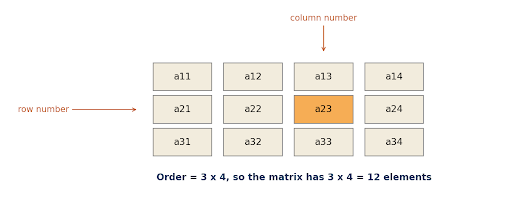
Figure 1: Reading the order of a matrix and naming an element by its position
Addition and Scalar Multiplication
Two matrices can be added or subtracted only if they have the same order, and the work is done entry by entry. Multiplying by a number multiplies every entry by that number.

A + B is defined only when A and B have the same order
Multiplication of Matrices
Best Courses for You

JEE

NEET

Foundation JEE

Foundation NEET

CBSE
The product AB is defined only when the number of columns in A equals the number of rows in B. If A is m x n and B is n x p, then AB is m x p.
(m x n) times (n x p) gives (m x p)
To find one entry of AB, take the matching row of A and the matching column of B, multiply the pairs, and add the results.
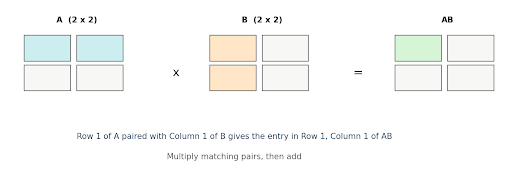
Figure 2: One entry of AB comes from a row of A paired with a column of B
Matrix multiplication is not commutative. In general, AB is not equal to BA, and sometimes only one of the two products is even defined.
Transpose of a Matrix
The transpose, written A′, is obtained by turning the rows into columns and the columns into rows. If A has order m x n, then A′ has order n x m.
(A + B)′ = A′ + B′
(AB)′ = B′A′ (note the order reverses)
Symmetric and Skew Symmetric Matrices
Symmetric: A′ = A
Skew-symmetric: A′ = −A, so every diagonal entry is 0
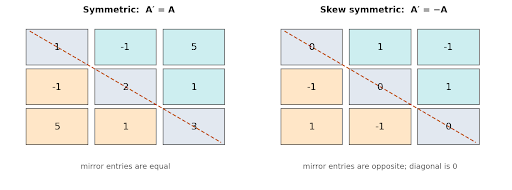
Figure 3: A symmetric matrix and a skew-symmetric matrix, using the matrices from Exercise 3.3
Every square matrix can be split into a symmetric part and a skew-symmetric part.
A = ½(A + A′) + ½(A − A′)
The first bracket is always symmetric and the second is always skew-symmetric.
NCERT Solutions for Class 12 Math Chapter 3 Matrices
The chapter has Exercise 3.1 with 10 questions, Exercise 3.2 with 22, Exercise 3.3 with 12, Exercise 3.4 with a single question, and a Miscellaneous Exercise with 11. The 18 questions below are taken from all five so that every concept in the chapter is covered.
| Q | Source | Concept covered |
| 1 | Ex 3.1 Q1 | Order, number of elements, and naming an element |
| 2 | Ex 3.1 Q2 | Possible orders from the number of elements |
| 3 | Ex 3.1 Q4(i) | Constructing a matrix from a rule |
| 4 | Ex 3.1 Q6(ii) | Equality of matrices used to solve for unknowns |
| 5 | Ex 3.1 Q10 | Objective question on counting matrices |
| 6 | Ex 3.2 Q1(i),(iv),(v) | Addition and the products AB and BA |
| 7 | Ex 3.2 Q3(iii) | Product of matrices of different orders |
| 8 | Ex 3.2 Q7(i) | Solving a pair of matrix equations |
| 9 | Ex 3.2 Q14(i) | Showing that AB is not equal to BA |
| 10 | Ex 3.2 Q15 | Evaluating a matrix polynomial |
| 11 | Ex 3.2 Q20 | Word problem solved by matrix algebra |
| 12 | Ex 3.3 Q1(ii) | Finding a transpose |
| 13 | Ex 3.3 Q5(i) | Verifying that (AB)′ = B′A′ |
| 14 | Ex 3.3 Q7(i) | Showing a matrix is symmetric |
| 15 | Ex 3.3 Q7(ii) | Showing a matrix is skew-symmetric |
| 16 | Ex 3.3 Q10(i) | Splitting a matrix into symmetric and skew-symmetric parts |
| 17 | Ex 3.4 Q1 | Objective question on inverse matrices |
| 18 | Misc. Q5 | Proving a matrix polynomial equals the zero matrix |
Note on Exercise 3.4. After rationalization, this exercise contains only one objective question. Students working from an older guide will expect a full exercise on finding inverses by elementary row operations, and that material is no longer in the chapter.
Step-by-Step NCERT Solutions for Class 12 Maths Chapter 3
Q1. Ex 3.1 Q1: For the given 3 x 4 matrix A, write (i) the order, (ii) the number of elements, (iii) the elements a₁₃, a₂₁, a₃₃, a₂₄, a₂₃.
[ 2 5 19 -7 ]
[ 35 -2 5/2 12 ]
[ √3 1 -5 17 ]
(i) Order. Count the rows and the columns. There are 3 rows and 4 columns. The order is 3 x 4.
(ii) Number of elements. Multiply the two numbers in the order: 3 x 4 = 12. There are 12 elements.
(iii) Naming elements. In a with subscript ij, the first number is the row and the second is the column. So a₁₃ sits in row 1, column 3.
a₁₃ = 19, a₂₁ = 35, a₃₃ = −5, a₂₄ = 12, a₂₃ = 5/2.
Remember: row first, column second. Reading a₂₄ as row 4 is the most common slip in this question.
Q2. Ex 3.1 Q2: If a matrix has 24 elements, what are the possible orders it can have? What if it has 13 elements?
Step 1. The order m x n must satisfy m times n equals the number of elements. So list all pairs of whole numbers whose product is 24.
Step 2. The factor pairs of 24, taken in both orders, are:
(1 x 24), (24 x 1), (2 x 12), (12 x 2), (3 x 8), (8 x 3), (4 x 6), (6 x 4)
Step 3. For 13 elements, 13 is a prime number, so its only factors are 1 and 13.
(1 x 13) and (13 x 1)
Answer: eight possible orders for 24 elements, and only two for 13 elements.
Q3. Ex 3.1 Q4(i): Construct a 2 x 2 matrix A = [aᵢⱼ] whose elements are given by aᵢⱼ = (i + j)² / 2.
Step 1. A 2 x 2 matrix has four elements: a₁₁, a₁₂, a₂₁, a₂₂. Substitute each pair of positions into the rule.
a₁₁ = (1 + 1)²/2 = 4/2 = 2
a₁₂ = (1 + 2)²/2 = 9/2
a₂₁ = (2 + 1)²/2 = 9/2
a₂₂ = (2 + 2)²/2 = 16/2 = 8
Step 2. Place each value in its own position.
[ 2 9/2 ]
[ 9/2 8 ]
Q4. Ex 3.1 Q6(ii): Find x, y and z if [x+y, 2 ; 5+z, xy] = [6, 2 ; 5, 8].
Step 1. Two matrices are equal only when every matching pair of entries is equal. Comparing positions gives three equations.
x + y = 6, xy = 8, 5 + z = 5
Step 2. From 5 + z = 5 we get z = 0.
Step 3. We know x + y = 6 and xy = 8. Use the identity (x − y)² = (x + y)² − 4xy.
(x − y)² = 36 − 32 = 4, so x − y = 2 or x − y = −2.
Step 4. Solve each case with x + y = 6. If x − y = 2, then x = 4 and y = 2. If x − y = −2, then x = 2 and y = 4.
Answer: x = 4, y = 2, z = 0, or x = 2, y = 4, z = 0.
Remember: there are two valid answers here. Giving only one loses marks.
Q5. Ex 3.1 Q10: The number of all possible matrices of order 3 x 3 with each entry 0 or 1 is (A) 27 (B) 18 (C) 81 (D) 512.
Step 1. A 3 x 3 matrix has 3 x 3 = 9 entries.
Step 2. Each entry can be filled in 2 ways, either 0 or 1, and the choices are independent.
Total = 2⁹ = 512
Answer: option (D), 512.
Q6. Ex 3.2 Q1: Let A = [2, 4 ; 3, 2], B = [1, 3 ; −2, 5]. Find (i) A + B, (iv) AB, (v) BA.
(i) A + B. Add matching entries.
[ 2+1 4+3 ] [ 3 7 ]
[ 3-2 2+5 ] = [ 1 7 ]
(iv) AB. Row of A with column of B. Row 1 of A is (2, 4). Column 1 of B is (1, −2). So the first entry is 2(1) + 4(−2) = 2 − 8 = −6.
Continuing the same way: 2(3) + 4(5) = 26, then 3(1) + 2(−2) = −1, then 3(3) + 2(5) = 19.
[ -6 26 ]
[ -1 19 ]
(v) BA. Now the rows come from B, and the columns from A. Row 1 of B is (1, 3), column 1 of A is (2, 3), giving 1(2) + 3(3) = 11.
[ 11 10 ]
[ 11 2 ]
Remember: AB and BA are different matrices here. Always multiply in the order the question asks for.
Q7. Ex 3.2 Q3(iii): Compute the product [1, −2 ; 2, 3] times [1, 2, 3 ; 2, 3, 1].
Step 1. Check that the product is defined. The first matrix is 2 x 2 and the second is 2 x 3. The inner numbers match, so the product exists and has order 2 x 3.
Step 2. Work out each entry. For row 1 with column 1: 1(1) + (−2)(2) = 1 − 4 = −3.
Row 1, column 2: 1(2) + (−2)(3) = −4. Row 1, column 3: 1(3) + (−2)(1) = 1.
Row 2, column 1: 2(1) + 3(2) = 8. Row 2, column 2: 2(2) + 3(3) = 13. Row 2, column 3: 2(3) + 3(1) = 9.
[ -3 -4 1 ]
[ 8 13 9 ]
Q8. Ex 3.2 Q7(i): Find X and Y if X + Y = [7, 0 ; 2, 5] and X − Y = [3, 0 ; 0, 3].
Step 1. Add the two equations. The Y terms cancel.
2X = [ 7+3 0+0 ] [ 10 0 ]
[ 2+0 5+3 ] = [ 2 8 ]
Step 2. Divide every entry by 2.
X = [ 5 0 ]
[ 1 4 ]
Step 3. Substitute X back into X + Y to find Y.
Y = [ 7-5 0-0 ] [ 2 0 ]
[ 2-1 5-4 ] = [ 1 1 ]
Q9. Ex 3.2 Q14(i): Show that [5, −1 ; 6, 7] times [2, 1 ; 3, 4] is not equal to [2, 1 ; 3, 4] times [5, −1 ; 6, 7].
Step 1. Left-hand side. Row 1 of the first with column 1 of the second: 5(2) + (−1)(3) = 7. Working through the rest:
[ 7 1 ]
[ 33 34 ]
Step 2. Right-hand side. Now the matrices swap places: 2(5) + 1(6) = 16, and so on.
[ 16 5 ]
[ 39 25 ]
Step 3. The two results are different, so the products are not equal. This shows matrix multiplication is not commutative.
Q10. Ex 3.2 Q15: Find A² − 5A + 6I, where A = [2, 0, 1 ; 2, 1, 3 ; 1, −1, 0].
Step 1. Find A², which means A times A. Taking row 1 of A with column 1 of A gives 2(2) + 0(2) + 1(1) = 5, and continuing entry by entry:
[ 5 -1 2 ]
[ 9 -2 5 ]
[ 0 -1 -2 ]
Step 2. Find 5A by multiplying every entry of A by 5, and 6I, which is 6 down the diagonal and 0 elsewhere.
Step 3. Combine. Subtract 5A from A², then add 6I, entry by entry. For the top left: 5 − 10 + 6 = 1.
[ 1 -1 -3 ]
[ -1 -1 -10 ]
[ -5 4 4 ]
Remember: I is the identity matrix, not a matrix of ones. 6I has 6 only on the diagonal.
Q11. Ex 3.2 Q20: A school bookstore has 10 dozen chemistry books, 8 dozen physics books, and 10 dozen economics books, priced at Rs 80, Rs 60, and Rs 40 each. Find the total amount received from selling all the books using matrix algebra.
Step 1. Write the quantities as a row matrix and the prices as a column matrix. Keep the dozen as a factor of 12 outside.
12 [ 10 8 10 ] times [ 80 ; 60 ; 40 ]
Step 2. Multiply the row by the column, pairing each quantity with its price.
10(80) + 8(60) + 10(40) = 800 + 480 + 400 = 1680
Step 3. Multiply by 12 to convert dozens into books.
12 x 1680 = 20160
Answer: The bookstore receives Rs 20,160.
Q12. Ex 3.3 Q1(ii): Find the transpose of [1, −1 ; 2, 3].
Step 1. The transpose turns rows into columns. Row 1 of the original, which is (1, −1), becomes column 1 of the answer.
[ 1 2 ]
[ -1 3 ]
Q13. Ex 3.3 Q5(i): Verify that (AB)′ = B′A′ where A = [1 ; −4 ; 3] and B = [−1, 2, 1].
Step 1. Find AB. A is 3 x 1, and B is 1 x 3, so AB has order 3 x 3.
[ -1 2 1 ]
[ 4 -8 -4 ]
[ -3 6 3 ]
Step 2. Take the transpose of AB.
[ -1 4 -3 ]
[ 2 -8 6 ]
[ 1 -4 3 ]
Step 3. Find B′A′. B′ is the column [−1 ; 2 ; 1] and A′ is the row [1, −4, 3]. Multiplying gives exactly the same matrix as in Step 2.
Both sides agree, so the result is verified.
Remember: the order reverses when you transpose a product. Writing A′B′ instead of B′A′ is the usual error, and here it would not even be defined.
Q14. Ex 3.3 Q7(i): Show that A = [1, −1, 5 ; −1, 2, 1 ; 5, 1, 3] is a symmetric matrix.
Step 1. Write the transpose by turning rows into columns.
Step 2. Compare it with A. Every entry matches: the entry in row 1, column 2 is −1 and so is the entry in row 2, column 1. The same holds for every mirrored pair.
A′ = A, so A is symmetric
Q15. Ex 3.3 Q7(ii): Show that A = [0, 1, −1 ; −1, 0, 1 ; 1, −1, 0] is a skew-symmetric matrix.
Step 1. Write the transpose.
Step 2. Compare with −A, which is A with every sign changed. The entry in row 1, column 2 of A is 1, while the entry in row 2, column 1 is −1, so the mirrored pair is opposite. The same is true throughout, and the diagonal is all zeros.
A′ = −A, so A is skew-symmetric
Remember: a skew-symmetric matrix must have zeros all down the diagonal, since only 0 is its own opposite. Checking the diagonal first is a fast way to rule it out.
Q16. Ex 3.3 Q10(i): Express [3, 5 ; 1, −1] as the sum of a symmetric and a skew-symmetric matrix.
Step 1. Write A′ by turning rows into columns, giving [3, 1 ; 5, −1].
Step 2. Symmetric part. Work out ½(A + A′).
A + A′ = [ 6 6 ] P = [ 3 3 ]
[ 6 -2 ] so [ 3 -1 ]
Step 3. Skew-symmetric part. Work out ½(A − A′).
A - A′ = [ 0 4 ] Q = [ 0 2 ]
[ -4 0 ] so [ -2 0 ]
Step 4. Check. Adding P and Q returns the original matrix A, and P is symmetric while Q is skew-symmetric.
Q17. Ex 3.4 Q1: Matrices A and B will be inverses of each other only if (a) AB = BA (b) AB = BA = 0 (c) AB = 0, BA = I (d) AB = BA = I.
Step 1. B is the inverse of A when multiplying them together in either order returns the identity matrix.
Step 2. Option (a) is not enough, since many pairs commute without being inverses. Options (b) and (c) give the wrong result.
AB = BA = I
Answer: option (d).
Q18. Miscellaneous Q5: If A = [3, 1 ; −1, 2], show that A² − 5A + 7I = O.
Step 1. Find A². Row 1 with column 1 gives 3(3) + 1(−1) = 8. Row 1 with column 2 gives 3(1) + 1(2) = 5, and so on.
[ 8 5 ]
[ -5 3 ]
Step 2. Find 5A and 7I.
5A = [ 15 5 ] 7I = [ 7 0 ]
[ -5 10 ] [ 0 7 ]
Step 3. Combine entry by entry. Top left: 8 − 15 + 7 = 0. Top right: 5 − 5 + 0 = 0. Bottom left: −5 + 5 + 0 = 0. Bottom right: 3 − 10 + 7 = 0.
[ 0 0 ]
[ 0 0 ]
Every entry is zero, so A² − 5A + 7I = O. Proved.
Key Features of Infinity Learn NCERT Solutions for Class 12 Math Chapter 3
- Covers 18 selected questions from Exercise 3.1, Exercise 3.2, Exercise 3.3, Exercise 3.4 and the Miscellaneous Exercise.
- Each question is mapped to the concept it tests, so revision can be targeted.
- Every product is worked out entry by entry, so each number can be checked.
- Explains why AB and BA are usually different, with a worked example.
- Flags that Exercise 3.4 now contains only one question after rationalization.
- Prepared in line with the current rationalized NCERT textbook.
Why Use NCERT Solutions for Matrices?
Matrices carry a few difficult ideas but a lot of arithmetic. Most marks are lost to a single wrong entry in a long product, or to multiplying in the wrong order. Both are avoidable with a fixed method.
Students can use these solutions to:
- Check the order of a product before starting the arithmetic.
- Work through a product one entry at a time instead of trying to do it all at once.
- Keep the order of multiplication straight, since AB and BA are usually different.
- Apply the transpose rules correctly, especially the reversal in (AB)′ = B′A′.
- Split a square matrix into its symmetric and skew-symmetric parts.
Matrices rewards care more than cleverness. Two habits cover most of the chapter. The first is checking the order of a product before doing any arithmetic, which tells you at once whether the product exists and what size the answer should be. The second is working through a product one entry at a time, pairing a row with a column and writing the sum out, rather than trying to do several entries in your head.
Work through the 18 questions above, cover each solution, and rebuild the steps from memory. Once these feel comfortable, move on to Chapter 4, Determinants, which continues Unit II and uses the same matrix notation throughout.
Study Class 12 Math with Infinity Learn
Infinity Learn provides NCERT Solutions for every chapter of the current Class 12 Math syllabus, with step-by-step working, proofs written in the order the CBSE marking scheme expects, and clear labeling of the topics removed in the rationalization, so no time is spent on material that is no longer examined.
Practice chapter by chapter, check your method against the worked solutions, and revise the key results before your board examination. Start with the questions on this page, then continue through the rest of the syllabus with Infinity Learn.
course
No courses found
FAQs: NCERT Solutions for Class 12 Math Chapter 3 Matrices
How many exercises are there in NCERT Class 12 Math Chapter 3?
The current chapter has Exercise 3.1 with 10 questions, Exercise 3.2 with 22 questions, Exercise 3.3 with 12 questions, Exercise 3.4 with one question, and a Miscellaneous Exercise with 11 questions.
What is the order of a matrix?
The order tells you the size. A matrix with m rows and n columns has order m x n, and it contains m times n elements. The order is always written rows first.
When can two matrices be multiplied?
The product AB exists only when the number of columns in A equals the number of rows in B. If A is m x n and B is n x p, then AB has order m x p.
Why is AB not the same as BA?
Because each entry of a product comes from pairing a row of the first matrix with a column of the second. Swapping the matrices changes which rows and columns are paired, so the entries change. Sometimes only one of the two products is even defined.
What is the difference between a symmetric and a skew-symmetric matrix?
A matrix is symmetric when A′ = A, so mirrored entries across the diagonal are equal. It is skew-symmetric when A′ = −A, so mirrored entries are opposites, and every diagonal entry must be 0.
How do I split a matrix into symmetric and skew-symmetric parts?
Use A = ½(A + A′) + ½(A − A′). The first bracket is always symmetric and the second is always skew-symmetric, and this works for any square matrix.
What was removed from Chapter 3 in the rationalization?
Exercise 3.4 has been reduced to a single objective question, and the material on finding the inverse of a matrix by elementary row operations is no longer part of the chapter. Students using an older guide should skip that section.
How many marks does Chapter 3 carry in the CBSE Class 12 Math examination?
Chapter 3 sits in Unit II, Algebra, together with Chapter 4, Determinants. The unit carries 10 marks in the theory paper. The syllabus does not give a separate figure for Chapter 3 on its own.
