NCERT Solutions for Class 12 Maths Chapter 1 – Relations and Functions
By Rohit RP
|
Updated on 14 Sep 2026, 14:28 IST
Relations and Functions is Chapter 1 of the Class 12 Mathematics textbook and forms part of Unit I of the CBSE syllabus, together with Inverse Trigonometric Functions. Following the 2023 rationalization of the NCERT curriculum, the chapter retains two sections, Types of Relations and Types of Functions, while composition of functions, invertible functions and binary operations have been withdrawn. The chapter consists of Exercise 1.1, Exercise 1.2 and a Miscellaneous Exercise. These NCERT Solutions For Class 12 Maths provide worked answers to selected questions from each exercise, chosen to cover every concept in the revised chapter, and prepared in accordance with the current CBSE Class 12 Maths syllabus.
You can also download the NCERT Solutions for Class 12 Maths Chapter 1 PDF for revision and offline study.
Key Concepts Covered in Class 12 Maths Chapter 1 – Relations and Functions
The chapter covers the following important concepts:
- Relations on a set, including empty and universal relations
- Reflexive relations
- Symmetric relations
- Transitive relations
- Equivalence relations
- Equivalence classes
- One-one (injective) functions
- Onto (surjective) functions
- Bijective functions
- The effect of the domain and codomain on the type of a function
- Modulus, signum and greatest integer functions
- Counting problems involving functions and equivalence relations
Chapter Overview and Important Results
Relations on a Set
A relation R on a set A is a collection of ordered pairs taken from A. Three properties describe how it behaves.
Reflexive: (a, a) ∈ R for every a ∈ A
Symmetric: if (a, b) ∈ R then (b, a) ∈ R
Transitive: if (a, b) ∈ R and (b, c) ∈ R then (a, c) ∈ R
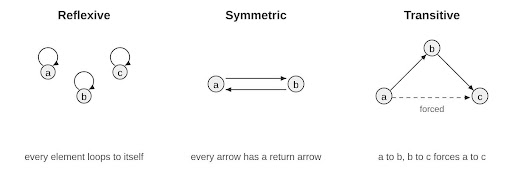
Figure 1: Reflexive, symmetric and transitive relations shown as arrow diagrams

A relation with all three properties is called an equivalence relation. Two special cases have names. The empty relation contains no pairs at all. The universal relation contains every possible pair.
Equivalence Classes
Best Courses for You

JEE

NEET

Foundation JEE

Foundation NEET

CBSE
An equivalence relation sorts a set into groups. Everything inside a group is related to everything else in that group, and nothing is related across groups. These groups are called equivalence classes.
[a] = { x ∈ A : (a, x) ∈ R }
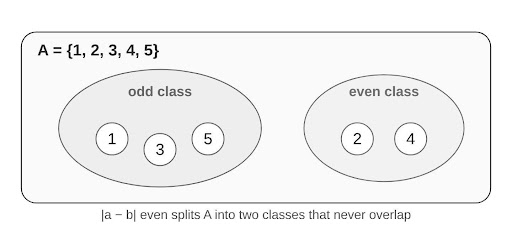
Figure 2: The relation "|a − b| is even" sorts A into an odd group and an even group
Types of Functions
A function f from A to B gives exactly one element of B to each element of A. The set A is the domain and the set B is the codomain. Two separate tests classify the function.
One-one (injective): if f(a) = f(b) then a = b
Onto (surjective): every element of B is an output of f
Bijective: one-one and onto together
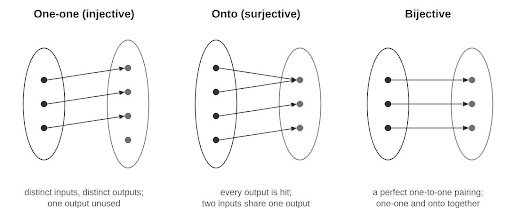
Figure 3: One-one, onto and bijective functions as arrow diagrams
Always run the two tests separately. A function can pass one and fail the other.
Standard Functions
Four functions appear again and again. The modulus, signum and greatest integer functions are all many-one, and none of them is onto R.
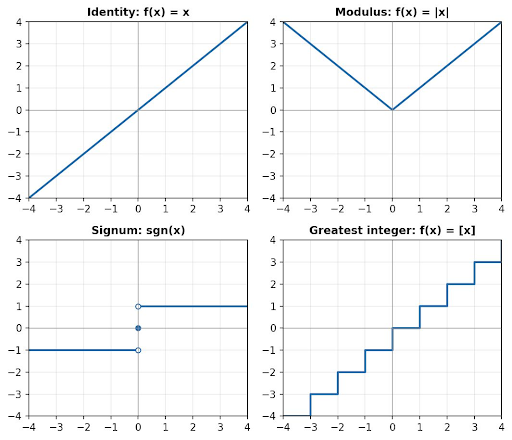
Figure 4: Identity, modulus, signum and greatest integer functions
NCERT Solutions for Class 12 Maths Chapter 1
The chapter has Exercise 1.1 with 16 questions, Exercise 1.2 with 12 questions and a Miscellaneous Exercise. The 18 questions below are taken from all three so that every concept in the chapter is covered.
| Q | Source | Concept covered |
| 1 | Ex 1.1 Q1(i) | Testing all three properties on a defined relation |
| 2 | Ex 1.1 Q1(ii) | Transitivity when no chain exists |
| 3 | Ex 1.1 Q1(iv) | Universal relation |
| 4 | Ex 1.1 Q2 | Disproving a property using one counterexample |
| 5 | Ex 1.1 Q6 | Symmetric but not reflexive or transitive |
| 6 | Ex 1.1 Q8 | Equivalence relation and its classes |
| 7 | Ex 1.1 Q9(i) | Equivalence class of a given element |
| 8 | Ex 1.1 Q10 | Building relations with chosen properties |
| 9 | Ex 1.1 Q14 | Equivalence relation in geometry |
| 10 | Ex 1.1 Q15 | Objective question on relation properties |
| 11 | Ex 1.2 Q1 | Domain and codomain decide the type of function |
| 12 | Ex 1.2 Q2(i), (ii) | Same formula, different domains |
| 13 | Ex 1.2 Q3 | Greatest integer function |
| 14 | Ex 1.2 Q4, Q5 | Modulus and signum functions |
| 15 | Ex 1.2 Q7(i) | Proving a function is bijective |
| 16 | Ex 1.2 Q10 | Rational function with excluded values |
| 17 | Miscellaneous | Counting onto functions on a finite set |
| 18 | Miscellaneous | Counting equivalence relations |
Step-by-Step NCERT Solutions for Relations and Functions
Q1. Ex 1.1 Q1(i): In A = {1, 2, …, 14}, R = {(x, y) : 3x − y = 0}. Check whether R is reflexive, symmetric and transitive.
Step 1. Write out R. The condition 3x − y = 0 means y = 3x. Only x = 1, 2, 3, 4 keep y inside the set, because x = 5 would give y = 15.
R = {(1, 3), (2, 6), (3, 9), (4, 12)}
Step 2. Reflexive? We would need (1, 1). Put x = 1, y = 1 into the rule: 3(1) − 1 = 2, which is not 0. So (1, 1) is not in R. Not reflexive.
Step 3. Symmetric? R contains (1, 3), so it would also need (3, 1). Put x = 3, y = 1: 3(3) − 1 = 8, which is not 0. Not symmetric.
Step 4. Transitive? R contains (1, 3) and (3, 9), so it would need (1, 9). Put x = 1, y = 9: 3(1) − 9 = −6, which is not 0. Not transitive.
Answer: R is neither reflexive nor symmetric nor transitive.
Q2. Ex 1.1 Q1(ii): In N, R = {(x, y) : y = x + 5 and x < 4}. Check all three properties.
Step 1. Write out R. Only x = 1, 2, 3 satisfy x < 4.
R = {(1, 6), (2, 7), (3, 8)}
Step 2. Reflexive? (1, 1) is not in R. Not reflexive.
Step 3. Symmetric? (1, 6) is in R but (6, 1) is not. Not symmetric.
Step 4. Transitive? To break transitivity we need a pair (a, b) and then a pair starting with b. The second numbers in R are 6, 7 and 8. None of these appears as a first number. So no such chain exists, and nothing can go wrong. Transitive.
Answer: R is transitive but neither reflexive nor symmetric.
Remember: if no case exists that could break the rule, the rule is treated as satisfied.
Q3. Ex 1.1 Q1(iv): In Z, R = {(x, y) : x − y is an integer}. Check all three properties.
Every element of Z is an integer, and one integer minus another is always an integer. So every possible pair is in R.
Reflexive? x − x = 0, which is an integer. Yes.
Symmetric? If x − y is an integer, then y − x is just its negative, so it is also an integer. Yes.
Transitive? If x − y and y − z are integers, adding them gives x − z, which is an integer. Yes.
Answer: R is an equivalence relation. It is the universal relation on Z.
Q4. Ex 1.1 Q2: Show that R = {(a, b) : a ≤ b²} on R is neither reflexive nor symmetric nor transitive.
To show a property fails, we only need one example that breaks it.
Reflexive? Take a = ½. The rule asks whether ½ ≤ (½)², that is ½ ≤ ¼. This is false. Not reflexive.
Symmetric? (1, 2) is in R because 1 ≤ 2² = 4. For symmetry we need (2, 1), which asks 2 ≤ 1² = 1. False. Not symmetric.
Transitive? (3, 2) is in R because 3 ≤ 4. (2, 1.5) is in R because 2 ≤ 2.25. Transitivity needs (3, 1.5), which asks 3 ≤ 2.25. False. Not transitive.
Answer: none of the three properties hold.
Remember: squaring makes a fraction between 0 and 1 smaller. Testing only whole numbers would give the wrong impression here.
Q5. Ex 1.1 Q6: Show that R = {(1, 2), (2, 1)} on {1, 2, 3} is symmetric but not reflexive or transitive.
Symmetric? The two pairs are reverses of each other, and both are present. Yes.
Reflexive? We would need (1, 1), (2, 2) and (3, 3). None of them is in R. No.
Transitive? (1, 2) followed by (2, 1) would require (1, 1). It is not in R. No.
Answer: R is symmetric only.
Q6. Ex 1.1 Q8: Show that R = {(a, b) : |a − b| is even} on A = {1, 2, 3, 4, 5} is an equivalence relation, and find its classes.
Reflexive? |a − a| = 0, and 0 is even. Yes.
Symmetric? |a − b| and |b − a| are the same number, so if one is even the other is too. Yes.
Transitive? Suppose |a − b| and |b − c| are both even. Adding two even numbers gives an even number, and |a − c| works out to be even as well. Yes.
So R is an equivalence relation. Now find the groups. Two odd numbers differ by an even amount. Two even numbers also differ by an even amount. But an odd and an even number differ by an odd amount, so they are never related.
Classes: {1, 3, 5} and {2, 4}
Answer: R is an equivalence relation with two classes, the odd numbers {1, 3, 5} and the even numbers {2, 4}.
Q7. Ex 1.1 Q9(i): In A = {x ∈ Z : 0 ≤ x ≤ 12}, R = {(a, b) : |a − b| is a multiple of 4}. Show R is an equivalence relation and find the elements related to 1.
Reflexive? |a − a| = 0, and 0 is a multiple of 4. Yes.
Symmetric? |a − b| = |b − a|. Yes.
Transitive? Adding or subtracting two multiples of 4 gives another multiple of 4. Yes.
Now find the elements related to 1. We need numbers in A whose distance from 1 is 0, 4, 8 or 12. Those are 1, 1 + 4 = 5, and 5 + 4 = 9. The next one would be 13, which is outside A.
[1] = {1, 5, 9}
Answer: R is an equivalence relation, and the elements related to 1 are 1, 5 and 9.
Q8. Ex 1.1 Q10: Give an example of a relation with each of the following sets of properties.
(i) Symmetric but not reflexive or transitive. On {1, 2, 3} take R = {(1, 2), (2, 1)}.
(ii) Transitive but not reflexive or symmetric. On R take R = {(a, b) : a < b}. Note a < a is false, and a < b does not give b < a.
(iii) Reflexive and symmetric but not transitive. On {1, 2, 3} take R = {(1,1), (2,2), (3,3), (1,2), (2,1), (2,3), (3,2)}. Here (1, 2) and (2, 3) are present but (1, 3) is missing.
(iv) Reflexive and transitive but not symmetric. On R take R = {(a, b) : a ≤ b}.
(v) Symmetric and transitive but not reflexive. On {1, 2, 3} take R = {(1,1), (2,2), (1,2), (2,1)}. The element 3 is not related to itself.
Q9. Ex 1.1 Q14: Show that the relation "is parallel to" on the set of lines in a plane is an equivalence relation, and find all lines related to y = 2x + 4.
Reflexive? A line is parallel to itself. Yes.
Symmetric? If line L is parallel to line M, then M is parallel to L. Yes.
Transitive? If L is parallel to M and M is parallel to N, then L is parallel to N. Yes.
Two lines are parallel exactly when their slopes are equal. The line y = 2x + 4 has slope 2. So every line related to it has slope 2 as well.
All lines of the form y = 2x + c, where c is any real number
Answer: it is an equivalence relation, and the class of y = 2x + 4 is the set of all lines y = 2x + c.
Q10. Ex 1.1 Q15: Let A = {1, 2, 3, 4} and R = {(1,1), (1,2), (1,3), (2,2), (3,3), (3,2), (4,4)}. Choose the correct option.
Reflexive? We need (1,1), (2,2), (3,3) and (4,4). All four are present. Yes.
Symmetric? (1, 2) is in R but (2, 1) is not. No.
Transitive? Check the chains that actually exist. (1,3) with (3,2) needs (1,2), which is present. (1,3) with (3,3) needs (1,3), present. (3,2) with (2,2) needs (3,2), present. Nothing is missing. Yes.
Answer: option (B), R is reflexive and transitive but not symmetric.
Q11. Ex 1.2 Q1: Show that f : R* → R*, f(x) = 1/x, is one-one and onto. Does the result still hold if the domain is N and the codomain stays R*?
Here R* means all real numbers except 0.
One-one? Suppose f(a) = f(b), that is 1/a = 1/b. Cross-multiplying gives a = b. Yes.
Onto? Take any y in R*. We need an x with 1/x = y. Choose x = 1/y, which is a real number and is not 0. Then f(1/y) = y. Yes. So f is bijective.
Now change the domain to N. The function f(n) = 1/n is still one-one, because 1/m = 1/n gives m = n. But it is no longer onto. For example, ⅗ belongs to R*, and there is no natural number n with 1/n = ⅗.
**Answer: f is one-one and onto on R*. With domain N it is one-one but not onto.**
Remember: whether a function is one-to-one or onto depends on the domain and codomain, not only on the formula.
Q12. Ex 1.2 Q2(i) and (ii): Check whether f(x) = x² is injective and surjective, first from N to N, then from Z to Z.
From N to N. If a² = b² and both a and b are natural numbers, then a = b, because both are positive. Injective. For surjective, take the value 3. There is no natural number whose square is 3. Not surjective.
From Z to Z. Here f(−1) = 1 and f(1) = 1. Two different inputs give the same output. Not injective. For surjective, take the value −4. No integer squared gives a negative number. Not surjective.
Answer: from N to N it is injective but not surjective. From Z to Z it is neither.
Q13. Ex 1.2 Q3: Show that the greatest integer function f : R → R, f(x) = [x], is neither one-one nor onto.
The greatest integer function rounds a number down to the nearest whole number.
One-one? [1.2] = 1 and [1.7] = 1. Two different inputs give the same output. No.
Onto? Every output is a whole number, so a value such as 0.5 is never produced. No.
Answer: the function is neither one-one nor onto.
Q14. Ex 1.2 Q4 and Q5: Show that the modulus function and the signum function on R are neither one-one nor onto.
Modulus function, f(x) = |x|. It is not one-one, because |−1| = 1 and |1| = 1. It is not onto, because |x| is never negative, so no negative number is ever an output.
Signum function. It gives 1 when x is positive, 0 when x = 0, and −1 when x is negative. It is not one-one, because every positive input gives the same output 1. It is not onto, because the only outputs are −1, 0 and 1.
Answer: both functions are neither one-one nor onto.
Q15. Ex 1.2 Q7(i): Is f : R → R given by f(x) = 3 − 4x one-one, onto or bijective?
One-one? Suppose 3 − 4a = 3 − 4b. Subtract 3 from both sides to get −4a = −4b. Divide by −4 to get a = b. Yes.
Onto? Take any real y and solve y = 3 − 4x. Rearranging gives 4x = 3 − y, so x = (3 − y)/4. This is a real number for every y. Yes.
Answer: f is bijective.
Q16. Ex 1.2 Q10: Let A = R − {3} and B = R − {1}, with f(x) = (x − 2)/(x − 3). Show that f is one-one and onto.
One-one? Suppose f(a) = f(b). Then:
(a − 2)(b − 3) = (b − 2)(a − 3)
Expanding the left side gives ab − 3a − 2b + 6. Expanding the right side gives ab − 3b − 2a + 6. Cancel ab and 6 from both sides to get −3a − 2b = −3b − 2a. Rearranging gives −a = −b, so a = b. Yes.
Onto? Take any y in B and solve y = (x − 2)/(x − 3). Cross-multiplying gives y(x − 3) = x − 2, so xy − 3y = x − 2. Collect the x terms: xy − x = 3y − 2, so x(y − 1) = 3y − 2.
x = (3y − 2)/(y − 1)
This works for every y except y = 1, and y = 1 has already been removed from B. The value of x is also never 3, so x lies in A. Yes.
Answer: f is one-one and onto.
Remember: the value removed from the codomain is exactly the value that would make the formula for x break down.
Q17. Miscellaneous Exercise: Find the number of all onto functions from the set {1, 2, 3, …, n} to itself.
The domain and the codomain have the same number of elements, n.
For the function to be onto, all n outputs must be used. There are only n inputs available, so each input must produce a different output. That means the function is also one-one.
A function that is both one-one and onto from a set to itself simply rearranges the n elements. The number of ways to arrange n items is n factorial.
Number of onto functions = n!
Answer: n! (n factorial).
Q18. Miscellaneous Exercise: The number of equivalence relations on {1, 2, 3} containing (1, 2) is (A) 1 (B) 2 (C) 3 (D) 4.
Step 1. Reflexivity forces (1,1), (2,2) and (3,3) into the relation.
Step 2. The relation must contain (1, 2). Symmetry then forces (2, 1) in as well.
Step 3. This gives a valid equivalence relation in which 1 and 2 are grouped together and 3 is on its own. That is the first one.
Step 4. The only other option is to bring 3 into the same group as 1 and 2, which gives every possible pair, that is the universal relation. That is the second one.
Step 5. Relating 3 to only one of 1 or 2 does not work, because transitivity would then force the other pair as well.
Answer: option (B), there are 2 such equivalence relations.
Key Features of Infinity Learn NCERT Solutions for Class 12 Maths Chapter 1
- Covers 18 selected questions from Exercise 1.1, Exercise 1.2 and the Miscellaneous Exercise.
- Each question is mapped to the concept it tests, so revision can be targeted.
- Every solution is broken into clear steps with the reason given at each stage.
- Where a property fails, one simple counterexample is shown.
- Equivalence relation answers give the actual classes, not just a yes or no.
- Prepared in line with the current rationalized NCERT textbook.
Why Use NCERT Solutions for Relations and Functions?
In this chapter, marks are given for the reasoning as well as the final answer. Writing "R is symmetric" on its own earns very little. Writing why it is symmetric earns the mark. The same few checks appear in the examination each year, so a student who can set out a clear proof has a reliable source of marks.
Students can use these solutions to:
- Learn the order in which a proof should be written.
- Practise disproving a property with a single counterexample.
- Work out the equivalence classes an equivalence relation creates.
- Keep the one-one test and the onto test separate.
- Check which topics are still part of the current syllabus.
Relations and Functions is a short chapter, but it sets up the language used through the rest of Class 12 Maths. Two habits carry almost all of it. First, when checking a relation, state the property, give the reason, then write the result. Second, when checking a function, treat "is it one-one?" and "is it onto?" as two separate questions, because a function can pass one and fail the other.
Work through the 18 questions above, cover each solution, and rebuild the steps from memory including the reason at each stage. Once these feel comfortable, move on to Chapter 2, Inverse Trigonometric Functions, which uses the same ideas of domain, range and one-one functions.
Study Class 12 Maths with Infinity Learn
Infinity Learn provides NCERT Solutions for every chapter of the current Class 12 Maths syllabus, with step-by-step working, proofs written in the order the CBSE marking scheme expects, and clear labelling of the topics removed in the 2023 rationalization, so no time is spent on material that is no longer examined.
Practise chapter by chapter, check your method against the worked solutions, and revise the key results before your board examination. Start with the questions on this page, then continue through the rest of the syllabus with Infinity Learn.
course
No courses found
FAQs on NCERT Solutions for Class 12 Maths Chapter 1
How many exercises are there in NCERT Class 12 Maths Chapter 1?
The current chapter has Exercise 1.1 with 16 questions, Exercise 1.2 with 12 questions, and a Miscellaneous Exercise. The earlier Exercise 1.3 and Exercise 1.4 were removed in the 2023 rationalization.
What are the important topics in Class 12 Maths Chapter 1?
Types of relations, which include reflexive, symmetric, transitive and equivalence relations, the equivalence classes these create, and types of functions, meaning one-one, onto and bijective. The modulus, signum and greatest integer functions also appear often.
What is the difference between a relation and a function?
A relation is any set of ordered pairs, and it may link one element to several others. A function gives exactly one output to each input. Every function is a relation, but a relation is a function only when no input is linked to two different outputs.
How do I prove that a relation is an equivalence relation?
Prove all three properties and give a reason for each one. Show that (a, a) is in R and say why. Show that (a, b) in R gives (b, a) in R and say why. Show that (a, b) and (b, c) in R give (a, c) in R and say why.
How do I check whether a function is one-one and onto?
For one-one, assume f(a) = f(b) and show this forces a = b. For onto, take any y in the codomain, solve f(x) = y for x, and check that this x lies in the domain. A function passing both tests is bijective.
Why does the same formula give different answers in different questions?
Because the domain and codomain are part of the function. The rule f(x) = x² is one-one on the natural numbers but not on the integers, since −1 and 1 both square to 1. Always read the sets before testing the formula.
Were binary operations removed from this chapter?
Yes. Composition of functions, invertible functions and binary operations were removed from Chapter 1 in the 2023 rationalization, so CBSE does not currently set questions on them from this chapter.
How many marks does Chapter 1 carry in the CBSE Class 12 Maths examination?
Chapter 1 sits in Unit I, Relations and Functions, together with Chapter 2, Inverse Trigonometric Functions. The unit carries 8 marks in the theory paper. The syllabus does not give a separate figure for Chapter 1 on its own.
