NCERT Solutions for Class 9 Maths Chapter 1 Orienting Yourself The Use of Coordinates
By Karan Singh Bisht
|
Updated on 4 Aug 2026, 17:04 IST
NCERT Solutions for Class 9 Maths Ganita Manjari Chapter 1 Orienting Yourself The Use of Coordinates are prepared by the expert faculty at Infinity Learn to help students understand every concept clearly. These Class 9 Maths Chapter 1 Solutions PDF explain each question in a simple, step-by-step manner so students can solve problems accurately and confidently in exams.
The NCERT Solutions for Class 9 Maths chapter 1 are designed as per the latest NCERT guidelines and focus on making Maths easier to learn. With detailed explanations for all exercise questions, students can strengthen their basics, improve problem-solving skills, and prepare effectively for school exams and CBSE board-level concepts.
Download PDF of NCERT Solutions Class 9 Maths Chapter 1 Orienting Yourself The Use of Coordinates - 2026-27
Download the NCERT Solutions Class 9 Maths Chapter 1 PDF for Orienting Yourself: The Use of Coordinates for Session 2026–27 from Infinity Learn. These step-by-step solutions help students understand coordinate concepts easily and prepare effectively for exams. Students can access the NCERT Class 9 Maths Chapter 1 PDF along with detailed explanations and solved exercises in both Hindi and English medium. The Class 9 Maths Chapter 1 Solutions PDF is useful for homework, revision, and practice anytime. Get free NCERT Solutions for Class 9 Maths PDF download and study with updated solutions based on the latest NCERT syllabus and Ganita Manjari Part 1 textbook.
NCERT Class 9 Maths Ganita Manjari Chapter 1 Solutions
Exercise 1.1
Fig. 1.3 shows Reiaan’s room with points OABC marking its corners. The x- and y-axes are marked in the figure. Point O is the origin.
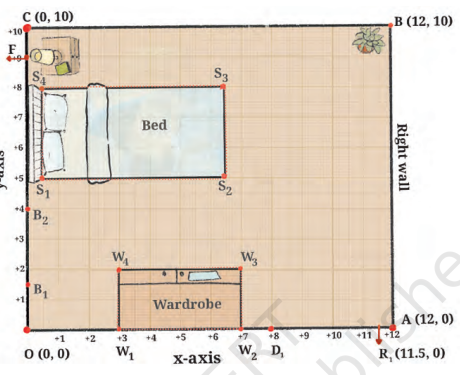
(i) If D₁R₁ represents the door to Reiaan’s room, how far is the door from the left wall (the y-axis) of the room? How far is the door from the x-axis?
Loading PDF...
Answer: The room door is located on the x-axis, therefore its distance from the x-axis is 0 units.
From the figure, the coordinates of the door endpoints are:
D₁ = (8, 0) and R₁ = (11.5, 0)
Hence, the door starts at a distance of 8 units from the y-axis.

(ii) What are the coordinates of D₁?
Answer: The coordinates of D₁ are (8, 0).
Best Courses for You

JEE

NEET

Foundation JEE

Foundation NEET

CBSE
(iii) If R₁ is the point (11.5, 0), how wide is the door? Do you think this is a comfortable width for the room door? If a person in a wheelchair wants to enter the room, will she/he be able to do so easily?
Answer: The coordinates of the door endpoints are D₁ = (8, 0) and R₁ = (11.5, 0).
So, the width of the door is:
Width = distance between D₁ and R₁
= 11.5 – 8
= 3.5 units
If 1 unit represents 1 foot, then the door width is 3.5 ft, which is about 42 inches.
A standard residential door is usually around 30 to 36 inches wide. So, this door is slightly wider than average and can be considered comfortable.
For wheelchair accessibility, a doorway generally needs at least 32 inches of clear width. Since 42 inches is greater than 32 inches, this door is wide enough for a wheelchair user to enter easily.
Therefore, the door width is comfortable and suitable for easy movement.
(iv) If B₁ (0, 1.5) and B₂ (0, 4) represent the ends of the bathroom door, is the bathroom door narrower or wider than the room door?
Answer: Coordinates of B₁ = (0, 1.5) and B₂ = (0, 4).
So, the width of the bathroom door
= distance between B₁ and B₂
= 4 – 1.5 = 2.5 units
Since 2.5 < 3.5, the bathroom door is narrower than the room door.
Exercise 1.2
On a graph sheet, mark the x-axis and y-axis and the origin O. Mark points from (-7, 0) to (13, 0) on the x-axis and from (0, – 15) to (0, 12) on the y-axis. (Use the scale 1 cm = 1 unit.) Using Fig. 1.5, answer the given questions.
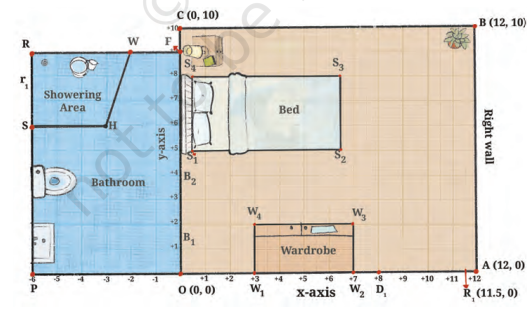
1. Place Reiaan’s rectangular study table with three of its feet at the points (8, 9), (11, 9) and (11, 7).
(i) Where will the fourth foot of the table be?
Answer: The three given points represent three vertices of a rectangle:
A = (8, 9)
B = (11, 9)
C = (11, 7)
To find the fourth vertex of the rectangle, we use:
- the same x-coordinate as point A, which is 8
- the same y-coordinate as point C, which is 7
Therefore, the coordinates of the fourth point are: (8, 7).
(ii) Is this a good spot for the table?
Answer: Yes, this is a suitable location because:
The table is arranged properly within the room.
It does not obstruct the doors or walking space.
Being placed close to the wall makes it convenient and practical for studying.
(iii) What is the width of the table? The length? Can you make out the height of the table?
Answers:
Width:
Distance between (8, 9) and (11, 9)
= 11 − 8
= 3 units
Length:
Distance between (11, 9) and (11, 7)
= 9 − 7
= 2 units
Height:
The height of the table cannot be found from the given diagram because it shows only a 2D top view, not the vertical measurement.
2. If the bathroom door has a hinge at B₁ and opens into the bedroom, will it hit the wardrobe? Are there any changes you would suggest if the door is made wider?
Answer: From Fig. 1.5, the bathroom door points are:
B₁ = (0, 1.5)
B₂ = (0, 4)
So, the width of the bathroom door is:
4 − 1.5 = 2.5 units
If the door is hinged at B₁ and opens into the bedroom, it will move in an arc with a radius of 2.5 units from B₁.
The wardrobe starts at:
W₁ = (3, 0)
W₄ = (3, 2)
The nearest edge of the wardrobe is around x = 3, which is farther than the door width of 2.5 units. Therefore, the bathroom door will not hit the wardrobe while opening.
If the door is made wider, it may come closer to the wardrobe or touch it. In that case, the door can be designed to open inward into the bathroom, the wardrobe can be shifted slightly to the right, or the door width can be kept limited for easy movement.
3. Look at Reiaan’s bathroom
(i) What are the coordinates of the four corners O, F, R, and P of the bathroom?
Answers:
From Fig. 1.5:
The coordinates of the four corners O, F, R and P of the bathroom are:
O = (0, 0)
F = (0, 9)
R = (-6, 9)
P = (-6, 0)
(ii) What is the shape of the showering area SHWR in Reiaan’s bathroom? Write the coordinates of the four corners.
Answer: From the figure, the coordinates are:
S = (-6, 6)
H = (-3, 6)
W = (-2, 9)
R = (-6, 9)
Here, one pair of opposite sides is parallel. Therefore, SHWR forms a trapezium.
Shape of SHWR: Trapezium
Coordinates of the corners:
S = (-6, 6)
H = (-3, 6)
W = (-2, 9)
R = (-6, 9)
(iii) Mark off a 3 ft × 2 ft space for the washbasin and a 2 ft × 3 ft space for the toilet. Write the coordinates of the corners of these spaces.
Answer: Washbasin Space (3 ft × 2 ft):
A rectangular space for the washbasin can be marked near the bottom-left corner of the bathroom.
Coordinates of the corners are:
(-6, 0.5), (-5, 0.5), (-5, 2), and (-6, 2)
Toilet Space (2 ft × 3 ft):
A rectangular space for the toilet can be placed above the washbasin area.
Coordinates of the corners are:
(-6, 3), (-4.5, 3), (-4.5, 4), and (-6, 4)
4. Other rooms in the house
(i) Reiaan’s room door leads from the dining room which has length 18 ft and width 15 ft. The length of the dining room extends from point P to point A. Sketch the dining room and mark the coordinates of its corners.
Answers: From Fig. 1.5:
P = (-6, 0)
A = (12, 0)
So, the length of PA is:
PA = 12 − (-6)
= 18 ft
This matches the given length.
Since the dining room is 15 ft wide and lies below PA, PA forms the upper side of the dining room. The room extends 15 units downward from PA.
Therefore, the four corners of the dining room are:
P = (-6, 0)
A = (12, 0)
Q = (12, -15)
S = (-6, -15)
Hence, the coordinates of the dining room corners are:
(-6, 0), (12, 0), (12, -15), and (-6, -15)
(ii) Place a rectangular 5 ft × 3 ft dining table precisely in the centre of the dining room. Write down the coordinates of the feet of the table.
Answers: The dining room extends:
From x = -6 to x = 12
From y = 0 to y = -15
Centre of the dining room:
x-coordinate of centre = (-6 + 12)/2 = 3
y-coordinate of centre = (0 + (-15))/2 = -7.5
Now place a 5 ft × 3 ft table at the centre. Taking length = 5 units along the x-axis and width = 3 units along the y-axis:
Half-length = 2.5
Half-width = 1.5
So the coordinates of corners (feet) of the table are:
(3 – 2.5, -7.5 – 1.5) = (0.5, -9)
(3 + 2.5, -7.5 – 1.5) = (5.5, -9)
(3 + 2.5, -7.5 + 1.5) = (5.5, -6)
(3 – 2.5, -7.5 + 1.5) = (0.5, -6)
The coordinates of the four feet of the dining table are:
(0.5, -9), (5.5, -9), (5.5, -6), (0.5, -6)
End-of-Chapter Exercises
1. What are the x-coordinate and y-coordinate of the point of intersection of the two axes?
Answer: The x-axis and y-axis intersect at the origin.
Therefore:
The x-coordinate = 0
The y-coordinate = 0
So, the point of intersection is (0, 0).
2. Point W has x-coordinate equal to –5. Can you predict the coordinates of point H which is on the line through W parallel to the y-axis? Which quadrants can H lie in?
Answer: If point W has an x-coordinate of -5, then every point on the line passing through W and parallel to the y-axis will also have the same x-coordinate, -5.
Therefore, point H can be written as:
H = (-5, y), where y is any real number.
Now, based on the value of y:
If y > 0, H lies in Quadrant II.
If y < 0, H lies in Quadrant III.
If y = 0, H lies on the x-axis.
So, point H can lie in Quadrant II, Quadrant III, or on the x-axis.
3. Consider the points R (3, 0), A (0, –2), M (–5, –2) and P (–5, 2). If they are joined in the same order, predict:
(i) Two sides of RAMP that are perpendicular to each other.
Answer: Let us Assume:
AM joins A(0, –2) to M(–5, –2), so it is horizontal.
MP joins M(–5, –2) to P(–5, 2), so it is vertical.
A horizontal line and a vertical line are perpendicular.
Therefore: -AM ⟂ MP
The two perpendicular sides are AM and MP.
(ii) One side of RAMP that is parallel to one of the axes.
Answer: AM is parallel to the x-axis because points A and M have the same y-coordinate, which is -2.
MP is parallel to the y-axis because points M and P have the same x-coordinate, which is -5.
Therefore, the sides parallel to the coordinate axes are:
AM, parallel to the x-axis, and MP, parallel to the y-axis.
(iii) Two points that are mirror images of each other in one axis. Which axis will this be? Now plot the points and verify your predictions.
Answer: Comparing both M(–5, –2) and P(–5, 2):
They have the same x-coordinate.
Their y-coordinates are equal in magnitude but opposite in sign.
So, they are mirror images of each other in the x-axis.
The points M and P are mirror images of each other.
The axis is the x-axis.
4. Plot point Z (5, –6) on the Cartesian plane. Construct a right-angled triangle IZN and find the lengths of the three sides.
Answer: Point Z is (5, –6).
To form a right-angled triangle easily, take:
I = (5, 0) on the x-axis
N = (0, –6) on the y-axis
Then triangle IZN is right-angled at Z? Let’s check:
IZ is vertical
ZN is horizontal
So, triangle IZN is right-angled at Z.
Coordinates of the points:
I = (5, 0)
Z = (5, –6)
N = (0, –6)
Now find the lengths of the sides:
- IZ:
Distance between (5, 0) and (5, –6)
= 0 – (–6) = 6 units
- ZN:
Distance between (5, –6) and (0, –6)
= 5 – 0 = 5 units
- IN:
Using distance formula:
IN = √[(5 – 0)² + (0 – (–6))²]
= √(5² + 6²)
= √(25 + 36)
= √61 units
Therefore, one possible right-angled triangle is formed by:
I = (5, 0)
Z = (5, –6)
N = (0, –6)
Lengths of the sides:
IZ = 6 units
ZN = 5 units
IN = √61 units
5. What would a system of coordinates be like if we did not have negative numbers? Would this system allow us to locate all the points on a 2-D plane?
Answer: If negative numbers did not exist, coordinates could only be zero or positive.
In that case, on the x-axis, we could mark only the points to the right of the origin, and on the y-axis, only the points above the origin.
So, we would be able to locate points only in Quadrant I, on the positive x-axis, on the positive y-axis, and at the origin.
We would not be able to locate points in Quadrants II, III, and IV, or on the negative parts of the axes.
Therefore, without negative numbers, it would not be possible to locate all points on a 2-D plane.
6. Are the points M (–3, –4), A (0, 0) and G (6, 8) on the same straight line? Suggest a method to check this without plotting and joining the points.
Answer: To check whether the points M (–3, –4), A (0, 0), and G (6, 8) lie on the same straight line using the Distance formula:
d = √[(x₂ − x₁)² + (y₂ − y₁)²]
MA = √[(0 + 3)² + (0 + 4)²]
= √(3² + 4²)
= √(9 + 16) = √25 = 5
AG = √[(6 − 0)² + (8 − 0)²]
= √(36 + 64)
= √100 = 10
MG = √[(6 + 3)² + (8 + 4)²]
= √(9² + 12²)
= √(81 + 144)
= √225 = 15
Now checking: MA + AG = 5 + 10 = 15 = MG
Since the sum of two distances equals the third, the points M, A and G lie on the same straight line.
7. Use your method (from Problem 6) to check if the points R (–5, –1), B (–2, –5) and C (4, –12) are on the same straight line. Now plot both sets of points and check your answers.
Answer: To check whether the points R (–5, –1), B (–2, –5) and C (4, –12) lie on the same straight line using the distance formula: d = √[(x₂ − x₁)² + (y₂ − y₁)²]
RB = √[(–2 + 5)² + (–5 + 1)²]
= √(3² + (–4)²)
= √(9 + 16) = √25 = 5
BC = √[(4 + 2)² + (–12 + 5)²]
= √(6² + (–7)²)
= √(36 + 49) = √85
RC = √[(4 + 5)² + (–12 + 1)²]
= √(9² + (–11)²)
= √(81 + 121) = √202
Now: RB + BC = 5 + √85 ≠ √202
Since the sum of two distances is not equal to the third, the points R, B and C do not lie on the same straight line.
8. Using the origin as one vertex, plot the vertices of:
(i) A right-angled isosceles triangle.
Answer: One possible set of coordinates for triangle OAB is:
O = (0, 0)
A = (4, 0)
B = (0, 4)
Here,
OA = 4 units
OB = 4 units
Also, OA is perpendicular to OB.
Therefore, triangle OAB is a right-angled isosceles triangle.
(ii) An isosceles triangle with one vertex in Quadrant III and the other in Quadrant IV.
Answer: One possible set of vertices is:
O = (0, 0), P = (–3, –4), Q = (3, –4)
Explanation:
P lies in Quadrant III
Q lies in Quadrant IV
OP = OQ = 5 units
So triangle OPQ is an isosceles triangle.
Key Advantages of NCERT Solutions for Class 9 Maths Ganita Manjari Chapter 1
Chapter 1 of Ganita Manjari Part 1 introduces students to important concepts related to coordinates and their practical applications. To understand these concepts clearly and solve textbook questions accurately, students need reliable and easy-to-follow solutions.
Infinity Learn provides detailed NCERT Solutions for Class 9 Maths Ganita Manjari Chapter 1 with step-by-step explanations prepared by expert faculty according to the latest NCERT syllabus, NEP 2020, and NCF 2023 guidelines.
Advantages of Using Infinity Learn NCERT Solutions
- Step-by-step solutions for all exercise questions in Chapter 1
- Easy explanations to help students understand coordinate geometry concepts clearly
- Prepared by expert Maths teachers for accurate and reliable learning
- Includes proper methods, diagrams, and calculations wherever required
- Helps improve logical thinking and problem-solving abilities
- Useful for homework, assignments, practice, and school exams
- Strengthens the foundation for advanced Maths concepts in higher classes
- Available in both Hindi and English medium
- Supports preparation for CBSE, State Boards, Olympiads, and NTSE exams
- Free downloadable PDF solutions for offline study and quick revision
- Updated according to the latest NCERT textbook Ganita Manjari Part 1 for Session 2026–27
- Student-friendly explanations designed to make Maths simple and interesting
| S.No. | Important Study Material for Maths Class 9 |
| 1 | CBSE Class 9 Maths NCERT Books |
| 2 | CBSE Class 9 Notes |
| 3 | CBSE Class 9 Maths Important Questions |
| 4 | CBSE Class 9 Maths NCERT Solutions |
| 7 | CBSE Class 9 Maths RD Sharma Solutions |
| 9 | CBSE Class 9 Maths Syllabus |
| 10 | CBSE Class 9 Sample Papers |
course
No courses found
FAQs on NCERT Solutions for Class 9 Maths Chapter 1
Where can I get NCERT Solutions for Class 9 Maths Chapter 1 for free?
Students can access free NCERT Solutions for Class 9 Maths Chapter 1 on Infinity Learn. The platform provides chapter-wise and exercise-wise solutions with easy explanations in both Hindi and English medium. Students can also access NCERT Solutions for Class 9 Maths PDF for quick revision and practice.
Can I download NCERT Solutions Class 9 Maths Chapter 1 PDF?
Yes, students can easily get NCERT Solutions Class 9 Maths Chapter 1 PDF download from Infinity Learn. The downloadable PDFs help students study offline, revise important concepts, and practice questions anytime.
How do Class 9 Maths Chapter 1 Solutions PDF help students?
Using Class 9 Maths Chapter 1 Solutions PDF helps students understand coordinate geometry concepts through step-by-step explanations, diagrams, and accurate methods. These solutions improve problem-solving skills and help students prepare for school exams, Olympiads, and future competitive exams.
Why is Infinity Learn best for NCERT Class 9 Maths solutions?
Infinity Learn is trusted by students for providing expert-verified and easy-to-understand Maths solutions. The platform offers free NCERT Solutions for Class 9 Maths PDF, detailed explanations, downloadable study materials, and updated content according to the latest NCERT guidelines.
Are Infinity Learn NCERT Solutions for Class 9 Maths Chapter 1 based on the latest syllabus?
Yes, Infinity Learn provides solutions based on the latest NCERT syllabus, including the new Ganita Manjari Part 1 textbook introduced under NEP 2020 and NCF 2023 for Session 2026–27.
What concepts are covered in Orienting Yourself – The Use of Coordinates?
Students learn how positions can be represented using coordinates, including axes, the origin, ordered pairs and the location of points on a coordinate plane. These concepts introduce the basic language used in later coordinate geometry.
Are the textbook exercises for this chapter solved on Infinity Learn?
Infinity Learn states that the page provides exercise-wise solutions for the chapter. Students should attempt the textbook questions independently before checking the solutions.
Why should students understand the use of coordinates in Class 9?
The chapter is part of the Class 9 Mathematics learning sequence and supports later topics involving graphs and coordinate geometry. Students should prepare it according to the textbook and their school’s assessment plan.
What common mistakes do students make while plotting coordinates?
Common errors include reversing the x- and y-coordinates, using the wrong sign, misreading the scale and plotting a point incorrectly. Writing each ordered pair in the form ((x,y)) and checking the axis labels can reduce these mistakes.
How should students prepare the chapter?
Students should first understand the axes, origin, scale and ordered-pair notation. They can then practise locating and plotting points, complete the textbook questions and review plotting errors using graph paper.
Why should students attempt the questions before reading the solutions?
Attempting the questions independently helps students identify what they understand and where they need help. The solutions can then be used to check the method and correct errors.
