- Arithmetic Expressions Class 7 NCERT PDF Download
- Arithmetic Expressions Class 7 Solutions Ganita Prakash Maths Chapter 2
- NCERT Class 7 Maths Chapter 2 Arithmetic Expressions Solutions Question Answer
- Benefits of NCERT Solutions For Class 7 Maths Chapter 2 Arithmetic Expressions
- FAQs on NCERT Solutions For Class 7 Maths Chapter 2
NCERT Solutions For Class 7 Maths Chapter 2 Arithmetic Expressions 2026-27
By Karan Singh Bisht
|
Updated on 27 Jul 2026, 18:15 IST
NCERT Solutions for Class 7 Maths Ganita Prakash Chapter 2 Arithmetic Expressions are prepared to help students understand the chapter in a simple, step-by-step, and exam-focused way. This Arithmetic Expressions Class 7 Solutions is written for the 2026-27 academic session so that Class 7 students can easily learn how to form, read, simplify, and evaluate arithmetic expressions.
The solutions is based on the latest NCERT Class 7 Maths Ganita Prakash textbook and the updated CBSE syllabus. Chapter 2 Arithmetic expressions Class 7 Solutions introduces students to numbers, operations, brackets, terms, simple expressions, complex expressions, and the correct order of solving expressions. The Arithmetic Expressions Class 7 Solutions are written by carefully studying the textbook exercises, examples, important concepts, and exam-based question patterns.
At Infinity Learn, these Arithmetic Expressions Class 7 Solutions are created by subject experts in a student-friendly format. Each answer is explained clearly so that students can understand the method behind every step instead of only memorizing the final answer. NCERT Solutions for Class 7 Maths also help students improve calculation accuracy, problem-solving skills, and confidence in Maths.
This NCERT Solutions is useful for Class 7 students, Maths teachers, and parents. Students can use it for homework, classwork, chapter revision, exam preparation, and quick doubt-solving. Teachers can use it for classroom explanation, while parents can use it to guide children during self-study.
Arithmetic Expressions Class 7 NCERT PDF Download
Students can download the Arithmetic Expressions Class 7 NCERT PDF from Infinity Learn for easy offline practice. The PDF includes stepwise solutions, important sums, clear explanations, formulas, and revision support to help students prepare better for Class 7 Maths Chapter 2.
Arithmetic Expressions Class 7 Solutions Ganita Prakash Maths Chapter 2
Arithmetic Expressions Class 7 Solutions are prepared to help students understand Ganita Prakash Class 7 Maths Chapter 2 in a simple and step-by-step way. These solutions make it easier for students to solve textbook questions, practise arithmetic expressions, and build confidence in Maths.
Loading PDF...
By using Ganita Prakash Class 7 Chapter 2 Solutions Arithmetic Expressions from Infinity Learn, students can understand each question clearly, improve problem-solving skills, and prepare better for homework, class tests, and exams.
NCERT Class 7 Maths Chapter 2 Arithmetic Expressions Solutions Question Answer
2.1 Simple Expressions
NCERT In-Text Questions (Page 24)
Example 1: Mallika spends ₹25 every day for lunch at school. Write the expression for the total amount she spends on lunch in a week from Monday to Friday.
Solution: Mallika spends ₹25 every day for lunch.
From Monday to Friday, there are 5 days.

So, total amount spent = ₹25 × 5
Expression: 25 × 5
Best Courses for You

JEE

NEET

Foundation JEE

Foundation NEET

CBSE
Total amount: ₹125
Therefore, Mallika spends ₹125 on lunch from Monday to Friday.
Q. Choose your favourite number and write as many expressions as you can having that value.
Solution: My favourite number is 12.
Here are some arithmetic expressions having the value 12:
- 10 + 2 = 12
- 15 - 3 = 12
- 6 × 2 = 12
- 24 ÷ 2 = 12
- 8 + 4 = 12
- 20 - 8 = 12
- 3 × 4 = 12
- 36 ÷ 3 = 12
- 5 + 5 + 2 = 12
- 2 × 3 × 2 = 12
- 18 - 4 - 2 = 12
- 4 + 4 + 4 = 12
Therefore, many different expressions can have the same value 12.
Figure it Out (Page 25)
Question 1. Fill in the blanks to make the expressions equal on both sides of the ‘=’ sign:
(a) 13 + 4 = _________ + 6
(b) 22 + _________ = 6 × 5
(c) 8 × _________ = 64 ÷ 2
(d) 34 – _________ = 25
Solution:
(a) 13 + 4 = 17
11 + 6 = 17
Therefore, 13 + 4 = 11 + 6
(b) Since 6 × 5 = 30
22 + 8 = 30
Therefore, 22 + 8 = 6 × 5
(c) Since 64 ÷ 2 = 32
8 × 4 = 32
Therefore, 8 × 4 = 64 ÷ 2
(d) Since 34 – 25 = 9
Therefore, 34 – 9 = 25
Question 2. Arrange the following expressions in ascending (increasing) order of their values.
(a) 67 – 19
(b) 67 – 20
(c) 35 + 25
(d) 5 × 11
(e) 120 ÷ 3
Solution:
(a) 67 – 19 = 48
(b) 67 – 20 = 47
(c) 35 + 25 = 60
(d) 5 × 11 = 55
(e) 120 ÷ 3 = 40
Therefore, 40 < 47 < 48 < 55 < 60
Thus, (e) < (b) < (a) < (d) < (c)
Comparing Expressions
NCERT In-Text Questions (Page 26)
Use ‘>’ or ‘<’ or ‘=’ in each of the following expressions to compare them. Can you do it without complicated calculations? Explain your thinking in each case.
Solution:
(a) 245 + 289 ___ 246 + 285
Compare the numbers:
245 is 1 less than 246, but 289 is 4 more than 285.
So, the left side gains 4 and loses only 1.
Therefore,
245 + 289 > 246 + 285
(b) 273 – 145 ___ 272 – 144
On the left side, both numbers are 1 more than the numbers on the right side.
273 is 1 more than 272, and 145 is 1 more than 144.
So, the difference remains the same.
Therefore,
273 – 145 = 272 – 144
(c) 364 + 587 ___ 363 + 589
364 is 1 more than 363, but 587 is 2 less than 589.
So, the left side is overall 1 less than the right side.
Therefore,
364 + 587 < 363 + 589
(d) 124 + 245 ___ 129 + 245
Both expressions have 245.
So, compare only 124 and 129.
Since 124 is less than 129,
124 + 245 < 129 + 245
(e) 213 – 77 ___ 214 – 76
In the right expression, the first number is 1 more and the number subtracted is 1 less.
So, the right side becomes greater.
Therefore,
213 – 77 < 214 – 76
Section 2.2: Reading and Evaluating Complex Expressions
Example 4: Mallesh brought 30 marbles to the playground. Arun brought 5 bags of marbles with 4 marbles in each bag. How many marbles did Mallesh and Arun bring to the playground?
Solution: Mallesh brought 30 marbles.
Arun brought 5 bags, and each bag has 4 marbles.
Marbles brought by Arun = 5 × 4
Marbles brought by Arun = 20
Total marbles = 30 + 20
Total marbles = 50
Therefore, Mallesh and Arun brought 50 marbles to the playground.
Example 5: Irfan bought a pack of biscuits for ₹15 and a packet of toor dal for ₹56. He gave the shopkeeper ₹100. Write an expression that can help us calculate the change Irfan will get back from the shopkeeper
Solution: Irfan spent money on:
Biscuits = ₹15
Toor dal = ₹56
Total cost = ₹15 + ₹56
He gave the shopkeeper ₹100.
So, the expression for the change is:
100 - (15 + 56)
Now,
100 - (15 + 56) = 100 - 71 = 29
Therefore, Irfan will get ₹29 back from the shopkeeper.
NCERT In-Text Questions (Pages 28-29)
Terms in Expressions
Check if replacing subtraction by addition in this way does not change the value of the expression, by taking different examples.
Solution: Yes, replacing subtraction by addition of the opposite number does not change the value of the expression.
This means:
a - b = a + (-b)
Let us check with some examples.
Example 1
8 - 3 = 5
Now replace subtraction by addition:
8 + (-3) = 5
So,
8 - 3 = 8 + (-3)
Can you explain why subtracting a number is the same as adding its inverse, using the Token Model of integers that we saw in the Class 6 textbook of mathematics?
Solution: Yes. In the Token Model of integers, we use:
- One positive token to represent +1
- One negative token to represent -1
- One positive token and one negative token together make a zero pair
So,
(+1) + (-1) = 0
This means adding or removing zero pairs does not change the value.
Example 1: 5 - 3
Start with 5 positive tokens.
To subtract 3, remove 3 positive tokens.
5 - 3 = 2
Now write it as addition of the inverse:
5 + (-3)
This means start with 5 positive tokens and add 3 negative tokens.
Now make zero pairs:
3 positive tokens pair with 3 negative tokens and become 0.
Only 2 positive tokens remain.
So,
5 + (-3) = 2
Therefore, 5 - 3 = 5 + (-3)
Does changing the order in which the terms are added give different values?
Solution: No. The value of the expression does not change because each term is separated by a ‘+’ sign. When an expression is written as addition of integers, we can change the order of the terms without changing the final value.
For example:
4 + 15 + (-9) = 19 + (-9) = 10
Now change the order:
(-9) + 15 + 4 = 6 + 4 = 10
Both expressions give the same value.
Therefore,
4 + 15 + (-9) = (-9) + 15 + 4
So, changing the order of addition does not change the value of the expression.
NCERT In-Text Questions (Pages 29-31)
Swapping and Grouping
Example 6: Madhu is flying a drone from a terrace. The drone goes 6 m up and then 4 m down. Write an expression to show how high the final position of the drone is from the terrace. Will the sum change if we swap the terms?
Solution: The drone goes 6 m up, so we write it as +6.
Then the drone goes 4 m down, so we write it as -4.
Expression:
6 + (-4)
Now,
6 + (-4) = 2
So, the final position of the drone is 2 m above the terrace.
Will the sum change if we swap the terms?
No, the sum will not change.
6 + (-4) = 2
Now swap the terms:
(-4) + 6 = 2
Both give the same answer.
Therefore,
6 + (-4) = (-4) + 6
So, the drone’s final position is 2 m above the terrace, and swapping the terms does not change the sum.
Will this also hold when there are terms having negative numbers as well? Take some more expressions and check.
Solution: Yes. This rule also holds when some terms are negative numbers, as long as the expression is written as addition of terms.
In addition, changing the order of terms does not change the value.
Example
7 + (-3) + 5
7 + (-3) + 5 = 4 + 5 = 9
Now change the order:
5 + 7 + (-3) = 12 + (-3) = 9
So,
7 + (-3) + 5 = 5 + 7 + (-3)
Can you explain why this is happening using the Token Model of integers that we saw in the Class 6 textbook of mathematics?
Solution: Using the Token Model, addition means combining groups of positive and negative tokens. When we combine two groups, the order does not matter. Whether we add collection A to collection B or collection B to collection A, the final set of tokens remains the same.
This shows the commutative property of addition for integers.
Statement:
In an expression with two terms, changing the order of the terms does not change the value.
Term 1 + Term 2 = Term 2 + Term 1
Example
Consider the expression:
(-7) + 10 + (-11)
First, add the first two terms and then the third:
((-7) + 10) + (-11)
= 3 + (-11)
= -8
Now, add the last two terms first and then the first term:
(-7) + (10 + (-11))
= (-7) + (-1)
= -8
In both cases, the value is -8.
Therefore, changing the order or grouping of terms in addition does not change the final value.
Does adding the terms of an expression in any order give the same value? Take some more expressions and check. Consider expressions with more than 3 terms also.
Solution: Yes, the terms of an expression can be added in any order, and the value remains the same.
Example
10 + (-5) + 2 + (-3)
= 5 + 2 + (-3)
= 7 + (-3)
= 4
Now, change the order of the terms:
10 + 2 + (-5) + (-3)
= 12 + (-5) + (-3)
= 7 + (-3)
= 4
Both expressions give the same value, 4.
Therefore, changing the order of addition does not change the value of the expression.
Can you explain why this (addition in any order gives same value) is happening using the Token Model of integers that we saw in the Class 6 textbook of mathematics?
Solution: Using the Token Model, adding many terms means bringing together different groups of positive and negative tokens. The final value depends only on the total number of positive tokens and negative tokens after they are combined.
The order in which we combine these groups does not change the result. Whether we add the first group, second group, or third group in any sequence, the final pile of tokens will remain the same.
So, when we add integers, changing the order of the terms does not change the value of the expression.
Manasa is adding a long list of numbers. It took her five minutes to add them all and she got the answer 11749. Then she realised that she had forgotten to include the fourth number 9055. Does she have to start all over again?
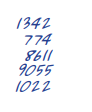
Solution: No, there is no need to start the addition again. She only needs to add the fourth number, 9055, to the sum she already found, 11749, to get the correct total.
So,
11749 + 9055 = 20804
Therefore, the correct sum of the given numbers is 20804.
NCERT In-Text Questions (Pages 32-33)
More Expressions and Their Terms
Example 7: Amu, Charan, Madhu, and John went to a hotel and ordered four dosas. Each dosa cost ₹23, and they wish to thank the waiter by tipping ₹5. Write an expression describing the total cost.
Solution: Each dosa costs ₹23.
They ordered 4 dosas.
Cost of 4 dosas = 4 × 23
Tip given to the waiter = ₹5
So, the expression for the total cost is:
4 × 23 + 5
Now,
4 × 23 + 5 = 92 + 5 = 97
Therefore, the total cost is ₹97.
Q. If the total number of friends goes up to 7 (ordering 7 dosas at ₹23 each) and the tip remains the same (₹5), how much will they have to pay? Write an expression for this situation and identify its terms.
Solution: There are 7 friends, so they order 7 dosas.
Cost of each dosa = ₹23
Tip = ₹5
Expression:
7 × 23 + 5
Now,
7 × 23 + 5 = 161 + 5 = 166
So, they will have to pay ₹166.
Terms of the expression:
In the expression 7 × 23 + 5, the terms are:
7 × 23 and 5
Here, 7 × 23 represents the cost of 7 dosas, and 5 represents the tip.
Example 8: Children in a class are playing “Fire in the mountain, run, run, run!”. Whenever the teacher calls out a number, students are supposed to arrange themselves in groups of that number. Whoever is not part of the announced group size, is out.
Solution: When 33 students make groups of 5, they can form 6 complete groups.
Since,
33 = 6 × 5 + 3
This means:
6 × 5 represents 6 groups with 5 students in each group.
3 represents the students who are left over.
So, Ruby’s expression shows the total number of students:
6 × 5 + 3
Now,
6 × 5 + 3 = 30 + 3 = 33
Therefore, the expression 6 × 5 + 3 correctly represents all 33 students.
Example 9: Raghu bought 100 kg of rice from the wholesale market and packed them into 2 kg packets. He already had four 2 kg packets. Write an expression for the number of 2 kg packets of rice he has now and identify the terms.
Solution: Raghu bought 100 kg of rice.
Each packet is of 2 kg, so the number of packets made from 100 kg rice is:
100 ÷ 2
He already had 4 packets.
So, the expression for the total number of 2 kg packets is:
100 ÷ 2 + 4
Now,
100 ÷ 2 + 4 = 50 + 4 = 54
Therefore, Raghu has 54 packets of rice now.
Terms of the expression:
In 100 ÷ 2 + 4, the terms are:
100 ÷ 2 and 4.
Example 10: Kannan has to pay ₹432 to a shopkeeper using coins of ₹1 and ₹5, and notes of ₹10, ₹20, ₹50 and ₹100. How can he do it?
Solution: Kannan can pay ₹432 in this way:
- 3 notes of ₹100 = ₹300
- 1 note of ₹50 = ₹50
- 3 notes of ₹20 = ₹60
- 1 note of ₹10 = ₹10
- 2 coins of ₹5 = ₹10
- 2 coins of ₹1 = ₹2
Expression:
3 × 100 + 1 × 50 + 3 × 20 + 1 × 10 + 2 × 5 + 2 × 1
Now,
300 + 50 + 60 + 10 + 10 + 2 = 432
Therefore, Kannan can pay ₹432 using these coins and notes.
Example 11: Here are two pictures. Which of these two arrangements matches with the expression 5 × 2 + 3?
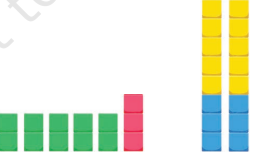
Solution: The first arrangement matches the expression:
5 × 2 + 3
Because it shows:
5 groups of 2 green blocks = 5 × 2 = 10
and 3 red blocks = +3
So,
5 × 2 + 3 = 10 + 3 = 13
The second arrangement shows two tall stacks, so it does not match 5 × 2 + 3.
Figure it Out (Pages 34-35)
Question 1. Find the values of the following expressions by writing the terms in each case.
(a) 28 – 7 + 8
Terms: 28, -7, 8
Value:
28 – 7 + 8
= 21 + 8
= 29
(b) 39 – 2 × 6 + 11
Terms: 39, -2 × 6, 11
Value:
39 – 2 × 6 + 11
= 39 – 12 + 11
= 27 + 11
= 38
(c) 40 – 10 + 10 + 10
Terms: 40, -10, 10, 10
Value:
40 – 10 + 10 + 10
= 30 + 10 + 10
= 50
So, the value is 50.
(d) 48 – 10 × 2 + 16 + 2
Terms: 48, -10 × 2, 16, 2
Value:
48 – 10 × 2 + 16 + 2
= 48 – 20 + 16 + 2
= 28 + 16 + 2
= 46
(e) 6 × 3 – 4 × 8 × 5
Terms: 6 × 3, -4 × 8 × 5
Value:
6 × 3 – 4 × 8 × 5
= 18 – 160
= -142
Question 2. Write a story/situation for each of the following expressions and find their values.
(a) 89 + 21 – 10
Riya had 89 stickers. Her friend gave her 21 more stickers. Then she gave 10 stickers to her brother.
Expression: 89 + 21 – 10
Value: 89 + 21 – 10 = 110 – 10 = 100
So, Riya has 100 stickers left.
(b) 5 × 12 – 6
A shopkeeper arranged 5 boxes of pencils. Each box had 12 pencils. Out of these, 6 pencils were sold.
Expression: 5 × 12 – 6
Value: 5 × 12 – 6 = 60 – 6 = 54
So, 54 pencils are left.
(c) 4 × 9 + 2 × 6
There are 4 rows of chairs with 9 chairs in each row. There are also 2 more rows with 6 chairs in each row.
Expression: 4 × 9 + 2 × 6
Value: 4 × 9 + 2 × 6 = 36 + 12 = 48
So, there are 48 chairs in all.
Question 3. For each of the following situations, write the expression describing the situation, identify its terms and find the value of the expression.
(a) Queen Alia gave 100 gold coins to Princess Elsa and 100 gold coins to Princess Anna last year. Princess Elsa used the coins to start a business and doubled her coins. Princess Anna bought jewellery and has only half of the coins left. Write an expression describing how many gold coins Princess Elsa and Princess Anna together have.
Solution: Princess Elsa had 100 gold coins and doubled them.
Coins with Elsa = 2 × 100
Princess Anna had 100 gold coins and has only half left.
Coins with Anna = 100 ÷ 2
Expression:
2 × 100 + 100 ÷ 2
Terms: 2 × 100 and 100 ÷ 2
Value:
2 × 100 + 100 ÷ 2
= 200 + 50
= 250
So, Princess Elsa and Princess Anna together have 250 gold coins.
(b) A metro train ticket between two stations is ₹40 for an adult and ₹20 for a child. What is the total cost of tickets:
(i) for four adults and three children?
(ii) for two groups having three adults each?
Solution: Adult ticket = ₹40
Child ticket = ₹20
(i) For four adults and three children
Cost for four adults = 4 × 40
Cost for three children = 3 × 20
Expression:
4 × 40 + 3 × 20
Terms: 4 × 40 and 3 × 20
Value:
4 × 40 + 3 × 20
= 160 + 60
= 220
So, the total cost is ₹220.
(ii) For two groups having three adults each
Each group has 3 adults.
Cost for one group = 3 × 40
For two such groups, expression:
3 × 40 + 3 × 40
Terms: 3 × 40 and 3 × 40
Value:
3 × 40 + 3 × 40
= 120 + 120
= 240
So, the total cost is ₹240.
(c) Find the total height of the window by writing an expression describing the relationship among the measurements shown in the picture
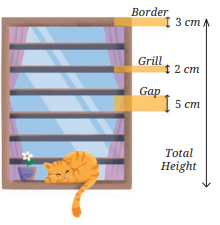
Solution: The picture shows:
- 2 borders: top and bottom, each 3 cm
- 6 grills, each 2 cm
- 7 gaps, each 5 cm
So, the expression for the total height is:
2 × 3 + 6 × 2 + 7 × 5
Now,
2 × 3 + 6 × 2 + 7 × 5
= 6 + 12 + 35
= 53
Therefore, the total height of the window is 53 cm.
Figure it Out Page 37
Question 1. Fill in the blanks with numbers, and boxes with operation signs such that the expressions on both sides are equal.
(a) 24 + (6 – 4) = 24 + 6 ___ 4
(b) 38 + ( ___ ) = 38 + 9 – 4
(c) 24 – (6 + 4) = 24 ___ 6 – 4
(d) 24 – 6 – 4 = 24 – 6 (__) ______
(e) 27 – (8 + 3) = 27 ___ 8 ___ 3
(f) 27 – ( ___ ) = 27 – 8 + 3
Solution:
(a) 24 + (6 – 4) = 24 + 6 – 4
Blank: –
(b) 38 + (9 – 4) = 38 + 9 – 4
Blank: 9 – 4
(c) 24 – (6 + 4) = 24 – 6 – 4
Blank: –
(d) 24 – 6 – 4 = 24 – (6 + 4)
Blank: + 4
(e) 27 – (8 + 3) = 27 – 8 – 3
Blanks: – , –
(f) 27 – (8 – 3) = 27 – 8 + 3
Blank: 8 – 3
Question 2. Remove the brackets and write the expression having the same value.
Solution:
(a) 14 + (12 + 10)
When there is a + sign before the bracket, signs inside do not change.
14 + 12 + 10
(b) 14 – (12 + 10)
When there is a – sign before the bracket, signs inside change.
14 – 12 – 10
(c) 14 + (12 – 10)
The + sign before the bracket keeps the signs same.
14 + 12 – 10
(d) 14 – (12 – 10)
The – sign before the bracket changes the signs inside.
14 – 12 + 10
(e) –14 + (12 – 10)
The + sign before the bracket keeps the signs same.
–14 + 12 – 10
(f) 14 – (–12 – 10)
The – sign before the bracket changes the signs inside.
14 + 12 + 10
Question 3: Find the values of the following expressions. For each pair, first try to guess whether they have the same value. When are the two expressions equal?
(a) (6 + 10) – 2 and 6 + (10 – 2)
They look like they may have the same value.
Now calculate:
(6 + 10) – 2
= 16 – 2
= 14
6 + (10 – 2)
= 6 + 8
= 14
So, both expressions are equal.
(b) 16 – (8 – 3) and (16 – 8) – 3
They may not have the same value because the brackets are placed differently.
Now calculate:
16 – (8 – 3)
= 16 – 5
= 11
(16 – 8) – 3
= 8 – 3
= 5
So, the two expressions are not equal.
(c) 27 – (18 + 4) and 27 + (–18 – 4)
They should have the same value because subtracting a number is the same as adding its negative.
Now calculate:
27 – (18 + 4)
= 27 – 22
= 5
27 + (–18 – 4)
= 27 + (–22)
= 5
So, both expressions are equal.
Question 4. In each of the sets of expressions below, identify those that have the same value. Do not evaluate them, but rather use your understanding of terms.
Solution:
(a) 319 + 537, 319 – 537, – 537 + 319, 537 – 319
Expressions:
- 319 + 537 → terms are 319, 537
- 319 – 537 → terms are 319, -537
- -537 + 319 → terms are -537, 319
- 537 – 319 → terms are 537, -319
The expressions with the same value are:
319 – 537 = -537 + 319
because both have the same terms: 319 and -537, only the order is changed.
(b) 87 + 46 – 109, 87 + 46 – 109, 87 + 46 – 109, 87 – 46 + 109, 87 – (46 + 109), (87 – 46) + 109
Expressions:
- 87 + 46 – 109 → terms are 87, 46, -109
- 87 + 46 – 109 → terms are 87, 46, -109
- 87 + 46 – 109 → terms are 87, 46, -109
- 87 – 46 + 109 → terms are 87, -46, 109
- 87 – (46 + 109) → terms are 87, -46, -109
- (87 – 46) + 109 → terms are 87, -46, 109
The expressions with the same value are:
87 + 46 – 109, 87 + 46 – 109, 87 + 46 – 109
These are the same expression.
Also,
87 – 46 + 109 = (87 – 46) + 109
because both have the same terms: 87, -46, 109.
The expression 87 – (46 + 109) has terms 87, -46, -109, so it does not match the others.
Question 5. Add brackets at appropriate places in the expressions such that they lead to the values indicated.
Solution:
(a) 34 – 9 + 12 = 13
Add brackets around 9 + 12:
34 – (9 + 12)
= 34 – 21
= 13
(b) 56 – 14 – 8 = 34
Add brackets around 56 – 14:
(56 – 14) – 8
= 42 – 8
= 34
(c) –22 – 12 + 10 + 22 = –22
Add brackets around 12 + 10:
–22 – (12 + 10) + 22
= –22 – 22 + 22
= –22
Question 6. Using only reasoning of how terms change their values, fill the blanks to make the expressions on either side of the equality (=) equal.
Solution:
(a) 423 + ______ = 419 + ______
Since 423 is 4 more than 419, the number added on the right side should be 4 more than the number added on the left side.
One possible answer is:
423 + 5 = 419 + 9
Because 9 is 4 more than 5.
So, the blanks are: 5 and 9
(b) 207 – 68 = 210 – ______
Here, 210 is 3 more than 207.
To keep the value the same, we must also subtract 3 more than 68.
68 + 3 = 71
So,
207 – 68 = 210 – 71
Blank: 71
Question 7. Using the numbers 2, 3 and 5, and the operators ‘+’ and ‘–’, and brackets, as necessary, generate expressions to give as many different values as possible. For example, 2 – 3 + 5 = 4 and 3 – (5 – 2) = 0.
Solution: Using the numbers 2, 3 and 5 once each, with +, – and brackets, we can form these expressions:
| Expression | Value |
| 2 + 3 + 5 | 10 |
| 2 - 3 + 5 | 4 |
| 2 + 3 - 5 | 0 |
| 3 - (2 - 5) | 6 |
| 3 - (2 + 5) | -4 |
| 2 - 3 - 5 | -6 |
So, the different values we can get are: 10, 6, 4, 0, -4, -6
Brackets help us change which numbers are added or subtracted first, so we can get more different values.
Question 8. Whenever Jasoda has to subtract 9 from a number, she subtracts 10 and adds 1 to it. For example, 36 – 9 = 26 + 1.
(a) Do you think she always gets the correct answer? Why?
(b) Can you think of other similar strategies? Give some examples.
Solution:
(a) Yes, Jasoda always gets the correct answer.
This is because 9 is 1 less than 10.
So, when she subtracts 10, she subtracts 1 extra. To correct this, she adds 1 back.
For example:
36 – 9
Instead of subtracting 9, she subtracts 10:
36 – 10 = 26
Now she adds 1 back:
26 + 1 = 27
So,
36 – 9 = 36 – 10 + 1 = 27
In general:
Number – 9 = Number – 10 + 1
Therefore, her strategy is correct.
(b) Other similar strategies
We can use the same idea with numbers close to 10, 20, 50, or 100.
1. Subtracting 8
Since 8 is 2 less than 10, subtract 10 and add 2.
45 – 8 = 45 – 10 + 2 = 35 + 2 = 37
2. Subtracting 19
Since 19 is 1 less than 20, subtract 20 and add 1.
74 – 19 = 74 – 20 + 1 = 54 + 1 = 55
3. Subtracting 48
Since 48 is 2 less than 50, subtract 50 and add 2.
125 – 48 = 125 – 50 + 2 = 75 + 2 = 77
4. Adding 9
Since 9 is 1 less than 10, add 10 and subtract 1.
36 + 9 = 36 + 10 – 1 = 46 – 1 = 45
5. Adding 99
Since 99 is 1 less than 100, add 100 and subtract 1.
258 + 99 = 258 + 100 – 1 = 358 – 1 = 357
Question 9. Consider the two expressions: a) 73 – 14 + 1, b) 73 – 14 – 1. For each of these expressions, identify the expressions from the following collection that are equal to it.
(a) 73 – (14 + 1)
b) 73 – (14 – 1)
(c) 73 + (– 14 + 1)
d) 73 + (– 14 – 1)
Solution:
Given expressions
Expression 1:
73 – 14 + 1
This has terms: 73, –14, +1
It is equal to:
b) 73 – (14 – 1)
because 73 – (14 – 1) = 73 – 14 + 1
c) 73 + (–14 + 1)
because it has the same terms: 73, –14, +1
So,
73 – 14 + 1 = 73 – (14 – 1) = 73 + (–14 + 1)
Expression 2:
73 – 14 – 1
This has terms: 73, –14, –1
It is equal to:
a) 73 – (14 + 1)
because 73 – (14 + 1) = 73 – 14 – 1
d) 73 + (–14 – 1)
because it has the same terms: 73, –14, –1
So,
73 – 14 – 1 = 73 – (14 + 1) = 73 + (–14 – 1)
Figure it Out Page No -41
Question 1. Fill in the blanks with numbers and boxes by signs, so that the expressions on both sides are equal (using the distributive property).
(a) 3 x (6 + 7) = 3 x 6 + 3 x 7 (Already filled)
(b) (8 + 3) x 4 = 8 x 4 + 3 x 4 (Already filled)
(c) 3 x (5 + 8) = 3 x 5 [+] 3 x [8]
(d) (9 + 2) x 4 = 9 x 4 [+] [2] x 4
(e) 3 x ([5] + 4) = 3 x [5] + [3 x 4] (Assuming first blank requires a number)
(f) ([13] + 6) x 4 = 13 x 4 + [6 x 4]
(g) 3 x ([5] + [2]) = 3 x 5 + 3 x 2
(h) ([2] + [3]) x [4] = 2 x 4 + 3 x 4
(i) 5 x (9 – 2) = 5 x 9 – 5 x [2]
(j) (5 – 2) x 7 = 5 x 7 – 2 x [7]
(k) 5 x (8 – 3) = 5 x 8 [-] 5 x [3]
(l) (8 – 3) x 7 = 8 x 7 [-] [3] x 7
(m) 5 x (12 [-] [7]) = [5×12] [-] 5 x [7] (Following distributive pattern for subtraction)
(n) (15 – [6]) x 7 = [15×7] [-] 6 x 7 (Following distributive pattern for subtraction)
(o) 5 x ([9] – [4]) = 5 x 9 – 5 x 4 (Identifying numbers from the expanded form)
(p) ([17] – [9]) x [7] = 17 x 7 – 9 x 7 (Identifying numbers from the expanded form)
Question 2 . 2. In the boxes below, fill ‘<‘,’>’ or ‘=’ after analysing the expressions… Use reasoning… not by evaluating.
(a) (8 – 3) x 29 ___ (3 – 8) x 29
Solution:
Reasoning:
LHS = (Positive 5) x 29, which is positive.
RHS = (Negative 5) x 29, which is negative.
Positive > Negative.
(b) 15 + 9 x 18 ___ (15 + 9) x 18
Solution:
Reasoning:
LHS = 15 + (9 x 18).
RHS = (15 + 9) x 18
= 15 x 18 + 9 x 18.
Comparing LHS and RHS:
15 + (9×18) vs (15×18) + (9×18).
Since 15 is much smaller than 15×18, the LHS is smaller than the RHS.
(c) 23 x (17 – 9) ___ 23 x 17 + 23 x 9
Solution:
Reasoning:
LHS = 23 x (8).
RHS = 23 x 17 + 23 x 9
= 23 x (17 + 9)
= 23 x (26).
Since 8 is much smaller than 26, the LHS is smaller than the RHS.
(d) (34 – 28) x 42 ___ 34 x 42 – 28 x 42
Solution=
Reasoning:
The RHS is the expanded form of the LHS using the distributive property.
Therefore, they are equal.
LHS = 6 x 42.
RHS = (34-28) x 42
= 6 x 42.
Question 3. Here is one way to make 14: 2 x (1 + 6) = 14. Are there other ways…? Fill them out below: (Using format _ x (_ + _) = 14 etc.)
Solution:
(a) _ x (_ + _) = 14.
Example:
7 x (1 + 1) = 14 or 2 x (3 + 4) = 14
(b) _ x (_ + _) = 14.
Example:
1 x (10 + 4) = 14 or 7 x (0 + 2) = 14
(c) _ x (_ + _ + _) = 14.
Example:
2 x (1 + 2 + 4) = 14 or 1 x (5 + 6 + 3) = 14
(d) _ x (_ + _ + _) = 14.
Example:
7 x (1 + 1 + 0) = 14 or 2 x (2 + 3 + 2) = 14
Question 4. Find out the sum of the numbers given in each picture below in at least two different ways. Describe how you solved it through expressions.
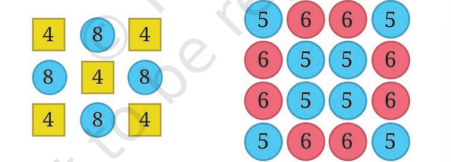
Solution: Picture 1
The first picture has five 4s and four 8s.
Way 1: Count each number separately
Expression:
5 × 4 + 4 × 8
= 20 + 32
= 52
So, the sum is 52.
Way 2: Add row-wise
Expression:
(4 + 8 + 4) + (8 + 4 + 8) + (4 + 8 + 4)
= 16 + 20 + 16
= 52
So, the sum is 52.
Picture 2
The second picture has eight 5s and eight 6s.
Way 1: Count each number separately
Expression:
8 × 5 + 8 × 6
= 40 + 48
= 88
So, the sum is 88.
Way 2: Add row-wise
Each row has the same sum:
5 + 6 + 6 + 5 = 22
There are 4 rows.
Expression:
4 × (5 + 6 + 6 + 5)
= 4 × 22
= 88
So, the sum is 88.
Figure it Out
Question 1. Read the situations given below. Write appropriate expressions for each of them and find their values.
(a) The district market in Begur operates on all seven days of a week. Rahim supplies 9 kg of mangoes each day from his orchard and Shyam supplies 11 kg of mangoes each day from his orchard to this market. Find the amount of mangoes supplied by them in a week to the local district market.
Solution: Rahim supplies 9 kg mangoes each day.
Shyam supplies 11 kg mangoes each day.
Together, they supply mangoes for 7 days.
Expression:
7 × (9 + 11)
Value:
7 × (9 + 11)
= 7 × 20
= 140
So, Rahim and Shyam supply 140 kg of mangoes in a week.
(b) Binu earns ₹20,000 per month. She spends ₹5,000 on rent, ₹5,000 on food, and ₹2,000 on other expenses every month. What is the amount Binu will save by the end of a year?
Solution: Binu earns ₹20,000 per month.
Her monthly expenses are:
Rent = ₹5,000
Food = ₹5,000
Other expenses = ₹2,000
Expression for monthly savings:
20000 – (5000 + 5000 + 2000)
= 20000 – 12000
= 8000
She saves ₹8,000 per month.
Expression for yearly savings:
12 × [20000 – (5000 + 5000 + 2000)]
Value:
12 × 8000 = 96000
So, Binu will save ₹96,000 by the end of a year.
(c) During the daytime a snail climbs 3 cm up a post, and during the night while asleep, accidentally slips down by 2 cm. The post is 10 cm high, and a delicious treat is on its top. In how many days will the snail get the treat?
Solution: During the day, the snail climbs 3 cm.
During the night, it slips down 2 cm.
So, in one full day and night, it moves up:
3 – 2 = 1 cm
But on the final day, once the snail reaches the top, it gets the treat and does not slip down again.
After 7 full days and nights, the snail reaches:
7 × (3 – 2) = 7 cm
On the 8th day, it climbs 3 cm more:
7 + 3 = 10 cm
Expression:
7 × (3 – 2) + 3
Value:
7 × 1 + 3
= 7 + 3
= 10
So, the snail will get the treat on the 8th day.
Question 2. Melvin reads a two-page story every day except on Tuesdays and Saturdays. How many stories would he complete reading in 8 weeks? Which of the expressions below describes this scenario?
(a) 5 × 2 × 8
(b) (7 – 2) × 8
(c) 8 × 7
(d) 7 × 2 × 8
(e) 7 × 5 – 2
(f) (7 + 2) × 8
(g) 7 × 8 – 2 × 8
(h) (7 – 5) × 8
Solution: Melvin does not read on Tuesdays and Saturdays.
So, in one week he reads on:
7 – 2 = 5 days
In 8 weeks, the number of stories he completes is:
(7 – 2) × 8 = 5 × 8 = 40
So, Melvin completes 40 stories in 8 weeks.
The expressions that describe this scenario are:
(b) (7 – 2) × 8
and
(g) 7 × 8 – 2 × 8
Both give the same value:
40 stories.
Question 3. Find different ways of evaluating the following expressions:
(a) 1 – 2 + 3 – 4 + 5 – 6 + 7 – 8 + 9 – 10
(b) 1 – 1 + 1 – 1 + 1 – 1 + 1 – 1 + 1 – 1
Solution: (a) 1 – 2 + 3 – 4 + 5 – 6 + 7 – 8 + 9 – 10
Way 1: Pair consecutive terms
(1 – 2) + (3 – 4) + (5 – 6) + (7 – 8) + (9 – 10)
= –1 – 1 – 1 – 1 – 1
= –5
Way 2: Add positive and negative terms separately
Positive terms: 1 + 3 + 5 + 7 + 9 = 25
Negative terms: 2 + 4 + 6 + 8 + 10 = 30
So,
25 – 30 = –5
Therefore, the value is –5.
(b) 1 – 1 + 1 – 1 + 1 – 1 + 1 – 1 + 1 – 1
Way 1: Pair each 1 and –1
(1 – 1) + (1 – 1) + (1 – 1) + (1 – 1) + (1 – 1)
= 0 + 0 + 0 + 0 + 0
= 0
Way 2: Count positive and negative terms
There are five +1 terms and five –1 terms.
So,
5 – 5 = 0
Therefore, the value is 0.
Question 4. Compare the following pairs of expressions using ‘<‘, ‘>’ or ‘=’ or by reasoning.
(a) 49 – 7 + 8 ___ 49 – (7 + 8)
(b) 83 x 42 – 18 ___ 83 x 40 – 18
(c) 145 – 17 x 8 ___ 145 – 17 x 6
(d) 23 x 48 – 35 ___ 23 x (48 – 35)
(e) (16 – 11) x 12 ___ -11 x 12 + 16 x 12
(f) (76 – 53) x 88 ___ 88 x (53 – 76)
(g) 25 x (42 + 16) ___ 25 x (43 + 15)
(h) 36 x (28 – 16) ___ 35 x (27 – 15)
Solution:
(a) =
(b) >
(c) <
(d) >
(e) =
(f) >
(g) = (h) >
5. Identify which of the following expressions are equal to the given expression without computation. You may rewrite the expressions using terms or removing brackets. There can be more than one expression that is equal to the given expression.
(a) 83 – 37 – 12
(i) 84 – 38 – 12
(ii) 84 – (37 + 12)
(iii) 83 – 38 – 13
(iv) – 37 + 83 – 12
(b) 93 + 37 × 44 + 76
(i) 37 + 93 × 44 + 76
(ii) 93 + 37 × 76 + 44
(iii) (93 + 37) × (44 + 76)
(iv) 37 × 44 + 93 + 76
Solution:
(a) (i) and (iv)
(b) (iv)
Question 6. Choose a number and create ten different expressions having that value.
Solution: Let’s take the number 26. Here are ten different expressions with the value 26:
- 10 + 16
- 30 – 4
- 13 × 2
- 52/2
- 5 + (3 × 7)
- (5 × 5) + 1
Benefits of NCERT Solutions For Class 7 Maths Chapter 2 Arithmetic Expressions
NCERT Solutions for Class 7 Maths Chapter 2 Arithmetic Expressions help students understand the chapter in a clear and step-by-step manner. These solutions are prepared according to the latest NCERT Ganita Prakash Class 7 Maths textbook and are useful for the 2026-27 academic session.
One major benefit of these solutions is that they explain how to form and solve arithmetic expressions using addition, subtraction, multiplication, division, brackets, and terms. Students can easily understand how different operations work together in an expression.
These Arithmetic Expressions Class 7 Solutions also help students improve their calculation skills. Each question is solved in a simple way so that students can follow the correct method and avoid common mistakes while simplifying expressions.
The solutions are helpful for homework, class tests, revision, and exam preparation. Students can practise exercise-wise questions and strengthen their understanding of important concepts from Chapter 2.
At Infinity Learn, the solutions are prepared by subject experts in an easy-to-understand format. Students can also download the Arithmetic Expressions Class 7 NCERT PDF for quick revision and offline practice. Overall, NCERT Solutions For Class 7 Maths Chapter 2 build confidence, improve problem-solving ability, and help students prepare better for their Maths exams.
course
No courses found
FAQs on NCERT Solutions For Class 7 Maths Chapter 2
Where can I download Arithmetic Expressions Class 7 NCERT PDF?
Students can download the Arithmetic Expressions Class 7 NCERT PDF from Infinity Learn. The PDF helps students revise Class 7 Maths Chapter 2 Arithmetic Expressions with step-by-step solutions, clear explanations, and exercise-wise answers.
Are Arithmetic Expressions Class 7 Solutions useful for exams?
Yes, Arithmetic Expressions Class 7 Solutions are very useful for exams. They help students understand how to solve expressions using addition, subtraction, multiplication, division, brackets, and terms. These solutions also improve calculation accuracy and build confidence for class tests and school exams.
What is included in NCERT Solutions For Class 7 Maths Chapter 2?
NCERT Solutions For Class 7 Maths Chapter 2 include textbook exercise solutions, step-by-step answers, important examples, concepts of terms, brackets, arithmetic operations, and methods to simplify expressions. The solutions are written in a simple way so that students can understand each question easily.
Why should students use Infinity Learn for Class 7 Maths Chapter 2?
Students should use Infinity Learn for Class 7 Maths Chapter 2 Arithmetic Expressions because the solutions are prepared by subject experts and explained in a student-friendly manner. Infinity Learn provides clear answers, easy explanations, exam-focused practice, and free PDF support to help students prepare better.
