- NCERT Solutions Class 7 Maths Chapter 1 Large Numbers Around Us
- Download NCERT Class 7 Maths Chapter 1 Large number Around Us PDF
- NCERT Class 7 Maths Chapter 1 Large Numbers Around Us Question Answer
- Key Concepts in Class 7 Maths Chapter 1 Large Number Around Us
- FAQs on NCERT Solutions For Class 7 Maths Chapter 1
NCERT Solutions For Class 7 Maths Chapter 1 Large Numbers Around Us (2026-27)
By Karan Singh Bisht
|
Updated on 15 Jul 2026, 16:26 IST
In NCERT Class 7 Maths Chapter 1 Large Number Around Us, students learn how large numbers are used in real-life situations and how to read, write, compare, and calculate them correctly. This chapter builds a strong understanding of lakhs, crores, millions, billions, place value, number names, estimation, and approximation.
Through examples such as population figures, distances between planets, large quantities, and national data, students understand the practical importance of big numbers in daily life. The Class 7 Maths Chapter 1 Large Number Around Us question answer section helps students solve textbook-based questions step by step and improve their problem-solving skills.
Students can also use Class 7 Maths Chapter 1 Solutions and Class 7 Maths Chapter 1 Solutions PDF for quick revision, homework support, and exam preparation. These solutions explain each concept in simple language and help students understand the correct method of writing answers.
For extra practice, the Large Number Around Us Class 7 Worksheet with Answers and NCERT Class 7 Maths Chapter 1 practice worksheets with answers are useful resources. Students can download the Class 7 Maths Chapter 1 Large Number Around Us PDF and practice from the Class 7 Maths Chapter 1 Large Number Around Us worksheet to strengthen their concepts and prepare confidently for school exams.
NCERT Solutions Class 7 Maths Chapter 1 Large Numbers Around Us
NCERT Solutions for Class 7 Maths Chapter 1 Large Numbers Around Us are available here for students who want detailed, step-by-step guidance. At Infinity Learn, we provide comprehensive Class 7 Maths Chapter 1 Solutions with clear explanations to help students understand each concept thoroughly.
These NCERT Class 7 Maths Chapter 1 Large Numbers Around Us solutions are perfect for homework, revision, and exam preparation. Students aiming to score high marks in Maths can use these solutions to strengthen their knowledge and confidently solve Class 7 Maths Chapter 1 Large Numbers Around Us questions.
Loading PDF...
Download NCERT Class 7 Maths Chapter 1 Large number Around Us PDF
Download NCERT Class 7 Maths Chapter 1 Large Number Around Us PDF for the 2026-27 session to practice and master important concepts from the chapter. This PDF includes chapter-wise questions and answers, step-by-step solutions, and exercises designed as per the latest CBSE syllabus class 7.
The Large Number Around Us Class 7 worksheet with answers helps students understand large numbers such as lakhs, crores, millions, billions, and their practical applications in real-life scenarios. Using this PDF, students can revise easily, complete homework, and prepare confidently for exams. This resource is perfect for students who want a structured, easy-to-use Class 7 Maths Chapter 1 Solutions PDF for practice and exam readiness.
NCERT Class 7 Maths Chapter 1 Large Numbers Around Us Question Answer
NCERT In-Text Questions (Pages 1-3)
Q. Eshwarappa shared this incident with his daughter, Roxie, and son Estu. Estu was surprised to know that there were about one lakh varieties of rice in this country. He wondered, “One lakh! So far, I have only tasted 3 varieties. If we tried a new variety each day, would we even come close to tasting all the varieties in a lifetime of 100 years?” What do you think? Guess.
Solution: One lakh is written as 1,00,000 in figures.

If Roxie and Estu try a new variety every day, they can taste 365 varieties in a year, since there are 365 days in a year. To try all 1,00,000 varieties, it would take them approximately 274 years.
Since 274 years is far longer than an average human lifetime, Roxie and Estu would not be able to taste all the varieties in their lifetime, even if they tried a new one every single day.
Best Courses for You

JEE

NEET

Foundation JEE

Foundation NEET

CBSE
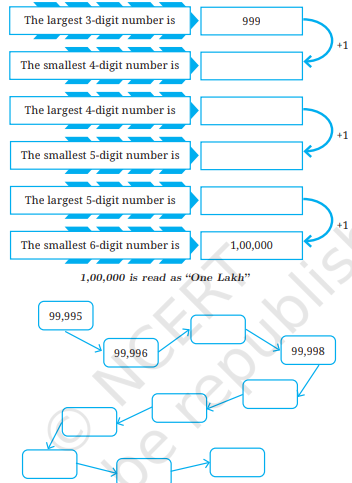
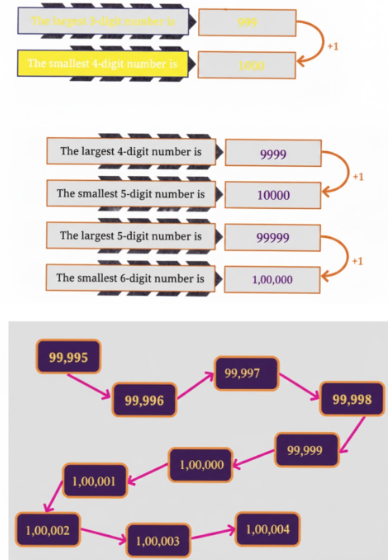
But how much is one lakh? Observe the pattern and fill in the boxes given below.
Solution:
1.1 A Lakh Varieties
1. What is 1 lakh written in numbers?
Answer: 1,00,000
2. How many zeroes are there in 1 lakh?
Answer: 5 zeroes
3. What is 1 crore written in numbers?
Answer: 1,00,00,000
4. How many zeroes are there in 1 crore?
Answer: 7 zeroes
5. How many thousands make 1 lakh?
Answer: 100 thousands
6. How many hundreds make 10,000?
Answer: 100 hundreds
7. How many hundreds make 1 lakh?
Answer: 1000 hundreds
8. What is the smallest 6-digit number?
Answer: 1,00,000
9. What is 100 lakhs called?
Answer: 1 crore
10. What is 1 million equal to in the Indian system?
Answer: 10 lakhs
Section B: Fill in the Blanks
1. The largest 3-digit number is _____.
Answer: 999
2. The smallest 4-digit number is _____.
Answer: 1000
3. The largest 4-digit number is _____.
Answer: 9999
4. The smallest 5-digit number is _____.
Answer: 10,000
5. The largest 5-digit number is _____.
Answer: 99,999
6. 1,00,000 is read as _____.
Answer: One lakh
7. 1 crore is written as _____.
Answer: 1,00,00,000
8. 1 arab is equal to _____ crores.
Answer: 100 crores
9. 1 lakh is _____ times 1000.
Answer: 100
10. 1 crore is _____ times 1 lakh.
Answer: 100
Section C: Write the Numbers in Words
1. 3,00,600
Answer: Three lakh six hundred
2. 5,04,085
Answer: Five lakh four thousand eighty-five
3. 27,30,000
Answer: Twenty-seven lakh thirty thousand
4. 70,53,138
Answer: Seventy lakh fifty-three thousand one hundred thirty-eight
5. 1,23,456
Answer: One lakh twenty-three thousand four hundred fifty-six
Section D: Write the Number in Indian Place Value System
1. One lakh twenty-three thousand four hundred fifty-six
Answer: 1,23,456
2. Four lakh seven thousand seven hundred four
Answer: 4,07,704
3. Fifty lakh five thousand fifty
Answer: 50,05,050
4. Ten lakh two hundred thirty-five
Answer: 10,00,235
5. One crore one lakh one thousand ten
Answer: 1,01,01,010
Section E: Short Answer Questions
1. According to the 2011 Census, the population of Chintamani was about 75,000. How much less than 1 lakh is 75,000?
Answer:
1,00,000 − 75,000 = 25,000
So, 75,000 is 25,000 less than 1 lakh.
2. The estimated population of Chintamani in 2024 is 1,06,000. How much more than 1 lakh is it?
Answer:
1,06,000 − 1,00,000 = 6,000
So, it is 6,000 more than 1 lakh.
3. By how much did the population of Chintamani increase from 2011 to 2024?
Answer:
1,06,000 − 75,000 = 31,000
So, the population increased by 31,000.
4. If a person eats 1 variety of rice every day, how many varieties can they eat in 100 years? Ignore leap years.
Answer:
365 × 100 = 36,500
So, the person can eat 36,500 varieties in 100 years.
5. Can a person taste 1 lakh rice varieties in 100 years by eating 3 varieties daily?
Answer:
3 × 365 × 100 = 1,09,500
Yes, a person can taste 1,09,500 varieties, which is more than 1 lakh.
Section F: Button Click Questions
1. A calculator has only a +1000 button. How many times should it be pressed to show 10,000?
Answer: 10 times
2. How many times should the +1000 button be pressed to show 53,000?
Answer: 53 times
3. How many times should the +1000 button be pressed to show 90,000?
Answer: 90 times
4. How many times should the +1000 button be pressed to show 1 lakh?
Answer: 100 times
5. A calculator has only a +10 button. How many times should it be pressed to show 780?
Answer: 78 times
6. How many times should the +10 button be pressed to show 10,000?
Answer: 1000 times
7. How many times should the +10 button be pressed to show 1 lakh?
Answer: 10,000 times
8. A calculator has only a +100 button. How many times should it be pressed to show 3700?
Answer: 37 times
9. How many times should the +100 button be pressed to show 97,600?
Answer: 976 times
10. How many times should the +100 button be pressed to show 1,00,000?
Answer: 1000 times
Section G: Express the Number in Different Ways
1. Write two expressions for 8300.
Answer:
8300 = (8 × 1000) + (3 × 100)
8300 = (5 × 1000) + (33 × 100)
2. Write two expressions for 40,629.
Answer:
40,629 = (40 × 1000) + (6 × 100) + (2 × 10) + (9 × 1)
40,629 = (30 × 1000) + (106 × 100) + (29 × 1)
3. Write two expressions for 56,354.
Answer:
56,354 = (56 × 1000) + (3 × 100) + (5 × 10) + (4 × 1)
56,354 = (46 × 1000) + (103 × 100) + (54 × 1)
4. Write two expressions for 66,666.
Answer:
66,666 = (66 × 1000) + (6 × 100) + (66 × 1)
66,666 = (6 × 10000) + (6 × 1000) + (6 × 100) + (6 × 10) + (6 × 1)
Section H: Word Problems
1. Somu is 1 metre tall. If each floor of a building is about 4 times his height and the building has 10 floors, what is the approximate height of the building?
Answer:
Height of one floor = 4 m
Height of 10 floors = 10 × 4 = 40 m
So, the building is approximately 40 m tall.
2. The Statue of Unity is about 180 m tall. Somu’s building is 40 m tall. How much taller is the Statue of Unity?
Answer:
180 − 40 = 140 m
The Statue of Unity is 140 m taller.
3. Kunchikal waterfall is about 450 m high. How much taller is it than Somu’s 40 m building?
Answer:
450 − 40 = 410 m
The waterfall is 410 m taller.
4. If each floor is 4 m high, approximately how many floors should Somu’s building have to be as high as the 450 m waterfall?
Answer:
450 ÷ 4 = 112.5
So, the building should have approximately 113 floors.
5. A bus can carry 50 people. How many people can 1 lakh buses carry?
Answer:
1,00,000 × 50 = 50,00,000
So, 1 lakh buses can carry 50 lakh people.
Section I: Indian and American Number System
1. Write 1,00,000 in the American system.
Answer: 100,000
2. What is 10,00,000 called in the American system?
Answer: One million
3. What is 1,00,00,000 called in the Indian system?
Answer: One crore
4. What is 1,000,000,000 called in the American system?
Answer: One billion
5. What is 1,00,00,00,000 called in the Indian system?
Answer: One arab or one hundred crores
Section J: True or False
1. 1 lakh has 6 zeroes.
Answer: False
2. 1 crore has 7 zeroes.
Answer: True
3. 100 lakhs make 1 crore.
Answer: True
4. 1 million is equal to 10 lakhs.
Answer: True
5. 1 arab is equal to 100 crores.
Answer: True
6. The Indian number system uses commas in a 3-2-2 pattern from right to left.
Answer: True
7. The American number system uses commas in a 3-3-3 pattern from right to left.
Answer: True
Section K: Multiplication Practice
1. Find 25 × 12.
Answer: 300
2. Find 25 × 240.
Answer: 6000
3. Find 250 × 120.
Answer: 30,000
4. Find 2500 × 12.
Answer: 30,000
5. Find 1250 × 380.
Answer: 4,75,000
6. Find 2100 × 70,000.
Answer: 14,70,00,000
7. Find 6400 × 62,500.
Answer: 40,00,00,000
Section L: Long Answer Questions
1. Explain the difference between the Indian and American number systems.
Answer: In the Indian number system, commas are placed in a 3-2-2 pattern from right to left. For example, 1 crore is written as 1,00,00,000. The common terms used are thousand, lakh, crore, and arab.
In the American or International number system, commas are placed in a 3-3-3 pattern from right to left. For example, 1 billion is written as 1,000,000,000. The common terms used are thousand, million, and billion.
2. Why do we use approximate values for large numbers?
Answer: Approximate values are useful because exact numbers are not always needed. For example, instead of saying the population of Chintamani is 76,068, we can say it is about 75,000. This gives a quick idea of the size of the number. Approximation helps us compare, estimate, and understand large numbers easily.
3. Why are large numbers easier to understand when compared with familiar things?
Answer: Large numbers can be difficult to imagine directly. When we compare them with familiar things, they become easier to understand. For example, the height of the Statue of Unity can be compared with the height of a building. Similarly, populations can be compared with stadium capacity or buses. Such comparisons help us get a better sense of large quantities.
Key Concepts in Class 7 Maths Chapter 1 Large Number Around Us
The first chapter of NCERT Class 7 Maths Chapter 1 Large Number Around Us introduces students to large numbers using real-world examples and gradually builds up to numerical operations. This chapter is essential for understanding numbers in lakhs, crores, and beyond, and applying them in daily life.
1. Reading and Writing Large Numbers
- Learn numbers beyond six digits like lakh and crore.
- Understand the Indian and International Place Value System.
- Practice writing numbers in words and numerals.
- Example: 7,28,69,002 = “Seven crore twenty-eight lakh sixty-nine thousand and two” in the Indian system.
2. Comparing Large Numbers
- Determine which number is greater or smaller using place values.
- Useful for interpreting real-world data such as population, revenue, or budgets.
- Example: Comparing the populations of different states in crores and lakhs.
3. Estimation
- Estimate sums, differences, products, and quotients by rounding off.
- Improves mental math and checks the reasonableness of answers.
- Example: Estimating the total cost of multiple items in lakhs or crores.
4. Operations Using Large Numbers
- Perform addition, subtraction, multiplication, and division on large 6- or 7-digit numbers.
- Solve application-based problems involving cost, distance, budgets, and more.
5. Use of Large Numbers in Daily Life
- Learn to interpret data from census, sports statistics, scientific measurements, and more.
- Explore real-life examples such as cricket scores, mobile users, and city populations.
6. Roman Numerals (Brief Introduction)
- Convert between Roman numerals and Hindu-Arabic numerals.
- Recognize applications in daily life: clocks, book chapters, events, and inscriptions.
course
No courses found
FAQs on NCERT Solutions For Class 7 Maths Chapter 1
Can I download the Class 7 Maths Chapter 1 Large Number Around Us PDF?
Yes, students can download the Class 7 Maths Chapter 1 Large Number Around Us PDF from Infinity Learn. It includes practice exercises, step-by-step solutions, and examples for revision and exam preparation.
What topics are covered in Class 7 Maths Chapter 1 Solutions?
The Class 7 Maths Chapter 1 Solutions cover:
- Reading and writing large numbers (lakhs, crores, millions)
- Indian and International number systems
- Estimation and rounding off
- Comparison of large numbers
- Real-life word problems
These are included in NCERT Class 7 Maths Chapter 1 practice worksheets with answers.
What is included in NCERT Class 7 Maths Chapter 1 new edition?
The NCERT Class 7 Maths Chapter 1 new edition covers large numbers, Indian and International number systems, comparison, estimation, rounding, and real-life applications. Infinity Learn provides detailed Class 7 Maths Chapter 1 solutions for all exercises.
Where can I download NCERT Class 7 Maths Chapter 1 PDF?
You can Ncert Class 7 Maths Chapter 1 PDF download from Infinity Learn, which provides the latest edition along with all exercises and solutions for easy study and revision.
How can I use Ncert Class 7 Maths Chapter 1 solutions effectively?
The Ncert Class 7 Maths Chapter 1 solutions from Infinity Learn are step-by-step guides for solving questions. Students can attempt problems first and then check the solutions to understand the methods and improve accuracy.
