- Coordinate Geometry Class 10 Syllabus for 2026–27
- Download Coordinate Geometry Class 10 Notes PDF
- Coordinate Geometry Basics
- Distance Formula Class 10
- Section Formula Class 10
- Coordinate Geometry Solved Examples
- Coordinate Geometry Important Questions with Solutions
- Common Mistakes in Coordinate Geometry
- Coordinate Geometry Quick Revision
- FAQs on Coordinate Geometry Class 10
Coordinate Geometry Class 10 Notes PDF: Chapter 7 Formulas, Examples and Questions
By rohit.pandey1
|
Updated on 22 Jul 2026, 14:44 IST
These Coordinate Geometry Class 10 Notes PDF cover the current CBSE and NCERT Chapter 7 syllabus. The main topics are the coordinate plane, distance formula, section formula for internal division and midpoint formula.
This guide also includes solved examples, common mistakes, Basic and Standard practice questions, a formula-selection guide and clear information about deleted or higher-class topics. Reviewed using the CBSE Class 10 Mathematics curriculum for 2026–27 and the current NCERT Coordinate Geometry chapter.
Coordinate Geometry Class 10 Syllabus for 2026–27
The official CBSE Class 10 syllabus includes a review of coordinate geometry, the distance formula and the section formula for internal division.
Topics Included in the Current Syllabus
Students should be able to:
- Read and plot points on a coordinate plane.
- Identify the x-axis, y-axis, origin and quadrants.
- Find the distance between two points.
- Find the distance of a point from the origin.
- Find a point that divides a line segment internally in a given ratio.
- Use the midpoint formula as the 1:1 case of internal division.
- Apply these formulas to geometrical and real-life questions.
The Coordinate Geometry unit is assigned six marks in the CBSE Class 10 course structure for 2026–27. This does not guarantee one fixed six-mark question because the number and type of questions may vary.
Download Coordinate Geometry Class 10 Notes PDF
The downloadable Coordinate Geometry notes should contain complete explanations, formulas, diagrams, solved examples, practice questions and answers without requiring registration.
Loading PDF...
Current, Derived and Deleted Topics
- Coordinate-plane review: Current syllabus. Learn fully.
- Distance formula: Current syllabus. Learn fully.
- Internal section formula: Current syllabus. Learn fully.
- Midpoint formula: Special case of internal division. Learn fully.
- Equidistant-point problems: Application of the distance formula. Practise.
- Trisection and equal division: Application of the section formula. Practise.
- Area of a triangle using coordinates: Rationalised out of the current chapter.
- External division: Higher-class topic. Do not mix it with the Class 10 internal formula.
- Centroid: Enrichment or higher-level topic.
- Slope and equation of a line: Outside the present Chapter 7 scope.
NCERT’s rationalised-content list identifies the coordinate-based “Area of a Triangle” section as dropped content.
The current NCERT chapter teaches internal division and states that external division will be studied in higher classes.
Also Check: CBSE Class 10 Maths Syllabus | CBSE Class 8 Maths Notes
Coordinate Geometry Basics
Coordinate geometry uses ordered pairs and algebra to locate points and study geometrical relationships on a plane.

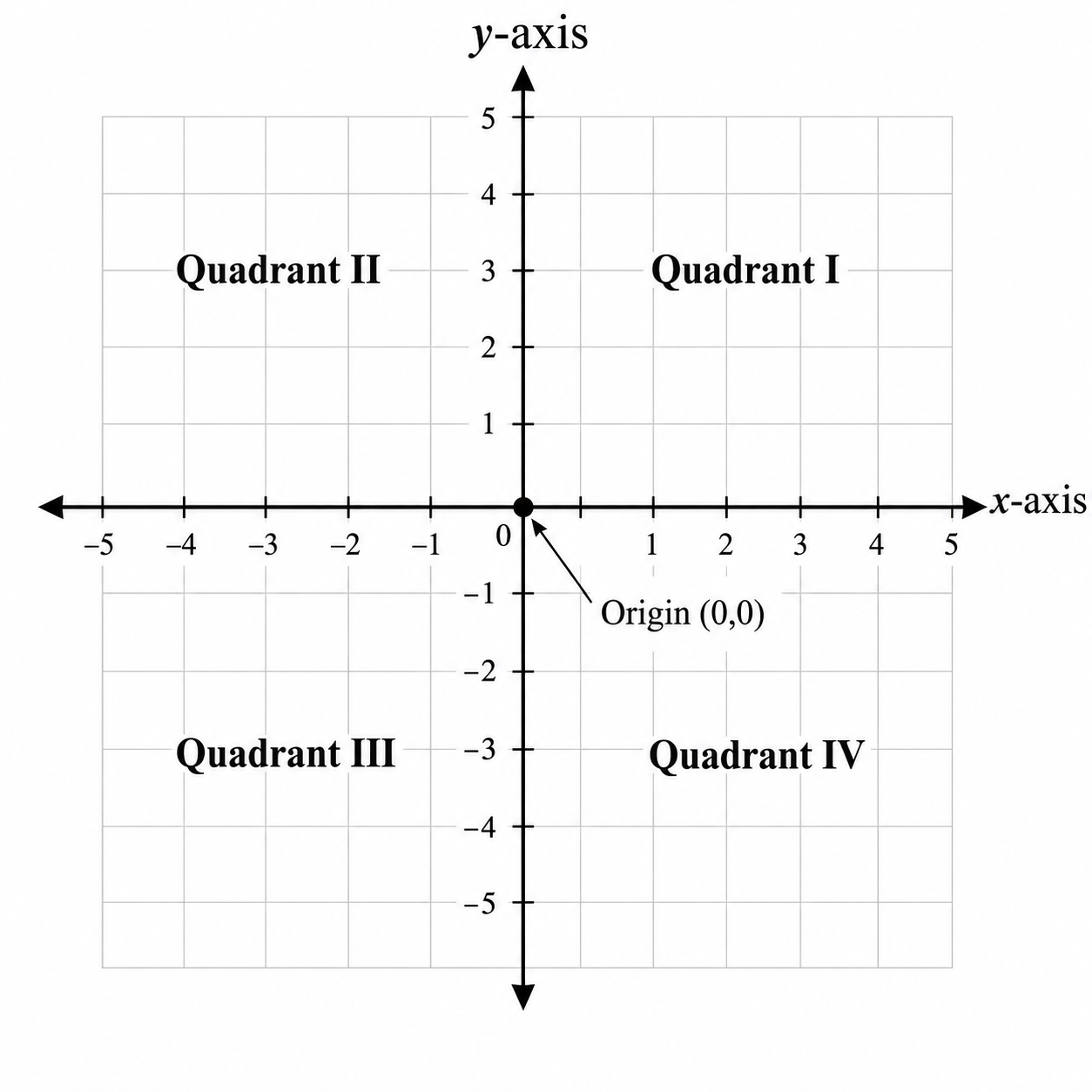
Cartesian Plane, Axes and Origin
A Cartesian plane is formed by two perpendicular number lines.
- x-axis: The horizontal number line.
- y-axis: The vertical number line.
- Origin: The point where the two axes meet, written as O(0, 0).
The axes divide the plane into four regions called quadrants.
Best Courses for You

JEE

NEET

Foundation JEE

Foundation NEET

CBSE
Ordered Pairs, Abscissa and Ordinate
A point is written as an ordered pair: P(x, y).
- Abscissa: The x-coordinate, which gives the horizontal position.
- Ordinate: The y-coordinate, which gives the vertical position.
The order matters. The points (2, 5) and (5, 2) are in different positions.
Signs in the Four Quadrants
- Quadrant I: (+, +), for example (3, 4)
- Quadrant II: (−, +), for example (−3, 4)
- Quadrant III: (−, −), for example (−3, −4)
- Quadrant IV: (+, −), for example (3, −4)
A useful order to remember is:
(+, +), (−, +), (−, −), (+, −)
Coordinates of Points on the Axes
- Point on the x-axis: (x, 0)
- Point on the y-axis: (0, y)
- Origin: (0, 0)
Common mistake: A point on the x-axis does not have an x-coordinate of zero. Its y-coordinate is zero because its vertical distance from the x-axis is zero.
Distance from the x-Axis and y-Axis
For a point P(x, y):
- Distance from the x-axis: |y|
- Distance from the y-axis: |x|
Absolute values are used because distance cannot be negative.
Example: For P(−6, 4):
- Distance from the x-axis = |4| = 4 units
- Distance from the y-axis = |−6| = 6 units
Reflection of a Point
- Reflection across the x-axis: (x, y) becomes (x, −y)
- Reflection across the y-axis: (x, y) becomes (−x, y)
- Reflection across both axes: (x, y) becomes (−x, −y)
Example: The reflection of (−3, 5) across the x-axis is (−3, −5).
Distance Formula Class 10
The distance formula finds the straight-line distance between two points by using their horizontal and vertical coordinate differences.
Distance Between Two Points
For points P(x₁, y₁) and Q(x₂, y₂), the distance is:
PQ = √[(x₂ − x₁)² + (y₂ − y₁)²]
Why the Distance Formula Works
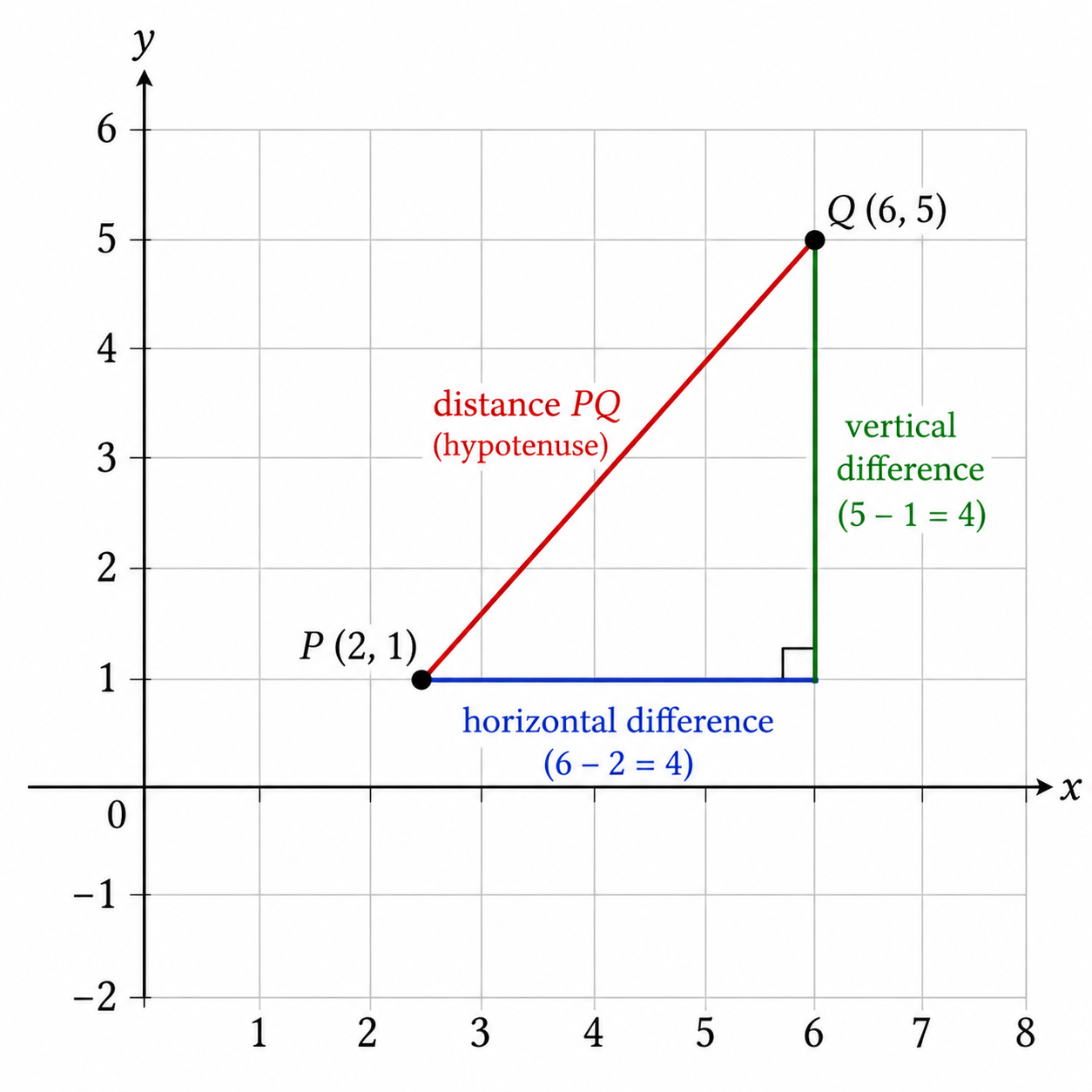
The horizontal and vertical differences between two points form the perpendicular sides of a right-angled triangle.
Horizontal change = x₂ − x₁
Vertical change = y₂ − y₁
Using Pythagoras’ theorem:
PQ² = (x₂ − x₁)² + (y₂ − y₁)²
Therefore:
PQ = √[(x₂ − x₁)² + (y₂ − y₁)²]
Steps for Using the Distance Formula
- Label the points as (x₁, y₁) and (x₂, y₂).
- Subtract the x-coordinates.
- Subtract the y-coordinates.
- Square both differences.
- Add the squared values.
- Take the positive square root.
Worked Example: Points in Different Quadrants
Find the distance between A(−2, 3) and B(4, −5).
AB = √[(4 − (−2))² + (−5 − 3)²]
AB = √[6² + (−8)²]
AB = √(36 + 64)
AB = 10 units
The horizontal difference is 6 and the vertical difference is 8, so a distance of 10 units is reasonable.
Does Subtraction Order Matter?
The subtraction order does not change the final distance because each difference is squared.
(x₂ − x₁)² = (x₁ − x₂)²
For example:
(4 − (−2))² = 6² = 36
(−2 − 4)² = (−6)² = 36
Use the same order for both coordinate pairs to reduce mistakes.
Distance Between Points on the Same Axis
For A(2, 0) and B(9, 0):
AB = |9 − 2| = 7 units
For C(0, −4) and D(0, 3):
CD = |3 − (−4)| = 7 units
The absolute-difference method is faster when both points lie on the same axis.
Distance of a Point from the Origin
For P(x, y), the origin is O(0, 0).
OP = √(x² + y²)
Example: Find the distance of P(−5, 12) from the origin.
OP = √[(-5)² + 12²]
OP = √(25 + 144)
OP = 13 units
Finding an Unknown Coordinate
Find the possible values of y if the distance between P(2, −3) and Q(10, y) is 10 units.
√[(10 − 2)² + (y − (−3))²] = 10
√[64 + (y + 3)²] = 10
64 + (y + 3)² = 100
(y + 3)² = 36
y + 3 = 6 or y + 3 = −6
y = 3 or y = −9
Two answers are possible because two different points can be the same distance from a fixed point.
Point on an Axis Equidistant from Two Points
Find the point on the y-axis that is equidistant from A(2, 3) and B(−4, 1).
A point on the y-axis has the form P(0, y).
Because PA = PB, equate the squared distances:
(0 − 2)² + (y − 3)² = (0 − (−4))² + (y − 1)²
4 + (y − 3)² = 16 + (y − 1)²
4 + y² − 6y + 9 = 16 + y² − 2y + 1
13 − 6y = 17 − 2y
−4 = 4y
y = −1
P = (0, −1)
Why an Equidistant Point Is Not Always the Midpoint
A midpoint is equidistant from the two endpoints, but every equidistant point is not a midpoint.
All points on the perpendicular bisector of a segment are equidistant from its endpoints. The midpoint is only the point where the perpendicular bisector meets the segment.
Use the midpoint formula only when the question says that the point:
- is the midpoint;
- bisects the segment;
- divides the segment in the ratio 1:1; or
- lies halfway between the endpoints.
Applications of the Distance Formula
The distance formula can be used to:
- Classify a triangle.
- Check whether a triangle is right-angled.
- Compare the sides and diagonals of a quadrilateral.
- Check whether three points are collinear.
- Find the radius of a circle.
Example: Classify a Triangle
Let A(0, 0), B(3, 4) and C(6, 0).
AB = √(3² + 4²) = 5
BC = √(3² + (−4)²) = 5
AC = 6
Since AB = BC, triangle ABC is an isosceles triangle.
Section Formula Class 10
The section formula gives the coordinates of a point that divides a line segment internally in a given ratio.
Meaning of Internal Division
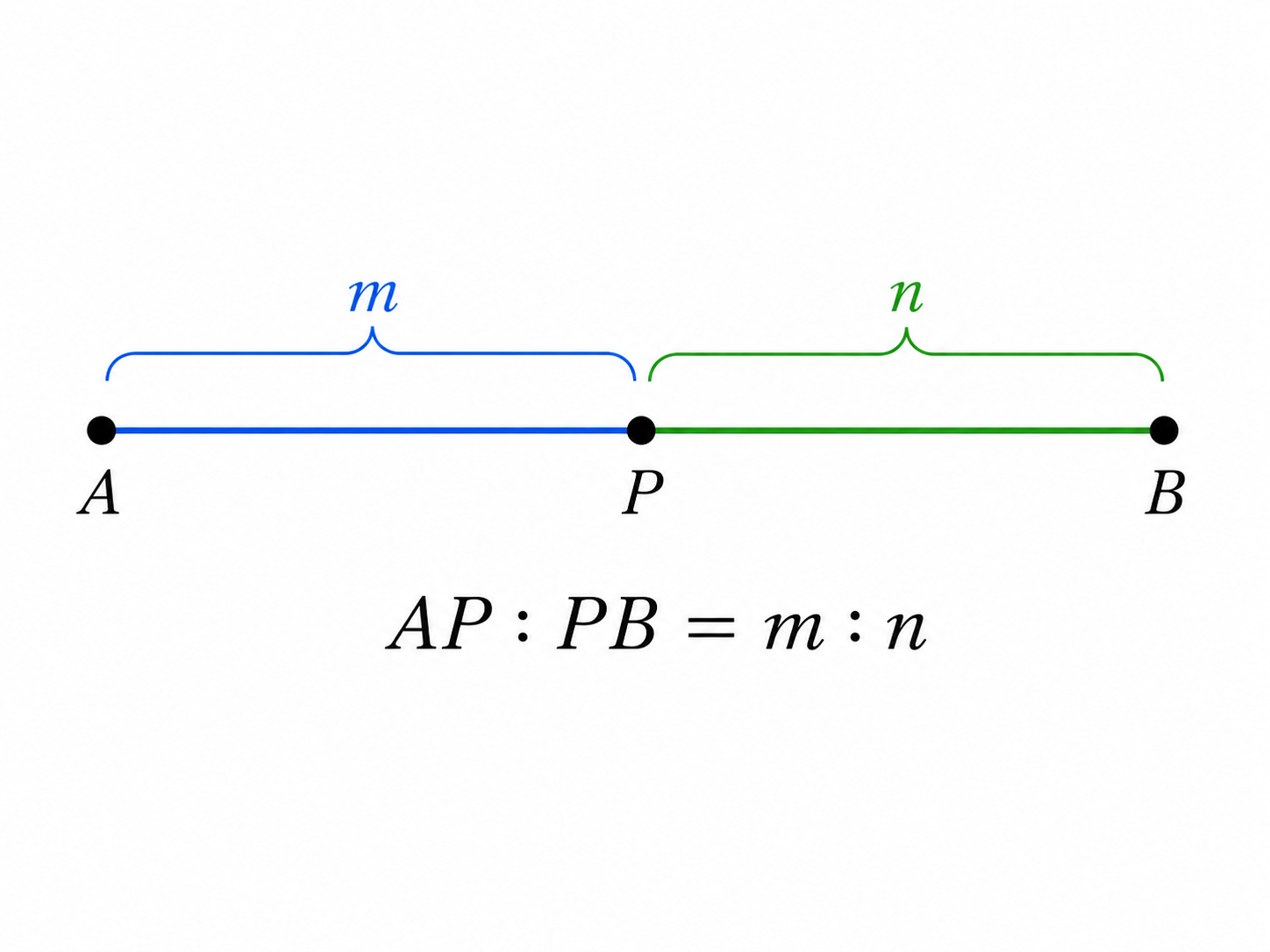
Suppose P lies between A and B and:
AP : PB = m : n
Then P divides the line segment AB internally in the ratio m:n.
Internal Section Formula
For A(x₁, y₁), B(x₂, y₂) and AP:PB = m:n:
P = ((mx₂ + nx₁)/(m + n), (my₂ + ny₁)/(m + n))
Steps for Applying the Section Formula
- Write the endpoints in the same order as the diagram.
- Write the ratio as AP:PB = m:n.
- Multiply m by the coordinates of B.
- Multiply n by the coordinates of A.
- Add the products.
- Divide both coordinates by m + n.
- Check that the point lies between the endpoints.
Why the Ratio Multiplies the Opposite Endpoint
The formula uses opposite weighting because a larger first segment places the dividing point closer to the second endpoint.
For example, if AP:PB = 4:1, point P is closer to B. The larger number 4 therefore multiplies the coordinates of B.
Worked Example: Internal Division
Find the point that divides the segment joining A(−2, 4) and B(8, −1) in the ratio 2:3.
m = 2 and n = 3
P = ((2 × 8 + 3 × (−2))/(2 + 3), (2 × (−1) + 3 × 4)/(2 + 3))
P = ((16 − 6)/5, (−2 + 12)/5)
P = (10/5, 10/5)
P = (2, 2)
The m:n Form and the k:1 Form
- m:n: Use m and n directly.
- k:1: Use m = k and n = 1.
- 1:k: Use m = 1 and n = k.
Do not treat k:1 and 1:k as the same ratio.
Reversing the Endpoints
If the endpoint order is reversed, the ratio order must also be reversed.
Original form:
AP:PB = 2:3
Reversed form:
BP:PA = 3:2
Reversing both the endpoints and ratio gives the same dividing point.
Midpoint Formula
A midpoint divides a line segment internally in the ratio 1:1.
M = ((x₁ + x₂)/2, (y₁ + y₂)/2)
Midpoint Example
Find the midpoint of A(−3, 5) and B(7, −1).
M = ((−3 + 7)/2, (5 + (−1))/2)
M = (4/2, 4/2)
M = (2, 2)
Finding the Ratio When the Point Is Given
The point P(5, 4) divides the segment joining A(1, 2) and B(11, 7). Find AP:PB.
Let AP:PB = m:n.
Using the x-coordinate:
5 = (11m + n)/(m + n)
5m + 5n = 11m + n
4n = 6m
m:n = 2:3
Check using the y-coordinate:
(2 × 7 + 3 × 2)/(2 + 3) = 20/5 = 4
Therefore, AP:PB = 2:3.
Finding an Unknown Endpoint
The midpoint of A(−2, 4) and B(x, y) is M(3, −1). Find B.
For the x-coordinate:
(−2 + x)/2 = 3
−2 + x = 6
x = 8
For the y-coordinate:
(4 + y)/2 = −1
4 + y = −2
y = −6
B = (8, −6)
Finding Where a Segment Meets an Axis
Find the point where the segment joining A(−3, 6) and B(6, −3) meets the x-axis.
Let the point divide AB in the ratio m:n.
Because the point lies on the x-axis, its y-coordinate is zero.
0 = (m × (−3) + n × 6)/(m + n)
−3m + 6n = 0
m = 2n
m:n = 2:1
Now calculate the x-coordinate:
x = (2 × 6 + 1 × (−3))/(2 + 1)
x = 9/3
P = (3, 0)
Points of Trisection
Points of trisection divide a line segment into three equal parts.
For A(0, 0) and B(9, 6):
- The first trisection point divides AB in the ratio 1:2.
- The second trisection point divides AB in the ratio 2:1.
First point:
P = ((1 × 9 + 2 × 0)/3, (1 × 6 + 2 × 0)/3)
P = (3, 2)
Second point:
Q = ((2 × 9 + 1 × 0)/3, (2 × 6 + 1 × 0)/3)
Q = (6, 4)
Applications of the Midpoint Formula
The midpoint formula can be used to:
- Find the centre of a circle when the endpoints of a diameter are known.
- Find a missing endpoint when the centre and one endpoint are known.
- Check whether the diagonals of a parallelogram bisect each other.
- Find a missing vertex of a parallelogram.
Example: Missing Parallelogram Vertex
A(1, 2), B(5, 3), C(7, 8) and D(x, y) are consecutive vertices of a parallelogram.
The diagonals AC and BD have the same midpoint.
Midpoint of AC:
((1 + 7)/2, (2 + 8)/2) = (4, 5)
Therefore:
(5 + x)/2 = 4
x = 3
(3 + y)/2 = 5
y = 7
D = (3, 7)
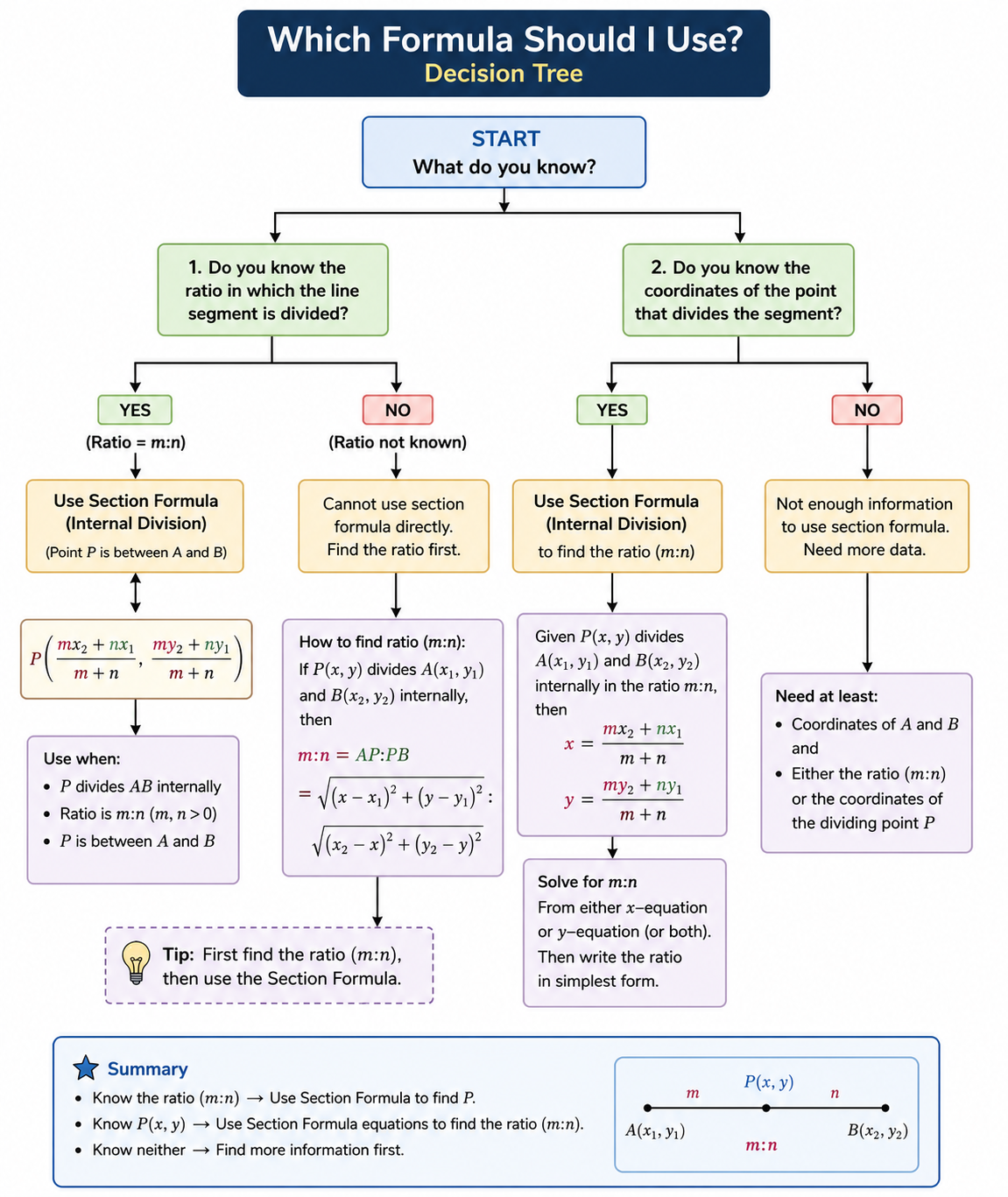
Step-by-Step Decision Process
- If a length is required, use the distance formula.
- If a point divides a segment in a stated ratio, use the section formula.
- If the ratio is 1:1, use the midpoint formula.
- If a point lies on an axis, set the other coordinate to zero.
- If a point is equidistant from two points, equate their squared distances.
- If a shape must be identified, calculate only the necessary sides and diagonals.
Common Misconceptions
- Incorrect: Every equidistant point is a midpoint.
Correct: An equidistant point may lie anywhere on the perpendicular bisector. - Incorrect: A point on the x-axis has x = 0.
Correct: A point on the x-axis has y = 0. - Incorrect: The ratio remains unchanged when endpoints are swapped.
Correct: Reverse the ratio as well. - Incorrect: A squared equation can have only one solution.
Correct: It may produce two valid coordinate values. - Incorrect: External-division signs are needed.
Correct: Use the internal formula for the current syllabus.
Coordinate Geometry Solved Examples
Coordinate Geometry solved examples should begin with direct formula questions and progress to unknown-coordinate, axis and geometrical applications.
Level 1: Direct Formula Questions
Example 1: Find the distance between A(1, 2) and B(7, 10).
AB = √[(7 − 1)² + (10 − 2)²]
AB = √(36 + 64)
AB = 10 units
Example 2: Find the midpoint of (−4, 6) and (8, −2).
M = ((−4 + 8)/2, (6 + (−2))/2)
M = (2, 2)
Level 2: Unknown Values and Axis Questions
Example 3: The distance between P(k, 2) and Q(3, 6) is 5 units. Find k.
√[(k − 3)² + (2 − 6)²] = 5
(k − 3)² + 16 = 25
(k − 3)² = 9
k − 3 = ±3
k = 6 or k = 0
Example 4: Find the point dividing A(2, −3) and B(12, 7) in the ratio 3:2.
P = ((3 × 12 + 2 × 2)/5, (3 × 7 + 2 × (−3))/5)
P = (40/5, 15/5)
P = (8, 3)
Level 3: Geometrical Applications
Example 5: Check whether A(0, 0), B(3, 0) and C(0, 4) form a right-angled triangle.
AB² = 9
AC² = 16
BC² = 25
Since AB² + AC² = BC²:
9 + 16 = 25
The triangle is right-angled at A.
Example 6: Check whether A(0, 0), B(2, 3) and C(4, 6) are collinear.
AB = √13
BC = √13
AC = √52 = 2√13
Since AB + BC = AC, the three points are collinear.
Competency-Based Example
A school map represents the library by L(2, 6), the laboratory by S(8, 2) and the assembly ground by G(0, 0).
- Find the distance between the library and laboratory.
- Find the midpoint of LS.
- Decide whether the library or laboratory is closer to the assembly ground.
- Explain which location would be a fair meeting point for students coming from L and S.
Coordinate Geometry Important Questions with Solutions
Important Coordinate Geometry questions should test direct formulas, reasoning, axis conditions, unknown coordinates and real-life applications.
Formula Warm-Up Questions
- Find the distance between (2, 3) and (6, 6).
- Find the distance of (−8, 15) from the origin.
- Find the midpoint of (−5, 7) and (3, −1).
- Find the point dividing (1, 4) and (11, 9) in the ratio 2:3.
- State the coordinates of a point on the y-axis with ordinate −6.
Mathematics Basic Practice
- Identify the quadrant containing (−4, 7).
- Find the distance of (5, −2) from the x-axis.
- Find the midpoint of two locations on a coordinate map.
- Find the distance between two plotted points.
- Find a point that divides a route in the ratio 1:2.
Mathematics Standard Practice
- Find an unknown coordinate from a given distance.
- Find a point on an axis equidistant from two points.
- Find the ratio in which a point divides a segment.
- Verify a triangle or quadrilateral using distances.
- Find a missing parallelogram vertex using diagonal midpoints.
Sample MCQ
The distance of the point (−7, 4) from the y-axis is:
- 4 units
- −7 units
- 7 units
- √65 units
Answer: 7 units
The distance from the y-axis is the absolute value of the x-coordinate:
|−7| = 7
Sample Assertion–Reason Question
Assertion: The midpoint of the segment joining (−2, 5) and (6, 1) is (2, 3).
Reason: A midpoint divides a segment internally in the ratio 1:1.
Answer: Both statements are true, and the reason correctly explains the assertion.
Common Mistakes in Coordinate Geometry
Most Coordinate Geometry errors come from incorrect signs, wrong ratio order and using a formula before understanding the question.
- Mistake: Writing a point on the x-axis as (0, y).
Correction: Write it as (x, 0). - Mistake: Removing brackets around negative numbers.
Correction: Write expressions such as (−5 − 3)². - Mistake: Pairing an x-coordinate with a y-coordinate.
Correction: Subtract x from x and y from y. - Mistake: Forgetting the square root.
Correction: Distance is the positive square root. - Mistake: Using the midpoint formula for every equidistant point.
Correction: Check whether the point actually bisects the segment. - Mistake: Swapping endpoints without reversing the ratio.
Correction: Reverse both together. - Mistake: Using external-division signs.
Correction: Use the internal formula for the current syllabus. - Mistake: Giving only one square-root value.
Correction: Check both possible coordinate values. - Mistake: Omitting units from a distance.
Correction: Write units unless a specific unit is provided. - Mistake: Writing coordinates without brackets.
Correction: Write the final point as (x, y).
How to Present Working in an Exam
- Given: Write the points and ratio accurately.
- Formula: State the required formula.
- Substitution: Use brackets around negative values.
- Simplification: Show one clear step per line.
- Conclusion: State the final distance, coordinate or ratio.
- Check: Confirm the axis, ratio or geometrical condition.
Final-Answer Checklist
- Did I pair x-values with x-values?
- Did I pair y-values with y-values?
- Did I use brackets around negative numbers?
- Did I write the ratio in the correct order?
- Is the internal point between the endpoints?
- Did I include both valid values?
- Did I add units to a distance?
- Did I write coordinates as an ordered pair?
Coordinate Geometry Quick Revision
The fastest revision method is to memorise the four core formulas, practise one question using each formula and review the most common sign and ratio mistakes.
Formula Recap
Distance formula:
PQ = √[(x₂ − x₁)² + (y₂ − y₁)²]
Distance from the origin:
OP = √(x² + y²)
Internal section formula:
P = ((mx₂ + nx₁)/(m + n), (my₂ + ny₁)/(m + n))
Midpoint formula:
M = ((x₁ + x₂)/2, (y₁ + y₂)/2)
course
No courses found
FAQs on Coordinate Geometry Class 10
What is coordinate geometry in Class 10 Maths?
Coordinate geometry uses ordered pairs and algebra to locate points and calculate relationships such as distance and internal division on a plane.
Where can I download Coordinate Geometry Class 10 Notes PDF?
Students can download Coordinate Geometry Class 10 Notes from Infnity Learn website's this page for syllabus-aligned notes, formulas, solved examples and practice questions.
What are all the formulas of coordinate geometry for Class 10?
The core formulas are the distance formula, distance-from-origin formula, internal section formula and midpoint formula.
How do you use the distance formula in coordinate geometry?
Subtract the x-coordinates, subtract the y-coordinates, square both differences, add them and take the positive square root.
What is the section formula in Class 10 coordinate geometry?
For AP:PB = m:n, the internal dividing point is ((mx₂ + nx₁)/(m + n), (my₂ + ny₁)/(m + n)).
How do you find the midpoint between two coordinates?
Add the two x-coordinates and divide by 2. Add the two y-coordinates and divide by 2.
When should I use the distance formula instead of the section formula?
Use the distance formula when a length or equidistance condition is required. Use the section formula when a point divides a segment in a stated ratio.
Why is an equidistant point not always the midpoint?
A midpoint lies on the segment and divides it equally. Other points on the perpendicular bisector can also be equidistant from the endpoints.
Can a missing-coordinate question have two answers?
Yes. A squared equation may produce two valid coordinate values representing two points at the same distance from a fixed point.
Is the area of a triangle included in the Class 10 syllabus for 2026–27?
The coordinate-based area-of-a-triangle section is listed as rationalised content. The current syllabus focuses on coordinate review, distance formula and internal section formula.
Is external division included in Class 10 coordinate geometry?
No. The current NCERT chapter teaches internal division and notes that external division will be studied in higher classes.
Is midpoint included if the syllabus only names the section formula?
Yes. The midpoint formula is the 1:1 special case of the internal section formula.
How many marks is Coordinate Geometry worth in Class 10?
The CBSE 2026–27 course structure assigns six marks to the Coordinate Geometry unit. The exact number and format of questions may vary.
Are these notes useful for Mathematics Basic and Standard?
Yes. The main concepts are shared, while the practice section separates direct Basic questions from more complex Standard applications.
