- Probability Class 10 Notes Overview
- Probability Class 10 Notes PDF Free Download
- Is Probability Chapter 14 or Chapter 15 in Class 10?
- Probability Class 10 Syllabus for 2026–27
- Important Terms in Class 10 Probability
- Experimental and Theoretical Probability
- How to Solve Probability Questions Step by Step
- “At Least,” “At Most” and Other Probability Wording
- Coin Toss Probability Questions
- Dice Probability Questions
- Playing Cards Probability Questions
- Probability with Marbles, Balls and Objects in a Bag
- Number-Selection Probability Questions
- Spinner and Real-Life Probability Questions
- Complementary Events in Probability
- Solved Examples of Probability for Class 10
- Probability Class 10 Important Questions
- Probability Class 10 MCQs
- Common Mistakes in Class 10 Probability
- How to Write Probability Answers for Full Marks
- Is NCERT Enough for Class 10 Probability?
- Probability Class 10 Quick Revision Plan
- Related Class 10 Maths Resources
- FAQs: Probability Class 10 Notes PDF
Probability Class 10 Notes PDF: Formulas, Examples and Questions
By rohit.pandey1
|
Updated on 27 Jul 2026, 13:03 IST
These Probability Class 10 Notes PDF explain every board-level concept using formulas, sample spaces, solved examples and practice questions. Probability is Chapter 14 in the current NCERT Class 10 Mathematics textbook, although some older books and websites still call it Chapter 15.
This revision guide covers probability formulas, complementary events, coins, dice, playing cards, marbles, number-selection questions, common mistakes, MCQs and quick revision plans.
Probability Class 10 Notes Overview
Class 10 Probability measures how likely an event is by comparing favourable outcomes with all equally likely possible outcomes.
Main Probability Formula
P(E) = Number of outcomes favourable to E / Total number of equally likely outcomes
Here, E represents the event whose probability must be found.
Complementary Probability Formula
The complement of event E means that E does not happen.
Loading PDF...
P(not E) = 1 - P(E)
Therefore:
P(E) + P(not E) = 1
Probability Class 10 Notes PDF Free Download
The downloadable Probability Class 10 notes PDF should provide the same core teaching content as this page in a compact, printable format.

Essential Probability Rules
| Rule | Meaning |
| 0 ≤ P(E) ≤ 1 | A probability cannot be negative or greater than 1 |
| P(E) = 0 | E is an impossible event |
| P(E) = 1 | E is a sure or certain event |
| P(not E) = 1 - P(E) | Probability that E does not happen |
| Sum of elementary probabilities = 1 | One of all possible outcomes must occur |
The current NCERT exercise directly tests complementary probability, impossible and certain events, the range from 0 to 1 and the sum of elementary-event probabilities.
One-Minute Example
A fair die has the following outcomes:
Best Courses for You

JEE

NEET

Foundation JEE

Foundation NEET

CBSE
S = {1, 2, 3, 4, 5, 6}
Let E be the event “an even number appears.”
Favourable outcomes:
E = {2, 4, 6}
Therefore:
P(E) = 3 / 6 = 1 / 2
Is Probability Chapter 14 or Chapter 15 in Class 10?
Probability is Chapter 14 in the current rationalised NCERT Class 10 Mathematics textbook. Chapter 15 is the numbering found in some older editions and legacy resources.
The official NCERT chapter PDF is titled Probability 14 and is marked as a 2026–27 reprint.
Use these labels:
- Current NCERT: Chapter 14 – Probability
- Older NCERT resources: Chapter 15 – Probability
- In an examination: Follow the chapter numbering used in your prescribed textbook
Both phrases may appear in online searches:
- Probability Class 10 Chapter 14 notes
- Probability Class 10 Chapter 15 notes
The mathematical concepts remain the same, but current educational content should identify it primarily as Chapter 14.
Probability Class 10 Syllabus for 2026–27
The 2026–27 CBSE Class 10 Probability syllabus covers the classical definition of probability and simple problems involving the probability of an event.
CBSE also states that students should apply probability to everyday likelihood and simple real-life situations.
Topics Included
- Classical or theoretical probability
- Equally likely outcomes
- Probability of a simple event
- Favourable and total outcomes
- Complementary events
- Sure and impossible events
- Coins, dice and cards
- Random selection from groups of objects
- Simple real-life probability problems
Topics Not Required as Core Class 10 Content
The following belong to later or more advanced study and should not be treated as required Class 10 Probability topics:
- Conditional probability
- Bayes’ theorem
- Probability distributions
- Permutations and combinations as a full topic
- Advanced independent-event formulas
- Advanced dependent-event formulas
Unit Weightage
Statistics and Probability form a combined CBSE unit. Do not claim that Probability alone always carries a fixed number of marks because individual paper patterns may vary.
Also Check: Latest CBSE Class 10 Maths syllabus
Basic Maths vs Standard Maths
Both Basic and Standard Maths students study the same core Probability concepts, but Standard Maths places more emphasis on applying and analysing ideas.
The 2026–27 Standard Maths paper design assigns approximately 24% to application and 22% to analysing, evaluating and creating across the complete paper.
| Preparation Area | Basic Maths | Standard Maths |
| Direct formula questions | Essential | Essential |
| Simple coin and die problems | Essential | Essential |
| Complement questions | Essential | Essential |
| Multi-step interpretation | Useful | High priority |
| Error-analysis questions | Useful | High priority |
| Unfamiliar real-life contexts | Moderate practice | Regular practice |
| Written justification | Basic explanation | Detailed reasoning |
Important Terms in Class 10 Probability
The key Probability terms describe an uncertain activity, its possible results and the group of outcomes being studied.
| Term | Definition | Example |
| Random experiment | An action whose exact result cannot be predicted beforehand | Tossing a coin |
| Trial | One performance of a random experiment | One coin toss |
| Outcome | A possible result of an experiment | Head |
| Sample space | The set of all possible outcomes | {H, T} |
| Event | One or more outcomes selected for study | Getting a head |
| Favourable outcomes | Outcomes that satisfy the event | H |
| Equally likely outcomes | Outcomes having the same chance of occurring | Each face of a fair die |
| Elementary event | An event containing exactly one outcome | Rolling a 3 |
| Complementary event | The event that the original event does not occur | Not rolling a 3 |
| Sure event | An event that must happen | Rolling a number from 1 to 6 |
| Impossible event | An event that cannot happen | Rolling a 7 on a standard die |
Equally Likely Outcomes Matter
The formula:
P(E) = Favourable outcomes / Total outcomes
works directly only when the outcomes being counted are equally likely.
For example, a car either starts or does not start, but those two outcomes are not automatically equally likely. The condition of the car affects their likelihood. NCERT includes questions asking students to decide whether listed outcomes are genuinely equally likely.
Experimental and Theoretical Probability
Theoretical probability is calculated from possible equally likely outcomes, while experimental probability is estimated from results observed in actual trials.
| Feature | Experimental Probability | Theoretical Probability |
| Based on | Observed results | All possible outcomes |
| Formula | Successful trials / Total trials | Favourable outcomes / Total outcomes |
| Can vary? | Yes | Not under the stated assumptions |
| Example | 47 heads in 100 tosses gives 47 / 100 | A fair coin gives 1 / 2 |
Experimental Probability Example
A coin is tossed 50 times and lands on heads 28 times.
Experimental probability of heads:
P(H) = 28 / 50 = 14 / 25
This does not mean the theoretical probability of a fair coin has changed.
The theoretical probability remains:
P(H) = 1 / 2
Examination Focus
The current CBSE syllabus explicitly lists the classical definition of probability and simple event-probability questions. Experimental probability is useful background, but revision should prioritize classical problems unless a teacher or question paper asks otherwise.
How to Solve Probability Questions Step by Step
A Probability question can usually be solved by identifying the experiment, listing the outcomes and applying the favourable-outcomes formula.
- Identify the experiment.
Determine what is being tossed, drawn, selected or observed.
- Write the sample space.
List all possible outcomes when the set is small.
- Check equal likelihood.
Confirm that each counted outcome has the same chance.
- Identify favourable outcomes.
Select the outcomes that satisfy the event.
- Apply the formula.
P(E) = Number of favourable outcomes / Total number of equally likely outcomes
- Simplify the answer.
Reduce the fraction where possible.
- Check the range.
The final answer must lie between 0 and 1.
Model Solution
Question:
A bag contains 4 blue balls and 6 yellow balls. Find the probability of selecting a blue ball at random.
Total outcomes:
4 + 6 = 10
Favourable outcomes:
4
Probability:
P(blue) = 4 / 10 = 2 / 5
Five-Second Answer Check
- Are all counted outcomes equally likely?
- Is the denominator the total number of outcomes?
- Is the numerator the number of favourable outcomes?
- Is the fraction simplified?
- Is the answer between 0 and 1?
“At Least,” “At Most” and Other Probability Wording
Probability wording must be translated into exact mathematical cases before any calculation begins.
| Wording | Mathematical Meaning |
| At least one | One or more |
| At most one | Zero or one |
| Exactly one | One only |
| None | Zero |
| More than 2 | 3 or more |
| Not more than 2 | 2 or less |
| Less than 5 | 0, 1, 2, 3 or 4 where applicable |
| At least once | One or more times |
| Neither | Not the first and not the second |
| Not E | Complement of E |
At Least One
When two coins are tossed:
S = {HH, HT, TH, TT}
“At least one head” includes:
{HH, HT, TH}
Therefore:
P(at least one head) = 3 / 4
NCERT uses this exact type of reasoning and treats HT and TH as separate ordered outcomes.
At Most One
For two coin tosses, “at most one head” includes zero heads or exactly one head:
{TT, HT, TH}
Therefore:
P(at most one head) = 3 / 4
Using a Complement for “At Least One”
It is often faster to calculate:
P(at least one success) = 1 - P(no successes)
For two coin tosses:
P(at least one head) = 1 - P(TT)
P(at least one head) = 1 - 1 / 4
P(at least one head) = 3 / 4
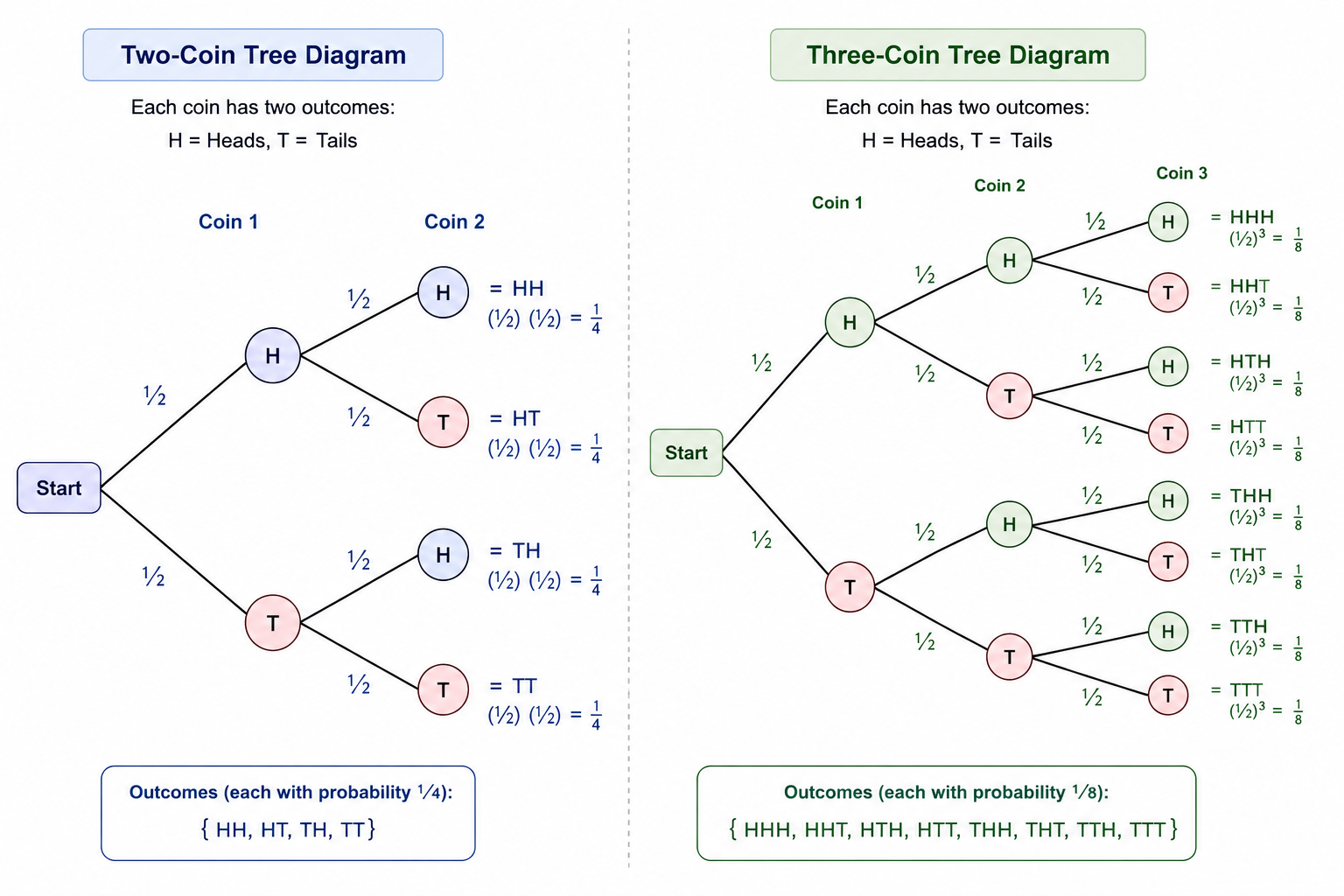
Coin Toss Probability Questions
Coin-toss questions require ordered sample spaces, which means HT and TH are treated as different outcomes.
One Coin
S = {H, T}
P(H) = 1 / 2
P(T) = 1 / 2
Two Coins
S = {HH, HT, TH, TT}
| Event | Favourable Outcomes | Probability |
| Two heads | HH | 1 / 4 |
| Exactly one head | HT, TH | 2 / 4 = 1 / 2 |
| At least one head | HH, HT, TH | 3 / 4 |
| No heads | TT | 1 / 4 |
| Same result | HH, TT | 2 / 4 = 1 / 2 |
Three Coins
Three coin tosses have:
2 x 2 x 2 = 8 possible outcomes
S = {HHH, HHT, HTH, HTT, THH, THT, TTH, TTT}
Example:
Find the probability of exactly two heads.
Favourable outcomes:
{HHT, HTH, THH}
Therefore:
P(exactly two heads) = 3 / 8
Common Coin Mistakes
- Writing only HH, HT and TT and omitting TH
- Treating “exactly one” as “at least one”
- Assuming two tosses have only two outcomes
- Forgetting that order matters
- Counting the number of heads instead of complete outcomes
Dice Probability Questions
A fair die has six equally likely outcomes, while two distinguishable dice produce 36 ordered outcomes.
One Die
S = {1, 2, 3, 4, 5, 6}
| Event | Favourable Outcomes | Probability |
| Prime number | 2, 3, 5 | 3 / 6 = 1 / 2 |
| Even number | 2, 4, 6 | 1 / 2 |
| Odd number | 1, 3, 5 | 1 / 2 |
| Number greater than 4 | 5, 6 | 1 / 3 |
| Multiple of 3 | 3, 6 | 1 / 3 |
| Number less than 7 | All six outcomes | 1 |
| Number equal to 8 | None | 0 |
NCERT includes one-die questions involving prime numbers, odd numbers and numbers lying within a stated range.
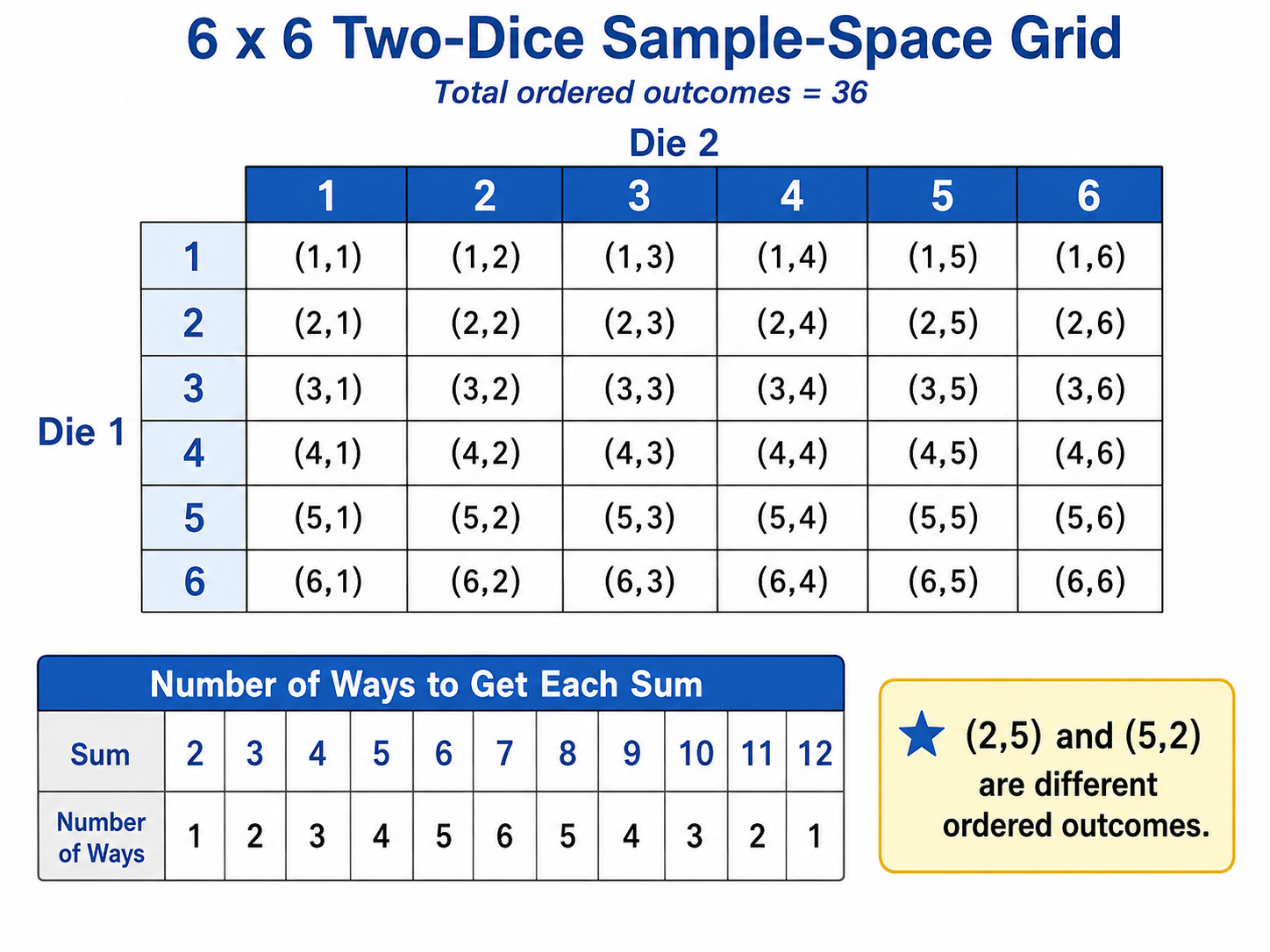
Two Dice
For a blue die and a red die, each outcome is an ordered pair:
(Blue die result, Red die result)
There are:
6 x 6 = 36 equally likely ordered outcomes
Probability of a Sum of 7
Favourable outcomes:
(1, 6), (2, 5), (3, 4), (4, 3), (5, 2), (6, 1)
Therefore:
P(sum of 7) = 6 / 36 = 1 / 6
Probability of a Sum of 8
Favourable outcomes:
(2, 6), (3, 5), (4, 4), (5, 3), (6, 2)
Therefore:
P(sum of 8) = 5 / 36
Why the Sums Are Not Equally Likely
The possible sums are 2 through 12, but they do not each occur in the same number of ways.
| Sum | Number of Ordered Outcomes |
| 2 | 1 |
| 3 | 2 |
| 4 | 3 |
| 5 | 4 |
| 6 | 5 |
| 7 | 6 |
| 8 | 5 |
| 9 | 4 |
| 10 | 3 |
| 11 | 2 |
| 12 | 1 |
Therefore, using 1 / 11 as the probability of every sum is incorrect. NCERT specifically asks students to examine and reject that argument.
Common Dice Mistakes
- Using 11 as the denominator for two-dice sums
- Treating (2, 5) and (5, 2) as one outcome
- Forgetting that two dice produce 36 outcomes
- Including an endpoint excluded by “greater than” or “less than”
- Treating repeated labels as a single outcome when they appear on different faces
Playing Cards Probability Questions
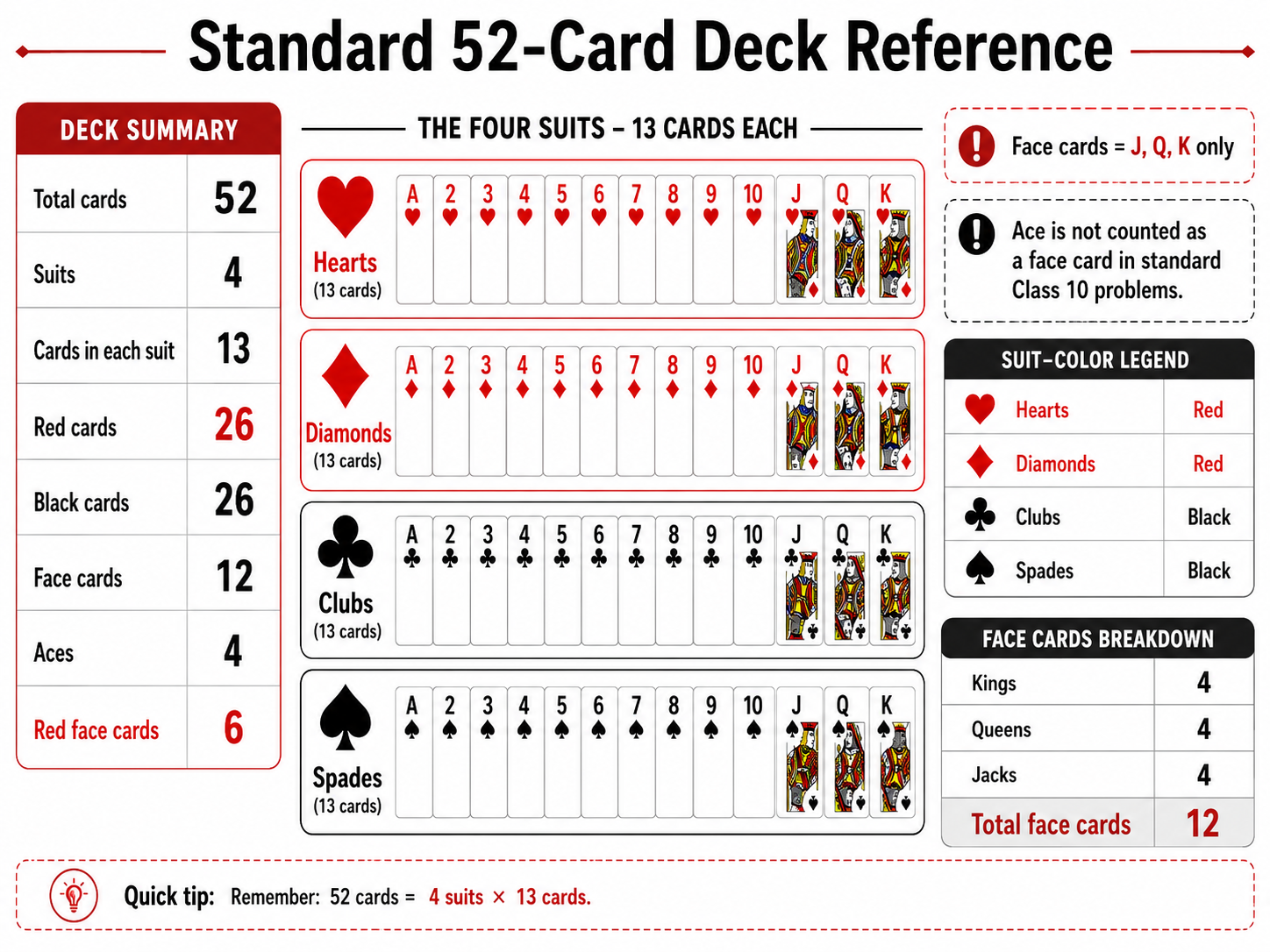
A standard deck has 52 cards divided into four suits, and knowing the deck structure prevents most card-probability errors.
Standard Deck Facts
| Card Category | Number |
| Total cards | 52 |
| Suits | 4 |
| Cards in each suit | 13 |
| Red cards | 26 |
| Black cards | 26 |
| Hearts | 13 |
| Diamonds | 13 |
| Clubs | 13 |
| Spades | 13 |
| Kings | 4 |
| Queens | 4 |
| Jacks | 4 |
| Aces | 4 |
| Face cards | 12 |
| Red face cards | 6 |
Face cards are jacks, queens and kings. An ace is not normally counted as a face card in Class 10 questions.
NCERT’s exercise includes kings, face cards, red face cards, individual named cards and suits.
Example 1: Red Card
P(red card) = 26 / 52 = 1 / 2
Example 2: Face Card
There are 12 face cards.
P(face card) = 12 / 52 = 3 / 13
Example 3: Red King
There are two red kings:
- King of hearts
- King of diamonds
P(red king) = 2 / 52 = 1 / 26
Example 4: Jack of Hearts
There is exactly one jack of hearts.
P(jack of hearts) = 1 / 52
Without Replacement
When a card is drawn and not replaced, the total number of cards decreases.
Suppose one queen is removed from a set containing the ten, jack, queen, king and ace of diamonds.
Four cards remain, including one ace.
P(ace on second draw) = 1 / 4
The removed queen cannot be drawn again.
P(queen on second draw) = 0
NCERT includes this form of without-replacement question in Exercise 14.1.
Common Card Mistakes
- Counting an ace as a face card
- Confusing 13 hearts with 26 red cards
- Saying there are four red kings instead of two
- Forgetting that each suit has 13 cards
- Keeping the denominator at 52 after a card is removed
Probability with Marbles, Balls and Objects in a Bag
Bag-selection probability is found by dividing the number of required objects by the total number of objects, provided every object is equally likely to be drawn.
Example
A box contains:
- 3 blue marbles
- 2 white marbles
- 4 red marbles
Total marbles:
3 + 2 + 4 = 9
Therefore:
P(blue) = 3 / 9 = 1 / 3
P(white) = 2 / 9
P(red) = 4 / 9
The three probabilities add to 1.
1 / 3 + 2 / 9 + 4 / 9 = 1
NCERT uses this exact structure to explain random selection and the sum of mutually exhaustive outcomes.
Probability of “Not Red”
Using a complement:
P(not red) = 1 - P(red)
If a bag contains 3 red and 5 black balls:
P(red) = 3 / 8
P(not red) = 1 - 3 / 8
P(not red) = 5 / 8
Does Object Size Matter?
The phrase “drawn at random” normally assumes that every object is equally likely to be selected.
If objects have noticeably different sizes, shapes or positions and the question does not establish equal likelihood, the simple counting formula may not be justified.
Number-Selection Probability Questions
Number-selection questions require accurate counting of primes, multiples, perfect squares and inclusive ranges.
Prime Numbers
A prime number has exactly two positive factors:
- 1
- The number itself
Important facts:
- 1 is not prime.
- 2 is the only even prime number.
Example:
A number is chosen from 1 to 10.
Prime numbers:
2, 3, 5, 7
Therefore:
P(prime) = 4 / 10 = 2 / 5
Perfect Squares
From 1 to 30, the perfect squares are:
1, 4, 9, 16, 25
Therefore:
P(perfect square from 1 to 30) = 5 / 30 = 1 / 6
Multiples
From 1 to 20, the multiples of 5 are:
5, 10, 15, 20
Therefore:
P(multiple of 5) = 4 / 20 = 1 / 5
Counting Inclusive Ranges
The number of integers from a to b, including both endpoints, is:
b - a + 1
From 11 to 30:
30 - 11 + 1 = 20
Common Number-Selection Mistakes
- Treating 1 as prime
- Forgetting that 1 is a perfect square
- Omitting one endpoint in an inclusive range
- Including the endpoint in “less than”
- Miscounting multiples
- Assuming zero is included when the range begins at 1
NCERT includes a numbered-disc problem involving two-digit numbers, perfect squares and divisibility by 5.
Spinner and Real-Life Probability Questions
Spinner and real-life problems use the same probability formula only when the represented outcomes are equally likely.
Equal Spinner Sections
A spinner is divided into eight equal sections numbered 1 to 8.
Probability of landing on an odd number:
Favourable outcomes:
1, 3, 5, 7
Therefore:
P(odd) = 4 / 8 = 1 / 2
NCERT includes an eight-section spinner question involving a specific number, odd numbers and numerical inequalities.
Unequal Spinner Sections
When sectors have different sizes, they are not equally likely merely because each section has a different label.
A larger sector has a greater chance of being selected.
Defective Product Example
A batch contains:
- 12 defective pens
- 132 good pens
Total pens:
12 + 132 = 144
Probability of choosing a good pen:
P(good) = 132 / 144 = 11 / 12
NCERT includes defective pens, bulbs and products as practical applications of random selection.
Original Case Study
A school checks 200 calculators before distributing them.
| Condition | Number |
| Fully working | 176 |
| Minor display issue | 16 |
| Not working | 8 |
| Total | 200 |
- Probability of selecting a fully working calculator
P(working) = 176 / 200 = 22 / 25
- Probability of selecting a calculator that is not working
P(not working) = 8 / 200 = 1 / 25
- Probability that a calculator has no complete failure
This includes fully working calculators and calculators with a minor display issue.
176 + 16 = 192
P(no complete failure) = 192 / 200 = 24 / 25
Complementary Events in Probability
Complementary events cover every possible outcome between them, so their probabilities always add to 1.
If event E means “a die shows 6,” then not E means “the die does not show 6.”
P(E) = 1 / 6
P(not E) = 1 - 1 / 6
P(not E) = 5 / 6
When to Use the Complement
Use 1 - P(E) when the opposite event is easier to count.
Common examples:
- At least one head
- Not selecting a red object
- A product is not defective
- A player does not win
- A particular number does not appear
- At least one success in repeated trials
Winning and Losing
If a match cannot end in a draw and:
P(Player A wins) = 0.62
Then:
P(Player B wins) = 1 - 0.62
P(Player B wins) = 0.38
NCERT uses a tennis-match example to demonstrate this complementary relationship.
Common Complement Mistakes
- Subtracting from 100 instead of 1 when probabilities are written as decimals
- Choosing an event that is not the exact opposite
- Forgetting that the two events must cover all possibilities
- Using a complement when direct counting is simpler
- Writing a negative result because the original probability was invalid
Solved Examples of Probability for Class 10
Solved examples should show the sample space, favourable outcomes, formula and final check rather than presenting only an answer.
Example 1: Sure Event
Question:
A die is thrown. Find the probability of obtaining a number less than 7.
All outcomes 1, 2, 3, 4, 5 and 6 satisfy the event.
P(number less than 7) = 6 / 6 = 1
This is a sure event.
Example 2: Impossible Event
Question:
A card is drawn from a standard deck. Find the probability that it is both a heart and a club.
No card belongs to two suits.
P(heart and club) = 0 / 52 = 0
This is an impossible event.
Example 3: Exactly One Head
Two coins are tossed.
S = {HH, HT, TH, TT}
Favourable outcomes:
{HT, TH}
P(exactly one head) = 2 / 4 = 1 / 2
Example 4: At Least One 5 in Two Die Throws
It is faster to find the complement:
No 5 appears in either throw.
Probability of not obtaining 5 in one throw:
5 / 6
For two ordered throws:
P(no 5) = 5 / 6 x 5 / 6
P(no 5) = 25 / 36
Therefore:
P(at least one 5) = 1 - 25 / 36
P(at least one 5) = 11 / 36
NCERT treats throwing one die twice as equivalent to throwing two distinguishable dice for this type of problem.
Example 5: Card Without Replacement
Five cards are shuffled:
- 10 of diamonds
- Jack of diamonds
- Queen of diamonds
- King of diamonds
- Ace of diamonds
The queen is drawn and put aside.
Four cards remain.
P(ace next) = 1 / 4
No queen remains.
P(queen next) = 0
Example 6: Incorrect Reasoning
Claim:
Two dice have 11 possible sums, so the probability of each sum is 1 / 11.
Why it is wrong:
The sums are not equally likely.
A sum of 2 has one ordered outcome.
A sum of 7 has six ordered outcomes.
Correct probabilities:
P(sum of 2) = 1 / 36
P(sum of 7) = 6 / 36 = 1 / 6
Probability Class 10 Important Questions
The most useful Class 10 Probability practice set mixes direct calculation, interpretation, complementary events and reasoning.
Foundation Questions
- A die is thrown once. Find the probability of obtaining a multiple of 2.
- A card is drawn from a standard deck. Find the probability of obtaining a black card.
- A bag contains 5 green and 7 yellow balls. Find the probability of drawing a green ball.
- Two coins are tossed. Find the probability of exactly two tails.
- A number is chosen from 1 to 20. Find the probability that it is prime.
Board-Ready Questions
- Two dice are thrown. Find the probability that their sum is 9.
- A card is drawn from a deck. Find the probability that it is neither a king nor a queen.
- Three coins are tossed. Find the probability of exactly two heads.
- A number is selected from 1 to 50. Find the probability that it is a multiple of 6.
- A batch contains 15 defective and 135 good bulbs. Find the probability of selecting a bulb that is not defective.
Reasoning Questions
- Explain why “getting a sum of 2” and “getting a sum of 7” are not equally likely when two dice are thrown.
- A student says the probability of rain tomorrow is 1.3. Explain the error.
- A spinner has four sections of unequal area. Can each labelled outcome be assigned probability 1 / 4? Justify.
- Explain why HT and TH are separate outcomes when two coins are tossed.
- A card is removed from a deck and not replaced. Explain why the denominator changes for the next draw.
Also Check: Probability Class 10 important questions with solutions
Probability Class 10 MCQs
These MCQs test formulas, terminology, counting and common Probability misconceptions.
1. The Probability of a Sure Event Is:
A. 0
B. 1 / 2
C. 1
D. Greater than 1
Answer: C
A sure event must occur, so its probability is 1.
2. Which Value Cannot Represent a Probability?
A. 0.4
B. 3 / 5
C. 110%
D. 1
Answer: C
A probability cannot exceed 1, and 110% equals 1.1.
3. A Fair Die Is Thrown Once. The Probability of Obtaining a Prime Number Is:
A. 1 / 6
B. 1 / 3
C. 1 / 2
D. 2 / 3
Answer: C
The prime outcomes are 2, 3 and 5.
P(prime) = 3 / 6 = 1 / 2
4. Two Coins Are Tossed. The Probability of At Least One Head Is:
A. 1 / 4
B. 1 / 2
C. 3 / 4
D. 1
Answer: C
The favourable outcomes are HH, HT and TH.
5. A Standard Deck Contains How Many Face Cards?
A. 4
B. 8
C. 12
D. 16
Answer: C
Each suit has a jack, queen and king.
3 x 4 = 12
6. If P(E) = 0.35, Then P(not E) Equals:
A. 0.35
B. 0.65
C. 1.35
D. -0.35
Answer: B
P(not E) = 1 - 0.35
P(not E) = 0.65
7. Two Dice Are Thrown. The Total Number of Ordered Outcomes Is:
A. 6
B. 11
C. 12
D. 36
Answer: D
Each result on the first die can be paired with six results on the second die.
8. Which Card Is Not a Face Card?
A. Jack
B. Queen
C. King
D. Ace
Answer: D
Standard Class 10 problems count jacks, queens and kings as face cards.
9. “At Most One Head” in Two Coin Tosses Includes:
A. HH only
B. HT and TH only
C. TT, HT and TH
D. Every outcome
Answer: C
At most one means zero or one.
10. The Probability of an Impossible Event Is:
A. 0
B. 1 / 2
C. 1
D. Undefined
Answer: A
Common Mistakes in Class 10 Probability
Most Probability errors come from incorrect counting or misreading the event rather than from the formula itself.
| Mistake | Incorrect Idea | Correct Approach |
| Two dice have 11 outcomes | Counts only sums | Two dice have 36 ordered outcomes |
| HT and TH are identical | Ignores order | They are separate outcomes |
| Ace is a face card | Includes ace with J, Q and K | Only J, Q and K are face cards |
| At least one means exactly one | Excludes multiple successes | At least one means one or more |
| Denominator stays unchanged | Ignores removed objects | Reduce the total after no replacement |
| Every listed result is equally likely | Assumes instead of checking | Confirm equal likelihood first |
| Probability can be 1.2 | Does not check the range | Probability must lie from 0 to 1 |
| 1 is prime | Misuses the definition | 1 has only one positive factor |
| Not red means black only | Ignores other colours | Include every colour except red |
| A final decimal needs a unit | Treats probability as measurement | Probability has no physical unit |
Mistake-Proof Checklist
Before submitting an answer, confirm:
- The event has been translated correctly.
- Every possible outcome has been counted.
- Favourable outcomes satisfy the complete condition.
- Outcomes are equally likely.
- The denominator reflects any removal.
- The answer is between 0 and 1.
How to Write Probability Answers for Full Marks
A complete Probability solution should identify the outcomes, show the formula and state a simplified final probability.
Recommended Answer Format
- Write the total number of possible outcomes.
- Write the number of favourable outcomes.
- State the formula.
- Substitute the values.
- Simplify the fraction.
- Write a final sentence.
Model Answer
Question:
A die is thrown once. Find the probability of obtaining an odd number.
Possible outcomes:
S = {1, 2, 3, 4, 5, 6}
Favourable outcomes:
{1, 3, 5}
Probability formula:
P(odd) = Number of favourable outcomes / Total number of outcomes
P(odd) = 3 / 6
P(odd) = 1 / 2
Therefore, the probability of obtaining an odd number is 1 / 2.
When to Write the Sample Space
Write the full sample space when:
- The number of outcomes is small
- Order matters
- The question asks for justification
- Two coins or two dice are involved
- Listing outcomes prevents a counting error
A full list may be unnecessary when selecting one object from a clearly counted group, but the total and favourable counts should still be shown.
Is NCERT Enough for Class 10 Probability?
NCERT should be completed first, but Standard Maths students generally benefit from additional reasoning questions, PYQs and sample-paper practice.
The NCERT exercise covers rules, equal likelihood, complements, bags, spinners, dice, cards, defective objects, number selection, two-dice sums and repeated trials.
Basic Maths Preparation
Complete:
- Every NCERT example
- Exercise 14.1
- Direct formula questions
- Basic complement questions
- Selected MCQs
- Recent official sample-paper questions
Standard Maths Preparation
Complete:
- NCERT examples and exercise
- NCERT Exemplar or equivalent reasoning problems
- Questions involving misleading wording
- Two-dice reasoning
- Case-study questions
- Previous-year and sample-paper questions
- Timed mixed practice
Probability Class 10 Quick Revision Plan
A focused revision plan should combine formulas, sample spaces, common traps and a small set of mixed questions.
15-Minute Revision
- Review the main formula.
- Review P(not E) = 1 - P(E).
- Memorize the standard card-deck facts.
- List the two-coin sample space.
- Review why two dice have 36 outcomes.
- Read the at-least and at-most table.
- Solve two quick questions.
45-Minute Revision
- Spend 10 minutes on definitions and formulas.
- Spend 10 minutes on coins and dice.
- Spend 10 minutes on cards and object selection.
- Spend 10 minutes solving five mixed questions.
- Spend 5 minutes correcting mistakes.
Full Chapter Revision
- Read the complete Class 10 Probability notes.
- Solve all NCERT examples and Exercise 14.1.
- Complete a 15-question mixed worksheet.
- Attempt 10 MCQs.
- Solve recent official-paper or sample-paper questions.
- Review every incorrect answer by mistake type.
- Retake the questions without notes.
Related Class 10 Maths Resources
These related resources support chapter revision, examination practice and cross-topic preparation.
course
No courses found
FAQs: Probability Class 10 Notes PDF
What Is the Formula for Probability in Class 10?
The formula is:
P(E) = Number of favourable outcomes / Total number of equally likely outcomes
It applies directly when all counted outcomes are equally likely.
How Do You Calculate Probability in Class 10 Maths?
List or count all equally likely outcomes, count the outcomes that satisfy the event, and divide favourable outcomes by total outcomes. Simplify the result and check that it lies between 0 and 1.
Is Probability Chapter 14 or Chapter 15 in Class 10?
Probability is Chapter 14 in the current NCERT Class 10 Mathematics textbook. Some older editions and websites identify it as Chapter 15.
What Is the Probability of an Impossible Event?
The probability of an impossible event is 0. For example, the probability of rolling a 7 on a standard six-faced die is 0.
What Is the Probability of a Sure Event?
The probability of a sure event is 1. Rolling a number from 1 to 6 on a standard die is a sure event.
What Is the Difference Between Experimental and Theoretical Probability?
Experimental probability comes from observed trial results, while theoretical probability comes from counting equally likely possible outcomes. Experimental results may vary, but the theoretical value remains fixed under the assumptions.
What Does “At Least One” Mean in Probability?
“At least one” means one or more. It is often fastest to calculate its probability by subtracting the probability of no successes from 1.
How Many Outcomes Are Possible When Two Dice Are Thrown?
Two distinguishable dice have 6 x 6 = 36 ordered outcomes. The possible sums from 2 to 12 are not equally likely.
Is an Ace a Face Card?
No. In standard Class 10 card questions, the face cards are jacks, queens and kings.
Can Probability Be Greater Than 1?
No. Every valid probability lies between 0 and 1, inclusive.
Is Probability Included in the 2026–27 CBSE Syllabus?
Yes. The syllabus includes the classical definition of probability, simple event-probability problems and applications to everyday likelihood.
Is Probability the Same for Basic and Standard Maths?
The core syllabus concepts are the same, but Standard Maths generally requires more application, analysis and unfamiliar problem-solving across its paper design.
How Many Marks Does Probability Carry in Class 10?
CBSE groups Statistics and Probability within one unit rather than guaranteeing a fixed Probability-only mark total. The exact number of Probability marks can vary between papers.
Is NCERT Enough for Class 10 Probability?
NCERT is the essential starting point and covers the complete core chapter. Basic Maths students should add selected PYQs, while Standard Maths students should also practise reasoning, competency-based and mixed application questions.
Where Can I Download Probability Class 10 Notes PDF?
Use the download section on this page for the complete notes, one-page formula sheet, practice worksheet and answer key.
