- Areas Related to Circles Class 10 Concepts Overview
- Areas Related to Circles Class 10 Notes PDF Download
- Is Areas Related to Circles Chapter 11 or Chapter 12?
- Areas Related to Circles Class 10 Syllabus
- Parts of a Circle
- Difference Between a Sector and a Segment
- Areas Related to Circles Formulas Class 10
- Which Formula Should You Use?
- How to Solve Areas Related to Circles Questions
- Solved Examples for Areas Related to Circles
- Shaded Region Questions Class 10
- NCERT Exercise 11.1 Question Overview
- Areas Related to Circles Important Questions for Exams
- Common Mistakes in Areas Related to Circles
- Practice MCQs with Answers
- Short-Answer Practice Questions
- Competency-Based Questions
- Areas Related to Circles Quick Revision Summary
- FAQs: Areas Related to Circles
Areas Related to Circles Class 10 Notes PDF – Chapter 11
By rohit.pandey1
|
Updated on 27 Jul 2026, 11:34 IST
Class 10 Maths Chapter 11 Areas Related to Circles Notes PDF covers arc length, area and perimeter of sectors, minor and major segments, shaded regions, and practical applications of circular figures.
These detailed CBSE notes include important formulas, simple definitions, labelled-diagram placeholders, step-by-step solved examples, important exam questions, common mistakes, MCQs, and quick revision points. The topic is Chapter 11 in the current NCERT textbook, although some older books and videos may show it as Chapter 12.
Also Check: Areas Related to Circles NCERT solutions
Areas Related to Circles Class 10 Concepts Overview
Areas Related to Circles is based on finding the length, perimeter, or area of a complete circle or a selected part of it.
The six core ideas of the chapter are:
- An arc is part of the circumference of a circle.
- A sector is the region enclosed by two radii and an arc.
- A segment is the region enclosed by a chord and an arc.
- Sector area is calculated as a fraction of the complete circle area.
- Arc length is calculated as a fraction of the complete circumference.
- Segment area is calculated by subtracting the triangle area from the sector area.
A major sector or major segment can usually be calculated by subtracting the corresponding minor region from the complete circle.
Loading PDF...
Shaded-region questions are solved by dividing the figure into familiar shapes and then adding or subtracting their areas.
Areas Related to Circles Class 10 Notes PDF Download
The Areas Related to Circles Class 10 Notes PDF provides complete chapter revision material in a printable and exam-friendly format.
Also Check: Complete Class 10 Maths notes PDF
Is Areas Related to Circles Chapter 11 or Chapter 12?
Areas Related to Circles is Chapter 11 in the current NCERT Class 10 Mathematics textbook.

Older editions placed this topic in Chapter 12. This is why many older videos, notes, and question banks still use the heading “Chapter 12 Areas Related to Circles.”
Students may use an older video to understand a formula, but they should match the questions with the latest textbook and syllabus.
Best Courses for You

JEE

NEET

Foundation JEE

Foundation NEET

CBSE
Areas Related to Circles Class 10 Syllabus
The current CBSE Class 10 Maths syllabus covers the areas of sectors and segments and questions involving their areas, perimeters, arcs, and circumferences.
Topics Included in the Chapter
- Area of a sector
- Length of an arc
- Perimeter of a sector
- Area of a minor segment
- Area of a major segment
- Area of a major sector
- Problems based on circumference and area
- Real-life applications of sectors and segments
- Segment-area questions based on 60°, 90°, and 120° central angles
CBSE currently restricts segment-area questions to central angles of 60°, 90°, and 120°. These angles allow the corresponding triangle area to be calculated using familiar geometric or trigonometric methods.
Supporting Concepts to Revise
Students should revise the following topics before beginning this chapter:
- Area of a circle
- Circumference of a circle
- Radius and diameter
- Area of a triangle
- Pythagoras’ theorem
- Standard trigonometric values
- Semicircles and quadrants
- Addition and subtraction of areas
- Composite plane figures
Also Check: Class 10 Trigonometry Notes | Circles Class 10 Notes
Parts of a Circle
The main parts of a circle are the centre, radius, diameter, chord, arc, sector, segment, and central angle.
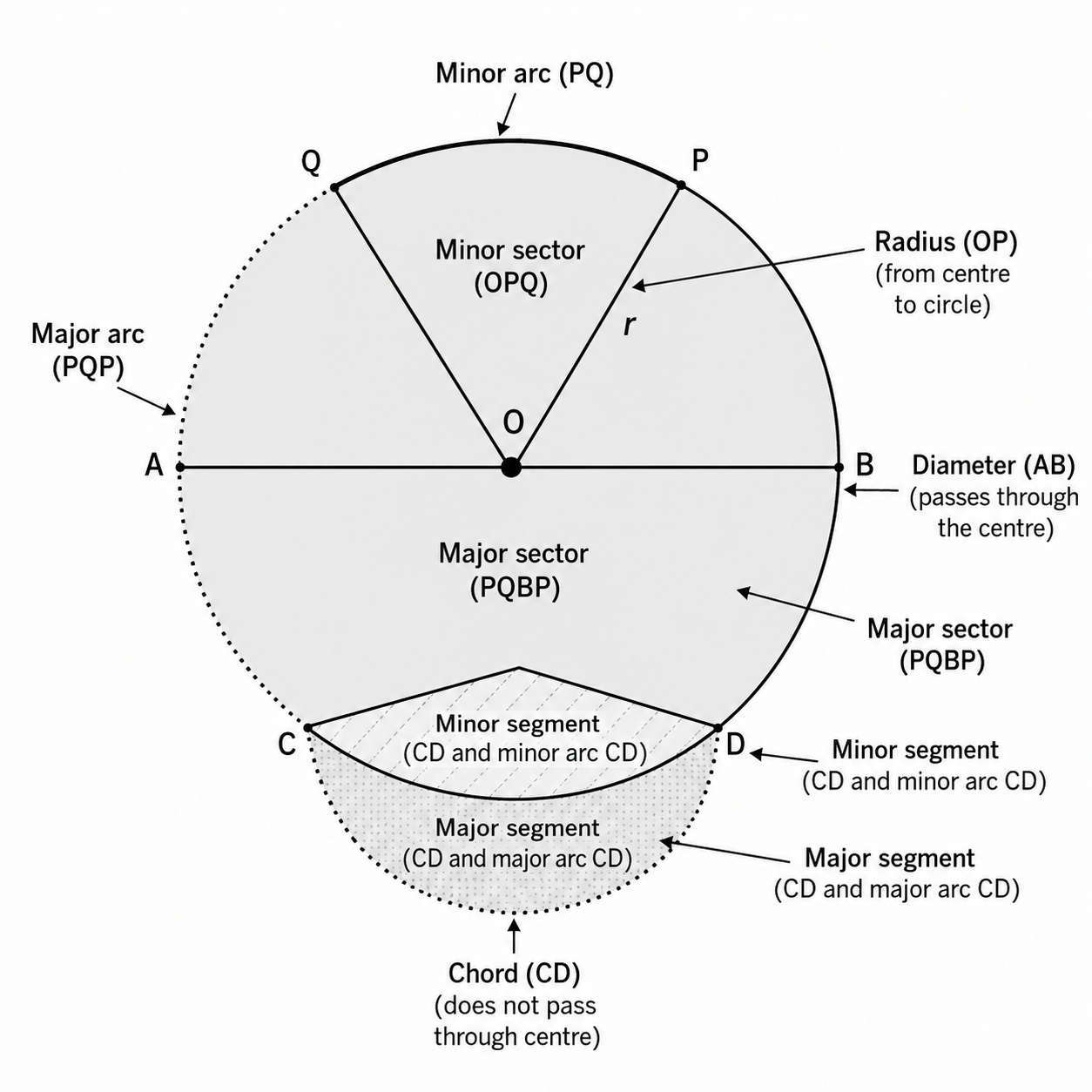
Centre
Centre: The fixed point inside a circle that is at the same distance from every point on the circumference.
Radius
Radius: A line segment joining the centre of a circle to any point on its circumference.
The radius is usually represented by the letter r.
Diameter
Diameter: A chord that passes through the centre of a circle.
Diameter = 2 × radius
d = 2 × r
Radius = diameter ÷ 2
r = d ÷ 2
Chord
Chord: A line segment joining any two points on the circumference of a circle.
Every diameter is a chord, but every chord is not a diameter.
Circumference
Circumference: The complete boundary or outer length of a circle.
The circumference of a circle is similar to the perimeter of a polygon.
Arc
Arc: A part of the circumference between two points.
Minor arc: The shorter arc between two points.
Major arc: The longer arc between the same two points.
Sector
Sector: The region enclosed by two radii and the arc between them.
A sector looks like a slice of pizza.
Minor sector: The smaller sector formed by two radii.
Major sector: The larger remaining sector.
Segment
Segment: The region enclosed by a chord and its corresponding arc.
Minor segment: The smaller segment.
Major segment: The larger segment.
Central Angle
Central angle: The angle formed by two radii at the centre of a circle.
The central angle is usually represented by the symbol θ.
If the minor angle is θ, then:
Major angle = 360° − θ
Difference Between a Sector and a Segment
A sector is enclosed by two radii and an arc, while a segment is enclosed by a chord and an arc.
| Feature | Sector | Segment |
| Enclosed by | Two radii and an arc | A chord and an arc |
| Reaches the centre | Yes | Usually no |
| Shape | Pizza-slice shape | Curved cap shape |
| Main area method | Fraction of circle area | Sector area − triangle area |
| Major region method | Circle area − minor sector | Circle area − minor segment |
| Common mistake | Forgetting two radii in perimeter | Forgetting to subtract the triangle |
A sector contains the triangle formed by the two radii and the chord. A segment is the part that remains after this triangle is removed from the sector.
Areas Related to Circles Formulas Class 10
The main Areas Related to Circles formulas calculate circumference, circle area, arc length, sector area, sector perimeter, and segment area.
In the formulas below:
- r means radius
- d means diameter
- R means outer radius
- θ means central angle
- π may be taken as 22/7, 3.14, or left as π according to the question
Circumference of a Circle
Circumference = 2 × π × radius
C = 2 × π × r
It can also be written as:
Circumference = π × diameter
C = π × d
Unit: centimetres, metres, kilometres, or another linear unit.
Area of a Circle
Area of circle = π × radius × radius
A = π × r²
Unit: square centimetres, square metres, square kilometres, or another square unit.
Area of a Semicircle
A semicircle is half of a complete circle.
Area of semicircle = 1/2 × π × radius × radius
Perimeter of a Semicircle
The perimeter of a semicircle includes the curved part and the diameter.
Perimeter of semicircle = π × radius + 2 × radius
Students should not write only π × radius because that gives only the curved length.
Area of a Quadrant
A quadrant is one-fourth of a complete circle.
Area of quadrant = 1/4 × π × radius × radius
Perimeter of a Quadrant
The perimeter of a quadrant includes the curved arc and two radii.
Perimeter of quadrant = 1/2 × π × radius + 2 × radius
Length of an Arc
Arc length = Central angle ÷ 360 × 2 × π × radius
The formula works because the arc represents the same fraction of the complete circumference as its central angle represents of 360°.
Unit: centimetres, metres, kilometres, or another linear unit.
Area of a Sector
Area of sector = Central angle ÷ 360 × π × radius × radius
The formula works because the sector represents the same fraction of the complete circular area as its central angle represents of 360°.
Unit: square centimetres, square metres, or another square unit.
Perimeter of a Sector
Perimeter of sector = Arc length + 2 × radius
Therefore:
Perimeter of sector = Central angle ÷ 360 × 2 × π × radius + 2 × radius
Students often lose marks by writing only the arc length and forgetting the two radii.
Area of a Minor Segment
Area of minor segment = Area of sector − Area of triangle
The triangle is formed by the two radii and the chord.
Area of a Major Sector
Area of major sector = Area of complete circle − Area of minor sector
It can also be calculated by using the major angle.
Major angle = 360° − Minor angle
Area of a Major Segment
Area of major segment = Area of complete circle − Area of minor segment
Area of a Circular Ring
A circular ring is formed between two circles with the same centre.
Area of ring = Area of outer circle − Area of inner circle
Area of ring = π × outer radius × outer radius − π × inner radius × inner radius
Area of ring = π × (R² − r²)
Do not use π × (R − r)². The radii must be squared before subtraction.
Complete Formula Table
| Required Quantity | Formula | Unit |
| Circumference | 2 × π × radius | Linear unit |
| Area of circle | π × radius × radius | Square unit |
| Arc length | Angle ÷ 360 × 2 × π × radius | Linear unit |
| Area of sector | Angle ÷ 360 × π × radius × radius | Square unit |
| Perimeter of sector | Arc length + 2 × radius | Linear unit |
| Area of minor segment | Sector area − triangle area | Square unit |
| Area of major sector | Circle area − minor sector area | Square unit |
| Area of major segment | Circle area − minor segment area | Square unit |
| Area of circular ring | π × (R² − r²) | Square unit |
Also Check: Class 10 Mensuration Formula Sheet
Which Formula Should You Use?
The correct formula depends on whether the question asks for a length, area, perimeter, sector, segment, or shaded region.
Use the following steps:
- Check whether the answer is a length or an area.
A length uses a linear unit such as cm, while an area uses a square unit such as cm². - Look at the boundary of the required region.
Two radii and an arc form a sector. A chord and an arc form a segment. - Identify whether the region is minor or major.
The minor region is smaller, while the major region is the larger remaining part. - Check whether the figure contains more than one shape.
Shaded regions may contain circles, sectors, triangles, squares, or rectangles. - Decide whether the areas must be added or subtracted.
Add separate shaded pieces and subtract shapes that have been removed.
Formula Selection Guide
| Words in the Question | Formula or Method |
| Length of the arc | Angle ÷ 360 × 2 × π × radius |
| Area swept by a hand or blade | Area of sector |
| Region between two radii | Area of sector |
| Complete boundary of a sector | Arc length + 2 × radius |
| Region between chord and arc | Area of segment |
| Major sector | Circle area − minor sector |
| Major segment | Circle area − minor segment |
| Circle inside a square | Square area − circle area |
| Circular path | Outer circle area − inner circle area |
| Equal sectors | Divide 360° by the number of sectors |
How to Solve Areas Related to Circles Questions
Every Areas Related to Circles problem can be solved by identifying the required region before substituting values into a formula.
Five-Step Solving Method
- Write the given information.
Note the radius, diameter, central angle, and value of π. - Mark the required region.
Identify whether the question asks for an arc, sector, segment, or shaded area. - Write the formula.
Writing the formula before substitution shows the correct method. - Substitute and simplify.
Cancel common factors before multiplying. - Write the answer with the correct unit.
Use a linear unit for length and a square unit for area.
How to Decide Whether to Add or Subtract
- Add the areas when separate pieces combine to form the required region.
- Subtract the areas when a smaller shape has been removed from a larger shape.
- Subtract an overlap when the same region has been counted twice.
- Multiply by the number of equal parts when several identical sectors or figures are present.
- Divide 360° by the number of equal sectors when the central angle is not given.
Which Value of π Should You Use?
Use the value of π stated in the question.
- Use 22/7 when the question gives it.
- Use 3.14 when the question specifically asks for it.
- Leave the answer in terms of π when an exact answer is acceptable.
- Do not change from 22/7 to 3.14 in the middle of a solution.
The current NCERT Exercise 11.1 instructs students to use 22/7 unless another value is stated.
Fractions, Decimals, and Rounding
Keep fractions and exact values during the working and round only at the final step.
For example:
Area of sector
= 120 ÷ 360 × 22/7 × 7 × 7
= 1/3 × 154
= 154/3 square centimetres
= 51.33 square centimetres approximately
Rounding separate values too early may produce a different final answer.
Correct Units
| Quantity | Correct Unit Type |
| Radius | cm, m, km |
| Diameter | cm, m, km |
| Arc length | cm, m, km |
| Circumference | cm, m, km |
| Perimeter | cm, m, km |
| Sector area | cm², m², km² |
| Segment area | cm², m², km² |
| Cost | Rupees or another currency after applying the stated rate |
Solved Examples for Areas Related to Circles
The following solved examples cover the main direct, segment, shaded-region, and real-life question types.
Example 1: Area of a Sector
Find the area of a 90° sector of a circle with radius 14 cm. Use π = 22/7.
Step 1: Write the formula.
Area of sector = Angle ÷ 360 × π × radius × radius
Step 2: Substitute the values.
Area of sector
= 90 ÷ 360 × 22/7 × 14 × 14
Step 3: Simplify.
Area of sector
= 1/4 × 616
= 154 square centimetres
Answer: The area of the sector is 154 cm².
Example 2: Length of an Arc
Find the length of a 60° arc in a circle of radius 21 cm. Use π = 22/7.
Arc length = Angle ÷ 360 × 2 × π × radius
Arc length
= 60 ÷ 360 × 2 × 22/7 × 21
= 1/6 × 132
= 22 centimetres
Answer: The length of the arc is 22 cm.
Example 3: Perimeter of a Sector
Find the perimeter of a 120° sector with radius 7 cm. Use π = 22/7.
Step 1: Calculate the arc length.
Arc length
= 120 ÷ 360 × 2 × 22/7 × 7
= 1/3 × 44
= 44/3 centimetres
Step 2: Add the two radii.
Perimeter of sector
= Arc length + 2 × radius
= 44/3 + 14
= 44/3 + 42/3
= 86/3 centimetres
= 28.67 centimetres approximately
Answer: The perimeter of the sector is approximately 28.67 cm.
Example 4: Area of a 60° Minor Segment
A chord in a circle of radius 14 cm forms a central angle of 60°. Find the area of the minor segment. Use π = 22/7 and √3 = 1.732.
Step 1: Calculate the sector area.
Sector area
= 60 ÷ 360 × 22/7 × 14 × 14
= 1/6 × 616
= 102.67 square centimetres approximately
Step 2: Calculate the triangle area.
The triangle is equilateral because all three angles are 60°.
Area of equilateral triangle
= √3 ÷ 4 × side × side
= 1.732 ÷ 4 × 14 × 14
= 84.87 square centimetres approximately
Step 3: Calculate the segment area.
Area of minor segment
= Sector area − Triangle area
= 102.67 − 84.87
= 17.80 square centimetres
Answer: The area of the minor segment is approximately 17.80 cm².
Example 5: Area of a 90° Minor Segment
A chord of a circle with radius 14 cm forms a 90° angle at the centre. Find the area of the minor segment. Use π = 22/7.
Step 1: Calculate the sector area.
Sector area
= 90 ÷ 360 × 22/7 × 14 × 14
= 154 square centimetres
Step 2: Calculate the triangle area.
The two radii form a right-angled triangle.
Triangle area
= 1/2 × base × height
= 1/2 × 14 × 14
= 98 square centimetres
Step 3: Subtract.
Segment area
= 154 − 98
= 56 square centimetres
Answer: The area of the minor segment is 56 cm².
Example 6: Area of a 120° Minor Segment
A chord of a circle with radius 14 cm forms a central angle of 120°. Find the area of the minor segment. Use π = 22/7 and √3 = 1.732.
Step 1: Calculate the sector area.
Sector area
= 120 ÷ 360 × 22/7 × 14 × 14
= 1/3 × 616
= 205.33 square centimetres approximately
Step 2: Calculate the triangle area.
Triangle area
= 1/2 × radius × radius × sin 120°
= 1/2 × 14 × 14 × √3/2
= 49 × 1.732
= 84.87 square centimetres approximately
Step 3: Calculate the segment area.
Segment area
= 205.33 − 84.87
= 120.46 square centimetres
Answer: The area of the minor segment is approximately 120.46 cm².
Example 7: Area of a Major Segment
The area of a minor segment in a circle of radius 14 cm is 56 cm². Find the area of the major segment. Use π = 22/7.
Step 1: Calculate the complete circle area.
Circle area
= 22/7 × 14 × 14
= 616 square centimetres
Step 2: Subtract the minor segment.
Major segment area
= Complete circle area − Minor segment area
= 616 − 56
= 560 square centimetres
Answer: The area of the major segment is 560 cm².
Example 8: Finding Radius from Circumference
The circumference of a circle is 44 cm. Find the area of one quadrant. Use π = 22/7.
Step 1: Find the radius.
Circumference = 2 × π × radius
44 = 2 × 22/7 × radius
Radius = 7 cm
Step 2: Find the quadrant area.
Area of quadrant
= 1/4 × 22/7 × 7 × 7
= 38.5 square centimetres
Answer: The area of the quadrant is 38.5 cm².
Example 9: Area Swept by Two Wipers
Two non-overlapping wipers each have a blade length of 21 cm and sweep through 120°. Find their total cleaned area. Use π = 22/7.
Step 1: Find the area cleaned by one wiper.
Area of one sector
= 120 ÷ 360 × 22/7 × 21 × 21
= 462 square centimetres
Step 2: Multiply by two.
Total cleaned area
= 2 × 462
= 924 square centimetres
Answer: The total cleaned area is 924 cm².
Example 10: Cost Based on Circular Area
A circular garden has a radius of 7 m. Grass costs ₹12 per square metre. Find the total cost of covering the garden.
Step 1: Calculate the garden area.
Area
= 22/7 × 7 × 7
= 154 square metres
Step 2: Calculate the cost.
Cost
= 154 × ₹12
= ₹1,848
Answer: The total cost is ₹1,848.
Shaded Region Questions Class 10
Shaded-region questions are solved by dividing the diagram into known shapes and then adding or subtracting their areas.
Pattern 1: Sector Minus Triangle
Use this pattern when the shaded region lies between a chord and an arc.
Shaded segment area = Sector area − Triangle area
Pattern 2: Circle Inside a Square
When a circle is inscribed in a square, the diameter of the circle equals the side of the square.
Shaded corner area = Area of square − Area of circle
Pattern 3: Square Inside a Circle
When all four vertices of a square touch the circle, the diagonal of the square equals the diameter of the circle.
Diameter of circle = Diagonal of square
Find the side of the square before calculating its area.
Pattern 4: Semicircles on the Sides of a Square
Calculate each semicircle and check whether any parts overlap.
Area of one semicircle = 1/2 × π × radius × radius
Total semicircle area = Number of semicircles × Area of one semicircle
Pattern 5: Quadrants at the Corners
Four quadrants of equal radius form one complete circle.
Area of four quadrants = π × radius × radius
This shortcut is useful when equal quadrants are removed from the corners of a square.
Pattern 6: Concentric Circles
The region between two circles with the same centre is called a circular ring.
Area of path = π × (Outer radius² − Inner radius²)
Pattern 7: Overlapping Circular Regions
Use the following method:
- Calculate the area of each complete region.
- Identify the overlapping region.
- Subtract the overlap if it has been counted twice.
Pattern 8: Swept Regions
A rotating hand, blade, beam, or sprinkler forms a sector.
Swept area = Angle ÷ 360 × π × radius × radius
Shaded-Region Strategy Table
| Diagram Pattern | Begin With | Main Operation |
| Segment | Sector | Subtract triangle |
| Circle inside square | Square | Subtract circle |
| Square inside circle | Circle | Subtract square |
| Corner quadrants | Square | Subtract quadrants |
| Circular ring | Outer circle | Subtract inner circle |
| Equal sectors | Complete circle | Divide or multiply |
| Overlapping figures | Sum of regions | Subtract overlap |
| Swept area | Sector | Multiply for equal blades |
NCERT Exercise 11.1 Question Overview
The current NCERT Exercise 11.1 contains 14 questions covering direct formulas, segments, real-life applications, and composite designs.
| Question Number | Main Skill Tested |
| 1 | Area of a 60° sector |
| 2 | Finding quadrant area from circumference |
| 3 | Area swept by a clock hand |
| 4 | Minor segment and major sector |
| 5 | Arc length, sector area, and segment |
| 6 | Minor and major segments |
| 7 | Area of a 120° segment |
| 8 | Quarter-circle grazing area |
| 9 | Wire length and equal sectors |
| 10 | Equal sectors in an umbrella |
| 11 | Area swept by car wipers |
| 12 | Lighthouse warning sector |
| 13 | Composite design and cost |
| 14 | Multiple-choice sector formula |
The exercise includes practical situations involving a clock, field, brooch, umbrella, car wipers, lighthouse, and table-cover design.
Our editorial classification of the current exercise shows:
- 7 of the 14 questions use clear real-life settings.
- Several questions require two or more calculation steps.
- Segment questions include the important angles of 60°, 90°, and 120°.
- The exercise tests interpretation as well as formula use.
Areas Related to Circles Important Questions for Exams
The most important exam questions cover sector formulas, arc length, segment calculations, shaded regions, and real-life applications.
CBSE assigns 10 marks to the complete Mensuration unit, not to Areas Related to Circles alone. The Mensuration unit also includes Surface Areas and Volumes.
Must-Practise Question Types
- Find the area of a sector from its radius and angle.
- Find the length of an arc.
- Find the perimeter of a sector.
- Find the radius from circumference.
- Find a 60° minor segment.
- Find a 90° minor segment.
- Find a 120° minor segment.
- Find a major sector or major segment.
- Solve a circle-inside-square question.
- Solve a circular-path question.
- Calculate an area swept by a wiper or rotating hand.
- Calculate cost from circular area.
- Identify an error in a student’s solution.
- Solve a composite shaded-region problem.
Likely 1-Mark Questions
- Write the formula for the length of an arc.
- Define a sector of a circle.
- Define a segment of a circle.
- Write the formula for the area of a sector.
- State the relationship between a radius and diameter.
- Write the formula for the area of a circular ring.
Likely 3-Mark Questions
- Find the area and perimeter of a 90° sector with radius 14 cm.
- Find the length of a 120° arc with radius 21 cm.
- Find the area of a 90° minor segment with radius 14 cm.
- Find the area of a circular path with given inner and outer radii.
- Find the shaded area when a circle is drawn inside a square.
Likely 5-Mark Questions
- A pair of wipers sweep non-overlapping sectors. Find the total area cleaned.
- A table-cover design contains equal circular sectors. Find the coloured area and its cost.
- A square contains quadrants at each corner. Find the remaining shaded area.
- A chord forms a 120° angle at the centre. Find both the minor and major segment areas.
- A circular garden has a path around it. Find the path area and the cost of paving it.
Model Answer Outline for a 5-Mark Segment Question
A chord of a circle of radius r forms an angle of 120° at the centre. Find the areas of the minor and major segments.
- Calculate the 120° sector area.
- Calculate the triangle area using 1/2 × r × r × sin 120°.
- Subtract the triangle area from the sector area.
- Calculate the complete circle area.
- Subtract the minor segment from the complete circle.
- Write both answers with square units.
Model Answer Outline for a 5-Mark Circular-Path Question
A circular path surrounds a garden with inner radius r and outer radius R.
- Calculate the outer circle area.
- Calculate the inner circle area.
- Subtract the inner area from the outer area.
- Apply the rate per square metre when cost is asked.
- Write the final area and cost with correct units.
Also Check: CBSE Class 10 Maths Sample Papers | Class 10 Maths Previous Year Questions
Common Mistakes in Areas Related to Circles
Most mistakes in this chapter occur because students identify the wrong region, use the wrong formula, or forget the correct unit.
| Common Mistake | Why It Is Wrong | Correct Check |
| Using diameter as radius | Formulas require radius | Divide diameter by 2 |
| Using radius instead of radius² | Area is two-dimensional | Check for square units |
| Using sector area for arc length | One is area and one is length | Check the required unit |
| Giving only arc length as sector perimeter | Two radii are missing | Trace the full boundary |
| Treating a segment as a sector | Triangle has not been removed | Look for the chord |
| Subtracting sector from triangle | Sector must be larger | Subtract triangle from sector |
| Using minor angle for major sector | Calculates the smaller region | Use 360° − minor angle |
| Rounding too early | Changes the final answer | Round only at the end |
| Mixing 3.14 and 22/7 | Makes the calculation inconsistent | Use one value throughout |
| Writing cm instead of cm² | Area requires square units | Check the type of quantity |
| Using π × (R − r)² for a ring | Radii must be squared first | Use π × (R² − r²) |
| Claiming the chapter carries 10 marks | The full Mensuration unit carries 10 marks | Name the complete unit |
Practice MCQs with Answers
These MCQs test definitions, formulas, and basic calculations.
1. What is the area of a 60° sector with radius 7 cm using π = 22/7?
A. 77/3 cm²
B. 77 cm²
C. 154 cm²
D. 44 cm²
Answer: A. 77/3 cm²
2. What is the length of a 90° arc with radius 14 cm?
A. 11 cm
B. 22 cm
C. 44 cm
D. 154 cm
Answer: B. 22 cm
3. The perimeter of a sector contains:
A. Only the arc
B. Only two radii
C. The arc and two radii
D. The complete circumference
Answer: C. The arc and two radii
4. The area of a minor segment is:
A. Triangle area − sector area
B. Sector area − triangle area
C. Circle area − sector area
D. Arc length − radius
Answer: B. Sector area − triangle area
5. A minor sector has an angle of 110°. What is the major-sector angle?
A. 110°
B. 180°
C. 250°
D. 360°
Answer: C. 250°
6. The circumference of a circle is 44 cm. What is its radius when π = 22/7?
A. 3.5 cm
B. 7 cm
C. 14 cm
D. 22 cm
Answer: B. 7 cm
7. What is the area of a quadrant with radius 14 cm?
A. 38.5 cm²
B. 77 cm²
C. 154 cm²
D. 616 cm²
Answer: C. 154 cm²
8. Which is the correct unit for the area of a segment?
A. cm
B. cm²
C. cm³
D. Degrees
Answer: B. cm²
9. Two non-overlapping 90° wipers each have radius 14 cm. What total area do they sweep?
A. 154 cm²
B. 196 cm²
C. 308 cm²
D. 616 cm²
Answer: C. 308 cm²
10. Why is a minor segment smaller than its corresponding sector?
A. The radius becomes shorter.
B. The central angle changes.
C. The triangle between the radii is removed.
D. The circumference is divided by two.
Answer: C. The triangle between the radii is removed.
Also Check: Areas Related to Circles MCQ Questions]
Short-Answer Practice Questions
The following questions progress from direct formula use to multi-step applications.
Question 1
Find the area of a 120° sector with radius 10 cm. Use π = 3.14.
Answer:
Area
= 120 ÷ 360 × 3.14 × 10 × 10
= 104.67 cm² approximately
Question 2
Find the length of a 90° arc with radius 12 cm. Use π = 3.14.
Answer:
Arc length
= 90 ÷ 360 × 2 × 3.14 × 12
= 18.84 cm
Question 3
A chord in a circle of radius 10 cm forms a 90° angle at the centre. Find the minor-segment area. Use π = 3.14.
Answer:
Sector area
= 90 ÷ 360 × 3.14 × 10 × 10
= 78.5 cm²
Triangle area
= 1/2 × 10 × 10
= 50 cm²
Segment area
= 78.5 − 50
= 28.5 cm²
Question 4
Using the result above, find the major-segment area.
Answer:
Complete circle area
= 3.14 × 10 × 10
= 314 cm²
Major segment area
= 314 − 28.5
= 285.5 cm²
Question 5
Find the area of a circular path with outer radius 10 m and inner radius 6 m. Use π = 3.14.
Answer:
Area of path
= 3.14 × (10² − 6²)
= 3.14 × (100 − 36)
= 3.14 × 64
= 200.96 m²
Competency-Based Questions
Competency-based questions require students to understand the situation before selecting a formula.
Question 1: Corner Sprinkler
A sprinkler is fixed at one corner of a square garden. It waters a quarter-circle region of radius 14 m. Find the watered area using π = 22/7.
Answer:
The corner creates a 90° sector.
Watered area
= 90 ÷ 360 × 22/7 × 14 × 14
= 154 m²
Question 2: Clock Display
A decorative clock has a minute hand 21 cm long. Find the area swept by the hand in 20 minutes.
Answer:
Angle covered in 20 minutes
= 20 ÷ 60 × 360
= 120°
Area swept
= 120 ÷ 360 × 22/7 × 21 × 21
= 462 cm²
Question 3: Circular Logo
A square logo has a side of 28 cm. A circle of radius 14 cm is printed inside it. Find the area outside the circle but inside the square.
Answer:
Square area
= 28 × 28
= 784 cm²
Circle area
= 22/7 × 14 × 14
= 616 cm²
Required area
= 784 − 616
= 168 cm²
Question 4: Rotating Safety Beam
A safety beam reaches 30 m and rotates through 72°. Find the covered area using π = 3.14.
Answer:
Covered area
= 72 ÷ 360 × 3.14 × 30 × 30
= 1/5 × 2,826
= 565.2 m²
Question 5: Error Diagnosis
A student calculates the area of a 90° sector with radius 14 cm using:
90 ÷ 360 × 2 × π × radius
The student writes the answer as 22 cm².
Answer:
The student used the arc-length formula but wrote an area unit.
Correct sector area
= 90 ÷ 360 × 22/7 × 14 × 14
= 154 cm²
Areas Related to Circles Quick Revision Summary
The quick revision summary contains the formulas, definitions, and checks students should review before an examination.
Important Definitions
Arc: A part of the circumference.
Sector: A region enclosed by two radii and an arc.
Segment: A region enclosed by a chord and an arc.
Minor region: The smaller region.
Major region: The larger remaining region.
Central angle: The angle formed by two radii at the centre.
Important Formulas
Circumference = 2 × π × radius
Area of circle = π × radius × radius
Arc length = Angle ÷ 360 × 2 × π × radius
Area of sector = Angle ÷ 360 × π × radius × radius
Perimeter of sector = Arc length + 2 × radius
Area of minor segment = Sector area − Triangle area
Area of major sector = Circle area − Minor sector area
Area of major segment = Circle area − Minor segment area
Area of circular ring = π × (Outer radius² − Inner radius²)
Important Rules
- Use the radius, not the diameter, in formulas.
- Use a linear unit for length.
- Use a square unit for area.
- Add two radii when calculating sector perimeter.
- Subtract triangle area when calculating segment area.
- Use 360° − minor angle for a major sector.
- Use the value of π given in the question.
- Round only at the final step.
- Segment questions mainly use 60°, 90°, and 120° angles.
Five Checks Before Submitting an Answer
- Did I convert diameter into radius?
- Did I select a length or area formula correctly?
- Did I subtract the triangle for a segment?
- Did I use the stated value of π?
- Did I write the correct unit?
Fifteen-Minute Revision Plan
- Three minutes: Revise parts of a circle.
- Four minutes: Read all formulas.
- Four minutes: Revise 60°, 90°, and 120° segment examples.
- Two minutes: Review shaded-region methods.
- Two minutes: Read the common-mistakes table.
course
No courses found
FAQs: Areas Related to Circles
Is Areas Related to Circles Chapter 11 or Chapter 12 in Class 10?
Areas Related to Circles is Chapter 11 in the current NCERT textbook. Older editions and many older online resources call it Chapter 12.
Is Areas Related to Circles included in the CBSE 2026–27 syllabus?
Yes. The chapter includes sector and segment areas and related perimeter and circumference problems.
How many exercises are there in Areas Related to Circles Class 10?
The current NCERT chapter contains Exercise 11.1 with 14 numbered questions. Older textbooks may show a different exercise structure.
What are all the Areas Related to Circles formulas for Class 10?
The main formulas cover circumference, circle area, arc length, sector area, sector perimeter, and minor and major segment areas.
What is the difference between a sector and a segment of a circle?
A sector is enclosed by two radii and an arc. A segment is enclosed by a chord and an arc.
How do you find the area and perimeter of a sector?
Sector area is calculated by multiplying the circle area by Angle ÷ 360. Sector perimeter is calculated by adding the two radii to the arc length.
How do you calculate the area of a minor and major segment?
Subtract the triangle area from the sector area to obtain the minor segment. Subtract the minor segment from the complete circle to obtain the major segment.
How do you solve shaded-region questions involving circles?
Divide the diagram into familiar shapes, calculate each area, and then add or subtract according to the shaded portion.
Should I use 22/7 or 3.14 for π in Class 10 Maths?
Use the value stated in the question. The current NCERT exercise generally asks students to use 22/7 unless another value is given.
Should answers be written as fractions or decimals in circle questions?
Keep the exact fraction during the working and convert it into a decimal only when required. Round only the final answer.
Can I use 1/2 × radius × radius × sin θ in segment questions?
Yes, this formula correctly gives the area of the triangle formed by two radii and their included angle. The complete working should still be shown clearly.
Which central angles can be asked in segment-area questions?
The current CBSE syllabus restricts segment-area problems to central angles of 60°, 90°, and 120°.
Is NCERT enough for Areas Related to Circles Class 10?
NCERT is the essential starting point because it defines the syllabus and includes direct, segment, and real-life questions. Students should then practise Exemplar, sample-paper, and previous-year questions.
What are the most important questions from Areas Related to Circles?
Students should prioritise arc length, sector perimeter, 60°/90°/120° segments, major regions, shaded figures, swept areas, and cost-based applications.
What is the weightage of Areas Related to Circles in Class 10?
CBSE assigns 10 marks to the complete Mensuration unit, which includes Areas Related to Circles and Surface Areas and Volumes. The chapter alone does not have a guaranteed 10-mark weightage.
Where can I download Areas Related to Circles Class 10 Notes PDF?
The complete notes PDF, formula sheet, and worksheet can be downloaded from Infinity Learn website.
