- Class 10 Maths Chapter 10 Circles Notes: Overview
- Download Class 10 Maths Chapter 10 Circles Notes PDF
- Essential Circle Terms
- Tangent vs Secant vs Chord
- Number of Tangents from a Point to a Circle
- Theorem 1: A Tangent Is Perpendicular to the Radius
- Theorem 2: Tangents from an External Point Are Equal
- Important Results from the Tangent Theorems
- How to Solve Class 10 Circles Questions
- Class 10 Circles Important Questions with Solutions
- Sample-Paper Evidence and Current Exam Pattern
- Common Mistakes in Class 10 Circles
- Circles vs Areas Related to Circles
- FAQs on Class 10 Maths Chapter 10 Circles Notes
Class 10 Maths Chapter 10 Circles Notes PDF 2026-27
By rohit.pandey1
|
Updated on 23 Jul 2026, 14:31 IST
Class 10 Maths Chapter 11 Areas Related to Circles Notes PDF covers arc length, sector area and perimeter, minor and major segments, shaded regions, and real-life applications of circular figures. These CBSE notes also include key formulas, labelled diagrams, step-by-step solved examples, important exam questions, quick revision points, and common mistakes to avoid.
Class 10 Maths Chapter 10 Circles Notes: Overview
Class 10 Circles focuses on tangents to a circle, the two main tangent theorems and applications involving lengths, angles and circumscribed figures.
The current CBSE Syllabus for Class 10 requires students to prove that a tangent is perpendicular to the radius at the point of contact, prove that tangents from an external point are equal, and apply tangent concepts to solve problems.
What You Will Learn
- Meaning of a tangent to a circle
- Difference between a tangent, secant and chord
- Meaning of the point of contact
- Number of tangents from points inside, on and outside a circle
- Tangent–radius perpendicular theorem
- Equal tangents theorem
- Tangent-length calculations using Pythagoras theorem
- Angle relationships formed by two tangents
- Applications involving concentric circles
- Applications involving triangles and quadrilaterals circumscribing circles
The NCERT 2026–27 reprint contains the two main theorem proofs, three worked examples, four questions in Exercise 10.1 and thirteen questions in Exercise 10.2.
Download Class 10 Maths Chapter 10 Circles Notes PDF
The Class 10 Maths Chapter 10 Circles Notes PDF should provide the complete lesson, theorem proofs, worked examples and printable practice without requiring a phone number or account.
Formula and Theorem Summary
| Result | Mathematical form |
| Radius is perpendicular to tangent | OP ⟂ PT |
| Tangents from one external point are equal | PA = PB |
| Tangent-length relationship | PT² = OP² − OT² |
| Tangent-length formula | PT = √(OP² − r²) |
| Angle between tangents | ∠APB = 180° − ∠AOB |
| Opposite-side sum in a tangential quadrilateral | AB + CD = AD + BC |
The tangent-length formula is not a separate circle theorem. It follows from Pythagoras theorem because the radius and tangent form a right angle at the point of contact.
Loading PDF...
What Is Included in the Current Syllabus?
| Must study | Supporting prior knowledge |
| Tangent at a point of contact | Radius, chord and diameter |
| Radius perpendicular to tangent | Pythagoras theorem |
| Equal tangents from an external point | RHS congruence |
| Applications of tangent properties | CPCT |
| Angle and length problems | Triangle angle sum |
The extension topics may be mathematically correct, but they are not named as core Circles outcomes in the CBSE 2026–27 curriculum. Use the prescribed tangent theorems in board-style solutions unless your school has taught an additional method.
Does the Chapter Have Exercise 10.3?
No. The current NCERT textbook has a Section 10.3, titled “Number of Tangents from a Point on a Circle,” but the exercises are numbered 10.1 and 10.2.
Also Check: NCERT solutions for Class 10 Circles
Essential Circle Terms
The essential terms in Class 10 Circles are circle, centre, radius, diameter, chord, secant, tangent, point of contact, normal and tangent segment.

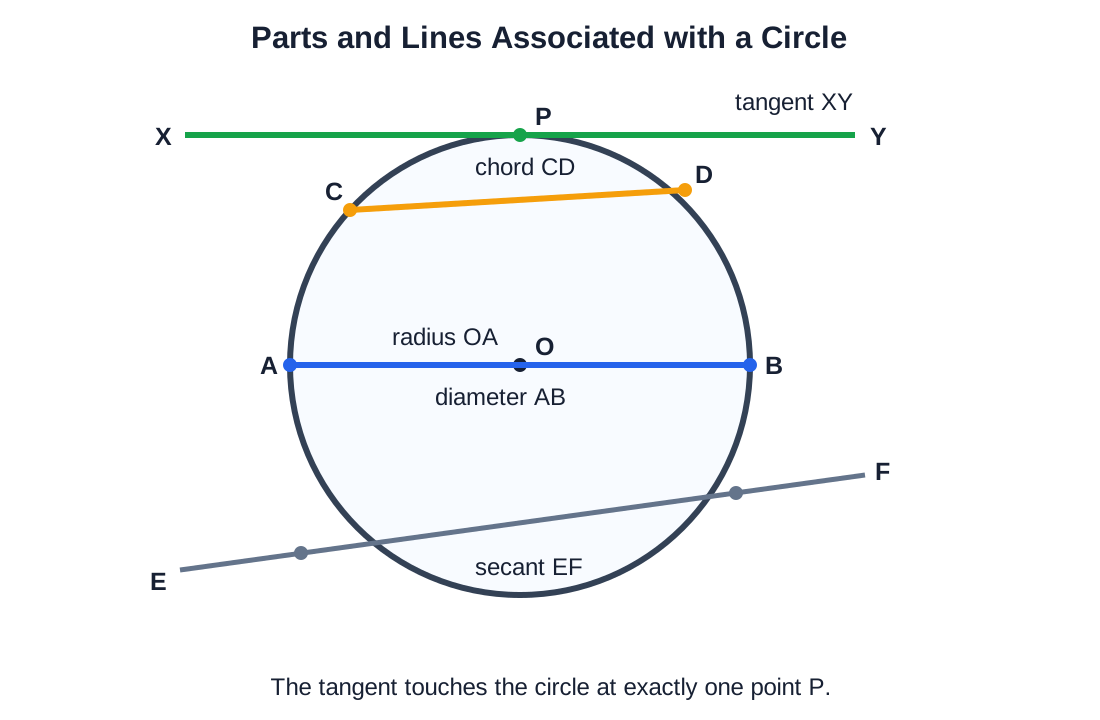
Circle, Centre, Radius and Diameter
Circle: A circle is the set of all points in a plane that are at the same fixed distance from a fixed point.
Centre: The fixed point inside the circle is called its centre.
Best Courses for You

JEE

NEET

Foundation JEE

Foundation NEET

CBSE
Radius: A line segment joining the centre to a point on the circle is a radius.
Diameter: A chord that passes through the centre is a diameter. Its length is twice the radius.
Chord and Secant
Chord: A chord is a line segment whose two endpoints lie on the circle.
Secant: A secant is a line that intersects a circle at two distinct points.
A chord is a segment, while a secant is a complete line.
Tangent and Point of Contact
Tangent: A tangent is a line that meets a circle at exactly one point.
Point of contact: The point shared by a tangent and the circle is called the point of contact.
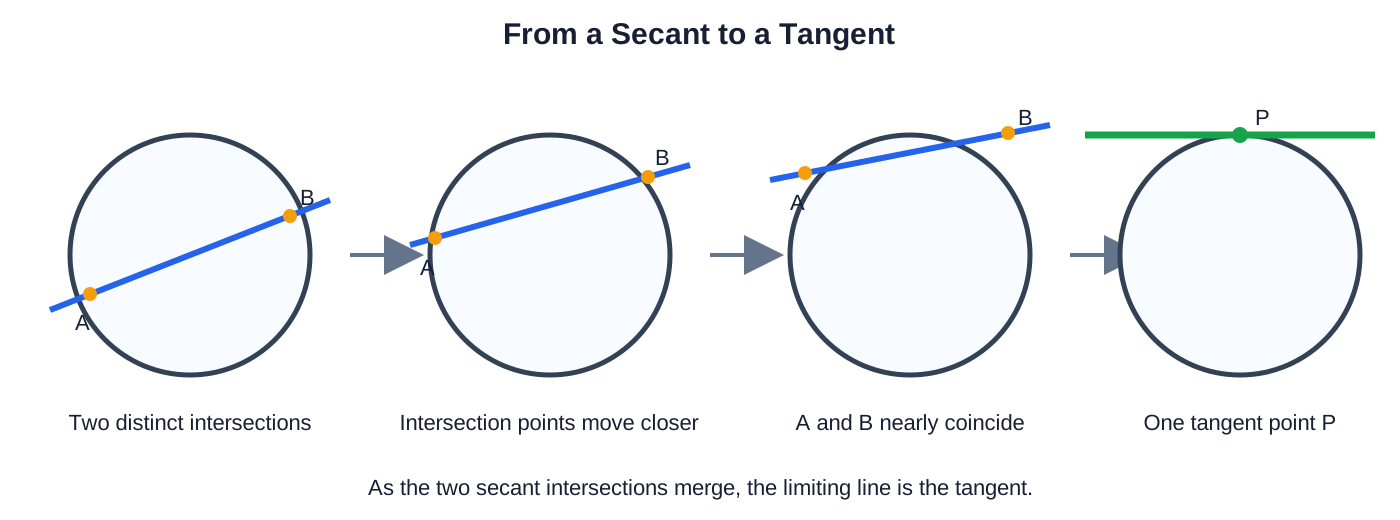
NCERT describes a tangent as a limiting case of a secant: as the two intersection points of a secant move towards each other, they eventually coincide at the point of contact.
Normal to a Circle
Normal: The line containing the radius through the point of contact is called the normal to the circle at that point.
The normal and tangent are perpendicular to each other.
Tangent Segment
Tangent segment: The portion of a tangent between an external point and its point of contact with the circle is called the tangent segment.
For example, if P is outside a circle and PT touches it at T, then PT is the length of the tangent from P.
Tangent vs Secant vs Chord
A tangent meets a circle once, a secant intersects it twice, and a chord joins two points on the circle.
| Feature | Tangent | Secant | Chord |
| Type | Complete line | Complete line | Line segment |
| Common points with circle | One | Two | Two endpoints |
| Main notation example | PT | AB extended | AB |
| Main Class 10 property | Radius is perpendicular at contact | Cuts the circle at two points | Can be bisected by a perpendicular from centre |
| Common mistake | Treating it as a short segment only | Calling it a tangent | Calling the whole secant a chord |
Why Is a Tangent a Special Case of a Secant?
A tangent is the limiting position of a secant when the two points at which the secant intersects the circle approach each other and finally become one point.
Can a Tangent Touch a Circle at Two Points?
No. A line that intersects a circle at two distinct points is a secant, not a tangent.
Can a Circle Have Parallel Tangents?
Yes. A circle can have two parallel tangents, one on each side. More than two tangents cannot be parallel to the same given line. NCERT illustrates this by moving parallel secants towards opposite edges of a circle.
Number of Tangents from a Point to a Circle
The number of tangents depends on whether the chosen point lies inside the circle, on the circle or outside it.
| Position of point P | Number of tangents |
| Inside the circle | 0 |
| On the circle | 1 |
| Outside the circle | 2 |
These three cases are explicitly demonstrated in the current NCERT chapter.
Point Inside the Circle: Zero Tangents
No tangent can pass through a point inside a circle because every line through that point intersects the circle at two points.
Point on the Circle: One Tangent
Exactly one tangent can be drawn at a point on a circle. That tangent is perpendicular to the radius through the point.
Point Outside the Circle: Two Tangents
Exactly two tangents can be drawn from a point outside a circle.
If the tangents from P touch the circle at A and B, then:
PA = PB
Theorem 1: A Tangent Is Perpendicular to the Radius
The tangent at any point of a circle is perpendicular to the radius through the point of contact.
This is one of the two theorem proofs specifically required in the CBSE 2026–27 curriculum.
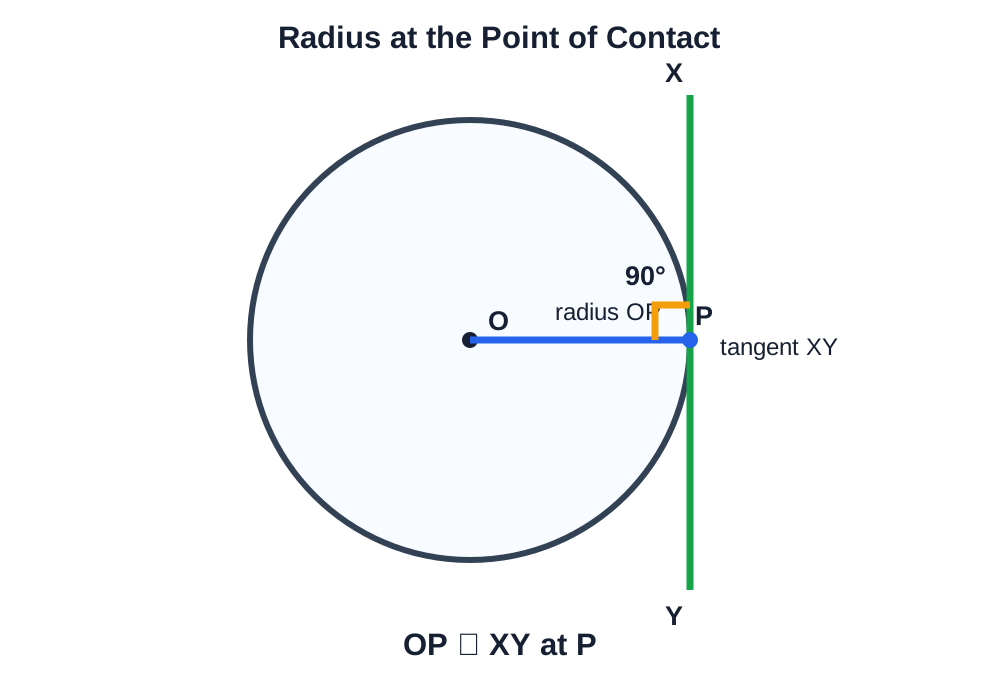
Given
A circle has centre O. The line XY is tangent to the circle at P.
To Prove
OP ⟂ XY
Proof
- Choose any point Q on the tangent XY other than P.
- Join OQ.
- Q lies outside the circle. If Q were inside the circle, line XY would intersect the circle at two points and would be a secant.
- Therefore, OQ is greater than the radius OP.
- This is true for every point Q on XY other than P.
- OP is therefore the shortest distance from O to the line XY.
- The shortest distance from a point to a line is perpendicular to the line.
Therefore:
OP ⟂ XY
This is the proof used in the current NCERT chapter.
Proof in Statement-and-Reason Form
| Statement | Reason |
| Q lies outside the circle | Otherwise XY would be a secant |
| OQ > OP | OP is a radius and Q is outside the circle |
| OP is the shortest distance from O to XY | Every other point on XY is farther from O |
| OP ⟂ XY | The shortest distance from a point to a line is perpendicular |
Converse of the Tangent–Radius Theorem
If a line is perpendicular to a radius at the endpoint of that radius on the circle, then the line is tangent to the circle.
This result helps confirm that a line is a tangent when perpendicularity is already known.
Example
A tangent PT touches a circle with centre O at T. Find ∠OTP.
Since OT is a radius and PT is tangent at T:
∠OTP = 90°
Common Errors
Incomplete statement: “A radius is perpendicular to a tangent.”
Correct: The radius through the point of contact is perpendicular to the tangent at that point.
Theorem 2: Tangents from an External Point Are Equal
Tangents drawn from the same external point to a circle are equal in length.
This is the second theorem proof explicitly required by the CBSE 2026–27 curriculum.
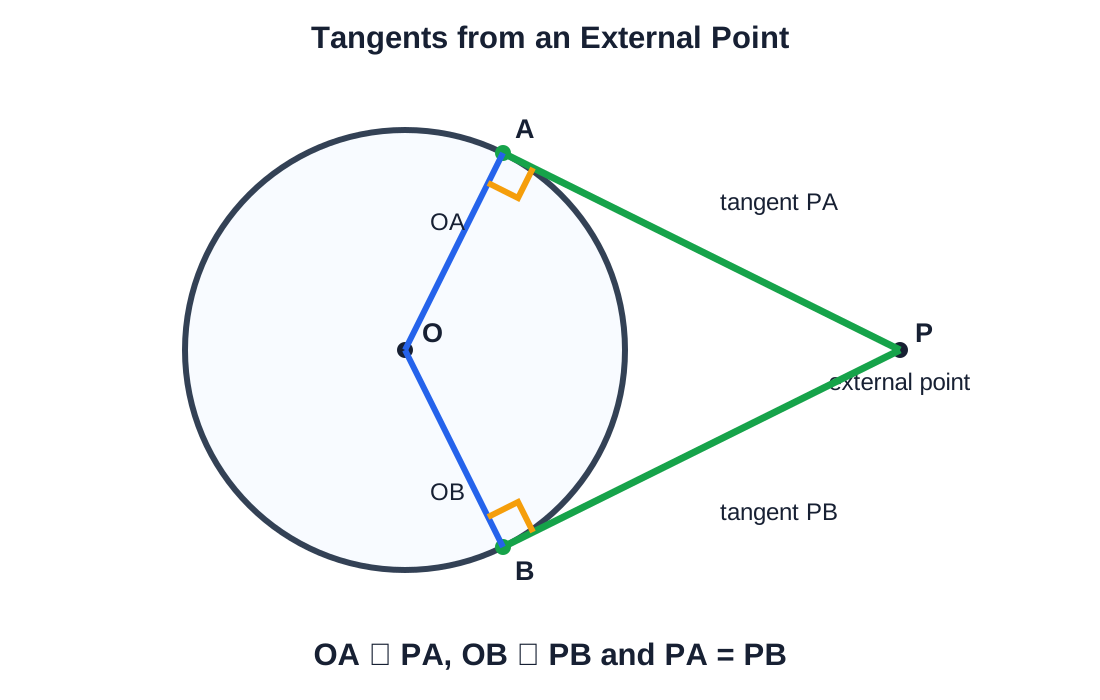
Given
P is a point outside a circle with centre O. PA and PB are tangents touching the circle at A and B.
To Prove
PA = PB
Construction
Join OA, OB and OP.
Proof Using RHS Congruence
In right triangles OAP and OBP:
- OA = OB because they are radii of the same circle.
- OP = OP because it is common to both triangles.
- ∠OAP = ∠OBP = 90° because each radius is perpendicular to its tangent.
Therefore:
△OAP ≅ △OBP by RHS congruence.
Hence:
PA = PB by CPCT.
The current NCERT text uses this RHS–CPCT proof and also notes a Pythagoras-based alternative.
Proof in Statement-and-Reason Form
| Statement | Reason |
| OA = OB | Radii of the same circle |
| ∠OAP = ∠OBP = 90° | Radius is perpendicular to tangent |
| OP = OP | Common hypotenuse |
| △OAP ≅ △OBP | RHS congruence |
| PA = PB | CPCT |
Alternative Proof Using Pythagoras Theorem
In right triangle OAP:
PA² = OP² − OA²
In right triangle OBP:
PB² = OP² − OB²
Since OA = OB:
PA² = PB²
Lengths are positive, so:
PA = PB
Important Consequence: OP Bisects the Angle Between Tangents
The congruent triangles OAP and OBP also give:
∠APO = ∠OPB
Therefore, OP bisects ∠APB.
NCERT identifies this consequence immediately after the proof of the equal tangents theorem.
Circle Class 10 Common Errors
Incorrect claim: “All tangents to one circle are equal.”
Correct: Only tangents drawn from the same external point are equal.
Important Results from the Tangent Theorems
The two tangent theorems lead to useful results involving parallel lines, angle bisectors, tangential quadrilaterals and concentric circles.
Tangents at the Endpoints of a Diameter Are Parallel
Let PA and QB be tangents at the endpoints A and B of diameter AB.
PA ⟂ AB
QB ⟂ AB
Two lines perpendicular to the same line are parallel.
Therefore:
PA ∥ QB
This result appears as a proof question in NCERT Exercise 10.2.
Angle Between Two Tangents and Central Angle
If PA and PB are tangents and A and B are their points of contact, then:
∠OAP = 90°
∠OBP = 90°
In quadrilateral OAPB:
∠AOB + ∠APB + 90° + 90° = 360°
Therefore:
∠AOB + ∠APB = 180°
or:
∠APB = 180° − ∠AOB
Example: If ∠AOB = 110°, then:
∠APB = 180° − 110° = 70°
OP Bisects Both Relevant Angles
In congruent triangles OAP and OBP:
∠APO = ∠OPB
and:
∠AOP = ∠POB
Therefore, OP bisects both the angle between the tangents and the central angle subtended by the points of contact.
Opposite Sides of a Tangential Quadrilateral
Suppose quadrilateral ABCD touches a circle at P, Q, R and S.
From equal tangents:
AP = AS
BP = BQ
CQ = CR
DR = DS
Now:
AB = AP + PB
BC = BQ + QC
CD = CR + RD
AD = AS + SD
Therefore:
AB + CD
= AP + PB + CR + RD
= AS + BQ + CQ + DS
= AD + BC
Hence:
AB + CD = AD + BC
This result is tested in NCERT Exercise 10.2 and appears in current official sample-paper material.
A Parallelogram Circumscribing a Circle Is a Rhombus
For a tangential quadrilateral:
AB + CD = AD + BC
In a parallelogram:
AB = CD
AD = BC
Therefore:
2AB = 2AD
So:
AB = AD
All four sides are equal. Hence, the parallelogram is a rhombus.
Chord of a Larger Concentric Circle Touching a Smaller Circle
Suppose two circles have the same centre O. Chord AB of the larger circle touches the smaller circle at P.
Since AB is tangent to the smaller circle at P:
OP ⟂ AB
A perpendicular from the centre of the larger circle to chord AB bisects the chord.
Therefore:
AP = PB
NCERT uses this as the first worked application after the equal tangents theorem.
Triangle Circumscribing a Circle
If a circle touches sides AB, BC and CA of a triangle, tangent segments from each vertex are equal.
If the contact points are F on AB, D on BC and E on CA:
AF = AE
BF = BD
CD = CE
This pairing is the fastest way to solve side-length questions involving an incircle.
How to Solve Class 10 Circles Questions
Most Class 10 Circles questions become easier when you identify the tangent, join the correct radius and mark equal tangent segments before calculating anything.
What Should You Draw First?
- See a tangent: Join the centre to the point of contact.
- See two tangents from one point: Mark their lengths equal.
- Know the centre distance and radius: Look for a right triangle and use Pythagoras theorem.
- See two points of contact: Join both points to the centre.
- See a circumscribed triangle or quadrilateral: Split each side at its contact point and pair equal tangents from each vertex.
- See concentric circles and a touching chord: Join the common centre to the point of contact.
- See two parallel tangents: Mark both radii perpendicular to them.
How to Identify the Hidden Right Triangle in Circle
The radius drawn to a point of contact is perpendicular to the tangent. This creates a right triangle whose sides are usually:
- Radius
- Tangent length
- Distance from external point to centre
The centre-to-external-point distance is the hypotenuse.
Therefore:
OP² = OT² + PT²
or:
PT = √(OP² − OT²)
Which Method Should You Use?
| Information in the question | Best first method |
| Radius and centre distance | Pythagoras theorem |
| Two tangents from one point | Equal tangent theorem |
| Two right triangles sharing a hypotenuse | RHS congruence |
| Central angle and tangent angle | Supplementary-angle result |
| Triangle or quadrilateral touching a circle | Pair equal tangent segments |
| Chord touching a smaller concentric circle | Tangent perpendicular to radius, then chord theorem |
| Parallel tangents plus another tangent | Equal tangents and angle bisectors |
Class 10 Circle Notes: How to Write a Proof of Circle for Full Marks
- Write the given information.
- State exactly what must be proved.
- Add any required construction.
- Name the triangles you are comparing.
- Give a reason for each equality or angle.
- State the correct congruence criterion.
- Use CPCT only after proving congruence.
- End by writing the required conclusion.
Can You Use an Extra Circle Theorem?
Use the two prescribed tangent theorems and earlier triangle results wherever possible. An advanced theorem may be valid, but a school marking scheme can expect steps based on the stated syllabus.
Class 10 Circles Notes: Solved Examples
These solved examples move from direct tangent-length calculations to angle questions, circumscribed figures and multi-step applications.
Example 1: Find a Tangent Length
Question: A point P is 41 cm from the centre O of a circle with radius 9 cm. Find the length of tangent PT.
Concept tested: Tangent–radius right triangle
Solution:
OT ⟂ PT
In right triangle OPT:
OP² = OT² + PT²
41² = 9² + PT²
1681 = 81 + PT²
PT² = 1600
PT = 40 cm
Answer: 40 cm
The official 2025–26 Mathematics Standard sample paper includes this as a one-mark question, showing that direct tangent-length calculations may appear in objective form.
Example 2: Find the Radius
Question: The length of a tangent from P is 12 cm, and P is 13 cm from the centre. Find the radius.
Solution:
Let the radius be r.
13² = 12² + r²
169 = 144 + r²
r² = 25
r = 5 cm
Answer: 5 cm
Example 3: Find the Angle Between Tangents
Question: PA and PB are tangents to a circle. If ∠AOB = 110°, find ∠APB.
Solution:
∠APB + ∠AOB = 180°
∠APB = 180° − 110°
∠APB = 70°
Answer: 70°
A question with these values appears in NCERT Exercise 10.2.
Example 4: Find a Bisected Central Angle
Question: Tangents PA and PB are inclined at 80°. Find ∠POA.
Solution:
∠APB = 80°
Therefore:
∠AOB = 180° − 80° = 100°
OP bisects ∠AOB.
So:
∠POA = 100° ÷ 2 = 50°
Answer: 50°
Example 5: Tangential Quadrilateral
Question: Quadrilateral ABCD circumscribes a circle. If BC = 7 cm, CD = 4 cm and AD = 3 cm, find AB.
Solution:
For a tangential quadrilateral:
AB + CD = AD + BC
AB + 4 = 3 + 7
AB + 4 = 10
AB = 6 cm
Answer: 6 cm
This exact structure appears in the official 2025–26 Mathematics Standard marking scheme.
Example 6: Concentric Circles
Question: Two concentric circles have radii 5 cm and 3 cm. A chord of the larger circle touches the smaller circle. Find the chord’s length.
Solution:
Let AB be the chord and P its point of contact with the smaller circle.
OP = 3 cm
OA = 5 cm
OP ⟂ AB
The perpendicular from the centre bisects chord AB, so:
AP = PB
In right triangle OPA:
OA² = OP² + AP²
5² = 3² + AP²
25 = 9 + AP²
AP² = 16
AP = 4 cm
Therefore:
AB = 2 × AP = 8 cm
Answer: 8 cm
Example 7: Equal Tangent Segments in a Triangle
Question: A circle touches the sides of triangle ABC. It touches BC at D, AB at F and AC at E. If BD = 10 cm, CD = 8 cm and AE = 4.5 cm, find AB and AC.
Solution:
From B:
BF = BD = 10 cm
From C:
CE = CD = 8 cm
From A:
AF = AE = 4.5 cm
Therefore:
AB = AF + FB
AB = 4.5 + 10
AB = 14.5 cm
AC = AE + EC
AC = 4.5 + 8
AC = 12.5 cm
Answer: AB = 14.5 cm and AC = 12.5 cm
Example 8: Tangent Segments and Perimeter
Question: From external point P, PA and PB are tangents of length 9 cm each. If chord AB is 12 cm, find the perimeter of triangle PAB.
Solution:
PA = PB = 9 cm
Perimeter:
PA + PB + AB
= 9 + 9 + 12
= 30 cm
Answer: 30 cm
Example 9: Prove Tangents at Diameter Endpoints Are Parallel
Question: PA and QB are tangents at the endpoints A and B of diameter AB. Prove PA ∥ QB.
Proof:
PA ⟂ OA
Since OA and OB form the same straight line AB:
PA ⟂ AB
Similarly:
QB ⟂ OB
Therefore:
QB ⟂ AB
Two lines perpendicular to the same line are parallel.
Hence:
PA ∥ QB
Example 10: Competency-Based Wheel Question
Question: A circular wheel touches a straight road at T. Its centre O is 35 cm above the road. A point P on the road is 84 cm from T. Find OP.
Solution:
OT is a radius and the road is tangent at T.
Therefore:
OT ⟂ PT
In right triangle OTP:
OP² = OT² + PT²
OP² = 35² + 84²
OP² = 1225 + 7056
OP² = 8281
OP = 91 cm
Answer: 91 cm
The wheel-and-ground model is also used by NCERT to illustrate a radius perpendicular to a tangent.
Class 10 Circles Important Questions with Solutions
The most useful Class 10 Circles important questions test theorem statements, tangent lengths, angle relations, equal tangent segments and applications in circumscribed figures.
One-Mark Questions
1. How many tangents can be drawn from a point inside a circle?
Answer: Zero.
2. A tangent touches a circle at how many points?
Answer: One point.
3. What angle does a tangent make with the radius at the point of contact?
Answer: 90°.
4. From external point P, PA and PB are tangents. If PA = 11 cm, find PB.
Answer: PB = 11 cm.
5. A tangent is 24 cm long and the external point is 25 cm from the centre. Find the radius.
25² = 24² + r²
r² = 625 − 576 = 49
Answer: 7 cm.
Two-Mark Questions
6. If the angle between two tangents is 65°, find the angle between the radii through the contact points.
∠AOB = 180° − 65° = 115°
Answer: 115°.
7. A point is 17 cm from the centre of a circle of radius 8 cm. Find the tangent length.
PT = √(17² − 8²)
PT = √(289 − 64)
PT = √225
Answer: 15 cm.
8. Explain why only one tangent can be drawn at a point on a circle.
The tangent at that point must be perpendicular to the radius through the point. Only one line can be drawn perpendicular to a given line through a fixed point.
Three-Mark Questions
9. Prove that OP bisects the angle between tangents PA and PB.
Join OA and OB.
In right triangles OAP and OBP:
OA = OB
OP = OP
∠OAP = ∠OBP = 90°
Therefore:
△OAP ≅ △OBP by RHS.
Hence:
∠APO = ∠OPB by CPCT.
Therefore, OP bisects ∠APB.
10. Prove that the angle between two tangents is supplementary to the central angle.
In quadrilateral OAPB:
∠OAP = 90°
∠OBP = 90°
The sum of angles in a quadrilateral is 360°.
Therefore:
∠AOB + ∠APB + 90° + 90° = 360°
∠AOB + ∠APB = 180°
Hence, the two angles are supplementary.
11. Prove AB + CD = AD + BC for a quadrilateral circumscribing a circle.
Mark the four points of contact and pair the tangent segments from each vertex:
AP = AS
BP = BQ
CQ = CR
DR = DS
Add the side expressions to obtain:
AB + CD = AD + BC
Assertion–Reason Question
Assertion: Tangents drawn from an external point to a circle are equal.
Reason: The radii drawn to the points of contact are equal and perpendicular to the tangents.
Answer: Both statements are true, and the reason supports the RHS congruence proof of the assertion.
Higher-Order Question
12. Two tangents PA and PB are drawn to a circle with centre O. If OP = 13 cm and the circle’s radius is 5 cm, find the area of quadrilateral OAPB.
First find tangent length:
PA = √(13² − 5²)
PA = √(169 − 25)
PA = 12 cm
Quadrilateral OAPB consists of two congruent right triangles.
Area of one triangle:
½ × 5 × 12 = 30 cm²
Total area:
2 × 30 = 60 cm²
Answer: 60 cm²
Also Check: CBSE Class 10 MCQs with answers
Sample-Paper Evidence and Current Exam Pattern
Current official sample material shows that Circles can be assessed through one-mark calculations, short applications and three-mark proof questions.
The latest Class X sample-paper set currently listed in CBSE’s official archive is for 2025–26. It should not be relabelled as a 2026–27 paper.
Verified Circles Questions in Official Sample Material
| Course | Marks | Question type | Concept |
| Mathematics Standard | 1 | MCQ | Tangent length from radius and centre distance |
| Mathematics Standard | 2 | Short answer | Triangle circumscribing a circle |
| Mathematics Standard | 3 | Proof | Parallel tangents with a third tangent |
| Mathematics Basic | 1 | MCQ | Tangent length and radius |
| Mathematics Basic | 1 | MCQ | Angle between tangent and radius |
| Mathematics Basic | 3 | Application | Tangential quadrilateral |
The Mathematics Standard sample paper asks students to calculate a tangent of length 40 cm from a radius of 9 cm and centre distance of 41 cm. It also contains a three-mark proof involving two parallel tangents and another tangent.
The Mathematics Basic sample paper includes direct tangent-length and angle applications, showing that Basic students also need more than definitions.
Common Mistakes in Class 10 Circles
The most common Circles mistakes involve using a theorem without checking its conditions, placing the right angle incorrectly and confusing tangent segments from different points.
| Common mistake | Correct idea |
| All tangents to a circle are equal | Only tangents from the same external point are equal |
| The radius is perpendicular to every line touching the diagram | It is perpendicular to the tangent at the point of contact |
| A secant touches once | A secant intersects twice |
| CPCT proves triangles congruent | CPCT is used after congruence is proved |
| OP is automatically an angle bisector | It follows from congruent triangles |
| Section 10.3 means Exercise 10.3 | The current chapter has Exercises 10.1 and 10.2 |
| Circles contains sector-area formulas | Those belong to Areas Related to Circles |
| The picture is drawn to scale | Geometry diagrams may not be to scale |
| A line that looks tangent must be tangent | Tangency must be given or proved |
| The tangent is the hypotenuse | OP, from centre to external point, is the hypotenuse |
Proof-Writing Errors
- Failing to state that OA and OB are radii
- Omitting the right-angle reason
- Using SAS when the correct test is RHS
- Writing CPCT before congruence
- Changing letters between the diagram and proof
- Ending without stating the required conclusion
Calculation Errors
- Adding radius and tangent instead of using Pythagoras
- Treating the radius as the hypotenuse
- Forgetting the square root in the final step
- Giving a negative length
- Using diameter instead of radius
Diagram-Reading Errors
- Confusing the point of contact with the external point
- Marking equal tangents from different external vertices
- Assuming a chord passes through the centre
- Missing the right triangle created by the radius
Circles vs Areas Related to Circles
Circles studies tangent properties and geometry proofs, while Areas Related to Circles studies sectors, segments, arcs, areas and perimeters.
| Feature | Circles | Areas Related to Circles |
| Main topic | Tangents | Sectors and segments |
| Main methods | Proofs, congruence, Pythagoras | Mensuration formulas |
| Typical diagrams | External points and tangent lines | Shaded regions and arcs |
| Main calculations | Tangent lengths and angles | Areas and perimeters |
| Key formula example | PT² = OP² − r² | Area of sector = θ/360° × πr² |
The CBSE curriculum lists these as separate units: Circles appears under Geometry, while Areas Related to Circles appears under Mensuration.
Class 10 Circle Notes: Five-Minute Quiz
1. How many tangents pass through a point outside a circle?
A. Zero
B. One
C. Two
D. Infinitely many
Answer: C. Two
2. If PT is tangent at T and OT is a radius, ∠OTP equals:
A. 45°
B. 60°
C. 90°
D. 180°
Answer: C. 90°
3. PA and PB are tangents from P. If PA = 7.5 cm, PB equals:
A. 3.75 cm
B. 7.5 cm
C. 15 cm
D. Cannot be found
Answer: B. 7.5 cm
4. A point is 10 cm from the centre of a circle of radius 6 cm. Find the tangent length.
PT = √(10² − 6²)
PT = √64
PT = 8 cm
Answer: 8 cm
5. The angle between two tangents is 50°. Find the central angle.
∠AOB = 180° − 50° = 130°
Answer: 130°
6. Which statement is correct?
A. Every chord is a tangent
B. Every tangent is a secant
C. A tangent meets a circle at one point
D. All tangents to the same circle have equal lengths
Answer: C
7. What must be proved before using CPCT?
Answer: The relevant triangles must be proved congruent.
8. A quadrilateral circumscribes a circle. If AB = 8 cm, BC = 6 cm and CD = 5 cm, find AD.
AB + CD = AD + BC
8 + 5 = AD + 6
AD = 7 cm
Answer: 7 cm
course
No courses found
FAQs on Class 10 Maths Chapter 10 Circles Notes
Where can I download Class 10 Maths Circles notes PDF for free?
Students can download CBSE Class 10 Circle Notes PDF from Infinity Learn website using this page to download the complete notes, proofs, solved examples and practice questions.
What are the two main theorems in Class 10 Circles?
The first theorem states that a tangent is perpendicular to the radius at the point of contact. The second states that tangents drawn from the same external point are equal.
How many tangents can be drawn from a point to a circle?
No tangent can be drawn from a point inside a circle, one tangent can be drawn from a point on the circle, and two tangents can be drawn from a point outside it.
Why is a tangent perpendicular to the radius?
The radius to the point of contact is the shortest distance from the centre to the tangent line. The shortest distance from a point to a line is perpendicular.
Why are tangents from an external point equal?
The two right triangles formed by the centre, external point and contact points are congruent by RHS. Their corresponding tangent sides are therefore equal by CPCT.
How do you find the length of a tangent from an external point?
Use PT = √(OP² − r²), where OP is the distance from the external point to the centre and r is the radius.
What is the difference between a tangent and a secant?
A tangent meets a circle at exactly one point, while a secant intersects it at two distinct points.
What is the difference between a chord, secant and tangent?
A chord is a segment joining two points on a circle, a secant is a full line crossing the circle twice, and a tangent is a line touching the circle once.
How do you find the angle between two tangents?
Subtract the central angle between the radii to the contact points from 180°. Thus, ∠APB = 180° − ∠AOB.
What is the point of contact of a tangent?
The point of contact is the single point at which the tangent and circle meet.
Are direct theorem proofs asked in the Class 10 board exam?
The current CBSE curriculum explicitly requires both tangent theorem proofs. Students should also practise applying the theorems in calculations and unfamiliar diagrams.
How should a circle theorem proof be written in an exam?
Write the given information, what must be proved, any construction, each mathematical statement with its reason, the congruence criterion where needed and the final conclusion.
Are NCERT questions enough for Class 10 Circles?
NCERT is the essential starting point and covers the official chapter concepts. For stronger preparation, especially in Mathematics Standard, also solve sample-paper, exemplar and competency-based questions.
Should I solve NCERT Exemplar questions for Circles?
Yes. Exemplar questions are useful for practising less familiar diagrams and multi-step applications after completing the textbook exercises.
What Class 9 circle concepts are needed in Class 10?
Useful prior concepts include chords, perpendiculars from the centre to a chord, triangle congruence, CPCT, isosceles triangles and Pythagoras theorem.
Can the alternate segment theorem be used in CBSE Class 10?
It is not named as a core Circles outcome in the current CBSE syllabus. Use the prescribed tangent theorems unless your teacher has approved an alternative method.
Is construction of tangents included in the current syllabus?
Formal tangent construction is not listed under the core Circles outcomes in the CBSE 2026–27 curriculum. Follow any additional instructions provided by your school.
Can Class 10 Circles be revised in one day?
The chapter can be revised in one day after it has already been studied. Focus on the two proofs, the tangent-length formula, derived angle results, NCERT exercises and common mistakes.
Which Circles diagrams should students practise?
Practise a single tangent with radius, two tangents from an external point, parallel tangents, a tangential quadrilateral, a triangle with an incircle and two concentric circles with a touching chord.
What are the most important Circles questions for board preparation?
Prioritise both theorem proofs, tangent-length calculations, angle-between-tangents questions, tangential quadrilaterals, circumscribed triangles, concentric-circle chords and parallel-tangent proofs.
