- Class 10 Maths Chapter 6 Triangles Overview
- Download Class 10 Maths Chapter 6 Triangles Notes PDF
- CBSE Class 10 Triangles Syllabus for 2026–27
- Important Concepts to Revise Before Triangles
- What is Similar Triangles
- Similarity Criteria of Triangles
- Basic Proportionality Theorem Class 10 Notes
- Converse of the Basic Proportionality Theorem
- How to Decide Which Triangle Theorem to Use
- How to Write Triangle Proofs in Board Exams
- Solved Class 10 Triangles Questions
- Common Mistakes in Class 10 Triangles
- Class 10 Triangles Important Questions
- How to Study and Revise Class 10 Triangles
- Other Topics Found in Older Triangles Notes
- FAQs: Class 10 Maths Chapter 6 Triangles Notes
Class 10 Maths Chapter 6 Triangles Notes 2026-27 PDF
By rohit.pandey1
|
Updated on 22 Jul 2026, 15:35 IST
The Class 10 Maths Chapter 6 Triangles Notes PDF provides clear and complete revision notes on similar triangles, the Basic Proportionality Theorem, converse BPT, and the AA, SSS and SAS similarity criteria. These notes are designed for CBSE Class 10 students who want to understand the chapter, revise important concepts and practise exam-style questions.
Triangles is an important geometry chapter because it teaches students how to compare figures, identify corresponding sides and angles, prove triangles similar and calculate unknown lengths using proportional relationships. The chapter also develops proof-writing and diagram-reading skills that are useful in board examinations.
This article includes simple definitions, theorem statements, an exam-ready proof of BPT, solved examples, common mistakes, important questions, revision tips and downloadable study resources. It also explains how to identify the correct theorem in a question instead of memorising solutions without understanding them.
Class 10 Maths Chapter 6 Triangles Overview
Class 10 Maths Chapter 6 focuses on similar triangles, proportional sides and the conditions used to prove that two triangles have the same shape.
In earlier classes, students learn about types of triangles, angle properties and congruence. In Class 10, these ideas are extended to similarity. Two similar triangles may have different sizes, but their corresponding angles are equal and their corresponding sides are proportional.
Download Class 10 Maths Chapter 6 Triangles Notes PDF
Download the Class 10 Triangles chapter 6 PDF with concise notes and solved examples. Learn how to prove that two triangles are similar, apply the properties of proportional sides, calculate unknown lengths, and establish parallel lines using similarity theorems.
Loading PDF...
Important Terms
Similar figures: Figures that have the same shape but may have different sizes.
Congruent figures: Figures that have the same shape and the same size.
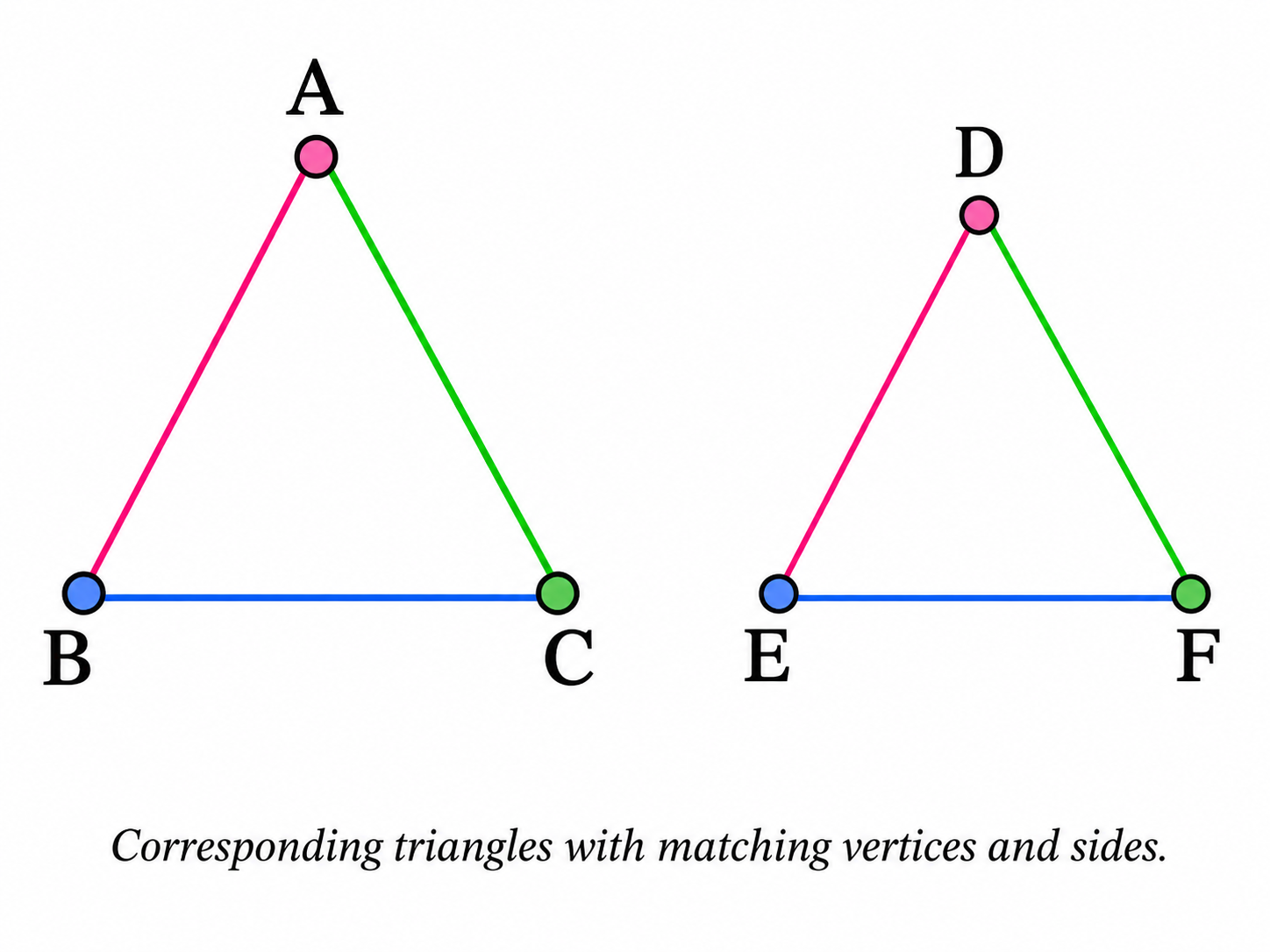
Corresponding vertices: Vertices that occupy matching positions in two triangles.
Corresponding sides: Sides that join matching vertices in two triangles.

Scale factor: The common ratio between corresponding lengths in two similar figures.
Similarity criterion: A set of conditions used to prove that two triangles are similar.
Best Courses for You

JEE

NEET

Foundation JEE

Foundation NEET

CBSE
CBSE Class 10 Triangles Syllabus for 2026–27
The CBSE 2026–27 Triangles syllabus includes similar triangles, BPT, converse BPT and the AA, SSS and SAS similarity criteria.
The chapter is included under Unit IV: Geometry in the CBSE Class 10 Mathematics curriculum.
Topics Included in the Current Syllabus
| Topic | Learn the Statement? | Learn the Formal Proof? | Apply in Questions? |
| Similar and congruent figures | Yes | Not applicable | Yes |
| Basic Proportionality Theorem | Yes | Yes | Yes |
| Converse of BPT | Yes | Not prescribed as a theorem proof | Yes |
| AA or AAA similarity criterion | Yes | Not prescribed as a criterion proof | Yes |
| SSS similarity criterion | Yes | Not prescribed as a criterion proof | Yes |
| SAS similarity criterion | Yes | Not prescribed as a criterion proof | Yes |
What Does “State Without Proof” Mean?
“State without proof” means that students must know and apply the result, but they do not need to derive the complete theorem from first principles.
For example, students do not need to prove why the AA criterion is always true. They may still need to show that two angles are equal and then write:
Triangle ABC is similar to Triangle DEF by AA similarity.
Current Syllabus Versus Older Notes
Older Class 10 Triangles notes may include topics that are not listed in the current CBSE 2026–27 Triangles syllabus.
| Topic | Current CBSE Triangles Status |
| Similar figures and similar triangles | Included |
| BPT and converse BPT | Included |
| AA, SSS and SAS similarity | Included |
| Areas of similar triangles | Not listed in the current Triangles syllabus section |
| Pythagoras theorem and its converse | Not listed in the current Triangles syllabus section |
| RHS similarity | Not one of the three main criteria listed in the CBSE syllabus |
Treat areas of similar triangles and Pythagoras theorem as supplementary unless your school or board specifically includes them.
Also Check: CBSE Class 10 Maths Notes 2026-27
These percentages apply to the complete Mathematics paper, not only the Triangles chapter.
Important Concepts to Revise Before Triangles
Students should revise angle relationships, congruence and ratio manipulation before attempting Class 10 similarity proofs.
Angle Properties Used in Proofs
Alternate interior angles: Equal when a transversal crosses two parallel lines.
Corresponding angles: Equal when a transversal crosses two parallel lines.
Vertically opposite angles: Equal angles formed where two lines intersect.
Angle-sum property: The three interior angles of a triangle total 180 degrees.
Exterior-angle property: An exterior angle equals the sum of the two opposite interior angles.
Common angle: An angle shared by two triangles is equal to itself.
How to Solve Triangle Questions
BPT questions require students to simplify ratios, cross-multiply proportions and preserve the same corresponding order.
Example:
x/6 = 4/8
Cross-multiply:
8x = 24
Therefore:
x = 3
What is Similar Triangles
Two triangles are similar when their corresponding angles are equal and their corresponding sides are proportional.
Similar Triangles Versus Congruent Triangles
| Feature | Similar Triangles | Congruent Triangles |
| Shape | Same | Same |
| Size | May be different | Same |
| Corresponding angles | Equal | Equal |
| Corresponding sides | Proportional | Equal |
| Scale factor | Any positive value | Exactly 1 |
| Symbol | Similar to | Congruent to |
Key result: All congruent triangles are similar, but all similar triangles are not congruent.
Example of Similar Triangles
A triangle with sides 3 cm, 4 cm and 5 cm and another triangle with sides 6 cm, 8 cm and 10 cm are similar because:
3/6 = 4/8 = 5/10 = 1/2
They are not congruent because their corresponding sides are not equal.
How to Match Corresponding Vertices
The order of letters in a similarity statement shows which vertices correspond.
If Triangle ABC is similar to Triangle PQR, then:
- A corresponds to P
- B corresponds to Q
- C corresponds to R
Therefore:
- Angle A = Angle P
- Angle B = Angle Q
- Angle C = Angle R
The corresponding sides are:
AB/PQ = BC/QR = AC/PR
Do not compare AB with QR because they are not corresponding sides.
Scale Factor
The scale factor is the number by which every corresponding length is multiplied to produce the second similar figure.
Suppose Triangle ABC is similar to Triangle DEF, AB = 6 cm and DE = 9 cm.
The scale factor from Triangle ABC to Triangle DEF is:
DE/AB = 9/6 = 3/2
If BC = 8 cm, then:
EF = 3/2 × 8 = 12 cm
Similarity Criteria of Triangles
The AA, SSS and SAS criteria prove two triangles similar without checking every corresponding side and angle.
| Criterion | Information Required | Critical Check |
| AA | Two pairs of corresponding angles are equal | The angles must correspond |
| SSS | Three pairs of corresponding sides are proportional | All three ratios must match |
| SAS | Two pairs of sides are proportional and their included angles are equal | The angle must lie between the proportional sides |
AA or AAA Similarity Criterion
Two triangles are similar by AA when two angles of one triangle equal two corresponding angles of another triangle.
If Angle A = Angle D and Angle B = Angle E, then Triangle ABC is similar to Triangle DEF by AA similarity.
The third angles are also equal because the angles of each triangle total 180 degrees.
Common mistake: Do not use AA only because two angles look equal in the diagram. Establish the equality using a given fact or an angle property.
SSS Similarity Criterion
Two triangles are similar by SSS when all three pairs of corresponding sides are proportional.
Suppose one triangle has sides 4 cm, 6 cm and 8 cm, and another has corresponding sides 6 cm, 9 cm and 12 cm.
4/6 = 6/9 = 8/12 = 2/3
Therefore, the triangles are similar by SSS.
Common mistake: Two matching ratios are not enough for SSS. All three corresponding side ratios must be equal.
SAS Similarity Criterion
Two triangles are similar by SAS when two pairs of corresponding sides are proportional and the angles included between those sides are equal.
Suppose:
AB/DE = AC/DF = 2/3
and Angle A = Angle D.
Because Angle A lies between AB and AC, and Angle D lies between DE and DF, the triangles are similar by SAS.
Common mistake: The equal angle must be between the two proportional side pairs.
How to Choose Between AA, SSS and SAS
- Look for angles first: Two matching angle pairs indicate AA.
- Count the side ratios: Three matching side ratios indicate SSS.
- Check two sides and their angle: Two proportional side pairs and an equal included angle indicate SAS.
- Do not combine unrelated facts: One equal angle and two random side lengths may not prove similarity.
Basic Proportionality Theorem Class 10 Notes
The Basic Proportionality Theorem states that a line parallel to one side of a triangle divides the other two sides in the same ratio.
BPT is also commonly called Thales theorem.
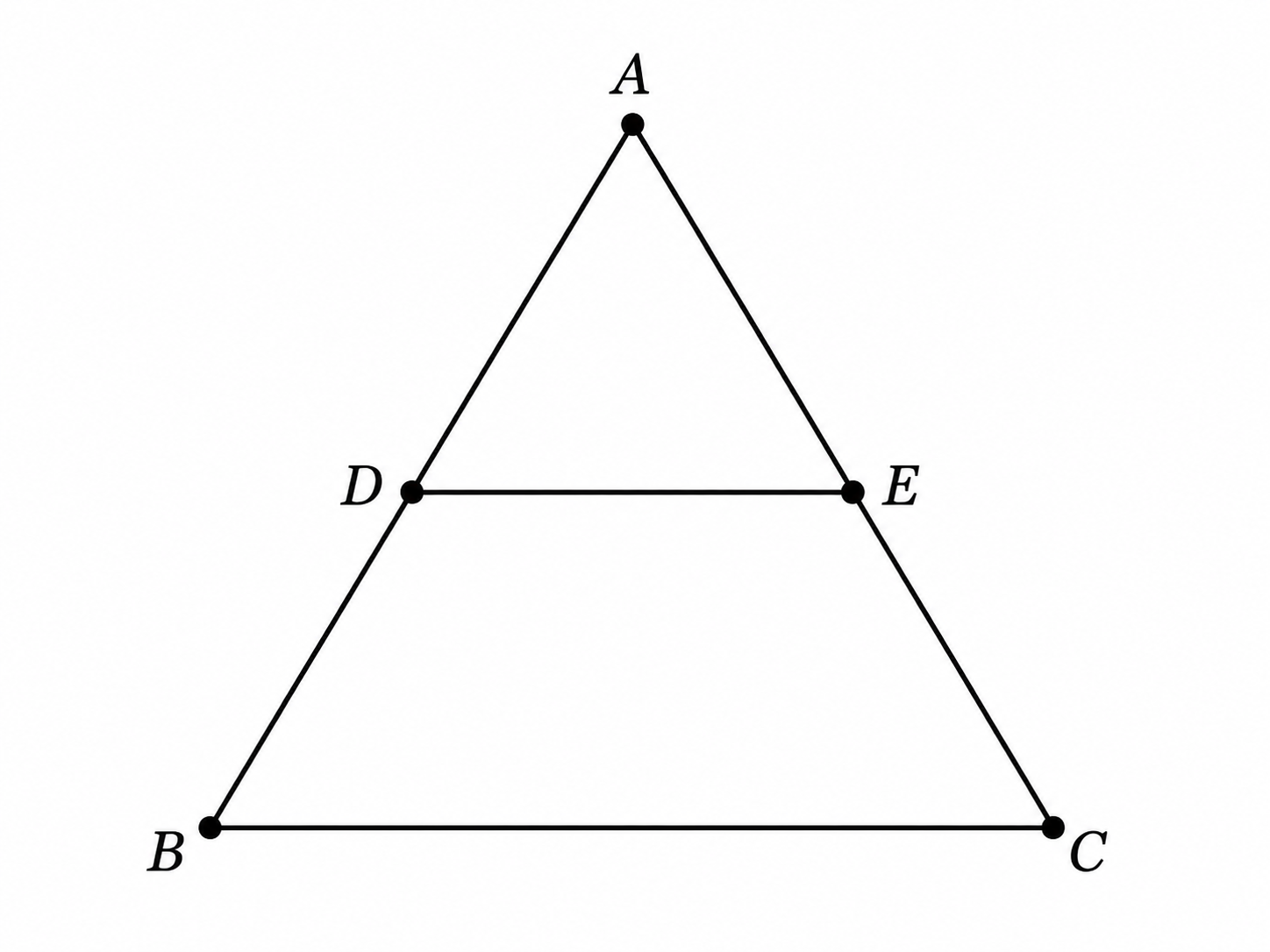
BPT Statement
In Triangle ABC, let D lie on AB and E lie on AC.
If DE is parallel to BC, then:
AD/DB = AE/EC
BPT in Simple Words
A line parallel to the base of a triangle cuts the other two sides proportionally.
If it divides one side in the ratio 2:3, it divides the other side in the same ratio.
Step-by-Step Proof of BPT
Given: In Triangle ABC, D lies on AB, E lies on AC, and DE is parallel to BC.
To prove:
AD/DB = AE/EC
Proof:
- Triangles ADE and BDE have bases AD and DB on the same straight line AB.
- They have the same altitude from point E.
- Therefore, Area of Triangle ADE / Area of Triangle BDE = AD/DB.
- Triangles ADE and CDE have bases AE and EC on the same straight line AC.
- They have the same altitude from point D.
- Therefore, Area of Triangle ADE / Area of Triangle CDE = AE/EC.
- Triangles BDE and CDE are on the same base DE and lie between the same parallel lines DE and BC.
- Therefore, Area of Triangle BDE = Area of Triangle CDE.
- Hence, AD/DB = AE/EC.
Hence proved.
Understanding the Ratios in BPT
When DE is parallel to BC:
AD/DB = AE/EC
You may also derive:
AD/AB = AE/AC
because AB = AD + DB and AC = AE + EC.
Do not mix a divided segment with an unrelated full side without establishing an equivalent proportion.
Solved Example 1: Find a Segment
In Triangle ABC, DE is parallel to BC.
AD = 4, DB = 6 and AE = 5. Find EC.
By BPT:
AD/DB = AE/EC
4/6 = 5/EC
4 × EC = 30
EC = 7.5 units
Solved Example 2: Algebraic Lengths
In Triangle PQR, XY is parallel to QR. X lies on PQ and Y lies on PR.
PX = x + 1, XQ = x − 1, PY = 6 and YR = 3.
By BPT:
PX/XQ = PY/YR
(x + 1)/(x − 1) = 6/3
(x + 1)/(x − 1) = 2
x + 1 = 2x − 2
x = 3
Therefore, PX = 4 and XQ = 2.
Common BPT Mistakes
| Mistake | Why It Is Wrong | Correct Approach |
| Applying BPT without parallel lines | Parallelism is a condition of the theorem | Check or prove that the line is parallel |
| Writing AD/AE = DB/EC automatically | These are not the standard corresponding divisions | Begin with AD/DB = AE/EC |
| Reversing only one ratio | The corresponding order becomes inconsistent | Reverse both ratios or neither |
| Trusting the drawing | A diagram may not be drawn to scale | Use only stated or proved information |
Converse of the Basic Proportionality Theorem
Converse BPT states that if a line divides two sides of a triangle in the same ratio, that line is parallel to the third side.
In Triangle ABC, suppose D lies on AB and E lies on AC.
If:
AD/DB = AE/EC
then:
DE is parallel to BC.
BPT Versus Converse BPT
| Feature | BPT | Converse BPT |
| Given | A parallel line | Equal side ratios |
| Find or prove | Proportional segments | Parallel lines |
| Typical wording | If DE is parallel to BC, find x | Show that DE is parallel to BC |
| Direction | Parallelism leads to ratios | Ratios lead to parallelism |
Solved Example: Prove Two Lines Parallel
In Triangle ABC:
AD = 3, DB = 5, AE = 6 and EC = 10.
Check the ratios:
AD/DB = 3/5
AE/EC = 6/10 = 3/5
Therefore:
AD/DB = AE/EC
By converse BPT:
DE is parallel to BC.
Midpoint Theorem Connection
The midpoint theorem is a special proportional situation related to BPT.
If D and E are the midpoints of AB and AC, then:
AD = DB and AE = EC
Therefore:
AD/DB = AE/EC = 1
By converse BPT:
DE is parallel to BC.
How to Decide Which Triangle Theorem to Use
Choose the theorem from the information given: parallel lines suggest BPT, proportional divisions suggest converse BPT, and matching angles or sides suggest a similarity criterion.
Theorem-Selection Table
| Information in the Question | Likely Theorem |
| A line is parallel to one side of a triangle | BPT |
| Two sides are divided in the same ratio | Converse BPT |
| Two corresponding angles are equal | AA similarity |
| Three corresponding side pairs are proportional | SSS similarity |
| Two side pairs are proportional and the included angles are equal | SAS similarity |
| Similar triangles are already given | Use corresponding-side proportions |
| A shared angle and another equal angle are visible | AA similarity |
| Triangles are rotated or overlap | Redraw and match corresponding vertices |
Five-Step Decision Process
- Write what is given. Do not begin with what the diagram appears to show.
- Mark parallel lines and equal angles.
- List known side ratios.
- Check all conditions of one theorem.
- Name the theorem in the final step.
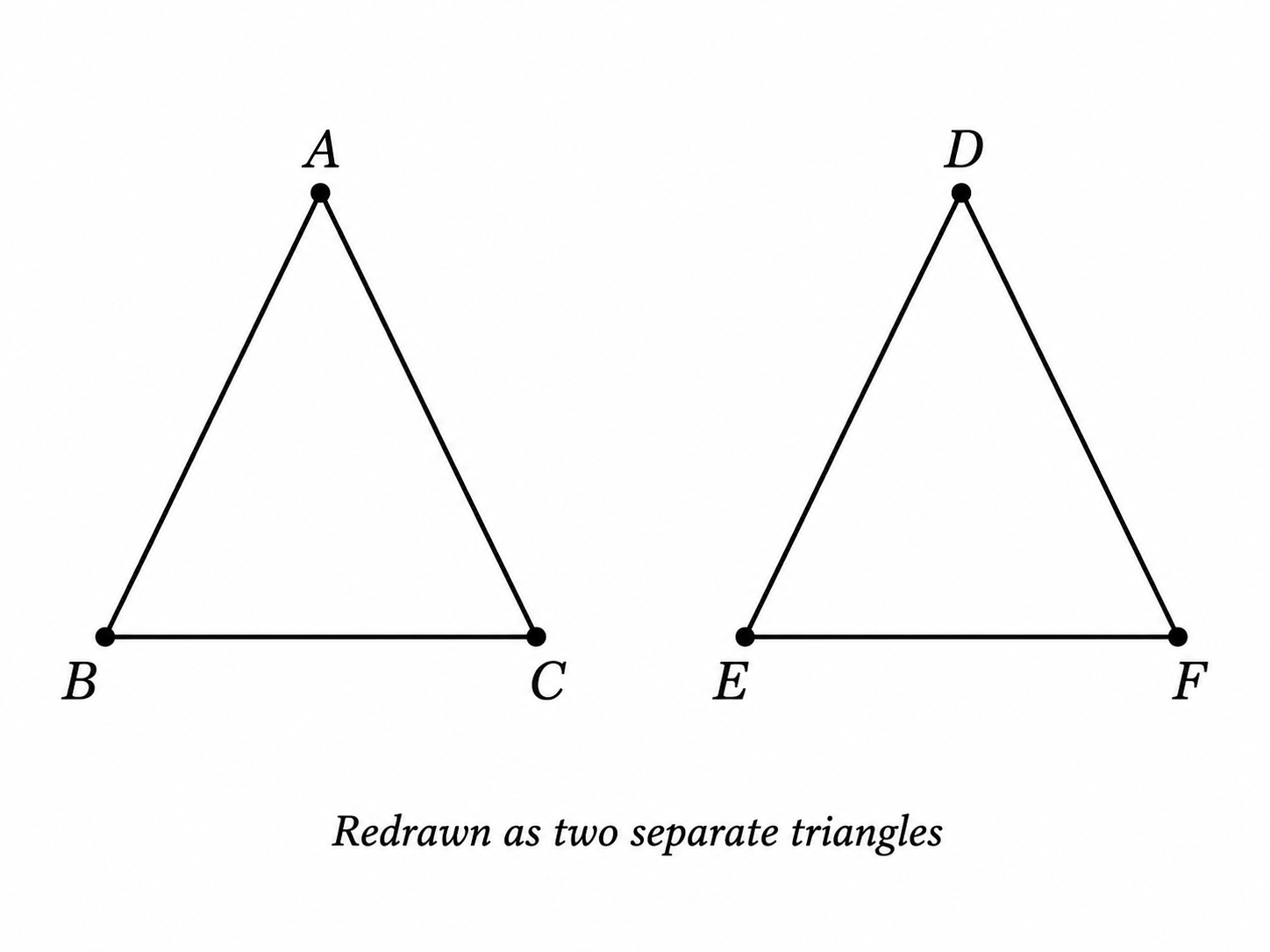
Hidden or Overlapping Triangles
Overlapping triangles become easier when they are copied separately and their corresponding vertices are marked.
- Draw each triangle separately.
- Keep the original vertex labels.
- Mark equal or common angles.
- Identify corresponding sides.
- Write the similarity statement in matching order.
How to Write Triangle Proofs in Board Exams
A complete triangle proof identifies the triangles, establishes every required condition, names the theorem and states the conclusion in corresponding order.
Seven-Step Proof Method
- Identify the two triangles.
- Write the first equality or proportionality.
- Give the reason.
- Write the second required relationship.
- Give the reason.
- Name the similarity criterion or theorem.
- State the required conclusion.
Useful Reasons to Write
- Given
- Common angle
- Alternate interior angles
- Corresponding angles
- Vertically opposite angles
- Angle-sum property
- Sides of an isosceles triangle
- BPT
- Converse BPT
- AA similarity
- SSS similarity
- SAS similarity
- Corresponding sides of similar triangles
Model Proof
Given: In Triangles ABC and DEF, Angle A = Angle D and Angle B = Angle E.
Proof:
Angle A = Angle D (Given)
Angle B = Angle E (Given)
Therefore, Triangle ABC is similar to Triangle DEF by AA similarity.
Hence:
AB/DE = BC/EF = AC/DF
Why Order Matters
The order of letters in a similarity statement must preserve the matching vertices.
If Angle A = Angle D and Angle B = Angle E, then C corresponds to F.
The correct statement is:
Triangle ABC is similar to Triangle DEF.
Writing Triangle ABC is similar to Triangle DFE incorrectly matches B with F.
Can You Use CPCT After Proving Similarity?
CPCT applies to congruent triangles, not merely similar triangles.
After proving similarity, state that corresponding angles are equal or corresponding sides are proportional. Do not conclude that corresponding sides are equal unless the scale factor is 1.
Solved Class 10 Triangles Questions
Solved examples should help students recognise the theorem before performing the calculation.
Example 1: Find a Missing Side Using Similarity
Triangle ABC is similar to Triangle DEF.
AB = 6, DE = 9 and BC = 10. Find EF.
AB/DE = BC/EF
6/9 = 10/EF
6 × EF = 90
EF = 15 units
Example 2: Perimeter of Similar Triangles
Two similar triangles have a corresponding-side ratio of 2:3. The smaller triangle has a perimeter of 24 cm.
The perimeter ratio is also 2:3.
24/P = 2/3
2P = 72
P = 36 cm
Example 3: Prove Similarity With Parallel Lines
In Triangle ABC, D lies on AB, E lies on AC, and DE is parallel to BC.
Prove that Triangle ADE is similar to Triangle ABC.
Angle ADE = Angle ABC because they are corresponding angles.
Angle AED = Angle ACB because they are corresponding angles.
Therefore, Triangle ADE is similar to Triangle ABC by AA similarity.
Example 4: Determine Whether SAS Applies
Suppose:
AB/DE = AC/DF
and Angle B = Angle E.
SAS cannot yet be applied. The included angles between AB and AC, and DE and DF, are Angle A and Angle D. More information is required.
Example 5: Indirect Measurement
A vertical pole 6 metres high casts a 4-metre shadow. At the same time, a tower casts a 28-metre shadow.
Let the height of the tower be h.
6/4 = h/28
4h = 168
h = 42 metres
Example 6: Corresponding Medians
Corresponding medians of similar triangles are proportional to their corresponding sides.
If Triangle ABC is similar to Triangle DEF, and AP and DQ are corresponding medians, then:
AB/DE = AP/DQ
[INTERNAL LINK: Class 10 Triangles solved questions → Triangles questions with solutions]
Common Mistakes in Class 10 Triangles
Most errors in Triangles come from incorrect correspondence, incomplete theorem conditions or unjustified assumptions about a diagram.
| Mistake | Correct Rule |
| Similar means equal sides | Similar sides are proportional; congruent sides are equal |
| Triangles look similar, so they are similar | Prove AA, SSS or SAS |
| Writing vertices in any order | Preserve corresponding order |
| Using SAS with the wrong angle | The equal angle must be included between the proportional sides |
| Applying BPT without parallel lines | Parallelism must be given or proved |
| Applying converse BPT when ratios differ | The two side-division ratios must be equal |
| Reversing only one ratio | Reverse all corresponding ratios consistently |
| Using CPCT after similarity | Use proportional sides and equal corresponding angles |
| Assuming the diagram is to scale | Use only stated or proved information |
| Forgetting to name the criterion | Write “by AA, SSS or SAS similarity” |
Error-Correction Example
Incorrect:
AB/DE = AC/DF, therefore the triangles are similar by SSS.
Why it is incorrect: Only two side ratios have been established.
Correct approach: Establish the third ratio and use SSS, or establish that the included angles are equal and use SAS.
[DOWNLOAD: Common Mistakes in Triangles Checklist]
Class 10 Triangles Important Questions
Triangles can be assessed through MCQs, assertion–reason items, short proofs, numerical applications and case-based questions.
MCQ Practice
- If Triangle ABC is similar to Triangle PQR, which side corresponds to BC?
- Which angle is required for SAS when two side ratios are given?
- If the scale factor is 3, how does the perimeter change?
- Which condition is sufficient to apply converse BPT?
Assertion–Reason Practice
Assertion: A line joining the midpoints of two sides of a triangle is parallel to the third side.
Reason: The line divides both sides in the ratio 1:1.
Both statements are true, and the reason correctly explains the assertion using converse BPT.
Proof-Based Questions
- Prove the Basic Proportionality Theorem.
- Prove two triangles similar using AA.
- Use converse BPT to prove two lines parallel.
- Show that corresponding medians of similar triangles are proportional.
Competency-Based Questions
- Choose the correct theorem from a new diagram.
- Explain why a proposed similarity proof is incorrect.
- Correct an incorrectly ordered similarity statement.
- Determine whether enough information has been given.
- Compare two possible solution methods.
Case-Study Example: Architectural Model
An architect creates a scale model of a triangular roof.
- The model’s base is 30 cm.
- The actual roof’s base is 12 metres.
- A support beam in the model is 18 cm.
Questions can test:
- The scale factor
- The actual beam length
- Corresponding-side ratios
- Whether the model and roof are similar or congruent
How to Study and Revise Class 10 Triangles
The most effective revision order is concepts first, theorem recognition second and mixed examination practice last.
- Revise angle properties and ratios.
- Understand similar versus congruent triangles.
- Learn the correct corresponding order.
- Master AA, SSS and SAS individually.
- Learn the formal BPT proof.
- Practise converse BPT.
- Solve theorem-selection questions.
- Complete the NCERT exercises.
- Attempt sample-paper and PYQ questions.
- Review mistakes instead of repeating questions already mastered.
Is NCERT Enough for Triangles?
NCERT is the essential starting point, but official sample papers and selected previous-year questions provide useful practice in different examination formats.
- NCERT: Concepts, examples and core exercises
- NCERT Exemplar: Additional reasoning and varied problems
- Official sample papers: Current question format
- PYQs: Timed board-exam practice
Also Check: Class 10 NCERT solutions for Maths | NCERT Solutions for Triangles Class 10
One-Day Revision Plan
| Time | Task |
| 30 minutes | Revise angle properties and correspondence |
| 45 minutes | Revise AA, SSS and SAS |
| 45 minutes | Learn the BPT statement and proof |
| 30 minutes | Practise converse BPT |
| 60 minutes | Solve mixed questions |
| 30 minutes | Attempt MCQs and assertion–reason questions |
| 30 minutes | Review errors and the theorem sheet |
One day can refresh a previously studied chapter, but it is not a substitute for regular practice when the concepts are new.
Other Topics Found in Older Triangles Notes
Areas of similar triangles and Pythagoras theorem should be clearly separated from the current CBSE 2026–27 Triangles syllabus.
Areas of Similar Triangles
For two similar triangles, the ratio of their areas equals the square of the ratio of their corresponding sides.
Area of Triangle ABC / Area of Triangle DEF = (AB/DE)2
Include this as supplementary material unless it is required by the student’s specific curriculum.
Pythagoras Theorem
In a right-angled triangle, the square of the hypotenuse equals the sum of the squares of the other two sides.
Hypotenuse2 = Base2 + Perpendicular2
Pythagoras theorem is a useful geometry result, but it is not listed in the current CBSE 2026–27 Triangles syllabus section.
How Many Questions Should You Practise?
Practise enough varied questions to recognise every theorem rather than solving a large number of repetitive calculations.
- 3 AA questions
- 3 SSS questions
- 3 SAS questions
- 4 BPT questions
- 4 converse BPT questions
- 5 mixed theorem-selection questions
- 5 MCQs
- 2 assertion–reason questions
- 2 complete proof questions
course
No courses found
FAQs: Class 10 Maths Chapter 6 Triangles Notes
What are similar triangles in Class 10?
Similar triangles have equal corresponding angles and proportional corresponding sides. They have the same shape, although their sizes may differ.
What is the difference between similar and congruent triangles?
Similar triangles may have different sizes, while congruent triangles have the same shape and size. Every pair of congruent triangles is similar, but every pair of similar triangles is not congruent.
What are the similarity criteria for triangles in Class 10?
The three main criteria are AA, SSS and SAS. AA uses two equal corresponding angles, SSS uses three proportional side pairs, and SAS uses two proportional side pairs with equal included angles.
How do I know whether to use AA, SSS or SAS similarity?
Use AA when two angle pairs are equal, SSS when all three corresponding side ratios match, and SAS when two corresponding side ratios and the included angles match.
What is the Basic Proportionality Theorem in Class 10 Maths?
BPT states that a line drawn parallel to one side of a triangle divides the other two sides in the same ratio.
What is the difference between BPT and converse BPT?
BPT starts with a parallel line and concludes that the side divisions are proportional. Converse BPT starts with proportional side divisions and concludes that the line is parallel.
Which proof is required in Class 10 Triangles?
The CBSE 2026–27 syllabus specifically includes the proof of the Basic Proportionality Theorem. Students must also know and apply converse BPT and the AA, SSS and SAS similarity criteria.
Is Pythagoras theorem included in Class 10 Triangles in 2026–27?
Pythagoras theorem is not listed in the current CBSE 2026–27 Triangles syllabus section. It may still appear in older notes or as supplementary content.
Is NCERT enough for Class 10 Triangles?
NCERT is the required foundation for concepts and exercises. Add official sample papers and selected previous-year questions to practise unfamiliar diagrams and different exam formats.
