- What Are Sectors Of The Indian Economy?
- Classification Of Sectors
- Primary Sector
- Secondary Sector
- Tertiary Sector
- Difference Between Primary, Secondary And Tertiary Sectors
- Interdependence Of The Three Sectors
- Gross Domestic Product
- Why Is The Tertiary Sector Becoming Important In India?
- Employment In Different Sectors
- Disguised Unemployment
- Organised Sector
- Unorganised Sector
- Organised Sector Vs Unorganised Sector
- How Can Workers In The Unorganised Sector Be Protected?
- Public Sector And Private Sector
- Difference Between Public And Private Sector
- Why Does The Government Spend On Public Sector Activities?
- Chapter Summary
- Important Questions
- FAQs: Sectors of the Indian Economy
Sectors of the Indian Economy Class 10 Notes
By rohit.pandey1
|
Updated on 17 Jul 2026, 12:05 IST
The Indian economy is divided into different sectors to understand how people produce goods and services. In Class 10 Social Science Syllabus, sectors are mainly classified in three ways: primary, secondary and tertiary sectors based on economic activity; organised and unorganised sectors based on employment conditions; and public and private sectors based on ownership.
According to NCERT Class 10 Economics Chapter 2, studying sectors helps us understand production, employment, Gross Domestic Product, and the changing role of different activities in India’s economy.
What Are Sectors Of The Indian Economy?
A sector is a part or division of the economy where similar economic activities are grouped together. Economic activities are activities that generate income by producing goods or providing services.
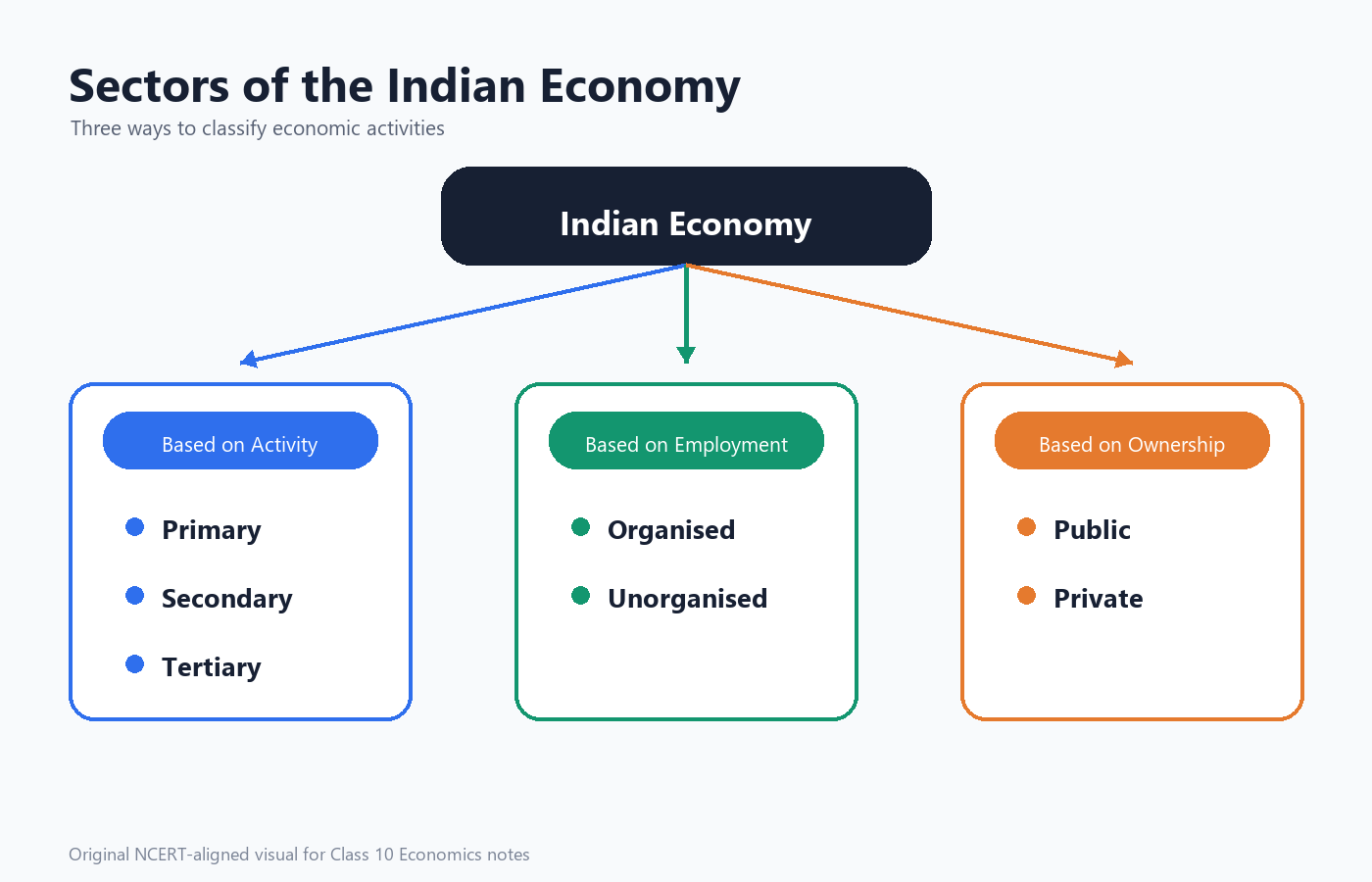
For example, farming, fishing, mining, factory work, transport, banking, teaching, and healthcare are all economic activities. These activities are grouped into sectors to study their contribution to income, employment, and development.
Classification Of Sectors
| Basis of Classification | Types of Sectors |
| Nature of economic activity | Primary, Secondary, Tertiary |
| Employment conditions | Organised, Unorganised |
| Ownership of enterprises | Public, Private |
Primary Sector
The primary sector includes activities that directly use natural resources. It is called the primary sector because it forms the base for many other economic activities.
Examples of primary sector activities include farming, fishing, forestry, dairy, mining, and animal husbandry.
Loading PDF...
In simple words, whenever goods are produced by collecting, growing, or extracting things from nature, the activity belongs to the primary sector.
Secondary Sector
The secondary sector includes activities in which natural products or raw materials are changed into other forms through manufacturing or construction. It is also called the industrial sector.
Examples include making cloth from cotton, sugar from sugarcane, steel from iron ore, furniture from wood, and buildings through construction.
The secondary sector depends on the primary sector for raw materials and adds value by converting them into finished or semi-finished goods.

Tertiary Sector
The tertiary sector includes activities that provide services instead of producing goods directly. It supports the primary and secondary sectors by helping in production, transport, storage, trade, communication, banking, education, and healthcare.
Examples include teachers, doctors, lawyers, transport workers, bankers, software professionals, shopkeepers, and communication service providers.
Best Courses for You

JEE

NEET

Foundation JEE

Foundation NEET

CBSE
The tertiary sector is also called the service sector because it mainly provides services.
Difference Between Primary, Secondary And Tertiary Sectors
| Point | Primary Sector | Secondary Sector | Tertiary Sector |
| Meaning | Uses natural resources directly | Converts raw materials into goods | Provides services |
| Also called | Agriculture and allied sector | Industrial sector | Service sector |
| Main output | Raw materials | Manufactured goods | Services |
| Examples | Farming, fishing, mining | Factories, construction, textiles | Banking, transport, teaching |
| Depends on | Nature | Primary sector | Primary and secondary sectors |
Interdependence Of The Three Sectors
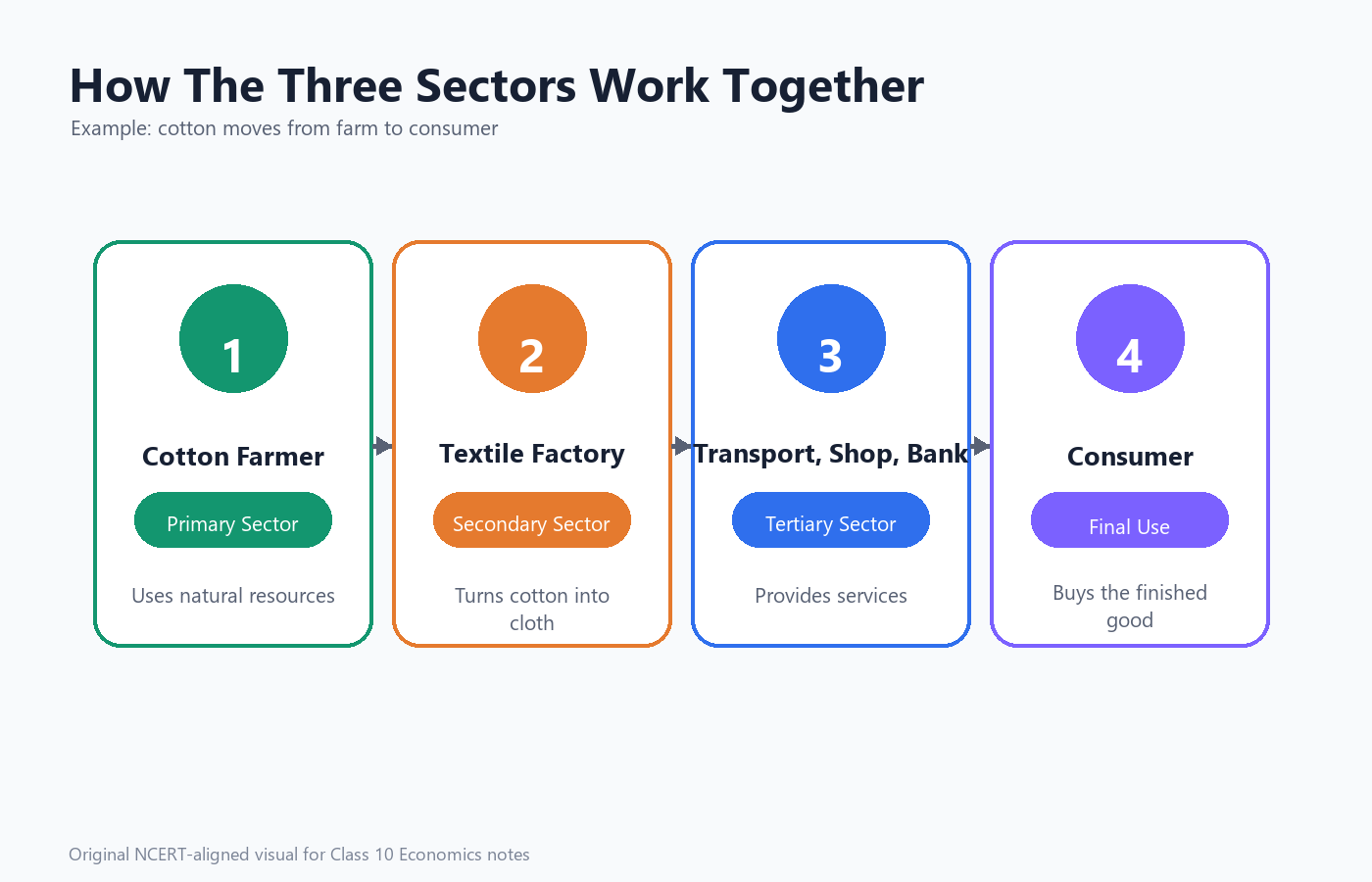
The three sectors are interdependent. For example, a farmer grows cotton in the primary sector. A textile factory converts cotton into cloth in the secondary sector. Transporters, traders, shops, banks, and advertisers help sell the cloth through the tertiary sector.
This shows that no sector works completely alone. Growth in one sector often creates demand in other sectors.
Gross Domestic Product
Gross Domestic Product, or GDP, is the value of all final goods and services produced within a country during a particular year.
Only final goods and services are counted in GDP because counting intermediate goods separately would lead to double counting. For example, if wheat is used to make flour and flour is used to make biscuits, only the final value of biscuits is counted.
Why Is The Tertiary Sector Becoming Important In India?
The tertiary sector has grown rapidly in India because modern economies need more services. As agriculture and industry develop, they need transport, storage, banking, insurance, communication, and trade.
Rising income has also increased demand for education, healthcare, tourism, restaurants, shopping, private transport, and professional services. Information technology, digital payments, online services, and communication networks have further increased the importance of the service sector.
Employment In Different Sectors
A sector’s contribution to GDP and its share in employment may be different. In India, many people still depend on the primary sector, especially agriculture. However, the primary sector may not always contribute as much to GDP as the number of people working in it.
This creates a problem of low productivity and underemployment, especially in rural areas.
Disguised Unemployment
Disguised unemployment is a situation where more people are working in an activity than actually required. Even if some workers are removed, total production does not fall.
For example, if five family members work on a small farm that actually needs only three people, the extra two workers are disguisedly unemployed. They appear to be working, but their contribution to output is very low or zero.
Organised Sector
The organised sector includes enterprises that are registered with the government and follow rules and regulations. Workers in this sector usually get regular wages, fixed working hours, paid leave, job security, and benefits such as provident fund or pension.
Examples include government offices, schools, banks, railways, registered factories, and large companies.
Unorganised Sector
The unorganised sector includes small and scattered units that are usually not registered with the government or do not follow formal employment rules. Workers often face low wages, irregular work, long working hours, no paid leave, and little job security.
Examples include street vendors, domestic workers, small shop workers, daily wage labourers, and casual construction workers.
Organised Sector Vs Unorganised Sector
| Organised Sector | Unorganised Sector |
| Registered with government | Usually not registered |
| Follows labour laws | Often outside formal regulation |
| Fixed working hours | Irregular working hours |
| Regular wages | Irregular income |
| Job security | Little or no job security |
| Paid leave and benefits | Few or no benefits |
How Can Workers In The Unorganised Sector Be Protected?
Workers in the unorganised sector can be protected through minimum wages, affordable credit, health facilities, education, social security, insurance, skill training, and employment guarantee schemes. Government support is important because many workers in this sector are poor and do not have bargaining power.
Public Sector And Private Sector
The public sector includes activities owned and controlled by the government. Examples include railways, government schools, government hospitals, post offices, and public sector banks.
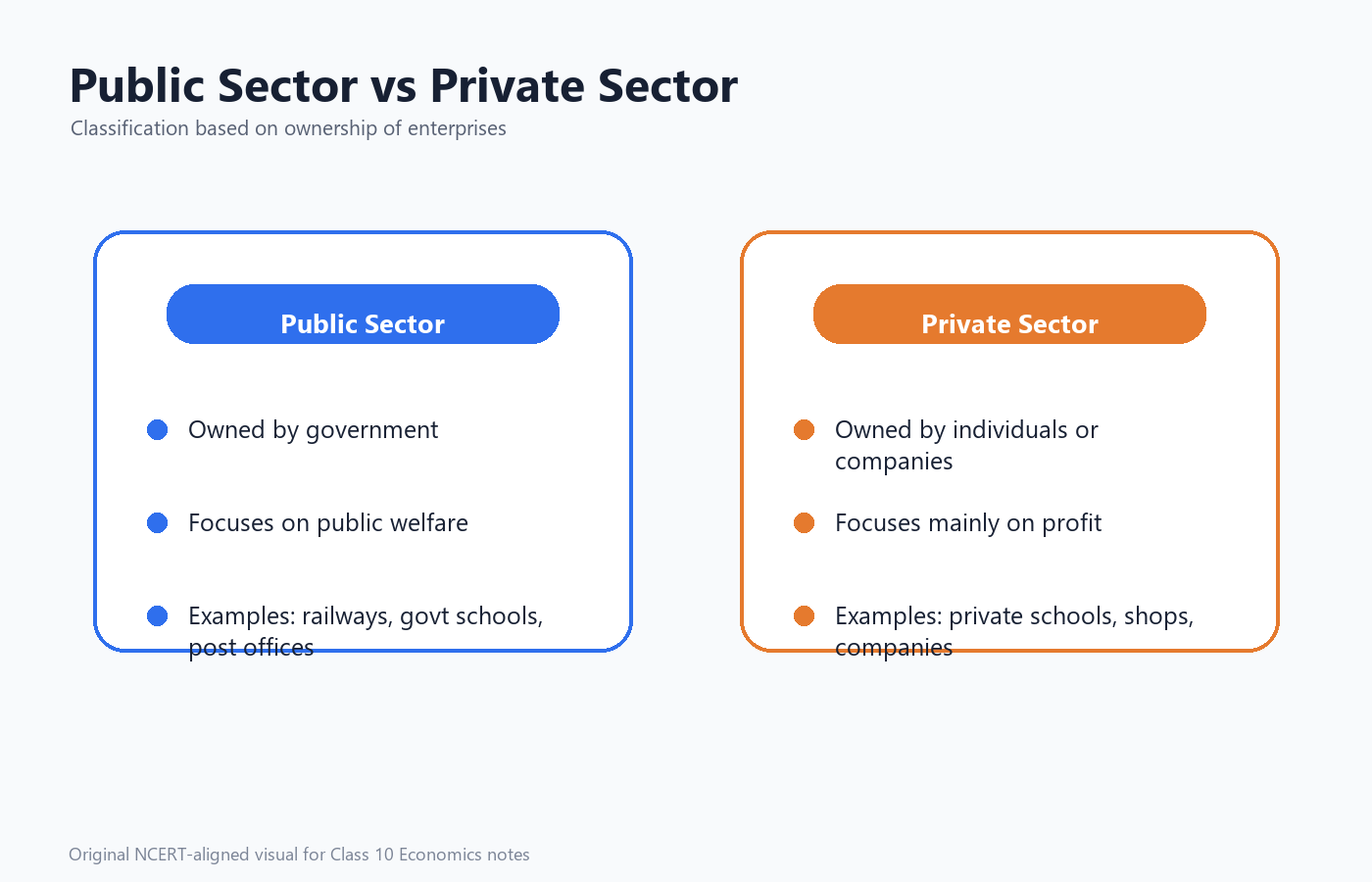
The private sector includes activities owned and controlled by individuals or private companies. Examples include private schools, private hospitals, shops, factories, and private companies.
Difference Between Public And Private Sector
| Public Sector | Private Sector |
| Owned by government | Owned by individuals or companies |
| Main aim is public welfare | Main aim is profit |
| Provides essential services | Provides goods and services for profit |
| Example: Indian Railways | Example: private airlines |
Why Does The Government Spend On Public Sector Activities?
The government spends on public sector activities because some services are essential for all citizens but may not be provided affordably by private companies. These include education, healthcare, roads, bridges, drinking water, electricity, law and order, and defence.
The public sector also supports weaker sections of society and helps in balanced economic development.
Chapter Summary
The Indian economy is divided into sectors to study production, employment, and ownership. The primary sector uses natural resources, the secondary sector converts raw materials into goods, and the tertiary sector provides services. GDP measures the value of final goods and services produced in a country. The organised sector provides better job security, while the unorganised sector needs protection. The public sector works for welfare, while the private sector mainly works for profit.
Important Questions
- What are the three sectors of the Indian economy?
- Give two examples each of primary, secondary and tertiary sectors.
- What is GDP?
- Why are only final goods and services counted in GDP?
- Why is the tertiary sector becoming important in India?
- What is disguised unemployment? Explain with an example.
- Differentiate between organised and unorganised sectors.
- Why do workers in the unorganised sector need protection?
- Differentiate between public and private sectors.
- Why does the government provide public sector services?
course
No courses found
FAQs: Sectors of the Indian Economy
What are the sectors of the Indian economy?
The main sectors of the Indian economy are primary, secondary and tertiary sectors. They are classified based on the nature of economic activity.
What is the primary sector?
The primary sector includes activities that directly use natural resources, such as farming, fishing, mining, forestry and dairy.
What is the secondary sector?
The secondary sector includes activities that convert raw materials into finished goods through manufacturing or construction.
What is the tertiary sector?
The tertiary sector includes service-based activities such as transport, banking, education, healthcare, trade and communication.
Why is the tertiary sector called the service sector?
It is called the service sector because it provides services rather than producing goods directly.
What is GDP in Class 10 Economics?
GDP is the value of all final goods and services produced within a country during a particular year.
What is disguised unemployment?
Disguised unemployment occurs when more people work in an activity than required, and removing some workers does not reduce total output.
What is the difference between organised and unorganised sector?
The organised sector follows government rules and provides job security, while the unorganised sector has irregular work, low wages and little protection.
