

















Courses

By Karan Singh Bisht
|
Updated on 30 Jul 2026, 12:15 IST
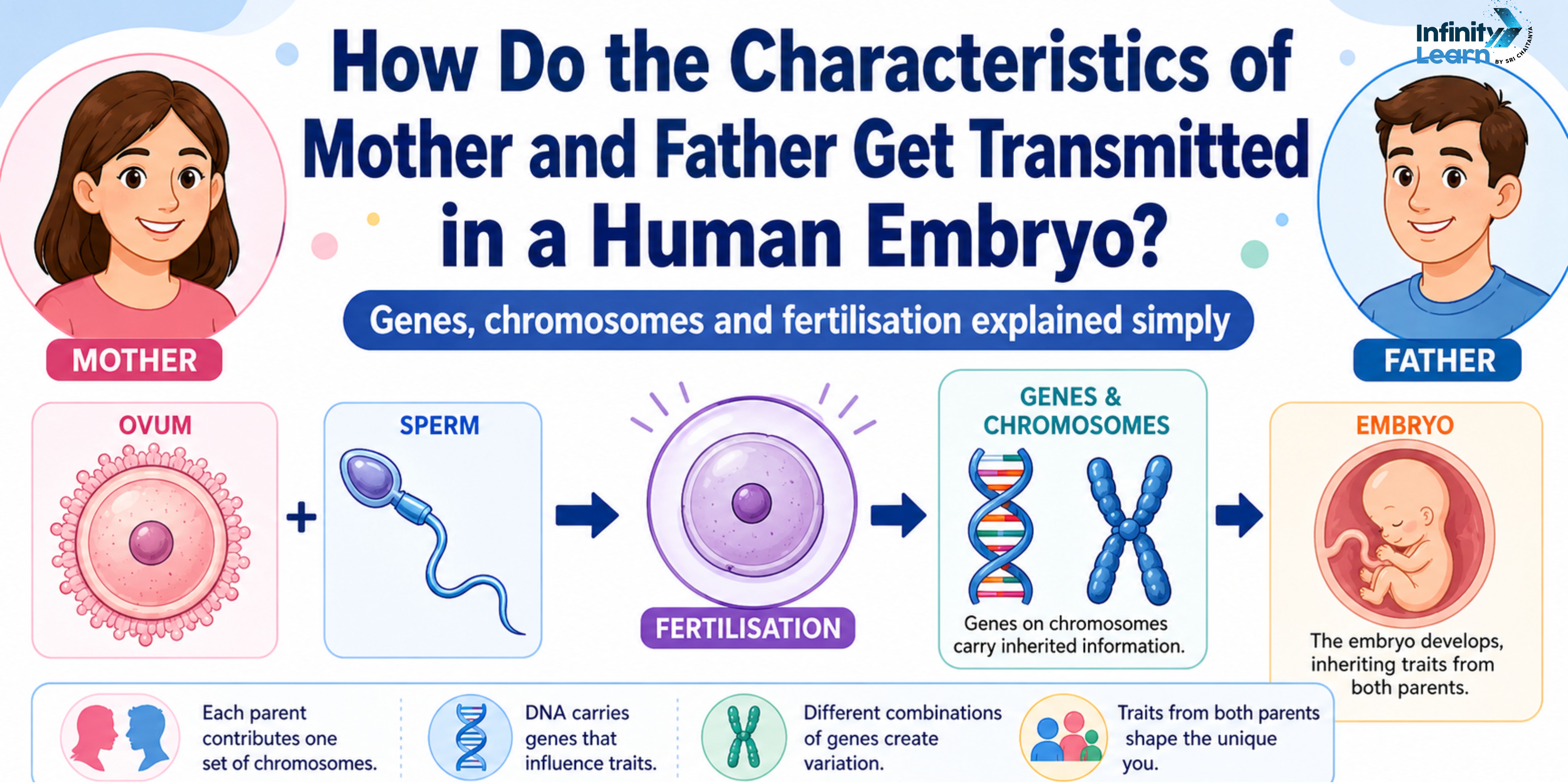
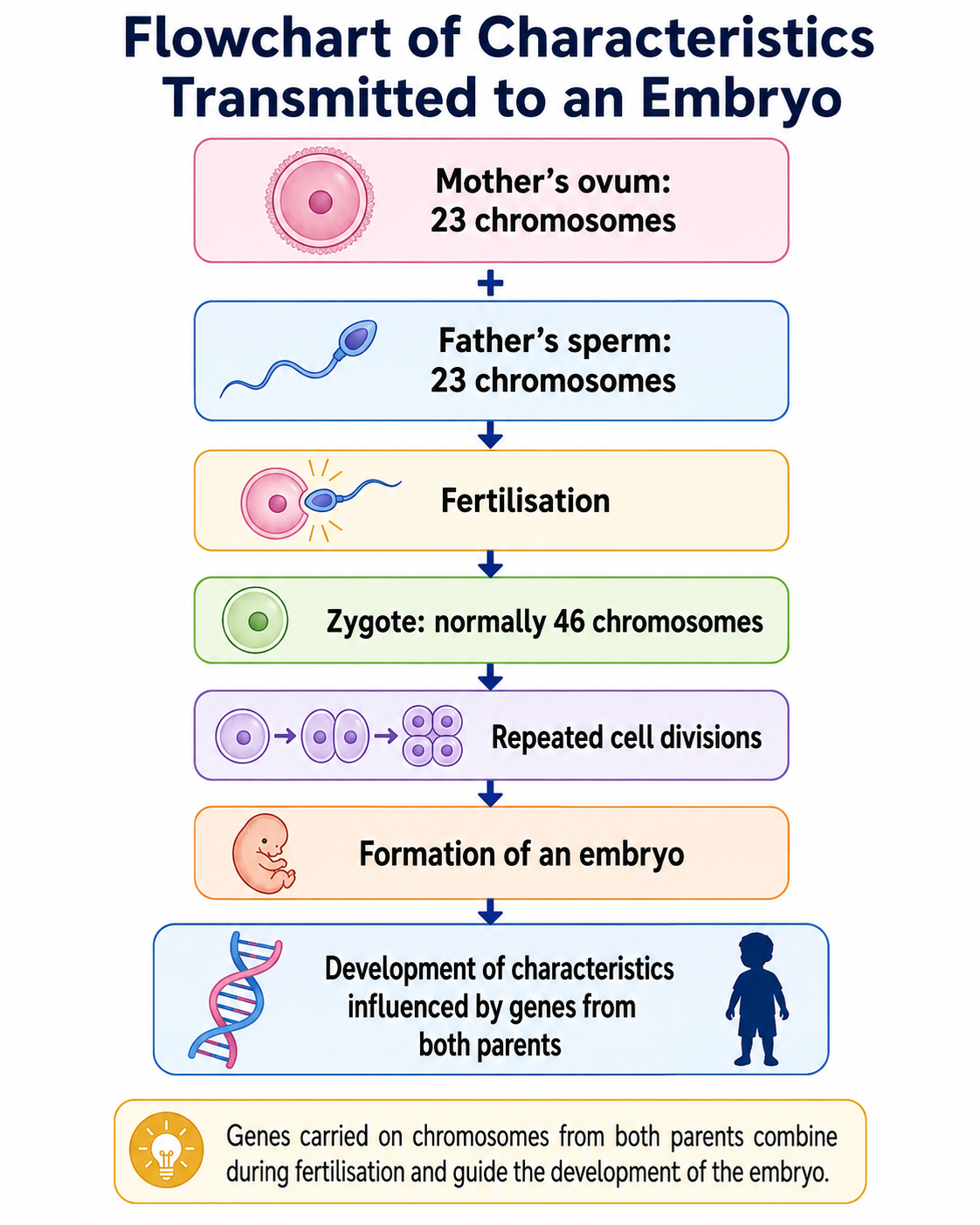
The characteristics of the mother and father are transmitted to a human embryo through genes carried on chromosomes. During fertilisation, the mother’s ovum contributes 23 chromosomes and the father’s sperm contributes another 23 chromosomes. Their fusion forms a zygote with 46 chromosomes containing genetic information from both parents. The zygote then divides repeatedly and develops into an embryo, which may show characteristics of the mother, the father or both.
This content has been written to explain the process of heredity in a clear, step-by-step and student-friendly way. It is based mainly on the concepts of genes, chromosomes, reproduction and inheritance covered in the NCERT Class 10 Science chapters on Heredity and Reproduction, supported by standard biological explanations. Scientific terms are introduced in simple language, and the sequence from gamete formation to fertilisation, zygote formation and embryo development is explained carefully to avoid confusion.
The article is intended primarily for Class 9 and Class 10 students, especially those following the NCERT and CBSE curriculum. Teachers, tutors and parents may also use it for classroom explanations, homework support and revision. Its purpose is to help learners understand why children resemble their parents, how both parents contribute genetic information and why every child receives a unique combination of characteristics.
The characteristics of the mother and father are transmitted through genes, which are carried on chromosomes.
During fertilisation, the mother’s ovum, containing 23 chromosomes, joins with the father’s sperm, which also contains 23 chromosomes. Their fusion produces a single cell called a zygote with 46 chromosomes. The zygote receives one set of nuclear chromosomes from the mother and one set from the father.
The zygote then divides repeatedly and develops into an embryo. Therefore, the embryo carries genetic information from both parents and may show characteristics of the mother, the father or both.
Heredity is the process through which biological characteristics are passed from parents to their children. These inherited characteristics are also called traits.

Inherited traits can influence:
Genes influence many human traits, but they do not always act alone. Several characteristics are influenced by multiple genes, and some are also affected by nutrition, health and other environmental factors.

JEE

NEET

Foundation JEE

Foundation NEET

CBSE
To understand inheritance, students need to know the relationship among DNA, genes and chromosomes.
Chromosomes contain DNA → DNA contains genes → Genes influence characteristics
The male reproductive cell is called a sperm, while the female reproductive cell is called an ovum or egg. Most human body cells contain 46 chromosomes, but sperm and ova normally contain only 23 chromosomes each. These reproductive cells are formed through a special type of cell division called meiosis. During meiosis, chromosome pairs are separated so that each reproductive cell receives only one chromosome from every pair.
During fertilisation, a sperm fuses with an ovum. The nuclei of the two reproductive cells combine, bringing maternal and paternal chromosomes together in one cell. This process restores the normal chromosome number:
23 chromosomes from the mother + 23 chromosomes from the father = 46 chromosomes in the zygote.
The immediate result of fertilisation is not a fully developed embryo. It is a single cell called a zygote.The zygote contains a new and unique combination of genes from both parents. It is the first cell of the new individual.
After fertilisation, the zygote begins to divide repeatedly. It first forms a group of cells and then develops into an embryo. As the cells divide, the genetic information in the zygote is copied into the newly formed cells. Although most of these cells contain the same DNA, different genes become active in different cells. This allows some cells to develop into muscle, nerve, skin and other specialised cells.
For many genes located on chromosome pairs, the child receives one version from the mother and another from the father. Different versions of the same gene are called alleles. The combination of alleles inherited by the child helps influence which characteristics may appear.
A child resembles both parents because both contribute genetic material during fertilisation. The ovum carries chromosomes inherited from the mother’s family, while the sperm carries chromosomes inherited from the father’s family. When they combine, the child receives a new mixture of maternal and paternal genes.
A child may therefore have a facial feature resembling one parent, a blood group influenced by both parents and other characteristics that may also appear in grandparents or earlier generations. Resembling one parent more strongly does not mean that the child received more nuclear DNA from that parent.
For the chromosomes in the cell nucleus, each parent normally contributes 23 chromosomes. In this sense, the mother and father make approximately equal contributions to the child’s nuclear genetic material. However, the ovum contributes much more cellular material than the sperm, including most of the cytoplasm. A small amount of DNA is also present inside mitochondria, and mitochondrial DNA is almost always inherited from the mother through the ovum. For a Class 10 answer, the main point is: The mother and father normally contribute equal sets of nuclear chromosomes to the child.
For some genes, one allele may be dominant, while another may be recessive. A dominant allele can influence the observable characteristic even when only one copy is present. A recessive characteristic generally appears when the relevant recessive allele is received from both parents.
However, “dominant” does not mean stronger, healthier, better or more common. It only describes how one allele is expressed in relation to another allele. This simple dominant–recessive pattern is useful for understanding basic inheritance, but not every human characteristic follows such a simple rule.
No. Some characteristics are strongly influenced by one gene, but many human characteristics are polygenic, which means they are influenced by two or more genes. Height and skin pigmentation are examples of polygenic characteristics. Their development may also be affected by environmental conditions. For example, inherited genes influence a person’s potential height, but nutrition and health during growth can also affect the final height. Therefore, a child’s observable characteristics, known as the phenotype, may result from genes, gene expression and environmental influences working together.
Brothers and sisters have the same biological parents, but they usually do not receive exactly the same combination of genes.
During meiosis:
In addition, each fertilisation event involves a different sperm and ovum. These processes produce new genetic combinations, which is why siblings may differ in appearance and other characteristics.
Identical twins are an important exception because they generally develop when one fertilised egg separates into two embryos.
In the common human chromosomal pattern:
When an X-bearing sperm fertilises the ovum, the usual chromosomal combination is XX. When a Y-bearing sperm fertilises it, the usual combination is XY.
Therefore, the father’s sperm determines whether the child receives an X or Y chromosome. The mother is not responsible for determining whether the child is male or female.
Inherited characteristics and acquired characteristics are different.
| Inherited characteristics | Acquired characteristics |
| Passed through genetic material | Develop during a person’s lifetime |
| Received from biological parents | Result from learning, experience, injury or environment |
| May be passed to the next generation | Are generally not transmitted through genes |
| Example: blood group | Example: a scar or learned skill |
Some characteristics, such as height, cannot be placed completely in only one category because both genes and environmental factors may influence them.
The characteristics of the mother and father are transmitted through genes carried on chromosomes. During fertilisation, the ovum and sperm contribute 23 chromosomes each and form a zygote with 46 chromosomes. Thus, the developing embryo receives genetic information from both parents.
The characteristics of the mother and father are transmitted to a human embryo through DNA, genes and chromosomes. The sperm and ovum each normally contribute 23 chromosomes during fertilisation, producing a zygote with 46 chromosomes. The zygote divides repeatedly and develops into an embryo carrying a unique combination of genetic information from both parents. This combination explains why children resemble their parents but are not usually identical to either one. It also creates the variation seen among brothers and sisters. At Infinity Learn, this topic can be studied through simple explanations, flowcharts and exam-ready answers so that students understand both the scientific process and the correct way to present it in an examination.
No courses found
Characteristics are transmitted through genes carried on chromosomes. During fertilisation, the mother’s egg and the father’s sperm combine to form a zygote. Each normally contributes 23 chromosomes, so the zygote receives 46 chromosomes containing genetic information from both parents. The zygote then divides and develops into an embryo.
A child may inherit genetic influences related to blood group, natural hair texture, eye colour, skin pigmentation, height, facial features and certain health conditions. Most of these characteristics are not inherited from only one parent; they result from combinations of genes received from both parents, often along with environmental influences.
There are no four biological or genetic “types of mothers.” This question usually refers to four commonly discussed parenting styles:
These categories describe how parents combine emotional warmth, rules and control; they are not categories of motherhood itself.
There is no fixed scientific list, and good parenting can look different across families and cultures. Five widely valued qualities are:
Research-based parenting guidance emphasises warmth, active listening, clear communication, predictable rules and a safe, supportive home.
A child normally receives about half of their nuclear DNA from their father through the sperm. Paternal genes may contribute to characteristics such as blood group, height potential, hair and eye features, facial structure and inherited health tendencies, but most traits are shaped by gene combinations from both parents rather than the father alone. The father also contributes either an X or a Y chromosome. In the usual chromosomal pattern, daughters receive their father’s X chromosome, while sons receive his Y chromosome.
A child normally receives about half of their nuclear DNA from their mother through the egg. Maternal genes can influence the same broad kinds of characteristics as paternal genes, including blood group, appearance, growth and inherited health tendencies. The egg also supplies the embryo’s mitochondria, so mitochondrial DNA is usually inherited from the mother.
The embryo comes from both biological parents. The mother provides the egg and the father provides the sperm. Their genetic material combines during fertilisation to form a zygote, which divides repeatedly and develops into an embryo. The mother additionally provides the environment in which the embryo develops during pregnancy.
Girls receive approximately half of their nuclear DNA from each parent. They normally receive one X chromosome from the mother and one X chromosome from the father. However, mitochondrial DNA is generally inherited only from the mother. Therefore, the nuclear contribution is approximately equal, while a very small additional amount of genetic material comes maternally through mitochondria.
Genes are the units of heredity and are located on chromosomes. The sperm and egg contain 23 chromosomes each. During fertilisation, they fuse to form a zygote with 46 chromosomes—23 from the mother and 23 from the father. The genes on these chromosomes transmit parental characteristics to the offspring and also produce variation.
Babies normally receive approximately 50% of their nuclear DNA from the mother and 50% from the father. One chromosome in each of the 23 pairs comes from each parent. The main exception is mitochondrial DNA, which is usually inherited from the mother through the egg. Therefore, 50–50 is accurate for nuclear DNA, with a small maternal contribution from mitochondrial DNA.