








Courses

By Karan Singh Bisht
|
Updated on 24 Jul 2026, 16:38 IST
Why is solving the last ten years of papers multiple times can significantly improve your rank in JEE? Because JEE Main Physics rewards pattern recognition more than raw memory. Concepts repeat. Setups repeat. Even the traps repeat, just with different numbers plugged in. This guide organizes JEE Main Physics PYQs chapter-wise, so you can revise by topic instead of hunting through scattered papers. You get the highest-yield chapters first, solved examples with difficulty tags, and a repetition table you can actually use for planning your last month of prep. So here's the plan. We rank the chapters, walk through solved PYQ-style problems from each major group, then close with a study schedule you can copy directly.
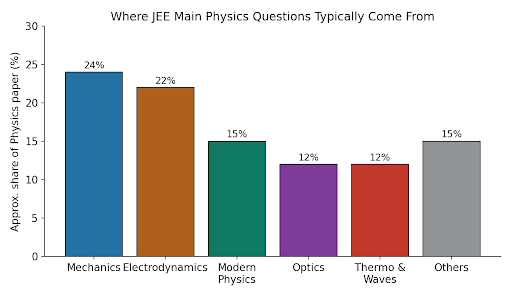
NTA does not publish an official chapter-wise breakup. But once you line up papers from recent years side by side, a pattern shows up fast. A handful of chapters keep resurfacing, session after session, shift after shift. Mechanics, electrodynamics, and modern physics together account for well over half the Physics section. Ray optics and thermodynamics fill in most of the remaining share. The chart below reflects this trend, built from cross-checking multiple years of papers rather than any single source.
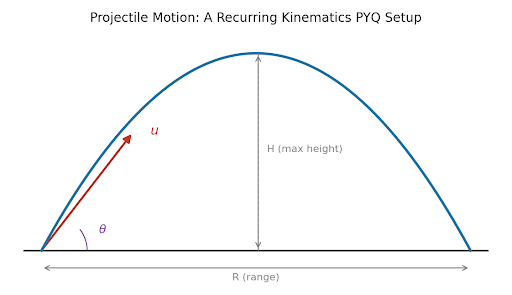
A few sub-topics show up in nearly every shift, not just every year. Projectile motion and circular motion inside kinematics. Series-parallel resistor networks inside current electricity. Photoelectric effect graphs inside modern physics. Convex lens and prism numericals inside ray optics. If your revision time is short, start here.
Mechanics questions test setup speed more than raw difficulty. Get the free-body diagram or the velocity components wrong early, and the rest of the problem collapses.
Difficulty: Medium
A ball is projected at an angle θ with speed u. Find the ratio of maximum height to range.
Using H = u²sin²θ / 2g and R = u²sin2θ / g, the ratio H/R simplifies to tanθ / 4. Students often forget that sin2θ = 2 sinθ cosθ, and end up with an extra factor of 2 in the wrong place.

Difficulty: Hard

JEE

NEET

Foundation JEE

Foundation NEET

CBSE
Two blocks connected by a string over a frictionless pulley, one on a rough incline, are a JEE Main favourite. The trick is writing separate equations for each block, keeping tension as the unknown that links them, then solving simultaneously rather than guessing which block accelerates faster.
Difficulty: Medium
Rolling without slipping questions, and orbital velocity comparisons between two satellites at different heights, both appear almost every year. For rolling bodies, always check whether the question wants the centre-of-mass velocity or the contact-point condition; mixing the two is the single most common mistake here.
Electrodynamics stretches across five sub-chapters, but the underlying question types repeat heavily. Once you have solved twenty resistor-network problems, the twenty-first rarely surprises you.
Difficulty: Easy
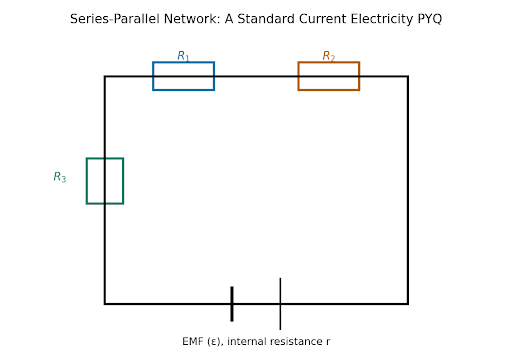
Given a battery with internal resistance r connected to a network mixing series and parallel resistors, find the current drawn from the source. Reduce the network step by step: combine parallel branches first, then add series segments, and only then apply I = ε / (R_total + r).
Difficulty: Medium
Electrostatics PYQs usually revolve around field and potential due to point charges or simple symmetric bodies. Magnetic effects questions often ask for force on a current-carrying conductor in a uniform field. EMI numericals frequently involve a rod sliding on rails inducing motional EMF. AC circuit questions test power factor and resonance in LCR circuits, and examine whether you can spot when a circuit is purely resistive at resonance.
These two chapters reward students who draw the diagram first and calculate second. Skipping the sketch is where most marks get lost.
Difficulty: Easy
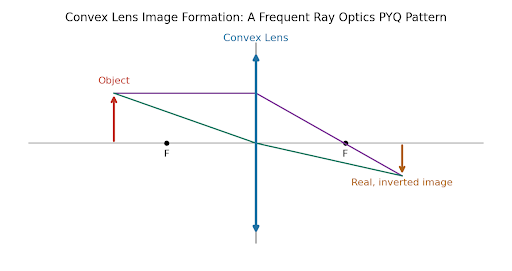
An object placed beyond twice the focal length of a convex lens forms a real, inverted, diminished image between F and 2F on the other side. JEE Main frequently asks you to find image distance and magnification using 1/v − 1/u = 1/f, then combines it with a second lens or a mirror in the same question.
Difficulty: Medium
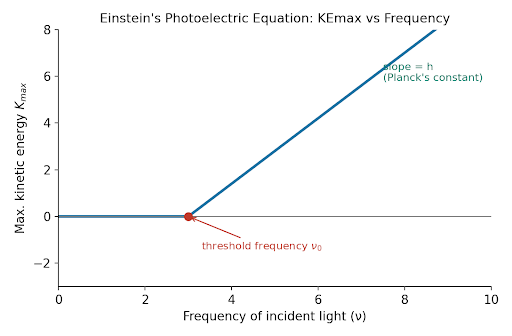
Einstein's photoelectric equation, KEmax = hν − φ, turns up as both a direct numerical and a graph-reading question. When JEE Main gives you a KEmax vs frequency graph, the slope always equals Planck's constant h, and the y-intercept always equals −φ, the negative of the work function.
Difficulty: Medium
Bohr model energy level questions and radioactive decay half-life numericals both repeat consistently. For half-life problems, always convert the elapsed time into a clean number of half-lives before applying N = N0(1/2)^n; skipping this step is where most calculation errors creep in.
This group covers SHM, wave motion, thermodynamics, kinetic theory, and fluid mechanics. Individually each contributes fewer questions than mechanics or electrodynamics, but combined they form a dependable 12 to 15 percent of the paper.
Difficulty: Easy
Time period questions for a spring-mass system or a simple pendulum are close to guaranteed. Watch for combinations, springs in series or parallel attached to the same mass, since the effective spring constant changes the time period formula.
Difficulty: Medium
First law of thermodynamics numericals involving isothermal or adiabatic processes for an ideal gas appear regularly, alongside root-mean-square speed comparisons between different gases at the same temperature. Remember that rms speed depends on molar mass, so lighter gases always move faster at a given temperature.
Difficulty: Medium
Bernoulli's equation applied to a leaking tank, or terminal velocity of a sphere falling through a viscous fluid, are the two setups that recur most. Both questions test whether you can correctly identify which terms in the equation actually change between the two points being compared.
Use this table as a quick revision map. It highlights chapters that go beyond the occasional appearance and instead show up as a near-certainty every year.
| Chapter Group | Typical Questions per Paper | Repeats 3+ Times Yearly? |
| Current Electricity | 2 to 3 | Yes |
| Modern Physics (Photoelectric, Atoms, Nuclei) | 3 to 5 | Yes |
| Mechanics (Kinematics, Laws of Motion, Rotation) | 5 to 7 | Yes |
| Ray and Wave Optics | 2 to 4 | Yes |
| Electrostatics and Magnetic Effects | 3 to 4 | Yes |
| EMI and AC Circuits | 1 to 2 | Occasionally |
| Thermodynamics and Kinetic Theory | 2 to 3 | Occasionally |
| SHM and Waves | 1 to 2 | Occasionally |
| Fluid Mechanics and Properties of Matter | 1 to 2 | Occasionally |
Reading a worked solution helps. Watching someone draw the diagram and set up the equation in real time, in the order they actually thought of it, usually helps more. Infinity Learn's chapter-wise PYQ library links a short video solution to each question inside the practice sets referenced below, so you can check your working method, not just your final answer.
Mechanics, electrodynamics, and modern physics carry the paper. Master those three groups first, since together they cover more than half of every JEE Main Physics attempt you will sit for.
A workable last-month schedule: spend the first ten days on mechanics and electrodynamics PYQs chapter by chapter, the next seven on optics and modern physics, and the final week on waves, thermodynamics, and fluid mechanics, closing with two full mock papers under timed conditions.
Solving JEE Main Physics PYQs chapter-wise is not about memorizing answers. It is about noticing the same five or six question skeletons appear again and again, so that on exam day, nothing actually feels unfamiliar.
No courses found
Platforms like Infinity Learn organize previous year questions by chapter rather than by exam year, letting you practice one topic, such as current electricity or rotational motion, in a single focused sitting.
Current electricity, modern physics, mechanics, and ray optics show up most consistently across recent papers, together forming more than half of the Physics section most years.
Working through the last 8 to 10 years of papers, chapter-wise rather than year-wise, gives enough pattern exposure for most aspirants. Quality of analysis after each attempt matters more than raw question count.
PYQs are essential but not sufficient on their own. They reveal question patterns and repeated setups, but you still need conceptual study and fresh practice problems to handle the year's inevitable new variations.
Infinity Learn's chapter-wise practice sets pair each PYQ with a video walkthrough, so you can review the reasoning behind a solution rather than just checking the final answer.