- Moment of Inertia (MOI)
- Torque and Angular Acceleration
- Angular Momentum and Its Conservation
- Rotational Kinetic Energy and Rolling Motion
- Common JEE PYQ Patterns in Rotational Motion
- Common Mistakes and How to Avoid Them
- How Infinity Learn Supports Your Preparation
- FAQs: Rotational Motion: Concepts, Derivation & Examples
Rotational Motion: Concepts, Derivation & Examples
By rohit.pandey1
|
Updated on 7 Jul 2026, 13:05 IST
If you have solved previous JEE papers, you have probably noticed that rotational motion is one of the most frequently tested mechanics topics. It is often combined with other areas of physics. Many questions require you to apply Newton’s laws, work-energy principles, or simple harmonic motion alongside rotational variables. This integrated approach is one reason many students find the chapter challenging.
A strong understanding of the underlying concepts can help you solve some of the most scoring mechanics questions with confidence. Conversely, relying strictly on memorized formulas makes it easy to miss the subtle conceptual shifts that examiners build into these problems.
The underlying principles apply well beyond exam preparation. Every turning wheel, every stabilizing satellite gyroscope, and every planet maintaining its orbit follows these identical laws. When a bicycle tire rolls across asphalt or a figure skater pulls her arms inward to increase her spin speed, you are seeing angular momentum and moment of inertia at work.
This guide covers the core concepts commonly tested in JEE-level rotational motion questions. We will start with the geometry of moment of inertia, move into torque dynamics, and finish with rolling motion and its applications. Through direct derivations and a close look at common student errors, you will build the foundational clarity needed for test day.
Moment of Inertia (MOI)
Definition and Physical Significance
Moment of inertia is the rotational counterpart of mass. Where mass measures a body's reluctance to change its linear velocity, moment of inertia measures its reluctance to change its angular velocity about a given axis. For a system of particles:
I = Σ mᵢrᵢ²
where rᵢ is the perpendicular distance of the i-th particle from the axis of rotation. For a continuous body, the sum becomes an integral:
I = ∫ r² dm

The key physical insight is that MOI depends not just on how much mass a body has, but on how that mass is distributed relative to the axis. Two objects of identical mass can have very different moments of inertia — a solid disc and a ring of the same mass and radius do not behave the same way when spun, because the ring has all its mass concentrated at the rim.
MOI of Standard Shapes
These five results are used so often in JEE problems that they're worth committing to memory rather than deriving from scratch every time.
Best Courses for You

JEE

NEET

Foundation JEE

Foundation NEET

CBSE
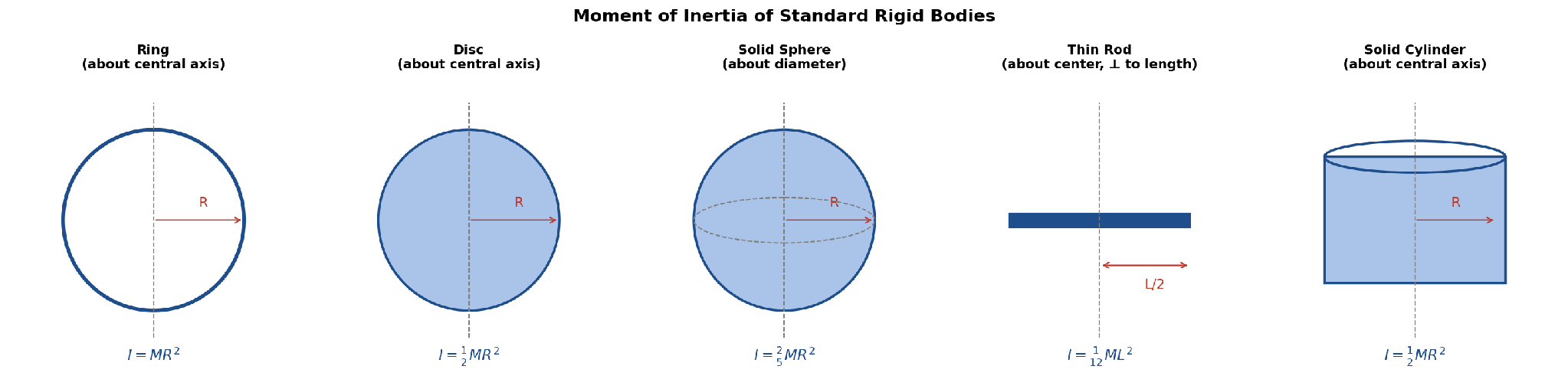
Figure 1: Moment of Inertia of standard rigid bodies about their common axes.
| Body | Axis | Moment of Inertia |
| Ring | Through centre, perpendicular to plane | I = MR² |
| Disc | Through centre, perpendicular to plane | I = ½MR² |
| Solid Sphere | Through diameter | I = ⅖MR² |
| Hollow Sphere | Through diameter | I = ⅔MR² |
| Thin Rod | Through centre, perpendicular to length | I = 1/12 ML² |
| Thin Rod | Through one end, perpendicular to length | I = ⅓ML² |
| Solid Cylinder | Along central axis | I = ½MR² |
Notice the pattern: mass concentrated farther from the axis (rings, hollow spheres) always gives a larger MOI than mass spread closer to the axis (discs, solid spheres) for the same M and R.
Parallel Axis Theorem
This theorem lets you find the MOI about any axis, provided you already know the MOI about a parallel axis through the centre of mass.
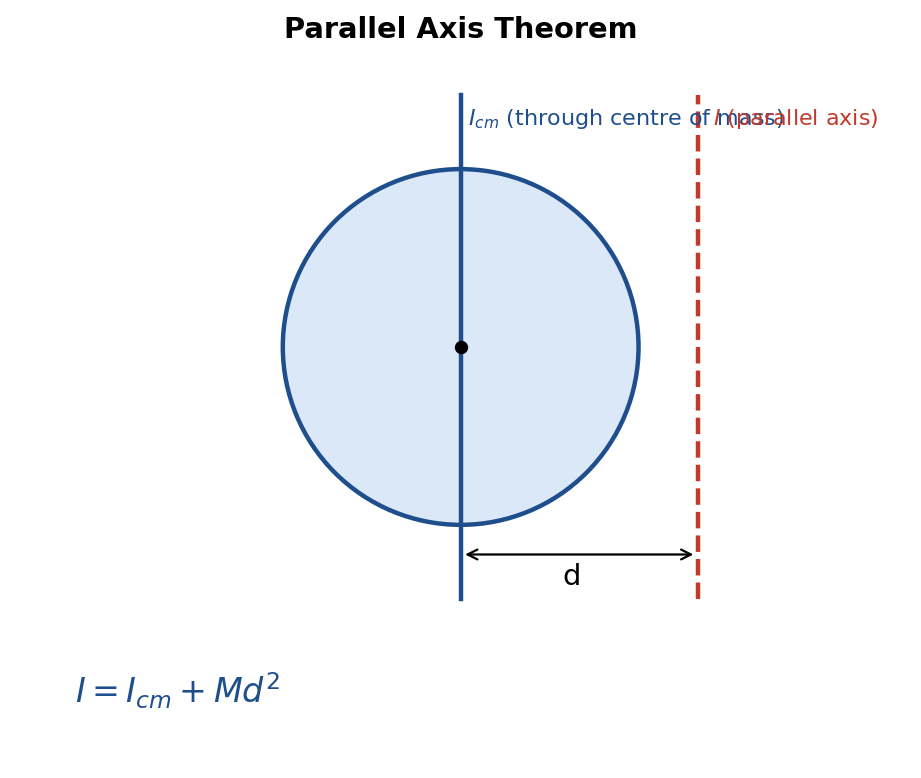
Figure 2: Parallel Axis Theorem — the offset axis at distance d from the centre-of-mass axis.
Statement: The moment of inertia I about any axis equals the moment of inertia I_cm about a parallel axis through the centre of mass, plus Md², where d is the perpendicular distance between the two axes.
I = I_cm + Md²
Derivation: Consider a rigid body of mass M rotating about an axis at distance d from a parallel axis through its centre of mass. For a small mass element dm at position r from the centre of mass, its distance from the new axis is (r + d) in the plane perpendicular to the axis. Then:
I = ∫|r+d|² dm = ∫r² dm + 2d·∫r dm + d²∫dm
Since r is measured from the centre of mass, ∫r dm = 0 by definition of the centre of mass. This leaves:
I = I_cm + Md²
Perpendicular Axis Theorem
This one applies only to planar (flat) laminae.
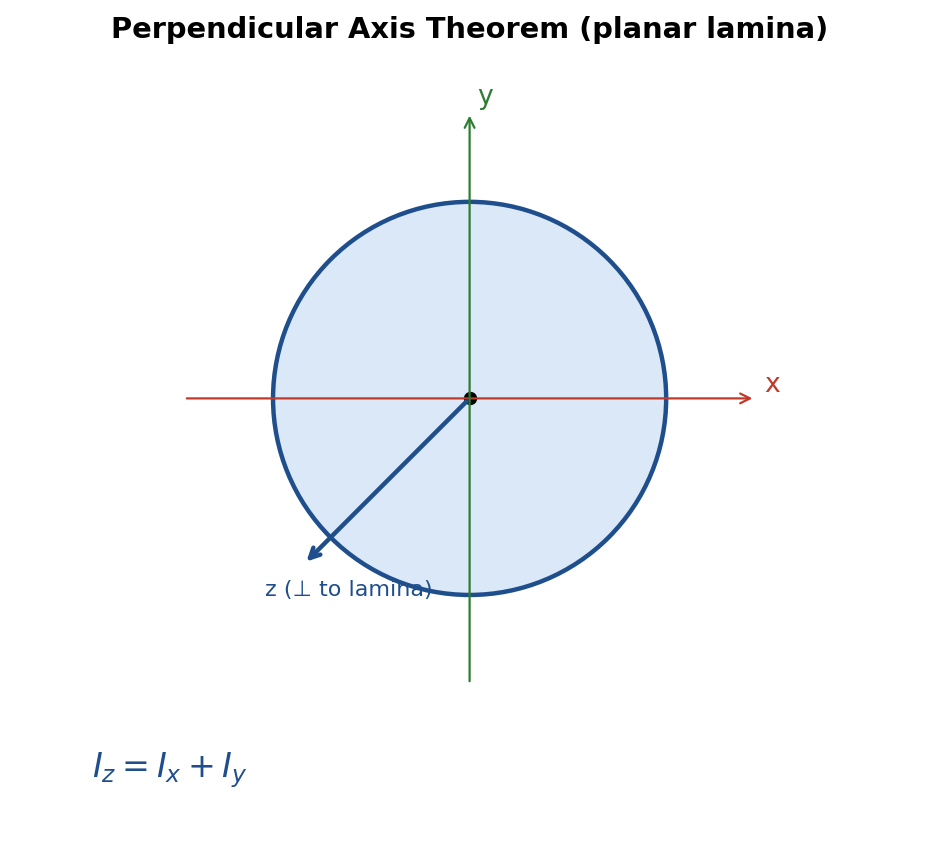
Figure 3: Perpendicular Axis Theorem for a planar lamina in the x–y plane.
Statement: For a flat lamina lying in the x-y plane, the moment of inertia about the z-axis (perpendicular to the plane) equals the sum of the moments of inertia about two mutually perpendicular axes (x and y) lying in the plane and intersecting where the z-axis passes through.
I_z = I_x + I_y
Derivation: For any point mass dm in the lamina at coordinates (x, y), its distance from the z-axis is √(x²+y²), its distance from the x-axis is y, and from the y-axis is x. So:
I_z = ∫(x²+y²) dm = ∫x² dm + ∫y² dm = I_y + I_x
A quick application: for a disc of mass M and radius R, I_x = I_y by symmetry, and since I_z = ½MR², each diameter axis has I_x = I_y = ¼MR².
Radius of Gyration
Radius of gyration (K) is the distance from the axis at which, if the entire mass of the body were concentrated as a point, it would give the same moment of inertia:
I = MK² ⇒ K = √(I/M)
It's a useful way to compare how "spread out" different bodies are relative to an axis, independent of their actual mass.
Torque and Angular Acceleration
Torque as the Rotational Analogue of Force
Just as force causes linear acceleration, torque causes angular acceleration. Torque is the turning effect of a force about a chosen axis or point, defined as:
τ = r × F, |τ| = rF sinθ
where θ is the angle between the position vector r (from the axis to the point of application of the force) and the force F.
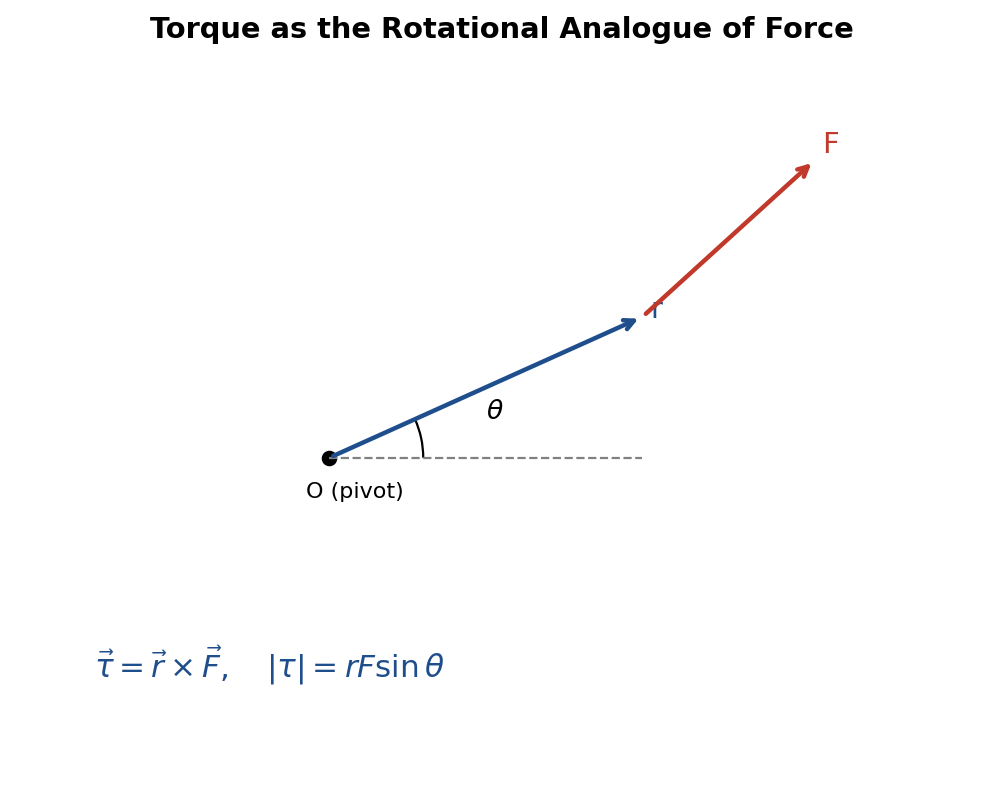
Figure 4: Torque as the rotational analogue of force.
Torque is maximum when the force is applied perpendicular to r (θ = 90°), and zero when the force acts along the same line as r — which is exactly why door handles are placed far from the hinge, not next to it.
Relation Between Torque, MOI, and Angular Acceleration
Newton's second law for rotation is the direct analogue of F = ma:
τ = Iα
Derivation: For a rigid body made of particles, each particle i experiences a tangential force Fᵢ = mᵢaₜ,ᵢ = mᵢrᵢα (since aₜ = rα for rotation). The torque contributed by this particle is τᵢ = rᵢFᵢ = mᵢrᵢ²α. Summing over all particles:
τ = Σ mᵢrᵢ²α = (Σ mᵢrᵢ²)α = Iα
Couple and Its Properties
A couple is a pair of equal, opposite, and parallel forces acting on a body at different points, such that their net force is zero but they produce a net turning effect. Because the net force is zero, a couple produces pure rotation with no translation. Its torque, τ = F × d (where d is the perpendicular distance between the two forces), is the same about any point in the plane — unlike torque due to a single force, which depends on the choice of pivot.
Angular Momentum and Its Conservation
Definition and Formula
Angular momentum is the rotational analogue of linear momentum:
L = r × p = Iω
For a rigid body rotating about a fixed axis, L = Iω, directly paralleling p = mv.
Law of Conservation of Angular Momentum
Statement: If the net external torque on a system is zero, its total angular momentum remains constant.
Derivation: Since τ = dL/dt (torque is the rate of change of angular momentum, by analogy with F = dp/dt), if τ_net = 0:
dL/dt = 0 ⇒ L = constant ⇒ I₁ω₁ = I₂ω₂
Applications
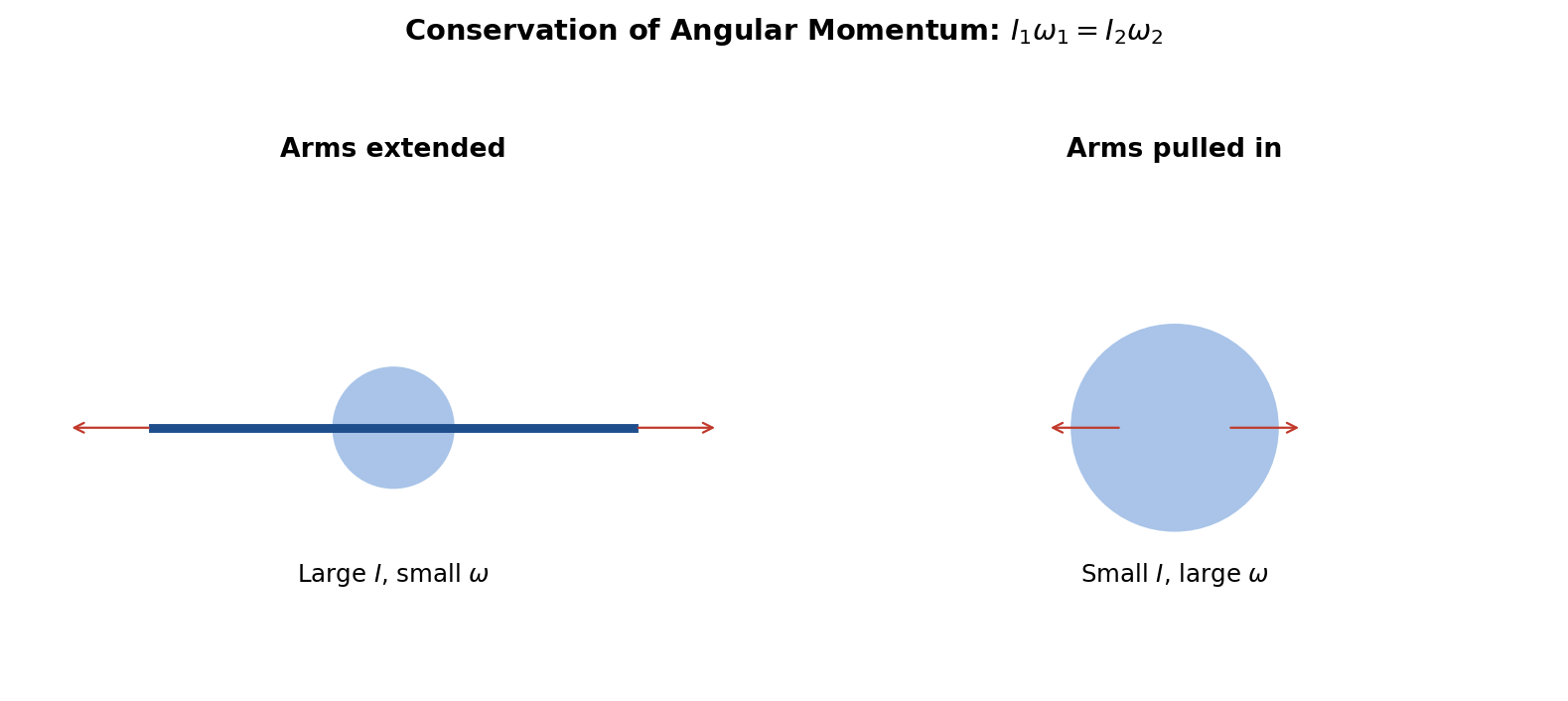
Figure 5: Conservation of angular momentum — arms extended vs. arms pulled in.
- Ice skater spinning: When a skater pulls her arms inward, her moment of inertia I decreases. Since L = Iω must stay constant (no external torque about the spin axis), her angular velocity ω increases — she spins faster.
- Collapsing star: A star that collapses under gravity into a neutron star shrinks its radius dramatically, drastically reducing I. Since L is conserved, ω shoots up, this is the mechanism behind the extremely rapid rotation of pulsars.
Rotational Kinetic Energy and Rolling Motion
Kinetic Energy of a Rotating Body
KE_rot = ½Iω²
This follows the same form as translational kinetic energy (½mv²), with I replacing m and ω replacing v.
Rolling Without Slipping
A body that rolls without slipping has both translational and rotational motion simultaneously, linked by the condition:
v_cm = Rω
Its total kinetic energy is the sum of translational and rotational parts:
KE_total = ½Mv_cm² + ½I_cmω²
Substituting I_cm = kMR² (where k is a shape-dependent constant — e.g., k = ⅖ for a solid sphere) and ω = v_cm/R:
KE_total = ½Mv_cm²(1+k)
This single relation explains why, on the same incline, a solid sphere always reaches the bottom before a disc, and a disc before a ring the smaller the k, the less energy is "locked up" in rotation, and the more speed the body gains.
Rolling on an Inclined Plane
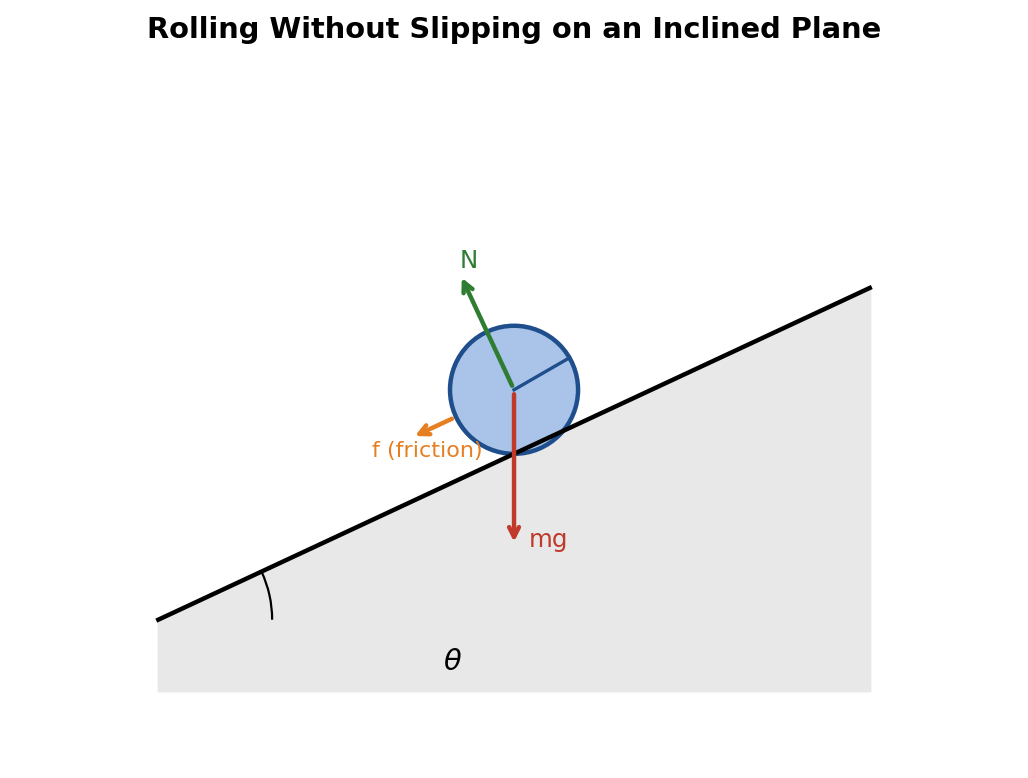
Figure 6: Rolling without slipping on an inclined plane, with mg, N, and static friction f.
For a body of radius R rolling without slipping down a rough incline of angle θ, energy conservation gives:
Mgh = ½Mv²(1+k) ⇒ v = √(2gh / (1+k))
and the linear acceleration down the incline works out to:
a = g sinθ / (1+k)
Static friction (not kinetic) is what provides the torque needed for rolling without slipping — a detail that trips up a lot of students, covered further in Section 7.
Common JEE PYQ Patterns in Rotational Motion
JEE PYQ questions on this chapter cluster into three recurring types. Below is one worked example from each — all built independently for this guide, not lifted from any test series.
Pattern 1: Moment of Inertia Calculations
Question: A uniform rod of mass 3 kg and length 2 m is bent at its midpoint into an L-shape, so the two halves are perpendicular to each other. Find the moment of inertia of the bent rod about an axis through the bend point, perpendicular to the plane containing both halves.
Solution: Each half has mass m = 1.5 kg and length l = 1 m.
For a rod about an axis through one end, perpendicular to its length: I = ⅓ml².
Since both halves lie in the plane and the axis is perpendicular to that plane and passes through their common end (the bend point), each half contributes independently:
I_each = ⅓(1.5)(1)² = 0.5 kg·m²
I_total = 2 × 0.5 = 1 kg·m²
Pattern 2: Angular Momentum Conservation
Question: A horizontal disc of mass 4 kg and radius 0.5 m rotates freely about a vertical axis through its centre at 6 rad/s. A 1 kg point mass is gently placed on the rim of the disc. Find the new angular velocity.
Solution: I_disc = ½(4)(0.5)² = 0.5 kg·m². I_point mass = mR² = (1)(0.5)² = 0.25 kg·m².
No external torque acts (the mass is placed gently, and forces are internal), so angular momentum is conserved:
I₁ω₁ = (I₁ + I_point mass)ω₂
(0.5)(6) = (0.5 + 0.25)ω₂
ω₂ = 3 / 0.75 = 4 rad/s
Pattern 3: Rolling Motion Problems
Question: A solid cylinder and a solid sphere, both of the same mass and radius, are released from rest at the top of the same incline. Find the ratio of their times to reach the bottom.
Solution: Using a = g sinθ/(1+k): for a solid cylinder, k = ½, so a_cyl = g sinθ/1.5 = 2g sinθ/3.
For a solid sphere, k = ⅖, so a_sph = g sinθ/1.4 = 5g sinθ/7.
Since both start from rest and cover the same distance s, s = ½at² ⇒ t ∝ 1/√a:
t_cyl / t_sph = √(a_sph / a_cyl) = √(15/14) ≈ 1.036
The sphere reaches the bottom marginally faster — a direct consequence of its smaller k.
Common Mistakes and How to Avoid Them
- Confusing the axis of rotation. MOI values change completely depending on which axis you pick. Always identify the axis explicitly before reaching for a formula, a rod's MOI about its centre is four times smaller than about its end, and mixing the two up is one of the most common silent errors in this chapter.
- Errors in applying the parallel axis theorem. The theorem only works when one of the two axes passes through the centre of mass. Students frequently try to shift between two arbitrary parallel axes directly — you must always route through I_cm first.
- Ignoring rolling friction vs sliding friction. In rolling-without-slipping problems, it's static friction that acts (since the contact point has zero relative velocity), and static friction does no work. Treating it as kinetic friction, or assuming it always dissipates energy, leads to wrong energy-conservation equations.
- Forgetting the rolling constraint. Many marks are lost simply by forgetting to substitute v = Rω (or its differentiated form a = Rα) to connect translational and rotational quantities.
How Infinity Learn Supports Your Preparation
Rotational motion is a chapter where watching a concept explained once rarely settles it, the ideas need to be seen from multiple angles before they stick. Infinity Learn's structure is built around that reality:
- Interactive concept videos break down rotational mechanics visually, showing how MOI, torque, and angular momentum connect rather than presenting them as isolated formulas to memorise.
- Step-by-step doubt resolution is available for exactly the kind of tricky MOI problems covered above — bent rods, composite bodies, and axis-shift questions that don't fit a single template.
- Mock tests with analytics flag whether a student's rotational-motion errors are conceptual (wrong axis, wrong theorem) or computational, so revision time goes where it's actually needed rather than being spread evenly across a chapter that's already understood.
Rotational motion rewards students who build it up systematically: moment of inertia as the foundation, torque and τ = Iα as the equation of motion, angular momentum conservation as the shortcut for collision-and-transfer problems, and rolling motion as the chapter's favourite way of combining everything at once. The formulas are few enough to memorise in an afternoon, the real skill is recognising which one a given question is quietly asking for, and getting the axis right before you write anything down.
For JEE Main specifically, expect this chapter to show up as one direct formula-based question and one multi-concept problem (often rolling motion combined with energy conservation) in most years. Treat it as guaranteed marks once the core theorems are solid.
course
No courses found
FAQs: Rotational Motion: Concepts, Derivation & Examples
What is the easiest way to learn Moment of Inertia for JEE?
Start by memorising the five standard-shape formulas as a set, then practise the parallel and perpendicular axis theorems on those same five shapes before moving to composite bodies. Deriving each formula once by hand (rather than only reading the derivation) makes the axis-dependence far easier to remember under exam pressure.
How do I solve rolling motion problems quickly?
Identify the shape constant k for the rolling body first (k = ½ for cylinders/discs, ⅖ for solid spheres, ⅔ for hollow spheres, 1 for rings/hoops), then plug directly into a = g sinθ/(1+k) or v = √(2gh/(1+k)) instead of re-deriving energy equations from scratch each time.
Which rotational motion derivations are asked in JEE Advanced?
JEE Advanced tends to favour the parallel and perpendicular axis theorem derivations, the τ = Iα derivation from first principles, and energy-distribution derivations for rolling bodies — often combined with a second topic like SHM or collisions within the same question.
What is the difference between torque and angular momentum?
Torque (τ = Iα) is the rotational analogue of force — it's what causes angular acceleration. Angular momentum (L = Iω) is the rotational analogue of momentum — it's the quantity that torque changes over time (τ = dL/dt). Torque is a cause; angular momentum is a conserved quantity in its absence.
How many questions come from rotational motion in JEE Main?
Typically 1–2 questions per JEE Main attempt draw directly from rotational motion, though rolling motion and angular momentum concepts frequently resurface inside questions nominally about other chapters, such as combined translation-rotation or collision problems.