Work-Energy Theorem: Formula, Derivation & Examples
By rohit.pandey1
|
Updated on 7 Jul 2026, 12:26 IST
Have you ever wondered why some complex physics problems take pages of equations using Newton's laws, while top rankers solve them in just two lines . The secret lies in changing your perspective from vector forces to scalar energy. In the JEE and NEET physics syllabus, mechanics form the bedrock of your score, and inside mechanics, the Work-Energy Theorem is arguably the most powerful tool you will ever use. It acts as a direct mathematical bridge linking force, displacement, and velocity without requiring you to calculate time or instantaneous acceleration.
Students preparing for JEE Main and NEET often find this theorem one of the quickest ways to solve mechanics questions, because it avoids lengthy force and acceleration calculations. Mastering it simplifies many mechanics problems and resurfaces later in gravitation, oscillations, and electrostatics, wherever a change in kinetic energy is involved. Instead of tracking changing vector forces at every point of motion, you look only at the initial and final states of the object. This guide breaks down the core concepts, step-by-step derivations for constant and variable forces, practical applications, and JEE-level solved numericals.
Definition of the Work-Energy Theorem
Formal Definition
The theorem states that the net work done by all the forces acting on a particle is exactly equal to the change in its kinetic energy. This applies to individual particles, systems of particles, and rigid bodies under translational motion.
W_net = ΔKE = KE_f − KE_i
Here, W_net represents the total work done by every single force acting on the object, KE_f is the final kinetic energy, and KE_i is the initial kinetic energy. Written using mass (m), final velocity (v), and initial velocity (u), the expression becomes:
W_net = ½mv² − ½mu²
The Scalar Nature of Energy vs. Vector Forces
Newton's laws force you to deal with vectors. You have to resolve forces along the x, y, and z-axes, manage vector signs, and calculate instantaneous acceleration vectors. The Work-Energy Theorem sweeps this complexity away, because work and kinetic energy are purely scalar quantities — they have magnitude but no direction.
Since kinetic energy depends only on speed and not direction, there is no need to resolve it into components. A particle moving at 5 m/s along the positive x-axis has exactly the same kinetic energy as an identical particle moving at 5 m/s at an angle of 60°. This scalar simplification drastically reduces calculation errors during high-pressure exams.

Conditions and Essential Assumptions
The theorem is generally applied in inertial frames. When solving problems in non-inertial frames, pseudo forces must also be considered to calculate the net work done accurately. In the particle form of the theorem, the object is treated as a particle or rigid body; if internal deformation occurs, some work may convert into internal energy rather than translational kinetic energy.
Derivation of the Work-Energy Theorem
Understanding how this theorem originates from Newton's second law clarifies its foundational role in mechanics. Here is how mathematics works out for both constant and variable forces.
Best Courses for You

JEE

NEET

Foundation JEE

Foundation NEET

CBSE
Derivation for a Constant Force
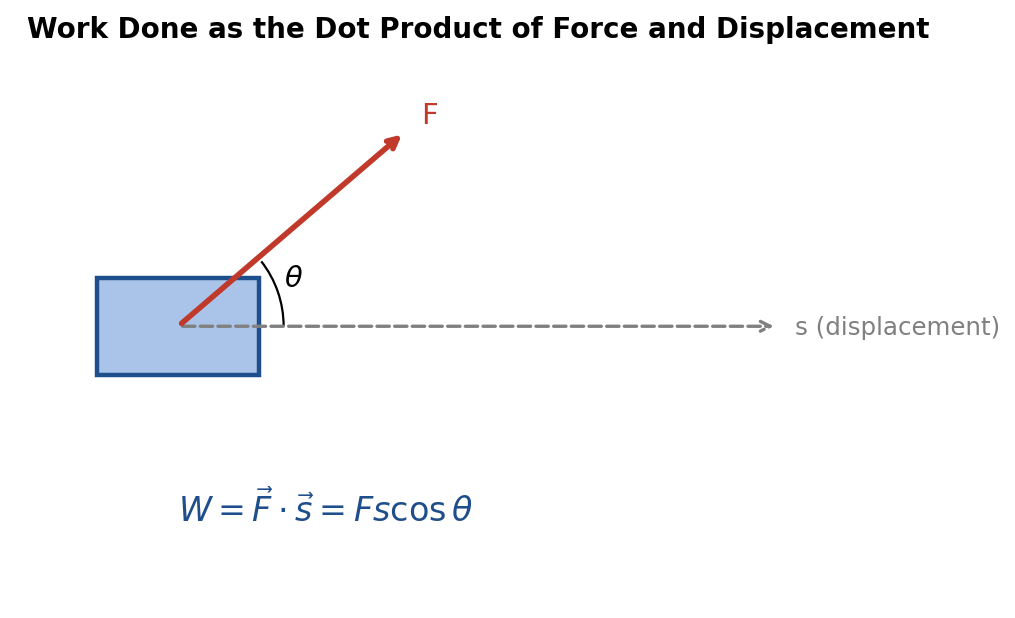
Suppose a constant net force F acts on a body of mass m along a straight line, causing a uniform acceleration over a linear displacement s. According to Newton's second law:
F = ma
From the third equation of motion, which relates initial velocity u, final velocity v, acceleration a, and displacement s:
v² = u² + 2as
Rearranging to isolate acceleration:
a = (v² − u²) / 2s
Multiplying both sides by the mass m:
ma = m(v² − u²) / 2s
The left side, m·a, is exactly the net force F. Substituting F directly:
F = m(v² − u²) / 2s ⇒ Fs = ½mv² − ½mu²
By definition, the product of a constant force and displacement in its direction is the work done, W = Fs. Hence:
W = ½mv² − ½mu² = ΔKE
This completes the proof for a constant-force system.
Derivation for a Variable Force (Using Calculus)
Real-world forces fluctuate. Think of a compressing spring or gravitational pull between separating bodies — such forces change value at every millimetre of displacement. For a variable force, definite integration is required.
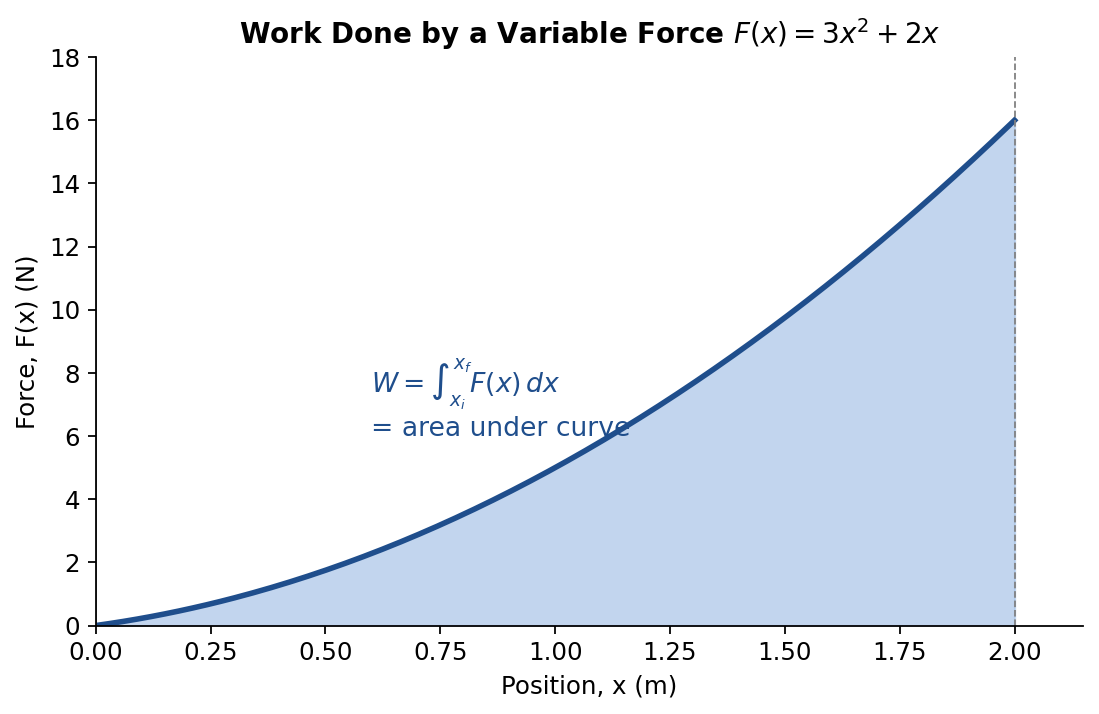
Figure 2: For a variable force, work equals the area under the F–x curve.
Let a one-dimensional variable force F(x) act on a mass m, shifting its position from xᵢ to x_f. The small work done dW during an infinitesimal displacement dx is:
dW = F(x) dx
By Newton's second law, force is mass times acceleration, and acceleration can be rewritten as the rate of change of velocity with time:
F = ma = m (dv/dt)
Using the chain rule to make this position-dependent:
dv/dt = (dv/dx)(dx/dt) = v (dv/dx)
since dx/dt is simply the instantaneous velocity v. So the force becomes:
F = mv (dv/dx)
Substituting this into dW = F dx:
dW = mv (dv/dx) dx = mv dv
The dx terms cancel cleanly, leaving a differential equation purely in terms of velocity. Integrating both sides as position changes from xᵢ to x_f, while velocity changes from u to v:
W = ∫ᵤᵛ mv dv = m ∫ᵤᵛ v dv
Since mass is constant, it comes outside the integral. Integrating v with respect to dv gives v²/2, and applying the limits:
W = m [v²/2 − u²/2] = ½mv² − ½mu²
This calculus proof shows the theorem holds even when forces are constantly changing.
Key Concepts and Applications
Positive, Negative, and Zero Work
Work is not always a positive value. Because work involves a dot product, W = F·s = Fs cosθ, the angle θ between the force vector and the displacement vector dictates the sign.
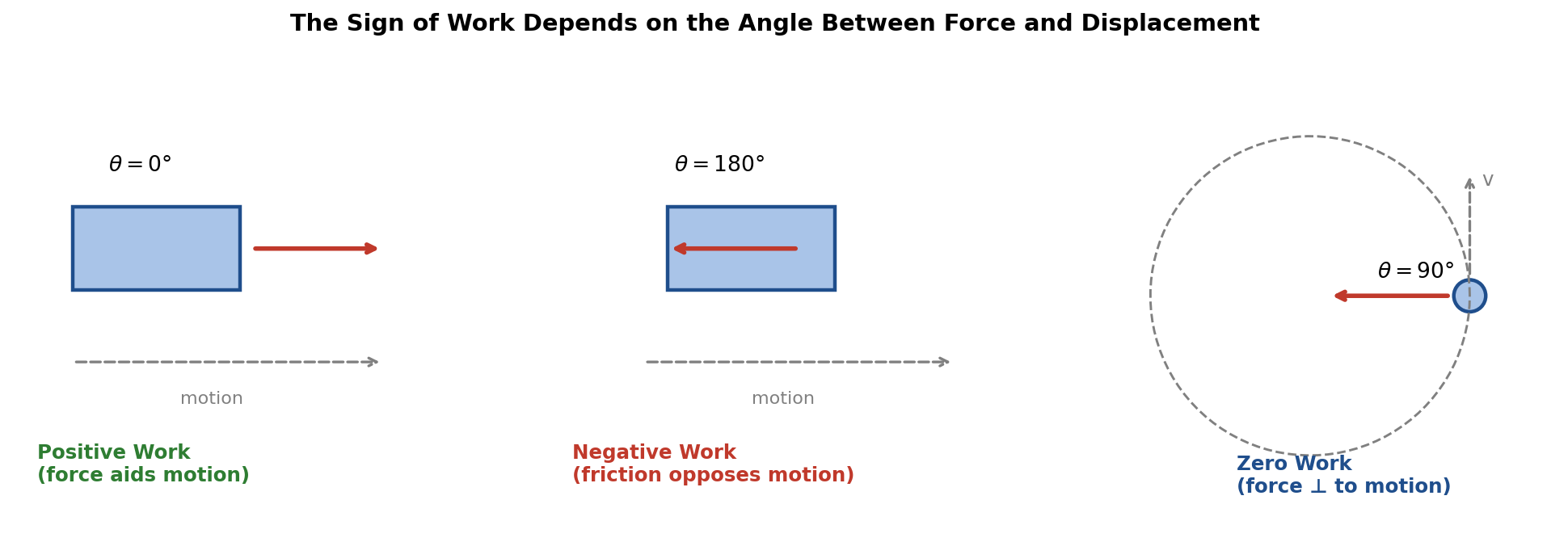
Figure 3: The sign of work depends entirely on the angle between force and displacement.
| Case | Angle θ | Example | Effect on KE |
| Positive Work | 0° ≤ θ < 90° | An engine accelerating a car | Kinetic energy increases |
| Negative Work | 90° < θ ≤ 180° | Kinetic friction slowing a sliding block | Kinetic energy decreases |
| Zero Work | θ = 90° | Centripetal force on a satellite | Kinetic energy unchanged |
Conservative vs. Non-Conservative Forces
When calculating W_net, every force present in the system must be accounted for. These forces generally fall into two groups.
- Conservative forces: work done depends only on the starting and ending positions, not the path taken. Gravity, electrostatic forces, and ideal spring forces are examples. This work can be stored as potential energy, ΔPE = −W_conservative.
- Non-conservative forces: work done depends entirely on the path taken. Friction, air resistance, and viscous drag are classic examples — this work is dissipated as heat or sound and cannot be recovered.
Work-Energy Theorem vs. Conservation of Mechanical Energy
Students often treat these as interchangeable, but they are not quite the same.
| Feature | Work-Energy Theorem | Conservation of Mechanical Energy |
| Core statement | Net work done equals the change in kinetic energy. | Total mechanical energy (KE + PE) remains constant over time. |
| Applicability | Universal — applies to all forces (friction, gravity, tension). | Restricted — holds only if non-conservative forces do no work. |
| System view | How external and internal work alters a body's speed. | Internal transformation between potential and kinetic states. |
Common Mistakes Students Make
- Forgetting to include all forces: W_net means the sum of work done by every internal, external, conservative, non-conservative, and pseudo force. If a block slides down an incline, don't just calculate the work done by gravity — add the negative work done by friction too.
- Mismanaging the reference frame: analysing a pulley system from an accelerating lift requires adding a pseudo force, F_pseudo = m·a_lift, to the free body diagram, and then computing the work done by this pseudo force over the displacement observed within the lift.
- Confusing individual work with net work: a single force can do negative work on an object even while its kinetic energy increases, because other forces are doing a larger amount of positive work. Always compute the algebraic sum of all work values before equating it to ΔKE.
Solved JEE-Level Numericals
Let's apply the theory to three distinct problems that replicate the complexity of JEE Main and Advanced questions.
Numerical 1: Work Done by Friction on an Incline
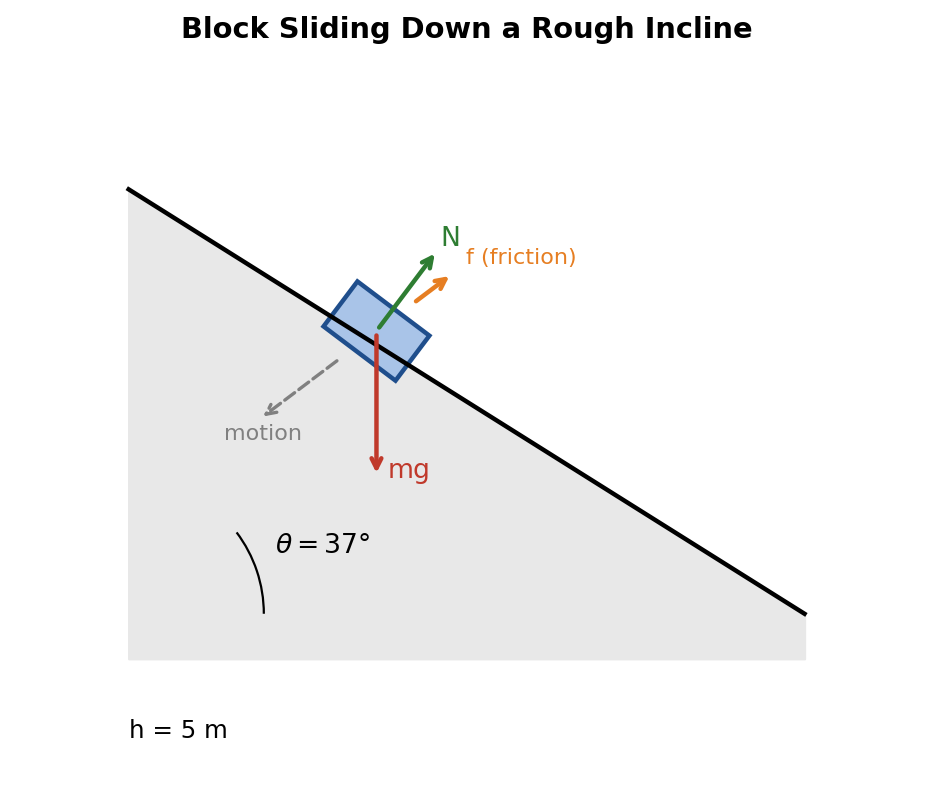
Figure 4: Forces acting on a block sliding down a rough incline.
Question: A block of mass m = 2 kg starts from rest at the top of a rough inclined plane of height h = 5 m and angle 37°. It reaches the bottom with a final velocity of 6 m/s. Find the work done by friction during this slide. (Take g = 10 m/s².)
Solution: The forces doing work on the block are gravity (W_g) and friction (W_f); the normal force acts at 90° to the incline, so W_N = 0. By the theorem:
W_net = W_g + W_f = KE_f − KE_i
The block starts from rest, so KE_i = 0. Work done by gravity depends only on the vertical drop h:
W_g = mgh = (2)(10)(5) = 100 J
Final kinetic energy at the bottom:
KE_f = ½mv² = ½(2)(6²) = 36 J
Substituting into the theorem:
100 + W_f = 36 ⇒ W_f = −64 J
The work done by friction is −64 J. The negative sign confirms that friction opposes the block's displacement.
Numerical 2: Variable Force Problem Using Integration
Question: A particle of mass m = 0.5 kg moves along the x-axis under a position-dependent force F(x) = (3x² + 2x) N. If it starts with a velocity of 2 m/s at x = 0, what is its velocity at x = 2 m?
Solution: Since the force varies with position, total work is found by integrating F(x) from x = 0 to x = 2:
W = ∫₀² (3x² + 2x) dx = [x³ + x²]₀²
W = (8 + 4) − (0) = 12 J
Equating this net work to the change in kinetic energy:
W = ½mv² − ½mu²
12 = ½(0.5)v² − ½(0.5)(2²) = 0.25v² − 1
0.25v² = 13 ⇒ v² = 52 ⇒ v ≈ 7.21 m/s
The velocity of the particle at x = 2 m is approximately 7.21 m/s.
Numerical 3: Combined System with Spring and Gravity
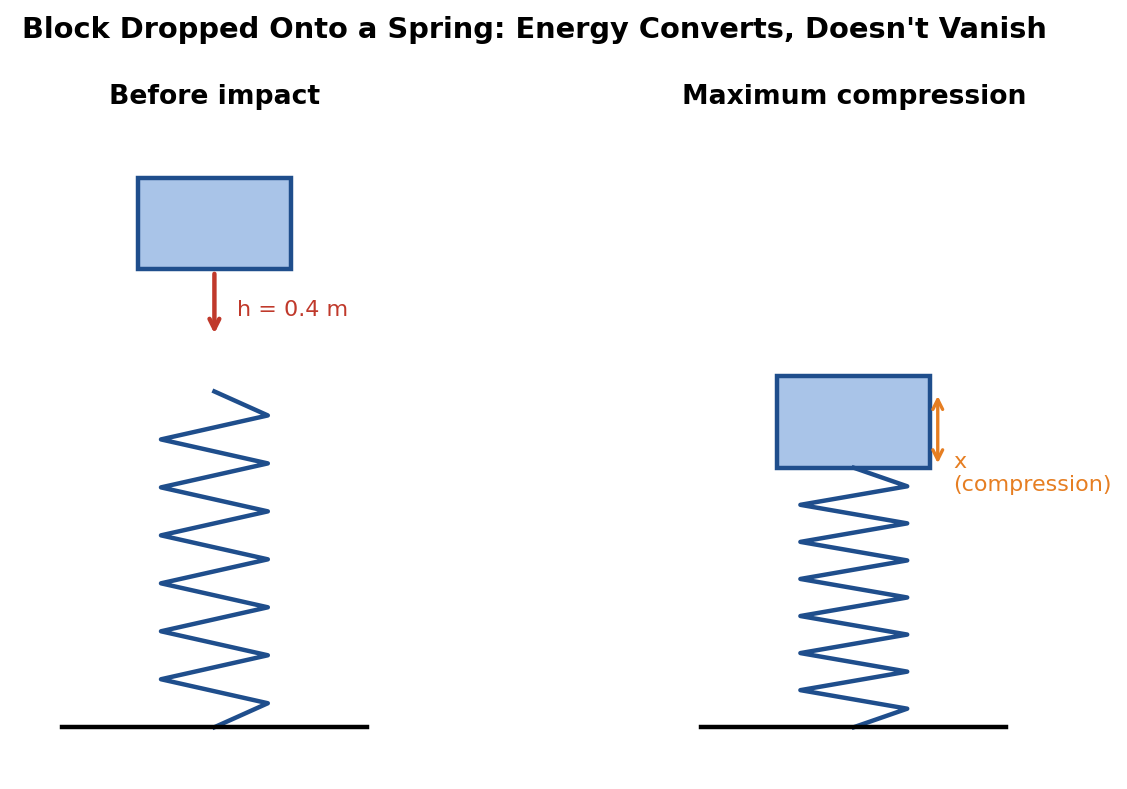
Figure 5: A block dropped onto a spring — gravity does positive work, the spring does negative work.
Question: A block of mass 1 kg is dropped from rest from a height of 0.4 m onto a vertical spring of stiffness k = 400 N/m mounted on the floor. Find the maximum compression x of the spring. (Take g = 10 m/s².)
Solution: The block drops, hits the spring, and compresses it until it momentarily stops. Since both initial and final velocities are zero, ΔKE = 0.
Gravity does positive work over the total distance dropped, (h + x); the spring pushes back, doing negative work. Applying the theorem to the combined system:
W_gravity + W_spring = ΔKE = 0
mg(h + x) − ½kx² = 0
Substituting m = 1, h = 0.4, k = 400, g = 10:
(1)(10)(0.4 + x) − ½(400)x² = 0
4 + 10x − 200x² = 0
Dividing through by −2 and rearranging into standard quadratic form:
100x² − 5x − 2 = 0
Solving with the quadratic formula, x = [5 ± √(25 + 800)] / 200, and taking the positive root:
x ≈ 0.168 m = 16.8 cm
The maximum compression of the spring is 16.8 cm.
7. How Infinity Learn Helps Master This Topic
Mastering competitive physics requires moving past basic memorisation to develop deep visualisation skills. Infinity Learn provides a structured ecosystem designed to help you conquer challenging mechanics topics like work and energy:
- Interactive video lectures: complex derivations are broken down using targeted animations, turning abstract calculus like the variable-force integral into an intuitive visual concept.
- Curated practice pools: chapter-wise practice problems categorised into easy, intermediate, and advanced JEE/NEET tracks, so you avoid frustrating learning plateaus.
- Instant doubt resolution: stuck on a multi-concept numerical late at night? Continuous doubt-support connects you with physics experts who clarify errors step by step.
- Smart diagnostics: performance tracking across mechanics chapters highlights whether your errors are sign-convention slips or integration gaps, so you know exactly what to revise.
Conclusion
The Work-Energy Theorem is a fundamental shortcut that converts difficult vector-mechanics problems into simple scalar addition. By establishing that W_net = ΔKE, you eliminate the need to calculate instantaneous acceleration or track time across complex paths. Whether you're dealing with a constant frictional incline, a variable spring force, or a multi-body pulley setup, this single equation bypasses tedious vector work and gets you straight to the answer.
As you continue preparing for JEE and NEET, make this theorem your primary tool for analysing mechanical systems. Draw free-body diagrams to capture every acting force, watch your sign conventions closely, and reach for integration whenever a force changes with position.
course
No courses found
FAQs: Work-Energy Theorem: Formula, Derivation & Examples
What is the Work-Energy Theorem in simple words?
It means that if you total up the work done on an object by every acting force pushing, gravity, friction that total will exactly equal the change in the object's kinetic energy. Positive net work speeds the object up; negative net work slows it down.
How is the Work-Energy Theorem derived for variable force?
By rewriting Newton's second law, F = ma, in position-dependent calculus form as F = mv(dv/dx), then substituting into dW = F dx. The dx terms cancel, and integrating mv dv between the velocity limits u and v gives W_net = ½mv² − ½mu².
Which JEE questions frequently use the Work-Energy Theorem?
It's heavily used in problems involving variable spring forces, objects sliding down curved tracks, vertical circular motion, and multi-body systems with friction — and it also appears in electrostatics, when calculating the final velocity of a charged particle moving through a changing potential field.
What is the difference between the Work-Energy Theorem and conservation of energy?
The theorem is always valid: all active forces contribute to changing an object's kinetic energy. Conservation of mechanical energy is a restricted special case that applies only when non-conservative forces like friction or air resistance do no work on the system.
How do I apply the Work-Energy Theorem to pulley systems?
Treat the connected blocks and string as a single combined system. Calculate the work done by gravity on each moving mass, and add any work done by friction on rough surfaces. Because internal string tensions pull with equal and opposite magnitudes at each end, their work contributions cancel out, keeping the net equation straightforward.