- 1. Electrostatics (Chapters 1 & 2)
- 2. Current Electricity (Chapter 3)
- 3. Magnetic Effects of Current (Chapter 4)
- 4. Electromagnetic Induction and AC (Chapters 6 & 7)
- 5. Optics (Chapters 9 & 10)
- 6. Modern Physics (Chapters 11–13)
- 7. Derivation Frequency Matrix
- FAQs on Chapter-Wise Physics Derivations for CBSE Class 12 Board Exams
Chapter-Wise Physics Derivations for CBSE Class 12 Board Exams
By Ankit Gupta
|
Updated on 16 Jul 2026, 12:56 IST
If you have ever stared at the CBSE Class 12 Physics syllabus a week before the board exam, you already know the feeling. There are dozens of derivations spread across multiple chapters, and remembering which ones matter most can quickly become overwhelming.
The good news? Not every derivation carries the same weight. Derivation-based questions regularly feature in the CBSE Class 12 Physics paper and contribute a significant share of the theory marks, but the board tends to rotate through a very predictable set of core derivations. This guide organizes your mandatory NCERT derivations chapter by chapter so you know exactly what to revise before stepping into the exam hall.
1. Electrostatics (Chapters 1 & 2)
Electrostatics derivations are high-yield options for the 5-mark long-answer questions. The board expects clean geometric setups and explicit statements about your assumptions.
Electric Field due to an Electric Dipole
- Axial Line: Start by picking a point P along the dipole axis at a distance r from its center. Calculate the individual electric fields produced by +q and −q. Since these two fields point in opposite directions, subtract their magnitudes to find the net field.
- Equatorial Line: Place your target point at a distance r on the perpendicular bisector. When you resolve the fields into components, the vertical parts (E sinθ) cancel out due to symmetry. The horizontal parts (E cosθ) point in the exact same direction, opposite to the dipole moment vector (p), so you add them together.
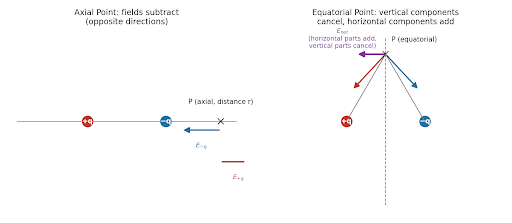
Fig 1: Axial fields subtract (opposite directions); equatorial components cancel vertically and add horizontally
Capacitance of a Parallel Plate Capacitor
Why It Matters: This is one of the easiest scoring derivations in the syllabus because the mathematical flow is completely linear.
The Steps: Start with the uniform electric field between two plates, which is E = σ/ε0. Link this to the potential difference using V = Ed. Finally, substitute this potential into the definition of capacitance (C = Q/V) to get C = ε0A/d.
Effect of a Dielectric Slab
Common Board Mistake: Students often forget to specify whether the battery remains connected or disconnected during the derivation. Always read the problem statement carefully.
The Steps: Introducing a dielectric slab reduces the internal electric field by a factor of K due to polarization (E = E0/K). Because the field drops, the potential difference decreases to V = V0/K. When you plug this back into the capacitance formula, the final value increases by a factor of K, giving C = KC0.

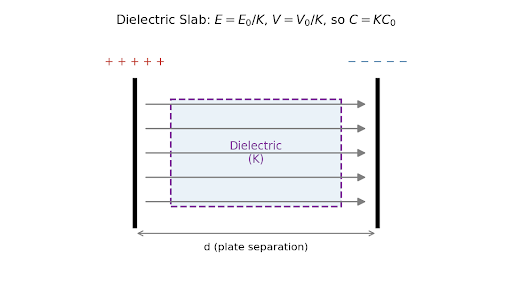
Fig 2: Inserting a dielectric slab drops E and V by a factor of K, so capacitance rises to C = KC0
2. Current Electricity (Chapter 3)
Derivations here move away from complex geometry and focus squarely on circuit laws.
Best Courses for You

JEE

NEET

Foundation JEE

Foundation NEET

CBSE
Wheatstone Bridge Balance Condition
Exam Tip: Do not just jump into the equations. State clearly that the bridge is balanced only when the current through the galvanometer drops to zero (Ig = 0).
The Steps: Apply Kirchhoff's Voltage Law (KVL) around both closed loops of the network. By matching the potential drops across adjacent resistors under zero-galvanometer current, you show that the ratio of the resistances matches: P/Q = R/S.
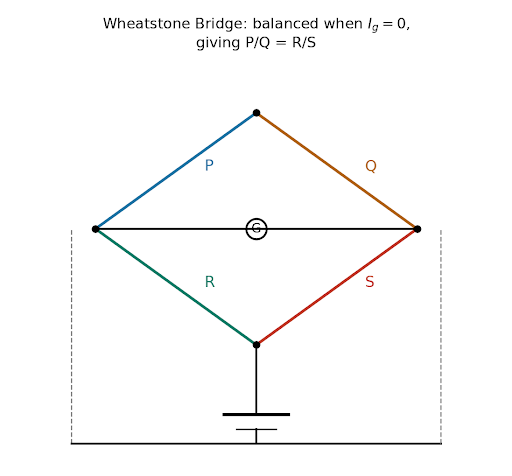
Fig 3: The Wheatstone bridge network, balanced when the galvanometer reads zero current
Metre Bridge Working Principle
Revision Priority: This derivation is a practical application of the Wheatstone bridge.
The Steps: Because the resistance of a uniform wire is directly proportional to its length (R ∝ l), the balancing condition at a null point l allows you to find the unknown resistance X using the remaining wire length (100 − l): X = R(100 − l)/l.
3. Magnetic Effects of Current (Chapter 4)
This chapter tests your ability to handle three-dimensional vector orientations. Your diagrams must match your mathematical signs perfectly.
Biot-Savart Law: Field on the Axis of a Circular Loop
Why It Matters: This is a favorite 5-mark question for board paper setters.
The Steps: Select a tiny current element dl on the loop. Use the Biot-Savart equation to project its small magnetic field dB. Notice that the components perpendicular to the central axis cancel out completely as you move around the ring. To find the net field, integrate only the axial components (dB cosθ) around the full circle.
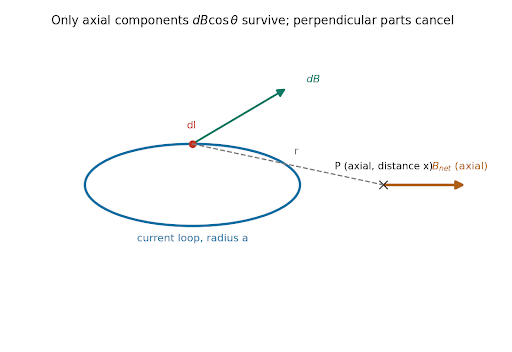
Fig 4: Only the axial components of dB survive after integrating around the full loop
Ampere's Circuital Law and the Solenoid
Exam Tip: Always sketch your imaginary Amperian loop clearly. For a solenoid, use a rectangular loop that goes inside and outside the coil structure.
The Steps: Apply the integral formula ∮B·dl = μ0 I_enclosed. Show that the magnetic field outside an ideal solenoid is zero. This means the only segment contributing to the integration is the one running parallel to the field inside, which gives B = μ0 n I.
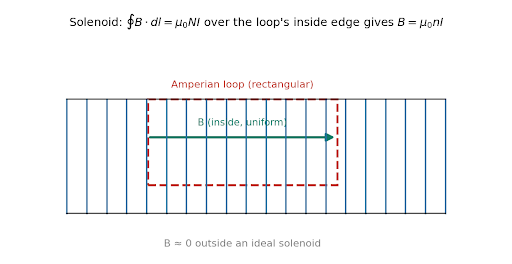
Fig 5: The rectangular Amperian loop used to derive the solenoid's interior field
4. Electromagnetic Induction and AC (Chapters 6 & 7)
These chapters rely heavily on rates of change and time-dependent calculus.
Self-Inductance of a Long Solenoid
The Steps: Start by writing down the interior magnetic field of a solenoid, B = μ0 n I. Use this to find the total magnetic flux linking all turns of the wire (Φ = Nφ_B). Since flux is also directly related to inductance by Φ = LI, equate the expressions to get your final formula: L = μ0 n² A l.
Alternating Current (AC) Generator
The Steps: Imagine a coil of area A spinning with a constant angular velocity ω inside a uniform magnetic field B. The changing flux through the turning loop is written as Φ = BA cos(ωt). Differentiate this expression with respect to time using Faraday's Law (e = −dΦ/dt) to reveal the classic sinusoidal induced EMF: e = BAω sin(ωt).
5. Optics (Chapters 9 & 10)
Optics contains the most visually demanding derivations in your Class 12 preparation. One missing arrow on a light ray or a flipped sign convention can break the entire mathematical sequence.
Lens Maker's Formula
Common Board Mistake: Skipping the intermediate step where you treat the image from the first refracting surface as a virtual object for the second surface. Evaluators look specifically for this statement.
The Steps: Start by applying the single spherical refraction formula to the first surface of a thick lens. Then, write the refraction equation for the second surface. Adding these two geometric equations together cancels out the intermediate image distance, which gives the final Lens Maker's relation: 1/f = (n−1)(1/R1 − 1/R2).
Refraction Through a Prism
Revision Priority: This derivation shows up regularly in both theory papers and practical viva questions.
The Steps: Track a light ray passing through a triangular prism and use geometry to relate the angle of deviation to the interior angles (i + e = A + D). Next, apply the condition for minimum deviation (D = Dm), where the light path becomes perfectly symmetric (i = e and r1 = r2 = A/2). Substitute these values into Snell's Law to find the refractive index.
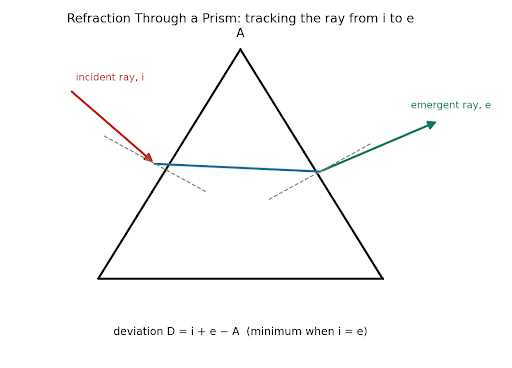
Fig 6: Tracking the ray through a prism from incidence to emergence, the geometry behind the deviation formula
Young's Double Slit Experiment (YDSE)
The Steps: Calculate the path difference (Δx = xd/D) between two overlapping light waves traveling from coherent slits to a screen. Set this path difference equal to whole numbers of the wavelength (nλ) to find the locations of bright fringes. Subtracting adjacent positions shows that the fringe width (β) remains uniform across the screen.
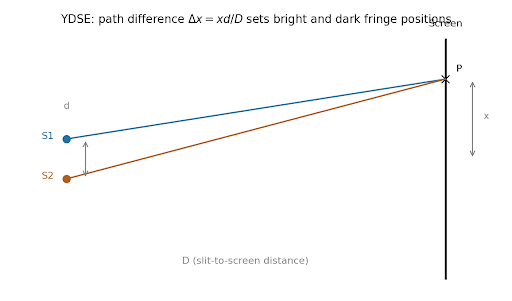
Fig 7: YDSE geometry, the path difference xd/D determines where bright and dark fringes fall on the screen
6. Modern Physics (Chapters 11–13)
Modern physics derivations are purely algebraic. They do not require complex geometric diagrams, but you must define your quantum variables clearly.
Bohr Model: Energy of the nth Orbit
The Steps: Start by balancing the inward electrostatic Coulomb force with the outward centripetal force for a revolving electron. Combine this with Bohr's quantization condition for angular momentum (mvr = nh/2π) to solve for the radius of the orbit. Finally, substitute this radius into the total mechanical energy equation (E = K + U) to find the quantized energy states.
Radioactive Decay Law
The Steps: Start with the foundational core principle: the rate at which a radioactive sample disintegrates is directly proportional to the total number of active nuclei present at that exact moment (−dN/dt = λN). Separate your variables (dN/N = −λdt) and integrate both sides from your initial state t = 0 (N = N0) to time t to find the exponential decay curve: N = N0e^(−λt).
7. Derivation Frequency Matrix
Use this breakdown to prioritize your revision sessions. Focus heavily on the three-star derivations before moving down the list.
| ⭐⭐⭐ Must Revise | ⭐⭐ Good to Revise | ⭐ Optional Revision |
| Lens Maker's Formula | Axial Line Electric Field | Toroid Magnetic Field |
| Equatorial Line Electric Field | Self-Inductance of a Solenoid | Transformer Turn Ratio |
| Prism Refractive Index Formula | Wheatstone Bridge Balance | de Broglie Wavelength Relation |
| Fringe Width in YDSE | Bohr Orbit Energy Expression | Magnetic Force on a Wire |
| Parallel Plate Capacitor (with Dielectric) | Potentiometer Applications | Metre Bridge Verification |
How Infinity Learn Helps with Board Exam Derivations
Successfully reproducing these derivations under exam conditions requires moving past temporary memorization to understanding the structural logic behind each step. Infinity Learn supports your board prep through targeted academic resources:
- NCERT-Aligned Derivation Videos: Step-by-step visual lessons that follow the exact notations and step layouts approved by CBSE evaluators.
- Step-by-Step Marking Scheme Worksheets: Practice resources that explicitly show you where step-marks are awarded for statements, diagrams, mathematical transitions, and final units.
- Targeted Board Mock Papers: Full-length testing modules designed to evaluate your speed and accuracy in presenting multi-step long answers under timed conditions.
Presentation Tips to Secure Full Marks
Even if derivations seem difficult, remember that they are among the most predictable questions in the CBSE Physics paper. Once you understand the sequence of steps, reproducing them becomes straightforward. Use these presentation strategies to ensure the evaluator gives you full marks:
- The "Let Us Consider" Opening: Never start a derivation directly with an equation. Write a brief, two-line introductory sentence defining your parameters (e.g., "Let us consider a parallel plate capacitor with plate area A and separation distance d...").
- Use a Ruler for Diagrams: Hand-drawn, wavy lines look unprofessional and can obscure your geometric angles. Always use a sharp pencil and a ruler to construct your ray paths, wave fronts, and circuit schematics.
- Box Your Final Answer: When you arrive at your final equation, draw a clean box around it and state the standard SI unit right next to it. This structural cue guides the teacher's eye directly to the correct result, making it easy to award full marks quickly.
course
No courses found
FAQs on Chapter-Wise Physics Derivations for CBSE Class 12 Board Exams
Which CBSE Class 12 Physics derivations are most important?
The highest-yield derivations include the Lens Maker's Formula, Refraction through a Prism, the Fringe Width expression in YDSE, the Electric Field on the Equatorial Line of a Dipole, and the Capacitance of a Parallel Plate Capacitor containing a dielectric slab.
How do I write derivations in board exams for full marks?
To get full marks, your answer must include a brief initial statement defining your variables, a neat and fully labelled pencil diagram, logical step-by-step algebraic transitions, and the final formula clearly highlighted inside a box with its proper SI units.
Are derivations from all chapters asked in CBSE boards?
Are derivations from all chapters asked in CBSE boards?