- 1. Treating Electric Field Vectors Like Ordinary Numbers
- 2. Misapplying Superposition with Continuous Charge Distributions
- 3. Confusing Electric Potential with Electric Field
- 4. Incorrect Gaussian Surface Selection
- 5. Sign Errors in Potential Calculations
- 6. Forgetting Induced Charges on Conductors
- 7. Wrong Capacitor Combination Formulas
- 8. Missing the Energy Perspective in Capacitor Problems
- 9. Errors in Dipole-Related Calculations
- 10. Misapplying Coulomb's Law in a Medium
- FAQs on JEE Electrostatics Numerical Doubts
JEE Electrostatics Numerical Doubts: 10 Common Mistakes & Fixes
By Ankit Gupta
|
Updated on 16 Jul 2026, 12:25 IST
Electrostatics is a cornerstone of JEE Physics, carrying a massive weightage in both JEE Main and JEE Advanced. Because it introduces abstract concepts like field lines, non-uniform charge distributions, and vector calculus, it is also one of the chapters where students make the most mistakes.
Many students memorize every formula perfectly but still stumble when solving actual numerical problems. The issue usually isn't a lack of preparation, it is the small conceptual mistakes that lead down the wrong path. By analyzing common student errors, this guide breaks down the 10 most frequent mistakes made in JEE Electrostatics numericals and shows you exactly how to fix them.
1. Treating Electric Field Vectors Like Ordinary Numbers
❌ Common Error: When finding the net electric field at a single point due to multiple charges, it is easy to accidentally drop the vector notation. Students often calculate the individual magnitudes using Coulomb's Law and add them up algebraically, completely ignoring directions.
✅ Smarter Method: The electric field (E) is a strict vector quantity. You must resolve each field into components along the x, y, and z axes using unit vectors (î, ĵ, k̂) before doing any addition.
Exam Pitfall Breakdown
Imagine two point charges q1 = +2 μC and q2 = −2 μC placed at coordinates (0, 3) m and (0, −3) m. What is the net electric field at the origin (0,0)?
- The Trap: Looking at the equal magnitudes and equal distances, a student might assume they perfectly cancel out, concluding that E = 0.
- The Reality: Sketch the actual directions. The positive charge q1 pushes a test charge away from itself (downward, along −ĵ). The negative charge q2 pulls the test charge toward itself (also downward, along −ĵ). Because both vectors point in the exact same direction, their magnitudes add up.
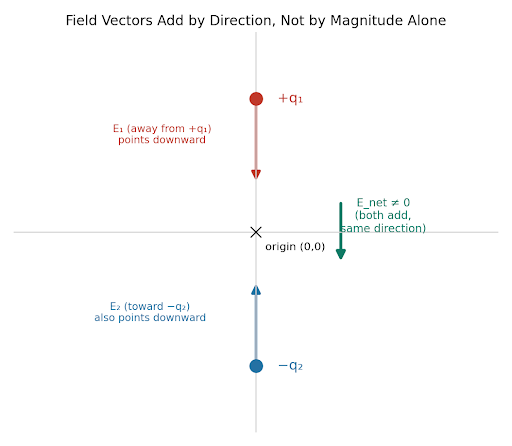
Fig 1: Both field contributions point the same way at the origin, so they add instead of cancelling
2. Misapplying Superposition with Continuous Charge Distributions
❌ Student Thinking: "If a continuous body like a uniformly charged rod of length L has a total charge Q, I can simplify the calculus by pretending it's a single point charge located entirely at its geometric center (L/2)."

✅ Physics Reality: Treating the entire distribution as if its total charge were concentrated at the center does not work for electric field calculations. For continuous objects, you must select an infinitesimal element dq, write down its local field contribution dE, and integrate across the physical boundaries of the object.
Complete Mathematical Verification
Let's calculate the exact electric field at a distance d from the end of a uniformly charged rod of length L and total charge Q. If you incorrectly treat it as a point charge at its midpoint, you get an incorrect value.
Best Courses for You

JEE

NEET

Foundation JEE

Foundation NEET

CBSE
To solve it correctly, define a small element dx at a variable distance x from the target point. The linear charge density is λ = Q/L, making the charge of this tiny element dq = (Q/L)dx. Write the field element and integrate from the closest edge (x = d) to the farthest edge (x = d + L).
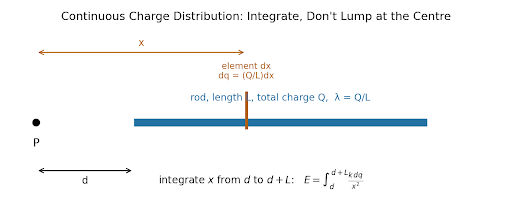
Fig 2: Set up the element dx at distance x, then integrate across the rod's full length
3. Confusing Electric Potential with Electric Field
❌ Common Error: It is incredibly common to confuse a scalar state with a vector gradient. Students frequently assume that if the net electric potential (V) at a specific point is zero, the electric field (E) at that exact spot must also be zero.
Quick Check
- Electric Potential (V): A scalar quantity representing work done. Equal positive and negative values cancel out algebraically.
- Electric Field (E): A vector quantity representing the spatial gradient of that potential (E = −dV/dr). Even if V = 0, the slope of the potential curve can be steep, meaning a strong electric field exists.
Think about the exact midpoint of an electric dipole (charges +q and −q separated by a distance 2a). The potential cancels out completely. However, the electric field vectors from both charges point in the exact same direction along the axis, reinforcing one another. The field is far from zero.
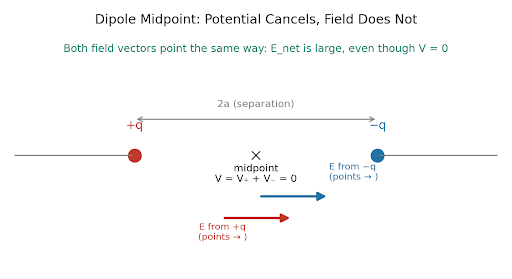
Fig 3: At a dipole's midpoint, potential cancels to zero but the field vectors reinforce each other
4. Incorrect Gaussian Surface Selection
❌ Student Thinking: "Gauss's Law isn't working for this asymmetric charge layout because Gauss's Law must be invalid here."
✅ Reality Check: Gauss's Law is always true for any closed surface, but it is not always useful. Students often choose arbitrary shapes that enclose a charge but lack geometric symmetry. If the electric field magnitude (E) varies across your surface, or if the angle between the field lines and the surface area vector (dA) keeps changing, you cannot pull E out of the integration sign (∮E·dA).
When solving JEE problems, match the imaginary surface to the charge symmetry:
- Spherical Layouts: Use a concentric spherical Gaussian surface.
- Line Charges / Cylinders: Use a coaxial cylindrical Gaussian surface.
- Infinite Sheets: Use a symmetric pillbox cylinder intersecting the sheet.
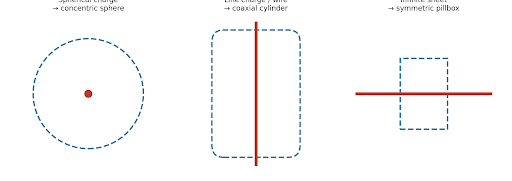
Fig 4: Matching the Gaussian surface shape to the symmetry of the charge distribution
5. Sign Errors in Potential Calculations
❌ Common Error: When calculating electric potential or potential energy, students often take the absolute values of the charges, planning to "figure out the sign later" just like they do with vector forces.
✅ Smarter Method: Potential energy is a scalar, not a vector. You must include the positive or negative signs of the charges directly into your formulas. A negative charge inherently creates a negative potential well.
Numerical Proof
Find the work done by an external agent to bring a −3 μC charge from infinity to a point where the existing electric potential is +500 V.
- The Trap: Dropping the negative sign of the charge, which gives an incorrect work value of +1.5 mJ.
- The Fix: Apply the work-energy theorem while preserving all signs: W = qV = (−3×10⁻⁶)(500) = −1.5 mJ.
The negative result tells us that the field naturally attracts the charge; the external agent must actually exert a backward, braking force to keep the charge from accelerating.
6. Forgetting Induced Charges on Conductors
❌ Common Error: Assuming that a conductor's net charge distribution stays completely uniform and static even when another point charge is brought right next to it.
✅ What JEE Expects: Conductors are full of free electrons that shift instantaneously when an external field appears. This movement creates induced charges on the surfaces.
Keep these two foundational properties of conductors in mind for JEE numericals:
- Electrostatic Equilibrium: The net electric field inside the bulk material of a conductor is always zero (E_in = 0).
- Grounded Conductors: When a conductor is earthed, its net charge is no longer fixed. Instead, its boundary condition locks to an absolute potential of zero (V = 0). Electrons will travel into or out of the ground to maintain this zero-potential state. Always set V_conductor = 0 to calculate the final charge left on an earthed system.
7. Wrong Capacitor Combination Formulas
❌ Common Error: Under tight exam time limits, working quickly can cause a mental slip where you apply standard resistor combination patterns to capacitors.
✅ Step-by-Step Correct Method: Capacitor rules are the exact mathematical inverse of resistor rules. Remember this quick memory trick: "Capacitors behave opposite to resistors."
- Capacitors in Parallel: The voltage across them is identical, but they store charge independently. They add up directly: C_total = C1 + C2 + C3.
- Capacitors in Series: The charge Q on every single plate is identical, while the total voltage drops split across them: 1/C_total = 1/C1 + 1/C2 + 1/C3.
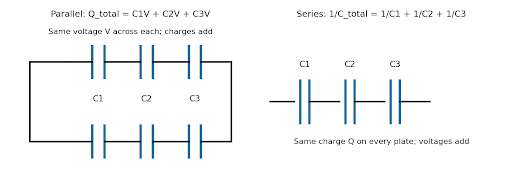
Fig 5: Parallel combination shares voltage; series combination shares charge
8. Missing the Energy Perspective in Capacitor Problems
❌ Common Error: Students often focus only on charge redistribution after reconnecting capacitors and completely forget to analyze what happens to the stored electrostatic energy. They frequently assume that if charge is conserved, the total stored energy (U = ½CV² = Q²/2C) must also automatically remain conserved.
✅ Smarter Method: While the total charge is completely conserved (ΣQi = ΣQf), total electrostatic energy is lost as heat within the connecting wires and as sparking during the redistribution of charge. You must calculate initial and final energy states independently to find the difference.
Fully Solved Numerical
A 2 μF capacitor (C1) is charged to 100 V and then connected in parallel with an uncharged 3 μF capacitor (C2). Let's find the exact energy lost.
- Step 1: Initial stored energy: U_i = ½ × C1 × V² = ½ × 2μF × (100)² = 10,000 μJ = 10 mJ.
- Step 2: Common potential using charge conservation: V_c = (C1V + 0) / (C1 + C2) = (2×100)/(5) = 40 V.
- Step 3: Final stored energy: U_f = ½ × (C1+C2) × V_c² = ½ × 5μF × (40)² = 4,000 μJ = 4 mJ.
- Step 4: Energy lost: U_i − U_f = 10 mJ − 4 mJ = 6 mJ, dissipated as heat and sparking during redistribution.
9. Errors in Dipole-Related Calculations
❌ Common Error: Using the simplified short-dipole formulas (E ∝ 1/r³) for every dipole question on the page, without checking the actual dimensions given in the problem.
✅ Smarter Method: The short-dipole formulas are approximations that only hold true if the observation distance r is vastly larger than the dipole's half-length a (r ≫ a).
| Target Location | Exact Structural Formula | Short Dipole Approximation (r ≫ a) |
| Axial Point Field (E_axial) | 2kpr / (r² − a²)² | 2kp / r³ |
| Equatorial Point Field (E_eq) | kp / (r² + a²)^(3/2) | kp / r³ |
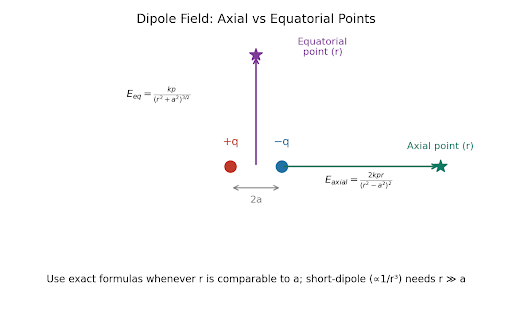
Fig 6: Axial and equatorial observation points, where exact formulas matter when r is close to a
⚠ JEE Advanced Alert: If a problem states that an electric dipole features charges separated by 2 cm (2a = 2 cm → a = 1 cm) and asks for the field at an axial point just 3 cm away (r = 3 cm), you cannot use the short-dipole approximation. The values are too close. You must apply the exact formula.
10. Misapplying Coulomb's Law in a Medium
❌ Common Error: When problems submerge charges into a fluid or a dielectric medium, students often calculate the force using the default vacuum permittivity (ε₀), or accidentally multiply the force by the dielectric constant instead of dividing.
Quick Check
When a dielectric medium with a relative permittivity εr (also known as the dielectric constant, K) fills up the space, the net electrostatic force between the charges scales down by a factor of K: F_medium = F_vacuum / K.
Solved Problem
Two point charges in a vacuum experience an attractive force F. If they are placed into a liquid with a dielectric constant of K = 4 at exactly half their initial separation distance, what is the new force?
Write down the expression with the updated parameters (r' = r/2 and K = 4): F' = kq1q2 / [K(r')²] = kq1q2 / [4×(r/2)²] = kq1q2 / [4×r²/4] = kq1q2/r² = F.
The decrease in force caused by the dielectric fluid is perfectly offset by the increase in force from bringing the charges closer together. The final force stays exactly equal to F.
How Infinity Learn Helps Fix Electrostatics Mistakes
If you repeatedly lose marks because of sign conventions, vector components, or limits of integration, targeted error analysis is the most effective way to break those habits before exam day. True mastery of JEE electrostatics numerical doubts goes beyond reading textbook solutions, it requires actively identifying exactly where your own problem setups deviate from foundational principles.
Infinity Learn helps you build this analytical clarity through:
- Error-Analysis-Based Practice Modules: Question sets designed explicitly around the common conceptual blind spots targeted by JEE paper setters, training you to spot tricks early.
- Step-by-Step Video Walkthroughs: Clear, visual breakdowns that focus heavily on correct mathematical setups, component resolution, and boundary integration.
- Personalized Doubt Support: Direct access to expert physics mentors who can help you resolve tricky topics like conductor grounding, non-uniform distributions, and variable dielectric slabs.
Conclusion
The secret to scoring high in JEE Electrostatics is not just memorizing formulas; it is developing a systematic approach to problems. Before writing down an equation, always ask yourself: Is this a vector addition? Is there a dielectric medium? Is the short-dipole approximation valid here?
One of the most effective habits for JEE preparation is maintaining a dedicated error log. Every time you make a conceptual mistake during your practice, note down the question, identify exactly why the mistake happened, and write down the correction in your own words. Reviewing this log before your next mock test is the fastest way to turn common calculation doubts into reliable exam-day accuracy.
course
No courses found
FAQs on JEE Electrostatics Numerical Doubts
What are the most common mistakes in JEE electrostatics?
The most frequent errors include adding electric field vectors algebraically without considering their coordinate directions, applying short-dipole approximations when distances are comparable to dipole lengths, and dropping charge signs in scalar potential equations.
How do I improve accuracy in electrostatics numericals?
Always start by sketching a clear coordinate axis diagram for vector problems. Write out your charge signs explicitly, and never use short-cut approximations unless the problem clearly states that the observation distance is much larger than the charge dimensions.
Which electrostatics formulas are most important for JEE?
Key areas to prioritize include Gauss's Law integration setups, the potential-field gradient relationship (E = −dV/dr), the energy configurations of charge systems, and capacitance variations when inserting dynamic dielectric slabs.
How do I solve Gauss's Law problems without errors?
Ensure your chosen imaginary Gaussian surface matches the core symmetry of the charge layout perfectly. Check that the electric field magnitude is uniform across that surface and that the angle between the field vector and the area vector stays at 0° or 90°.
Where can I get step-by-step electrostatics solutions?
You can access the structured prep tools on the Infinity Learn platform, which provides targeted practice questions, video solutions for past years' JEE questions, and live support from physics mentors.