

















Courses

By Karan Singh Bisht
|
Updated on 10 Jul 2026, 16:27 IST
Chemical Bonding is one of the few chemistry chapters that keeps appearing throughout JEE and NEET. Once you understand how atoms combine, many topics in inorganic, organic, and even physical chemistry become much easier to follow. That is why this chapter consistently carries a high weight in both exams, typically translating to three or four direct questions every year.
A common roadblock for students is trying to memorize every molecule instead of focusing on spatial geometry. If you cannot picture how a molecule arranges itself in three dimensions, or why a lone pair alters a bond angle, inorganic chemistry quickly becomes a frustrating exercise in rote learning. This guide skips the generic definitions and breaks down the core structural rules, shortcut formulas, and fully verified exam-style questions you need to know.
Atoms bond to achieve a stable, lower-energy state, usually by matching the stable configuration of the nearest noble gas. They achieve this octet configuration by transferring or sharing valence electrons.
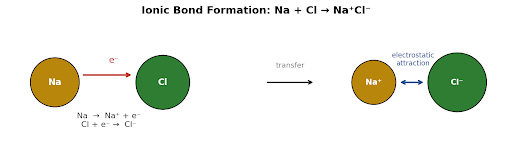
An ionic bond forms when an electropositive atom (typically a metal) transfers one or more valence electrons to an electronegative atom (typically a non-metal). The electrostatic attraction between the resulting oppositely charged ions holds the compound together.
Na → Na⁺ + e⁻ Cl + e⁻ → Cl⁻
Sodium ([Ne] 3s¹) loses its outer electron to form Na⁺, while chlorine ([Ne] 3s² 3p⁵) gains that electron to become Cl⁻. High lattice energy, low ionisation enthalpy of the metal, and high electron gain enthalpy of the non-metal all favour ionic bond formation.
When atoms have similar electronegativities, they share electrons rather than transferring them. Valence Bond Theory explains that this sharing occurs when atomic orbitals overlap.

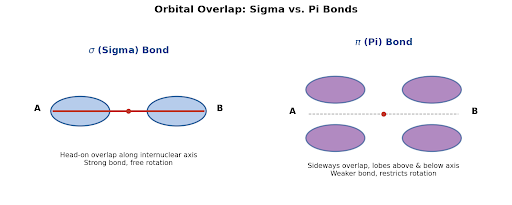
Sigma (σ) bond: forms when atomic orbitals overlap head-on (end-to-end) along the internuclear axis. Electron density concentrates directly between the two nuclei, creating a strong bond that allows free rotation about the axis.

JEE

NEET

Foundation JEE

Foundation NEET

CBSE
Pi (π) bond: forms when atomic orbitals overlap sideways, perpendicular to the internuclear axis. The electron cloud sits above and below the nodal plane. Sideways overlap is less effective than head-on overlap, making a π bond weaker than a σ bond and preventing free rotation.
A coordinate bond is a covalent bond where one atom (the donor) provides both electrons to an electron-deficient atom (the acceptor). Once formed, it behaves exactly like a standard covalent bond. For example, in the ammonium ion:
NH₃ + H⁺ → NH₄⁺
the nitrogen atom in ammonia donates its lone pair into the empty 1s orbital of H⁺.
| Property | Ionic Compounds | Covalent Compounds |
| Physical state | Hard, crystalline solids (strong lattice attraction) | Gases, liquids, or soft solids |
| Melting / boiling points | High | Relatively low |
| Electrical conductivity | Conducts only when molten or in aqueous solution | Generally poor conductors |
| Solubility | Dissolves well in polar solvents (H₂O); poor in non-polar | Dissolves well in non-polar solvents (benzene, CCl₄) |
Valence Bond Theory explains how orbitals mix, but it does not predict the actual shapes of molecules. VSEPR theory fills that gap: electron pairs around a central atom repel each other and arrange themselves as far apart as possible for maximum stability.
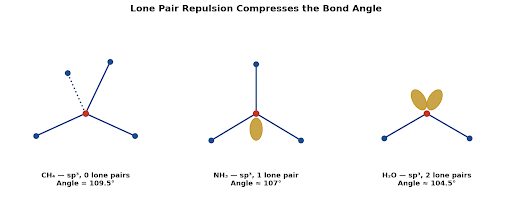
Lone pairs stay closer to the central atom and occupy more angular space than bonding pairs, which are pulled outward by the second nucleus. This creates an uneven repelling force:
lp–lp > lp–bp > bp–bp
The shape of a molecule is determined by its steric number — the total count of σ bonds plus lone pairs on the central atom.
| Steric No. | Base Geometry | Ideal Angle | With Lone Pairs | Example |
| 2 | Linear | 180° | — | BeCl₂, CO₂ |
| 3 | Trigonal planar | 120° | 1 lp → Bent / V-shaped (<120°) | BF₃ / SO₂ |
| 4 | Tetrahedral | 109.5° | 1 lp → Trigonal pyramidal (~107°); 2 lp → Bent (~104.5°) | CH₄ / NH₃ / H₂O |
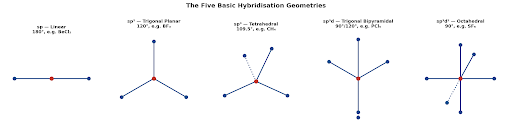
Hybridisation explains observations that simple atomic-orbital pictures cannot — for instance, methane forms four identical bonds even though carbon's ground-state configuration (2s² 2p²) suggests otherwise. Hybridisation is the blending of an atom's valence orbitals of slightly different energies into a new set of identical, equal-energy orbitals.
| Hybridisation | Orbitals Mixed | Geometry / Angle | s Character | Example |
| sp | 1 s + 1 p | Linear, 180° | 50% | BeCl₂ |
| sp² | 1 s + 2 p | Trigonal planar, 120° | 33.3% | BF₃ |
| sp³ | 1 s + 3 p | Tetrahedral, 109°28′ | 25% | CH₄ |
| sp³d | 1 s + 3 p + 1 d | Trigonal bipyramidal | 20% | PCl₅ |
| sp³d² | 1 s + 3 p + 2 d | Octahedral, 90° | 16.7% | SF₆ |
In sp³d systems such as PCl₅, the two axial bonds experience greater repulsion from the three equatorial bonds than the equatorial bonds experience from each other, making the axial P–Cl bonds slightly longer and weaker.
Rather than drawing out valence electrons under exam pressure, calculate the steric number (H) directly:
H = ½ [V + M − C + A]
where V = valence electrons on the central atom, M = number of monovalent atoms (H, F, Cl, Br, I) attached to it, C = positive charge on the species (if a cation), and A = negative charge on the species (if an anion).
| H value | Hybridisation |
| 2 | sp |
| 3 | sp² |
| 4 | sp³ |
| 5 | sp³d |
| 6 | sp³d² |
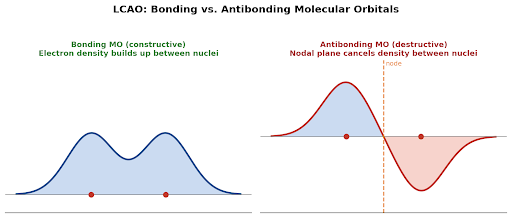
Valence Bond Theory treats electrons as if they stay fixed between two specific nuclei. Molecular Orbital Theory takes a different view, treating the entire molecule as one system: atomic orbitals merge completely into molecular orbitals that span the whole molecule.
The linear combination of atomic orbitals (LCAO) produces two types of molecular orbitals:
Bond Order = (N_b − N_a) / 2
where N_b and N_a are the numbers of electrons in bonding and antibonding molecular orbitals respectively.
Molecules with up to 14 electrons (B₂, C₂, N₂) — with s–p mixing:
σ1s < σ*1s < σ2s < σ*2s < (π2pₓ = π2p_y) < σ2p_z < (π*2pₓ = π*2p_y) < σ*2p_z
Molecules with more than 14 electrons (O₂, F₂) — without s–p mixing:
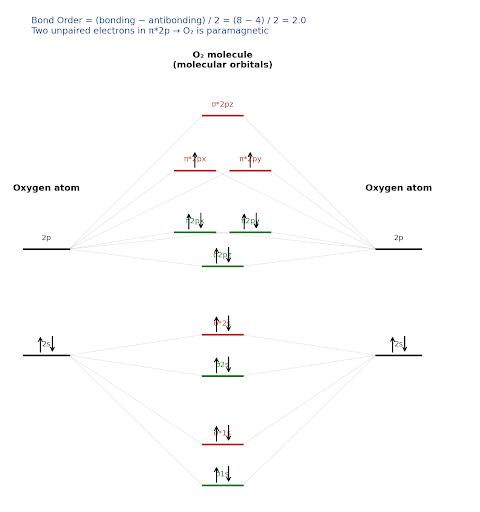
σ1s < σ*1s < σ2s < σ*2s < σ2p_z < (π2pₓ = π2p_y) < (π*2pₓ = π*2p_y) < σ*2p_z
Notice the σ2p_z and π2p orbitals swap positions between the two regimes — this switch is exactly what the s and p orbitals' mixing (or lack of it) causes, and it is a frequent point of confusion in JEE Advanced questions.
The fundamental chemistry is identical, but JEE and NEET test this chapter differently.
| Topic | JEE Main & Advanced Focus | NEET Focus |
| Primary theme | Conceptual analysis, MOT parameter shifts, multi-chapter questions | Direct application, NCERT textbook lines, structural matching |
| Molecular Orbital Theory | Fractional bond orders of heteronuclear ions, magnetic property shifts | Matching standard diatomics to bond order or magnetism |
| VSEPR & geometry | Advanced bond-angle variations from electronegativity shifts | Identifying geometry of common central atoms |
| Hybridisation | Mixed-backbone structures, coordination chemistry states | Applying the core formula to find basic hybrid states |
Question 1: Using Molecular Orbital Theory, determine the correct increasing order of bond lengths for O₂, O₂⁺, O₂⁻, and O₂²⁻.
Solution: Using the >14-electron filling order, and counting only the 12 valence electrons of neutral O₂ (the inner 1s electrons contribute equally to bonding and antibonding orbitals and cancel out of the bond-order calculation, so they can be safely ignored):
O₂ (12 valence e⁻): 8 bonding, 4 antibonding → Bond Order = (8 − 4)/2 = 2.0
O₂⁺ (11 valence e⁻): 8 bonding, 3 antibonding → Bond Order = (8 − 3)/2 = 2.5
O₂⁻ (13 valence e⁻): 8 bonding, 5 antibonding → Bond Order = (8 − 5)/2 = 1.5
O₂²⁻ (14 valence e⁻): 8 bonding, 6 antibonding → Bond Order = (8 − 6)/2 = 1.0
Since bond length is inversely proportional to bond order, the higher the bond order, the shorter the bond. Arranging from shortest to longest bond length:
O₂⁺ < O₂ < O₂⁻ < O₂²⁻
Question 2: Find the hybridisation state, number of lone pairs, and exact geometry of the central atom in xenon difluoride (XeF₂).
Solution: For the central Xe atom, V = 8 valence electrons, M = 2 monovalent F atoms, no net charge:
H = ½ [8 + 2 − 0 + 0] = 10/2 = 5 → sp³d hybridisation
A value of 5 gives a base trigonal bipyramidal electron geometry. The number of lone pairs is:
Lone pairs = H − attached atoms = 5 − 2 = 3
VSEPR places these three lone pairs in the equatorial positions (120° apart) to minimise repulsion, leaving the two fluorine atoms at the axial positions, directly opposite each other. The resulting molecular shape is Linear.
Question 3: Which of these molecules has a non-zero net dipole moment: BF₃, NF₃, CO₂, or CCl₄?
Solution: Dipole moment is a vector quantity, so symmetry matters as much as polarity of individual bonds.
Answer: NF₃.
Question 4: What is the correct shape of an SF₄ molecule according to VSEPR theory?
Solution: For sulfur, V = 6 and M = 4 (four monovalent F atoms):
H = ½ [6 + 4] = 10/2 = 5 → sp³d hybridisation
Lone pairs = 5 − 4 = 1. For a steric number of 5 with one lone pair, the lone pair occupies an equatorial position (to minimise the stronger lp–bp repulsion with fewer neighbours), and the remaining four fluorine atoms form the classic See-Saw shape.
Question 5: Which of these compounds contains both ionic and covalent bonds: H₂O, NaCl, NH₄Cl, or CH₄?
Solution: H₂O and CH₄ have only covalent bonds; NaCl is a purely ionic lattice. NH₄Cl is built from NH₄⁺ cations and Cl⁻ anions held together by an ionic bond, while inside the ammonium ion itself, the four N–H bonds (one of them coordinate) are covalent. This makes NH₄Cl the correct choice, since it contains both bond types simultaneously.
Question 6: The bond order of an N₂ molecule is 3. What is the total number of sigma and pi bonds inside it?
Solution: A bond order of 3 corresponds to a stable triple bond, N≡N. In any multiple-bond system, the first bond formed (by head-on overlap) is always a single σ bond; every additional bond formed by sideways overlap is a π bond. A triple bond therefore consists of 1 σ bond and 2 π bonds.
Infinity Learn combines video lessons, practice questions, and doubt support in one place, so you can revise a concept, solve problems immediately, and track progress without switching between resources:
Chemical Bonding looks difficult at first because it introduces several new ideas at once. The good news is that the same concepts keep repeating throughout chemistry — understand hybridisation, molecular geometry, and bond order properly, and many later chapters become far easier to follow. Spend your time practising these ideas rather than trying to memorise individual molecules; the steric-number and bond-order formulas in this guide will take you through the overwhelming majority of JEE and NEET questions on this chapter.
No courses found
Calculate the central atom's steric number using H = ½[V + M − C + A]. The resulting value directly reveals the hybrid state (2 = sp, 3 = sp², 4 = sp³, 5 = sp³d, 6 = sp³d²), saving you from manually sketching valence-shell diagrams under exam conditions.
Yes — Molecular Orbital Theory appears regularly in NEET. Questions usually ask you to find the bond order of simple diatomic species (like O₂ or N₂) and their ions, or to identify whether a molecule is paramagnetic or diamagnetic based on its unpaired electrons.
First, find the steric number of the central atom to establish its base electron geometry. Next, subtract the number of attached atoms from the steric number to find the lone-pair count. Finally, place those lone pairs to minimise repulsion and see how the remaining bonds compress into the final molecular shape.
JEE frequently tests structural exceptions: comparing bond angles affected by back-bonding, calculating fractional bond orders involving s–p mixing in MOT, and determining dipole-moment vector cancellations in asymmetrical molecules.
The core topics are identical, but the presentation varies. NEET questions are direct, stay close to the NCERT textbook, and can usually be solved quickly with the core formulas. JEE questions more often merge multiple concepts, requiring you to reason through structural exceptions and advanced orbital interactions rather than apply a formula directly.