High-Weightage JEE Main Organic Chemistry PYQs with Solutions
By Ankit Gupta
|
Updated on 16 Jul 2026, 15:40 IST
Picture this: you are sitting in the JEE Main exam center. You flip to the Chemistry section and spot an Organic Chemistry question that looks like a straightforward, two-step conversion. You confidently scribble down the product, pick option B, and move on.
What you didn't realize is that step one created a hidden secondary carbocation that quietly underwent a 1,2-hydride shift, completely changing the final structure. Option B was the trap. The actual answer was D.
This is exactly how the National Testing Agency (NTA) operates. They rarely test raw textbook definitions. Instead, they blend structural traps, stereochemical twists, and unexpected reagent combinations into a single problem to see if you truly understand electron movement.
Organic Chemistry generally contributes around one-third of the Chemistry section, making it one of the biggest opportunities to gain, or lose, marks.
Textbook theories can only tell you what an isolated reagent does in a pristine laboratory setting. Previous year questions (PYQs) reveal how those reagents are combined under exam conditions. This guide focuses on the highest-yield mechanisms and organizes high-weightage Organic Chemistry PYQs from the last five years into reaction families, giving you the exact patterns needed to spot the traps before you fall into them.
Substitution Reaction PYQs
Nucleophilic substitution mechanisms (SN1 and SN2) are highly favored in JEE Main. Questions consistently focus on structural variations that alter carbocation stability or steric hindrance around the leaving group.
Solved PYQ 1: Carbocation Rearrangements
Question: Identify the major product formed when 3-methylbutan-2-ol is treated with concentrated hydrobromic acid (\text{HBr}).
Step-by-Step Approach:

- Protonation: the hydroxyl group (–OH) on 3-methylbutan-2-ol accepts a proton from HBr, converting it into an excellent leaving group (–OH₂⁺).
- Leaving group departure: the water molecule departs. A secondary carbocation forms at C-2.
- Hydride shift: the adjacent C-3 carbon holds a tertiary hydrogen. To optimize thermodynamic stability, a 1,2-hydride shift occurs to generate a more stable tertiary carbocation.
- Nucleophilic attack: the bromide ion (Br⁻) attacks this tertiary carbocation center.
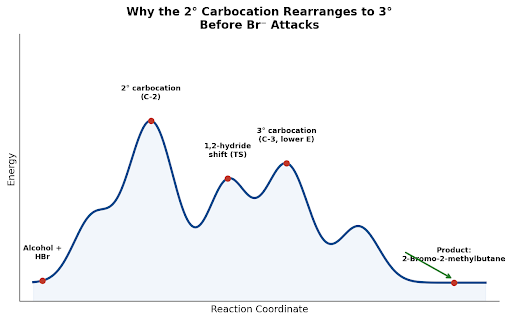
Figure 1: The reaction only makes sense once you track the energy drop from the 2° to the 3° carbocation.
Best Courses for You

JEE

NEET

Foundation JEE

Foundation NEET

CBSE
Mechanism Explanation: the reaction follows an SN1 pathway driven by carbocation stability. The initial secondary carbocation undergoes a rapid 1,2-hydride shift to attain the lower energy state of a tertiary carbocation before nucleophilic capture.
Major Product: 2-Bromo-2-methylbutane.
Solved PYQ 2: Steric Hindrance in Bimolecular Substitution
Question: Arrange the following compounds in decreasing order of their reactivity toward an S_N2 reaction: 1-Bromobutane, 2-Bromobutane, 2-Bromo-2-methylpropane.
Step-by-Step Approach:
- Analyze steric hindrance: the SN2 mechanism operates via a single-step concerted pathway where the incoming nucleophile attacks from the backside, exactly opposite to the leaving group.
- 1-Bromobutane is a primary (1°) alkyl halide with minimal crowding.
- 2-Bromobutane is a secondary (2°) alkyl halide with moderate crowding.
- 2-Bromo-2-methylpropane is a tertiary (3°) alkyl halide where the bulky methyl groups physically block the nucleophile's approach.
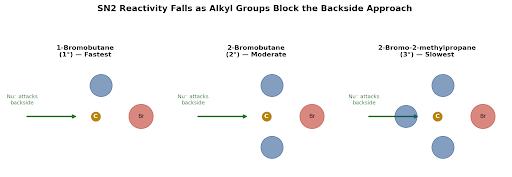
Figure 2: More alkyl groups around the electrophilic carbon means a more crowded backside, and a slower SN2 reaction.
Mechanism Explanation: because SN2 reactions proceed through a pentacoordinate transition state, the activation energy increases significantly with structural bulk. Primary halides offer the lowest steric barrier, facilitating rapid backside inversion.
Reactivity Order: 1-Bromobutane > 2-Bromobutane > 2-Bromo-2-methylpropane.
Addition Reaction PYQs
Addition reactions primarily focus on alkene and alkyne functional groups. Regioselective or stereochemical constraints are frequently combined in these problems.
Solved PYQ 1: Regioselectivity and Hydroboration
Question: Predict the major product when propene reacts with:
- HBr in the presence of peroxides.
- BH3/THF followed by alkaline H2O2
- Peroxide-induced addition: the reaction of propene (CH₃–CH=CH₂) with HBr in the presence of organic peroxides proceeds via a free-radical mechanism. The bromine radical attacks the terminal carbon to yield a more stable secondary carbon radical. The hydrogen radical then binds to the C-2 position, demonstrating anti-Markovnikov regioselectivity.
- Hydroboration-oxidation: the addition of borane (BH₃) involves a concerted, syn-addition where boron attaches to the less hindered terminal carbon while hydrogen attaches to the internal carbon. Subsequent oxidation replaces the boron atom with a hydroxyl group without any skeletal rearrangement.
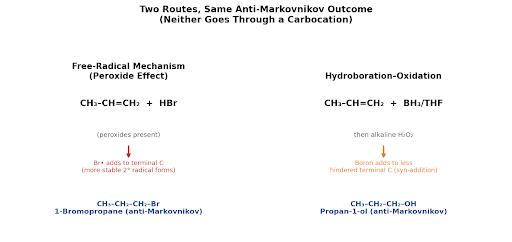
Figure 3: Different mechanisms, same anti-Markovnikov destination, since neither route passes through a carbocation.
Mechanism Explanation: both pathways bypass the traditional Markovnikov carbocation rule through alternate intermediate states. The free-radical pathway relies on radical stabilization, while the hydroboration path is dictated by steric preferences during the cyclic four-membered transition state.
Products: (1) 1-Bromopropane, (2) Propan-1-ol.
Solved PYQ 2: Conjugated Diene Additions
Question: What is the major product obtained when 1,3-butadiene reacts with one equivalent of \text{HBr} at high temperature (40°C)?
- Protonation: electrophilic attack of H⁺ on the terminal carbon of 1,3-butadiene yields a resonance-stabilized allylic carbocation.
- Temperature dependency: at low temperatures (−80°C), the reaction is kinetically controlled, favoring the 1,2-addition product. At higher temperatures (40°C), the reaction reaches thermodynamic equilibrium.
- Thermodynamic choice: the 1,4-addition product features an internal alkene (CH₃–CH=CH–CH₂Br) which possesses a higher degree of alkyl substitution than the terminal alkene formed via 1,2-addition. The more substituted alkene is thermodynamically more stable.
Mechanism Explanation: high-temperature environments drive the reaction toward thermodynamic control. The allylic carbocation allows the nucleophile (Br⁻) to attack at the terminal C-4 position, yielding a more stable, highly substituted internal alkene system.
Major Product: 1-Bromo-but-2-ene (1,4-addition product).
Elimination Reaction PYQs
Elimination pathways (E1 and E2) compete heavily with substitution pathways. Focus areas include base strength, solvent conditions, and the resulting alkene geometry.
Solved PYQ 1: Regiochemical Outcomes via Dehydrohalogenation
Question: Identify the major product when 2-bromobutane is heated with alcoholic potassium hydroxide KOH.
- Base identification: alcoholic KOH yields ethoxide ions (C₂H₅O⁻), which act as a strong, non-bulky base promoting a bimolecular elimination (E2) pathway.
- Abstraction options: the base can abstract a proton from either the C-1 primary position or the C-3 secondary position.
- Zaitsev's rule application: abstracting the proton from the C-3 position generates the more substituted internal alkene, which is stabilized by greater hyperconjugation. Abstracting from C-1 yields a less stable terminal alkene.

Mechanism Explanation: the transition state leading to the more substituted alkene possesses a lower activation energy barrier. As a result, the reaction predominantly follows Zaitsev's rule to yield the highly stable internal alkene.
Major Product: But-2-ene (specifically trans-but-2-ene due to minimized steric clashes between methyl groups).
Solved PYQ 2: Hofmann vs Zaitsev Pathways
Question: Contrast the major elimination products formed when 2-bromo-2-methylbutane reacts with sodium ethoxide versus potassium tert-butoxide.
- Analyze the leaving group: bromide is an excellent leaving group, meaning the reaction path is heavily dictated by the nature of the base.
- Sodium ethoxide is a small, unhindered base that can easily access the internal secondary protons at the C-3 position, yielding the highly substituted Zaitsev alkene.
- Potassium tert-butoxide is a bulky, sterically hindered base. It cannot easily approach the crowded internal C-3 position.
- Determine pathway: the bulky base selectively removes the easily accessible β-hydrogens on the terminal carbon, driving the reaction toward the less substituted Hofmann elimination product.
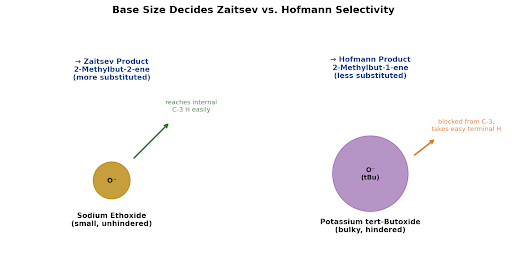
Figure 4: A bulky base can't reach the crowded internal proton, so it settles for the easier terminal one.
Mechanism Explanation: steric congestion within the base forces an alteration in regioselectivity. Bulky bases preferentially remove less crowded primary protons to avoid severe spatial repulsions, bypassing the thermodynamic stability of the internal alkene.
Products: with sodium ethoxide: 2-methylbut-2-ene. With potassium tert-butoxide: 2-methylbut-1-ene.
Named Reaction PYQs
Named organic reactions serve as the primary building blocks for multi-step synthesis pathways in JEE Main.
Important Named Reactions Matrix
| Named Reaction | Reactants & Key Reagents | Intermediate / TS | Distinct Feature |
|---|---|---|---|
| Aldol Condensation | Carbonyls with α-H + Dilute NaOH | Enolate ion intermediate | Forms α,β-unsaturated carbonyls |
| Cannizzaro Reaction | Carbonyls without α-H + Conc. NaOH | Hydride ion transfer | Simultaneous self-oxidation and reduction |
| Friedel-Crafts Alkylation | Benzene + Alkyl Halide + Anhydrous AlCl₃ | Carbocation electrophile | Electrophilic aromatic substitution with rearrangement risks |
| Sandmeyer Reaction | Benzene Diazonium Chloride + CuCl/HCl | Copper(I)-mediated substitution | Direct replacement of the diazonium group by halogens |
| Williamson Synthesis | Sodium Alkoxide + Primary Alkyl Halide | SN2 transition state | Clean synthesis of symmetrical and unsymmetrical ethers |
Solved PYQ: Cross-Aldol Condensation
Question: What is the major product obtained when a mixture of benzaldehyde and acetaldehyde is treated with dilute sodium hydroxide at elevated temperatures?
- Enolate generation check: benzaldehyde (C₆H₅CHO) lacks α-hydrogens and cannot form an enolate ion. Acetaldehyde (CH₃CHO) contains three α-hydrogens and reacts with dilute NaOH to yield a nucleophilic enolate ion: ⁻CH₂CHO.
- Nucleophilic addition: because benzaldehyde lacks α-hydrogens, it acts exclusively as the electrophile in this mixture. The enolate ion derived from acetaldehyde attacks the carbonyl carbon of benzaldehyde.
- Dehydration: heating the intermediate aldol compound triggers the loss of a water molecule, establishing a highly stable conjugated system.
Reagents and Conditions: dilute NaOH initiates enolate formation at room temperature. Subsequent heating drives the final dehydration phase.
Major Product: Cinnamaldehyde (C₆H₅–CH=CH–CHO).
Functional Group Conversion PYQs
Multi-step functional group conversions test your ability to chain individual reactions together in a logical sequence.
Solved PYQ: Deciphering the Synthetic Chain
Question: Identify compounds A, B, and C in the following synthetic sequence:
CH3CH2OH ──PBr3──▶ CH3CH2Br ──alc. KCN──▶ CH3CH2CN ──H3O+, Heat──▶ CH3CH2COOH
- Conversion 1 (Ethanol → A): phosphorus tribromide (PBr₃) converts primary alcohols into alkyl bromides via an SN2 mechanism. The hydroxyl group is substituted cleanly by bromine without structural rearrangement. A = Bromoethane (CH₃CH₂Br).
- Conversion 2 (A → B): potassium cyanide (KCN) provides nucleophilic cyanide ions (CN⁻). The reaction proceeds via an SN2 displacement of the bromide ion, extending the carbon skeleton chain by one carbon atom. B = Propanenitrile (CH₃CH₂CN).
- Conversion 3 (B → C): acid-catalyzed hydrolysis (H₃O⁺, heat) converts the nitrile group (–CN) completely into a carboxylic acid group (–COOH), releasing ammonium ions as a byproduct. C = Propanoic acid (CH₃CH₂COOH).
Complete Pathway Summary: this conversion sequence demonstrates a reliable method for stepping up an aliphatic chain, transforming a two-carbon alcohol into a three-carbon carboxylic acid.
Isomerism and IUPAC Naming PYQs
Isomerism and nomenclature questions ensure you understand structural variations and scientific labeling before diving into complex reaction pathways.
Solved PYQ 1: Evaluating Stereoisomer Counts
Question: Determine the total number of stereoisomers possible for 2,3-dichlorobutane.
- Locate chiral centers: the structural formula for 2,3-dichlorobutane is CH₃–CH(Cl)–CH(Cl)–CH₃. Both C-2 and C-3 carbons are bound to four distinct groups, meaning the molecule contains two chiral centers (n = 2).
- Analyze structural symmetry: the molecule is highly symmetrical and contains an internal plane of symmetry in its eclipsed conformation.
- Calculate total forms: based on the presence of two chiral carbon centers, the maximum number of structural permutations allows for 2² = 4 potential configurations. However, because the molecule is symmetrical, one pair of these potential stereoisomers forms an identical, superimposable compound featuring an internal mirror plane. This molecule is an optically inactive meso form.
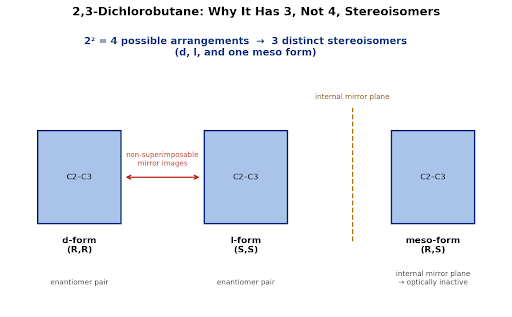
Figure 5: The R,S combination is its own mirror image, collapsing what looks like 4 stereoisomers down to 3.
Explanation: the structural symmetry reduces the overall stereoisomer count. Instead of four distinct structures, the configurations yield one pair of optically active enantiomers (d and l isomers) and one optically inactive meso form due to internal compensation of optical activity.
Total Stereoisomers: 3.
Solved PYQ 2: Navigating Principal Functional Groups
Question: Assign the correct IUPAC name for the following compound:
CH3-CH(OH)-CH2-CO-CH2-COOH
- Identify the principal functional group: the compound contains a hydroxyl group (–OH), a ketone group (–CO–), and a carboxylic acid group (–COOH). According to IUPAC priority rules, the carboxylic acid functional group takes absolute priority and defines the suffix.
- Find the principal chain: the longest continuous carbon chain containing the principal group spans six carbon atoms, establishing "hexanoic acid" as the parent chain.
- Number the chain: start numbering directly from the carboxylic acid carbon to assign the lowest possible locants to the remaining functional groups.
- Identify prefixes: the ketone group at C-3 is designated by the prefix "oxo", and the hydroxyl group at C-5 is designated by the prefix "hydroxy". The prefixes are arranged alphabetically, so hydroxy precedes oxo, irrespective of their locants.
Explanation: prioritizing the carboxylic acid fixes the numbering alignment. Substituent prefixes are then organized alphabetically to form the final name.
IUPAC Name: 5-Hydroxy-3-oxohexanoic acid.
How Infinity Learn Helps with Organic Chemistry PYQs
Mastering organic mechanisms requires focused practice and step-by-step structural breakdown. Infinity Learn provides specialized tools designed to streamline your review of organic chemistry PYQs:
- Reaction-Type Practice Sets: access an extensive, sorted question bank where you can isolate specific mechanisms like SN1/SN2 or electrophilic additions, allowing you to target and patch conceptual gaps systematically.
- Mechanism-Based Video Solutions: watch step-by-step molecular animations and expert breakdowns that map out arrow-pushing mechanisms, electron shifts, and stereochemical changes visually.
- Mock Tests with PYQ-Heavy Organic Chemistry Sections: take timed practice exams that mirror recent NTA question distributions, helping you build proper pacing and confidence for the actual exam.
Conclusion
An analysis of recent organic chemistry papers highlights a clear distribution of high-yield topics. The most frequently tested reaction categories include nucleophilic substitutions influenced by carbocation rearrangements, electrophilic additions following Markovnikov or anti-Markovnikov pathways, and prominent named reactions like Aldol Condensation and Cannizzaro transformations.
When building your study strategy, avoid passive reading. Always keep a scratch pad nearby to draw out reaction mechanisms manually. Track electron movement using formal arrow-pushing notation, explicitly label structural stereochemistry, and map out intermediate states for every problem. Working through past papers systematically by mechanism type will help you secure maximum marks in the organic chemistry section of the JEE Main.
course
No courses found
FAQs on High-Weightage JEE Main Organic Chemistry PYQs
Which organic chemistry topics are most asked in JEE Main?
General Organic Chemistry (GOC) forms the foundation of the exam, while Aldehydes, Ketones, Carboxylic Acids, and Hydrocarbons carry the highest marks weightage. Reaction mechanisms involving named conversions and structural identification problems appear in almost every shift.
How do I solve organic chemistry PYQs effectively?
Do not look at the solution immediately. Identify the active reagents, locate the principal functional groups, and draw out the step-by-step mechanism on paper. Once you have determined the major product, verify your intermediate states against the answer key to identify any overlooked rearrangements or stereochemical changes.
Which named reactions are most important for JEE Main?
The most critical named transformations include the Aldol Condensation, Cannizzaro Reaction, Friedel-Crafts Alkylation/Acylation, Reimer-Tiemann Reaction, Williamson Ether Synthesis, and the Sandmeyer Reaction.
Where can I find mechanism-based solutions for JEE PYQs?
Infinity Learn provides an extensive repository of detailed, step-by-step video solutions and written guides that walk you through the arrow-pushing mechanisms for recent JEE Main organic chemistry questions.
How many organic chemistry questions come in JEE Main?
Organic Chemistry usually contributes around 7 to 10 questions out of the 25 required questions in the Chemistry paper, depending heavily on the specific exam shift.