- Download PDF of NCERT Solutions for Class 9 English Kaveri Chapter 3 Winds of Change & Canvas of Soil (2026-27)
- Class 9 English Kaveri Chapter 3 Winds of Change Question Answers
- NCERT Class 9 English Kaveri Poem 3 Canvas of Soil Solutions
- FAQs on NCERT Solutions Class 9 English Chapter 3 Question Answer
NCERT Solutions for Class 9 English Kaveri Chapter 3 Winds of Change & Canvas of Soil
By Karan Singh Bisht
|
Updated on 28 Jul 2026, 14:22 IST
NCERT Solutions for Class 9 English Kaveri Chapter 3 Winds of Change & Canvas of Soil are designed to help students understand the chapter in a simple, clear, and exam-focused way. The solutions explain the meaning, central idea, important events, characters, language, and key messages of the chapter so that students can read, revise, and answer textbook questions with confidence.
This chapter helps learners think about change, growth, challenges, and how new experiences can shape a person’s thoughts and actions. To make learning easier, the solutions are written in a step-by-step format using simple language, so students can understand both the lesson and the poem without confusion.
Infinity Learn provides detailed NCERT Solutions for Class 9 English Kaveri Chapter 3 based on the latest CBSE 2026-27 academic syllabus. The content is prepared by referring to the Class 9 English Kaveri textbook and its exercise sections, including Reflect and Respond, Reading for Meaning, Check Your Understanding, Critical Reflection, Vocabulary and Structures in Context, Writing Task, and Learning Beyond the Text.
The chapter includes the expository article Winds of Change and the poem Canvas of Soil by Maya Anthony. Infinity Learn explains both parts with textbook solutions, summaries, word meanings, Hindi translation, and grammar support. Students can also learn important language concepts such as collocations, fixed expressions, and present perfect tense through easy explanations.
These NCERT solutions are useful for Class 9 students, especially those studying under the CBSE curriculum. They can use the solutions to complete homework, revise chapter-wise concepts, improve comprehension, practice answer writing, and prepare for class tests and school exams. Teachers and parents can also use these solutions to guide students in understanding the chapter better. The FREE PDF makes it convenient for students to study anytime and revise the chapter before exams. With English and Hindi medium support, simple explanations, and no-login access, Infinity Learn helps students learn Class 9 English in a more organized and student-friendly way.
Download PDF of NCERT Solutions for Class 9 English Kaveri Chapter 3 Winds of Change & Canvas of Soil (2026-27)
Class 9 English Kaveri Chapter 3 Winds of Change Question Answers
I. Does anyone in your family use a hand fan? What do you call it in your language? What is it made of?
Loading PDF...
Answer: Yes, hand fans are still used in many homes, especially in rural areas and during power cuts. In Hindi, a hand fan is commonly called “pankha” or “haath ka pankha.” It is usually made from natural or simple materials such as palm leaves, bamboo, grass, cloth, or paper.
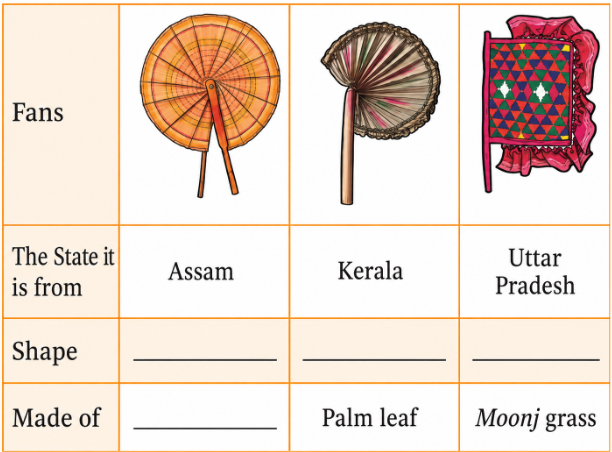
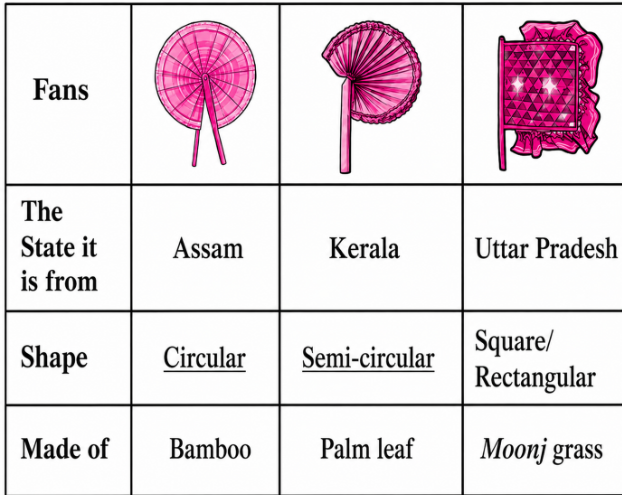
II. Work in pairs. Study the pictures given below carefully and complete the information. Discuss your answers with your classmates and teacher.
Answer:

III. Work in pairs. Match the underlined words in Column 1 with the meanings in Column 2 given on the next page. Share your answers with your classmates and teacher.
Best Courses for You

JEE

NEET

Foundation JEE

Foundation NEET

CBSE
I visited the crafts fair yesterday. It was a wonderful experience. Each indigenous artefact was an innovative creation of industrious crafts persons with its intricate design. It invoked a sense of respect for the initiatives taken by the government to showcase them.
| Column 1 | Column 2 |
| 1. indigenous | (iv) local — from where it originated |
| 2. innovative | (v) new and original in approach |
| 3. industrious | (i) hardworking |
| 4. intricate | (vi) elaborate/detailed |
| 5. invoked | (iii) brought out |
| 6. initiatives | (ii) actions to improve a situation |
Answer:
| Column 1 | Column 2 |
| 1. indigenous | (iv) local — from where it originated |
| 2. innovative | (v) new and original in approach |
| 3. industrious | (i) hardworking |
| 4. intricate | (vi) elaborate/detailed |
| 5. invoked | (iii) brought out |
| 6. initiatives | (ii) actions to improve a situation |
Page 73 – Check Your Understanding
I. Work in pairs to complete the table on pankha. Share your answers with your classmates and teacher.
| State | Type of Fan | Material Used |
| Rajasthan | appliqué hand fan | __________ |
| __________ | __________ | gold thread |
| __________ | temple hand fans | __________ |
| Gujarat | mirror work hand fans | __________ |
| __________ | __________ | beads |
| __________ | __________ | leather, decorated with thread and wool |
| West Bengal | sola hand fans | __________ |
| Uttar Pradesh | __________ | pure gold, silver zari, silk and satin frills |
| Bihar | __________ | bamboo |
Answer:
| State | Type of Fan | Material Used |
| Rajasthan | Appliqué hand fan | Fabric pieces with ornamental needlework |
| Rajasthan | — | Gold thread |
| Rajasthan | Temple hand fans | Fans engraved brass |
| Gujarat | Mirror work hand fans | Pure cotton with mirror work |
| Gujarat | Beads hand fan | Beads |
| Gujarat | Leather hand fan | Leather, decorated with thread and wool |
| West Bengal | Sola hand fans | Sola (water grass) |
| Uttar Pradesh | Phadh hand fan | Pure gold, silver zari, silk and satin frills |
| Bihar | Bamboo hand fan | Bamboo |
Page 74 – Critical Reflection
I. Read the extracts given below and answer the questions that follow.
1. Over time, pankhas became significant cultural goods distributed through trade routes. They were considered exotic and stylish. Although there was substantial commonality in their use across India, different villages and towns developed their own varieties of traditional pankhas. Each place developed pankhas with distinct materials or a variety of intricate designs, that set them apart from one another.
(i) State whether the following sentence is true or false.
Pankhas were one of the most popular items of commerce.
Answer: True. Pankhas were widely exchanged through trade routes and were regarded as valuable cultural and commercial items.
(ii) Why has the word ‘traditional’ been used to describe pankhas?
Answer: The word ‘traditional’ has been used to describe pankhas because they have been used for many years and are closely linked with local customs, regional culture, and handmade craftsmanship.
(iii) Complete the following statement.
The sentence ‘They were considered exotic and stylish’ is an opinion and not a fact because
Answer: The sentence is an opinion because words such as “exotic” and “stylish” show personal feelings or judgment. Different people may have different opinions about whether pankhas are exotic or stylish.
(iv) Infer one reason for commonality in the use of pankhas across India.
Answer: One reason for the common use of pankhas across India is the country’s hot climate. People across different regions needed a simple and useful way to cool themselves before electric fans became common.
(v) Select which one of the two statements is the correct assertion for the given reason.
Reason: Pankhas were made of indigenous materials, unique to the region, with elaborate designs.
A. Each kind of pankha could be distinguished from the others.
B. Pankhas were used by many people.
Answer: A. Each kind of pankha could be distinguished from the others.
2. With time and the advent of technology and innovative creations, the beautiful culture of pankhas runs the risk of slowly losing its presence among IndiAnswer: Once made for personal use, over time this handicraft has transformed into a commercial business and now provides some form of livelihood to India’s artisAnswer: The slight increase in popularity and demand is significantly factored by the different versions of the pankha being crafted.
(i) Infer one negative impact of technological advancement on pankha.
Answer: One negative impact of technological advancement is that handmade pankhas are not used as frequently in everyday life. Electric fans, coolers, and air conditioners have reduced their practical importance.
(ii) Complete the statement with an appropriate reason.
The writer refers to ‘pankhas’ not just as an object but as a ‘culture’ because
Answer: The writer refers to pankhas as a culture because they reflect regional traditions, local materials, artistic designs, community skills, and the lifestyle of people from different parts of India.
(iii) Select a line from the extract which depicts how the role of the pankha has changed over the years.
Answer: “Once made for personal use, over time this handicraft has transformed into a commercial business.”
(iv) List one way in which the increase in demand of pankhas might benefit artists.
Answer: An increase in demand for pankhas can help artisans earn better income and encourage them to continue practising their traditional craft.
(v) Select the factor that has contributed to the commercialisation of pankhas.
A. cultural preservation
B. economic demand
C. technological advancements
D. artisan initiative
Answer: B. economic demand
II. Answer the following questions.
Question 1: How does the title ‘Winds of Change’ capture the essence of the chapter?
Answer: The title “Winds of Change” is suitable for the chapter because it reflects the movement from traditional handmade pankhas to modern cooling devices like electric fans, coolers, and air conditioners. The word “winds” is directly related to fans and air, while “change” points to the transformation in people’s lifestyles due to technology.
Earlier, pankhas were commonly used for cooling and were also valued for their beauty, craftsmanship, and cultural importance. With time, electric fans became more popular because they were more convenient and could cool many people at once. Thus, the title highlights both the physical movement of air and the broader cultural change from traditional craft to modern comfort.
Question 2: Support the following statement with any two relevant examples from the chapter.
‘The structure and design of pankhas are testimony to the cultural identity of the region.’
Answer: The structure and design of pankhas show the cultural identity of different regions because they are made using local materials, traditional patterns, and regional craft skills.
For example, Rajasthan is known for appliqué and zardozi pankhas made with colourful fabric, gold thread, and ornamental needlework. These pankhas reflect the rich decorative craft tradition of the region.
Similarly, West Bengal’s sola pankhas are made from the soft white centre of the sola plant. They show the region’s skill in using natural materials to create delicate handmade items. These examples prove that pankhas are not only useful objects but also symbols of regional culture and craftsmanship.
Question 3: TThe chapter mentions pankhas running the risk of slowly losing their presence among Indians. Evaluate how the balance between preserving traditional craftsmanship and incorporating innovative designs in the creation of pankhas will help in this regard
Answer: Preserving traditional craftsmanship while adding innovative designs can help pankhas remain relevant in modern times. Traditional methods protect the cultural and artistic value of the craft, while new designs make pankhas more attractive to today’s buyers.
Artisans can continue using regional materials, patterns, and handmade techniques while creating pankhas for decoration, gifting, festivals, and eco-friendly lifestyle products. This can increase demand, support artisans financially, and encourage younger generations to value the craft. In this way, tradition and innovation together can help prevent pankhas from disappearing.
Question 4: How might initiatives such as pankha-making workshops contribute to the preservation of this traditional craft?
Answer: Pankha-making workshops can help preserve this traditional craft by teaching people the process, skills, and cultural importance behind handmade pankhas. These workshops give artisans a platform to share their knowledge with students, craft lovers, and younger generations.
They also help people understand the effort, creativity, and patience involved in making pankhas by hand. When more people learn about and appreciate this craft, artisans receive better recognition and support. This helps keep the tradition alive and encourages its continuation.
Question 5: The writer mentions celebrating pankhas in the concluding part of the chapter. Assess how this could be beneficial to artisans and the craft.
Answer: Celebrating pankhas can help create awareness about their cultural, artistic, and historical value. It allows people to see pankhas not just as old cooling tools but as beautiful examples of traditional Indian craftsmanship.
This recognition can increase the demand for handmade pankhas and provide better earning opportunities for artisans. It can also encourage younger people to learn the craft and continue the tradition. In this way, celebrating pankhas can support both the artisans and the survival of the craft.
Question 6: How does the restriction of the use of pankha for decorative purposes reflect the changing cultural role of these traditional fans in modern India?
Answer: The use of pankhas mainly as decorative items shows that their role has changed in modern India. Earlier, pankhas were used regularly for cooling, but modern appliances like electric fans and air conditioners have reduced their everyday use.
Even though they are no longer widely used for practical cooling, pankhas continue to hold cultural and artistic value. Their use as decorative pieces shows that people still appreciate their beauty, design, and craftsmanship. This reflects how pankhas have shifted from being daily-use objects to symbols of tradition and heritage.
Page 76 – Vocabulary and Structures in Context
Vocabulary and Structures in Context
I. Read the following pairs of words from the text.

1. Classify the pairs of words given above in the following categories. One example has been done for you.
| Appearance | Place | Material |
| __________ | within and outside | __________ |
| __________ | __________ | __________ |
| __________ | __________ | __________ |
Answer:
| Appearance | Place | Material |
| exotic and stylish | within and outside | silk and brass |
| ornate and encrusted | villages and towns | thread and wool |
| intricate designs | Ajanta Paintings | bamboo sticks |
| glittering ornate | — | cane and palm leaves |
| colourful beads | — | cotton-based |
| delicate pankhas | — | gold and silver zari |
| sturdy bamboo | — | cardboard |
| antique pankhas | — | leather, silver, beads |
II. Find the word pairs for the following fixed expressions. Write the meanings of these expressions by selecting them from the box given below. One example has been done for you.
Some common expressions with ‘and’ have a fixed order that cannot be changed. The shortest expression comes first. For example, bread and butter (*not butter and bread)
| Word 1 | and | Word 2 | Fixed Expression | Meaning of the Expression |
| 1. high | and | tear | __________ | __________ |
| 2. cut | and | fast | __________ | __________ |
| 3. fact | and | sundry | __________ | __________ |
| 4. all | and | thin | all and sundry | everyone, not just a few special people |
| 5. wear | and | figures | __________ | __________ |
| 6. time | and | run | __________ | __________ |
| 7. thick | and | again | __________ | __________ |
| 8. hard | and | dry | __________ | __________ |
Now, match the following meanings with the correct word pairs created above.
- in a difficult situation, without help or money-
- the damage to the object due to normal use –
- accurate and detailed information –
- even when there are problems or difficulties –
- everyone, not just a few special people –
- often; on many or all occasions –
- to make a quick or sudden escape –
Answer:
| Word 1 | and | Word 2 | Fixed Expression | Meaning of the Expression |
| 1. high | and | tear | high and dry | in a difficult situation, without help |
| 2. cut | and | fast | cut and run | to make a quick or sudden escape |
| 3. fact | and | sundry | fact and figures | accurate and detailed information |
| 4. all | and | thin | all and sundry | everyone, not just a few special people |
| 5. wear | and | figures | wear and tear | the damage to an object due to normal use |
| 6. time | and | run | time and again | often; on many or all occasions |
| 7. thick | and | again | thick and thin | even when there are problems or difficulties |
| 8. hard | and | dry | hard and fast | strict and final decision |
III. Read the following word combinations from the text.
- sustainable livelihood
- aesthetically pleasing
- appreciating the culture
The given phrases are conventional combinations just like fixed expressions. Such combinations are called collocations.
A collocation is when two or more words are often used together in a natural way. These word combinations sound “right” to native speakers because they commonly occur in everyday language.
Examples:
- Heavy rain
- Strong coffee
- Catch a bus
- Make a mistake
- Tell a story
- Fast food
Question 1: Choose the appropriate word collocations for the following sentences.
(i) The students have to (take/give) the English exam tomorrow.
Answer: The students have to take the English exam tomorrow.
(ii) The interviewer asked the candidate to (take/ have) a seat.
Answer: The interviewer asked the candidate to take a seat.
(iii) My scooter (dashed against/ran into) a car.
Answer: My scooter ran into a car.
(iv) I must (take/own) responsibility for my success.
Answer: I must take responsibility for my success.
(v) I would like to (tone up/improve) my grammar
Answer: I would like to improve my grammar.
IV Read the following sentences. Underline the verbs.
- In modern times, pankhas have become traditional craft items in India.
- Gujarat’s industrious home-based women workers have worked tirelessly in the handicraft of pankha-making.
- Many tribes in India have adopted this handicraft.
- Once made for personal use, this handicraft has transformed into a commercial business.
Answer:
- In modern times, pankhas have become traditional craft items in India.
- Gujarat’s industrious home-based women workers have worked tirelessly in the handicraft of pankha-making.
- Many tribes in India have adopted this handicraft.
- Once made for personal use, this handicraft has transformed into a commercial business.
Now, fill in the blanks with the present perfect form of verbs in the following paragraph. One example has been done for you.
Puppets have long fascinated (fascinate) audiences worldwide. Puppeteers (i) ______ (create) intricate characters and captivating stories with their skillful artistry. They (ii) ______ (master) the delicate movements that bring these lifeless figures to life, entertaining both children and adults. Over the years, puppetry (iii) ______ (evolve), using modern technology while preserving traditional techniques. Many puppeteers (iv) ______ (pass) down their craft through generations, ensuring its continuity. They (v) ______ (perform) in theatres, on television, and at festivals, conveying important cultural narratives.
Answer: Puppets have long fascinated audiences worldwide. Puppeteers (i) have created intricate characters and captivating stories with their skillful artistry. They (ii) have mastered the delicate movements that bring these lifeless figures to life, entertaining both children and adults. Over the years, puppetry (iii) has evolved, using modern technology while preserving traditional techniques. Many puppeteers (iv) have passed down their craft through generations, ensuring its continuity. They (v) have performed in theatres, on television, and at festivals, conveying important cultural narratives.
Page 79 – Listen and Respond
I. You will listen to a dialogue between a boy and a girl discussing which type of pankha they should choose as a gift. As you listen, choose four statements out of seven that are true from 1–7 given below.
(Transcript for teacher on page 263)
- Rohan thinks Grandma prefers heavier items because they feel more substantial.
- Priya suggests getting a pankha that can be easily moved around.
- Rohan believes Grandma enjoys siting in the verandah during the evenings.
- Priya knows Grandma likes to keep special items close to her.
- Rohan thinks a pankha with intricate designs would be too delicate for Grandma’s liking.
- Priya suggests choosing between a bamboo pankha with beadwork or an embroidered pankha with mirror work.
- Rohan decided they should buy the pankha without consulting their mom.
Answer: The four correct statements are:
- Priya suggests buying a pankha that can be moved easily from one place to another.
- Rohan thinks that Grandma likes sitting in the verandah in the evenings.
- Priya understands that Grandma likes keeping special things close to her.
- Priya suggests choosing either a bamboo pankha with beadwork or an embroidered pankha with mirror work.
Speaking Activity
I. Work in groups of four. Look at the pictures of the four different kinds of fans given below.
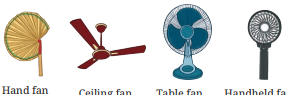
- Each of you in the group will pick one kind of fan.
- Imagine yourself to be that fan.
- Use the points given in the box below.
Introduce yourself as the fan which you have chosen.
- Describe yourself, for example, your features, etc.
- What do you like about yourself?
- What do you feel is your weakness?
- What makes you unique?
- What makes you unique?
Answer: I am a Hand Fan
Hello everyone! I am a hand fan. I am small, light, and easy to carry. I am usually made from materials such as bamboo, palm leaves, cloth, or paper. Sometimes, I am beautifully decorated with colourful patterns, embroidery, beadwork, or mirror work.
People use me by moving me back and forth with their hands to create cool air. I do not need electricity, so I am very useful during power cuts, outdoor travel, village fairs, and hot summer days.
What I like most about myself is that I am eco-friendly, portable, and simple to use. My weakness is that I can cool only one person at a time and need manual effort. I am unique because I represent traditional art, regional culture, and handmade craftsmanship.
Or
I am a Ceiling Fan
Hello everyone! I am a ceiling fan. I am fixed to the ceiling and usually have three or four blades. I am made of metal and plastic and am available in different colours, sizes, and designs.
I work with electricity and rotate quickly to circulate air throughout a room. I can cool many people at the same time, which makes me useful in homes, classrooms, offices, and shops.
What I like most about myself is that I am powerful and can cover a large area. My weakness is that I cannot work without electricity and cannot be moved easily from one place to another. I am unique because I provide comfort to everyone in the room equally.
Or
I am a Table Fan
Hello everyone! I am a table fan. I am usually placed on desks, tables, or shelves to provide cool air. I have strong blades and can move from side to side to spread air in different directions.
What I like most about myself is that I am useful, reliable, and easier to move than a ceiling fan. I can be shifted from one room to another whenever needed. My weakness is that I need electricity to work. I am unique because I provide direct airflow and can be used wherever personal cooling is required.
Or
I am a Handheld Fan
Hi everyone! I am a handheld fan. I am small, light, and easy to carry. I can easily fit into a hand or bag and provide quick personal cooling.
I usually work with batteries or rechargeable power. I am useful while travelling, walking outdoors, waiting in crowded places, or sitting where there is no proper airflow.
What I like most about myself is that I am portable and convenient. My weakness is that I depend on battery power and may stop working when the battery runs out. I am unique because I can offer comfort almost anywhere.
Page 80 – Writing Task
I. Describe an artefact you have made in your craft class or learnt from someone.
Begin with collection and organisation of the facts with the help of the pointers given above. Do not include your opinion in the factual description.
Answer: A Paper Hand Fan
A paper hand fan is a simple and attractive artefact that I made during my craft class. It is circular in shape and about 20 centimetres in diameter. The fan is made using colourful paper sheets and two wooden sticks, which serve as its handle. Its pleated folds give it a neat and beautiful look.
To make the fan, we first took a rectangular sheet of coloured paper and folded it back and forth in a zigzag pattern. Then, we tied one end firmly with a rubber band and attached two ice cream sticks on both sides to make the handle. After that, we opened the other end carefully to form the shape of a fan.
Paper hand fans are commonly made in many parts of India using waste or recycled paper. They are eco-friendly, inexpensive, and easy to make. They can be used on hot days or kept as decorative craft items.
Making this fan helped me understand the value of traditional crafts. It also showed me how simple materials can be turned into something useful, creative, and beautiful.
Page 80 – Learning Beyond the Text
I. Identify any art or craft item from your region and make a presentation describing its features, materials and process involved in making it, its usage, etc.
- Name of the object and its physical characteristics appearance, shape, size, colour, etc.
- What is it made up of?
- Which region does it belong to? How has it been used traditionally?
- Is there an origin story associated with it? How has it evolved over time?
- How can it be used effectively and safely in today’s time?
Answer:
- Pottery is one of the oldest and most popular craft forms in India. Clay pots are usually round or oval in shape and are made in different sizes, ranging from small decorative pots to large vessels used for storing water. They are generally reddish-brown or earthy brown in colour, and their surface may be smooth or textured depending on the design.
- Pottery is made from natural clay, also called mitti. The clay is mixed with water to make it soft and easy to shape. Sometimes, materials like sand or straw are added to make the clay stronger. After the pot is shaped, it is dried, baked, and sometimes decorated with natural colours or paints.
- This craft is practised in many parts of India. Places such as Khurja in Uttar Pradesh, Jaipur in Rajasthan, and Manipur are especially known for their pottery traditions. Traditionally, clay pots were used for storing water, cooking food, and carrying grains. Clay lamps, known as diyas, are still widely used during festivals like Diwali.
- Pottery has a long history and dates back to the Indus Valley Civilisation. Over thousands of years, it has developed from simple household items into a beautiful form of decorative art. Today, potters use both traditional hand wheels and modern electric wheels to create different pottery items.
- In modern times, pottery is used as decorative pieces, flower pots, kulhad cups, and artistic showpieces. Clay products are also eco-friendly because they are biodegradable. By buying handmade pottery, people can support local artisans and promote sustainable living.
NCERT Class 9 English Kaveri Poem 3 Canvas of Soil Solutions
Page 86 – Reflect and Respond
I. Work in pairs. Discuss what all you see in a garden. Think of the colours you see and where you see them. Share your responses with your teacher.
Answer: In a garden, we can see many beautiful things. There are colourful flowers such as roses, marigolds, and sunflowers. We can also see green grass, tall trees, small shrubs, and creepers. Birds and butterflies are often seen flying around the garden. Some gardens also have benches, pathways, and small ponds.
A garden is full of colours. The leaves and grass are green, the flowers may be red, yellow, white, or pink, and the tree trunks and soil are brown. We can also see the blue colour of the sky reflected in the water.
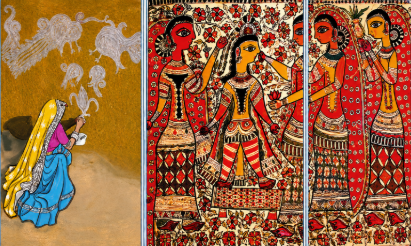
II. Look at the picture of a garden and a painting given below. Speak about any similarities between the garden and the painting.
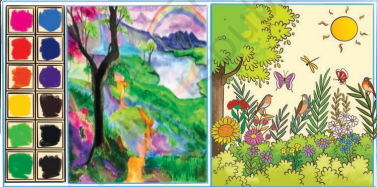
Speak using the following:
- Just as a garden ____________, similarly, a painting ____________
- A garden and a painting, both ____________.
- ____________ is common to both a garden and a painting.
- Like a garden, a painting too ____________.
Answer:
- Just as a garden has different colours and textures, similarly, a painting uses different colours and brush strokes to create beauty.
- A garden and a painting, both express creativity and bring joy to the viewer.
- Colour is common to both a garden and a painting.
- Like a garden, a painting too captures the beauty of nature and life in a vivid and colourful way.
III. Let us acquaint ourselves with the meanings of palette, hue, and canvas.
- Palette: a thin oval or rectangular board or tablet that painter holds and mixes colours on.
- Hue: shade of a colour
- Canvas: (here) painting
Now, look at the painting given above and identify palette, canvas, and select a hue.
Answer: Looking at the given picture:
- Palette: The palette is shown on the left side of the image. It is a rectangular board that holds different colours such as pink, blue, red, yellow, green, and black. Paintbrushes are also placed near it.
- Canvas: The canvas refers to the paintings shown in the centre and on the right side of the image. These are the surfaces on which the landscape and garden scenes have been painted.
- Hue: One example of a hue in the picture is green, which can be seen in the trees, grass, and plants. Other hues such as blue, yellow, and red can also be observed in the image.
Page 87 – Check Your Understanding
I. Read the poem again and complete the summary of each stanza by filling in the blanks.
1. The _____________ is portrayed as a rich palette where gardeners’s _ _ _ a _ s flourish in the form of _____________, awaiting spring.
Answer: The earth/soil is portrayed as a rich palette where gardeners’ dreams flourish in the form of seeds, awaiting spring.
2. The garden flowers __________ into a beautiful display of different b __ __ __ __ __ m s, resembling a __________ by Mother Nature, in the light of morning.
Answer: The garden flowers bloom into a beautiful display of different blossoms, resembling a painting/artwork by Mother Nature, in the light of morning.
3. Each garden is likened to a wide __ __ n __ __ s, integrating art and __________. Through the efforts of gardeners, gardens transform into still-life __________.
Answer: Each garden is likened to a wide canvas, integrating art and life. Through the efforts of gardeners, gardens transform into still-life paintings.
II. Select the appropriate title for each stanza from those given below. There are two extra titles.
- Nature’s Work of Art
- Sweet-smelling Blossoms
- Gardens as Living Canvas
- Earth and Possibilities
- The Painter’s Canvas
Answer:
- Stanza 1 — 4. Earth and Possibilities
- Stanza 2 — 1. Nature’s Work of Art
- Stanza 3 — 3. Gardens as Living Canvases
III. Match the poetic devices in Column 1 to the examples in Column 2.
Discuss your responses in pairs. Then share the responses with your classmates and teacher.
| Column 1 | Column 2 |
| 1. Imagery [mind pictures] | (iv) colours, brushstrokes, blossoms, shades of green |
| 2. Metaphor [comparison without use of ‘like’ or ‘as’] | (vi) garden as a painting, plot as canvas, seeds as brushstrokes |
| 3. Rhyme Scheme | (ii) AABB |
| 4. Tone [what the poet feels] | (i) appreciative |
| 5. Mood [what the reader feels] | (vii) joyful |
| 6. Speaker | (v) a gardener |
| 7. Alliteration [same consonant sound] | (iii) ‘Blossoms bloom’ |
Answer:
| Column 1 | Column 2 |
| 1. Imagery [mind pictures] | (iv) colours, brushstrokes, blossoms, shades of green |
| 2. Metaphor [comparison without use of ‘like’ or ‘as’] | (vi) garden as a painting, plot as canvas, seeds as brushstrokes |
| 3. Rhyme Scheme | (ii) AABB |
| 4. Tone [what the poet feels] | (i) appreciative |
| 5. Mood [what the reader feels] | (vii) joyful |
| 6. Speaker | (v) a gardener |
| 7. Alliteration [same consonant sound] | (iii) ‘Blossoms bloom’ |
Page 89 – Critical Reflection
I. Read the given extracts from the poem and answer the questions that follow.
Brushstrokes of seeds, planted true, Awaiting spring’s vibrant hue.
(i) The poet has used a metaphor in ‘Brushstrokes of seeds’. Which option from those given below uses a mataphor?
- Her mother’s heart heard her heartfelt request with kindness.
- She has a heart of gold.
- Her heart did a dance of joy on seeing the new doll.
- She has very kind heart.
Answer: B. She has a heart of gold.
(ii) Complete the sentence appropriately.
The phrases ‘planted true’ is significant because it implies ____________.
Answer:The phrase “planted true” is significant because it suggests that the seeds are planted with care, honesty, and dedication. It shows that gardeners put sincere effort, hope, and patience into their work, just like an artist who creates a painting with full commitment.
(iii) Why has the poet used the word ‘ hue’ instead of ‘colours’ in the extract?
Answer: The poet uses the word “hue” instead of “colours” because “hue” sounds more poetic and artistic. It refers to different shades and tones of colour, which matches the poem’s theme of comparing gardening with painting. The word also supports the artistic imagery of the poem and helps maintain the rhyme with “true.”
(iv) Complete the following analogy correctly with a word from the extract.
Summer: hot: :: Spring : ___________
Answer:
Summer: hot :: Spring : vibrant
(v) Read the Assertion (A) and the Reason (R) and selecting the option that is correctly suited.
(A): Gardeners wait for Spring.
(R): Gardens are worth painting in Spring.
A. Both (A) and (R) are true and (R) is the correct explanation of (A).
B. Both (A) and (R) are rue but (R) is not the correct explanation of (A).
C. (A) is true but (R) is false.
D. (A) is false but (R) is true.
Answer: B. Both (A) and (R) are true but (R) is not the correct explanation of (A).
2. Each plot, a canvas wide, Where art and life coincide.
(i) What does ‘Each plot’ refer to in this extract?
Answer: “Each plot” refers to every small section or part of a garden. The poet compares each garden plot to a wide canvas, suggesting that every part of the garden becomes a beautiful and unique artwork created by the gardener.
(ii) Select which option imitates the rhyme scheme of the extract.
A. beautiful and clear
laughter and cheer
B. beautiful and clear
laughter and tears
Answer:
A. beautiful and clear
laughter and cheer
(iii) Select the line from the extract that conveys that gardening blends aesthetic beauty with natural growth.
Answer: The line “Where art and life coincide” means that gardening brings together artistic beauty and natural growth. A garden is not only a place where plants grow, but also a space where creativity, colours, and life come together beautifully.
(iv) Complete the following sentence appropriately.
The plot is likened to a canvas suggesting that ___________.
Answer: The plot is likened to a canvas suggesting that a garden, like a painting, is a place of creativity and imagination. Just as a painter uses colours and designs to create art on a canvas, a gardener uses plants, flowers, and patterns to turn a plot of land into a living work of art.
(v) Why has the poet most likely used the word ‘wide’ instead of ‘long’ in ‘canvas wide’?
Answer: The poet uses “wide” instead of “long” because “wide” gives a sense of openness, space, and freedom. It suggests that the garden spreads out beautifully in many directions, just like a canvas full of creative possibilities. The word also shows that a garden, like art, has endless scope for imagination. Additionally, “wide” fits better with the rhythm and flow of the poem.
II. Give reason for the comparisons made by the poet in the poem.
- A painter is compared to a gardener because ___________.
- A palette is like earth as ___________.
- The brushstrokes are like seeds because ___________.
- A canvas is similar to a garden plot as ___________.
Answer:
- A painter is compared to a gardener because both use creativity, imagination, and skill to create something beautiful.
- A palette is compared to the earth because both contain different colours and provide the base for a beautiful creation.
- Brushstrokes are compared to seeds because both begin the process of creation. Brushstrokes create a painting, while seeds grow into plants and flowers.
- A canvas is similar to a garden plot because both are open spaces where creativity can be expressed.
III. Answer the following questions.
1. How does the metaphor ‘Brushstrokes of seed’, enhance the understanding of gardening as an art form?
Answer: The metaphor ‘Brushstrokes of seed’ helps us understand gardening as an art form by comparing the act of planting seeds to the act of painting. Just as every brushstroke on a canvas is carefully made and adds beauty to a painting, every seed planted in the soil is placed with care and contributes to the beauty of a garden.
This metaphor shows that gardening is not only a simple activity of growing plants, but also a creative process. It requires imagination, patience, skill, and effort, just like painting.
2. What can you infer about the poet’s perspective on the relationship between nature and creativity from the following lines? ‘Each plot, a canvas wide,/Where art and life coincide.’
Answer: From these lines, we can infer that the poet sees nature and creativity as closely connected. The poet compares each garden plot to a canvas, suggesting that a garden is a place where artistic expression and natural life come together.
The lines show that creativity is not limited to paintings or drawings. It can also be seen in nature, especially when a gardener shapes a garden with plants, flowers, colours, and patterns. Thus, the poet believes that art and life exist together beautifully in a garden.
Do you think the imagery in the poem successfully paints a vivid picture in the reader’s mind? If yes, why?
Answer: Yes, the imagery in the poem successfully creates a clear and beautiful picture in the reader’s mind. The poet uses colourful and lively images such as “shades of green, red, and blue,” “blossoms bloom,” and “brushstrokes of seeds.”
These images help the reader imagine a bright and colourful garden. The comparison of a garden to a painting, with a canvas, palette, and brushstrokes, makes the poem more visual and meaningful. It allows the reader to see gardening as a creative and artistic activity.
3. Support the view that the poet’s mention of the colour yellow, besides red, blue and green, would have lent effectively to the imagery.
Answer: The mention of the colour yellow would have made the imagery of the poem more effective and complete. Yellow is a common and bright colour found in gardens through flowers like sunflowers, marigolds, and daffodils. It is also associated with sunlight, warmth, and freshness.
Adding yellow along with red, blue, and green would have made the garden’s picture more colourful and realistic. It would also have strengthened the comparison between a garden and a painting, as yellow is often used by artists to show light, energy, and brightness.
4. Considering the line ‘Gardens become paintings still’, what can you interpret about the poet’s view on the timelessness of nature’s beauty?
Answer: From the line ‘Gardens become paintings still’, we can understand that the poet sees nature’s beauty as timeless. The word ‘still’ can suggest something calm and motionless, like a painting, and also something that continues to exist over time.
The poet suggests that a garden captures the beauty of nature just as a painting captures beauty on a canvas. Even though flowers may bloom and fade, the beauty of nature continues to inspire people. This shows that, for the poet, nature’s beauty is lasting and meaningful.
5. Justify the title of the poem, ‘Canvas of Soil’.
Answer: The title ‘Canvas of Soil’ is suitable and meaningful because it connects gardening with art. A canvas is the surface on which a painter creates a painting. In the poem, the soil is compared to a canvas because it holds seeds, plants, flowers, and colours that together create the beauty of a garden.
The title highlights the main idea of the poem: gardening is a creative art form. Just as a painter uses colours and brushstrokes to create art, a gardener uses soil, seeds, and plants to create a living work of art. Therefore, the title clearly reflects the theme and message of the poem.
course
No courses found
FAQs on NCERT Solutions Class 9 English Chapter 3 Question Answer
Where can I find Winds of Change Class 9 Question Answer?
Students can find Winds of Change Class 9 Question Answer on Infinity Learn. The solutions are written in simple language to help students understand the chapter, revise important points, and practise textbook questions effectively.
Is Winds of Change class 9 question answer PDF available?
Yes, students can access the Winds of change class 9 question answer pdf on Infinity Learn. The PDF helps students revise the chapter anytime and prepare for class tests, homework, and school exams.
What is included in the Class 9 English question Answer PDF Kaveri?
The Class 9 English question Answer PDF Kaveri includes chapter-wise solutions, summaries, word meanings, grammar explanations, and answers to textbook exercises. Infinity Learn provides these solutions in a student-friendly format for easy understanding.
How can Infinity Learn help with Winds of Change Class 9 Question Answer?
Infinity Learn provides detailed Winds of Change Class 9 Question Answer prepared by expert teachers. The answers explain the main ideas, important events, vocabulary, grammar points, and writing tasks in a clear and exam-focused way.
Where can I get Canvas of Soil Class 9 Question Answer?
Students can get Canvas of Soil Class 9 Question Answer on Infinity Learn. The solutions explain the meaning of the poem, poetic ideas, important lines, and textbook questions in simple English.
Are Winds of Change and Canvas of Soil part of Class 9 English Kaveri?
Yes, Winds of Change and Canvas of Soil are included in Class 9 English Kaveri Chapter 3. Infinity Learn provides answers for both the prose and poem sections to help students complete the full chapter.
Is the Winds of Change Class 9 PDF useful for exam preparation?
Yes, the Winds of change class 9 question answer pdf is useful for exam preparation because it helps students revise answers, understand key ideas, practise writing, and prepare confidently for school examinations.
Why should students use Infinity Learn for Class 9 English Kaveri solutions?
Students should use Infinity Learn because it provides accurate, easy-to-understand, and syllabus-aligned solutions for Class 9 English Kaveri. The answers are designed to improve comprehension, homework completion, revision, and exam readiness.
