NCERT Solutions for Class 9 Science Chapter 4 Describing Motion Around Us 2026-27
By Karan Singh Bisht
|
Updated on 23 Jul 2026, 16:27 IST
NCERT Class 9 Science Exploration Chapter 4 Solutions are prepared to help students understand Describing Motion Around Us in a simple, clear, and exam-focused way. This content is written for the 2026-27 academic session so that students can study the chapter confidently, revise important concepts, and practice textbook questions with accurate answers.
The information is based on the latest NCERT Class 9 Science Exploration textbook and the updated CBSE syllabus for 2026-27. Chapter 4 explains the basic concepts of motion, including motion in a straight line, distance and displacement, speed, velocity, acceleration, graphical representation of motion, and basic equations of motion. The solutions are written by understanding the chapter concepts, textbook exercises, activities, examples, and exam-oriented question patterns.
At Infinity Learn, these Class 9 Science Chapter 4 solutions are created by subject experts to make Physics concepts easier for students. Each answer is written step by step so that students can understand how motion is described using words, numbers, graphs, and equations. Real-life examples are also used to help learners connect the chapter with everyday situations.
This NCERT Solutions is useful for Class 9 students, teachers, and parents. Students can use it for homework, textbook exercise answers, class tests, annual exam preparation, and quick revision. Teachers can use these solutions for classroom support, while parents can use them to guide students during self-study.
Download Describing Motion Around Us Class 9 Questions and Answers PDF
Students can download the NCERT Class 9 Science Exploration Chapter 4 Solutions PDF from Infinity Learn for free and practice anytime. Along with textbook solutions, students can also revise extra questions, important questions, and chapter-wise explanations to strengthen their understanding of motion and improve exam readiness.
Describing Motion Around Us Class 9 Questions and Answers (Exercise)
Revise, Reflect, Refine (NCERT Textbook Page No. 68)
Loading PDF...
Question 1. My father went to a shop from home which is located at a distance of 250 m on a straight road. On reaching there, he discovered that he forgot to carry a cloth bag. He came home to take it, went to the shop again, bought provisions and came back home. How much was the total distance travelled by him? What was his displacement from home?
Solution: The distance between home and the shop is 250 m.
The father travels this distance four times:
Home to shop = 250 m

Shop to home = 250 m
Home to shop again = 250 m
Best Courses for You

JEE

NEET

Foundation JEE

Foundation NEET

CBSE
Shop to home again = 250 m
Total distance travelled = 250 m + 250 m + 250 m + 250 m
Total distance travelled = 1000 m
Since he starts from home and finally comes back home, his initial position and final position are the same.
Displacement = 0 m
Therefore, the total distance travelled is 1000 m and the displacement is 0 m.
Question 2. A student runs from the ground floor to the fourth floor of a school building to collect a book and then comes down to their classroom on the second floor. If the height of each floor is 3 m, find:
(i) the total vertical distance travelled, and
(ii) their displacement from the starting point.
Solution: Height of each floor = 3 m
The student first goes from the ground floor to the fourth floor.
Distance travelled upward = 4 × 3 m
Distance travelled upward = 12 m
Then the student comes down from the fourth floor to the second floor.
Distance travelled downward = 2 × 3 m
Distance travelled downward = 6 m
(i) Total vertical distance travelled = 12 m + 6 m
Total vertical distance travelled = 18 m
(ii) The student starts from the ground floor and finally reaches the second floor.
Displacement from the starting point = 2 × 3 m
Displacement from the starting point = 6 m upward
Therefore, the total vertical distance travelled is 18 m and the displacement is 6 m upward.
Question 3. A girl is riding her scooter and finds that its speedometer reading is constant. Is it possible for her scooter to be accelerating, and if so, how?
Solution: Yes, the scooter can be accelerating even when the speedometer reading is constant.
A speedometer shows only speed, but acceleration depends on change in velocity. Velocity includes both speed and direction.
If the scooter is moving on a curved road at a constant speed, its direction keeps changing. Since the direction changes, the velocity also changes.
Therefore, the scooter is accelerating even though its speed remains constant.
Question 4. A car starts from rest and its velocity reaches 24 ms-1 in 6 s. Find the average acceleration and the distance travelled in these 6 s.
Solution: Given:
Initial velocity, u = 0 m/s
Final velocity, v = 24 m/s
Time, t = 6 s
Average acceleration = change in velocity / time
Average acceleration = (v - u) / t
Average acceleration = (24 - 0) / 6
Average acceleration = 24 / 6
Average acceleration = 4 m/s²
Now, distance travelled can be calculated using the formula:
s = u × t + 1/2 × a × t²
s = 0 × 6 + 1/2 × 4 × 6²
s = 0 + 2 × 36
s = 72 m
Therefore, the average acceleration is 4 m/s² and the distance travelled is 72 m.
Question 5. A motorbike moving with initial velocity 28 ms-1 and constant acceleration stops after travelling 98 m. Find the acceleration of the motorbike and the time taken to come to a stop.
Solution: Given:
Initial velocity, u = 28 m/s
Final velocity, v = 0 m/s
Distance travelled, s = 98 m
Using the equation:
v² = u² + 2as
0² = 28² + 2 × a × 98
0 = 784 + 196a
196a = -784
a = -784 / 196
a = -4 m/s²
The negative sign shows that the motorbike is slowing down.
Now, to find the time taken:
v = u + at
0 = 28 + (-4) × t
0 = 28 - 4t
4t = 28
t = 28 / 4
t = 7 s
Therefore, the acceleration of the motorbike is -4 m/s² and the time taken to stop is 7 s.
Question 6. Fig. 4.27 shows a position-time graph of two objects A and B that are moving along the parallel tracks in the same direction. Do objects A and B ever have equal velocity? Justify your answer.
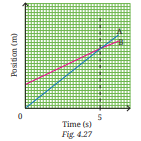
Solution: In a position-time graph, the slope or gradient of the graph at any point gives the instantaneous velocity of the object.
From Fig. 4.27, object A and object B have different position-time graphs.
Object A has a straight line with a steeper slope. This means that object A is moving with a higher constant velocity.
Object B also has a straight-line graph, but its slope is less steep. This means that object B is moving with a lower constant velocity.
Since both graphs are straight lines, both objects are moving with constant velocities. However, their slopes are different, so their velocities are also different.
The two lines seem to meet at one point, around t = 5 s. At this point, objects A and B have the same position, but they do not have the same velocity. Velocity depends on the slope of the graph, not on the position.
Therefore, objects A and B never have equal velocity. Their velocities remain different throughout the motion.
Question 7. A graph in Fig. 4.28 shows the change in position with time for two objects, A and B, moving in a straight line from 0 to 10 seconds. Choose the correct option(s).
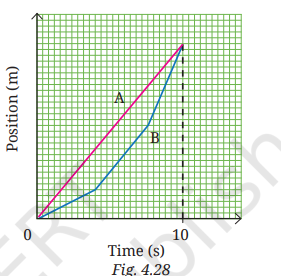
(i) The average velocity of both over the 10 s time interval is equal since they have the same initial and final positions.
(ii) The average speeds of both over the 10 s time interval are equal since both cover equal distance in equal time.
(iii) The average speed of A over the 10 s time interval is lower than that of B since it covers a shorter distance than B in 10 seconds.
(iv) The average speed of A over the 10 s time interval is greater than that of B since B’s speed is lower than A’s in some segments
Solution:
Correct options: (i) and (ii)
Explanation:
From the graph, both objects A and B start from the same position at t = 0 s and reach the same final position at t = 10 s.
(i) Correct:
Average velocity = displacement / time
Both A and B have the same displacement in the same time interval of 10 s.
So, their average velocities are equal.
(ii) Correct: Both objects move in the same direction without coming back, so the distance covered is equal to their displacement. Since both cover the same distance in the same time, their average speeds are also equal.
(iii) Incorrect: A does not cover a shorter distance than B. Both cover the same distance.
(iv) Incorrect: Even though B’s speed changes in different segments, its total distance covered in 10 s is the same as A’s. So, A’s average speed is not greater than B’s.
Question 8. A truck driver driving at the speed of 54 km h-1 notices a road sign with a speed limit of 40 km h-1 (Fig. 4.29) for trucks. He slows down to 36 km h-1 in 36 s. What was the distance travelled by him during this time? Assume the acceleration to be constant while slowing down.
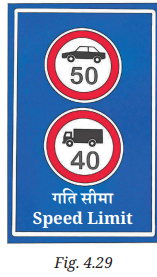
Solution: Given:
Initial speed, u = 54 km/h
Final speed, v = 36 km/h
Time, t = 36 s
First, convert the speeds into m/s.
u = 54 × 5 / 18
u = 15 m/s
v = 36 × 5 / 18
v = 10 m/s
Since acceleration is constant, distance travelled can be found using average velocity.
Average velocity = (u + v) / 2
Average velocity = (15 + 10) / 2
Average velocity = 25 / 2
Average velocity = 12.5 m/s
Distance travelled = average velocity × time
Distance travelled = 12.5 × 36
Distance travelled = 450 m
Therefore, the truck driver travelled 450 m while slowing down.
Question 9. A car starts from rest and accelerates uniformly to 20 ms-1 in 5 seconds. It then travels at 20 ms-1 for 10 seconds and finally applies the brake (with uniform acceleration) to stop in 6 seconds. Find the total distance travelled.
Solution: The motion has three parts.
Part 1: Car accelerates from rest to 20 m/s in 5 s
Initial velocity, u = 0 m/s
Final velocity, v = 20 m/s
Time, t = 5 s
Distance travelled = average velocity × time
Average velocity = (u + v) / 2
Average velocity = (0 + 20) / 2
Average velocity = 10 m/s
Distance travelled in first part = 10 × 5
Distance travelled in first part = 50 m
Part 2: Car travels at constant speed of 20 m/s for 10 s
Distance = speed × time
Distance = 20 × 10
Distance = 200 m
Part 3: Car slows down from 20 m/s to rest in 6 s
Initial velocity, u = 20 m/s
Final velocity, v = 0 m/s
Time, t = 6 s
Average velocity = (u + v) / 2
Average velocity = (20 + 0) / 2
Average velocity = 10 m/s
Distance travelled in third part = 10 × 6
Distance travelled in third part = 60 m
Total distance travelled = 50 m + 200 m + 60 m
Total distance travelled = 310 m
Therefore, the total distance travelled by the car is 310 m.
Question 10. A bus is travelling at 36 km h-1 when the driver sees an obstacle 30 m ahead. The driver takes 0.5 seconds to react before pressing the brake. Once the brake is applied, the velocity of the bus reduces with constant acceleration of 2.5 ms2. Will the bus be able to stop before reaching the obstacle?
Solution: Given:
Initial speed of bus = 36 km/h
Reaction time = 0.5 s
Distance of obstacle = 30 m
Retardation = 2.5 m/s²
First, convert speed into m/s.
Speed = 36 × 5 / 18
Speed = 10 m/s
Distance travelled during reaction time:
Distance = speed × time
Distance = 10 × 0.5
Distance = 5 m
Now, braking starts after 5 m.
Initial velocity while braking, u = 10 m/s
Final velocity, v = 0 m/s
Acceleration, a = -2.5 m/s²
Using the equation:
v² = u² + 2as
0² = 10² + 2 × (-2.5) × s
0 = 100 - 5s
5s = 100
s = 100 / 5
s = 20 m
Braking distance = 20 m
Total stopping distance = reaction distance + braking distance
Total stopping distance = 5 m + 20 m
Total stopping distance = 25 m
The obstacle is 30 m away.
Since 25 m is less than 30 m, the bus will stop before reaching the obstacle.
Distance left before obstacle = 30 m - 25 m
Distance left before obstacle = 5 m
Therefore, yes, the bus will be able to stop before reaching the obstacle, with 5 m distance remaining.
Question 11. A student said, “The Earth moves around the Sun”. In this context, discuss whether an object kept on the Earth can be considered to be at rest.
Solution: Yes, an object kept on the Earth can be considered to be at rest, but only with respect to the Earth.
Rest and motion depend on the point of reference. If we observe an object such as a table, chair, or book from the Earth’s surface, it appears to be at rest because its position does not change with respect to nearby objects.
However, the Earth itself moves around the Sun. So, the object kept on the Earth is also moving along with the Earth when seen from the Sun or from space.
Therefore, the same object can be at rest with respect to the Earth but in motion with respect to the Sun. This shows that rest and motion are relative.
Question 12. The velocity-time graph from 0 s to 120 s for a cyclist is shown in Fig. 4.30. Shade the areas (in different colours) representing the displacement of the cyclist
(i) while cyclist is moving with constant velocity.
(ii) when the velocity of cyclist is decreasing.
Also, calculate the displacement and average acceleration in the 120 s time interval.
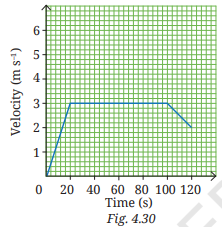
Solution: In a velocity-time graph, the area under the graph represents the displacement of the object.
(i) Area to shade for constant velocity
The cyclist moves with constant velocity from 20 s to 100 s.
Shade the rectangular area under the horizontal line between:
Time = 20 s to 100 s
Velocity = 3 m/s
This area represents displacement during constant velocity.
Displacement = length × breadth
Displacement = (100 - 20) × 3
Displacement = 80 × 3
Displacement = 240 m
(ii) Area to shade when velocity is decreasing
The cyclist’s velocity decreases from 100 s to 120 s.
Shade the trapezium under the sloping line between:
Time = 100 s to 120 s
Velocity decreases from 3 m/s to 2 m/s
Displacement = 1/2 × (sum of parallel sides) × height
Displacement = 1/2 × (3 + 2) × 20
Displacement = 1/2 × 5 × 20
Displacement = 50 m
Total displacement in 120 s
The motion has three parts:
From 0 s to 20 s:
Displacement = 1/2 × base × height
Displacement = 1/2 × 20 × 3
Displacement = 30 m
From 20 s to 100 s:
Displacement = 80 × 3
Displacement = 240 m
From 100 s to 120 s:
Displacement = 50 m
Total displacement = 30 m + 240 m + 50 m
Total displacement = 320 m
Average acceleration in 120 s
Initial velocity = 0 m/s
Final velocity = 2 m/s
Time = 120 s
Average acceleration = change in velocity / time
Average acceleration = (2 - 0) / 120
Average acceleration = 2 / 120
Average acceleration = 1 / 60 m/s²
Average acceleration = 0.017 m/s² approximately
Therefore, the total displacement is 320 m and the average acceleration is 0.017 m/s².
Question 13. A girl is preparing for her first marathon by running on a straight road. She uses a smartwatch to calculate her running speed at different intervals. The graph (Fig. 4.31) depicts her velocity versus time. Estimate the distance she ran based on the graph.
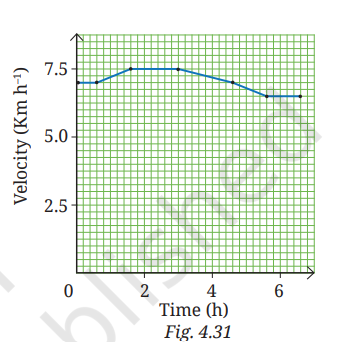
Solution: To estimate the distance, we find the area under the velocity-time graph.
From the graph, the approximate values are:
From 0 h to 0.5 h, velocity is about 7 km/h.
Distance = 7 × 0.5
Distance = 3.5 km
From 0.5 h to 1.5 h, velocity increases from about 7 km/h to 7.5 km/h.
Distance = average velocity × time
Distance = (7 + 7.5) / 2 × 1
Distance = 7.25 km
From 1.5 h to 3 h, velocity is constant at about 7.5 km/h.
Distance = 7.5 × 1.5
Distance = 11.25 km
From 3 h to 5.5 h, velocity decreases from about 7.5 km/h to 6.5 km/h.
Distance = (7.5 + 6.5) / 2 × 2.5
Distance = 7 × 2.5
Distance = 17.5 km
From 5.5 h to 6.5 h, velocity is about 6.5 km/h.
Distance = 6.5 × 1
Distance = 6.5 km
Total distance = 3.5 + 7.25 + 11.25 + 17.5 + 6.5
Total distance = 46 km approximately
Therefore, the girl ran about 46 km based on the graph.
Question 14. On entering a state highway, a car continues to move with a constant velocity of 6 ms-1 for 2 minutes and then accelerates with a constant acceleration 1ms-2 for 6 seconds. Find the displacement of the car on the state highway in the 2 min 6 s time interval by drawing a velocity-time graph for its motion.
Solution: Given:
Constant velocity = 6 m/s
Time for constant velocity = 2 minutes = 120 s
Acceleration = 1 m/s²
Time for acceleration = 6 s
Total time = 120 s + 6 s
Total time = 126 s
For first 120 s:
Displacement = velocity × time
Displacement = 6 × 120
Displacement = 720 m
For next 6 s:
Initial velocity, u = 6 m/s
Acceleration, a = 1 m/s²
Time, t = 6 s
Final velocity = u + at
Final velocity = 6 + 1 × 6
Final velocity = 12 m/s
Displacement during acceleration = average velocity × time
Average velocity = (initial velocity + final velocity) / 2
Average velocity = (6 + 12) / 2
Average velocity = 9 m/s
Displacement = 9 × 6
Displacement = 54 m
Total displacement:
Total displacement = 720 m + 54 m
Total displacement = 774 m
Therefore, the displacement of the car in 2 min 6 s is 774 m.
Question 15. Two cars A and B start moving with a constant acceleration from rest, in a straight line. Car A attains a velocity of 5 ms-1 in 5 s. Car B attains a velocity of 3 ms-1 in 10 s. Plot the velocity-time graphs for both the cars in the same graph. Using the graph, calculate the displacement in the two time intervals mentioned (Hint: Calculate the acceleration in both cases. Then calculate their velocities at five instants of time to plot the graph).
Solution: Both cars start from rest, so initial velocity of both cars is 0 m/s.
For Car A
Initial velocity, u = 0 m/s
Final velocity, v = 5 m/s
Time, t = 5 s
Acceleration = (v - u) / t
Acceleration = (5 - 0) / 5
Acceleration = 1 m/s²
So, acceleration of Car A = 1 m/s²
Velocities of Car A at different times:
| Time (s) | Velocity of Car A (m/s) |
| 0 | 0 |
| 1 | 1 |
| 2 | 2 |
| 3 | 3 |
| 4 | 4 |
| 5 | 5 |
Displacement of Car A = area under velocity-time graph
The graph is a triangle.
Displacement = 1/2 × base × height
Displacement = 1/2 × 5 × 5
Displacement = 12.5 m
So, displacement of Car A in 5 s = 12.5 m
For Car B
Initial velocity, u = 0 m/s
Final velocity, v = 3 m/s
Time, t = 10 s
Acceleration = (v - u) / t
Acceleration = (3 - 0) / 10
Acceleration = 0.3 m/s²
So, acceleration of Car B = 0.3 m/s²
Velocities of Car B at different times:
| Time (s) | Velocity of Car B (m/s) |
| 0 | 0 |
| 2 | 0.6 |
| 4 | 1.2 |
| 6 | 1.8 |
| 8 | 2.4 |
| 10 | 3 |
Displacement of Car B = area under velocity-time graph
The graph is a triangle.
Displacement = 1/2 × base × height
Displacement = 1/2 × 10 × 3
Displacement = 15 m
So, displacement of Car B in 10 s = 15 m
Therefore, the displacement of Car A is 12.5 m, and the displacement of Car B is 15 m.
Question 16. Rohan studies science from 6 PM to 7:30 PM at home. Consider the tip of the minutes hand of the wall clock. During the given time interval, what is its:
(i) distance travelled,
(ii) displacement,
(iii) speed, and
(iv) velocity.
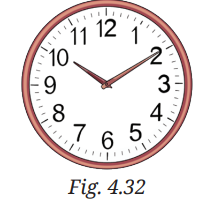
The length of the minute’s hand is 7 cm (Fig. 4.32).
Solution: Given:
Length of minute hand, r = 7 cm
Time interval = 6:00 PM to 7:30 PM
Total time = 1 hour 30 minutes = 90 minutes
In 60 minutes, the minute hand completes 1 full revolution.
In 90 minutes, the minute hand completes 1.5 revolutions.
(i) Distance travelled
Distance travelled by the tip of the minute hand in 1 revolution = circumference of circle
Circumference = 2 × pi × r
Distance in 1 revolution = 2 × pi × 7
Distance in 1 revolution = 14 pi cm
Distance in 1.5 revolutions = 1.5 × 14 pi
Distance = 21 pi cm
Using pi = 22 / 7:
Distance = 21 × 22 / 7
Distance = 66 cm
Therefore, the distance travelled is 66 cm.
(ii) Displacement
At 6:00 PM, the minute hand is at 12.
At 7:30 PM, the minute hand is at 6.
So, the initial and final positions are opposite ends of a diameter.
Displacement = diameter of the circle
Displacement = 2 × r
Displacement = 2 × 7
Displacement = 14 cm
Therefore, the displacement is 14 cm downward.
(iii) Speed
Average speed = total distance / total time
Average speed = 66 / 90
Average speed = 0.733 cm/min approximately
Therefore, the average speed is 0.733 cm/min.
(iv) Velocity
Average velocity = displacement / time
Average velocity = 14 / 90
Average velocity = 0.156 cm/min approximately
Therefore, the average velocity is 0.156 cm/min downward.
Advantages of Using Infinity Learn Chapter 4 Science Class 9 NCERT Solutions
- Easy Explanation of Motion Concepts: Infinity Learn explains Chapter 4, Describing Motion Around Us, in simple language so students can clearly understand distance, displacement, speed, velocity, and acceleration.
- Step-by-Step NCERT Solutions: Each textbook question is solved in a clear and structured way, helping students understand how to write correct answers in exams.
- Helps in Numerical Practice: The solutions explain formulas and calculations step by step, making motion-related numerical problems easier to solve.
- Improves Graph Understanding: Students learn how to read and interpret position-time graphs and velocity-time graphs with better clarity.
- Useful for CBSE 2026-27 Exam Preparation: The solutions are prepared according to the latest NCERT Class 9 Science Exploration textbook and are helpful for the 2026-27 academic session.
- Supports Homework and Revision: Students can use Infinity Learn solutions for completing homework, revising textbook exercises, and preparing for class tests.
- Builds Strong Physics Basics: Chapter 4 introduces important Physics concepts that form the foundation for higher classes, especially topics related to motion and mechanics.
- Student-Friendly Language: The answers are written in an easy-to-understand format, making them useful for self-study and quick revision.
- Free PDF Access: Students can download the Describing Motion Around Us Chapter 4 Science Class 9 NCERT Solutions PDF from Infinity Learn and study offline anytime.
- Helpful for Students, Teachers, and Parents: Students can use it for practice, teachers can use it for classroom support, and parents can use it to guide children during study.
course
No courses found
FAQs on Describing Motion Around Us Class 9 Questions and Answers
Where can I get Describing motion around us class 9 questions and answers PDF?
Students can get the Describing motion around us class 9 questions and answers PDF on Infinity Learn. The PDF includes textbook solutions, important questions, numerical problems, and easy explanations for quick revision and exam preparation.
Are Describing motion around us class 9 questions and answers NCERT based?
Yes, Describing motion around us class 9 questions and answers NCERT are prepared according to the latest NCERT Class 9 Science Exploration textbook. Infinity Learn provides chapter-wise answers in simple language so students can understand concepts like distance, displacement, speed, velocity, acceleration, and graphs.
Can I download Describing Motion Around Us Class 9 PDF for free?
Yes, students can download the Describing Motion Around Us Class 9 PDF from Infinity Learn for free. This PDF is useful for homework, class tests, numerical practice, and last-minute revision before exams.
What is included in Class 9 science chapter 4 question answer PDF?
Class 9 science chapter 4 question answer PDF includes NCERT exercise solutions, extra questions, graph-based questions, numerical problems, and concept-based answers from Chapter 4, Describing Motion Around Us. Infinity Learn explains each answer step by step for better understanding.
Where can I find NCERT Class 9 Science Chapter 4 PDF?
Students can find the NCERT Class 9 Science Chapter 4 PDF and solutions on Infinity Learn. The PDF helps students study the chapter offline and revise important topics such as motion in a straight line, velocity-time graphs, position-time graphs, and equations of motion.
Why should I use Infinity Learn for Class 9 Science Chapter 4 solutions?
Students should use Infinity Learn because the solutions are written in a clear, student-friendly, and exam-focused format. The Describing Motion Around Us Class 9 questions and answers PDF helps students practise better, understand numerical problems, and prepare confidently for exams.
