- Download PDF of NCERT Solutions For Class 9 Maths Chapter 6 Measuring Space: Perimeter and Area
- Class 9 Maths Ganita Manjari Chapter 6 Solutions Measuring Space Perimeter and Area
- Key Points of NCERT Class 9 Maths Chapter 6 – Measuring Space: Perimeter and Area
- All Formulas in Class 9 Maths Ganita Manjari Chapter 6
- Frequently Asked Questions on NCERT Solutions for Class 9 Maths Chapter 6
NCERT Solutions for Class 9 Maths Chapter 6 Measuring Space: Perimeter and Area - Free PDF Download
By Karan Singh Bisht
|
Updated on 3 Jul 2026, 16:40 IST
Infinity Learn provides NCERT Solutions for Class 9 Maths Chapter 6, Measuring Space: Perimeter and Area, created by expert Maths teachers and aligned with the latest NCERT Ganita Manjari syllabus for the 2026-27 academic session. These solutions are designed to help students understand key concepts such as perimeter, circumference, π, arc length, area of rectangles, parallelograms, triangles, and circles through clear explanations, formulas, diagrams, and step-by-step methods.
Chapter 6 focuses on measuring the boundaries and surfaces of different two-dimensional shapes. It begins with the basic idea of perimeter and gradually introduces students to the circumference of a circle, the importance of π, and the formula for finding the length of an arc. The chapter also explains how to calculate the area of rectangles, parallelograms, triangles, and circles using logical reasoning and visual understanding.
The solutions also cover important concepts such as Heron’s formula, Brahmagupta’s formula for cyclic quadrilaterals, sector area, and activity-based questions given in the chapter. Each solution is explained in a simple and student-friendly way so that learners can understand not only the formula but also the reason behind each step.
Students often make mistakes while applying formulas for arc length, sector area, triangle area, and circle-based questions. Infinity Learn’s expert-created solutions help students identify the correct formula, understand its application, and solve problems with better accuracy. These solutions also support quick revision, homework help, and exam preparation for CBSE Class 9 .
Based on the official NCERT Class 9 Maths Chapter 6 content, these solutions are reviewed for accuracy and structured to build conceptual clarity. With regular practice and guidance from Infinity Learn expert teachers, students can strengthen their understanding of geometry and mensuration and gain confidence in solving perimeter and area-based problems.
Download PDF of NCERT Solutions For Class 9 Maths Chapter 6 Measuring Space: Perimeter and Area
Class 9 Maths Ganita Manjari Chapter 6 Solutions Measuring Space Perimeter and Area
Solving questions with the help of Class 9 Ganita Manjari Chapter 6 Solutions and NCERT Solutions for Class 9 Maths Chapter 6, Measuring Space: Perimeter and Area, helps students build confidence and improve their problem-solving skills.
Loading PDF...
Ganita Manjari Class 9 Chapter 6 Solutions Measuring Space Perimeter and Area
Ex 6.1 class 9
1. The perimeter of a circle is 44 cm. What is its radius?
Solution: Perimeter of circle = Circumference = 44 cm
Formula for circumference C = 2πr
44 = 2 × 22/7 × r [Using π = 22/7]

44 = 44r/7
r = 44 × 7 / 44
Best Courses for You

JEE

NEET

Foundation JEE

Foundation NEET

CBSE
r = 7 cm
2. Calculate, correct to 3 significant figures, the circumference of a circle with: (i) radius 7 cm (ii) radius 10 cm (iii) radius 12 cm.
Solution:
(i) Radius r = 7 cm
We know that C = 2πr
C = 2 × 22/7 × 7
= 44 cm
Therefore, circumference = 44.0 cm
(ii) Radius = 10 cm
We know that C = 2πr
C = 2 × 22/7 × 10
= 440/7
= 62.857…
Correct to 3 significant figures: C = 62.9 cm
(iii) Radius = 12 cm
We know that C = 2πr
C = 2 × 22/7 × 12
= 528/7
= 75.428…
Correct to 3 significant figures: C = 75.4 cm
3. Calculate the length of the arc of a circle if: (i) the radius is 3.5 cm and the angle at the centre is 60°, and (ii) the radius is 6.3 m and the angle at the centre is 120°.
Solution:
(i) Radius = 3.5 cm, angle = 60°
We know that Arc Length L = θ/360 × 2πr
⇒ L = 60/360 × 2 × 22/7 × 3.5
= 1/6 × 22
= 11/3 cm
= 3.67 cm
(ii) Radius = 6.3 m, angle = 120°
We know that Arc Length L = θ/360 × 2πr
L = 120/360 × 2 × 22/7 × 6.3
= 1/3 × 2 × 22/7 × 6.3
= 1/3 × 39.6
= 13.2 m
4. Find the perimeter of a sector (i.e., the curved portion as well as the two straight portions) of a circle of radius 14 cm and sector angle 75°.
Solution: Radius = 14 cm
Sector angle = 75°
We know that the Perimeter of Sector = L + 2r
Now the Arc length L = θ/360 × 2πr
= 75/360 × 2 × 22/7 × 14
= 75/360 × 88
= 5/24 × 88
= 55/3 cm
Therefore the Perimeter = 55/3 + 2 × 14
= 55/3 + 28
= 55/3 + 84/3
= 139/3 cm
= 46.33 cm
The perimeter of the sector is 139/3 cm or 46.33 cm.
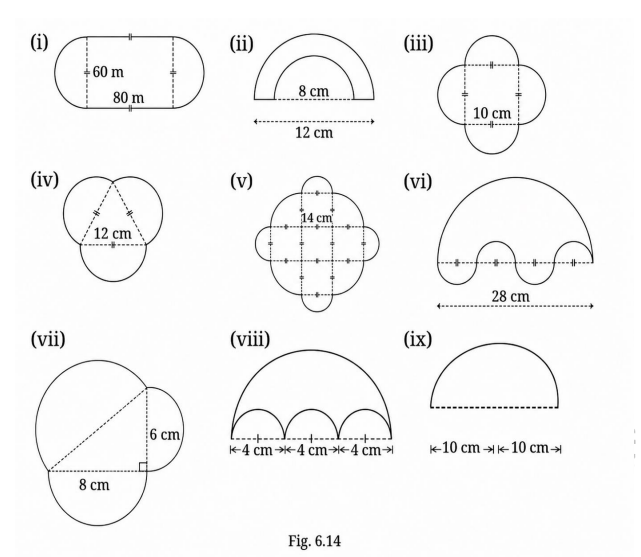
5. Find the perimeters of the following shapes (taking the arcs to be quarter or half or three-quarters of a circle, as appropriate) (Fig. 6.14 i to 6.14 ix).
Solution:
(i) The shape has:
Two straight parts of 80 m each
Two semicircles with diameter 60 m
Two semicircles together form one complete circle.
Therefore,
Perimeter = two straight parts + circumference of one circle
= 80 + 80 + π × 60
= 160 + 22/7 × 60
= 160 + 1320/7
= 348.57 m
(ii)
Outer semicircle diameter = 12 cm
Outer radius = 6 cm
Inner semicircle diameter = 8 cm
Inner radius = 4 cm
Two straight side parts = 2 cm + 2 cm = 4 cm
Therefore,
Perimeter = outer semicircle + inner semicircle + straight parts
= π × 6 + π × 4 + 4
= 10π + 4
= 10 × 22/7 + 4
= 220/7 + 4
= 35.43 cm
(iii)
The figure has 4 semicircles, each with diameter 10 cm.
Radius of each semicircle = 10/2 = 5 cm
Therefore,
Perimeter = 4 × semicircle length
= 4 × πr
= 4 × π × 5
= 20π
= 20 × 22/7
= 440/7
= 62.86 cm
(iv)
The figure has 3 semicircles, each with diameter 12 cm.
Radius of each semicircle = 12/2 = 6 cm
Therefore,
Perimeter = 3 × semicircle length
= 3 × πr
= 3 × π × 6
= 18π
= 18 × 22/7
= 396/7
= 56.57 cm
(v)
The figure has 4 semicircles, each with diameter 14 cm, and 4 quarter circles, each with radius 14 cm.
Radius of each semicircle = 14/2 = 7 cm
Therefore,
Perimeter = 4 × semicircle length + 4 × quarter circle length
= 4 × π × 7 + 4 × 1/2 × π × 14
= 28π + 28π
= 56π
= 56 × 22/7
= 176 cm
(vi)
The total base length is 28 cm.
For the large upper semicircle:
Diameter = 28 cm
Radius = 14 cm
For the small semicircles:
The base is divided into 4 equal parts.
So, diameter of each small semicircle = 28/4 = 7 cm
Radius of each small semicircle = 7/2 = 3.5 cm
Therefore,
Perimeter = large semicircle + 4 small semicircles
= π × 14 + 4 × π × 3.5
= 14π + 14π
= 28π
= 28 × 22/7
= 88 cm
(vii)
The figure has semicircles drawn on the sides of a right-angled triangle.
The perpendicular sides are 6 cm and 8 cm.
Using the Baudhāyana–Pythagoras theorem:
h² = 6² + 8²
= 36 + 64
= 100
So,
h = 10 cm
The diameters of the semicircles are 6 cm, 8 cm, and 10 cm.
Therefore, their radii are:
3 cm, 4 cm, and 5 cm
Now,
Perimeter = semicircle on 6 cm side + semicircle on 8 cm side + semicircle on 10 cm side
= π × 3 + π × 4 + π × 5
= π × (3 + 4 + 5)
= 12π
= 12 × 22/7
= 264/7
= 37.71 cm
(viii)
For the large semicircle:
Diameter = 12 cm
Radius = 6 cm
There are 3 small semicircles, each with diameter 4 cm.
Radius of each small semicircle = 4/2 = 2 cm
Therefore,
Perimeter = large semicircle + 3 small semicircles
= π × 6 + 3 × π × 2
= 6π + 6π
= 12π
= 12 × 22/7
= 264/7
= 37.71 cm
(ix)
For the large semicircle:
Diameter = 20 cm
Radius = 10 cm
There are 2 small semicircles, each with diameter 10 cm.
Radius of each small semicircle = 10/2 = 5 cm
Therefore,
Perimeter = large semicircle + 2 small semicircles
= π × 10 + 2 × π × 5
= 10π + 10π
= 20π
= 20 × 22/7
= 440/7
= 62.86 cm
6. If the diameter of a car tyre is 56 cm, then: (i) How far does the car need to travel for the tyre to complete one revolution? (ii) How many revolutions does the tyre make if the car travels 10 km?
Solution:
(i) Distance in one revolution = Circumference of tyre
C = 2πr
= 2 × 22/7 × 28
= 22 × 8
= 176 cm
(ii) Total distance = 10 km = 10 × 1000 × 100 = 1,000,000 cm
Number of revolutions = Total distance / Distance per revolution
= 1,000,000 / 176
= 5681.82 ≈ 5682 revolutions
7. Find the total perimeter of all the petals in each of the given flowers.
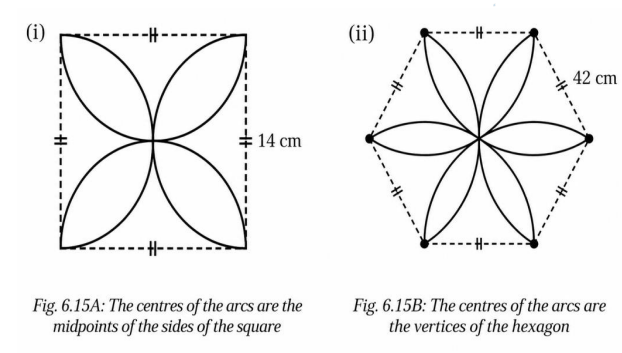
Solution: (i) The figure is a square with side 14 cm.
Each petal is formed by quarter-circle arcs whose centres lie at the midpoints of the sides.
Radius of each quarter circle = 14/2 = 7 cm
Each petal is made up of 2 quarter circles, which together form 1 semicircle.
Total number of petals = 4
So, total curved length = 4 semicircles = 2 complete circles
Therefore,
Perimeter = 2 × circumference of one circle
= 2 × 2πr
= 4πr
= 4 × 22/7 × 7
= 88 cm
Hence, the total perimeter of the figure is 88 cm.
(ii) The figure is based on a regular hexagon with side 42 cm.
Each petal is formed by arcs of circles with radius 42 cm. There are 6 petals, and each petal consists of 2 arcs of 60° each.
So, total angle formed by one petal = 60° + 60° = 120°
Total angle for all 6 petals
= 6 × 120°
= 720°
= 2 complete circles
Therefore,
Perimeter = 2 × circumference of a circle with radius 42 cm
= 2 × 2πr
= 4πr
= 4 × 22/7 × 42
= 4 × 132
= 528 cm
Hence, the total perimeter of the figure is 528 cm.
8. The ratio of the perimeters of two circles is 5 : 4. What is the ratio of their radii?
Solution: Given, ratio of the perimeters of two circles = 5 : 4
Let the radius of the first circle = R
Let the radius of the second circle = r
According to the question:
Perimeter of first circle : Perimeter of second circle = 5 : 4
2πR : 2πr = 5 : 4
Since 2π is common, it gets cancelled.
R : r = 5 : 4
Hence, the ratio of their radii is 5 : 4.
Ex 6.2 class 9
1. Find the area of triangle ADE in Fig. 6.31.
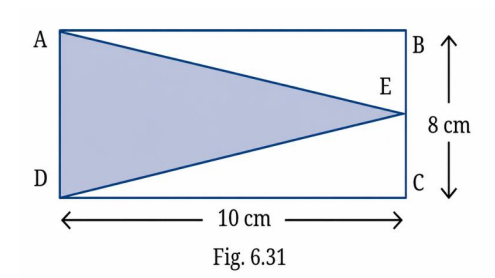
Solution: From the figure:
AD = 8 cm
Height from AD to E = 10 cm
Area of triangle ADE
= 1/2 × base × height
= 1/2 × 8 × 10
= 40 cm²
Therefore, the area of triangle ADE is 40 cm².
2. The parallel sides of a trapezium are 40 cm and 20 cm. If its non-parallel sides are both equal, each being 26 cm, find the area of the trapezium.
Solution: Difference between the parallel sides = 40 − 20 = 20 cm
Since the non-parallel sides are equal, the difference is divided equally on both sides.
Half of the difference = 20/2 = 10 cm
Using the Pythagoras theorem:
Height² = 26² − 10²
= 676 − 100
= 576
Therefore,
Height = 24 cm
Now,
Area of trapezium
= 1/2 × sum of parallel sides × height
= 1/2 × (40 + 20) × 24
= 30 × 24
= 720 cm²
Therefore, the area of the trapezium is 720 cm².
3. Find the area of a triangle, given that its sides are 8 cm and 11 cm long, and its perimeter is 32 cm.
Solution: Third side = Perimeter − sum of the other two sides
= 32 − (8 + 11)
= 32 − 19
= 13 cm
So, the sides of the triangle are 8 cm, 11 cm, and 13 cm.
Semi-perimeter,
s = 32/2
= 16 cm
Using Heron’s formula:
Area = √[s(s − a)(s − b)(s − c)]
= √[16(16 − 8)(16 − 11)(16 − 13)]
= √[16 × 8 × 5 × 3]
= √1920
= 8√30 cm²
Therefore, the area of the triangle is 8√30 cm².
4. The sides of a triangular plot are in the ratio 3 : 5 : 7; its perimeter is 300 m. Find its area.
Solution: Let the sides of the triangle be 3x, 5x, and 7x.
Given perimeter = 300 m
So,
3x + 5x + 7x = 300
15x = 300
x = 20
Therefore, the sides of the triangle are:
3x = 3 × 20 = 60 m
5x = 5 × 20 = 100 m
7x = 7 × 20 = 140 m
Now, semi-perimeter,
s = 300/2 = 150 m
Using Heron’s formula:
Area = √[s(s − a)(s − b)(s − c)]
= √[150(150 − 60)(150 − 100)(150 − 140)]
= √[150 × 90 × 50 × 10]
= √6750000
= 1500√3 m²
Therefore, the area of the triangle is 1500√3 m².
5. One diagonal of a rhombus is twice as long as the other diagonal. If the rhombus has area 128 cm², find the length of the shorter diagonal.
Solution: Let the shorter diagonal be x cm.
Then, the longer diagonal = 2x cm.
Area of rhombus = 1/2 × d₁ × d₂
= 128 = 1/2 × x × 2x
= 128 = x²
= x = √128
= x = 8√2
6. ABCD is a parallelogram. P and Q are any two points on side AB. What can you say about the ratio area(△PCD) : area(△QCD)?
Solution: Triangles PCD and QCD have the same base, CD.
Since points P and Q lie on AB and AB is parallel to CD, the perpendicular distances of P and Q from CD are equal.
Therefore, both triangles have:
- Same base CD
- Same height
So, their areas are equal.
Hence,
area(△PCD) : area(△QCD) = 1 : 1
7. O is any point on the diagonal PR of a parallelogram PQRS. Prove that the areas of triangles PSO and PQO are equal.
Solution: In parallelogram PQRS, diagonal PR is drawn, and point O lies on PR.
Triangles PSO and PQO have the same base, PO.
Also, points S and Q lie on opposite sides of PR in the parallelogram. Since opposite sides of a parallelogram are parallel, the perpendicular distances of S and Q from line PR are equal.
Therefore, triangles PSO and PQO have:
- Same base PO
- Equal heights
So,
area(△PSO) = area(△PQO)
Hence proved.
8. If the mid-points of the sides of a 4-gon are joined in order, prove that the area of the parallelogram thus formed will be half of the area of the given 4-gon. (You may wonder whether the 4-gon thus formed is always a parallelogram, and if so, why? These questions will be tackled and answered in the chapter on quadrilaterals.)
Solution: Let ABCD be the given quadrilateral.
Let P, Q, R, and S be the midpoints of sides AB, BC, CD, and DA respectively. Join P, Q, R, and S in order.
So, PQRS is the quadrilateral formed inside ABCD.
Now, draw diagonal AC of quadrilateral ABCD.
In triangle ABC, P and Q are the midpoints of AB and BC.
Therefore, by the midpoint theorem:
PQ ∥ AC and PQ = 1/2 AC
In triangle ADC, S and R are the midpoints of AD and DC.
Therefore, by the midpoint theorem:
SR ∥ AC and SR = 1/2 AC
So, PQ ∥ SR and PQ = SR
Hence, PQRS is a parallelogram.
Now, the four corner triangles are:
△APS, △BPQ, △CQR, and △DRS
Each of these triangles has half the base and half the height of the corresponding larger triangle formed by diagonal AC. Therefore, the total area of the four corner triangles is half the area of the original quadrilateral ABCD.
So, the remaining middle parallelogram PQRS has the other half of the area.
Therefore, area(parallelogram PQRS) = 1/2 × area(quadrilateral ABCD)
Hence proved.
Key Points of NCERT Class 9 Maths Chapter 6 – Measuring Space: Perimeter and Area
- Chapter 6, Measuring Space: Perimeter and Area, focuses on measuring the boundary and surface area of different two-dimensional shapes.
- Students learn the meaning of perimeter as the total length of the boundary of a shape.
- The chapter explains the circumference of a circle and introduces the important relationship between circumference and diameter.
- Students understand the significance of π (pi) and learn why values like 22/7 are only approximations.
- The chapter covers the formula for finding the length of an arc of a circle.
- Students learn how to calculate the area of basic shapes such as rectangles, parallelograms, triangles, and circles.
- Important formulas such as area of a triangle, Heron’s formula, and area of a circle are explained with examples.
- The chapter introduces advanced ideas such as Brahmagupta’s formula for cyclic quadrilaterals and the concept of squaring a rectangle.
- Activity-based questions, puzzles, and “Think and Reflect” tasks help students develop logical reasoning and visual understanding.
- Infinity Learn NCERT Solutions for Class 9 Maths Chapter 6 are created by expert teachers to help students understand formulas, solve problems step by step, and prepare confidently for CBSE exams.
All Formulas in Class 9 Maths Ganita Manjari Chapter 6
| Shape / Concept | Formula |
| Perimeter of rectangle | 2(a + b) |
| Circumference of circle | 2πr or πd |
| Length of arc | 2πr × (θ°/360°) |
| Area of rectangle | ab sq. units |
| Area of square | a² sq. units |
| Area of parallelogram | base × height = bh |
| Area of triangle | ½ × base × height = ½bh |
| Semi-perimeter (triangle) | s = ½(a + b + c) |
| Heron’s formula | √[s(s−a)(s−b)(s−c)] |
| Area of circle | πr² |
| Area of sector | πr² × (θ°/360°) |
| Area of triangle (circumcircle) | abc / 4R |
| Area of triangle (incircle) | r(a + b + c) / 2 |
| Semi-perimeter (cyclic 4-gon) | s = ½(a + b + c + d) |
| Brahmagupta’s formula | √[(s−a)(s−b)(s−c)(s−d)] |
NCERT Solutions for Class 9 Maths Chapter-wise
| Chapter No. | Important Links for class 9 Maths Chapter-wise Solutions PDF |
| Chapter 1 | Orienting Yourself: The Use of Coordinates |
| Chapter 2 | Introduction to Linear Polynomials |
| Chapter 3 | The World of Numbers |
| Chapter 4 | Exploring Algebraic Identities |
| Chapter 4 | I’m Up and Down, and Round and Round |
Important Study Materials for Class 9 Maths
course
No courses found
Frequently Asked Questions on NCERT Solutions for Class 9 Maths Chapter 6
How are NCERT Solutions for Class 9 Maths Chapter 6 helpful for CBSE exam preparation?
NCERT Solutions for Class 9 Maths Chapter 6 help students prepare for CBSE exams by providing step-by-step answers, clear explanations, important formulas, and practice-based learning. Infinity Learn expert-created solutions help students understand perimeter, area, circumference, arc length, and related mensuration concepts with better clarity.
Is Class 9 Maths Ganita Manjari Chapter 6 easy or difficult?
Class 9 Maths Ganita Manjari Chapter 6, Measuring Space: Perimeter and Area, can be easy if students understand the formulas and practise regularly. Some questions may feel challenging because they involve diagrams, arcs, circles, triangles, and application-based problems. Infinity Learn makes the chapter easier through simple explanations and step-by-step solutions.
How can Class 9 Maths Chapter 6 Solutions PDF help in exam preparation?
Class 9 Maths Chapter 6 Solutions PDF helps students revise formulas, practise solved examples, and understand the correct method of solving NCERT questions. With Infinity Learn’s solutions PDF, students can study anytime, revise before exams, and improve accuracy in perimeter and area-based problems.
Where can I find Class 9 NCERT Solutions Chapter 6 Maths?
Students can find Class 9 NCERT Solutions Chapter 6 Maths on Infinity Learn. The solutions are prepared by expert teachers and are designed to help students understand every concept in Measuring Space: Perimeter and Area in a simple and structured way.
Is the Class 9 NCERT Solutions Chapter 6 PDF available online?
Yes, the Class 9 NCERT Solutions Chapter 6 PDF is available online. Students can use Infinity Learn to access Chapter 6 solutions for quick revision, homework help, and CBSE exam preparation.
Why should students use Infinity Learn for Class 9 Maths Chapter 6 Solutions?
Students should use Infinity Learn for Class 9 Maths Chapter 6 Solutions because the content is created by expert teachers and explained in an easy-to-understand manner. The solutions include step-by-step methods, formula-based explanations, and exam-focused practice support to help students build confidence.
Where can I download NCERT Solutions for Class 9 Maths Chapter 6 PDF?
Students can download NCERT Solutions for Class 9 Maths Chapter 6 PDF from Infinity Learn. The PDF helps students revise offline, practise textbook questions, and prepare effectively for school tests and CBSE exams.
Are NCERT Solutions for Class 9 Maths Chapter 6 suitable for CBSE students?
Yes, NCERT Solutions for Class 9 Maths Chapter 6 are suitable for CBSE students because they follow the NCERT syllabus and help students prepare according to school exam requirements. Infinity Learn solutions are aligned with the latest syllabus and help students understand concepts clearly through expert guidance.
