How Forces Affect Motion NCERT Solutions Class 9 Science Exploration
By Karan Singh Bisht
|
Updated on 29 Jul 2026, 16:19 IST
NCERT Solution for Class 9 Science Exploration Chapter 6 How Forces Affect Motion are designed to help students understand the chapter in a simple, clear, and step-by-step way. These solutions are useful for the 2026-27 academic session and help students revise textbook exercise questions, extra questions, and important concepts in both English and Hindi Medium.
Class 9 How Forces Affect Motion chapter 6 explains how force changes the motion of objects. Students learn how a force can make an object move, stop a moving object, change its speed, change its direction, or even change its shape. Since this chapter is connected with earlier concepts like position, velocity, and acceleration, it helps students build a strong base in Physics.
The NCERT solutions are prepared using the latest NCERT Class 9 Science Exploration textbook and the important topics given in Chapter 6. These include force, friction, Newton’s laws of motion, inertia, action and reaction, and real-life applications of force. Each answer is written after carefully studying the textbook explanations, activities, examples, and exercise questions.
At Infinity Learn, subject experts explain the chapter in easy language so that students can understand the reason behind every answer. The solutions do not simply give direct answers; they explain concepts with familiar examples such as catching a cricket ball, rowing a canoe, airbags in cars, rocket launch, and friction between different surfaces.
These solutions are helpful for Class 9 students who want support with homework, revision, school exams, and concept clarity. Teachers can use them for classroom explanation, and parents can use them to guide students during self-study.
By using NCERT Solutions for Class 9 Science Exploration Chapter 6 from Infinity Learn, students can improve their understanding of force and motion, practice important questions, write better answers, and prepare confidently for exams.
Loading PDF...
Download How Forces Affect Motion Class 9 NCERT Solutions PDF
How Forces Affect Motion Class 9 Questions and Answers (Exercise)
Revise, Reflect, Refine
1. Using a horizontal force F, a table is moved across the floor at a constant velocity. How much is the frictional force exerted by the floor on the table?
Answer: Since the table is moving with constant velocity, its acceleration is zero.
So, the net force on the table is zero.
This means the frictional force must be equal in magnitude to the applied force F, but it acts in the opposite direction.

Frictional force = F
So, the floor exerts a frictional force of magnitude F on the table, opposite to the direction of motion.
Best Courses for You

JEE

NEET

Foundation JEE

Foundation NEET

CBSE
2. For a ball moving on a smooth frictionless surface, choose the appropriate option that will make the following statements physically correct.
(i) If no net force is applied on the ball, the velocity of the ball will remain the same/increase/decrease.
Answer: remain the same
(ii) If a net force is applied on the ball in the direction of its motion, the magnitude of the velocity of the ball will remain the same/increase/decrease.
Answer: increase
(iii) If a net force is applied on the ball in a direction opposite to the direction of its motion, the magnitude of the velocity of the ball will remain the same/increase/decrease.
Answer: decrease
3. Two blocks P and Q on a smooth horizontal surface are shown in Fig. 6.36(a) and Fig. 6.36(b). Two forces of magnitudes 4 N and 5 N are acting in opposite directions on block P, while block Q is moving with a constant velocity. Which of the following statement is correct?
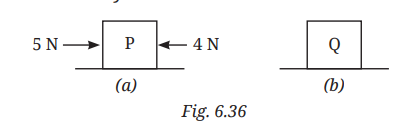
Which of the following statement is correct?
(i) P experiences a net force and Q does not experience a net force.
(ii) P does not experience a net force and Q experiences a net force.
(iii) Both P and Q experience a net force.
(iv) Neither P nor Q experiences a net force.
Answer: Correct option: (i) P experiences a net force and Q does not experience a net force.
Explanation:
For block P, two opposite forces are acting:
5 N to the right and 4 N to the left.
Net force on P = 5 N - 4 N = 1 N to the right
So, P experiences a net force.
For block Q, it is moving with constant velocity on a smooth surface. Constant velocity means acceleration is zero, so the net force must be zero.
So, Q does not experience a net force.
4. While practising for the snake boat race (𝘝𝘢𝘭𝘭𝘶𝘮 𝘬𝘢𝘭𝘪 in Kerala), 100 oarsmen are rowing a boat together. Out of these, 95 row backwards to propel the boat forward. But by mistake, 5 oarsmen row in the opposite direction. If each oarsman applies a horizontal force of 200 N, what is the net force on the snake boat?
(Ignore drag forces, air friction, etc.)
Answer: 95 oarsmen apply force in the correct direction to move the boat forward.
Force by 95 oarsmen:
95 × 200 = 19000 N
5 oarsmen row in the opposite direction, so their force acts backward.
Force by 5 oarsmen:
5 × 200 = 1000 N
Net force on the boat:
19000 - 1000 = 18000 N
Therefore, the net force on the snake boat is 18000 N in the forward direction.
5. When a net force acts on an object, we observe that the object accelerates:
(i) opposite to the direction of force, with acceleration proportional to the force acting on the object.
(ii) opposite to the direction of force, with acceleration proportional to the mass of the object.
(iii) in the direction of force, with acceleration inversely proportional to the force acting on the object.
(iv) in the direction of force, with acceleration proportional to the force acting on the object.
Answer: In the direction of force, with acceleration proportional to the force acting on the object.
Explanation:
When a net force acts on an object, the object accelerates in the same direction as the net force.
According to Newton’s second law:
F = ma
So,
a = F / m
This means acceleration increases when the net force increases, if the mass remains the same.
Therefore, the correct answer is: (iv) in the direction of force, with acceleration proportional to the force acting on the object.
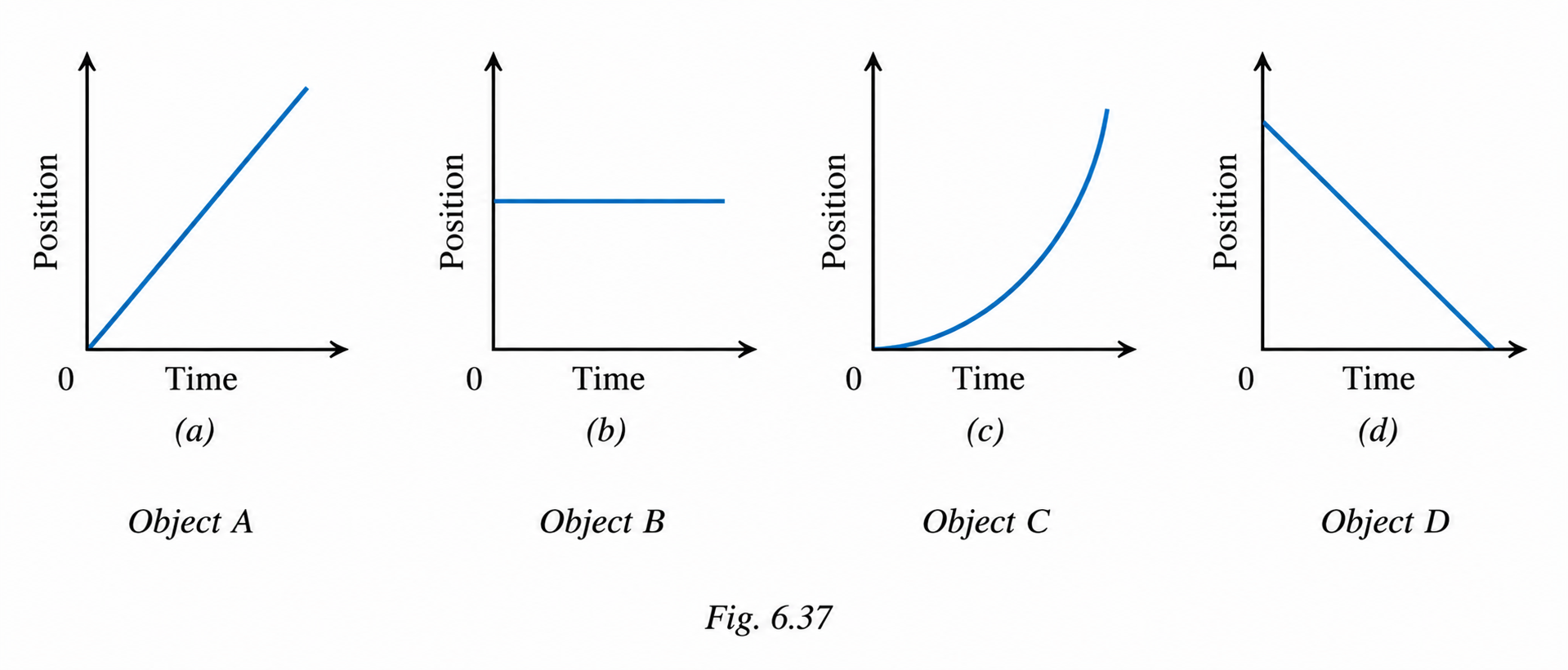
6. The position-time graph for four objects A, B, C and D moving along a straight line are given in Fig. 6.37. A net force acts on:
(i) Object A
(ii) Object B
(iii) Object C
(iv) Object D
Answer: Correct option: (iii) Object C
In a position-time graph, the slope shows velocity.
- Object A has a straight slanting line, so its velocity is constant. Net force is zero.
- Object B has a horizontal line, so it is at rest. Net force is zero.
- Object C has a curved line, so its velocity is changing. This means it is accelerating.
- Object D has a straight slanting line downward, so it has constant velocity in the opposite direction. Net force is zero.
Since a net force causes acceleration, a net force acts on Object C.
7. A sailor jumps out from a small boat to the shore (Fig. 6.38). As the sailor jumps forward, will the boat move? If yes, in which direction and why?
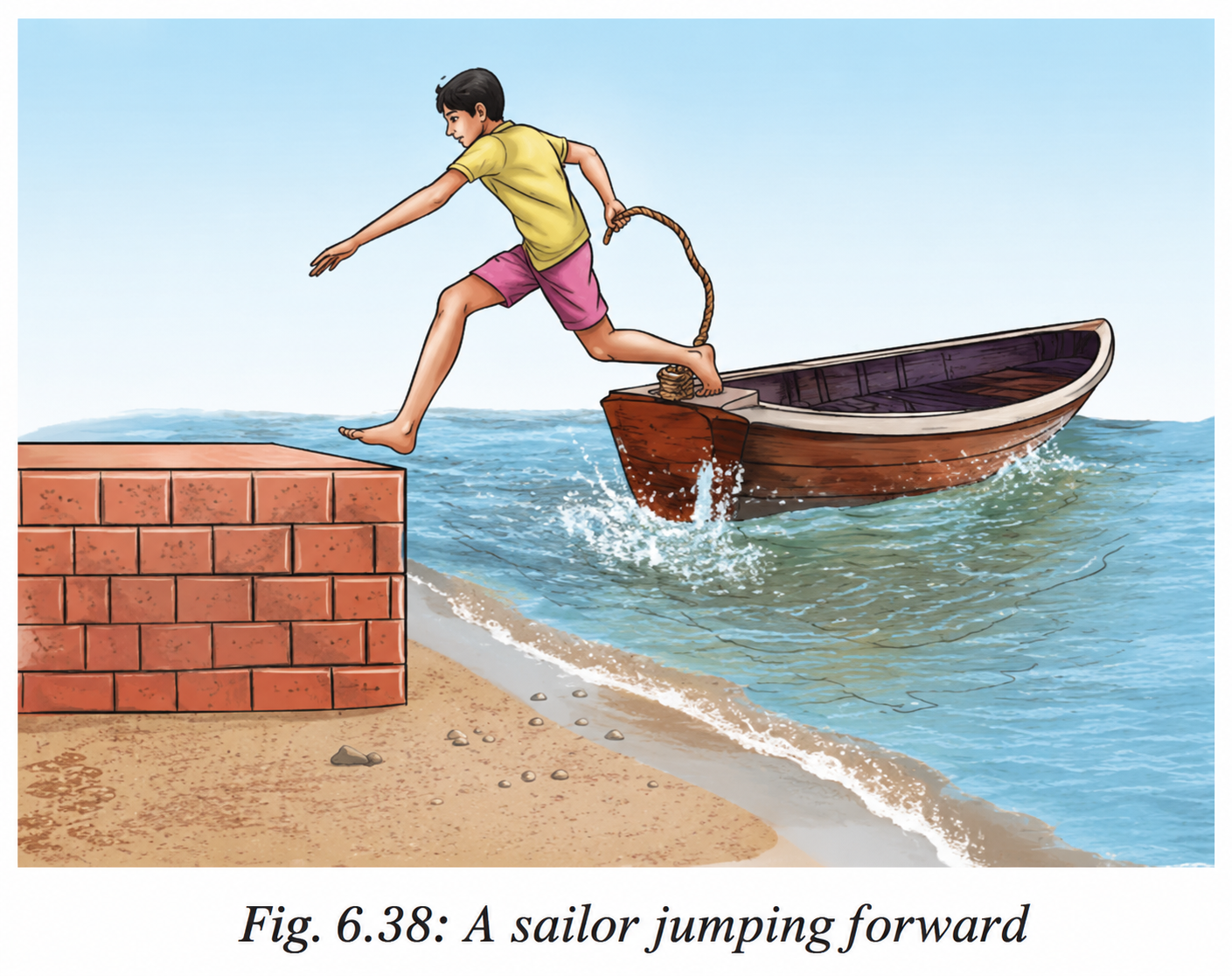
Answer: Yes, the boat will move backward, away from the shore.
When the sailor jumps forward, he pushes the boat backward with his feet. According to Newton’s third law of motion, the boat pushes the sailor forward with an equal and opposite force.
So:
- Sailor moves forward towards the shore
- Boat moves backward, away from the shore
This happens because action and reaction forces are equal in magnitude and opposite in direction.
8. During a high jump event, a landing mat or sand bed is placed for the athlete to fall upon (Fig. 6.39). Explain the reason behind it.
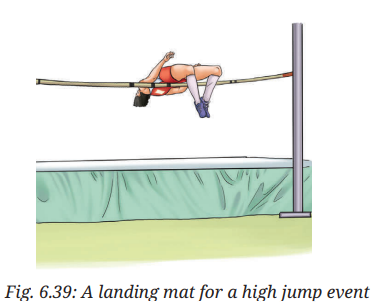
Answer: A landing mat or sand bed is placed so that the athlete lands safely. When the athlete falls from a height, their body has momentum. On landing, this momentum has to become zero. A soft mat or sand bed increases the time taken to stop the athlete’s body. Since the stopping time increases, the force acting on the athlete becomes smaller.
So, the mat reduces the impact force and protects the athlete from injury. Therefore, a landing mat or sand bed is used in a high jump event to make the landing safer.
9. A hand cart loaded with vegetables collides with an identical but empty hand cart. During the collision:
(i) the loaded cart exerts a force of larger magnitude on the empty cart.
(ii) the empty cart exerts a force of larger magnitude on the loaded cart.
(iii) neither cart exerts a force on the other.
(iv) the loaded cart and the empty cart both exert an equal magnitude of force on each other.
Answer: The loaded cart and the empty cart both exert an equal magnitude of force on each other.
Explanation:
During a collision, both carts push each other with equal force in opposite directions. This is according to Newton’s third law of motion.
Even though the loaded cart has more mass and the empty cart may move more, the force exerted by each cart on the other is equal in magnitude and opposite in direction.
Therefore, the correct answer is: (iv) the loaded cart and the empty cart both exert an equal magnitude of force on each other.
10. The acceleration-mass graph for the acceleration produced by a force on objects of different masses is plotted in Fig. 6.40. Plot the force-mass graph for this case.
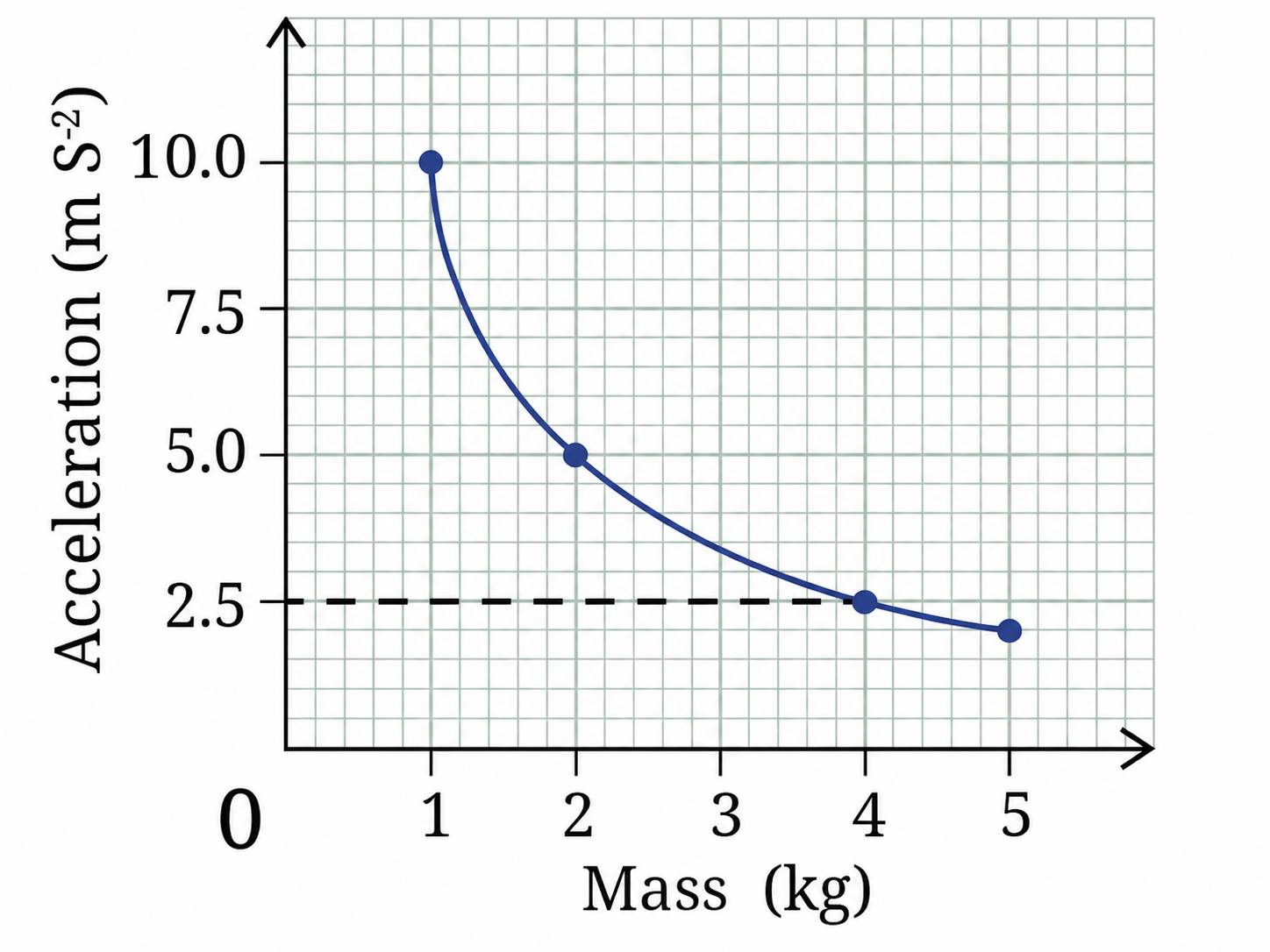
Answer: From the acceleration-mass graph:
Force = mass × acceleration
Using the points shown:
| Mass (kg) | Acceleration (m/s²) | Force = m × a |
| 1 | 10 | 1 × 10 = 10 N |
| 2 | 5 | 2 × 5 = 10 N |
| 4 | 2.5 | 4 × 2.5 = 10 N |
| 5 | 2 | 5 × 2 = 10 N |
So, the force is the same in all cases:
F = 10 N
Therefore, the force-mass graph will be a horizontal straight line parallel to the mass axis at 10 N.
Graph description:
Take mass (kg) on the x-axis and force (N) on the y-axis. Mark points such as (1, 10), (2, 10), (4, 10), (5, 10) and join them. The graph will be a horizontal line.
11. The velocity-time graph of an object of mass 10 kg moving along a straight line is shown in Fig. 6.41. Calculate the force acting on the object by using the graph.
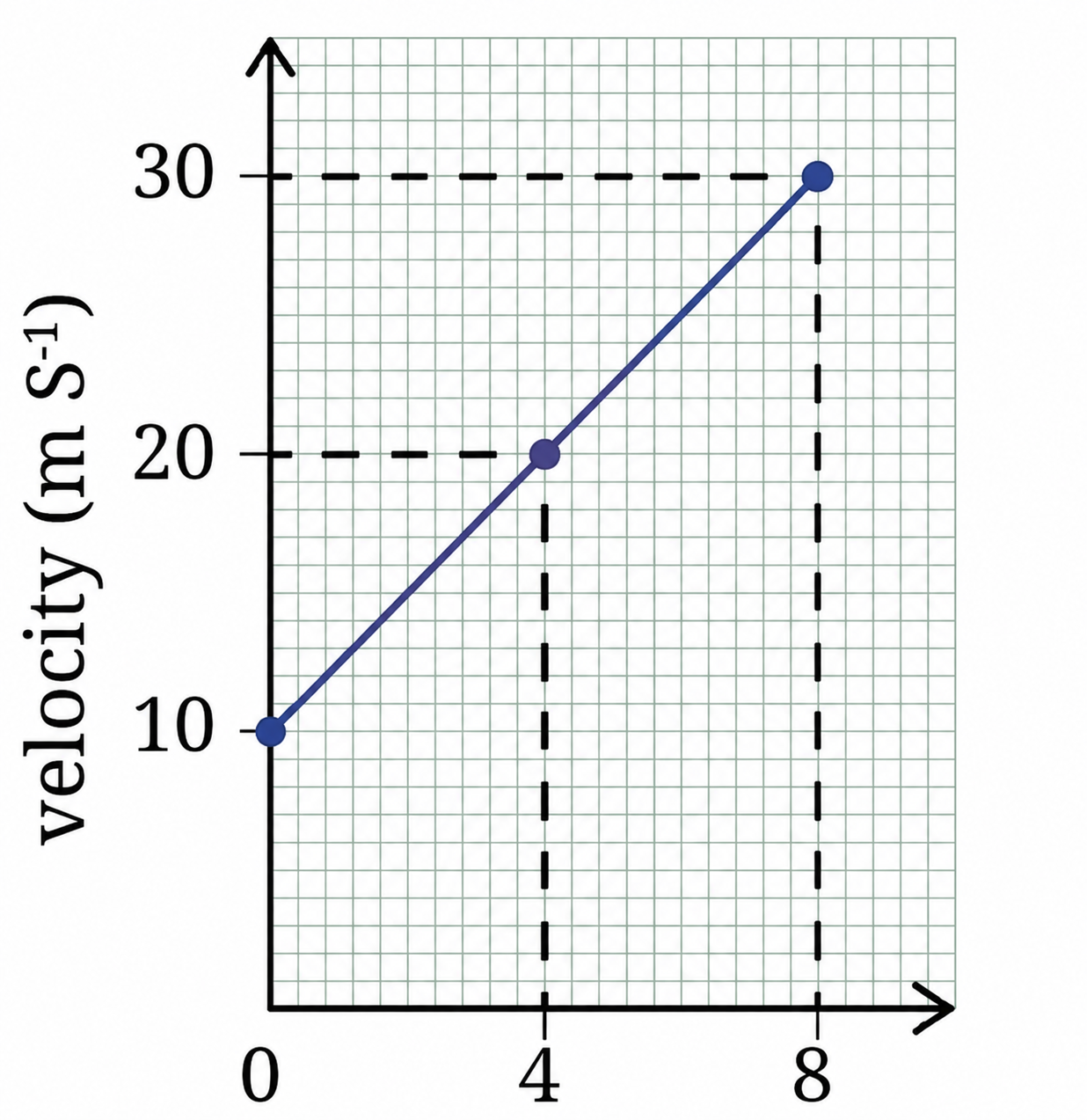
Answer: From the velocity-time graph:
Initial velocity, u = 10 m/s
Final velocity, v = 30 m/s
Time taken, t = 8 s
Mass of object, m = 10 kg
Acceleration is the slope of the velocity-time graph:
a = (v - u) / t
a = (30 - 10) / 8 = 20 / 8 = 2.5 m/s²
Now, using Newton’s second law:
F = m × a
F = 10 × 2.5 = 25 N
Therefore, the force acting on the object is 25 N.
12. A bullet of mass 50 g moving with a speed of 100 m/s enters a heavy stationary wooden block and stops after penetrating a distance of 50 cm. Estimate the stopping force acting on the bullet. (assume that the bullet undergoes constant acceleration within the block).
Answer: Mass = 50 g = 0.05 kg
Initial velocity (u) = 100 m/s
Final velocity (v) = 0 m/s
Distance (s) = 50 cm = 0.5 m
Using:
v² = u² + 2as
0 = (100)² + 2a(0.5)
0 = 10000 + a
a = −10000 m/s²
Force:
F = ma = 0.05 × (−10000) = −500 N
Stopping force = 500 N (opposite to direction of motion).
13. An ace footballer converted a penalty shot by kicking the football with a speed of 108 km h⁻¹. The estimated force they imparted was 800 N. The mass of the football was 0.4 kg. Calculate the time of contact between their foot and the ball.
Answer: Speed = 108 km/h = 30 m/s
Initial velocity (u) = 0
Final velocity (v) = 30 m/s
Mass = 0.4 kg
Force = 800 N
Using: F = ma
a = F/m = 800/0.4 = 2000 m/s²
Using: v = u + at
30 = 0 + (2000)t
t = 30/2000 = 0.015 s
Time of contact = 0.015 s.
14. An object of mass 2 kg moving with a constant velocity of 10 m s⁻¹ encounters a rough patch where the force of friction on the object is 7 N. At the same time, an additional constant force of 3 N opposing the motion is applied on the object. After entering the rough patch, how much distance does the object travel before coming to rest?
Answer:
Mass of object, m = 2 kg
Initial velocity, u = 10 m/s
Final velocity, v = 0 m/s
Frictional force = 7 N
Additional opposing force = 3 N
Total opposing force:
7 + 3 = 10 N
So, net force acting opposite to motion = 10 N
Using Newton’s second law:
F = ma
10 = 2 × a
a = 5 m/s²
Since the force is opposing the motion, acceleration is negative:
a = -5 m/s²
Now use:
v² = u² + 2as
0² = 10² + 2(-5)s
0 = 100 - 10s
10s = 100
s = 10 m
Therefore, the object travels 10 m before coming to rest.
15. A tractor pulls a harrow (a ploughing tool) of mass m₁ with a net force F resulting in an acceleration of a₁. The same tractor pulls a trolley of mass m₂ with a force F producing an acceleration of a₂. If the tractor now pulls the trolley with the harrow placed on it (with the same force F), then obtain an expression for the resulting acceleration in terms of a₁ and a₂. Ignore friction.
Answer: For the harrow of mass m₁:
F = m₁a₁
So,
m₁ = F / a₁
For the trolley of mass m₂:
F = m₂a₂
So,
m₂ = F / a₂
Now, the tractor pulls the trolley with the harrow placed on it.
So, total mass is:
m₁ + m₂
Let the resulting acceleration be a.
Using Newton’s second law:
F = (m₁ + m₂)a
So,
a = F / (m₁ + m₂)
Substitute the values of m₁ and m₂:
a = F / (F/a₁ + F/a₂)
Taking F common in the denominator:
a = F / [F(1/a₁ + 1/a₂)]
So,
a = 1 / (1/a₁ + 1/a₂)
Therefore,
a = (a₁a₂) / (a₁ + a₂)
So, the resulting acceleration is:
a = a₁a₂ / (a₁ + a₂)
16. When the pole of a bar magnet is brought close to a magnetic compass, the bar magnet and the compass needle (which is also a magnet) exert a magnetic force on each other. As per Newton’s third law of motion, both the forces are equal in magnitude and opposite in direction. However, the compass needle moves, whereas the bar magnet does not move (Fig. 6.42). Explain why.
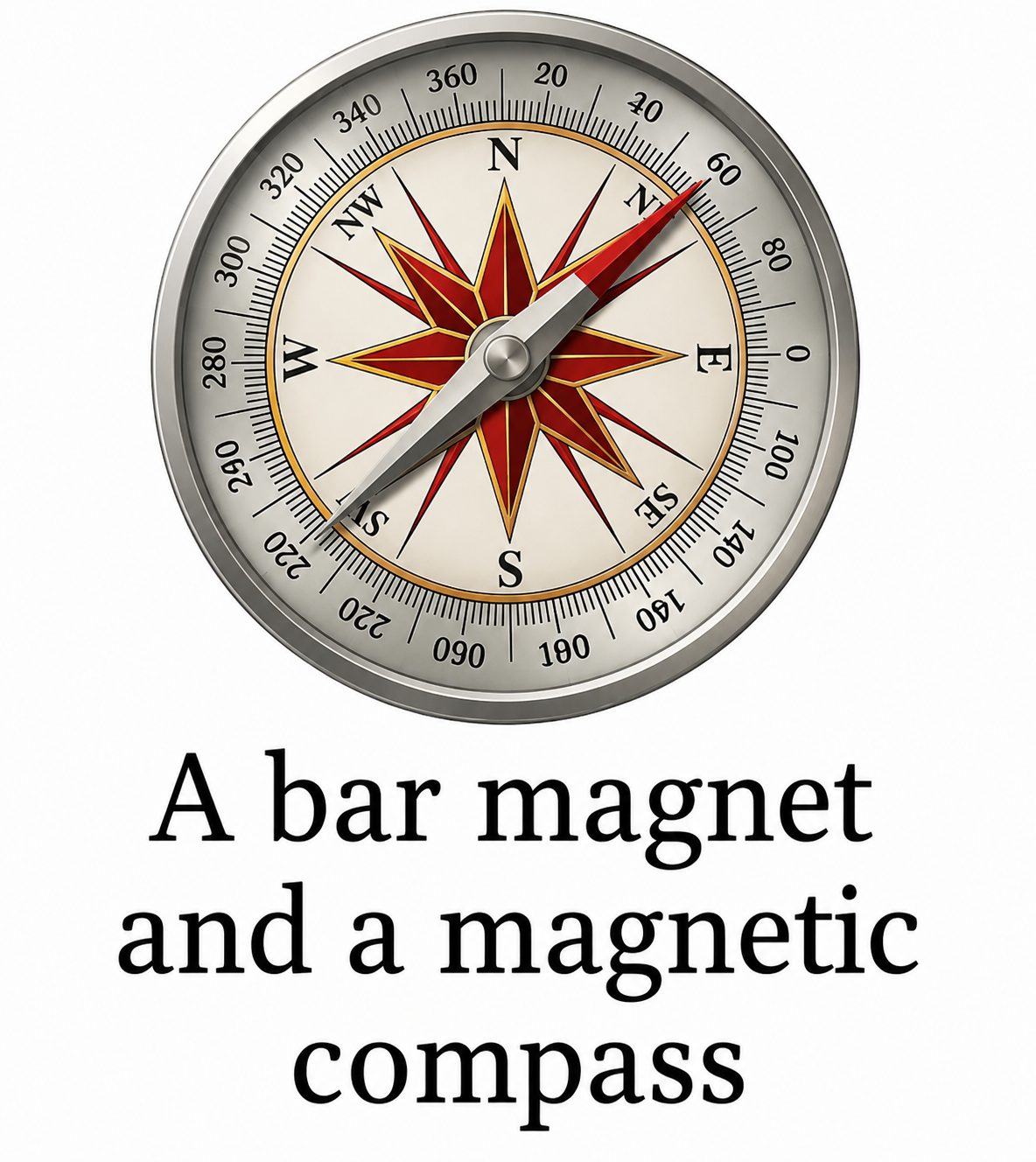
Answer: The bar magnet and the compass needle experience equal and opposite magnetic forces, as required by Newton’s third law. But equal force does not mean equal motion.
The compass needle is:
- very light,
- mounted on a low-friction pivot, and
- free to rotate.
So even a small magnetic force produces a noticeable turning effect, or torque, on it.
The bar magnet is much heavier and is usually held in the hand or resting on a surface. Friction, support forces, and the force applied by the hand prevent it from moving noticeably. Its acceleration is therefore extremely small.
Thus, both magnets exert equal forces on each other, but the compass needle moves because it is light and free to rotate, whereas the bar magnet is restrained.
How Forces Affect Motion Class 9 Question Answer Science Exploration Chapter 6 Important Formulas
| Formula | Meaning |
| F = ma | Newton’s Second Law |
| a = F/m | Acceleration from force and mass |
| F = mg | Weight (gravitational force on an object) |
| g = 9.8 m/s² ≈ 10 m/s² | Acceleration due to gravity (near Earth’s surface) |
| Net F = F₁ + F₂ | Forces acting in the same direction |
| Net F = F₁ − F₂ | Forces acting in opposite directions |
| a = F / (m₁ + m₂) | Acceleration of a system of two connected objects |
Class 9 NCERT Science Book Exploration Solutions Chapter-wise Links
- Chapter 1 Exploration Entering the World of Secondary Science Class 9 Question Answer
- Chapter 2 Cell The Building Block of Life Class 9 Question Answer
- Chapter 3 Tissues in Action Class 9 Question Answer
- Chapter 4 Describing Motion Around Us Class 9 Question Answer
- Chapter 5 Exploring Mixtures and Their Separation Class 9 Question Answer
course
No courses found
Class 9 Science Exploration Chapter 6 FAQs
What is included in the How Forces Affect Motion Class 9 NCERT PDF?
How Forces Affect Motion Class 9 Science Chapter 6 PDF contains exercise questions, detailed answers, explanations, numerical problems, diagrams and graph-based questions. It covers topics such as balanced and unbalanced forces, acceleration, friction, momentum and Newton’s laws of motion. Students can use the chapter resources available from Infinity Learn for revision and exam preparation.
Where can students find the How forces affect motion class 9 NCERT solutions PDF?
Students can access study materials and chapter-wise solutions through Infinity Learn. The solutions explain every answer step by step and include numerical calculations, graphs and conceptual questions from the chapter.
What topics are covered in How Forces Affect Motion Question Answer?
How Forces Affect Motion Class 9 questions and answers cover:
- Net force and friction
- Constant velocity and acceleration
- Newton’s first, second and third laws
- Force–mass and acceleration–mass relationships
- Momentum and impact force
- Position–time and velocity–time graphs
For example, the chapter explains that an object moving with constant velocity has zero acceleration and therefore experiences zero net force.
Does the Class 9 science NCERT solutions chapter 6 PDF contain numerical problems?
Yes. The PDF includes several numerical problems based on:
- (F = ma)
- Equations of motion
- Acceleration from velocity–time graphs
- Stopping force
- Distance travelled before coming to rest
- Time of contact between two objects
How can Infinity Learn help with Class 9 Science Chapter 6?
Infinity Learn provides student-friendly explanations, chapter-wise NCERT solutions, revision materials and practice questions. Students looking for the How Forces Affect Motion Class 9 NCERT PDF, How forces affect motion class 9 NCERT solutions PDF, or Class 9 Science NCERT solutions Chapter 6 PDF can use Infinity Learn resources for structured revision and exam preparation.
How does force affect the motion of an object?
A net force can change an object’s speed, direction of motion or both. According to Newton’s second law, acceleration occurs in the direction of the net force and is directly proportional to the force when mass remains constant.
Why does an object moving with constant velocity have zero net force?
Constant velocity means that the object’s speed and direction are not changing. Therefore, its acceleration is zero. According to (F = ma), when acceleration is zero, the net force acting on the object is also zero.
How can students identify acceleration from a position–time graph?
The slope of a position–time graph represents velocity. A straight line shows constant velocity, while a curved line shows changing velocity and therefore acceleration. In the exercise, Object C has a curved position–time graph, so a net force acts on it.
