- NCERT Solutions for Class 9 Science Chapter 2 PDF
- Class 9 Science NCERT Solutions Chapter 2 Overview
- NCERT Solutions for Class 9 Science Chapter 2 Question Answers
- Benefits of Using Infinity Learn Class 9 Science Chapter 2 Solutions
- How to Study NCERT Class 9 Science Chapter 2 Effectively
- FAQs on NCERT Solutions for Class 9 Science Chapter 2
NCERT Solutions for Class 9 Science Exploration Chapter 2 Cell: The Building Block of Life
By Karan Singh Bisht
|
Updated on 29 Jun 2026, 13:07 IST
Cell: The Building Block of Life NCERT Solutions for Class 9 Science Exploration Chapter 2 are updated for the 2026-27 academic session. These solutions are useful for CBSE students and other boards that follow the NCERT curriculum. Students can also access Chapter 2 Science Class 9 PDF resources to study the chapter, revise key concepts, and practice textbook questions.
Chapter 2 of Class 9 Science Exploration, Cell: The Building Block of Life, introduces students to cells, the basic structural and functional units of all living organisms. The chapter begins with how life may have originated in water, including environments similar to hot springs such as Puga Valley in Ladakh, and then takes students into the microscopic world of cells.
In this chapter, students learn how cells are studied using light and electron microscopes. They also explore the structure and functions of the cell membrane, cell wall, nucleus, and important cell organelles such as mitochondria, ribosomes, chloroplasts, and the Golgi apparatus. The chapter further explains how cells divide through mitosis and meiosis.
Class 9 Science Chapter 2 also introduces Cell Theory, an important principle in biology that explains the basic nature of living organisms. It connects cell biology with real-life examples such as osmosis, food preservation, and cancer. As part of the revised NCERT curriculum for the 2026-27 session, this chapter helps students build a strong foundation for understanding life processes and living systems.
NCERT Solutions for Class 9 Science Chapter 2 PDF
Students can download Chapter 2 Science Class 9 PDF resources on Infinity Learn to revise the chapter anytime. These PDF resources help students study textbook answers, practice questions, and prepare for exams in a structured way.
Class 9 Science NCERT Solutions Chapter 2 Overview
NCERT Class 9 Science Chapter 2 Cell: The Building Block of Life, introduces students to the microscopic world of cells. It explains how all living organisms are made up of cells and how each cell performs important life functions. The chapter begins with the origin of life and explains how life may have started in water. It then introduces students to the study of cells using light microscopes and electron microscopes. Students also learn about the structure of plant and animal cells, the function of different cell organelles, and how cells divide.
Loading PDF...
This chapter covers:
- cell as the basic unit of life
- discovery and study of cells
- use of light and electron microscopes
- Cell Theory
- cell membrane and cell wall
- nucleus and cytoplasm
- plant and animal cells
- important cell organelles
- osmosis and diffusion
- mitosis and meiosis
- real-life connections such as food preservation and cancer
Infinity Learn solutions explain these topics in simple language so that students can understand the chapter clearly.
NCERT Solutions for Class 9 Science Chapter 2 Question Answers
Class 9 Science Chapter 2, Cell: The Building Block of Life, introduces students to the basic unit of life- the cell. The chapter explains the structure of cells, the functions of cell organelles, cell membrane, cell wall, plastids, endoplasmic reticulum, and other important concepts related to living organisms. Students can use these question answers to revise the chapter and understand how to write correct responses in exams.
Cell The Building Block of Life Class 9 Question Answer Science Exploration Chapter 2
Revise, Reflect, Refine (NCERT Textbook Page No. 24)

Question 1. Differentiate between the following pairs of terms based on the clues given in parentheses:
- Cell membrane and cell wall (permeability)
- RER and SER (structure)
- Chloroplasts and chromoplasts (pigments)
Answer:
Best Courses for You

JEE

NEET

Foundation JEE

Foundation NEET

CBSE
- Cell membrane and cell wall: The cell membrane is selectively permeable. It allows only certain substances to enter and leave the cell according to the cell’s requirement. In contrast, the cell wall is freely permeable and allows most substances, such as water and minerals, to pass through easily.
- RER and SER: RER, or rough endoplasmic reticulum, has ribosomes attached to its outer surface, which gives it a rough appearance. SER, or smooth endoplasmic reticulum, does not have ribosomes on its surface and therefore appears smooth.
- Chloroplasts and chromoplasts: Chloroplasts contain the green pigment chlorophyll, which helps plants carry out photosynthesis. Chromoplasts contain coloured pigments such as yellow, orange, or red carotenoids. These pigments give bright colours to flowers and fruits.
Question 2. Two similar animal cells are placed in two different solutions:
- Cell X is placed in pure water.
- Cell Y is placed in a concentrated salt solution
Cells are observed after some time. Cell X swells, and Cell Y shrinks. Which statement provides the correct explanation for the above observations?
- Salt molecules moved into Cell Y, causing it to shrink.
- Water moved into Cell X, and more water moved out of Cell Y than the salt solution entered in it.
- Water moved into Cell X and moved out of Cell Y through the cell membrane.
- Solute movement caused osmosis in both cells.
Answer: (iii) Water moved into Cell X and moved out of Cell Y through the cell membrane.
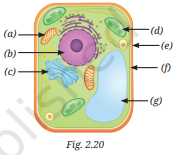
Question 3: Look at the diagram of a cell in Fig. 2.20. Identify the parts labelled from (a) to (g) and correctly match them with their functions given below:
- Controlling all the activities of a cell.
- Site of cellular respiration.
- Storage organelle that also provides rigidity to the cell.
- Separates the cell contents from surroundings.
- Provides structural rigidity to the cell.
- Packs and stores materials received from ER.
- Helps in manufacturing food
Answer:
- Controlling all the activities of a cell – (b) Nucleus
- Site of cellular respiration – (a) Mitochondria
- Storage organelle that also provides rigidity to the cell – (g) Vacuole
- Separates the cell contents from surroundings – (f) Cell membrane
- Provides structural rigidity to the cell – (e) Cell wall
- Packs and stores materials received from ER – (c) Golgi apparatus
- Helps in manufacturing food – (d) Chloroplast
Question 4. Which of the following option(s) of the pairs of cell organelles are correctly placed under the given categories?
| Options | Present in the plant cells | Absent in the animal cells |
| (i) | Leucoplast | Cell wall |
| (ii) | Mitochondria | Ribosome |
| (iii) | Cell wall | Golgi apparatus |
| (iv) | Lysosome | Endoplasmic Reticulum |
Answer: (i) Leucoplasts, Cell wall
Question 5. Two students, Renu and Rohit, were having a discussion on the plastids. Renu emphasised that all parts of the plants, even roots, contain plastids. However, Rohit did not agree with the statement and told her that plasrids are absent in plant roots since the roots are underground and do not need to perform photosynthesis. Who is correct? Justify your answer.
Answer: Renu is right. Plastids are found in different parts of plants, including roots. However, root cells usually do not have chloroplasts because roots grow underground and do not receive enough sunlight for photosynthesis. Instead of chloroplasts, root cells contain leucoplasts. Leucoplasts are colourless plastids that help store food materials such as starch, oils, and proteins.
Question 6. Mitochondria and chloroplasts are two important organelles in a plant cell. Discuss how these two Organalles are structurally and functionally similar to each other, and different from each other.
Answer: Mitochondria and chloroplasts are both double-membrane cell organelles. They also have their own DNA and ribosomes, which allow them to make some of their own proteins. Since they can perform some functions independently, they are called semi-autonomous organelles. Both organelles are also involved in energy-related processes inside the cell.
However, they differ in their location, function, and structure. Mitochondria are found in both plant and animal cells. They carry out cellular respiration and release energy in the form of ATP. Chloroplasts are found only in plant cells and help in photosynthesis by using sunlight to prepare glucose.
Structurally, chloroplasts contain a semi-fluid substance called the stroma. Inside the stroma, there are disc-shaped membrane structures that contain chlorophyll. Mitochondria, on the other hand, have a highly folded inner membrane called cristae, which increases the surface area for cellular respiration.
Question 7. Which of the following pairs of cell organelles contains DNA?
- Chloroplasts, Ribosomes
- Mitochondria, Nucleus
- Golgi bodies, Ribosomes
- Nucleus, Lysosomes
Answer: (ii) Mitochondria, Nucleus
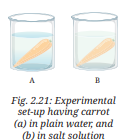
Question 8. A researcher carried out an experiment in which she took two carrots of similar size. She placed one carrot in plain water and the other carrot in concentrated salt solution (Fig. 2.21). After 24 hours she recorded her observations
- What hypothesis does she want to test through this experiment?
- What would you suggest for the Improvement of this experiment?
- Why does the carrot in plain water stay stiff and crunchy, but the carrot in concentrated salt solution become rubbery and limp?
Answer:
(i) The researcher wants to study the effect of osmosis on plant tissue under two conditions: a hypotonic solution, such as plain water, and a hypertonic solution, such as salt solution. She expects water to move into the carrot cells when they are placed in plain water, while water will move out of the cells when they are placed in the salt solution.
(ii) She can do few improvements in this experiment as given below:
- Use carrot pieces of the same size and shape so that the comparison is fair.
- Measure the initial and final weight or length of each carrot piece to record the change accurately.
- Add a third carrot piece in an isotonic solution, where the concentration is the same as inside the cell. This can act as a control and should show little or no change.
- Record observations at regular time intervals, such as every 30 minutes, to track how quickly the change occurs.
- Keep the temperature constant throughout the experiment so that it does not affect the results.
(iii) Carrot in Plain Water Beaker A
Plain water is a hypotonic solution because it has a lower solute concentration than the solution inside carrot cells. Due to osmosis, water moves into the carrot cells. As a result, the cells become turgid, or swollen with water. The swollen cells press against the rigid cell wall, creating turgor pressure. This pressure helps the carrot remain firm, stiff, and crunchy.
Carrot in Concentrated Salt Solution Beaker B
The concentrated salt solution is a hypertonic solution because it has a higher solute concentration than the solution inside carrot cells. Due to osmosis, water moves out of the carrot cells. As the cells lose water, they become flaccid, or limp. This condition is called plasmolysis, where the inner cell contents shrink away from the cell wall. Because of this, the carrot becomes soft, rubbery, and less firm.
Question 9. Indicate the presence or absence of following structures in bacterial and animal cells:
| Structures in a cell | Bacterial cell | Animal cell |
| Chromosome | ||
| Nucleus | ||
| Mitochondria | ||
| Golgi complex | ||
| Chromoplasts |
Answer:
| Structures in a cell | Bacterial cell | Animal cell |
| Chromosome | Present | Present |
| Nucleus | Absent | Present |
| Mitochondria | Absent | Present |
| Golgi complex | Absent | Present |
| Chromoplasts | Absent | Absent |
10. Carry out the following experiment:
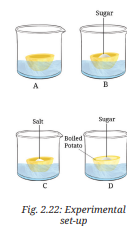
Take four peeled potato halves and scoop each one out to make potato cups. One of these potato cups should be made from a boiled potato. Place each of the potato cups in a beaker containing water (Fig. 2.22).
Now, set up the experiment as follows:
- Keep Cup A empty.
- Add one teaspoon sugar in Cup B.
- Add one teaspoon salt in Cup C.
- Add one teaspoon sugar in the boiled potato in Cup D.
Observe the four potato cups at least two hours and answer the following questions:
- Explain why water gathers in the hollowed portion of Cup B and Cup C.
- Why is Cup A necessary for this experiment?
- (Explain why water does not gather in the hollowed portions of Cups A and D.
Answer:
(i) Cups B and C contain sugar and salt inside the hollow part of the potato. These substances make the solution inside the potato cups hypertonic, meaning it has a higher solute concentration than the water outside in the beaker.
The water in the beaker is hypotonic, as it has a lower solute concentration. Due to osmosis, water moves from the beaker into the potato cups through the potato tissue. As a result, water collects inside cups B and C.
(ii) Cup A acts as the control in the experiment. It is an empty potato cup with no sugar or salt added. This helps us compare the results and confirm that water collects in cups B and C because of the solutes added, not because of the potato itself.
(iii) In Cup A, no solute is added inside the potato cup. Since there is no strong concentration difference between the inside of the cup and the surrounding water, osmosis does not occur significantly. Therefore, no water collects in Cup A.
In Cup D, the potato is boiled and sugar is added inside it. Boiling kills the potato cells and damages their selectively permeable cell membranes. Since osmosis requires a living or intact selectively permeable membrane, water cannot move into the cup by osmosis. Therefore, even though sugar is present, no water collects in Cup D.
Question 11. Identify the pair that incorrectly matches the cell organelle with its function.
(i) Ribosome – Protein synthesis
(ii) SER – Lipid and cellulose synthesis
(iii) Lysosome – Digestion of foreign agents
Answer: The incorrect pair is (ii) SER – Lipid and cellulose synthesis
- Ribosome - Protein synthesis: Correct. Ribosomes are the sites where proteins are made inside the cell.
- SER - Lipid and cellulose synthesis: Incorrect. The smooth endoplasmic reticulum, or SER, helps in the synthesis and storage of lipids and hormones. It does not synthesise cellulose. Cellulose is a major part of the plant cell wall and is mainly associated with cell wall formation.
- Lysosome - Digestion of foreign agents: Correct. Lysosomes contain digestive enzymes that break down foreign particles, waste materials, and worn-out cell organelles.
Question 12. What outcome do you expect if all the mitochondria are removed from a eukaryotic cell?
Answer: If all mitochondria are removed from a eukaryotic cell, the cell will not be able to produce enough energy to survive. Mitochondria are known as the powerhouses of the cell because they carry out cellular respiration and produce ATP, which is the main energy currency of the cell. Without mitochondria, ATP production would be greatly reduced.
As a result, important cell activities such as active transport, protein synthesis, cell division, repair, and other metabolic processes would slow down or stop because they require energy. The cell may produce a small amount of energy through anaerobic respiration in the cytoplasm for a short time. However, this energy is not enough to support the cell for long. Eventually, the cell would lose its normal functions and die.
Question 13. Which phenomenon inhibits the formation of tumours in the human body? Can plants also develop tumours? Explain.
Answer: Tumour formation in the human body is normally controlled by a process called contact inhibition. In this process, cells stop dividing when they come in contact with neighbouring cells. This prevents unnecessary and uncontrolled cell growth. Yes, plants can also develop tumour-like growths. However, plant tumours are different from cancers in animals. They are usually caused by infections, such as bacterial infection, or by abnormal cell division. Plant tumours are generally less harmful because plant cells have rigid cell walls. These cell walls restrict the spread of tumour cells to other parts of the plant.
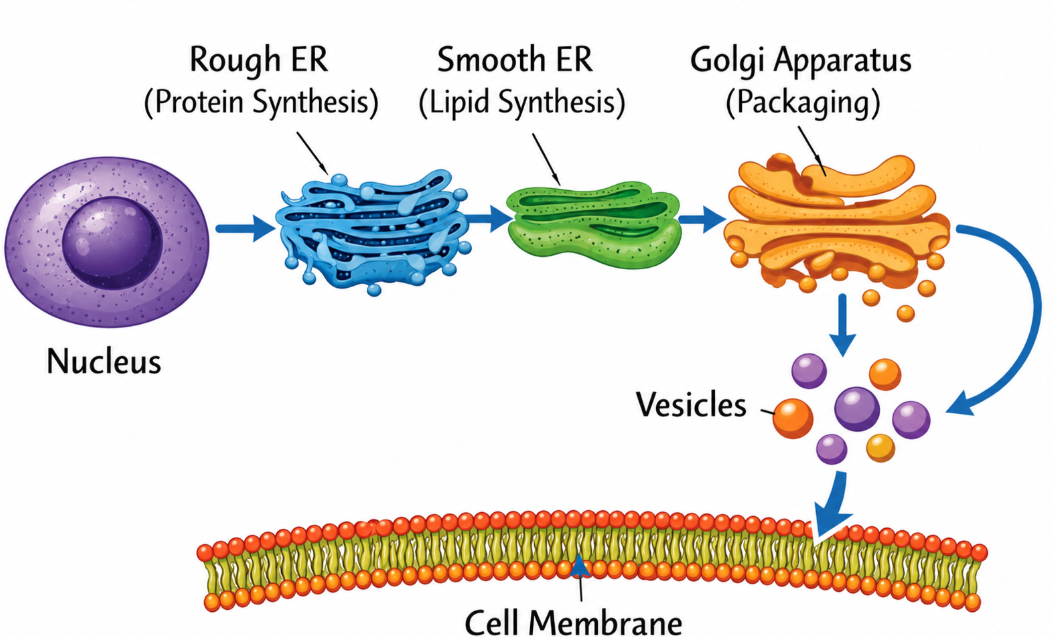
Question 14. The cell membrane of a cell is made up of proteins and lipids. Which cell organelles help in the synthesis of cell membrane? Write the path of these compounds from their site of synthesis to the cell membrane and show this through a labelled diagram.
Answer: The main organelles involved in making and transporting materials for the cell membrane are ribosomes, endoplasmic reticulum, Golgi apparatus, vesicles, and the cell membrane.
Ribosomes present on the rough endoplasmic reticulum help in protein synthesis. These proteins are then transported through the endoplasmic reticulum to the Golgi apparatus.
The smooth endoplasmic reticulum helps in the synthesis of lipids. These lipids are also sent to the Golgi apparatus for further processing.
The Golgi apparatus receives proteins and lipids from the endoplasmic reticulum. It modifies, sorts, and packages them into small sacs called vesicles. These vesicles then move towards the cell membrane and fuse with it.
The pathway can be understood as:
For proteins: Ribosomes on RER → protein synthesis → transport through ER → Golgi apparatus → packaging into vesicles → fusion with cell membrane
For lipids: SER → lipid synthesis → transport to Golgi apparatus → packaging into vesicles → delivery to cell membrane
Question 15. Which would happen if gametes are formed by mitotic divisions?
Answer: If gametes were produced by mitosis instead of meiosis, they would have the full number of chromosomes, or diploid (2n), instead of half the number, or haploid (n).
During fertilisation, when two diploid gametes fuse, the zygote would have four sets of chromosomes (4n) instead of the normal diploid number. In the next generation, the chromosome number would keep doubling, such as 8n, 16n, 32n, and so on.
This continuous increase in chromosome number would disturb normal cell functioning. The cells may become genetically unstable and unable to work properly. Such chromosome imbalance could be harmful or even lethal for the organism.
Meiosis is important because it keeps the chromosome number constant from one generation to the next. It also creates genetic variation through recombination, while mitosis produces identical cells and does not create the same level of diversity.
Question 16. A farmer, Deepa, was very happy with the harvest of amla (Indian Gooseberry) and lemons on her farm. However, she could sell only onefourth of the produce in the local market. Recognising that a significant amount of produce may be lost post-harvest, she employed a traditional yet scientifically sound method to extend the shelf life of amla and lemons. She turned perishable produce into profitable products, such as pickles and sharbat. She used the excess produce to prepare pickles, murabbas, and sharbat by adding appropriate amounts of salt, sugar, or jaggery to small pieces of fruit and their juices. These were then stored in small glass bottles for sale, helping her prevent the wastage of post-harvest produce. This shift from farming to agro-processing would strengthen food security and boost the local economy, creating a sustainable model that cuts waste while increasing her income. Based on the above passage answer the following question
(i) Which scientific concept has the farmer applied in the preservation of the farm produce?
(ii) How does the addition of high concentrations of salt and sugar create an environment that prevents the growth of spoilage-causing bacteria and fungi?
(iii) Suggest a healthy recipe of this kind for food preservation.
(iv) What are the scientific values addressed in this case?
Answer: (i) The farmer used the principle of osmosis for food preservation.(ii) Salt and sugar, when used in high concentration, create a hypertonic environment around microorganisms such as bacteria and fungi. Due to osmosis, water moves out of these microbial cells. As a result, the microbes become dehydrated, their growth is slowed or stopped, and the food is protected from spoilage.
(iii) Healthy amla pickle recipe:
Take 500 g chopped amla. Add 2 tablespoons mustard oil, 1 tablespoon turmeric powder, 1 tablespoon red chilli powder, 2 tablespoons salt, and 1 tablespoon jaggery instead of using excess sugar.
Heat the mustard oil slightly, add the spices, and mix this with the chopped amla. Store the mixture in a clean, dry glass jar and keep it in sunlight for a few days. This method helps preserve the amla, improves its flavour, and retains nutrients such as vitamin C while reducing microbial growth.
(iv) The scientific values shown in this example include resource conservation, food preservation using osmosis, sustainable use of agricultural produce, food security, and innovation through traditional knowledge and science. It also promotes economic awareness, entrepreneurship, and reduction of food waste.
Benefits of Using Infinity Learn Class 9 Science Chapter 2 Solutions
Infinity Learn provides easy-to-understand solutions for Class 9 Science NCERT Solutions Chapter 2. These solutions help students learn the chapter in a simple and organized way.
- Helps students understand Cell: The Building Block of Life in a simple way.
- Provides step-by-step answers to NCERT textbook questions.
- Makes difficult topics like cell organelles, osmosis, mitosis, and meiosis easier to learn.
- Supports school homework and regular practice.
- It helps students prepare for class tests and exams.
- Improves answer-writing skills with clear explanations.
- Useful for quick revision before exams.
- Covers important topics such as cell membrane, nucleus, mitochondria, ribosomes, chloroplasts, and cell wall.
- Helps students understand diagrams and differences between key terms.
- Suitable for CBSE and other boards that follow the NCERT curriculum.
- Builds strong concept clarity for higher-level Biology topics.
- Allows students to study Chapter 2 in a focused and organized way.
How to Study NCERT Class 9 Science Chapter 2 Effectively
To study NCERT Class 9 Science Chapter 2 effectively, students should follow a proper method instead of only memorizing answers.
- Read the chapter carefully: Start by reading the chapter from the NCERT textbook. Focus on the meaning of important terms such as cell, nucleus, organelles, osmosis, mitosis, and meiosis.
- Understand the structure of a cell: Learn the parts of a cell and understand their functions. Try to compare plant cells and animal cells.
- Make an organelle-function table: Prepare a table of cell organelles and their functions. This will help in quick revision before exams.
- Practice diagrams: Draw and label plant and animal cells. Diagram-based questions are important for Science exams.
- Revise Cell Theory: Understand the three main points of Cell Theory and why it is important in biology.
- Learn the difference between mitosis and meiosis: Make a comparison table to revise both types of cell division.
- Solve textbook questions: Attempt the questions yourself first. Then use Infinity Learn NCERT solutions to check your answers and improve your explanation.
Class 9 Study Materials
course
No courses found
FAQs on NCERT Solutions for Class 9 Science Chapter 2
What is Chapter 2 of Class 9 Science Exploration about?
NCERT Chapter 2 Class 9 Science Exploration Cell: The Building Block of Life, is about cells, which are the basic units of all living organisms. It explains cell structure, Cell Theory, cell organelles, osmosis, mitosis, meiosis, and the role of cells in life processes.
Where can I get NCERT Solutions for Class 9 Science Chapter 2?
Students can get NCERT Solutions for Class 9 Science Chapter 2 on Infinity Learn. The solutions provide clear, step-by-step answers for the chapter Cell: The Building Block of Life.
Are Class 9 Science NCERT Solutions Chapter 2 useful for exams?
Yes, Class 9 Science NCERT Solutions Chapter 2 on Infinity Learn are useful for exams because they explain textbook questions in a simple format and help students practise correct answer writing.
What are the important topics in NCERT Class 9 Science Chapter 2?
Important topics include Cell Theory, cell membrane, cell wall, nucleus, cytoplasm, mitochondria, ribosomes, chloroplasts, Golgi apparatus, osmosis, mitosis, meiosis, and differences between plant and animal cells.
Can I access Chapter 2 Science Class 9 PDF?
Yes, students can access Chapter 2 Science Class 9 PDF resources on Infinity Learn for revision, homework, and exam preparation.
Why is the cell called the basic unit of life?
The cell is called the basic unit of life because all living organisms are made up of cells. All important life processes, such as nutrition, respiration, growth, repair, and reproduction, take place inside cells.
What is Cell Theory in Class 9 Science Chapter 2?
Cell Theory states that all living organisms are made up of cells, the cell is the basic structural and functional unit of life, and new cells arise from pre-existing cells.
What is the difference between plant cells and animal cells?
Plant cells have a cell wall, chloroplasts, and a large central vacuole. Animal cells do not have a cell wall or chloroplasts and usually have smaller vacuoles. Infinity Learn solutions explain these differences in an easy table format for quick revision.
What is osmosis in Chapter 2 Science Class 9?
Osmosis is the movement of water molecules through a selectively permeable membrane from a region of higher water concentration to a region of lower water concentration. This concept is explained with examples in Infinity Learn’s Class 9 Science Chapter 2 solutions.
How can Infinity Learn help in Class 9 Science Chapter 2 preparation?
Infinity Learn helps students prepare for Class 9 Science Chapter 2 by providing step-by-step NCERT solutions, simple explanations, important topics, diagram-based help, PDF resources, and exam-focused revision support.
