Tissues in Action Class 9 NCERT Solutions Science Exploration Chapter 3
By Karan Singh Bisht
|
Updated on 29 Jul 2026, 16:15 IST
NCERT Solutions for Class 9 Science Exploration Chapter 3 Tissues in Action are prepared in English for the 2026-27 academic session, along with additional questions and answers. This learning material is designed to help students understand the chapter clearly, revise important concepts and prepare effectively for school examinations. Students searching for a Class 9 Science NCERT Solutions Chapter 3 PDF or a reliable NCERT Class 9 Science Chapter 3 PDF can use these solutions for classroom learning, homework support and exam preparation. The explanations are written in simple, student-friendly language and follow the topics and learning objectives covered in the latest NCERT Science Exploration textbook and CBSE syllabus.
Chapter 3, Tissues in Action, introduces students to biological tissues the building blocks of living organisms. Life begins with a single cell that divides repeatedly and eventually forms the skin, muscles, bones, nerves and other organs of the body. The chapter explains how structurally similar cells organize themselves into tissues and work together to perform specific functions. The Tissues in Action Class 9 NCERT Solutions PDF presents these concepts in a clear and organised manner, while the Tissues in Action Notes Class 9 help learners revise important definitions, functions and differences between various tissue types.
The chapter explores how plant and animal tissues differ in their structure and function. In plants, meristematic tissues- apical, lateral and intercalary support growth in length, increase in girth and regrowth after damage. Permanent tissues such as parenchyma, collenchyma, sclerenchyma, xylem and phloem perform functions including storage, protection, support and transportation. Students can use the Class 9 Science Chapter 3 Tissues in Action exercise question answer material to understand these concepts through detailed explanations and textbook-based solutions.
In animals, the chapter discusses four major tissue types: epithelial, connective, muscular and nervous tissues. It also covers the musculoskeletal system, skeletal system and different types of joints, including ball-and-socket, hinge, pivot and fixed joints. These topics connect tissue structure with movement and other body functions. The Tissue Chapter Class 9 NCERT PDF question answer resource is useful for students who need step-by-step explanations, additional practice and quick revision before examinations.
Download Tissues in Action Class 9 NCERT Solutions PDF
Tissues in Action Class 9 Questions and Answers (Exercise)
Revise, Reflect, Refine (NCERT Textbook Page No. 44)
Question 1. Meristematic tissues divide repeatedly. What property of their cells allows them to do this?
(i) They have thick walls for protection.
Loading PDF...
(ii) They contain large vacuoles that store nutrients.
(iii) They have thin walls, dense cytoplasm, and large, prominent nucleus.
(iv) They are functionally differentiated cells.
Answer: (iii) They have thin walls, dense cytoplasm, and large, prominent nucleus.

Question 2. If a plant is unable to transport food from leaves to roots, which tissue is malfunctioning?
(i) Xylem
Best Courses for You

JEE

NEET

Foundation JEE

Foundation NEET

CBSE
(ii) Phloem
(iii) Epidermis
(iv) Sclerenchyma
Answer: (ii) Phloem
Question 3. Why are the epithelial tissues that line an animal’s internal organs usually only one or a few cells thick?
(i) To store food efficiently.
(ii) To provide maximum strength.
(iii) To allow quick exchange of materials across them.
(iv) To reduce friction.
Answer: (iii) To allow quick exchange of materials across them.
Question 4. You can perform these two jumps (Fig. 3.21):
Straight-leg jump – keep knees and ankles stiff.
Normal jump – bend knees and ankles naturally.
How did your ankle, knee, and hip positions differ between the two jumps?
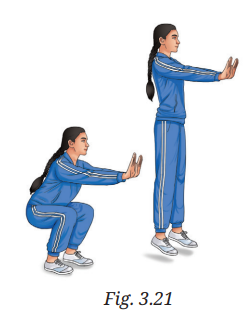
Answer: In the straight-leg jump, the ankles, knees and hips stayed mostly straight and stiff, with very little bending.
In the normal jump, the body first bent at all three joints:
- the ankles flexed,
- the knees bent deeply, and
- the hips moved backward and flexed.
During take-off, the ankles, knees and hips then extended together. This greater joint movement helps produce a stronger and more comfortable jump.
5. Which type of joint is involved when you bend your knees and ankles?
(i) Ball and socket
(ii) Hinge
(iii) Pivot
Answer: (ii) Hinge
6. In each of the following cases (A, B, C and D), choose the correct option as given below:
(i) Both (A) and (R) are true, and (R) is the correct explanation of (A). (ii) Both (A) and (R) are true, but (R) is not the correct explanation of (A). (iii) (A) is true, but (R) is false. (iv) (A) is false, but (R) is true.
A. Assertion: Epithelium is well-suited for gas exchange in the lungs. Reason: It consists of multiple layers of tall cells that slow down diffusion.
B. Assertion: Cardiac muscle can contract continuously without fatigue. Reason: Cardiac muscle cells have a high number of mitochondria and an abundant blood supply.
C. Assertion: Tendons connect bone to bone and allow joint movement. Reason: Tendons are made of tough connective tissue that transmits force from muscle to bone.
D. Assertion: In a hinge joint, movement occurs primarily in one plane. Reason: The bone ends are shaped to allow sliding in all directions.
Answer:
A. (iii) — A is true, but R is false.
B. (i) — Both A and R are true and R is the correct explanation of A.
C. (iv) — A is false, but R is true.
D. (iii) — A is true, but R is false.
7. Plot a graph between the age of a tree (in years) on the x-axis and the diameter of the tree (in cm) along with the number of annual rings formed over time on the y-axis, using the data given in the Table 3.7.
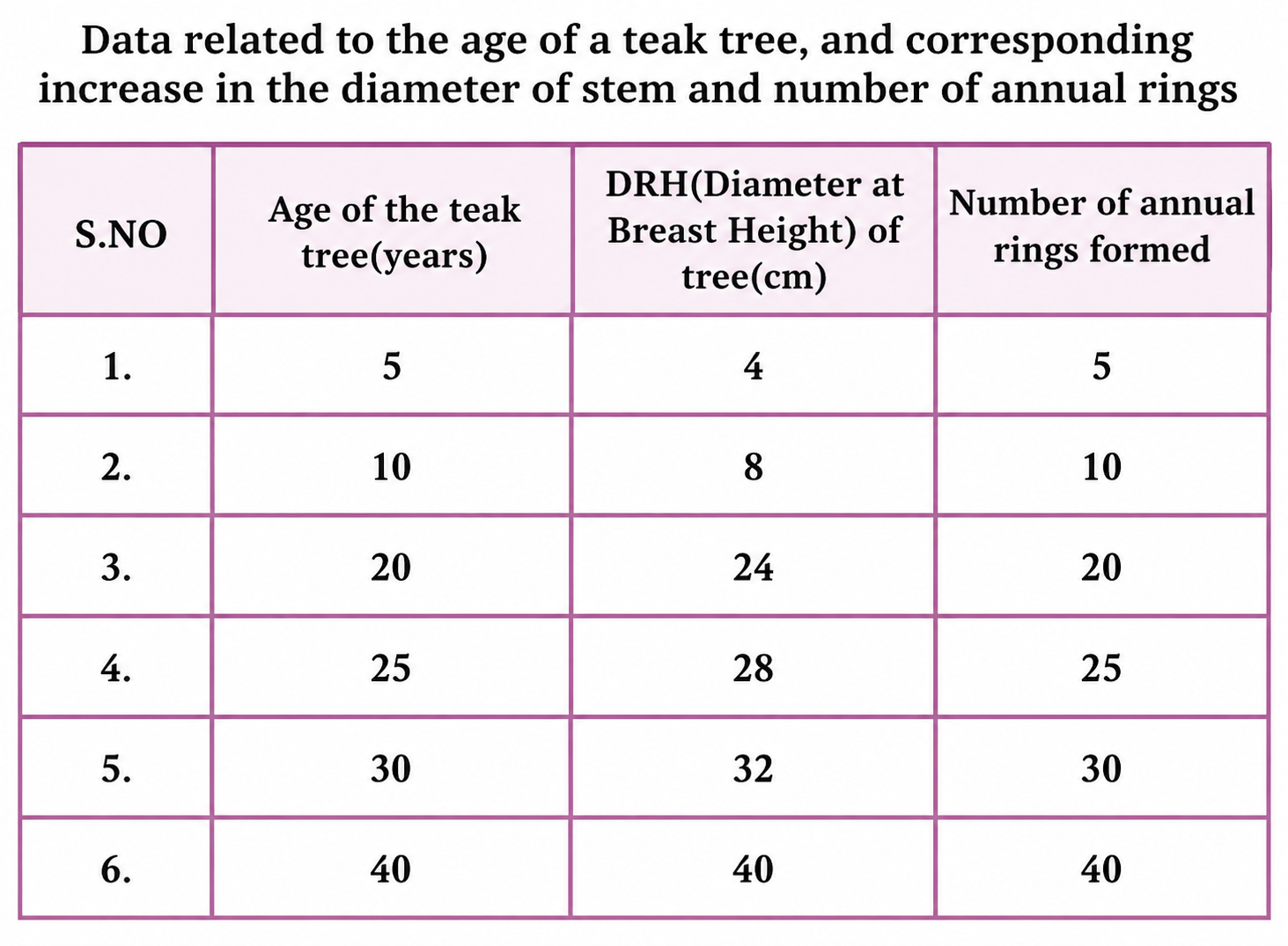
(i) Analyse the graph in terms of the diameter of the stem over time and share the interpretation.
(ii) What is the relation between the diameter of the teak tree to the annual rings formed?
(iii) Which specialised tissue is responsible for the girth of the stem and where is it located?
Answer: (i) The diameter of a teak tree generally increases as it grows older, although the rate of increase is not constant. From 10 to 20 years, the diameter rises sharply from 8 cm to 24 cm, indicating a phase of rapid growth. After 20 years, the trunk continues to widen, but the increase becomes slower and more gradual. Overall, the data show that the tree undergoes continuous lateral growth throughout its life.
(ii) The number of annual rings is equal to the age of the tree in years. For example, a 5-year-old tree has 5 rings, while a 40-year-old tree has 40 rings. Since the diameter also increases with age, trees with more annual rings generally have thicker trunks. Each annual ring represents one year of growth, showing that the stem diameter is closely related to the number of rings formed.
(iii) The lateral meristem is responsible for increasing the girth or thickness of the stem. It is arranged along the circumference of the stem and continuously divides to produce new cells on both the inner and outer sides. This cell formation increases the diameter of the trunk. Over time, the activity of the lateral meristem produces annual growth rings that can be seen in a cross-section of the stem.
8. In a forest, it was observed that one of the trees was severely debarked by an elephant to meet its food requirements, as the bark is a rich source of nutrients (Fig. 3.22).
Based on your learning, answer the following:
(i) Which function(s) of the tree is/are hampered by debarking?
(ii) Which plant tissue would be affected by further damage to the tree trunk even after debarking?
(iii) Which function of the tree would be hampered if the tissues beneath the bark were severely damaged?
(iv) What assumptions are you making to answer the questions above? How would the answer change if your assumptions are also changed?
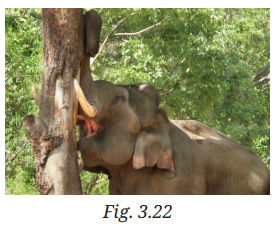
Answer: (i) Debarking damages the tree’s protective covering and may also injure the phloem present in the inner bark. Therefore, protection from water loss, pests, pathogens and mechanical injury is reduced. The transport of prepared food from the leaves to other parts of the plant may also be disturbed.
(ii) If the trunk is damaged further after the bark has been removed, the vascular cambium and xylem tissues beneath the bark may be affected.
(iii) Severe damage to the tissues beneath the bark can hamper:
- transport of water and minerals from the roots to the leaves by the xylem;
- increase in the girth of the stem due to damage to the vascular cambium; and
- mechanical support provided by the woody xylem.
(iv) These answers assume that the bark has been removed deeply enough to damage the inner bark and phloem, but that the xylem is initially intact. They also assume that a considerable part of the trunk has been debarked.
If only the outermost bark is removed, the main effect would be loss of protection, while food transport may continue. If the bark is removed completely around the trunk, or girdled, phloem transport may stop and the roots may eventually starve. If the damage extends deeper into the cambium and xylem, secondary growth and the upward transport of water and minerals will also be seriously affected.
9. Aamrapali observed that a young mango sapling’s stem bends flexibly during monsoon winds and does not break. Which tissue is responsible for this flexibility? Predict and provide your explanation of the impact if the existing tissue was replaced by sclerenchyma.
Answer: The tissue responsible for the flexible bending of a young mango stem is collenchyma. Its living cells have unevenly thickened walls, which provide mechanical support while allowing the stem to bend without breaking during strong monsoon winds.
If collenchyma were replaced by sclerenchyma, the stem would become more rigid and less flexible. Sclerenchyma cells have thick, lignified walls and are usually dead at maturity. They provide strength, but they do not allow much bending. As a result, the young stem would be more likely to crack or break under strong winds instead of bending safely.
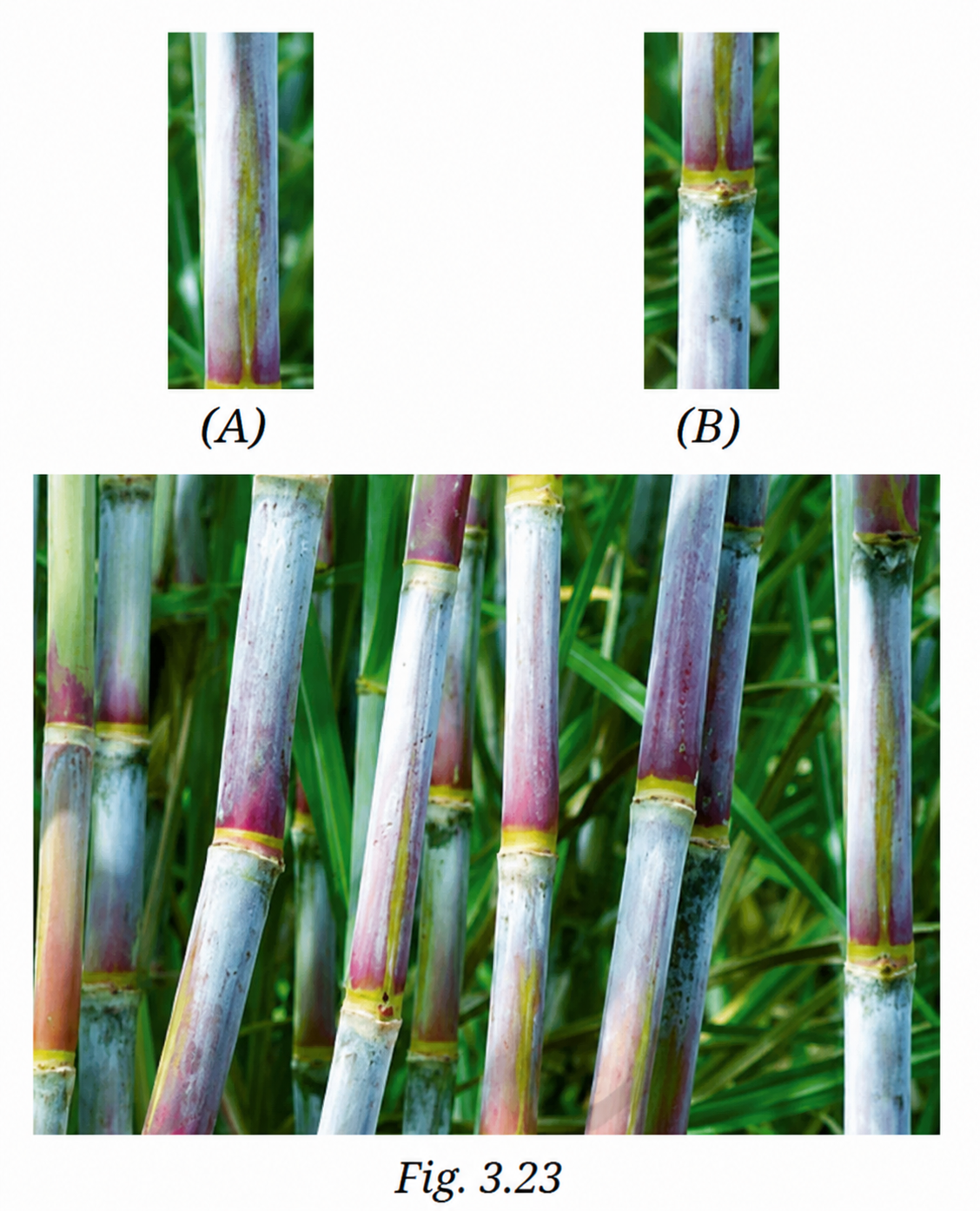
10. Sohan designed an experiment for the regeneration of sugarcane, where he used cuttings to grow sugarcane. He used two types of cuttings, type ‘A’ and type ‘B’ (Fig. 3.23).
After a few weeks, type ‘B’ cuttings sprouted and developed into sugarcane plants, whereas the type ‘A’ cuttings did not sprout.
(i) Why were the type ‘B’ cuttings able to grow as sugarcane but type ‘A’ could not?
(ii) What difference was present in type ‘B’ compared to type ‘A’?
(iii) What observation or measurement was made to determine whether this change had an effect?
(iv) What parameters should be kept the same for both types of cuttings to ensure a fair comparison?
Answer:
(i) Type B cuttings were able to grow because they contained nodes with intercalary meristem, an actively dividing tissue present at the nodes of the stem. These meristematic cells helped the cuttings regenerate and produce new shoots and roots. Type A cuttings were probably taken only from internodal regions and lacked this meristematic tissue, so they could not sprout or regenerate.
(ii) Type B cuttings included the nodes of the sugarcane stem, where intercalary meristematic cells are found. These cells can continue dividing and differentiate into new plant tissues. Type A cuttings were likely taken from the internodal regions between the nodes. These regions mainly contain permanent tissues and do not have the same capacity for regeneration.
(iii) The main observation was whether the cuttings developed new shoots and roots after planting. Visible sprouting, such as the emergence of leaves or shoots, showed successful regeneration. The length of the new growth could also be measured at regular intervals to compare the two types more accurately. Type B cuttings sprouted, whereas Type A cuttings showed no visible growth.
(iv) For a fair comparison, the following conditions should be kept the same:
- the length of both types of cuttings;
- the age and health of the parent plants;
- the soil, water, sunlight and temperature;
- the time of planting;
- the direction in which the cuttings are planted; and
- the number of cuttings used in each group.
11. During the discussion in class, Rohan gives a statement that, “A tissue is a group of similar cells performing similar functions”. But Rajiv counter argues that, “this is true in case of simple tissues but little different in case of complex tissues”. Provide your explanation in view of the discussion in class.
Answer: Both statements are partly correct.
Rohan’s definition applies clearly to simple tissues, which are made up of only one type of similar cells performing a common function. For example, parenchyma, collenchyma and sclerenchyma are simple tissues.
Rajiv’s argument is correct for complex tissues. Complex tissues contain different types of cells that work together to perform a common function. These cells may differ in structure, but they act as one functional unit.
For example:
- Xylem consists of vessels, tracheids, xylem fibres and xylem parenchyma. Together, they transport water and minerals and provide support.
- Phloem consists of sieve tubes, companion cells, phloem fibres and phloem parenchyma. Together, they transport prepared food.
Therefore, a more complete definition is: A tissue is a group of cells, similar or different in structure, organized to perform a specific function.
12. Coconut husk fibres are used for mats which are tough and fibrous. Which tissue has structural features suitable for providing this strength? Explain why living parenchyma couldn’t serve the same purpose.
Answer: The tissue responsible for the toughness and strength of coconut husk fibres is sclerenchyma.
Sclerenchyma cells have very thick, lignified cell walls and are usually dead at maturity. These features make the fibres hard, strong and resistant to stretching or breaking, which is why coconut husk is suitable for making durable mats and ropes.
Living parenchyma could not provide the same strength because its cells have thin, non-lignified walls and are mainly involved in functions such as storage, photosynthesis and repair. Parenchyma is soft and flexible, so it does not have the mechanical strength needed for tough fibrous products.
13. Vibha claims to her friend Neha that, “Meristematic cells are located only at the root and shoot apices”. What do you think about this statement? What question can Neha ask Vibha to help her understand further if the statement is incorrect?
Answer: Vibha’s statement is incomplete. Meristematic cells are found at the root and shoot apices as apical meristems, where they increase the length of the plant. However, meristematic tissues also occur in other regions:
- Intercalary meristems are present at the bases of leaves or internodes and help in elongation and regrowth.
- Lateral meristems are found along the sides of stems and roots and increase their girth.
Neha can ask Vibha:
“If meristematic cells are found only at the root and shoot tips, how do stems increase in thickness and how do grasses regrow after being cut?”
This question would help Vibha understand that meristematic tissues are not limited to apical regions.
14. A plant cell and an animal cell are of the same size.
(i) Which cell will have a larger vacuole? Give reasons.
(ii) What assumptions are you making to answer the question above?
Answer:
(i) The plant cell will generally have a larger vacuole. A mature plant cell usually contains one large central vacuole filled with cell sap. It stores water and dissolved substances and maintains turgor pressure, which helps the cell remain firm. An animal cell usually has much smaller and often several temporary vacuoles.
(ii) The answer is based on the following assumptions:
- Both are typical, mature plant and animal cells.
- The plant cell is healthy and sufficiently hydrated.
- Neither cell is highly specialised or in an unusual condition.
- Cell size refers to the overall dimensions of the cells, not the size of individual organelles.
If the plant cell were young or dehydrated, its vacuole might be smaller. Similarly, some specialised animal cells may contain relatively large storage vesicles, so the comparison may differ.
15. A textbook states, “Each plant tissue performs only one specific function”. What questions would you ask to critically examine the correctness of this statement? What examples of tissues would you take to find out the answers to these questions?
Answer: To examine the statement critically, I would ask:
- Can the same tissue perform different functions in different parts of a plant?
- Does a tissue have only one role, or can it perform a main function along with additional functions?
- Do all cells of a complex tissue perform exactly the same function?
- Can the structure or location of a tissue influence the function it performs?
- Do some tissues help in both transport and mechanical support?
Examples that can be studied include:
- Parenchyma: It stores food and water, but when it contains chloroplasts, it also performs photosynthesis. In aquatic plants, parenchyma with large air spaces provides buoyancy.
- Collenchyma: It provides support as well as flexibility to young stems and leaf stalks.
- Sclerenchyma: It gives mechanical strength and may also protect plant parts, as in coconut husk.
- Xylem: It transports water and minerals, but its fibres and thick-walled cells also provide support.
- Phloem: It transports prepared food, while some of its cells also store food and provide strength.
These examples show that the statement is not completely correct. A plant tissue may have one major function, but it can also perform additional functions depending on its structure, location and type of cells.
Class 9 NCERT Science Book Exploration Solutions Chapter-wise Links
course
No courses found
FAQs on Tissues in Action Class 9 NCERT Solutions
What does the Class 9 Science NCERT Solutions Chapter 3 PDF contain?
The PDF contains solutions to the exercise questions from Class 9 Science Exploration Chapter 3 – Tissues in Action. It covers the “Revise, Reflect, Refine” section and provides clear answers to conceptual, analytical and application-based questions. Students can use the chapter resources from Infinity Learn for homework, revision and examination preparation.
Where can students find the Class 9 Science Chapter 3 exercise question answer PDF?
Students looking for a chapter-wise exercise solution can refer to the Tissues in Action Class 9 question answer resource by Infinity Learn. It includes textbook questions, multiple-choice questions, assertion–reason questions, experiments and detailed explanations.
What topics are covered in the Tissues in Action Class 9 NCERT Solutions PDF?
Tissues in Action Class 9 chapter 3 covers:
- meristematic and permanent tissues;
- xylem and phloem;
- epithelial, connective and muscular tissues;
- plant growth and annual rings;
- joints and body movement;
- regeneration in sugarcane; and
- differences between simple and complex tissues.
The opening questions discuss meristematic cells, phloem and epithelial tissue.
Is the Tissues in Action Class 9 NCERT Solutions PDF download useful for exam preparation?
Yes, the solutions explain concepts in a step-by-step manner and include reasoning-based questions, observations, assumptions and experimental controls. This makes the PDF useful for school tests, class assignments and final examination revision.
Does the Class 9 Science Chapter 3 Tissues in Action exercise question answer include activity-based questions?
Yes, class 9 science chapter 3 Tissues in Action includes activity-based questions, such as comparing a straight-leg jump with a normal jump and observing the movement of the ankles, knees and hips. It explains how bending and extending the joints help produce a stronger jump.
Are plant growth and annual rings explained in the NCERT Class 9 Science Chapter 3 PDF?
Yes, the NCERT Class 9 Science Chapter 3 PDF explains the relationship between a tree’s age, stem diameter and annual rings. It states that the diameter generally increases with age and identifies the lateral meristem as the tissue responsible for increasing the girth of the stem.
How do the Tissues in Action Notes Class 9 explain simple and complex tissues?
Simple tissues consist mainly of one type of similar cell performing a common function. Complex tissues contain different types of cells working together. For example, xylem contains vessels, tracheids, fibres and parenchyma, while phloem contains sieve tubes, companion cells, fibres and parenchyma.
Why should students use Infinity Learn for Tissues in Action?
Infinity Learn provides structured answers, concept explanations and exercise solutions that help students understand the chapter rather than memorise isolated facts. The material can be used as a Tissues in Action Class 9 NCERT Solutions PDF, revision guide and exam-preparation resource.
