NCERT Solutions for Class 9 English Kaveri Chapter 7 Carrier of Words
By Ankit Ankit
|
Updated on 19 Nov 2026, 11:42 IST
NCERT Solutions for Class 9 English Kaveri Chapter 7, Carrier of Words, help students understand the chapter in a simple and clear way. This chapter tells us about the hard work, dedication, and important role of postal workers in connecting people who live far away. It teaches us the value of communication, kindness, responsibility, and service to society.
The chapter focuses on Khetaram, a Gramin Dak Sewak who delivers letters in the Thar Desert of Rajasthan. He travels long distances on foot through difficult weather conditions to deliver letters to people living in remote villages. His work shows how letters carry emotions, memories, happiness, and important messages. The chapter also includes the poem Words by Charles Swain, which explains the importance of choosing our words carefully.
Students can use the Carrier of Words Class 9 Summary to understand the main ideas, important events, and lessons of the chapter. The Carrier of words class 9 question answer chapter 7 section provides simple explanations of textbook questions. These answers help students understand the story and prepare for school examinations.
The carrier of words class 9 question answer ncert solutions cover important questions from the chapter using easy language. Students searching for carrier of words class 9 question answer english can learn how to write clear, meaningful, and well-structured answers. These solutions also improve reading, writing, vocabulary, and comprehension skills.
For additional practice, the Carrier of Words Class 9 Extra question Answer section helps students revise important topics and understand the chapter more deeply. The Carrier of words class 9 question answer mcq section is useful for testing knowledge and preparing for objective-type questions.
Loading PDF...
Download NCERT Solutions for Class 9 English Kaveri Chapter 7 Carrier of Words PDF
Students can download NCERT Solutions for Class 9 English Kaveri Chapter 7 Carrier of Words PDF to understand the chapter easily and prepare for exams. The PDF includes simple and accurate answers to textbook questions, important explanations, and helpful study material.
These solutions help students understand the main ideas of the chapter and improve their reading and writing skills. Students can use the Carrier of Words Class 9 Question Answer PDF for quick revision, homework, and exam preparation. Downloading the PDF also makes it easy to study anytime and anywhere.
Carrier of Words Class 9 Question Answer
I. Observe the pictures showing people doing the same kind of work.
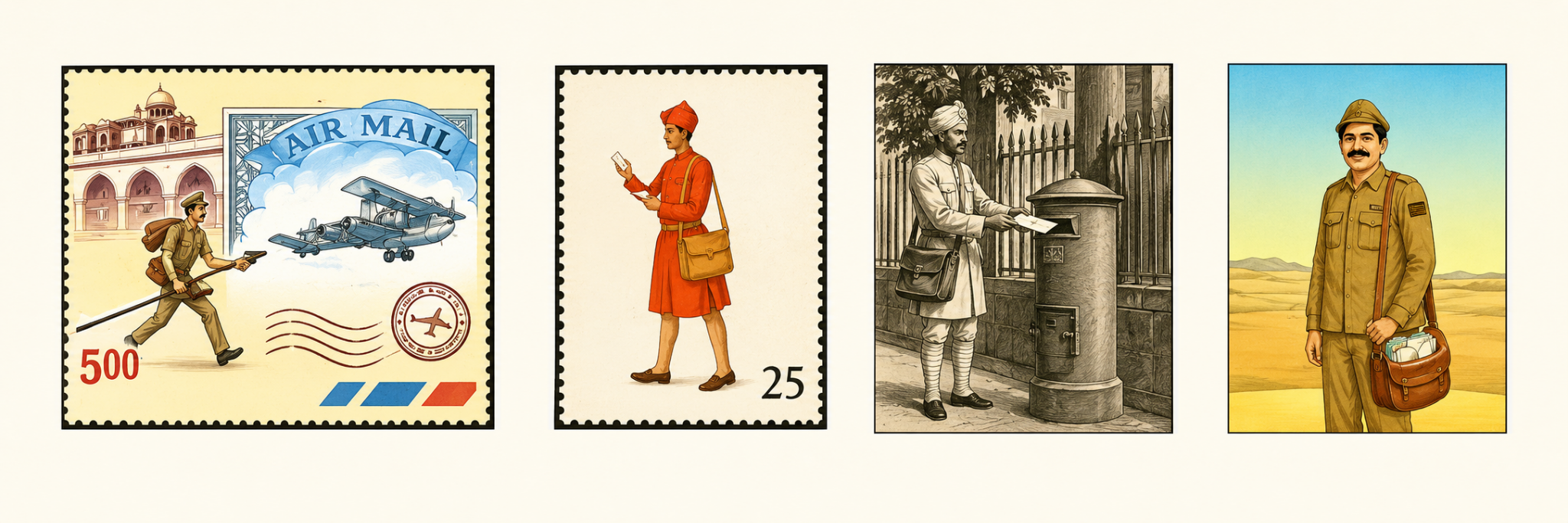
Discuss these questions with a partner and share your thoughts in class.
Question 1. What occupation do the people in the pictures have?

Answer: All the people shown work in postal services. They are postmen or other postal employees.
Question 2. What problems might they face while working?
Best Courses for You

JEE

NEET

Foundation JEE

Foundation NEET

CBSE
Answer: Their duties are not always easy. They may have to cover great distances, carry bags full of mail, use rough roads and continue working during heavy rain, bitter cold or intense summer heat.
Question 3. How does their work influence the people they visit?
Answer: Postal workers help people communicate with friends and relatives who live elsewhere. They bring letters, packages, money orders and essential papers. Since they may deliver happy as well as upsetting news, families often see them as trustworthy and important members of the community.
II. Group discussion
Question 1. In what ways can words travel from one place to another?
Answer: Written words can reach others through letters, postcards, notes and various other messages carried or sent between people.
Question 2. Who can be described as a carrier of words?
Answer: Anyone who takes a message from its sender to its receiver, such as a postman, delivery worker or messenger, is a carrier of words.
Question 3. What methods help people keep in touch?
Answer: People communicate through letters, postcards, phone calls and online services. Today, emails, text messages, mobile apps and the internet also make staying in contact much easier.
III. Choose suitable words from the box to complete the passage.
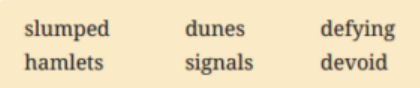
Reworded practice passage: At the point where the road ended, we got out of our vehicle. Our bodies immediately gave us (1) _______ that visiting the sand (2) _______ during the afternoon was a terrible idea. We had seen a few small (3) _______ on the way. In the burning sunshine, hardly anyone dared to be outside, (4) _______ the heat. Camels lay (5) _______ under the limited shade of khejri trees. People in this faraway region depended on BSNL, as the area was (6) _______ of other mobile networks.
Answers:
- signals
- dunes
- hamlets
- defying
- slumped
- devoid
Check Your Understanding — Page 207
I. Complete Khetaram's details for an identity card.
Answer:
| Detail | Information |
| Name | Khetaram |
| Job title | Gramin Dak Sewak (GDS) |
| Organisation | India Post |
| Work address | Somarad Branch Post Office, close to the India–Pakistan border in Rajasthan |
| Means of travel | Usually walks; occasionally uses a bus or accepts a ride in a BSF vehicle for some distance |
| Main duties | (1) Take letters, parcels and money orders to distant settlements; (2) read letters for people who need help; (3) assist villagers in writing replies; (4) keep isolated communities in contact despite the difficult desert environment |
II. Discuss with your teacher.
Question 1. What might have led Khetaram to accept such a demanding job?
Answer: The job provides money that his family needs to live. It also lets him help people in villages that are far from towns and rely on postal services to receive messages and financial support.
Question 2. What feelings might Khetaram experience while doing this work each day?
Answer: He would likely feel satisfied that his work matters to many families. However, the long walks, difficult paths and severe weather might also leave him tired at the end of the day.
Check Your Understanding — Page 210
I. Match each situation to its reason.
Answer:
| Situation | Explanation |
| Letters are taken to homes in the evening. | The daytime heat in the desert can become dangerous, sometimes reaching 50°C or higher. |
| Khetaram may sit or rest at the entrance of any home. | People know him well, trust him and make him feel welcome. |
| BSF personnel offer him a ride. | The soldiers recognise the difficulty of his journey and help him whenever possible. |
II. Why did villagers give him jaggery when he announced a birth or marriage?
Answer: Offering a sweet is a common way to celebrate good news. By giving Khetaram jaggery, villagers shared their happiness and thanked him for bringing a joyful message.
III. In what ways would telephone connections make Khetaram's work simpler?
Answer: With working phone lines, urgent information could reach villagers more quickly. Khetaram would not always have to walk a long distance just to pass on a message, so communication would take less time and effort.
Critical Reflection — Pages 210–212
I. Read the passages and answer the questions.
Passage 1: Khetaram explains that drought and poor harvests are common. Even a successful bajra crop cannot feed his family of five, so his postal income is essential. Other families in the area also depend on money orders sent by relatives.
(i) Why does a single bajra harvest make only a small difference to Khetaram's family?
Answer: The amount grown cannot provide enough food or earnings to meet the family's needs for the whole year.
(ii) Why does Khetaram consider famine a normal part of life there?
Answer: Rainfall is very low in the desert, making farming uncertain. Even in a better year, the family may harvest just one small bajra crop. Because shortages happen so often, living with them has become routine.
(iii) Give one reason Khetaram needed paid employment.
Answer: His farm could not produce enough to support all five members of his family.
(iv) Complete the comparison: Other families : money orders :: Khetaram : _______.
Answer: Job.
(v) What does the expression 'a good year' mean in this context?
Answer: It refers to a year with conditions good enough for Khetaram to grow at least one crop of bajra.
Passage 2: An envelope with a torn upper corner brings news of a death. Khetaram remains outside the house, reads the message aloud twice and destroys the letter because he believes such sad news should not be brought indoors.
(i) Who is most likely to have removed the corner of the envelope?
A. Khetaram
B. The person sending the letter
C. The person receiving the letter
D. The postmaster
Answer: B. The person sending the letter.
(ii) Why might Khetaram read the message two times?
Answer: He wants the listeners to hear and fully understand the serious news, even though it is painful.
(iii) What does Khetaram believe about sad messages, and what does he do?
Answer: He feels that news of death should not be carried into someone's home. Therefore, he stays at the doorway, reads the letter twice and then tears it up.
(iv) True or false: Tearing the letter goes against Khetaram's belief.
Answer: False. His action matches his belief that a message containing bad news should be destroyed after it has been delivered.
(v) Identify one quality of Khetaram shown here.
Answer: He is considerate. He tries to deliver distressing information gently and respects the feelings and customs of the family.
II. Answer the questions below.
Question 1. Why did the Postmaster General of Rajasthan's Western Region describe the work of a GDS as invaluable?
Answer: Gramin Dak Sewaks serve places where access to regular facilities is limited. They bring mail and money orders to remote villages and often help residents read or write messages. Their service makes a real difference to people who might otherwise remain cut off from others.
Question 2. How did the aim of India Post differ from that of the postal service under British rule?
Answer: The colonial postal network mainly supported the needs of British administration. India Post, on the other hand, is intended to serve people across the country, including those in distant villages, by providing communication and other postal and financial services.
Question 3. Give two examples that show villagers trusted Gramin Dak Sewaks.
Answer: First, residents felt comfortable allowing postal workers into their homes and asking them to read private letters or write replies. Second, a proposal to give their responsibilities to patwaris was not continued because these officials could not replace the dependable service and strong personal bonds of the GDS workers.
Question 4. Why might Khetaram have been thankful that he could remain a GDS after turning 60?
Answer: His postal earnings were important for his family's daily needs. Since farming brought in very little, continuing the job meant that he could still provide for the household.
Question 5. Why does the writer honour workers such as Khetaram?
Answer: The writer admires their commitment to helping others despite extreme temperatures, long journeys and limited facilities. These workers make sure that even distant villages receive essential messages and money orders, keeping families connected.
Vocabulary and Structures in Context — Pages 212–215
I. Match the expressions to their meanings.
Answer:
| Expression | Meaning |
| 1. Crumbles into sand | (iii) Vanishes into the desert landscape |
| 2. Give a new lease of life | (i) Offer another opportunity to live or begin again |
| 3. Turn into a trickle before drying out | (iv) Become smaller little by little and eventually stop |
| 4. Bearing words across this desolate geography | (ii) Taking written messages through a sparsely populated region |
Use the expressions in your own sentences.
- After many years of strong desert winds, the abandoned mud structure began to crumble into sand.
- The successful operation helped give a new lease of life to the injured traveller.
- As summer continued, the flowing stream turned into a trickle before drying out.
- The postal worker kept bearing words across this desolate geography, bringing distant families closer.
II. Find alliteration and metaphor in the given passage.

Answer: Alliteration occurs when neighbouring words begin with the same or similar sound. The examples in the extract are “Khetaram's khaki,” “scorching summer,” and “swirling sandstorms.”
A metaphor describes something as though it were something else, without using “like” or “as.” The description “a walking sandman” is a metaphor because Khetaram becomes covered in sand while travelling through desert storms.
III. Match the vocabulary words with the ideas they suggest.
Answer:
| Word | Related idea |
| 1. Arid | (iii) Land that produces little because it is very dry |
| 2. Concessional | (i) A reduced interest rate offered to farmers |
| 3. Gaunt | (v) A thin, worn-out farmer waiting for rain |
| 4. Remote | (ii) A faraway part of the world |
| 5. Desolate | (iv) A vast, empty stretch of desert |
Make sentences using the words.
- The arid soil could not support many crops.
- Farmers were offered loans at a concessional rate of interest.
- After months of hardship, the farmer appeared gaunt and weak.
- The teacher travelled to a remote settlement near the border.
- There was hardly any sign of life in the desolate landscape.
IV. Present perfect tense
The verbs in the exercise use the present perfect tense. We form this tense with has/have + past participle. It may describe a recent action, a personal experience, an achievement, a change or something in the past that remains connected to the present.
Complete the paragraph using the correct present perfect forms.
Answer:
- I have recently got a set of postage stamps from my grandfather.
- He has collected the stamps over the past twenty years.
- I have studied most of the stamps in his collection and enjoyed seeing them.
- I have begun collecting stamps myself.
- My grandfather has truly inspired me.
V. Active and passive voice
In active voice, the subject carries out the action: A GDS delivers letters near the border.
In passive voice, the subject receives the action: Letters are delivered near the border by a GDS.
Exercise: Khetaram advises his nephew, who hopes to become a GDS, to build stamina, practise reading clearly, write neatly and wear clothes that protect him from the sun. Fill in the paragraph about this advice using passive forms.
Answer: A great deal of stamina will be required for this work. Next, clear reading (A) will be important because (B) you may be expected to read letters aloud to villagers. Words (C) must be written neatly, as (D) you may be asked to prepare replies for people. Long-sleeved shirts and trousers (E) should be worn for protection from the heat.
Listen and Respond — Pages 215–216
I. Listen to the announcement and select the suitable word.
Question: The girl ended her talk by making a _______ (suggestion/request/advice).
Answer: Request.
II. Listen again and choose the correct options.
Question 1. Which occasion was being discussed?
(i) A letter-writing carnival
(ii) Philately Day
(iii) Indian Postal Day
Answer: (iii) Indian Postal Day.
Question 2. India Post is known for its very large network _______.
(i) within India
(ii) across the world
(iii) among design institutes
Answer: (ii) Across the world.
Question 3. People are trying to bring back letter-writing because this art has largely been _______.
(i) celebrated
(ii) appreciated
(iii) forgotten
Answer: (iii) Forgotten.
Question 4. Which activities are included in the letter-writing carnival?
(i) Calligraphy and graphology
(ii) Origami and designing
(iii) Posting letters and philately
Answer: (i) Calligraphy and graphology.
Question 5. What will the postal department contribute to the event?
(i) Hands-on demonstrations
(ii) Drama and dancing
(iii) A letter-writing workshop
Answer: (i) Hands-on demonstrations.
Speaking Activity — Pages 216–217
I. Imagine a discussion among a postcard, an inland letter, an envelope and a money-order form. Each argues that it is the most useful.

Form a group of four and discuss their usefulness, cost, privacy, writing space and ability to hold extra items. You may use the suggested phrases in the accompanying chart.
Sample answer — a group conversation:
Postcard: I believe I am an easy and affordable way to send short messages. Everyone can read what is written on me, but I am perfect for quick greetings.
Inland Letter: That is a fair point, but I give people more room to write. Since I can be folded and closed, I also keep personal messages private.
Envelope: I would add that I can safely hold letters, photographs, greeting cards and important documents. I am especially useful when the sender wants privacy or needs to include extra papers.
Money Order: Messages matter, but so does financial help. I allow people to send money to relatives who may live very far away.
Postcard: I agree that each of us serves a different purpose. My strength is sharing brief, inexpensive messages.
Inland Letter: I am more suitable for longer, personal letters.
Envelope: I protect items that cannot be sent on a postcard alone.
Money Order: And I help families give financial support when it is needed.
Everyone: None of us is useful in exactly the same way, but together we help people communicate and support one another.
Writing Task — Pages 217–218
A condolence message is written to comfort someone who has lost a loved one. It expresses sympathy and offers support during a difficult time.
I. Read the sample condolence message.
Khetaram finds a letter whose torn corner signals that Bhawar Singh's uncle has died. Sawant Singh later sends a sympathetic reply to his cousin.
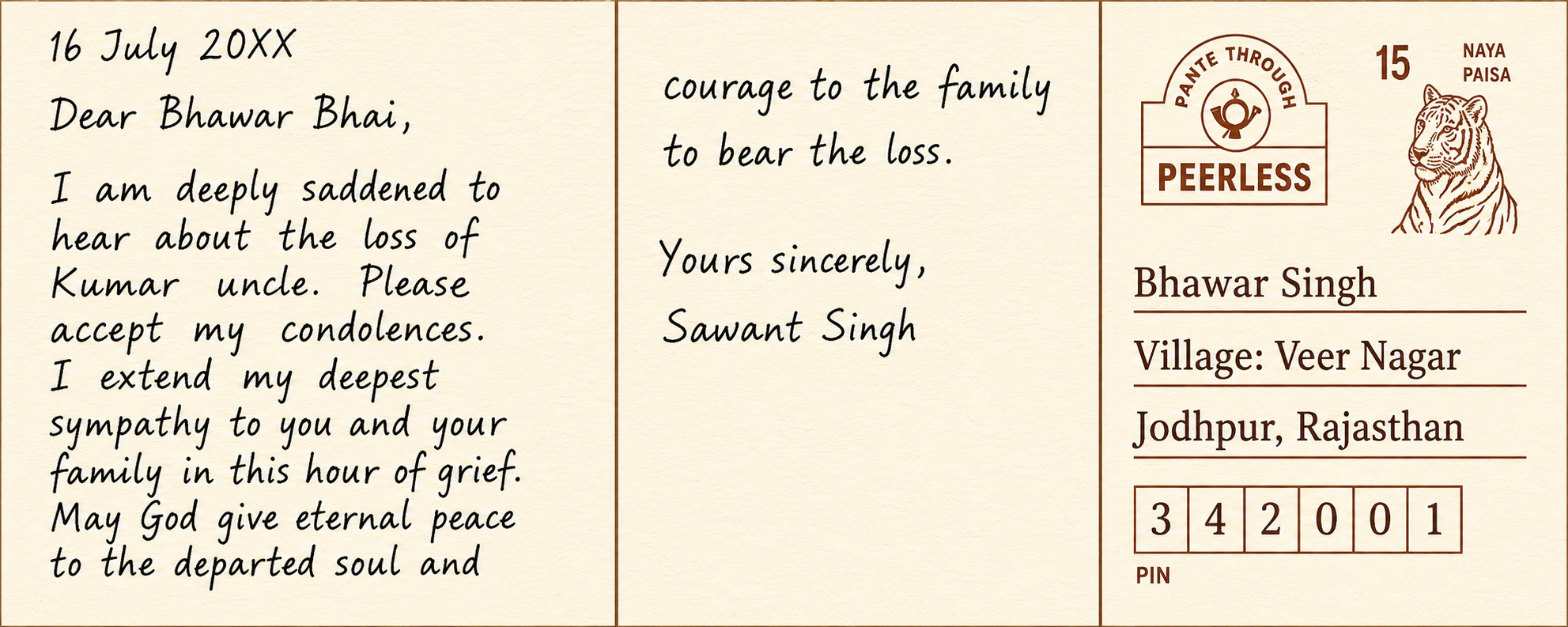
Task: Write an imaginary message on behalf of your parents to your aunt after the death of her father.
Sample answer:
20 February 2027
Dear Aunt,
We were very sorry to learn that your father has passed away. Please accept our deepest sympathy. We know how much he meant to you, and we understand that this must be a very difficult time for the whole family.
We hope that the happy memories you shared with him will bring you comfort. Whenever you need someone to talk to or any kind of help, please remember that we are here for you.
May you and your family find courage and peace as you face this loss.
With love and sympathy,
Aditya Malhotra
course
No courses found
FAQs on NCERT Solutions for Class 9 English Kaveri Chapter 7 Carrier of Words
What is the main theme of Class 9 English Kaveri Chapter 7 Carrier of Words?
The main theme of Carrier of Words is the importance of communication and the dedication of postal workers. The chapter highlights how Khetaram, a Gramin Dak Sewak, delivers letters and important messages to people living in remote desert villages despite facing many difficulties.
Who is Khetaram in Chapter 7 Carrier of Words?
Khetaram is a Gramin Dak Sewak (GDS) who works for India Post in Rajasthan. He travels long distances through the Thar Desert to deliver letters, money orders, and important news. His hard work and dedication make him an important part of village life.
How can NCERT Solutions for Class 9 English Kaveri Chapter 7 help students?
NCERT Solutions for Class 9 English Kaveri Chapter 7 Carrier of Words provide easy and clear answers to textbook questions. These solutions help students understand the chapter, complete their homework, improve their English skills, and prepare for school examinations.
What difficulties does Khetaram face while delivering letters?
Khetaram faces several challenges, such as extreme heat, sandstorms, long walking distances, and difficult desert routes. Despite these problems, he continues his work with honesty and dedication to keep people connected.
Where can students find Carrier of Words Class 9 Question Answer PDF?
Students can find the Carrier of Words Class 9 Question Answer PDF on educational websites that provide NCERT study materials. The PDF helps students practise textbook questions, revise important topics, and study the chapter whenever needed.
What important lessons do students learn from Carrier of Words Class 9 Chapter 7?
The chapter teaches students the values of hard work, responsibility, kindness, and dedication. It also explains the importance of postal services in connecting people, especially in remote villages. Students learn to respect people who work sincerely to help others.
