- Light Reflection and Refraction Class 10 Chapter Overview
- Light Reflection and Refraction Class 10 Notes PDF Download
- What is Light?
- Reflection of Light Class 10
- Laws of Reflection Class 10
- Regular vs Diffuse Reflection
- Plane Mirror Class 10
- Spherical Mirrors Class 10
- Concave Mirror Class 10
- Convex Mirror Class 10
- Concave vs Convex Mirror Difference
- Important Terms Related to Spherical Mirrors
- New Cartesian Sign Convention Class 10
- Rules for Ray Diagrams of Spherical Mirrors
- Ray Diagram for Concave Mirror Class 10
- Ray Diagram for Convex Mirror Class 10
- Real and Virtual Image Difference Class 10
- Mirror Formula Class 10
- Magnification Class 10
- Refraction of Light Class 10
- Why Does a Pencil Appear Bent in Water?
- Laws of Refraction Class 10
- Snell’s Law Class 10
- Rarer to Denser Medium Bending Class 10
- Refractive Index Class 10
- Absolute vs Relative Refractive Index Class 10
- Refractive Index Numericals Class 10
- Refraction Through Glass Slab Class 10
- Total Internal Reflection Class 10
- Spherical Lenses Class 10
- Convex Lens Class 10
- Concave Lens Class 10
- Difference Between Concave and Convex Lens
- Important Terms Related to Lenses
- Ray Diagram for Convex Lens Class 10
- Ray Diagram for Concave Lens Class 10
- Lens Formula Class 10
- Magnification Formula for Lens Class 10
- Power of Lens Class 10
- All Formulas of Light Class 10
- Light Reflection and Refraction Numericals Class 10
- Difference Between Reflection and Refraction
- Difference Between Concave and Convex Lens
- Difference Between Concave and Convex Mirror
- Important Questions for Light Class 10
- Light Reflection and Refraction Class 10 MCQ with Answers
- Assertion Reason Questions
- Case Study Questions on Light Reflection and Refraction
- NCERT Solutions Support for Light Reflection and Refraction Class 10
- Important Diagrams for Light Reflection and Refraction Class 10
- Common Mistakes Students Should Avoid
- FAQs on Light Reflection and Refraction Class 10
Light Reflection and Refraction Class 10 Notes
By rohit.pandey1
|
Updated on 1 Jul 2026, 12:02 IST
Light Reflection and Refraction Class 10 Notes explain how light behaves when it strikes a surface or passes from one medium to another. This chapter covers reflection, refraction, spherical mirrors, lenses, ray diagrams, mirror formula, lens formula, refractive index, magnification, power of a lens, sign convention, numericals, MCQs and important questions.
This chapter is commonly searched as Class 10 Science Chapter 9 Notes, Light Class 10 Notes, and Light Reflection Refraction Class 10 Notes. Chapter numbering may vary slightly depending on textbook edition, but the core concepts remain important for CBSE Class 10 Science board exam preparation.
Light Reflection and Refraction Class 10 Chapter Overview
Light is a form of energy that helps us see objects. We see objects because light from them enters our eyes. In this chapter, students learn how light travels, how it reflects from mirrors, how it refracts through glass and water, and how spherical mirrors and lenses form images.
| Topic | What You Will Learn |
| Reflection of Light | Laws of reflection, regular and diffuse reflection, plane mirror |
| Spherical Mirrors | Concave mirror, convex mirror, focus, centre of curvature, ray diagrams |
| Mirror Formula | Relation between object distance, image distance and focal length |
| Magnification | Image size compared to object size |
| Refraction of Light | Bending of light from one medium to another |
| Snell’s Law | Mathematical relation between angle of incidence and angle of refraction |
| Refractive Index | Measure of optical density of a medium |
| Glass Slab Refraction | Lateral displacement and emergent ray |
| Spherical Lenses | Convex lens, concave lens, focus, optical centre and ray diagrams |
| Lens Formula | Relation between object distance, image distance and focal length |
| Power of Lens | Ability of a lens to converge or diverge light |
| Numericals | Mirror formula, lens formula, refractive index, magnification and power |
Light Reflection and Refraction Class 10 Notes PDF Download
Students can download the Light Reflection and Refraction Class 10 Notes PDF to revise the chapter anytime, even without internet access. This PDF is designed for quick concept revision, formula practice, ray diagram preparation, and step-by-step numerical solving.
The notes cover important topics such as laws of reflection, spherical mirrors, mirror formula, refraction of light, Snell’s law, refractive index, spherical lenses, lens formula, power of lens, ray diagrams, MCQs, and important questions.
Download PDF: Light Reflection and Refraction Class 10 Notes PDF
What is Light?
Light is a form of energy that produces the sensation of vision. It travels in a straight line in a transparent medium. This straight-line path of light is called rectilinear propagation of light.
Loading PDF...
Important Properties of Light
| Property | Meaning |
| Light travels in straight lines | In a uniform transparent medium, light follows a straight path |
| Light can be reflected | It can bounce back from a surface |
| Light can be refracted | It can bend while passing from one medium to another |
| Light forms images | Mirrors and lenses form images using reflection and refraction |
| Light travels very fast | Speed of light in vacuum is about 3 × 10⁸ m/s |
Reflection of Light Class 10
Reflection of light is the bouncing back of light into the same medium after striking a surface. For example, when light falls on a plane mirror, it returns to the same medium and forms an image. This is reflection.
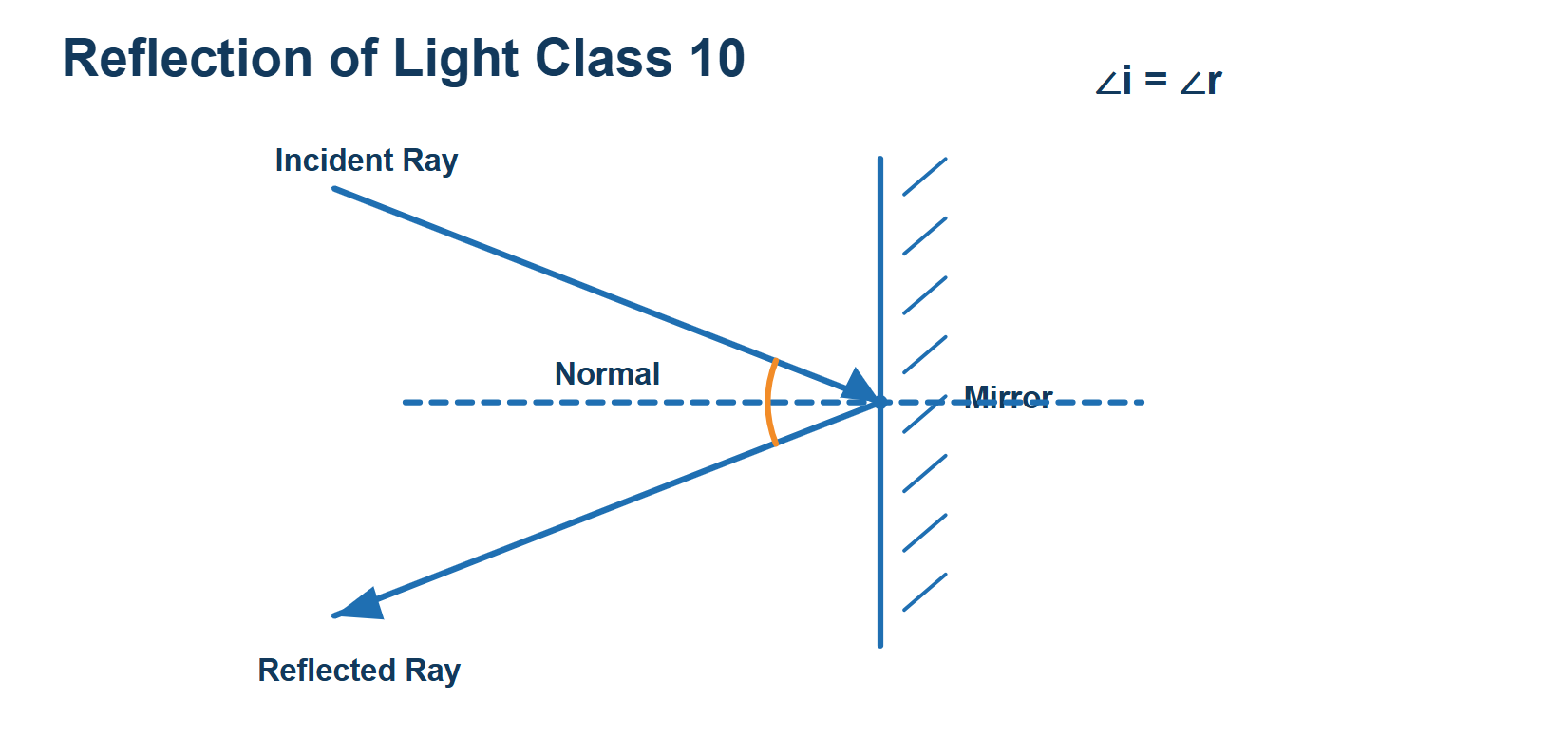
Reflection of Light Definition Class 10
Reflection of light is the phenomenon in which light rays bounce back into the same medium after striking a reflecting surface.
Important Terms in Reflection
| Term | Meaning |
| Incident ray | Ray of light that falls on the reflecting surface |
| Reflected ray | Ray of light that returns after reflection |
| Point of incidence | Point where incident ray strikes the surface |
| Normal | Perpendicular line drawn at the point of incidence |
| Angle of incidence | Angle between incident ray and normal |
| Angle of reflection | Angle between reflected ray and normal |
Laws of Reflection Class 10
The laws of reflection are used to describe how light reflects from a surface.
First Law of Reflection
The incident ray, reflected ray and normal at the point of incidence all lie in the same plane.

Second Law of Reflection
The angle of incidence is equal to the angle of reflection.
∠i = ∠r
Best Courses for You

JEE

NEET

Foundation JEE

Foundation NEET

CBSE
Example
If a light ray falls on a mirror at an angle of incidence of 40°, then the angle of reflection will also be 40°.
Regular vs Diffuse Reflection
| Basis | Regular Reflection | Diffuse Reflection |
| Surface | Smooth and polished | Rough or uneven |
| Reflected rays | Parallel after reflection | Scattered in different directions |
| Image formation | Clear image is formed | Clear image is not formed |
| Example | Plane mirror | Wall, paper, wooden surface |
Important Note
Diffuse reflection does not mean that the laws of reflection fail. Each ray still follows the laws of reflection, but because the surface is uneven, reflected rays scatter in different directions.
Plane Mirror Class 10
A plane mirror is a flat reflecting surface. It forms an image that appears behind the mirror.
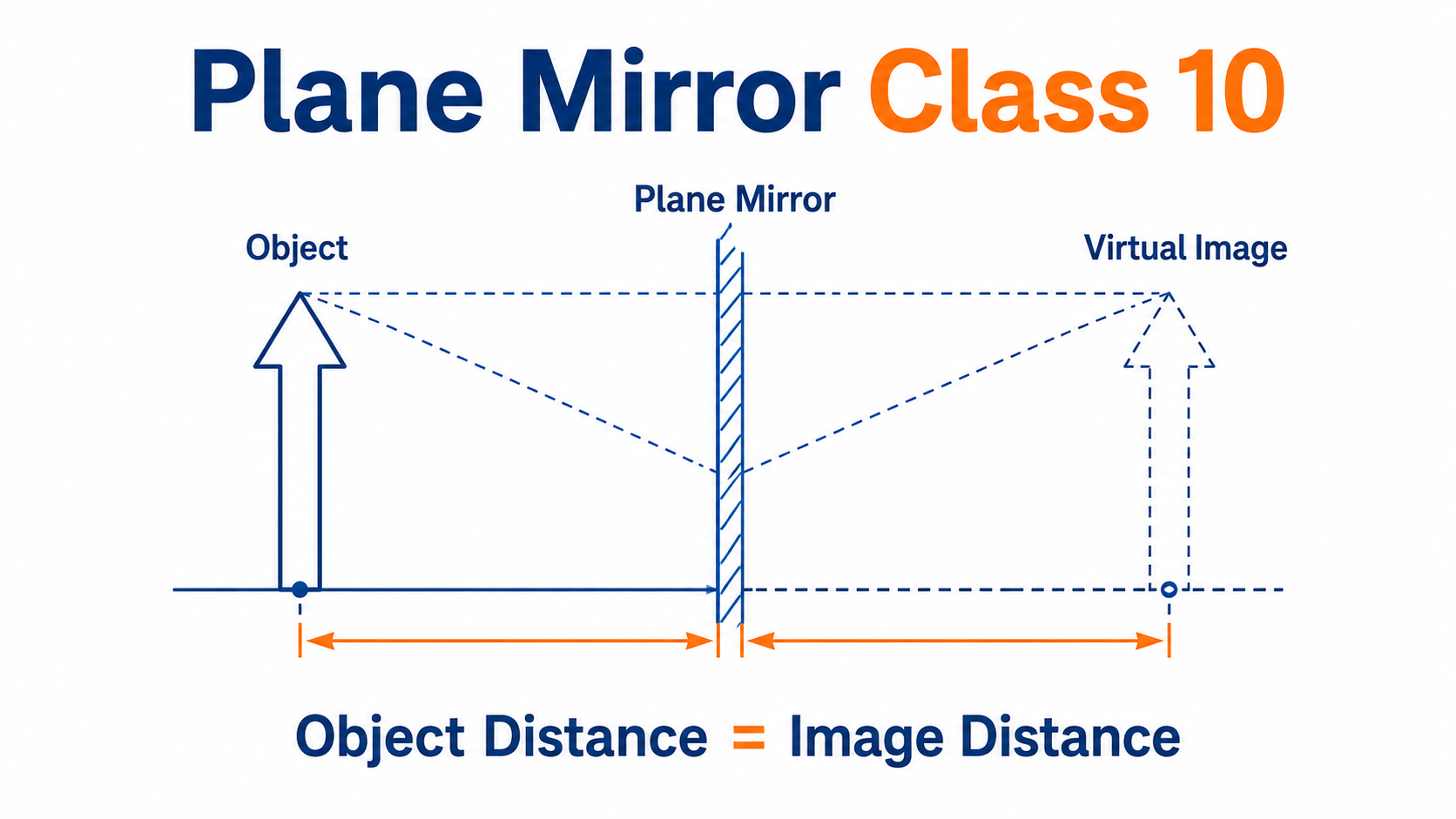
Image Formed by Plane Mirror
| Property | Description |
| Nature | Virtual and erect |
| Size | Same size as object |
| Distance | Image distance = object distance |
| Laterally inverted? | Yes |
| Can be obtained on screen? | No |
What is Lateral Inversion?
Lateral inversion means the left side of the object appears as the right side in the image, and the right side appears as the left side.
Example: The word “AMBULANCE” is written in reverse on ambulances so that drivers can read it correctly in rear-view mirrors.
Spherical Mirrors Class 10
A spherical mirror is a mirror whose reflecting surface is part of a hollow sphere. Spherical mirrors are of two types:
- Concave mirror
- Convex mirror
Concave Mirror Class 10
A concave mirror is a spherical mirror whose reflecting surface is curved inward. It is also called a converging mirror because it converges parallel rays of light.
Uses of Concave Mirror Class 10
| Use | Reason |
| Shaving mirror | Forms enlarged image when object is close |
| Dentist mirror | Gives magnified view of teeth |
| Torch reflector | Produces parallel beam of light |
| Headlights | Produces strong parallel beam |
| Solar furnace | Converges sunlight at focus |
Convex Mirror Class 10
A convex mirror is a spherical mirror whose reflecting surface is curved outward. It is also called a diverging mirror because it diverges parallel rays of light.
Uses of Convex Mirror Class 10
| Use | Reason |
| Rear-view mirror in vehicles | Gives wider field of view |
| Security mirror in shops | Covers larger area |
| Road safety mirrors | Helps see vehicles around corners |
Why is Convex Mirror Used as Rear-view Mirror?
A convex mirror is used as a rear-view mirror because it always forms a virtual, erect and diminished image. It also provides a wider field of view, allowing the driver to see a larger area of traffic behind the vehicle.
Concave vs Convex Mirror Difference
| Basis | Concave Mirror | Convex Mirror |
| Shape | Curved inward | Curved outward |
| Also called | Converging mirror | Diverging mirror |
| Focus | Real focus | Virtual focus |
| Image formed | Can be real or virtual | Always virtual and erect |
| Field of view | Small | Large |
| Use | Shaving mirror, headlights | Rear-view mirror |
Important Terms Related to Spherical Mirrors
| Term | Symbol | Meaning |
| Pole | P | Centre point of reflecting surface |
| Centre of curvature | C | Centre of the sphere of which mirror is a part |
| Radius of curvature | R | Distance between pole and centre of curvature |
| Principal axis | — | Straight line passing through P and C |
| Principal focus | F | Point where rays parallel to principal axis meet or appear to meet |
| Focal length | f | Distance between pole and focus |
| Aperture | — | Effective diameter of reflecting surface |
Radius of Curvature and Focal Length Relation
For a spherical mirror:
R = 2f
or
f = R/2
This relation is often used in mirror formula numericals.
New Cartesian Sign Convention Class 10
The New Cartesian Sign Convention is used to assign positive and negative signs to distances in mirror and lens numericals.
Sign Convention for Mirrors Class 10
| Quantity | Sign |
Object distance u | Usually negative |
| Distance measured in direction of incident light | Positive |
| Distance measured opposite to incident light | Negative |
| Height above principal axis | Positive |
| Height below principal axis | Negative |
| Focal length of concave mirror | Negative |
| Focal length of convex mirror | Positive |
Sign Convention for Lenses Class 10
| Quantity | Sign |
Object distance u | Usually negative |
| Image distance for real image | Positive |
| Image distance for virtual image | Negative |
| Focal length of convex lens | Positive |
| Focal length of concave lens | Negative |
| Height above principal axis | Positive |
| Height below principal axis | Negative |
Exam Tip
Most mistakes in Light Reflection and Refraction numericals happen because of wrong signs. Always write u, v, f and their signs before substituting values in the formula.
Rules for Ray Diagrams of Spherical Mirrors
Ray diagrams help us find the position, size and nature of images formed by mirrors.
Ray Rules for Concave Mirror
| Incident Ray | Reflected Ray |
| Parallel to principal axis | Passes through focus |
| Passing through focus | Becomes parallel to principal axis |
| Passing through centre of curvature | Retraces its path |
| Incident at pole | Reflects according to laws of reflection |
Ray Rules for Convex Mirror
| Incident Ray | Reflected Ray |
| Parallel to principal axis | Appears to come from focus |
| Directed towards focus | Becomes parallel to principal axis |
| Directed towards centre of curvature | Retraces its path |
| Incident at pole | Reflects according to laws of reflection |
Ray Diagram for Concave Mirror Class 10
A concave mirror can form different types of images depending on the position of the object.
Image Formation Table for Concave Mirror
| Object Position | Image Position | Image Size | Nature of Image |
| At infinity | At focus F | Highly diminished | Real and inverted |
| Beyond C | Between F and C | Diminished | Real and inverted |
| At C | At C | Same size | Real and inverted |
| Between C and F | Beyond C | Enlarged | Real and inverted |
| At F | At infinity | Highly enlarged | Real and inverted |
| Between F and P | Behind mirror | Enlarged | Virtual and erect |
Most Important Concave Mirror Ray Diagrams
Students should practise these object positions carefully:
- Object at infinity
- Object beyond C
- Object at C
- Object between C and F
- Object at F
- Object between F and P
Ray Diagram for Convex Mirror Class 10
A convex mirror always forms a virtual, erect and diminished image.
Image Formation Table for Convex Mirror
| Object Position | Image Position | Image Size | Nature of Image |
| At infinity | At focus behind mirror | Highly diminished | Virtual and erect |
| Anywhere between infinity and pole | Between pole and focus behind mirror | Diminished | Virtual and erect |
Real and Virtual Image Difference Class 10
| Basis | Real Image | Virtual Image |
| Formation | Formed by actual meeting of rays | Formed by apparent meeting of rays |
| Screen | Can be obtained on screen | Cannot be obtained on screen |
| Nature | Usually inverted | Usually erect |
| Example | Image on cinema screen | Image in plane mirror |
Mirror Formula Class 10
The mirror formula gives the relation between object distance, image distance and focal length.
1/v + 1/u = 1/f
Where:
| Symbol | Meaning |
u | Object distance |
v | Image distance |
f | Focal length |
Mirror Formula Numericals Class 10 Solved Example
Question: A concave mirror has focal length 20 cm. An object is placed at a distance of 30 cm in front of it. Find the image distance.
Given:
f = -20 cmu = -30 cmv = ?
Using mirror formula:
1/v + 1/u = 1/f
1/v + 1/(-30) = 1/(-20)
1/v - 1/30 = -1/20
1/v = -1/20 + 1/30
1/v = (-3 + 2)/60
1/v = -1/60
v = -60 cm
Answer: The image is formed 60 cm in front of the mirror. It is real and inverted.
Magnification Class 10
Magnification tells how many times the image is enlarged or diminished compared to the object.
Magnification Formula for Mirror
m = h'/h = -v/u
Where:
| Symbol | Meaning |
m | Magnification |
h' | Height of image |
h | Height of object |
v | Image distance |
u | Object distance |
Interpretation of Magnification
| Magnification | Meaning |
m > 1 | Image is enlarged |
m < 1 | Image is diminished |
m = 1 | Image is same size |
m positive | Image is virtual and erect |
m negative | Image is real and inverted |
Refraction of Light Class 10
Refraction of light is the bending of light when it passes from one transparent medium to another.
For example, a pencil partly immersed in water appears bent because light rays bend while moving from water to air.
Refraction of Light Definition Class 10
Refraction of light is the change in direction or bending of light when it passes obliquely from one transparent medium to another due to change in speed.
Why Does a Pencil Appear Bent in Water?
A pencil appears bent in water because light coming from the submerged part of the pencil bends when it passes from water to air. This bending of light is called refraction. Due to refraction, the underwater part appears to be at a different position.
Laws of Refraction Class 10
There are two laws of refraction.
First Law of Refraction
The incident ray, refracted ray and normal at the point of incidence all lie in the same plane.
Second Law of Refraction / Snell’s Law
The ratio of sine of angle of incidence to sine of angle of refraction is constant for a given pair of media.
sin i / sin r = constant
This constant is called the refractive index of the second medium with respect to the first medium.
Snell’s Law Class 10
Snell’s law explains the relation between angle of incidence and angle of refraction.
n₂₁ = sin i / sin r
Where:
| Symbol | Meaning |
i | Angle of incidence |
r | Angle of refraction |
n₂₁ | Refractive index of medium 2 with respect to medium 1 |
Rarer to Denser Medium Bending Class 10
When light travels from a rarer medium to a denser medium, it bends towards the normal.
When light travels from a denser medium to a rarer medium, it bends away from the normal.
| Path of Light | Bending |
| Rarer to denser | Towards normal |
| Denser to rarer | Away from normal |
| Along normal | No bending |
Example
When light travels from air to glass, it bends towards the normal. When it travels from glass to air, it bends away from the normal.
Refractive Index Class 10
Refractive index tells how much a medium bends light. It also tells how much the speed of light reduces in that medium.
Absolute Refractive Index Formula Class 10
n = c/v
Where:
| Symbol | Meaning |
n | Absolute refractive index |
c | Speed of light in vacuum |
v | Speed of light in the medium |
Relative Refractive Index
Relative refractive index of medium 2 with respect to medium 1 is:
n₂₁ = v₁/v₂
Where:
v₁= speed of light in medium 1v₂= speed of light in medium 2
Absolute vs Relative Refractive Index Class 10
| Basis | Absolute Refractive Index | Relative Refractive Index |
| Meaning | Refractive index with respect to vacuum or air | Refractive index of one medium with respect to another |
| Formula | n = c/v | n₂₁ = v₁/v₂ |
| Depends on | Speed in vacuum and medium | Speed in two different media |
| Example | Refractive index of glass | Refractive index of glass with respect to water |
Refractive Index Numericals Class 10
Example 1
Question: Speed of light in a medium is 2 × 10⁸ m/s. Find its refractive index.
Given:
c = 3 × 10⁸ m/sv = 2 × 10⁸ m/s
Using:
n = c/v
n = (3 × 10⁸) / (2 × 10⁸)
n = 1.5
Answer: Refractive index of the medium is 1.5.
Refraction Through Glass Slab Class 10
When a ray of light passes through a rectangular glass slab, it bends twice:
- It bends towards the normal when it enters the glass slab from air.
- It bends away from the normal when it comes out from glass to air.
The emergent ray is parallel to the incident ray but shifted sideways. This sideways shift is called lateral displacement.
Lateral Displacement
Lateral displacement is the perpendicular distance between the incident ray’s original path and the emergent ray.
Refraction Through Glass Slab Result
| Observation | Result |
| Incident ray and emergent ray | Parallel |
| Angle of incidence and angle of emergence | Equal |
| Ray path | Shifted sideways |
| Cause | Refraction at two parallel surfaces |
Total Internal Reflection Class 10
Total internal reflection is the phenomenon in which light travelling from a denser medium to a rarer medium is completely reflected back into the denser medium.
This happens only when:
- Light travels from denser to rarer medium.
- Angle of incidence is greater than the critical angle.
Applications of Total Internal Reflection
| Application | Explanation |
| Optical fibre | Light undergoes repeated total internal reflection |
| Diamond sparkling | Multiple total internal reflections make diamond shine |
| Mirage | Light bends and reflects in layers of hot air |
Why Does a Diamond Sparkle?
A diamond sparkles because its high refractive index causes light to undergo multiple total internal reflections inside it. This traps and reflects light many times, making the diamond appear bright and sparkling.
Optical Fibre Working Class 10
Optical fibres work on the principle of total internal reflection. Light entering the fibre undergoes repeated total internal reflection and travels long distances with very little loss of intensity.
Spherical Lenses Class 10
A lens is a transparent medium bounded by two surfaces, at least one of which is spherical. Spherical lenses are mainly of two types:
- Convex lens
- Concave lens
Convex Lens Class 10
A convex lens is thicker at the centre and thinner at the edges. It is also called a converging lens because it converges parallel rays of light.
Uses of Convex Lens Class 10
| Use | Reason |
| Magnifying glass | Forms enlarged image |
| Camera | Forms real image on sensor |
| Microscope | Magnifies small objects |
| Telescope | Helps view distant objects |
| Spectacles | Corrects hypermetropia |
Concave Lens Class 10
A concave lens is thinner at the centre and thicker at the edges. It is also called a diverging lens because it diverges parallel rays of light.
Uses of Concave Lens Class 10
| Use | Reason |
| Spectacles | Corrects myopia |
| Door peephole | Gives wider field of view |
| Optical instruments | Used in lens combinations |
Difference Between Concave and Convex Lens
| Basis | Convex Lens | Concave Lens |
| Shape | Thicker at centre, thinner at edges | Thinner at centre, thicker at edges |
| Also called | Converging lens | Diverging lens |
| Focus | Real focus | Virtual focus |
| Image formed | Real or virtual depending on object position | Always virtual, erect and diminished |
| Focal length | Positive | Negative |
| Use | Magnifying glass, camera | Spectacles for myopia |
Important Terms Related to Lenses
| Term | Meaning |
| Optical centre | Centre point of lens |
| Principal axis | Line passing through optical centre and centres of curvature |
| Principal focus | Point where rays parallel to principal axis meet or appear to meet |
| Focal length | Distance between optical centre and focus |
| Aperture | Effective diameter of lens |
| Centre of curvature | Centre of sphere of which lens surface is a part |
Ray Diagram for Convex Lens Class 10
A convex lens forms different images depending on the position of the object.
Image Formation Table for Convex Lens
| Object Position | Image Position | Image Size | Nature of Image |
| At infinity | At F₂ | Highly diminished | Real and inverted |
| Beyond 2F₁ | Between F₂ and 2F₂ | Diminished | Real and inverted |
| At 2F₁ | At 2F₂ | Same size | Real and inverted |
| Between F₁ and 2F₁ | Beyond 2F₂ | Enlarged | Real and inverted |
| At F₁ | At infinity | Highly enlarged | Real and inverted |
| Between F₁ and optical centre | Same side as object | Enlarged | Virtual and erect |
Ray Diagram for Concave Lens Class 10
A concave lens always forms a virtual, erect and diminished image.
Image Formation Table for Concave Lens
| Object Position | Image Position | Image Size | Nature of Image |
| At infinity | At focus on same side | Highly diminished | Virtual and erect |
| Anywhere between infinity and optical centre | Between focus and optical centre | Diminished | Virtual and erect |
Lens Formula Class 10
The lens formula gives the relation between object distance, image distance and focal length.
1/v - 1/u = 1/f
Where:
| Symbol | Meaning |
u | Object distance |
v | Image distance |
f | Focal length |
Lens Formula Numericals Class 10 Solved Example
Question: An object is placed at a distance of 30 cm from a convex lens of focal length 20 cm. Find the image distance.
Given:
u = -30 cmf = +20 cmv = ?
Using lens formula:
1/v - 1/u = 1/f
1/v - 1/(-30) = 1/20
1/v + 1/30 = 1/20
1/v = 1/20 - 1/30
1/v = (3 - 2)/60
1/v = 1/60
v = 60 cm
Answer: The image is formed 60 cm on the other side of the lens. It is real and inverted.
Magnification Formula for Lens Class 10
For lenses:
m = h'/h = v/u
Where:
| Symbol | Meaning |
m | Magnification |
h' | Height of image |
h | Height of object |
v | Image distance |
u | Object distance |
Power of Lens Class 10
Power of a lens is the ability of a lens to converge or diverge light rays.
Power of Lens Formula
P = 1/f
Here, f is measured in metres.
Unit of Power
The SI unit of power of lens is dioptre, represented by D.
1 D = 1 m⁻¹
Sign of Power
| Lens | Focal Length | Power |
| Convex lens | Positive | Positive |
| Concave lens | Negative | Negative |
Power of Lens Numericals Class 10
Question: Find the power of a convex lens of focal length 50 cm.
Given:
f = 50 cm = 0.5 m
Using:
P = 1/f
P = 1/0.5
P = +2 D
Answer: Power of the lens is +2 D.
All Formulas of Light Class 10
Use this formula sheet for quick revision before exams.
| Concept | Formula |
| Mirror formula | 1/v + 1/u = 1/f |
| Lens formula | 1/v - 1/u = 1/f |
| Mirror magnification | m = h'/h = -v/u |
| Lens magnification | m = h'/h = v/u |
| Radius and focal length | R = 2f |
| Refractive index | n = c/v |
| Relative refractive index | n₂₁ = v₁/v₂ |
| Snell’s law | sin i / sin r = constant |
| Power of lens | P = 1/f |
| Unit of power | 1 dioptre = 1 m⁻¹ |
Light Reflection and Refraction Numericals Class 10
Numerical 1: Mirror Formula
Question: An object is placed 20 cm in front of a concave mirror of focal length 15 cm. Find the image distance.
Given:
u = -20 cmf = -15 cm
Using:
1/v + 1/u = 1/f
1/v + 1/(-20) = 1/(-15)
1/v - 1/20 = -1/15
1/v = -1/15 + 1/20
1/v = (-4 + 3)/60
1/v = -1/60
v = -60 cm
Answer: Image is formed 60 cm in front of the mirror.
Numerical 2: Lens Formula
Question: An object is placed 15 cm from a convex lens of focal length 10 cm. Find image distance.
Given:
u = -15 cmf = +10 cm
Using:
1/v - 1/u = 1/f
1/v - 1/(-15) = 1/10
1/v + 1/15 = 1/10
1/v = 1/10 - 1/15
1/v = (3 - 2)/30
1/v = 1/30
v = 30 cm
Answer: Image is formed 30 cm on the other side of the lens.
Numerical 3: Magnification
Question: An object of height 4 cm forms an image of height -8 cm. Find magnification.
Given:
h = 4 cmh' = -8 cm
Using:
m = h'/h
m = -8/4
m = -2
Answer: Magnification is -2. The image is real, inverted and enlarged.
Numerical 4: Refractive Index
Question: The speed of light in glass is 2 × 10⁸ m/s. Find refractive index of glass.
n = c/v
n = (3 × 10⁸)/(2 × 10⁸)
n = 1.5
Answer: Refractive index of glass is 1.5.
Numerical 5: Power of Lens
Question: Find the power of a concave lens of focal length -25 cm.
f = -25 cm = -0.25 m
P = 1/f
P = 1/(-0.25)
P = -4 D
Answer: Power of the lens is -4 D.
Difference Between Reflection and Refraction
| Basis | Reflection | Refraction |
| Meaning | Bouncing back of light | Bending of light |
| Medium | Light returns to same medium | Light enters another medium |
| Cause | Striking a reflecting surface | Change in speed of light |
| Laws | Laws of reflection | Laws of refraction |
| Example | Mirror image | Pencil appearing bent in water |
Difference Between Concave and Convex Lens
| Basis | Concave Lens | Convex Lens |
| Shape | Thin at centre | Thick at centre |
| Nature | Diverging lens | Converging lens |
| Focal length | Negative | Positive |
| Image | Always virtual, erect, diminished | Real or virtual depending on object position |
| Use | Corrects myopia | Magnifying glass, camera |
Difference Between Concave and Convex Mirror
| Basis | Concave Mirror | Convex Mirror |
| Surface | Reflecting surface curves inward | Reflecting surface curves outward |
| Nature | Converging mirror | Diverging mirror |
| Image | Real or virtual | Always virtual |
| Field of view | Less | More |
| Common use | Shaving mirror, headlights | Rear-view mirror |
Important Questions for Light Class 10
One-mark Questions
- Define reflection of light.
- State the laws of reflection.
- What is refraction of light?
- What is refractive index?
- Write the mirror formula.
- Write the lens formula.
- What is power of a lens?
- What is the SI unit of power of lens?
- What is lateral displacement?
- What is total internal reflection?
Two-mark Questions
- Differentiate between reflection and refraction.
- Write two uses of concave mirror.
- Write two uses of convex mirror.
- Differentiate between concave and convex lens.
- Why is convex mirror used as rear-view mirror?
- Why does a pencil appear bent in water?
- Define real and virtual image.
- Write the relation between radius of curvature and focal length.
Three-mark Questions
- Draw ray diagram for image formation by concave mirror when object is beyond C.
- Draw ray diagram for image formation by convex lens when object is between F and 2F.
- Explain refraction through a glass slab.
- Explain Snell’s law with formula.
- Derive the nature of image formed by convex mirror.
- Explain power of a lens and write its SI unit.
Five-mark Questions
- Explain image formation by a concave mirror for different object positions using a table.
- Explain image formation by a convex lens for different object positions using a table.
- Write all formulas of Light Reflection and Refraction Class 10 and explain the symbols.
- Solve a numerical based on mirror formula and magnification.
- Explain refraction, refractive index and lateral displacement through a glass slab.
Light Reflection and Refraction Class 10 MCQ with Answers
1. The bouncing back of light from a surface is called:
A. Refraction
B. Reflection
C. Dispersion
D. Scattering
Answer: B. Reflection
2. The angle of incidence is equal to:
A. Angle of refraction
B. Angle of reflection
C. Angle of deviation
D. Critical angle
Answer: B. Angle of reflection
3. A convex mirror always forms an image that is:
A. Real and inverted
B. Virtual and erect
C. Real and enlarged
D. Real and same size
Answer: B. Virtual and erect
4. The mirror formula is:
A. 1/v - 1/u = 1/f
B. 1/v + 1/u = 1/f
C. v/u = f
D. P = 1/f
Answer: B. 1/v + 1/u = 1/f
5. The lens formula is:
A. 1/v - 1/u = 1/f
B. 1/v + 1/u = 1/f
C. m = -v/u
D. R = 2f
Answer: A. 1/v - 1/u = 1/f
6. A convex lens is also called:
A. Diverging lens
B. Converging lens
C. Plane lens
D. Reflecting lens
Answer: B. Converging lens
7. The SI unit of power of lens is:
A. metre
B. centimetre
C. dioptre
D. watt
Answer: C. Dioptre
8. Refractive index is given by:
A. n = v/c
B. n = c/v
C. n = u/v
D. n = f/R
Answer: B. n = c/v
9. The relation between radius of curvature and focal length is:
A. R = f
B. R = 2f
C. f = 2R
D. R = 1/f
Answer: B. R = 2f
10. A concave lens always forms an image that is:
A. Real and inverted
B. Virtual, erect and diminished
C. Real and enlarged
D. Virtual and enlarged
Answer: B. Virtual, erect and diminished
Assertion Reason Questions
Question 1
Assertion: A convex mirror is used as a rear-view mirror.
Reason: A convex mirror provides a wider field of view and forms virtual, erect and diminished images.
Answer: Both Assertion and Reason are true, and Reason is the correct explanation of Assertion.
Question 2
Assertion: A pencil appears bent when partly immersed in water.
Reason: Light bends when it passes from water to air.
Answer: Both Assertion and Reason are true, and Reason is the correct explanation of Assertion.
Question 3
Assertion: A concave mirror can form both real and virtual images.
Reason: The nature of image depends on the position of the object.
Answer: Both Assertion and Reason are true, and Reason is the correct explanation of Assertion.
Question 4
Assertion: Power of a concave lens is negative.
Reason: Focal length of a concave lens is negative according to sign convention.
Answer: Both Assertion and Reason are true, and Reason is the correct explanation of Assertion.
Question 5
Assertion: The emergent ray from a rectangular glass slab is parallel to the incident ray.
Reason: Refraction occurs at two parallel surfaces of the glass slab.
Answer: Both Assertion and Reason are true, and Reason is the correct explanation of Assertion.
Case Study Questions on Light Reflection and Refraction
Case Study 1: Concave Mirror
A student places an object in front of a concave mirror. When the object is placed beyond the centre of curvature, the image is formed between focus and centre of curvature. The image is real, inverted and diminished.
Questions:
- What type of mirror is used?
- Where is the object placed?
- Where is the image formed?
- What is the nature of the image?
- Write one use of this mirror.
Answers:
- Concave mirror.
- Beyond centre of curvature.
- Between focus and centre of curvature.
- Real, inverted and diminished.
- It is used in headlights, shaving mirrors or solar furnaces.
Case Study 2: Glass Slab
A ray of light enters a rectangular glass slab from air. It bends towards the normal while entering the slab and bends away from the normal while coming out. The emergent ray is parallel to the incident ray but shifted sideways.
Questions:
- What phenomenon is shown?
- Why does light bend while entering glass?
- What is lateral displacement?
- How are incident ray and emergent ray related?
- What happens when light enters along the normal?
Answers:
- Refraction of light.
- Because speed of light changes when it enters glass.
- Lateral displacement is the sideways shift between incident ray path and emergent ray.
- They are parallel.
- No bending occurs.
Case Study 3: Convex Lens
A convex lens is used to form an image of an object. When the object is placed between F and 2F, the image is formed beyond 2F. The image is real, inverted and enlarged.
Questions:
- What type of lens is used?
- Where is the object placed?
- Where is the image formed?
- What is the nature of the image?
- Write one use of convex lens.
Answers:
- Convex lens.
- Between F and 2F.
- Beyond 2F.
- Real, inverted and enlarged.
- It is used in magnifying glasses, cameras, microscopes and telescopes.
NCERT Solutions Support for Light Reflection and Refraction Class 10
Students should solve NCERT Solutions for class 10 Science after revising the concepts. The most important NCERT question types include:
- Laws of reflection and refraction
- Mirror formula numericals
- Lens formula numericals
- Refractive index numericals
- Ray diagrams for concave mirror
- Ray diagrams for convex lens
- Power of lens questions
- Application-based questions like rear-view mirror and pencil in water
Important Diagrams for Light Reflection and Refraction Class 10
Students should practise these diagrams carefully:
| Diagram | Why Important |
| Laws of reflection | Basic ray diagram |
| Concave mirror image formation | Very important for board exams |
| Convex mirror image formation | Common conceptual question |
| Refraction through glass slab | Important practical-based question |
| Convex lens image formation | High diagram value |
| Concave lens image formation | Frequently asked |
| Total internal reflection | Useful for application questions |
Common Mistakes Students Should Avoid
| Mistake | Correct Concept |
| Using wrong sign for focal length | Concave mirror negative, convex mirror positive |
| Confusing mirror and lens formula | Mirror: 1/v + 1/u = 1/f; Lens: 1/v - 1/u = 1/f |
| Writing convex mirror forms real image | Convex mirror always forms virtual and erect image |
| Forgetting focal length in metres for power | Convert cm to m before using P = 1/f |
| Confusing real and virtual image | Real image can be obtained on screen |
| Confusing concave lens and convex lens | Convex converges, concave diverges |
| Ignoring signs in numericals | Always apply New Cartesian Sign Convention |
Light Reflection and Refraction is one of the most important Physics chapters in Class 10 Science Syllabus. Students should focus on laws of reflection, laws of refraction, spherical mirrors, spherical lenses, sign convention, mirror formula, lens formula, refractive index, magnification, power of lens and ray diagrams.
For scoring well, practise all formulas, draw ray diagrams neatly, revise image formation tables and solve numericals step by step using the correct sign convention. Also practise MCQs, assertion-reason questions, case-based questions and important board-style questions for complete preparation.
course
No courses found
FAQs on Light Reflection and Refraction Class 10
What is reflection of light in Class 10?
Reflection of light is the bouncing back of light into the same medium after striking a reflecting surface. A plane mirror forms an image due to reflection.
What are the laws of reflection Class 10?
The laws of reflection are: the incident ray, reflected ray and normal lie in the same plane, and the angle of incidence is equal to the angle of reflection.
What is refraction of light Class 10?
Refraction of light is the bending of light when it passes from one transparent medium to another due to change in its speed.
What is Snell’s law Class 10?
Snell’s law states that for a given pair of media, the ratio of sine of angle of incidence to sine of angle of refraction is constant. It is written as sin i / sin r = constant.
What is refractive index formula Class 10?
The formula for absolute refractive index is n = c/v, where c is the speed of light in vacuum and v is the speed of light in the medium.
What is mirror formula Class 10?
The mirror formula is 1/v + 1/u = 1/f, where u is object distance, v is image distance and f is focal length.
What is lens formula Class 10?
The lens formula is 1/v - 1/u = 1/f, where u is object distance, v is image distance and f is focal length.
What is the relation between radius of curvature and focal length?
For a spherical mirror, radius of curvature is twice the focal length. The formula is R = 2f.
What is the difference between concave and convex lens?
A convex lens is thicker at the centre and converges light rays. A concave lens is thinner at the centre and diverges light rays.
What is the difference between real and virtual image?
A real image is formed by actual meeting of light rays and can be obtained on a screen. A virtual image is formed by apparent meeting of light rays and cannot be obtained on a screen.
What is total internal reflection Class 10?
Total internal reflection is the complete reflection of light back into the denser medium when light travels from a denser medium to a rarer medium at an angle greater than the critical angle.
What is power of lens Class 10?
Power of lens is the ability of a lens to converge or diverge light rays. It is calculated using P = 1/f, where focal length is measured in metres.
What is the SI unit of power of lens?
The SI unit of power of lens is dioptre, represented by D.
