- NCERT Solutions for Class 9 Science Exploration Chapter 5 PDF Download
- Download NCERT Solutions Exploring Mixtures and their separation Class 9 PDF
- Exploring Mixtures and Their Separation Class 9 Questions and Answers (Exercise)
- Class 9 Science Chapter 5 Exploring Mixtures and Their Separation Question Answer (InText)
- Key Features of NCERT Solutions for Class 9 Science Chapter 5 – Exploring Mixtures and their Separation
- FAQs on NCERT Solutions for Class 9 Science Exploration Chapter 5
NCERT Solutions for Class 9 Science Exploration Chapter 5 Exploring Mixtures and their Separation
By Karan Singh Bisht
|
Updated on 4 Aug 2026, 16:54 IST
The NCERT Solutions for Class 9 Science Exploration Chapter 5 Exploring Mixtures and their Separation help students understand important concepts related to mixtures, solutions, colloids, suspensions, and separation techniques. These NCERT solutions provide detailed, step-by-step answers to all textbook questions, making it easier for students to learn the chapter thoroughly and prepare effectively for exams. Prepared according to the latest CBSE syllabus, these solutions help students develop a strong conceptual understanding and improve their problem-solving skills.
NCERT Solutions for Class 9 Science Exploration Chapter 5 PDF Download
The NCERT Class 9 Science Exploration Solutions Chapter 5 Exploring Mixtures and their Separation provide detailed answers to all exercise questions based on the latest NCERT curriculum for the 2026-27 academic session. This chapter helps students understand the classification of mixtures, their properties, and the scientific methods used to separate different components of a mixture.
In Chapter 5: Exploring Mixtures and their Separation, students learn about homogeneous and heterogeneous mixtures, concentration of solutions, and factors affecting solubility. The chapter introduces important concentration expressions such as percentage by mass (% m/m), percentage by volume (% v/v), and mass by volume (% m/v), along with the interpretation of solubility curves.
Students also explore a variety of separation techniques used in laboratories and everyday life, including crystallization, distillation, paper chromatography, sublimation, centrifugation, coagulation, and the use of a separating funnel. These methods help in understanding how pure substances can be obtained from mixtures.
The chapter further explains the characteristics of solutions, suspensions, and colloids, highlighting concepts such as particle size, stability, and the Tyndall Effect. Real-world examples and scientific innovations make the chapter more engaging, including India's traditional Deg-Bhapka distillation technique from Kannauj and the innovative paperfuge, a low-cost device used for malaria detection. With its blend of scientific concepts and practical applications, this chapter provides a strong foundation for understanding mixtures and separation processes in the 2026-27 NCERT Science curriculum.
Download NCERT Solutions Exploring Mixtures and their separation Class 9 PDF
In this chapter, students learn about different types of mixtures, solutions, suspensions, colloids, concentration of solutions, and various methods used for separating mixtures. Topics such as filtration, evaporation, crystallization, distillation, chromatography, sublimation, and centrifugation are explained through practical examples and real-world applications.
Loading PDF...
By downloading the Exploring Mixtures and their Separation Class 9 PDF Solutions, students can revise concepts quickly, clear their doubts, and improve their problem-solving skills. These solutions follow the latest NCERT syllabus for the 2026-27 academic session and are useful for homework, assignments, class tests, and annual exam preparation.
Students can also access additional study materials, chapter summaries, important questions, revision notes, and worksheets on Infinity Learn to strengthen their understanding of Class 9 Science and achieve better academic results.
Exploring Mixtures and Their Separation Class 9 Questions and Answers (Exercise)
Question 1: Which of the following mixtures are correctly classified as homogeneous (Hm) and heterogeneous (Ht)? Choose the correct option.
(i) Air – Hm, Milk – Ht, Sugar solution – Hm, Smoke – Hm

(ii) Brass – Ht, Fog – Ht, Vinegar – Ht, Muddy water – Hm
(iii) Copper sulfate solution – Hm, Salt solution – Hm, Milk – Hm, Bronze – Hm
Best Courses for You

JEE

NEET

Foundation JEE

Foundation NEET

CBSE
(iv) Muddy water – Ht, Milk – Ht, Blood – Ht, Brass – Hm
Answer: (iv) Muddy water is a heterogeneous mixture because it contains large, visible particles that settle down when left undisturbed. Milk behaves as a colloid and exhibits the Tyndall effect, where suspended particles scatter light. Blood is also considered a heterogeneous mixture since it contains different types of cells that can be separated through centrifugation. In contrast, brass is a homogeneous mixture (alloy) because its components are uniformly distributed throughout the material.
Question 2. Choose the correct options, and explain the reason for the correct and incorrect options. Which among the following mixtures show the Tyndall Effect? A mixture of:
(a) air and dust particles
(b) copper sulfate and water
(e) starch and water
(d) acetone and water
(i) (a) and (b) (ii) (b) and (d)
(iii) (a) and (e) (iv) (e) and (d)
Answer: (iii) Air containing dust particles exhibits the Tyndall effect because the suspended dust particles scatter light as it passes through the mixture. This phenomenon is similar to the scattering of light by smoke or fog. A mixture of starch and water forms a colloidal solution (starch sol), in which the particles are large enough to scatter light but remain dispersed without settling down.
On the other hand, copper sulfate dissolved in water forms a true solution. The solute particles are extremely small (less than 1 nm in size), allowing light to pass through without scattering. Similarly, acetone mixed with water creates a homogeneous solution that appears completely uniform and does not exhibit the Tyndall effect.
Question 3. A mixture can be categorised as a solution, a suspension, or a colloid, each possessing distinct properties. Utilise the words or phrases provided in the box to fill in the Table 5.2. Words and phrases may be used more than once.
Words and Phrases: Large-sized particles; Particles remain evenly distributed; Small- sized particles (less than 1 nm diameter); Moderate-sized particles (1-1000 nm); Settles down when left undisturbed (more than 1000 nm in diameter); Does not settle down; Scatters light; Separates by filtration; Transparent; Salt solution; Milk; Sand in water; Smoke; Heterogeneous mixture; Cannot be separated by filtration; Mud; Butter; Brass. Complete the Table 5.2.
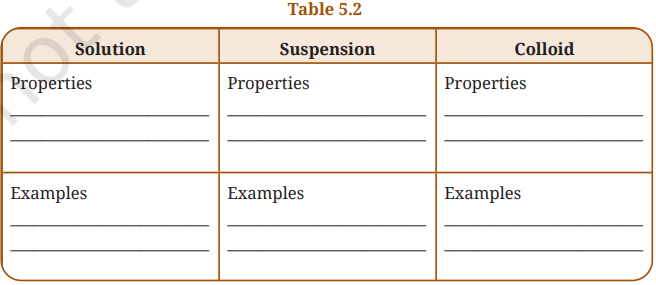
Answer:
| Solution | Suspension | Colloid |
| Properties | Properties | Properties |
| Small-sized particles (less than 1 nm in diameter); Particles remain evenly distributed; | Large-sized particles (more than 1000 nm in diameter); | Moderately-sized particles (1-1000 nm); Does not settle down; Heterogeneous mixture; |
| Does not Settles down, transparent, cannot be separated by filtration; Does not scatter light | settle down when left undisturbed; Heterogeneous mixture; Scatters light; Separates by filtration | Cannot be separated by filtration; Scatters light |
| Examples Salt solution; Brass | Examples Mud; Sand in water | Examples Milk; Butter; Smoke |
Question 5. The label on a cooking oil pack says one litre (910 g). If this oil is mixed with water, will it form a separate layer? If so, which substance will be on top? How will you separate the two layers? Also, draw the diagram of the apparatus used.
Answer: Yes, cooking oil and water separate into two distinct layers when mixed. This happens because they are immiscible liquids, meaning they do not dissolve in each other. Since cooking oil is less dense than water, it rises to the surface and forms the upper layer, while the denser water settles at the bottom. As a result, two clearly visible layers are formed, with oil floating above the water.
A separating funnel is commonly used to separate two immiscible liquids, such as oil and water, based on their difference in densities. The figure below illustrates the experimental setup used for this separation process.
Question 6. Assertion (A): Solutions do not exhibit the Tyndall effect.
Reason (R): The particles in solutions are larger than 100 nm, so they cannot scatter light. Choose the correct option:
(i) Both A and R are true, and R is the correct explanation of A.
(ii) Both A and R are true, but R is not the correct explanation of A.
(iii) A is true, but R is false.
(iv) A is false, but R is true.
Answer: (iii) The assertion is correct because true solutions do not show the Tyndall effect. The particles present in a solution are extremely small, typically less than 1 nm in diameter, which prevents them from scattering light. However, the reason is incorrect because it states that solution particles are larger than 100 nm. In reality, particles larger than 100 nm are found in colloids and suspensions, not in true solutions.
Question 7. How would you separate the mixtures given in Table 5.3? Mention the reason for choosing your method. If a mixture cannot be separated, explain why?
| Mixture | Method of separation | Reason for selection |
| Mud from muddy water | ||
| Plasma from other components in the blood sample | ||
| Naphthalene and sand | ||
| Chalk powder and common salt | ||
| Common salt and water | ||
| Oil from water | ||
| Pigments of the flower |
Answer:
| Mixture | Method of separation | Reason for selection |
| Mud from muddy water | Filtration | Mud particles (>1000 nm) settle and can be trapped by filter paper |
| Plasma from other components in the blood sample | Centrifugation | Blood cells heavier than plasma; centrifugation separates by density |
| Naphthalene and sand | Sublimation | Naphthalene sublimes on heating sand does not |
| Chalk powder and common salt | Dissolution + Filtration | Salt dissolves in water, chalk powder does not (insoluble) |
| Common salt and water | Evaporation | Salt left behind when water evaporates |
| Oil from water | Separating funnel | Oil (less dense) floats on water; separates into layers |
| Pigments of the flower | Chromatography | Different pigments have different solubilities and travel different distances |
Question 8. Two miscible liquids, A and B, are present in a mixture. The boiling point of A is 60 °C and the boiling point of B is 90 °C. Suggest a method to separate them. Also, draw a labelled diagram of the method suggested
Answer. The appropriate technique for separating miscible liquids A and B is simple distillation, as their boiling points differ by 30°C (60°C and 90°C respectively). The mixture is heated in a round-bottom flask until it reaches approximately 60°C, the boiling point of liquid A.
As the temperature rises, liquid A vaporises first, while liquid B remains in the flask due to its higher boiling point. The vapour of liquid A then passes through a water-cooled condenser, where it cools and changes back into liquid form. The condensed liquid is collected separately in a receiving flask as pure liquid A.
The distillation setup consists of a round-bottom flask, a thermometer, a still head, a condenser, and a receiving flask. The thermometer helps monitor the temperature to ensure that only liquid A is distilled before liquid B begins to vaporise at 90°C.
Question 9. Compare evaporation, crystallisation, and distillation. In which situation would you prefer each of these over the others?
Answer:
| Method | Process | What you get | Best situation |
| Evaporation | Heat the solution → solvent evaporates | Solid solute | When the solvent is not required (e.g., obtaining salt from seawater) |
| Crystallisation | Prepare hot saturated solution → cool slowly to form crystals | Pure solid crystals | When a pure solid is required (e.g., copper sulfate crystals) |
| Distillation | Heat to boil → Vapour condenses separately | Pure liquid (and residue left behind) | When the solvent or liquid needs to be recovered (e.g., separating water from a solution or separating miscible liquids) |
Question 10. Blood is an example of a colloidal mixture. (i) What would happen if blood behaved like a true suspension inside the body? (ii) In a blood sample, identify the dispersed phase and the dispersion medium.
Answer:
(i) Blood is considered a colloidal mixture because its particles remain evenly distributed throughout the liquid and do not settle under normal conditions. If blood behaved like a suspension, the heavier particles would gradually sink to the bottom when left undisturbed. Such settling could hinder blood flow, obstruct blood vessels, and impair the transport of oxygen, nutrients, and other essential substances throughout the body.
(ii) In blood, the dispersed phase consists of various cellular components, including red blood cells, white blood cells, and platelets. The dispersion medium is plasma, the liquid portion of blood that carries these cells and transports nutrients, hormones, and waste products throughout the body.
Question 11. You are given a mixture of sand, common salt and naphthalene (Fig. 5.25a). The Fig. 5.25b depicts various steps used to separate the components of this mixture. Identify and write down the correct sequence of separation techniques.
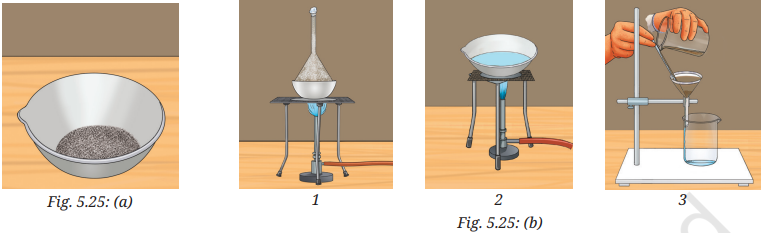
Answer: The correct order of separation methods is as follows:
Step 1: Sublimation (Image 1)
The mixture is heated in a china dish. During heating, naphthalene changes directly from a solid into vapour without passing through the liquid state. The vapours are then cooled and collected separately, while common salt and sand remain in the dish.
Step 2: Dissolution and Filtration (Image 3)
Water is added to the remaining mixture of sand and common salt. The salt dissolves in water to form a solution, whereas sand remains insoluble. The mixture is then filtered, separating the sand as the residue and the salt solution as the filtrate.
Step 3: Evaporation (Image 2)
The salt solution obtained after filtration is heated. As the water evaporates, solid common salt is left behind.
Final Sequence: Sublimation (Image 1) → Dissolution and Filtration (Image 3) → Evaporation (Image 2)
NCERT Solutions Class 9 Study Materials
- NCERT Solutions for Class 9 Maths (Ganita Manjari)
- NCERT Solutions for Class 9 Social Science (Understanding Society India and Beyond)
- NCERT Solutions for Class 9 English (Kaveri)
- NCERT Solutions for Class 9 Hindi (Ganga गंगा)
Question 13. Answer the following questions with the help of the data given in Table 5.4.
Table 5.4: Solubility of various salts (in g per 100 g of water) at different temperatures
| Salt | 10°C | 20°C | 30°C | 40°C | 60°C | 80°C |
| Potassium nitrate | 21 | 32 | 45 | 62 | 106 | 167 |
| Sodium chloride | 36 | 36 | 36.3 | 36.5 | 37 | 37 |
| Potassium chloride | 35 | 35 | 37.4 | 40 | 46 | 54 |
| Ammonium chloride | 24 | 37 | 41 | 41 | 55 | 66 |
(i) What mass of potassium nitrate would be needed to prepare its saturated solution in 50 g of water at 40 °C?
(ii) A student makes a saturated solution of potassium chloride in water at 80 °C and leaves the solution to cool at room temperature (25 °C). What would she observe as the solution cools? Explain.
(iii) What is the effect of a change in temperature on the solubility of salts? Also, compare the changes in the solubility of the four given salts with increasing temperature from 10 °C to 80 °C.
Answer:
(i) Mass of potassium nitrate for 50 g in water at 40 °C:
Solubiity = 62 g/100g water
For 50g water = (62 × 50) ÷ 100 = 31 g
Potassium nitrate needed for saturated solution.
(ii) When the solution is cooled, the solubility of potassium chloride decreases. As a result, the excess potassium chloride that cannot remain dissolved in the solution separates out and forms solid crystals.
(iii) The solubility of all four salts potassium nitrate, sodium chloride, potassium chloride, and ammonium chloride increases as the temperature rises from 10°C to 80°C. However, the extent of increase varies for each salt.
- Potassium nitrate shows the greatest increase in solubility with temperature, indicating a strong dependence on heating.
- Sodium chloride exhibits only a slight increase in solubility, making it the least affected by temperature changes.
- Potassium chloride demonstrates a gradual and steady rise in solubility as the temperature increases.
- Ammonium chloride also shows a consistent increase in solubility, though less pronounced than potassium nitrate.
Overall, potassium nitrate experiences the maximum increase in solubility, while sodium chloride shows the minimum increase over the given temperature range.
Question 14. Three students, A, B and C, are preparing sugar solutions for an experiment:
- Student A dissolves 20 g of sugar in 80 g of water. y
- Student B dissolves 20 g of sugar in 100 g of water. y
- Student C dissolves 30 g of sugar in 80 g of water.
(i) Calculate the mass percentage (% m/m) concentration of sugar in each student’s solution.
(ii) Whose solution is the most concentrated? Explain why.
Answer:
(i) Mass percentage of sugar in each student's solution
The mass percentage of a solute is calculated using the formula:
Mass Percentage (% m/m) = (Mass of Solute ÷ Mass of Solution) × 100
Student A
Mass of sugar = 20 g
Mass of water = 80 g
Total mass of solution = 20 g + 80 g = 100 g
Mass percentage of sugar = (20 ÷ 100) × 100 = 20%
Student B
Mass of sugar = 20 g
Mass of water = 100 g
Total mass of solution = 20 g + 100 g = 120 g
Mass percentage of sugar = (20 ÷ 120) × 100 = 16.67%
Student C
Mass of sugar = 30 g
Mass of water = 80 g
Total mass of solution = 30 g + 80 g = 110 g
Mass percentage of sugar = (30 ÷ 110) × 100 = 27.27%
(ii) Identification of the Most Concentrated Solution
Comparing the mass percentages:
- Student A = 20%
- Student B = 16.67%
- Student C = 27.27%
Since Student C's solution has the highest mass percentage of sugar (27.27%), it is the most concentrated solution among the three.
Question 15. Examine Fig. 5.26.
(i) Identify the separation technique marked as ‘S’.
(ii) Label the apparatus A, B and C.
(iii) Which of the following mixtures can be separated by the technique identified above? Use the data given in Table 5.5. Mixtures:
(a) water – acetone
(b) water – salt
(c) acetone – alcohol
(d) sand – salt
(e) alcohol – chloroform
(f) alcohol – benzene
Table 5.5: Boiling points of some compounds
| Solvent | Water | Acetone | Alcohol | Chloroform | Benzene |
| Temperature (°C) | 100 °C | 56 °C | 78 °C | 61 °C | 80 °C |
Answer:
(i) The apparatus labelled ‘S’ represents a simple distillation setup, which is used to separate substances based on differences in their boiling points.
(ii) The labelled components of the setup are:
- A – Distillation flask
- B – Condenser
- C – Receiving flask
(iii) Simple distillation is commonly used to separate a liquid from a dissolved solid or to separate two miscible liquids when there is a significant difference in their boiling points (typically more than 25°C).
Evaluation of the given mixtures:
- (a) Water and acetone – Yes, because their boiling points differ considerably, making simple distillation effective.
- (b) Water and salt – Yes, since water can be vaporised and condensed, leaving the salt behind in the flask.
- (c) Acetone and alcohol – No, as their boiling points are relatively close, making separation by simple distillation difficult.
- (d) Sand and salt – No, because this mixture contains solids and cannot be separated using distillation.
- (e) Alcohol and chloroform – No, due to the small difference in their boiling points.
- (f) Alcohol and benzene – No, as their boiling points are not sufficiently different for effective separation by simple distillation.
Therefore, the mixtures that can be separated using simple distillation are (a) water and acetone and (b) water and salt.
Class 9 Science Chapter 5 Exploring Mixtures and Their Separation Question Answer (InText)
Question 1. Why do suspended particles settle in muddy water over time but not in milk?
Answer: In muddy water, the suspended particles are relatively large and dense, causing them to settle at the bottom when the mixture is left undisturbed. In contrast, milk is a colloidal mixture in which the dispersed particles are extremely small and remain evenly distributed throughout the liquid. As a result, these particles do not settle down under normal conditions.
Question 2. How is evaporation different from boiling?
Answer: Evaporation and boiling are two different processes of vaporisation. Evaporation occurs only at the surface of a liquid and can take place at any temperature. In contrast, boiling occurs throughout the entire liquid and takes place only when the liquid reaches its specific boiling point.
Question 3. Why do you see bright rays of sunlight when it passes through small gaps between the
leaves of a dense tree?
Answer: The path of sunlight becomes visible because tiny particles of dust, smoke, or other suspended matter present in the air scatter the light in different directions. This phenomenon of light scattering by small particles is known as the Tyndall effect.
Pause and Ponder (NCERT Textbook Page No. 76)
Question 1. A common talcum powder contains 4% m/m zinc oxide, which acts as an antiseptic. How much zinc oxide is present in 300 g of the talcum powder?
Answer:
Given:
Zinc oxide content = 4% m/m
Mass of talcum powder = 300 g
Using the formula:
Mass of zinc oxide = (Percentage × Total mass) ÷ 100
= (4 × 300) ÷ 100
= 12 g
12 g of zinc oxide is present in 300 g of the talcum powder.
Question 2. Your mother gives you a bottle of orange juice concentrate to mix with water and serve it to your visiting friends. She asks you to mix two tablespoons of the concentrate with water in a glass tumbler. If each tablespoon measures 15 mL and you make 150 mL of juice per person, what is the % v/v of orange juice concentrate in the mixture you prepared?
Answer:
Each tablespoon contains 15 mL of orange juice concentrate.
Therefore, the volume of concentrate used:
= 2 × 15 mL
= 30 mL
The total volume of the prepared juice is 150 mL.
Using the formula:
% v/v = (Volume of Solute ÷ Volume of Solution) × 100
Substituting the values:
% v/v = (30 ÷ 150) × 100
= 20%
Final Answer:
The percentage by volume (% v/v) of orange juice concentrate in the prepared juice is 20%.
Question 3. Vinegar, used as a food preservative and additive, contains 5 % v/v acetic acid. Glacial acetic acid is a liquid, i.e., 100% acetic acid. If you want to make vinegar from glacial acetic acid, how would you proceed?
Answer: To prepare vinegar containing 5% v/v acetic acid from glacial acetic acid (100% acetic acid), the glacial acetic acid must be diluted with water.
The expression 5% v/v means that 5 mL of acetic acid is present in every 100 mL of solution.
Therefore, to prepare 100 mL of vinegar:
- Take 5 mL of glacial acetic acid.
- Add 95 mL of water.
- Mix the solution thoroughly.
This produces a vinegar solution containing 5% v/v acetic acid.
Similarly, for larger quantities, maintain the same ratio of 5 parts acetic acid to 95 parts water.
Pause and Ponder (NCERT Textbook Page No. 79)
Question 4. Refer to the solubility curves given in Activity 5.2. If equal masses of hot, saturated Solutions of compounds ‘A’ and ‘B’ are cooled from 80°C to 60°C, which solution is likely to deposit more solid?
Answer: Compound B will deposit a greater amount of solid when the hot saturated solutions are cooled from 80°C to 60°C. This is because the solubility curve of Compound B is steeper than that of Compound A, indicating a larger decrease in solubility over the same temperature range.
As the temperature decreases, the excess solute that can no longer remain dissolved separates out as solid crystals. Since Compound B experiences a greater reduction in solubility, more of its dissolved substance crystallises out of the solution. Therefore, Compound B deposits more solid than Compound A upon cooling.
Question 5. Will there be any change in the size of common salt crystals if the rate of evaporation is increased or decreased? Explain.
Answer: Yes, the size of crystals is influenced by the rate of evaporation. When evaporation occurs rapidly, crystals tend to be smaller because the dissolved particles have limited time to arrange themselves into a well-organized crystal structure. In contrast, slow evaporation promotes the growth of larger and more uniform crystals, as the particles get sufficient time to align and form a regular crystalline pattern.
Pause and Ponder (NCERT Textbook Page No. 82)
Question 6. State whether the following statements are True or False. Also, correct the False statements.
(i) Salt can be separated from a salt solution by evaporation or distillation.
(ii) Distillation can be used for separation of two liquids even when these have the same boiling point.
(iii) In paper chromatography, the solvent level should be above the sample spot at the beginning of the experiment.
(iv) Evaporation and crystallisation are the same processes.
Answer:
(i) True: Salt can be recovered from a salt solution using methods such as evaporation or distillation, both of which separate the dissolved salt from water.
(ii) False: Distillation cannot be used to separate two liquids that have the same boiling point. When two liquids have very similar boiling points, fractional distillation is preferred because it provides more effective separation than simple distillation.
(iii) False: In paper chromatography, the solvent level must always be kept below the sample spot at the start of the experiment. If the spot is submerged, the sample may dissolve directly into the solvent instead of moving up the paper for separation.
(iv) False: Evaporation and crystallization are not the same process. Evaporation removes the solvent, leaving the dissolved substance behind, which may contain impurities. Crystallisation, on the other hand, is used to obtain pure crystals from a saturated solution by allowing it to cool slowly and form well-defined crystals.
Pause and Ponder (NCERT Textbook Page No. 84)
Question 7. Why do immiscible liquids form two separate layers in a separating funnel?
Answer: Immiscible liquids do not dissolve or mix uniformly with one another. Due to differences in their densities, they form separate layers, with the denser liquid settling at the bottom and the less dense liquid floating above it.
Question 8. Is sublimation different from evaporation? Justify.
Answer: Yes, sublimation and evaporation are two distinct physical processes. Sublimation occurs when a substance changes directly from the solid state to the gaseous state without becoming a liquid. Common examples of substances that undergo sublimation include camphor, naphthalene, and ammonium chloride.
In contrast, evaporation is the process by which a liquid changes into vapour from its surface, usually at temperatures below its boiling point. For example, water gradually evaporates when exposed to air. Thus, sublimation involves a direct solid-to-gas transition, whereas evaporation involves a liquid-to-gas transition.
Pause and Ponder (NCERT Textbook Page No. 88)
Question 9. Clouds are made up of tiny water droplets or ice crystals floating in the air. Based on what you know about solutions, suspensions and colloids, what type of mixture do you think clouds are and why?
Answer: Clouds are an example of a colloidal system in which tiny droplets of water or minute ice crystals are dispersed throughout the air. These particles remain suspended for long periods without settling due to their small size. Clouds also exhibit the Tyndall effect, as the dispersed particles scatter sunlight, making the clouds visible in the sky.
Question 10. Why do cities with a lot of smoke and dust in the air often look hazy?
Answer: Tiny smoke and dust particles suspended in the air scatter light in different directions, a phenomenon known as the Tyndall effect. This scattering causes the atmosphere to appear hazy and can reduce visibility, especially in areas with high levels of dust, smoke, or pollution.
Class 9 NCERT Science Book Exploration Solutions Chapter-wise Links
- Chapter 1 Exploration Entering the World of Secondary Science Class 9 Question Answer
- Chapter 2 Cell The Building Block of Life Class 9 Question Answer
- Chapter 3 Tissues in Action Class 9 Question Answer
- Chapter 4 Describing Motion Around Us Class 9 Question Answer
- Chapter 6 How Forces Affect Motion Class 9 Question Answer
Key Features of NCERT Solutions for Class 9 Science Chapter 5 – Exploring Mixtures and their Separation
- Comprehensive Coverage: Provides detailed answers to all intext, exercise, and activity-based questions from Chapter 5.
- Step-by-Step Explanations: Solutions are explained in a simple and systematic manner to help students understand concepts easily.
- Aligned with the Latest NCERT Syllabus: Prepared according to the updated NCERT Science Exploration curriculum for the 2026–27 academic session.
- Concept-Focused Learning: Helps students build a strong understanding of mixtures, solutions, colloids, suspensions, and separation techniques.
- Exam-Oriented Preparation: Covers important concepts and question patterns frequently asked in school examinations.
- Accurate and Reliable Answers: Solutions are prepared by subject experts to ensure correctness and clarity.
- Easy-to-Understand Language: Uses student-friendly explanations suitable for Class 9 learners.
- Supports Self-Study: Enables students to learn independently and verify their answers while completing assignments and homework.
- Includes Practical Applications: Explains real-life examples of filtration, distillation, chromatography, sublimation, centrifugation, and other separation methods.
- Improves Problem-Solving Skills: Encourages analytical thinking and application of scientific concepts to different situations.
- Helpful for Revision: Serves as a quick revision resource before tests, exams, and assessments.
- Additional Learning Support: Students can access chapter notes, worksheets, MCQs, important questions, and study resources on Infinity Learn for more effective preparation.
course
No courses found
FAQs on NCERT Solutions for Class 9 Science Exploration Chapter 5
Where can I download the NCERT Solutions for Class 9 Science Chapter 5 PDF?
Students can download the NCERT Solutions for Class 9 Science Chapter 5 PDF from Infinity Learn. These solutions provide accurate, step-by-step answers to all textbook questions and help students understand the chapter thoroughly.
Are the Class 9 Science Chapter 5 Exercise Question Answers available in PDF format?
Yes, Infinity Learn offers the Class 9 Science Chapter 5 Exercise Question Answer PDF, which includes detailed solutions to all exercise questions, intext questions, and activity-based questions from the chapter Exploring Mixtures and their Separation.
How can I access the NCERT Solutions Class 9 Science Chapter 5 PDF Download?
Students can easily access the NCERT Solutions Class 9 Science Chapter 5 PDF Download on Infinity Learn. The PDF format allows students to study offline, revise concepts quickly, and prepare effectively for exams.
What topics are covered in Exploring Mixtures and their Separation Class 9 Question and Answer?
The Exploring Mixtures and their Separation Class 9 Question and Answer section covers important topics such as homogeneous and heterogeneous mixtures, solutions, colloids, suspensions, concentration, solubility, filtration, distillation, chromatography, sublimation, centrifugation, and other separation techniques. Infinity Learn provides detailed explanations for each concept.
Where can I find the NCERT Class 9 Science Chapter 5 PDF?
Students can access the NCERT Class 9 Science Chapter 5 PDF along with chapter notes, important questions, worksheets, and NCERT solutions on Infinity Learn, making it a one-stop learning resource for Class 9 Science.
Is Exploring Mixtures and their Separation Class 9 NCERT PDF enough for exam preparation?
The Exploring Mixtures and their Separation Class 9 NCERT PDF provides a strong foundation for exam preparation. When combined with the chapter-wise solutions, revision notes, MCQs, and practice questions available on Infinity Learn, students can prepare comprehensively and perform better in their examinations.
What do students learn in Exploring Mixtures and Their Separation?
Students learn about different types of mixtures, their properties and the physical methods used to separate their components. These concepts help students understand everyday processes and support later learning in Chemistry.
How should students prepare Exploring Mixtures and Their Separation?
Students should understand the differences among solutions, suspensions and colloids and learn why each separation method is used. They should complete the textbook activities and exercise questions, revise examples and practise application-based questions.
What common mistakes do students make in this chapter?
Students often confuse homogeneous and heterogeneous mixtures or mix up solutions, suspensions and colloids. They may also choose a separation method without considering properties such as particle size, solubility, density or boiling point.
What is the difference between a mixture and a compound?
A mixture contains two or more substances that are not chemically combined, and its components retain their individual properties. A compound is formed through chemical combination in a fixed proportion and has properties different from those of its constituent elements.
What are some real-life applications of separation techniques?
Examples include filtering water, separating cream from milk through centrifugation, obtaining salt through evaporation and separating pigments in inks or dyes through chromatography. These examples show how physical properties help determine a suitable separation method.
How do students choose the correct method for separating a mixture?
Students should consider the physical properties of the substances in the mixture. Particle size, solubility, density, boiling point, magnetic behaviour and the physical state of each component can help determine the correct separation method.
