- Doubt 1: How to Calculate MOI for Composite Bodies?
- Doubt 2: When to Use Torque vs Force in Problem Solving?
- Doubt 3: Why Does Angular Momentum Remain Conserved?
- Doubt 4: How to Solve Rolling Motion on Incline Problems?
- Doubt 5: What Is the Role of Friction in Rolling Motion?
- Doubt 6: How to Handle Fixed Axis vs Free Axis Rotation?
- Doubt 7: How to Approach MOI Problems with Removed Sections?
- Doubt 8: What Is the Instantaneous Axis of Rotation?
- Doubt 9: How to Apply Work-Energy Theorem for Rotating Bodies?
- Doubt 10: Angular Momentum in Collisions – How to Handle It?
- How Infinity Learn Resolves Physics Doubts Instantly
- FAQs on Top 10 JEE Physics Doubts in Rotational Motion
Top 10 JEE Physics Doubts in Rotational Motion – Solved Step by Step
By rohit.pandey1
|
Updated on 10 Jul 2026, 11:34 IST
Rotational motion breaks more JEE Physics scores than any other mechanics chapter. Ask any coaching faculty which topic generates the most doubt-session traffic, and the answer comes back almost every time: rotational motion. Part of the reason is structural. The chapter demands comfort with vectors, calculus, and geometry simultaneously, and a student who is otherwise strong in linear kinematics can still freeze the moment a disc starts rolling down an incline.
This piece works through the ten rotational motion doubts JEE aspirants raise most often, each solved the way a mentor would solve it during a live doubt call. Not a wall of theory. A fix, one doubt at a time, moving from moment of inertia through torque, angular momentum, rolling motion, and finally collisions. Clearing these ten first prevents the compounding confusion that shows up later in JEE Advanced-level combined-body problems.
Foundational doubts must be resolved before attempting mixed numericals. So this article is structured as a running FAQ, matching how students actually search and ask.
Doubt 1: How to Calculate MOI for Composite Bodies?
Moment of inertia (MOI) of a composite body is simply the sum of the MOI of each individual part about the same axis. The trick lies in bringing every part's MOI to a common axis using the parallel and perpendicular axis theorems.
Step-by-Step Approach
- Break the composite body into simple shapes: rods, discs, rings, or spheres.
- Find each part's MOI about its own centre of mass using the standard formula.
- Shift each MOI to the required axis using the parallel axis theorem, if the axis does not pass through that part's centre.
- Add all individual MOI values algebraically.
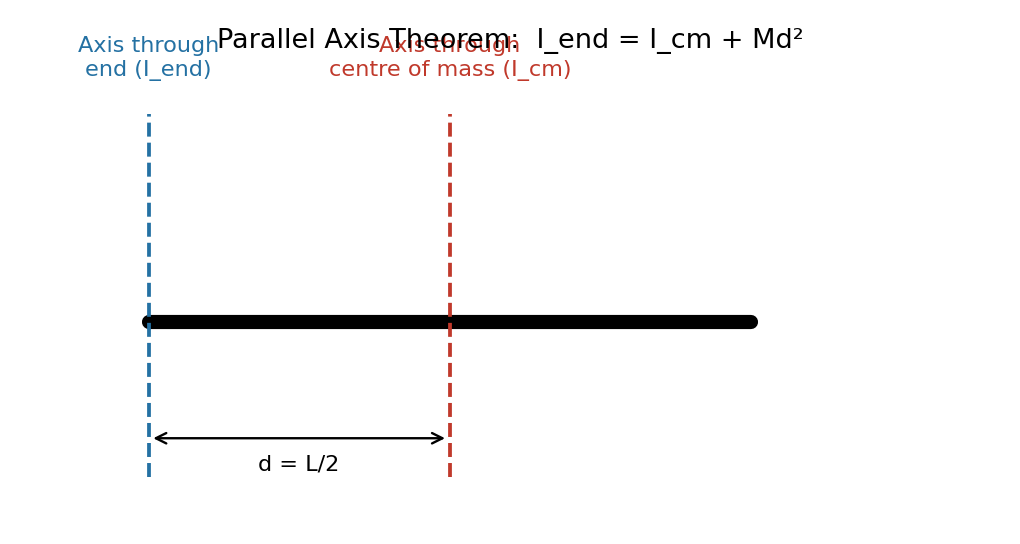
Fig 1: Parallel Axis Theorem, shifting MOI from the centre of mass to an end axis
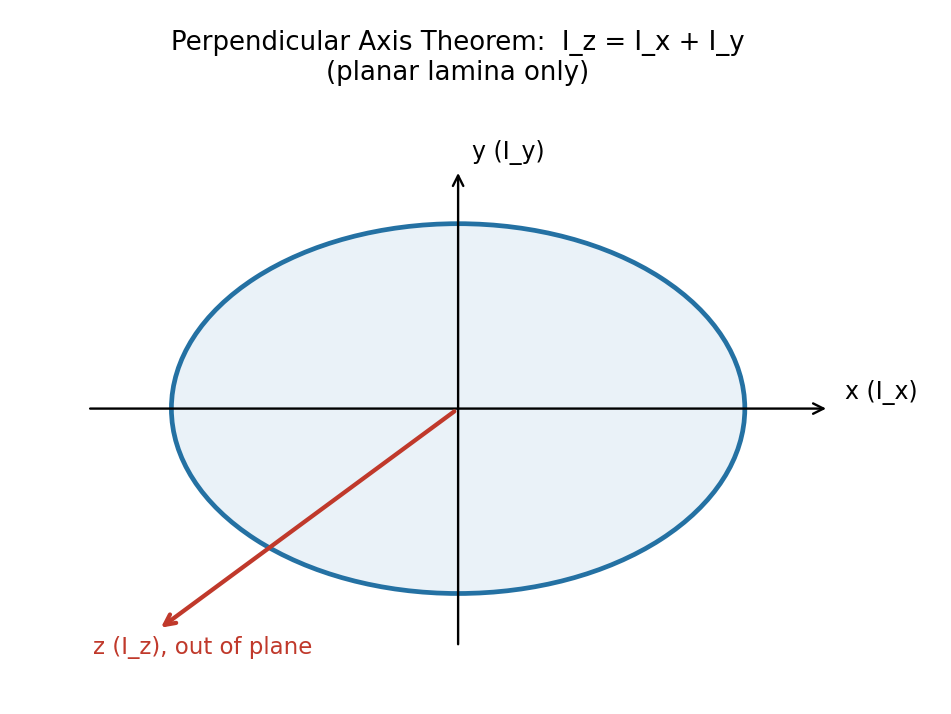
Fig 2: Perpendicular Axis Theorem, valid only for flat, planar bodies

Solved Example
A disc of mass M and radius R has a rod of mass m and length R attached along its diameter, both rotating about an axis through the centre, perpendicular to the disc.
MOI of disc about the given axis: (1/2)MR². MOI of rod about the same axis (through its centre): (1/12)mR². Total MOI = (1/2)MR² + (1/12)mR². No shifting needed here since both axes already pass through the same centre point.
Best Courses for You

JEE

NEET

Foundation JEE

Foundation NEET

CBSE
Doubt 2: When to Use Torque vs Force in Problem Solving?
Force changes linear momentum. Torque changes angular momentum. The rotational analogue concept means every linear quantity in Newton's second law has a matching rotational partner: force becomes torque, mass becomes moment of inertia, and acceleration becomes angular acceleration.
Decision Framework
- Use force (F = ma) when the question asks about the motion of the centre of mass.
- Use torque (τ = Iα) when the question asks about rotation about a fixed or moving axis.
- In combined problems (rolling bodies), write both equations together and solve simultaneously.
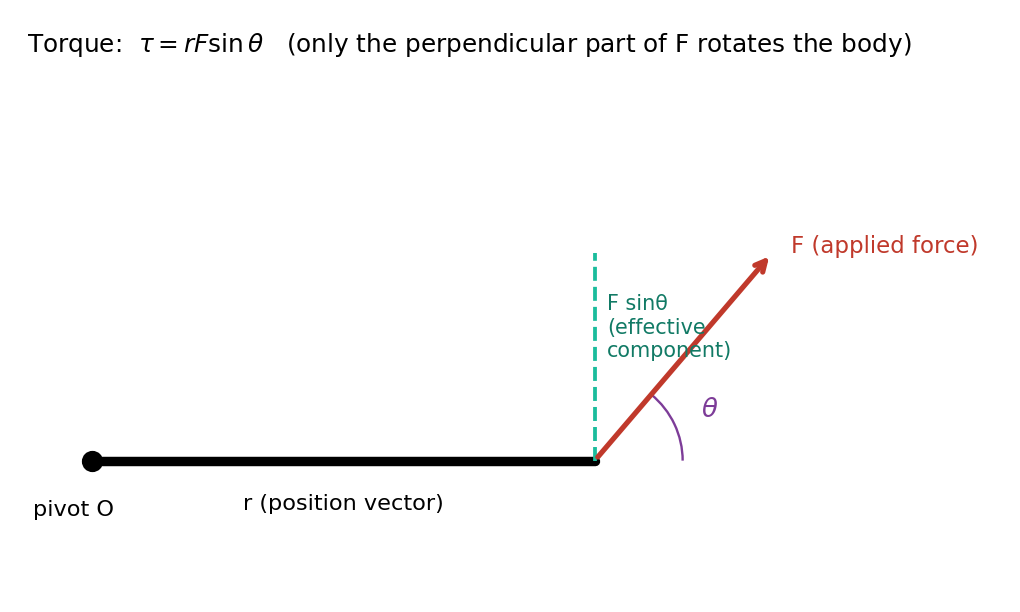
Fig 3: Only the perpendicular component of force produces torque about a pivot
Common Errors
- Using the full force magnitude instead of its perpendicular component while computing torque.
- Forgetting that torque depends on the point about which it is calculated, unlike force.
Doubt 3: Why Does Angular Momentum Remain Conserved?
Angular momentum stays constant whenever the net external torque on a system is zero. This falls directly out of the rotational analogue of Newton's second law: τ = dL/dt. If τ = 0, then L must stay fixed over time.
Real-Life Analogy
A figure skater pulling their arms inward spins faster because moment of inertia drops while angular momentum, L = Iω, holds steady. No external torque acts on the skater once they are already spinning freely on the ice, so I and ω trade off exactly to keep the product constant.
Doubt 4: How to Solve Rolling Motion on Incline Problems?
Two methods work here: the energy method and the force-torque method. JEE Main favours the energy method for speed, while JEE Advanced sometimes demands the force method to extract intermediate quantities like friction force.
Energy Method
Total mechanical energy is conserved for rolling without slipping (no energy lost to friction, since static friction does zero work at the contact point). Mgh = (1/2)mv² + (1/2)Iω², combined with v = ωR, gives acceleration directly through kinematics.
Force Method
Write mg sinθ − f = ma along the incline, and fR = Iα for rotation about the centre. Combine with a = Rα to solve for both acceleration and the friction force f simultaneously.
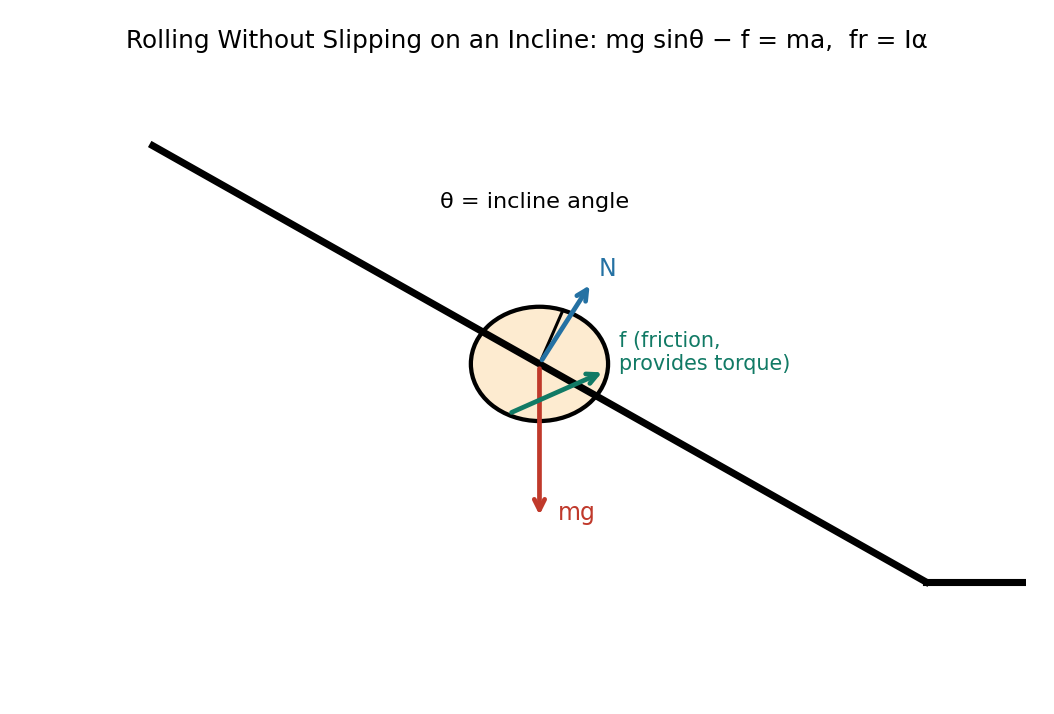
Fig 4: Force diagram for a cylinder rolling without slipping on an incline
Solved Numerical
A solid sphere (I = (2/5)MR²) rolls down an incline of angle θ = 30° without slipping. Using a = g sinθ / (1 + I/MR²) = g sinθ / (1 + 2/5) = (5/7)g sinθ. Substituting g = 9.8 and sinθ = 0.5 gives a ≈ 3.5 m/s².
Doubt 5: What Is the Role of Friction in Rolling Motion?
Static friction, not kinetic friction, governs rolling without slipping. This single distinction resolves most student confusion in this doubt category.
When Friction Does Zero Work
At the exact contact point of a rolling body, the instantaneous velocity is zero (see Doubt 8 below). Since work = force × displacement, and displacement of the contact point is zero over each instant, friction does zero work during pure rolling, even though it still supplies torque.
Common Misconceptions
- Assuming friction always opposes motion. In rolling, friction can act up the incline even while the body accelerates downward, since its role is to prevent slipping, not to resist translation.
- Believing friction always dissipates energy. In pure rolling it does not, because there is no relative sliding at contact.
Doubt 6: How to Handle Fixed Axis vs Free Axis Rotation?
Fixed axis rotation happens when the rotation axis itself does not move, such as a door on its hinges or a pulley on a fixed support. Free axis (or combined) rotation happens when the axis itself translates, as with a rolling ball or a spinning top moving across a table.
Problem-Solving Strategy
- Fixed axis: apply τ = Iα directly about that fixed axis, treat it like a standard rotational Newton's law problem.
- Free axis: separate translation of the centre of mass (F = Ma_cm) from rotation about the centre of mass (τ_cm = I_cm α), then connect the two using the rolling or constraint condition.
Doubt 7: How to Approach MOI Problems with Removed Sections?
When a cavity or hole is cut out of a larger body, treat the missing piece as negative mass rather than trying to derive a new formula from scratch.
Subtraction Method
MOI of remaining body = MOI of full body (without the cavity) − MOI of the removed piece (as if it were a separate object of its own mass and shape), both calculated about the same axis.
Solved Example with Disc and Removed Portion
A disc of mass M and radius R has a smaller disc of radius R/2 removed from one edge, tangent to the rim. First find the mass of the removed piece: since area scales with r², the removed disc has mass M/4. Its centre lies at distance R/2 from the main disc's centre. Apply the parallel axis theorem to find its MOI about the main axis, then subtract that value from the full disc's MOI of (1/2)MR².
Doubt 8: What Is the Instantaneous Axis of Rotation?
The instantaneous axis of rotation (IAOR) is the line about which a rolling or rotating body appears to rotate at any given moment, even though that axis itself may be moving through space. For a wheel rolling without slipping, the IAOR passes through the contact point with the ground.
Physical Meaning
At the contact point, translational velocity and rotational velocity cancel exactly, giving zero net velocity there. Every other point on the wheel can be treated as rotating purely about this contact point at that instant, which simplifies velocity calculations dramatically.
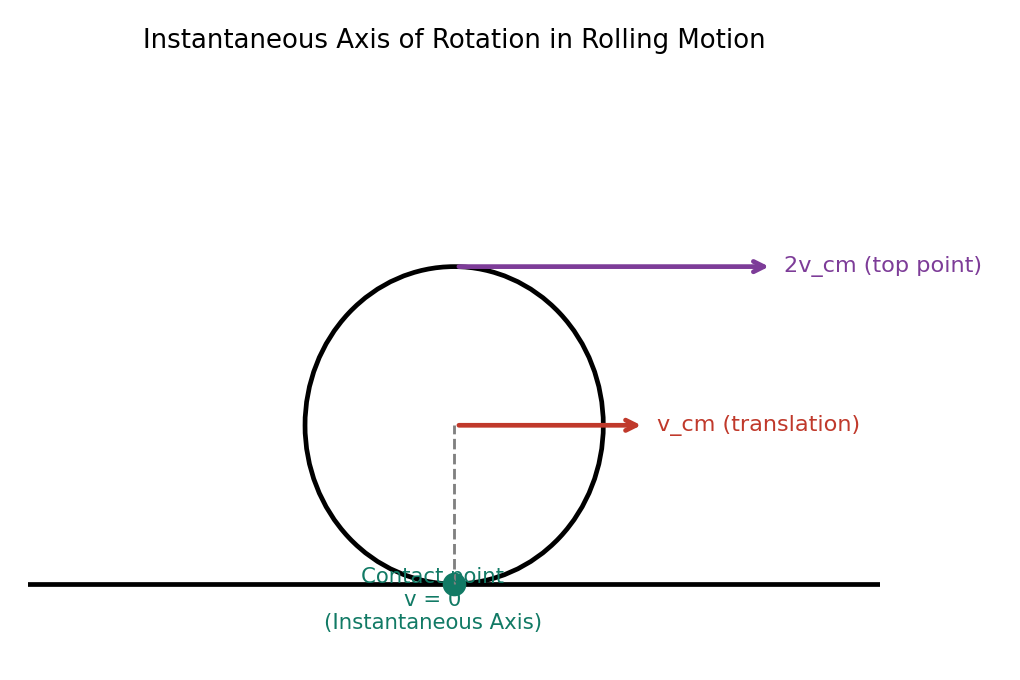
Fig 5: Velocity distribution on a rolling wheel about its instantaneous axis
Finding It in Different Scenarios
- Rolling on flat ground: IAOR is at the bottom contact point.
- Rolling on an incline: IAOR is again at the contact point, but now oriented along the slope.
- A rod sliding with one end on the ground and one on a wall: IAOR is found using the perpendiculars to each surface's velocity direction.
Doubt 9: How to Apply Work-Energy Theorem for Rotating Bodies?
Total kinetic energy of a rolling body has two components: translational, (1/2)mv², and rotational, (1/2)Iω². The work-energy theorem states that the net work done by all forces equals the change in this total kinetic energy.
Combined Translational and Rotational Energy Problems
For a body rolling down a height h without slipping, gravitational potential energy converts entirely into KE_total = (1/2)mv² + (1/2)Iω², since friction does no work. Substituting I in terms of MR² (using the relevant factor for the shape) and ω = v/R lets you solve directly for the final speed v.
Doubt 10: Angular Momentum in Collisions – How to Handle It?
Angular momentum about a chosen point is conserved during a collision whenever no external torque acts about that specific point during the (usually very short) collision interval, even if linear momentum is not separately conserved for each part.
Solved JEE-Level Problem
A rod of mass M and length L, pivoted at one end, is struck by a small ball of mass m moving with speed v perpendicular to the rod, at its free end. Angular momentum about the pivot just before impact: L_i = mvL. Just after impact, if the ball sticks to the rod and the system rotates with angular velocity ω: L_f = (I_rod + I_ball)ω = [(1/3)ML² + mL²]ω. Equating L_i = L_f and solving gives ω = mvL / [(1/3)ML² + mL²].
How Infinity Learn Resolves Physics Doubts Instantly
Infinity Learn runs a 24x7 doubt-solving feature built specifically for exactly this kind of mid-practice confusion, where a rotational motion numerical stalls a study session at any hour.
- Step-by-step video solutions break every rotational motion doubt into the same structure used in this article: concept, common trap, and solved example.
- Mentor-guided doubt sessions cover the harder combined-body and collision problems that typically appear in JEE Advanced rather than JEE Main.
- Difficulty-graded practice sets move from single-body MOI questions to multi-concept rolling and collision numericals.
Ten doubts, one connected chapter. Moment of inertia sets up every later calculation, torque and force split the rotational and translational parts of a problem, angular momentum conservation resolves spins and collisions, and rolling motion ties translation and rotation together through a single constraint equation.
A practical next step: rework each of the ten solved examples above without looking at the solution, then attempt three previous year JEE Main rotational motion questions back to back. Compounding confusion in this chapter almost always traces back to one of these ten gaps, so fixing them early changes how the rest of mechanics feels.
Rotational motion doubts JEE aspirants raise are rarely about intelligence. They are about repetition, and about which axis you are supposed to be looking at.
course
No courses found
FAQs on Top 10 JEE Physics Doubts in Rotational Motion
Where can I get step-by-step solutions for JEE rotational motion?
Coaching platforms with 24x7 doubt-resolution features, like Infinity Learn, provide step-by-step video solutions matched to JEE-level rotational motion problems, along with live mentor sessions for harder combined-body numericals.
What are the most common mistakes in rotational motion problems?
Using the full force instead of its perpendicular component for torque, forgetting that static friction does zero work in pure rolling, and mixing up fixed-axis with free-axis rotation strategies account for most lost marks.
How many questions come from rotational motion in JEE Main?
Rotational motion typically contributes 2 to 3 questions in JEE Main Physics, but its concepts overlap heavily with gravitation and simple harmonic motion, extending its real weightage.
Is rotational motion harder than linear motion for JEE?
It is not inherently harder, but it demands comfort with vectors and two simultaneous equations (force and torque) rather than one, which is why it feels more difficult until the pattern becomes familiar.
How do I practise rotational motion effectively?
Master the ten doubt categories above in order, since later topics like collisions and combined rolling-incline problems build directly on moment of inertia and torque fundamentals covered first.