- SN1 vs SN2 Reactions: The Solvent and Substrate Tussle
- Addition Reactions: Navigating the Peroxide Exception
- Elimination Reactions (E1 and E2)
- Named Reactions Most Asked in NEET
- How to Approach Organic Reaction Problems in NEET
- How Infinity Learn Solves Organic Chemistry Doubts
- FAQs: NEET Chemistry Organic Reactions: Most Confusing Doubts Answered
NEET Chemistry Organic Reactions: Most Confusing Doubts Answered
By rohit.pandey1
|
Updated on 10 Jul 2026, 14:01 IST
Organic chemistry makes up a significant portion of the NEET Chemistry section, generally contributing about one-third of the entire paper. While physical chemistry relies on mathematical formulas and inorganic demands systematic memory work, resolving your organic chemistry doubts NEET requires a clear understanding of reaction pathways.
Many medical aspirants struggle here because they treat chemical transformations as a sequence of isolated facts to memorize. Rote learning backfires the moment the National Testing Agency (NTA) introduces minor structural variations or multi-step conversions. Mastering organic chemistry requires analyzing how electrons move. Once you grasp underlying reaction mechanisms, predicting the major product becomes straightforward.
SN1 vs SN2 Reactions: The Solvent and Substrate Tussle
Nucleophilic substitution reactions are a frequent source of confusion because the choice between an SN1 and SN2 pathway depends on multiple competing factors.
How Does SN1 Lead to Racemization?
The SN1 reaction is a two-step, unimolecular process.
- Step 1: The leaving group departs, forming a planar carbocation intermediate. This is the slow, rate-determining step. Substrate stability dictates the reaction rate. Tertiary alkyl halides react fastest (3o > 2o > 1o), assuming identical leaving groups, because the positive charge is stabilized by the +I effect and hyperconjugation of neighboring alkyl groups.
- Step 2: The nucleophile attacks the planar carbocation from either the front or the back side. This non-directional attack often leads to racemization, as both configurations can form.
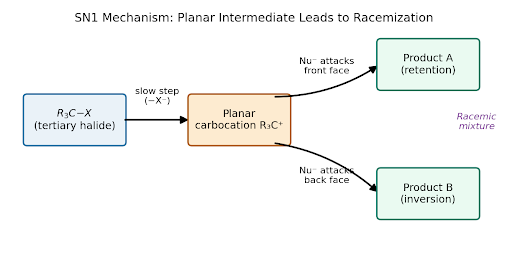
Fig 1: SN1 mechanism, the planar carbocation intermediate opens attack from both faces, giving a racemic mixture
Why Does SN2 Give Inversion?
The SN2 mechanism is a single-step, concerted, bimolecular process where the rate depends on both the substrate and the nucleophile concentration.
- Mechanism: The nucleophile performs a backside attack simultaneously as the leaving group exits. This requires a clear path to the electrophilic carbon.
- Steric Hindrance: Bulky groups block the incoming nucleophile. Therefore, methyl and primary alkyl halides react fastest (1o > 2o > 3o). The single-step transition state forces a complete inversion of configuration, known as Walden inversion.
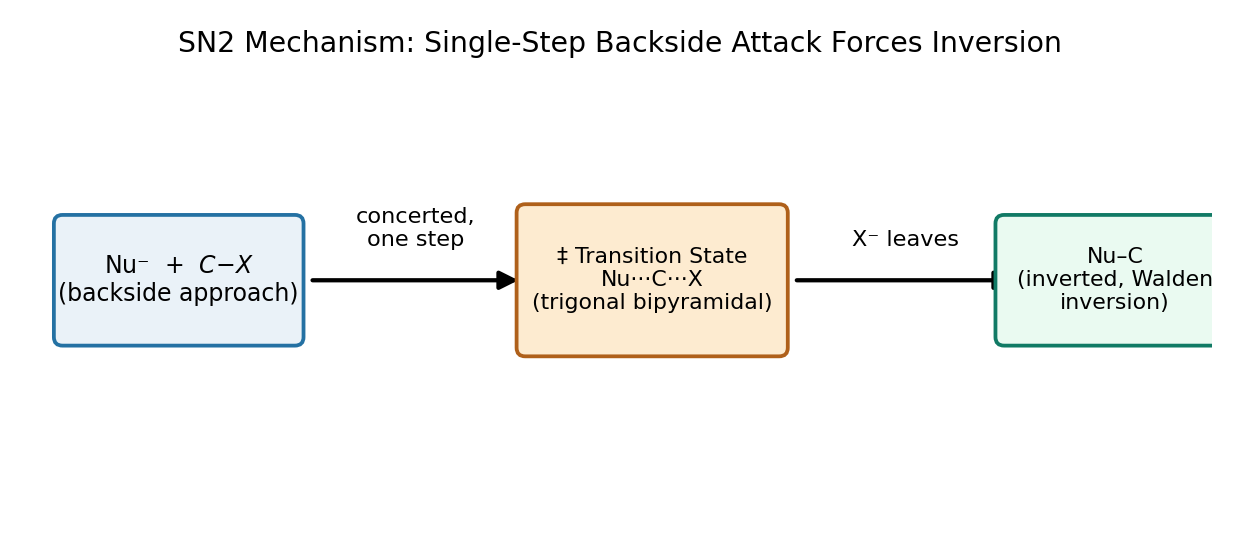

Fig 2: SN2 mechanism, a single concerted step forcing Walden inversion at the reacting carbon
How to Predict the Pathway
| Factor | Favoring SN1 | Favoring SN2 |
| Substrate Structure | 3° Alkyl halides | 1° or Methyl halides |
| Nucleophile Strength | Weak nucleophiles (e.g., H2O, EtOH) | Strong, negatively charged nucleophiles (e.g., OH⁻, CN⁻) |
| Solvent Type | Polar protic solvents (e.g., water, alcohols) | Polar aprotic solvents (e.g., DMSO, Acetone) |
Addition Reactions: Navigating the Peroxide Exception
Electrophilic addition reactions across carbon-carbon double bonds are foundational to alkene chemistry. The primary point of confusion lies in predicting regional selectivity when an asymmetric alkene reacts with a polar reagent like hydrogen bromide (HBr).
Best Courses for You

JEE

NEET

Foundation JEE

Foundation NEET

CBSE
Markovnikov's Rule
In standard hydrohalogenation, the reaction proceeds via a carbocation intermediate. The electrophile (H+) adds to the doubly bonded carbon that already holds more hydrogen atoms. This selective addition ensures the formation of the more stable carbocation intermediate. The nucleophile (Br−) then binds to the more substituted carbon, yielding the Markovnikov product.
The Peroxide Effect
When HBr reacts in the presence of organic peroxides (like benzoyl peroxide), the orientation changes completely. Hydrogen adds to the more substituted carbon, yielding the anti-Markovnikov product.
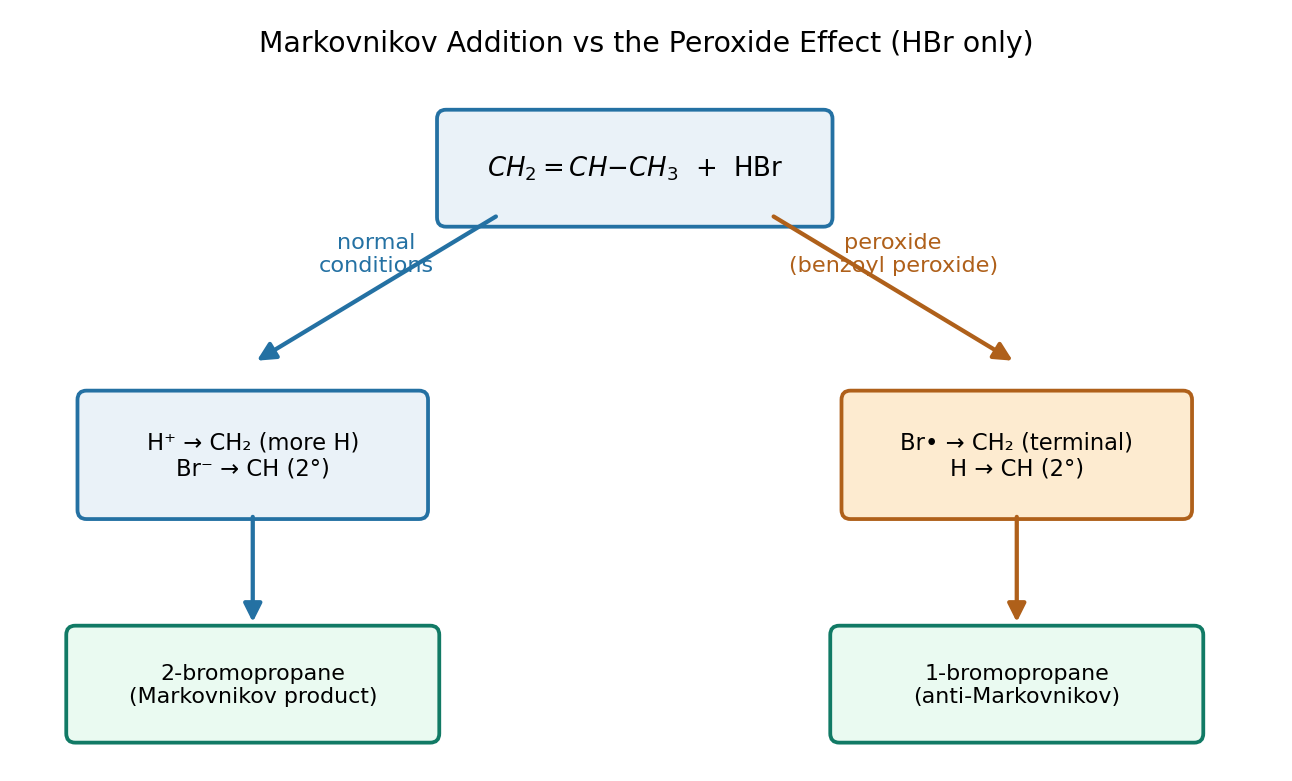
Fig 3: Markovnikov addition under normal conditions versus the peroxide-driven anti-Markovnikov pathway
Critical NEET Trap: As specified in NCERT, the peroxide effect is observed only with HBr. It does not occur with HCl or HI due to thermodynamic limitations in their respective steps.
Elimination Reactions (E1 and E2)
Elimination reactions frequently compete with nucleophilic substitution, as strong bases often act as strong nucleophiles.
E1 vs E2 Mechanisms
The E1 pathway is a stepwise process. The leaving group departs first to create a carbocation intermediate. A weak base then removes a neighboring proton (β-hydrogen) to form a stable double bond.
In contrast, E2 is a concerted, single-step reaction. A strong base extracts a β-hydrogen at the exact same time the leaving group departs. This requires the abstracting proton and the leaving group to be in an anti-periplanar geometry (180 degrees apart) for proper orbital alignment.
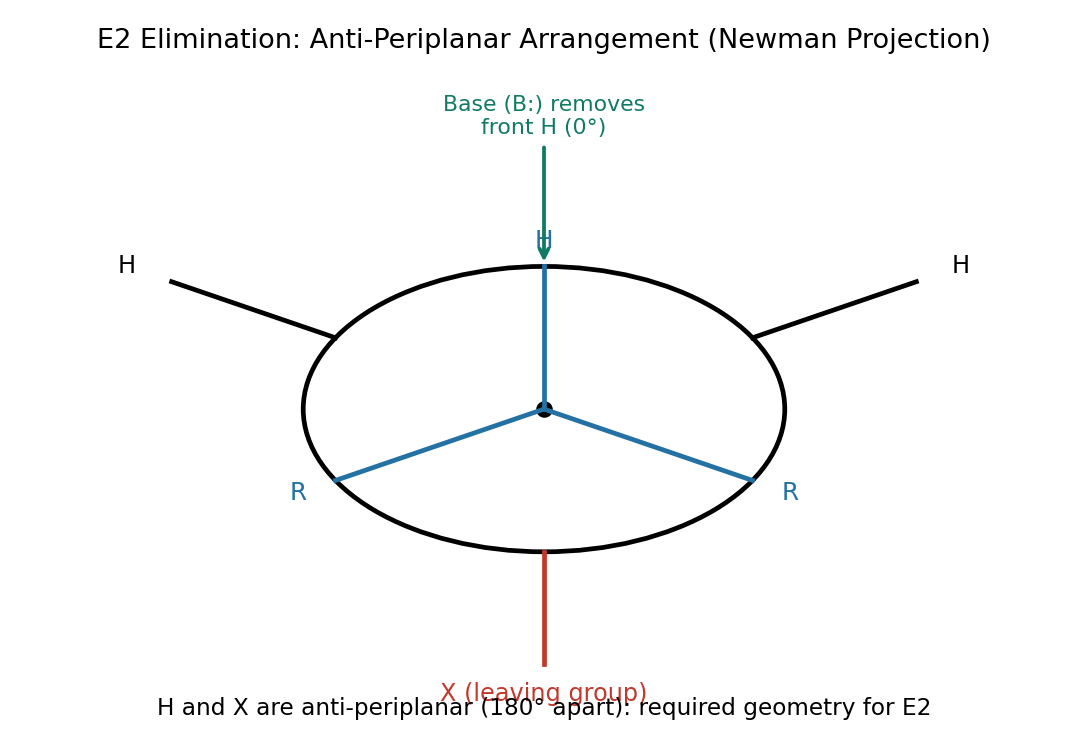
Fig 4: Newman projection showing the anti-periplanar geometry required for E2 elimination
Regioselectivity: Zaitsev's Rule
When multiple β-hydrogens are available, elimination generally favors the formation of the highly substituted, more stable alkene. This is known as Zaitsev's rule. Highly substituted alkenes are preferred because they possess greater thermodynamic stability due to the increased number of alkyl groups attached to the doubly bonded carbons.
Named Reactions Most Asked in NEET
Named reactions are high-yield areas where structural prerequisites and reaction conditions are frequently tested.
Aldol Condensation
This reaction requires aldehydes or ketones containing at least one α-hydrogen. When treated with a dilute base (dil. NaOH), the base abstracts the acidic α-hydrogen to generate a nucleophilic enolate ion. This ion attacks the carbonyl carbon of another molecule to yield a β-hydroxy carbonyl compound. Subsequent heating triggers dehydration, forming a conjugated α,β-unsaturated product.
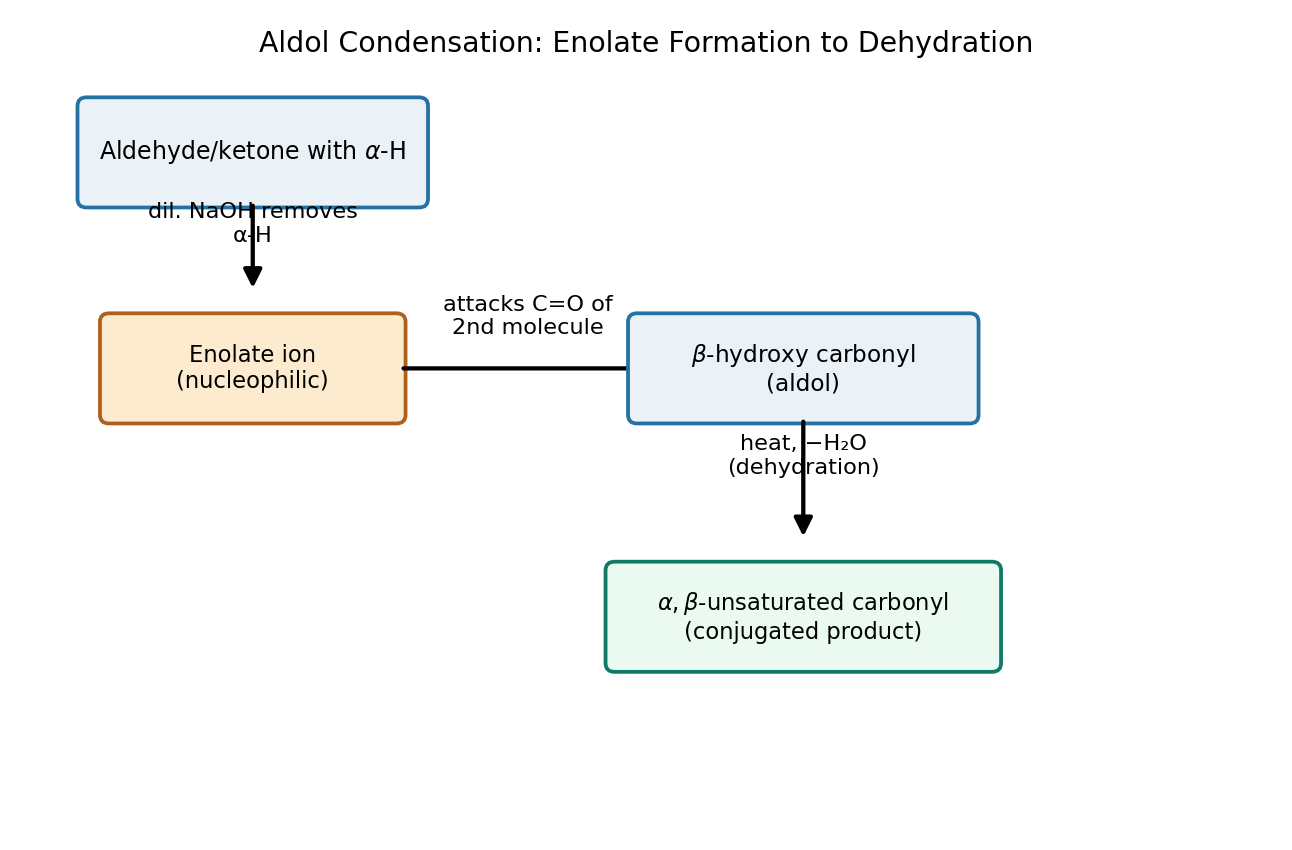
Fig 5: Aldol condensation, from enolate formation through to the dehydrated conjugated product
Cannizzaro Reaction
This reaction occurs exclusively in aldehydes lacking α-hydrogens, such as Formaldehyde or Benzaldehyde. When treated with concentrated alkali (conc. NaOH), these molecules undergo self-oxidation and reduction (disproportionation). One molecule is reduced to an alcohol, while the other is oxidized to a carboxylic acid salt.
Wurtz Reaction
Alkyl halides react with sodium metal in dry ether to form higher alkanes. This reaction is primarily ideal for preparing symmetrical alkanes containing an even number of carbon atoms.
Friedel-Crafts Alkylation and Acylation
- Alkylation: Benzene reacts with an alkyl halide in the presence of a Lewis acid catalyst (anhydrous AlCl3). The catalyst generates an electrophilic carbocation, which attacks the benzene ring. This pathway is prone to carbocation rearrangement.
- Acylation: Benzene reacts with an acyl halide using anhydrous AlCl3. This introduces an acyl group (R-CO-) to the ring, avoiding structural rearrangements since the intermediate acylium ion is resonance-stabilized.
Sandmeyer Reaction
Primary aromatic amines undergo diazotization with NaNO2 + HCl at low temperatures (0 to 5°C) to form stable benzene diazonium salts. Treating this salt with cuprous chloride (CuCl), cuprous bromide (CuBr), or cuprous cyanide (CuCN) replaces the diazonium group with -Cl, -Br, or -CN.
How to Approach Organic Reaction Problems in NEET
When evaluating an organic conversion sequence under exam conditions, apply this structural methodology to narrow down options quickly:
- Map out the Functional Groups: Locate sites of high electron density (double bonds, lone pairs) or electrophilic centers (carbons bound to halogens or carbonyls). Note any acidic positions, such as α-hydrogens next to a carbonyl group.
- Analyze the Reagents: Classify the incoming chemical species. Determine if it acts as a strong nucleophile, a bulky base, a radical initiator, or a selective reducing agent.
- Ask yourself which intermediate forms first: Evaluate whether the reaction conditions favor a specific intermediate. If a carbocation forms, check neighboring carbons for possible 1,2-hydride or 1,2-methyl shifts to optimize stability before finalizing the product structure.
- Isolate the True Product: Combine your pathway analysis to identify the major product, paying close attention to stereochemical requirements like inversion or racemization.
How Infinity Learn Solves Organic Chemistry Doubts
Mastering organic transformations requires moving beyond reading reactions on a flat page to visualizing molecular interactions. Infinity Learn provides targeted resources to bridge these conceptual gaps:
- Mechanism-focused Video Content: Step-by-step visual breakdowns track electron movement via clear arrow notation across all major reaction classes, ensuring you understand how intermediates form.
- Curated Diagnostic Question Bank: Practice sets are categorized by specific mechanistic features, allowing you to test your ability to spot structural traps, carbocation rearrangements, and stereochemical outcomes.
- Live Doubt Resolution Sessions: Connect directly with experienced chemistry educators to resolve ambiguous problem structures, multi-step conversions, and complex synthesis questions in real time.
course
No courses found
FAQs: NEET Chemistry Organic Reactions: Most Confusing Doubts Answered
What is the difference between SN1 and SN2 reactions?
SN1 is a two-step mechanism that proceeds via a carbocation intermediate, favoring tertiary substrates and polar protic solvents while often leading to racemization. SN2 is a single-step, concerted mechanism that requires a backside attack, favoring primary substrates and polar aprotic solvents while resulting in complete stereochemical inversion.
Which named reactions are most important for NEET?
High-yield reactions that regularly appear on the exam include Aldol Condensation, Cannizzaro Reaction, Friedel-Crafts Alkylation/Acylation, Sandmeyer Reaction, Wurtz Reaction, Reimer-Tiemann Reaction, and Hofmann Bromamide Degradation.
How do I memorise organic chemistry reactions for NEET?
Avoid brute-force memorization. Focus on learning foundational mechanisms, identifying electrophilic and nucleophilic sites, and maintaining a dedicated notebook for reaction charts that connect different functional groups.
Why is understanding mechanisms important in organic chemistry?
The NTA often alters standard textbook substrates slightly on the exam. If you only memorize final products, you may miss structural nuances like carbocation rearrangements or specific stereochemical configurations that dictate the correct answer.
How many questions come from organic chemistry in NEET?
Organic chemistry is highly critical, generally contributing about one-third of the Chemistry section.