- NCERT Solutions for Class 10 Maths Chapter 2 Polynomials: Free PDF
- NCERT Solutions for Class 10 Maths Chapter 2 Polynomials: All Exercises
- NCERT Solutions for Class 10 Maths Chapter 2 Polynomials: Overview
- Important Topics in Class 10 Maths Chapter 2 Polynomials
- Important Formulas for Class 10 Maths Chapter 2 Polynomials
- General Outline of Class 10 Maths Chapter 2 Polynomials
- Sample NCERT Solutions for Class 10 Maths Chapter 2 Polynomials
- Class 10 Maths Chapter 2 Exercise 2.2: Find the Zeroes and Verify the Relationship with Coefficients
- Finding a Quadratic Polynomial from the Sum and Product of its Zeroes
- Benefits of Studying Class 10 Maths Chapter 2 Polynomials
- Advantages of NCERT Solutions for Class 10 Maths Chapter 2 Polynomials
- Download CBSE Class 10 Maths Notes PDF
- FAQs on NCERT Solutions for Class 10 Maths Chapter 2 Polynomials
NCERT Solutions for Class 10 Maths Chapter 2 – Polynomials
By Rohit RP
|
Updated on 11 Aug 2026, 18:23 IST
NCERT Solutions for Class 10 Maths Chapter 2 Polynomials help students understand the important concepts of zeroes of a polynomial, graphs of polynomials, and the relationship between zeroes and coefficients of a quadratic polynomial. These concepts form an important part of algebra and help students develop a strong foundation for solving polynomial-based questions.
In Class 10 Maths Chapter 2 Polynomials, students learn how to identify the zeroes of a polynomial, understand their geometrical meaning using graphs, find the zeroes of quadratic polynomials, and verify the relationship between the zeroes and their coefficients. Students also learn how to form a quadratic polynomial when the sum and product of its zeroes are given.
The NCERT Solutions for Class 10 Maths Chapter 2 Polynomials provide clear explanations and step-by-step solutions to the questions given in the NCERT textbook. The solutions for Exercise 2.1 and Exercise 2.2 are explained in a simple way so that students can understand the concepts, practise different types of questions, and prepare effectively for their exams.
Students can use these Polynomials Class 10 NCERT Solutions for homework, revision, exam preparation, and clearing doubts related to zeroes of polynomials, polynomial graphs, sum and product of zeroes, and the relationship between zeroes and coefficients.
NCERT Solutions for Class 10 Maths Chapter 2 Polynomials: Free PDF
Students can download the NCERT Solutions for Class 10 Maths Chapter 2 Polynomials PDF for easy access to complete solutions and explanations. The PDF covers the important concepts and questions from Class 10 Maths Chapter 2 Exercise 2.1 and Exercise 2.2, with step-by-step methods to make problem-solving easier.
Download the NCERT Solutions for Class 10 Maths Chapter 2 Polynomials PDF below and use it for quick revision, practice, and exam preparation. It can help you revise important Polynomials Class 10 formulas, understand the geometrical meaning of zeroes of a polynomial, and learn the relationship between zeroes and coefficients of quadratic polynomials.
Loading PDF...
NCERT Solutions for Class 10 Maths Chapter 2 Polynomials: All Exercises
The NCERT Solutions for Class 10 Maths Chapter 2 Polynomials cover all questions from Exercise 2.1 and Exercise 2.2 of the current NCERT textbook. These exercises focus on important concepts such as the geometrical meaning of zeroes of a polynomial, finding the zeroes of quadratic polynomials, understanding the relationship between zeroes and coefficients, and forming a quadratic polynomial when the sum and product of its zeroes are given.
The Polynomials Class 10 NCERT Solutions provide simple, step-by-step methods for solving each question. These solutions help students understand the concepts clearly, practise important question types, and prepare effectively for school and board examinations.
Class 10 Maths Chapter 2 Exercise 2.1
Class 10 Maths Chapter 2 Exercise 2.1 is based on the geometrical meaning of zeroes of a polynomial. Students are given different polynomial graphs and need to determine the number of zeroes by observing the points where each graph intersects or touches the x-axis.
A value x = r is called a zero of a polynomial if:

p(r) = 0
In graphical form, the zeroes of a polynomial are represented by the x-coordinates of the points where its graph meets the x-axis.
Best Courses for You

JEE

NEET

Foundation JEE

Foundation NEET

CBSE
Class 10 Maths Chapter 2 Exercise 2.2
Class 10 Maths Chapter 2 Exercise 2.2 focuses on finding the zeroes of quadratic polynomials and verifying the relationship between zeroes and coefficients.
The general form of a quadratic polynomial is:
ax² + bx + c
If α and β are the zeroes of the quadratic polynomial ax² + bx + c, then:
Sum of zeroes:
α + β = -b/a
Product of zeroes:
αβ = c/a
Students also learn how to form a quadratic polynomial when the sum and product of its zeroes are given.
If:
S = Sum of zeroes
and
P = Product of zeroes
then a quadratic polynomial can be written as:
x² - Sx + P
or
x² - (Sum of zeroes)x + Product of zeroes
NCERT Solutions for Class 10 Maths Chapter 2 Polynomials: Overview
The NCERT Solutions for Class 10 Maths Chapter 2 help students develop a clear understanding of polynomials and their zeroes. The chapter explains how zeroes can be identified from graphs and how the zeroes of a quadratic polynomial are related to its coefficients.
A polynomial is an algebraic expression made up of variables, coefficients, and non-negative integer powers of variables. Depending on the highest power of the variable, polynomials can be classified as linear, quadratic, cubic, and higher-degree polynomials.
For example:
Linear polynomial: ax + b
Quadratic polynomial: ax² + bx + c
Cubic polynomial: ax³ + bx² + cx + d
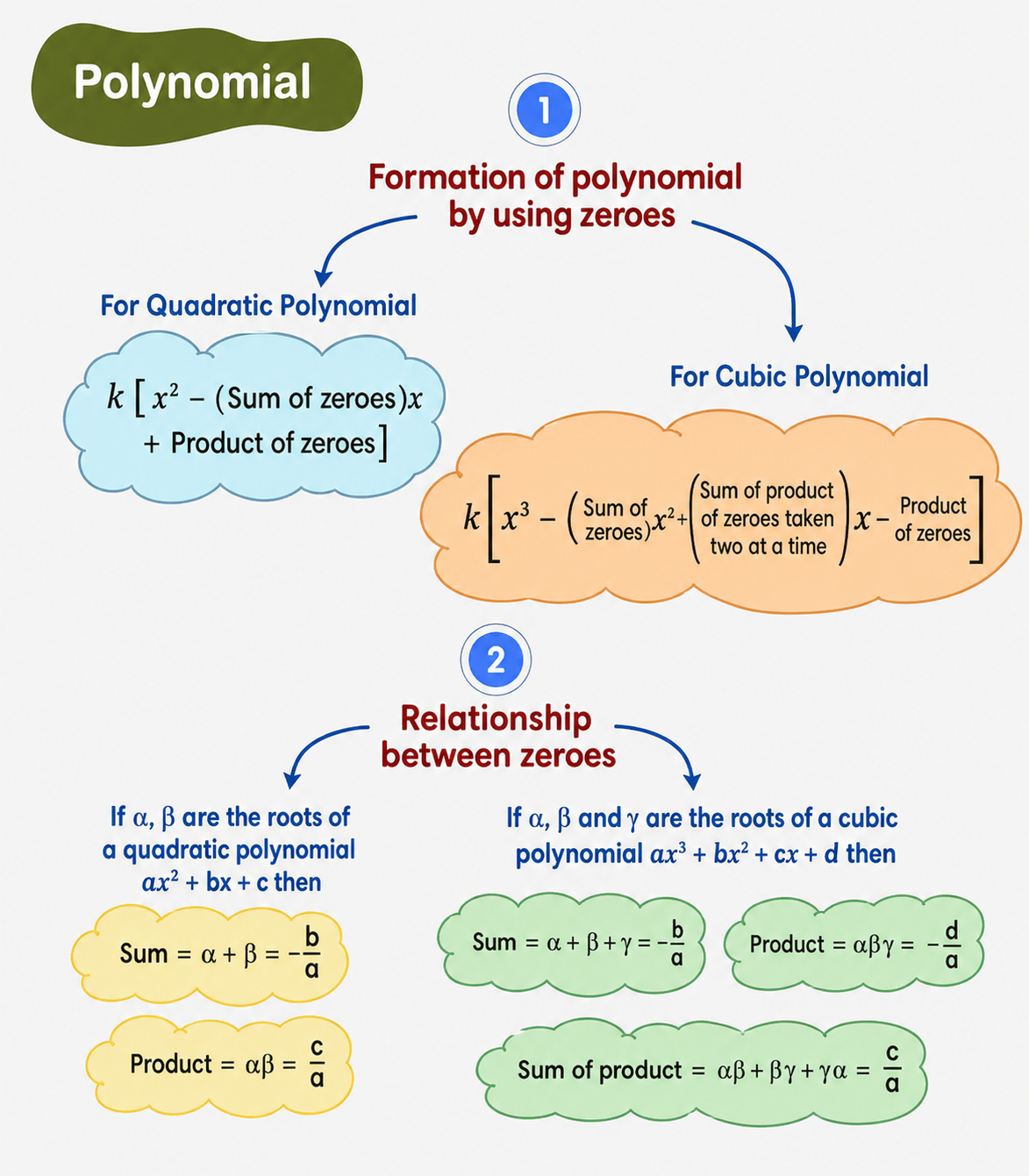
One of the most important concepts in Class 10 Maths Chapter 2 Polynomials is the relationship between the zeroes and coefficients of a quadratic polynomial.
For the quadratic polynomial:
ax² + bx + c
if α and β are its zeroes, then:
α + β = -b/a
and
αβ = c/a
These formulas help students verify the zeroes of a quadratic polynomial and also form a new quadratic polynomial when its zeroes or their sum and product are known.
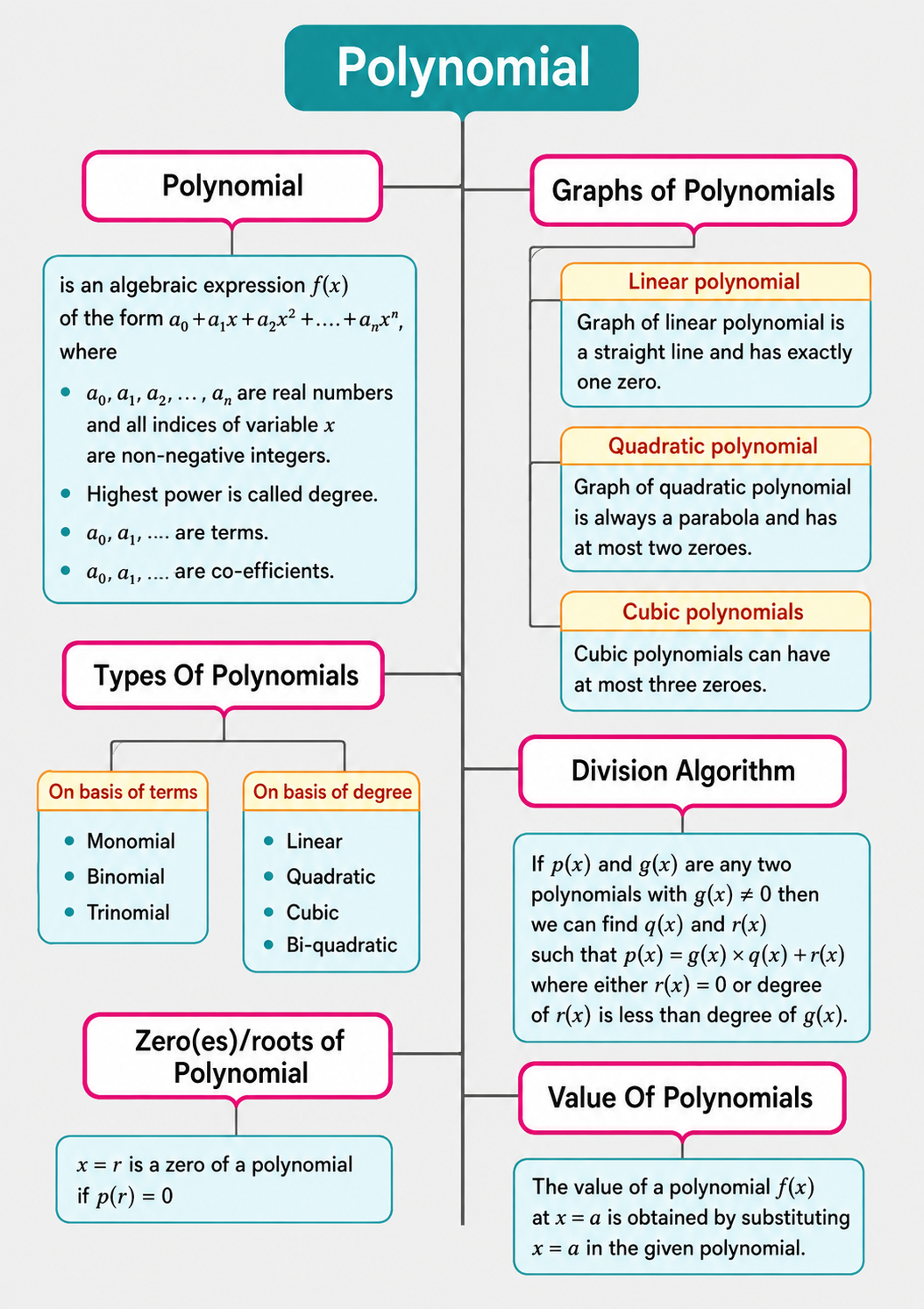
The NCERT Solutions for Class 10 Maths Chapter 2 Polynomials explain these concepts through solved examples and detailed exercise solutions. Students can use them for homework, revision, concept clarification, and exam preparation.
Important Topics in Class 10 Maths Chapter 2 Polynomials
Class 10 Maths Chapter 2 Polynomials introduces students to important concepts related to polynomial expressions, their zeroes, graphs, and coefficients. Understanding these topics makes it easier to solve questions from Class 10 Maths Exercise 2.1 and Exercise 2.2.
1. Definition of a Polynomial
A polynomial is an algebraic expression containing variables, coefficients, and powers of variables that are non-negative integers.
For example:
p(x) = 2x² + 5x - 3
Here, 2, 5, and -3 are coefficients, while the highest power of x is 2.
2. Types of Polynomials
Polynomials can be classified according to their degree.
Linear polynomial: ax + b
Degree = 1
Quadratic polynomial: ax² + bx + c
Degree = 2
Cubic polynomial: ax³ + bx² + cx + d
Degree = 3
3. Zeroes of a Polynomial
A number r is called a zero of a polynomial p(x) when substituting r in the polynomial gives zero.
The condition is:
p(r) = 0
For example, if p(2) = 0, then 2 is a zero of the polynomial.
4. Geometrical Meaning of Zeroes of a Polynomial
The zeroes of a polynomial are represented graphically by the points where the graph of the polynomial intersects or touches the x-axis.
Therefore:
Number of zeroes = Number of points where the graph meets the x-axis
This concept is especially important for solving Class 10 Maths Chapter 2 Exercise 2.1.
5. Graphs of Polynomials
Graphs help students understand the number of real zeroes of a polynomial.
A linear polynomial can have at most 1 zero.
A quadratic polynomial can have at most 2 zeroes.
A cubic polynomial can have at most 3 zeroes.
The number of real zeroes depends on how many times the graph intersects or touches the x-axis.
6. Zeroes of a Quadratic Polynomial
The general form of a quadratic polynomial is:
ax² + bx + c
The zeroes of a quadratic polynomial can often be found by factorising the polynomial and setting each factor equal to zero.
If α and β are the zeroes, their relationship with the coefficients can then be verified using the standard formulas.
7. Relationship Between Zeroes and Coefficients of a Quadratic Polynomial
For a quadratic polynomial:
ax² + bx + c
if α and β are its zeroes, then:
Sum of zeroes:
α + β = -b/a
Product of zeroes:
αβ = c/a
These are among the most important Polynomials Class 10 formulas and are frequently used in Exercise 2.2.
8. Forming a Quadratic Polynomial from Sum and Product of Zeroes
If the sum and product of the zeroes are known, a quadratic polynomial can be formed directly.
Let:
S = Sum of zeroes
P = Product of zeroes
Then:
Quadratic polynomial = x² - Sx + P
It can also be written as:
x² - (Sum of zeroes)x + Product of zeroes
For example, if the sum of the zeroes is 5 and their product is 6, then:
x² - 5x + 6
is a quadratic polynomial having those zeroes.
Important Formulas for Class 10 Maths Chapter 2 Polynomials
Students should remember the following formulas while solving questions from NCERT Solutions Class 10 Maths Chapter 2 Polynomials:
General form of a quadratic polynomial:
ax² + bx + c
Condition for r to be a zero of a polynomial:
p(r) = 0
Sum of zeroes of a quadratic polynomial:
α + β = -b/a
Product of zeroes of a quadratic polynomial:
αβ = c/a
Quadratic polynomial from sum and product of zeroes:
x² - Sx + P
Where:
S = Sum of zeroes
P = Product of zeroes
These formulas are useful for solving questions related to zeroes of quadratic polynomials, the relationship between zeroes and coefficients, and forming quadratic polynomials from their zeroes.
General Outline of Class 10 Maths Chapter 2 Polynomials
Class 10 Maths Chapter 2 Polynomials focuses mainly on understanding polynomial expressions, their zeroes, graphs, and the relationship between zeroes and coefficients of a quadratic polynomial. Students also learn how to form a quadratic polynomial when the sum and product of its zeroes are given.
The NCERT Solutions for Class 10 Maths Chapter 2 Polynomials provide step-by-step explanations for these concepts and help students solve questions from Exercise 2.1 and Exercise 2.2 with better understanding.
Introduction to Polynomials
A polynomial is an algebraic expression made up of variables, constants, and non-negative integer powers of variables. The terms of a polynomial are connected using addition, subtraction, or multiplication.
A polynomial in one variable x can be written in the general form:
p(x) = a₀ + a₁x + a₂x² + ... + aₙxⁿ
where:
- a₀, a₁, a₂, ... , aₙ are real numbers called coefficients.
- n is a non-negative integer.
- aₙ is not equal to 0.
- The highest power of x represents the degree of the polynomial.
For example:
p(x) = 3x² + 5x - 2
is a quadratic polynomial because the highest power of x is 2.
Types of Polynomials Based on Number of Terms
Polynomials can be classified according to the number of terms they contain.
Monomial: A polynomial containing only one term.
Example:
5x²
Binomial: A polynomial containing two terms.
Example:
x + 3
Trinomial: A polynomial containing three terms.
Example:
x² + 3x + 2
Types of Polynomials Based on Degree
Polynomials can also be classified according to their degree.
Linear Polynomial
General form:
ax + b
Degree = 1
Quadratic Polynomial
General form:
ax² + bx + c
Degree = 2
Cubic Polynomial
General form:
ax³ + bx² + cx + d
Degree = 3
Degree of a Polynomial
The degree of a polynomial is the highest power of the variable having a non-zero coefficient.
For example:
For:
p(x) = 2x² + 5x - 3
the highest power of x is 2.
Therefore:
Degree = 2
For:
p(x) = 3x⁴ + 2x² - 7
the highest power of x is 4.
Therefore:
Degree = 4
Understanding the degree of a polynomial helps students identify whether a polynomial is linear, quadratic, cubic, or of a higher degree.
Zeroes of a Polynomial
One of the most important concepts in Polynomials Class 10 is finding the zeroes of a polynomial.
A number r is called a zero of a polynomial p(x) if:
p(r) = 0
In simple words, if substituting a particular value of x into the polynomial gives 0, that value is called a zero or root of the polynomial.
For example:
Consider:
p(x) = x² - 5x + 6
Factorising:
p(x) = (x - 2)(x - 3)
Therefore:
x = 2 and x = 3
are the zeroes of the polynomial.
Geometrical Meaning of Zeroes of a Polynomial
The geometrical meaning of zeroes of a polynomial can be understood through its graph.
The zeroes of a polynomial are the x-coordinates of the points where the graph of:
y = p(x)
intersects or touches the x-axis.
Therefore:
Number of zeroes = Number of points where the graph meets the x-axis
For example:
- If the graph does not meet the x-axis, it has 0 real zeroes.
- If the graph meets the x-axis at one point, it has 1 real zero.
- If the graph meets the x-axis at two points, it has 2 real zeroes.
This concept forms the basis of Class 10 Maths Chapter 2 Exercise 2.1.
Relationship Between Zeroes and Coefficients of a Quadratic Polynomial
For a quadratic polynomial:
ax² + bx + c
if α and β are its zeroes, then:
Sum of zeroes:
α + β = -b/a
Product of zeroes:
αβ = c/a
These formulas are among the most important Polynomials Class 10 formulas and are used extensively in Class 10 Maths Chapter 2 Exercise 2.2.
Forming a Quadratic Polynomial from Sum and Product of Zeroes
If the sum and product of the zeroes are given, students can form a quadratic polynomial using the formula:
x² - (Sum of zeroes)x + Product of zeroes
If:
S = Sum of zeroes
and
P = Product of zeroes
then:
Required quadratic polynomial = x² - Sx + P
For example, if:
Sum of zeroes = 5
and
Product of zeroes = 6
then:
Required polynomial = x² - 5x + 6
Any non-zero multiple of this polynomial will also have the same zeroes.
Sample NCERT Solutions for Class 10 Maths Chapter 2 Polynomials
The following examples show the type of questions students solve in NCERT Solutions Class 10 Maths Chapter 2 Polynomials.
Exercise 2.1: Finding the Number of Zeroes from Graphs
In Class 10 Maths Chapter 2 Exercise 2.1, students observe graphs of different polynomials and determine their number of zeroes.
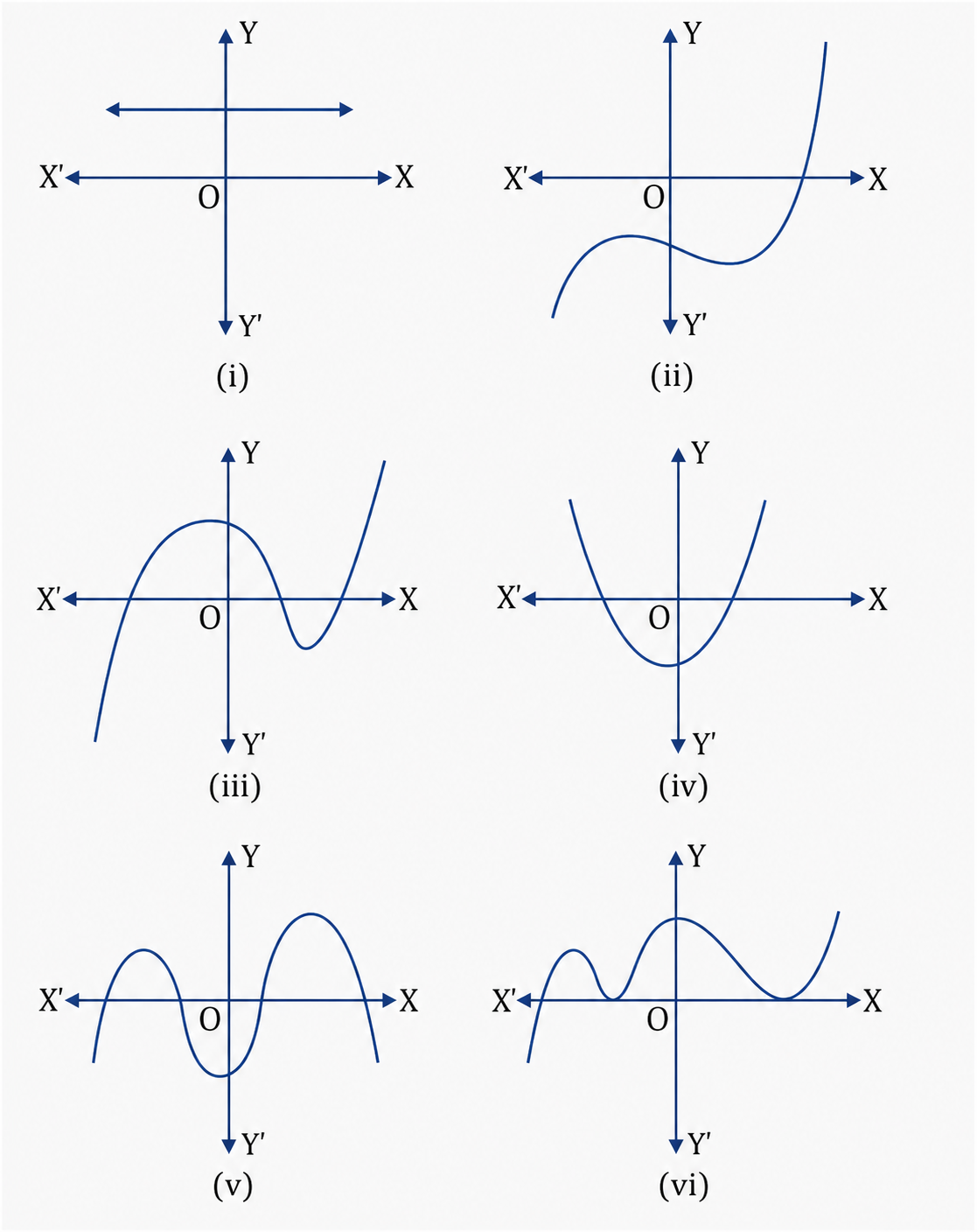
The basic rule is:
Number of zeroes = Number of points where the graph intersects or touches the x-axis
(i)
The graph of y = p(x) does not meet the x-axis.
Therefore:
Number of zeroes = 0
(ii)
The graph of y = p(x) meets the x-axis at one point.
Therefore:
Number of zeroes = 1
(iii)
The graph meets the x-axis at three different points.
Therefore:
Number of zeroes = 3
(iv)
The graph meets the x-axis at two points.
Therefore:
Number of zeroes = 2
(v)
The graph meets the x-axis at four points.
Therefore:
Number of zeroes = 4
(vi)
The graph meets or touches the x-axis at three points.
Therefore:
Number of zeroes = 3
Thus, the number of zeroes in the six graphs is:
0, 1, 3, 2, 4, 3
Class 10 Maths Chapter 2 Exercise 2.2: Find the Zeroes and Verify the Relationship with Coefficients
For a quadratic polynomial:
ax² + bx + c
if α and β are its zeroes, then:
α + β = -b/a
and
αβ = c/a
Question 1 (i): x² - 2x - 8
Given:
x² - 2x - 8
Factorising by splitting the middle term:
x² - 4x + 2x - 8
= x(x - 4) + 2(x - 4)
= (x + 2)(x - 4)
Therefore, the zeroes are:
α = -2
β = 4
Verification of Sum of Zeroes
α + β = -2 + 4 = 2
Using the formula:
-b/a = -(-2)/1 = 2
Therefore:
α + β = -b/a
Verification of Product of Zeroes
αβ = (-2)(4) = -8
Using the formula:
c/a = -8/1 = -8
Therefore:
αβ = c/a
Hence, the relationship between the zeroes and coefficients is verified.
Question 1 (ii): 4s² - 4s + 1
Given:
4s² - 4s + 1
Factorising:
4s² - 4s + 1 = (2s - 1)²
Therefore:
2s - 1 = 0
s = 1/2
The two zeroes are:
α = 1/2
β = 1/2
Sum of Zeroes
α + β = 1/2 + 1/2 = 1
Using the formula:
-b/a = -(-4)/4 = 1
Therefore:
α + β = -b/a
Product of Zeroes
αβ = (1/2)(1/2) = 1/4
Using the formula:
c/a = 1/4
Therefore:
αβ = c/a
Hence, the relationship is verified.
Question 1 (iii): 6x² - 7x - 3
Given:
6x² - 7x - 3
Splitting the middle term:
6x² - 9x + 2x - 3
= 3x(2x - 3) + 1(2x - 3)
= (2x - 3)(3x + 1)
Therefore:
2x - 3 = 0
x = 3/2
and:
3x + 1 = 0
x = -1/3
The zeroes are:
α = 3/2
β = -1/3
Sum of Zeroes
α + β = 3/2 - 1/3
= 9/6 - 2/6
= 7/6
Using:
-b/a = -(-7)/6 = 7/6
Therefore:
α + β = -b/a
Product of Zeroes
αβ = (3/2)(-1/3)
= -1/2
Using:
c/a = -3/6 = -1/2
Therefore:
αβ = c/a
Hence, the relationship is verified.
Question 1 (iv): 4u² + 8u
Given:
4u² + 8u
Taking the common factor:
4u(u + 2)
Therefore:
4u = 0
or:
u + 2 = 0
The zeroes are:
α = 0
β = -2
Sum of Zeroes
α + β = 0 - 2 = -2
Using:
-b/a = -8/4 = -2
Therefore:
α + β = -b/a
Product of Zeroes
αβ = 0 × (-2) = 0
Using:
c/a = 0/4 = 0
Therefore:
αβ = c/a
Hence, the relationship is verified.
Question 1 (v): t² - 15
Given:
t² - 15
Factorising:
t² - 15 = (t - √15)(t + √15)
Therefore, the zeroes are:
α = √15
β = -√15
Sum of Zeroes
α + β = √15 - √15 = 0
Using:
-b/a = 0
Therefore:
α + β = -b/a
Product of Zeroes
αβ = (√15)(-√15)
= -15
Using:
c/a = -15/1 = -15
Therefore:
αβ = c/a
Hence, the relationship is verified.
Question 1 (vi): 3x² - x - 4
Given:
3x² - x - 4
Splitting the middle term:
3x² - 4x + 3x - 4
= x(3x - 4) + 1(3x - 4)
= (3x - 4)(x + 1)
Therefore:
3x - 4 = 0
x = 4/3
and:
x + 1 = 0
x = -1
The zeroes are:
α = 4/3
β = -1
Sum of Zeroes
α + β = 4/3 - 1
= 1/3
Using:
-b/a = -(-1)/3 = 1/3
Therefore:
α + β = -b/a
Product of Zeroes
αβ = (4/3)(-1)
= -4/3
Using:
c/a = -4/3
Therefore:
αβ = c/a
Hence, the relationship between zeroes and coefficients is verified.
Finding a Quadratic Polynomial from the Sum and Product of its Zeroes
If:
Sum of zeroes = S
and:
Product of zeroes = P
then one quadratic polynomial is:
x² - Sx + P
(i) Sum = 1/4, Product = -1
Using:
x² - Sx + P
we get:
x² - (1/4)x - 1
Multiplying by 4:
4x² - x - 4
Therefore, one required quadratic polynomial is:
4x² - x - 4
(ii) Sum = √2, Product = 1/3
Using:
x² - Sx + P
we get:
x² - √2x + 1/3
Multiplying by 3:
3x² - 3√2x + 1
Therefore, one required quadratic polynomial is:
3x² - 3√2x + 1
(iii) Sum = 0, Product = √5
Using:
x² - Sx + P
we get:
x² - 0x + √5
Therefore:
Required polynomial = x² + √5
(iv) Sum = 1, Product = 1
Using:
x² - Sx + P
we get:
x² - x + 1
Therefore:
Required polynomial = x² - x + 1
(v) Sum = -1/4, Product = 1/4
Using:
x² - Sx + P
we get:
x² + (1/4)x + 1/4
Multiplying by 4:
4x² + x + 1
Therefore, one required quadratic polynomial is:
4x² + x + 1
(vi) Sum = 4, Product = 1
Using:
x² - Sx + P
we get:
x² - 4x + 1
Therefore:
Required polynomial = x² - 4x + 1
Benefits of Studying Class 10 Maths Chapter 2 Polynomials
Understanding Class 10 Maths Chapter 2 Polynomials is important because the concepts introduced in this chapter strengthen students' algebraic thinking and prepare them for more advanced mathematics.
1. Builds a Strong Foundation in Algebra
Polynomials are an important part of algebra. Learning about polynomial expressions, zeroes, coefficients, and graphs helps students understand related topics more easily.
2. Improves Problem-Solving Skills
Questions based on finding zeroes, factorisation, graphs, and relationships between coefficients require logical thinking. Regular practice helps students develop better problem-solving skills.
3. Helps in Understanding Quadratic Equations
The concepts of quadratic polynomials, zeroes, and factorisation are closely connected with Quadratic Equations, which students study in another Class 10 Maths chapter.
4. Develops Graph Interpretation Skills
The geometrical meaning of zeroes of a polynomial teaches students how algebraic expressions are represented graphically and how to interpret intersections with the x-axis.
5. Strengthens Understanding of Mathematical Relationships
The formulas:
α + β = -b/a
and
αβ = c/a
help students understand how the zeroes of a quadratic polynomial are connected to its coefficients.
6. Supports Exam Preparation
Questions based on zeroes of polynomials, graphs, and the relationship between zeroes and coefficients are important for practising the concepts covered in the chapter.
7. Prepares Students for Higher Mathematics
A clear understanding of polynomials supports future learning in algebra, functions, coordinate geometry, and other advanced mathematical topics.
Advantages of NCERT Solutions for Class 10 Maths Chapter 2 Polynomials
The NCERT Solutions for Class 10 Maths Chapter 2 Polynomials can be useful for students who want to understand the chapter thoroughly and practise NCERT textbook questions.
Step-by-Step Solutions
Each question is explained using a clear sequence of steps so students can understand how the final answer is obtained.
Better Conceptual Understanding
The solutions explain important concepts such as the zeroes of a polynomial, polynomial graphs, and the relationship between zeroes and coefficients.
Easy Revision
Students can use the solutions to quickly revise Class 10 Maths Chapter 2 Exercise 2.1 and Exercise 2.2 before examinations.
Helps Identify Mistakes
Comparing your method with the step-by-step solution can help you identify calculation, sign, and factorisation errors.
Useful for Self-Study
Students can use the Polynomials Class 10 NCERT Solutions to practise independently and clear doubts while studying at home.
Supports Exam Preparation
Regular practice of NCERT questions helps students become familiar with the concepts and question patterns included in the chapter.
NCERT Solutions for Class 10 Maths Chapter-Wise PDF Free Download
| NCERT Solutions for Class 10 Maths |
| Chapter 1 – Real Numbers |
| Chapter 2 – Polynomials |
| Chapter 3 – Pair of Linear Equations in Two Variables |
| Chapter 4 – Quadratic Equations |
| Chapter 5 – Arithmetic Progressions |
| Chapter 6 – Triangles |
| Chapter 7 – Coordinate Geometry |
| Chapter 8 – Introduction to Trigonometry |
| Chapter 9 – Some Applications of Trigonometry |
| Chapter 10 – Circles |
| Chapter 11 – Areas Related to Circles |
| Chapter 12 – Surface Areas and Volumes |
| Chapter 13 – Statistics |
| Chapter 14 – Probability |
Download CBSE Class 10 Maths Notes PDF
Students can read each chapter online or use the chapter-wise PDF links below for offline revision.
| Chapter | Download PDF |
| 1. Real Numbers | Real Numbers Class 10 notes PDF |
| 2. Polynomials | Polynomials Class 10 notes PDF |
| 3. Pair of Linear Equations in Two Variables | Pair of Linear Equations notes PDF |
| 4. Quadratic Equations | Quadratic Equations Class 10 notes PDF |
| 5. Arithmetic Progressions | Arithmetic Progressions notes PDF |
| 6. Triangles | Triangles Class 10 notes PDF |
| 7. Coordinate Geometry | Coordinate Geometry notes PDF |
| 8. Introduction to Trigonometry | Introduction to Trigonometry notes PDF |
| 9. Applications of Trigonometry | Applications of Trigonometry notes PDF |
| 10. Circles | Circles Class 10 notes PDF |
| 11. Areas Related to Circles | Areas Related to Circles notes PDF |
| 12. Surface Areas and Volumes | Surface Areas and Volumes notes PDF |
| 13. Statistics | Statistics Class 10 notes PDF |
| 14. Probability | Probability Class 10 notes PDF |
course
No courses found
FAQs on NCERT Solutions for Class 10 Maths Chapter 2 Polynomials
What are NCERT Solutions for Class 10 Maths Chapter 2 Polynomials?
NCERT Solutions for Class 10 Maths Chapter 2 Polynomials provide step-by-step answers to the questions given in the NCERT textbook. They help students understand concepts such as zeroes of a polynomial, polynomial graphs, and the relationship between zeroes and coefficients of quadratic polynomials.
What are the main topics covered in Class 10 Maths Chapter 2 Polynomials?
The main topics include zeroes of a polynomial, geometrical meaning of zeroes, graphs of polynomials, relationship between zeroes and coefficients of a quadratic polynomial, and forming a quadratic polynomial from the sum and product of its zeroes.
What is a zero of a polynomial?
A number r is called a zero of a polynomial p(x) if the value of the polynomial becomes zero when x = r.
p(r) = 0
For example, if p(2) = 0, then 2 is a zero of the polynomial.
- How can we find the number of zeroes of a polynomial from its graph?
The number of zeroes is equal to the number of points where the graph of y = p(x) intersects or touches the x-axis.
Number of zeroes = Number of points where the graph meets the x-axis
What is the relationship between zeroes and coefficients of a quadratic polynomial?
For a quadratic polynomial:
ax² + bx + c
if α and β are its zeroes, then:
α + β = -b/a
αβ = c/a
Here, α + β represents the sum of zeroes, while αβ represents their product.
How do you find the zeroes of a quadratic polynomial?
The zeroes of a quadratic polynomial can often be found by factorising the polynomial and setting each factor equal to zero.
For example:
x² - 5x + 6 = (x - 2)(x - 3)
Therefore, its zeroes are:
x = 2 and x = 3
How do you form a quadratic polynomial when the sum and product of zeroes are given?
If:
S = Sum of zeroes
and
P = Product of zeroes
then one quadratic polynomial can be written as:
x² - Sx + P
For example, if the sum is 5 and the product is 6, the polynomial is:
x² - 5x + 6
How many zeroes can a quadratic polynomial have?
A quadratic polynomial can have at most two real zeroes. Depending on its graph, it may have 0, 1, or 2 real zeroes.
How many zeroes can a cubic polynomial have?
A cubic polynomial can have at most three real zeroes. On a graph, these zeroes correspond to the points where the polynomial graph meets the x-axis.
What is covered in Class 10 Maths Chapter 2 Exercise 2.1?
Class 10 Maths Chapter 2 Exercise 2.1 focuses on the geometrical meaning of zeroes of a polynomial. Students study different graphs and identify the number of zeroes by counting how many times each graph intersects or touches the x-axis.
What is covered in Class 10 Maths Chapter 2 Exercise 2.2?
Class 10 Maths Chapter 2 Exercise 2.2 includes questions on finding the zeroes of quadratic polynomials, verifying the relationship between zeroes and coefficients, and forming quadratic polynomials when the sum and product of their zeroes are given.
What are the most important formulas in Class 10 Maths Chapter 2 Polynomials?
For a quadratic polynomial ax² + bx + c, the important formulas are:
Sum of zeroes: α + β = -b/a
Product of zeroes: αβ = c/a
If the sum of zeroes is S and their product is P:
Quadratic polynomial = x² - Sx + P
What is the difference between zeroes and roots of a polynomial?
In this context, zeroes and roots refer to the same values. They are the values of the variable for which the polynomial becomes equal to zero.
Can a graph touch the x-axis and still have a zero?
Yes. A polynomial has a zero whenever its graph intersects or touches the x-axis. The graph does not necessarily have to cross the x-axis.
Why are NCERT Solutions for Class 10 Maths Chapter 2 Polynomials useful for exam preparation?
The solutions help students understand the correct method for solving NCERT questions, revise important Polynomials Class 10 formulas, identify common mistakes, and practise concepts such as zeroes, graphs, factorisation, and the relationship between zeroes and coefficients.
Where can I download NCERT Solutions for Class 10 Maths Chapter 2 Polynomials PDF?
Students, download the NCERT Solutions for Class 10 Maths Chapter 2 Polynomials PDF from Infinity Learn official website offline practice, quick revision, and step-by-step solutions to Exercise 2.1 and Exercise 2.2.
