NCERT Solutions for Class 12 Physics Chapter 12 Atoms
By Ankit Ankit
|
Updated on 30 Oct 2026, 14:59 IST
NCERT Solutions for Class 12 Physics Chapter 12 – Atoms provide step-by-step answers to the textbook exercise questions, covering conceptual explanations, formula applications, and numerical problems. Each solution includes the necessary reasoning, calculations, and units to help students understand the method and verify their answers.
Chapter 12, Atoms, explains the structure of atoms through alpha-particle scattering, Rutherford's nuclear model, and Bohr's model of the hydrogen atom. It covers stationary energy levels, the radius and energy of electron orbits, and the emission and absorption of radiation in the hydrogen line spectrum. These solutions help students apply the chapter's concepts and formulas while practising NCERT questions for their Class 12 Physics examinations.
Download Class 12 Physics Chapter 12 NCERT Solutions PDF
Access complete solutions for Chapter 12: Atoms — download the PDF for offline revision and practice.
Chapter 12 Atoms: Key Concepts
- Alpha-Particle Scattering Experiment: The Geiger-Marsden setup demonstrating that an atom's positive charge and mass are concentrated in a tiny central nucleus, allowing calculations of the distance of closest approach.
- Rutherford's Nuclear Model: A planetary model where electrons revolve around the nucleus, though classical electrodynamics indicates it would suffer from radiative instability.
- Bohr's Model of the Hydrogen Atom: Introduction of stationary orbits where electrons do not radiate energy, governed by the quantization condition of angular momentum (L = nh/2π).
- Radius, Velocity, and Energy of Orbits: Mathematical derivations establishing how orbit radius scales as n², velocity scales inversely with n, and total energy is quantized as negative binding energy.
- Hydrogen Line Spectra: Emission and absorption transitions between energy levels resulting in specific spectral series (Lyman, Balmer, Paschen, Brackett, and Pfund).
NCERT Class 12 Physics Chapter 12: Structure and Key Topics
Chapter 12, Atoms, moves from Rutherford's nuclear model to Bohr's model of the hydrogen atom. It then covers energy levels, electron orbits, and hydrogen's spectral series.
The chapter has both conceptual and numerical questions, with numericals mainly based on energy, orbital radius, velocity, frequency, and wavelength.
This chapter also sets the stage for Chapter 13, Nuclei, where the focus shifts from the atom as a whole to its nucleus. So, while Chapter 12 deals mainly with atomic structure and electron energy levels, the next chapter takes up nuclear properties, binding energy, and nuclear reactions.
Important Formulas for Chapter 12
Distance of Closest Approach (r₀)
r0 = (1/4πε0) × (2Ze2)/K

where K is the kinetic energy of the incident α-particle and Z is the atomic number of the target nucleus.
Radius of the nᵗʰ Bohr Orbit (rₙ)
Best Courses for You

JEE

NEET

Foundation JEE

Foundation NEET

CBSE
rn = n2(ε0h2)/(πme2Z) = (0.529 Å × n2)/Z
Velocity of Electron in the nᵗʰ Orbit (vₙ)
vn = e2/(2ε0h) × (Z/n) = (2.18 × 10⁶ m/s) × Z/n
Energy of Electron in the nᵗʰ Orbit (Eₙ)
En = −13.6 Z2/n2 eV
Photon Energy Transition Relation
hν = Ei − Ef ⇒ ν = ΔE/h, λ = hc/ΔE
NCERT Solutions for Class 12 Physics Chapter 12: Atoms
Question 1: Choose the correct alternative from the clues given at the end of each statement:
(a) The size of the atom in Thomson's model is .......... the atomic size in Rutherford's model.
(b) In the ground state of .........., electrons are in stable equilibrium, while in .......... electrons always experience a net force.
(c) A classical atom based on .......... is doomed to collapse.
d) An atom has a nearly continuous mass distribution in .........., but has a highly non-uniform mass distribution in ..........
(e) The positively charged part of the atom possesses most of the mass in ..........
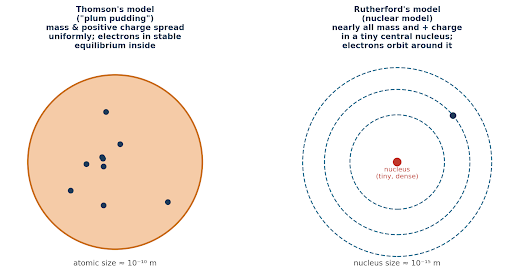
Fig. 1 — Thomson's uniformly charged sphere vs. Rutherford's tiny, dense central nucleus.
(a) The overall spatial dimension of the atom is defined by the outer electron cloud, spanning roughly 10⁻¹⁰ m in both frameworks. Consequently, Thomson's model yields an atomic size that is no different from Rutherford's model.
(b) Within Thomson's model, electrons reside inside a uniform positive charge distribution and occupy positions of stable equilibrium. Conversely, electrons in Rutherford's model undergo circular motion and continuously experience a net centripetal force toward the centre. The appropriate models are Thomson's model and Rutherford's model.
(c) Classical electrodynamics dictates that any accelerating charge radiates electromagnetic energy. Because Rutherford's model places electrons in accelerated orbits, they would continuously lose energy and spiral inward, rendering Rutherford's model unstable against collapse.
(d) Mass and positive charge are spread evenly throughout the volume in Thomson's model, whereas Rutherford's model concentrates virtually all mass into a central nucleus. This corresponds to Thomson's model and Rutherford's model respectively.
(e) The uniform positive sphere holds the mass in Thomson's model, and the dense nucleus holds the mass in Rutherford's model. Therefore, the positive portion contains the bulk of the mass in both the models.
Answer
(a) No different from
(b) Thomson's model / Rutherford's model
(c) Rutherford's model
(d) Thomson's model / Rutherford's model
(e) Both the models
Question 2: Suppose you are given a chance to repeat the alpha-particle scattering experiment using a thin sheet of solid hydrogen in place of the gold foil. (Hydrogen is a solid at temperatures below 14 K.) What results do you expect?
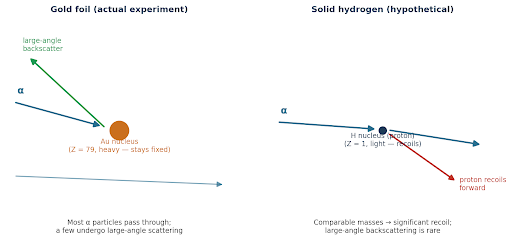
Fig. 2 — A heavy gold nucleus stays essentially fixed and can backscatter an α-particle; a light hydrogen nucleus recoils instead.
Nuclear mass and charge comparison
Gold has a high atomic number (Z = 79) and a massive nucleus that remains effectively stationary when struck by an alpha particle. Solid hydrogen consists of protons (Z = 1) whose mass is comparable to an alpha particle (mα ≈ 4mp).
Collision dynamics
The low nuclear charge of hydrogen results in a much weaker electrostatic repulsive force than gold. Because the target particles are light and comparable in mass to the projectiles, head-on collisions cause substantial proton recoil and large kinetic energy transfers rather than simple elastic scattering off a fixed target.
Answer
The characteristic wide-angle backscattering observed with gold foil will not occur in the same manner. Wide-angle events will be infrequent, and collisions will instead be dominated by significant recoil of the light target nuclei.
Question 3: A difference of 2.3 eV separates two energy levels in an atom. What is the frequency of radiation emitted when the atom transitions from the upper level to the lower level?
Given
ΔE = 2.3 eV
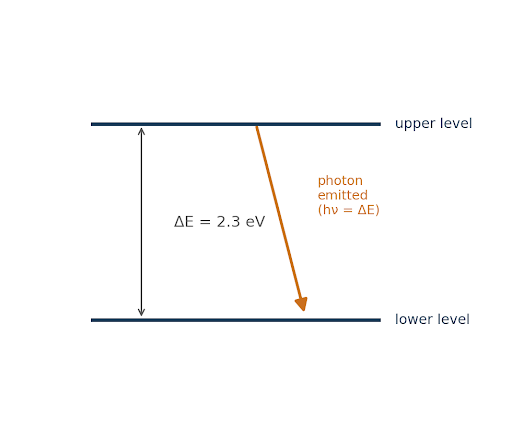
Fig. 3 — A photon of energy hν = ΔE is emitted as the atom drops to the lower level.
Conversion to joules
ΔE = 2.3 × 1.6 × 10−19 = 3.68 × 10⁻¹⁹ J
Formula and calculation
ν = ΔE/h = (3.68 × 10⁻¹⁹) / (6.63 × 10⁻³⁴) ≈ 5.55 × 10¹⁴ Hz
Answer
ν ≈ 5.55 × 10¹⁴ Hz
Question 4: The ground state energy of hydrogen atom is −13.6 eV. What are the kinetic and potential energies of the electron in this state?
Given
E = −13.6 eV
Energy relations
For an electron bound in a circular Bohr orbit, the total energy E is the sum of kinetic energy K and potential energy U: E = K + U. Applying electrostatic and centripetal force balance yields the virial relation U = −2K.
Derivation
Substituting U = −2K into the total energy equation:
E = K + (−2K) = −K ⇒ K = −E, U = 2E
Calculation
K = −(−13.6) = +13.6 eV, U = 2(−13.6) = −27.2 eV
Answer
Kinetic energy = +13.6 eV
Potential energy = −27.2 eV
Question 5: A hydrogen atom initially in the ground level absorbs a photon, which excites it to the n = 4 level. Determine the wavelength and frequency of the photon.
Given
ni = 1, nf = 4
Energy level formula
En = −13.6/n2 eV
E1 = −13.6 eV, E4 = −13.6/16 = −0.85 eV
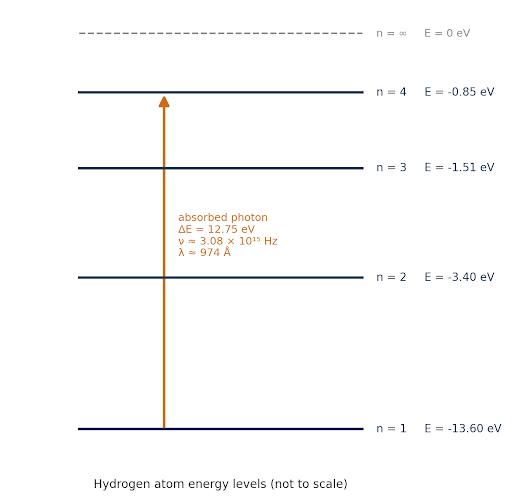
Fig. 4 — The absorbed photon lifts the electron from n = 1 to n = 4.
Photon energy change
ΔE = E4 − E1 = −0.85 − (−13.6) = 12.75 eV
Frequency calculation
ν = ΔE/h = [12.75 × 1.6 × 10−19] / (6.63 × 10⁻³⁴) ≈ 3.08 × 10¹⁵ Hz
Wavelength calculation
λ = c/ν = (3 × 10⁸) / (3.08 × 10¹⁵) ≈ 974 × 10−10 m = 974 Å
Answer
ν ≈ 3.08 × 10¹⁵ Hz
λ ≈ 974 Å
Question 6: Using the Bohr's model, calculate the speed of the electron in a hydrogen atom in the n = 1, 2, and 3 levels. What is the radius of the orbit in n = 1 level?
Governing formulas
For hydrogen (Z = 1), the velocity and orbit radius in the nᵗʰ level are given by:
vn = (2.18 × 10⁶ m/s)/n, rn = n2r1, r1 = 0.529 Å
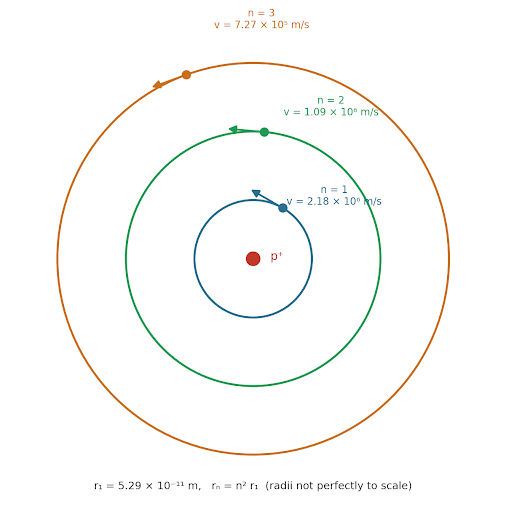
Fig. 5 — Bohr orbits for n = 1, 2, 3 with electron speed decreasing as n increases.
Speed calculations
v1 = 2.18 × 10⁶ m/s
v2 = (2.18 × 10⁶)/2 ≈ 1.09 × 10⁶ m/s
v3 = (2.18 × 10⁶)/3 ≈ 7.27 × 10⁵ m/s
Radius calculation (n = 1)
r1 = 0.529 Å = 5.29 × 10⁻¹¹ m
Answer
v1 ≈ 2.18 × 10⁶ m/s, v2 ≈ 1.09 × 10⁶ m/s, v3 ≈ 7.27 × 10⁵ m/s
r1 ≈ 5.29 × 10⁻¹¹ m
Question 7: The radius of the innermost electron orbit of a hydrogen atom is 5.3 × 10⁻¹¹ m. What are the radii of the n = 2 and n = 3 orbits?
Given
r1 = 5.3 × 10⁻¹¹ m
Formula
rn = n2 r1
This follows directly from the same n² scaling shown for the Bohr orbits in Fig. 5 above.
Calculations
r2 = 4 × (5.3 × 10−11) = 2.12 × 10⁻¹⁰ m
r3 = 9 × (5.3 × 10−11) = 4.77 × 10⁻¹⁰ m
Answer
r2 ≈ 2.12 × 10⁻¹⁰ m
r3 ≈ 4.77 × 10⁻¹⁰ m
Question 8
A 12.5 eV electron beam is used to bombard gaseous hydrogen at room temperature. What series of wavelengths will be emitted?
Given
incident electron energy = 12.5 eV
Excitation energy analysis
The energy required to excite hydrogen from the ground state (n = 1) to n = 3 is:
E3 − E1 = −1.51 − (−13.6) = 12.09 eV
The energy required to excite hydrogen from n = 1 to n = 4 is:
E4 − E1 = −0.85 − (−13.6) = 12.75 eV
Because the incident electron energy (12.5 eV) exceeds 12.09 eV but is less than 12.75 eV, it can excite the hydrogen atom up to the n = 3 state, but not to n = 4.
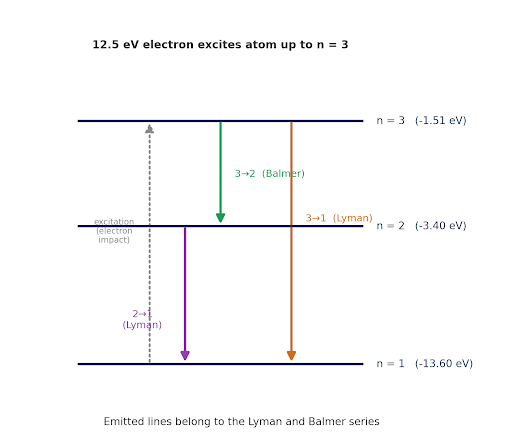
Fig. 6 — From n = 3, the atom cascades down through three possible transitions.
Possible de-excitation transitions
From the n = 3 excited level, atoms return to the ground state through the cascade transitions 3→2 (Balmer series), 3→1 (Lyman series), and 2→1 (Lyman series).
Answer
The emitted spectral lines belong to the Lyman series and the Balmer series.
Question 9: In accordance with the Bohr's model, find the quantum number that characterizes the earth's revolution around the sun in an orbit of radius 1.5 × 10¹¹ m with orbital speed 3 × 10⁴ m/s. (m(earth) = 6.0 × 10²⁴ kg)
Given
r = 1.5 × 10¹¹ m, v = 3 × 10⁴ m/s, m = 6.0 × 1024 kg
Quantization relation
Angular momentum is quantized according to Bohr's condition:
L = mvr = nh/2π ⇒ n = 2πmvr/h
Calculation
n = [2π × (6.0 × 1024) × (3 × 104) × (1.5 × 1011)] / (6.63 × 10⁻³⁴)
n ≈ 2.6 × 1074
Answer
n ≈ 2.6 × 1074
Key Features of NCERT Solutions for Class 12 Physics Chapter 12 Atoms
- Complete Solutions: Get solutions to all in-text and exercise questions, with the working explained along the way.
- Clear Energy Level Diagrams: Diagrams help you understand electron transitions and questions based on energy levels and spectra.
- Formulas Before Substitution: The relevant formula is given first, followed by the values and calculation.
- Aligned with CBSE 2026-27: The solutions follow the latest CBSE 2026-27 marking scheme.
- Easy Numerical Revision: The solutions keep the calculations clear and easy to review before exams.
Why Choose Infinity Learn NCERT Solutions for Class 12 Physics Chapter 12 Atoms
- Guidance from Experienced Physics Faculty: Learn from experienced Physics faculty with teaching expertise in JEE and NEET preparation. Their explanations help students approach the concepts and questions in Chapter 12 with greater confidence.
- Diagram-Rich Explanations: Visual explanations of atomic models, electron orbits, and spectral series make important concepts easier to follow and remember.
- Board and Competitive Exam Practice: Practice previous-year board and competitive exam questions to understand how concepts from Atoms are tested across different exams.
- Chapter-Wise Mock Tests: Chapter-wise mock tests give additional practice with numerical problems and help improve calculation accuracy before exams.
- Support for Difficult Questions: Get help with questions involving Bohr's model, energy levels, spectral transitions, and numerical calculations whenever a concept or solution approach is difficult to follow.
course
No courses found
What is Bohr's model of the hydrogen atom?
Bohr's model proposes that electrons move around the nucleus in specific circular paths called stationary orbits without radiating energy, where the angular momentum of the electron is quantized as an integral multiple of h/2π.
What are the limitations of Rutherford's atomic model?
Rutherford's model has two major difficulties: it predicts atomic instability because orbiting accelerated charges should continuously radiate energy and spiral inward, and it cannot account for discrete atomic line spectra.
What topics are included in Chapter 12 Atoms?
Chapter 12 covers the alpha-particle scattering experiment, Rutherford's nuclear model, Bohr's postulates, expressions for orbit radius, velocity, and energy, and qualitative treatments of hydrogen line spectra.
Where can I download NCERT Solutions for Chapter 12 Atoms?
You can download complete, step-by-step NCERT Solutions for Class 12 Physics Chapter 12 directly from Infinity Learn by utilizing the link provided at the top of this page.
