- Key Concepts Covered in Chapter 5
- NCERT Solutions for Class 12 Physics Chapter 5 – Magnetism and Matter
- Important Formulas from Magnetism and Matter
- NCERT Class 12 Physics Chapter 5 – Step-by-Step Solutions
- Key Features of NCERT Solutions for Class 12 Physics Chapter 5
- Why Choose Infinity Learn NCERT Solutions for Class 12 Physics Chapter 5?
- FAQs: NCERT Solutions For Class 12 Physics Chapter 5
NCERT Solutions For Class 12 Physics Chapter 5 – Magnetism and Matter
By Rohit RP
|
Updated on 28 Oct 2026, 11:58 IST
Why does a compass needle turn towards a particular direction when you leave it free to move? Why does a current-carrying coil behave like a magnet, and why do materials such as iron, copper and aluminium respond so differently to the same magnetic field?
These questions lead into Magnetism and Matter, Chapter 5 of the NCERT Class 12 Physics textbook. The chapter takes the magnetic-field concepts introduced in Chapter 4 and applies them to bar magnets, magnetic dipoles, solenoids and magnetic materials. It also explains why magnetic field lines behave differently from electric field lines and how the Earth's magnetic field can be described using quantities such as its horizontal component, declination and dip.
The chapter brings together several ideas that students often encounter separately: the magnetic moment of a current loop, the torque and potential energy of a magnetic dipole, the similarity between a bar magnet and a current-carrying solenoid, and the response of matter to an external magnetic field. It then uses these ideas to distinguish diamagnetic, paramagnetic and ferromagnetic materials.
For students, the difficulty is often not the formula itself. A question may require you to recognise whether it involves magnetic moment, torque, potential energy, the field of a dipole or the behaviour of a particular material. The direction of a magnetic field can also matter just as much as its magnitude.
These NCERT Solutions for Class 12 Physics Chapter 5 – Magnetism and Matter work through the retained NCERT exercises with the calculation and reasoning shown clearly. Each solution identifies the relevant physical relation, substitutes the given values and explains the result so that students can use the method when solving similar problems.
Download the NCERT Solutions for Class 12 Physics Chapter 5 – Magnetism and Matter PDF for revision and practice.
Key Concepts Covered in Chapter 5
- Bar magnet and magnetic field lines
- Magnetic dipole moment
- Bar magnet as an equivalent solenoid
- Magnetic field due to a short bar magnet
- Torque on a magnetic dipole in a uniform magnetic field
- Potential energy of a magnetic dipole
- Magnetism and Gauss's law
- Magnetisation and magnetic intensity
- Magnetic susceptibility
- Magnetic permeability
- Diamagnetic, paramagnetic and ferromagnetic materials
- Permanent magnets and electromagnets
- Magnetic behaviour of materials
NCERT Solutions for Class 12 Physics Chapter 5 – Magnetism and Matter
Chapter Overview
Chapter 5 develops the idea of a magnetic dipole and uses it to explain the behaviour of bar magnets and magnetic materials.
A bar magnet can be treated, at large distances, as a magnetic dipole. The chapter establishes its magnetic field along the axial and equatorial directions and explains how a magnetic dipole behaves when placed in a uniform magnetic field. A dipole of moment m in a uniform field B experiences a torque:

τ = mB sinθ
and has potential energy:
Best Courses for You

JEE

NEET

Foundation JEE

Foundation NEET

CBSE
U = −mB cosθ
where θ is the angle between m and B. Along the axial and equatorial lines of a short bar magnet, the field is:
Ba = (μ0/4π) × (2m/r3) Be = (μ0/4π) × (m/r3)
The chapter also introduces magnetisation (M) and magnetic intensity (H) to describe the response of magnetic materials:
H = B/μ0 − M M = χH (for a linear material)
B = μ0(H + M) B = μH (for a linear material)
Based on their magnetic susceptibility χ and response to an external field, materials are broadly classified as diamagnetic, paramagnetic and ferromagnetic.
How Chapter 5 Connects with Chapters 4 and 6
Chapter 5 follows directly from Moving Charges and Magnetism.
In Chapter 4, students learn that a current-carrying loop produces a magnetic field and has a magnetic dipole moment. Chapter 5 uses this idea to understand bar magnets and magnetic dipoles and to explain why a solenoid can behave like a bar magnet.
The chapter also introduces induced magnetic behaviour and magnetic materials, which provides useful background for Electromagnetic Induction in Chapter 6.
Important Formulas from Magnetism and Matter
These relations form the basis of most numerical questions involving magnetic dipoles and magnetic materials in this chapter.
| Concept | Formula |
| Torque on a magnetic dipole | τ = mB sinθ |
| Potential energy of a magnetic dipole | U = −mB cosθ |
| Magnetic moment of a solenoid | m = NIA |
| Axial field of a short bar magnet | Ba = (μ0/4π)(2m/r3) |
| Equatorial field of a short bar magnet | Be = (μ0/4π)(m/r3) |
| Magnetisation | M = (magnetic dipole moment)/volume |
| Magnetic intensity | H = B/μ0 − M |
| Magnetic susceptibility (linear material) | M = χH |
| Magnetic field in a material | B = μ0(H + M) |
| For a linear material | B = μH |
| Relative permeability | μr = 1 + χ |
NCERT Class 12 Physics Chapter 5 – Step-by-Step Solutions
Question 1 — NCERT Exercise 5.3
A short bar magnet placed with its axis at 30° with a uniform external magnetic field of 0.25 T experiences a torque of magnitude equal to 4.5 × 10⁻² J. What is the magnitude of magnetic moment of the magnet?
Given: B = 0.25 T, τ = 4.5 × 10⁻² J, θ = 30°
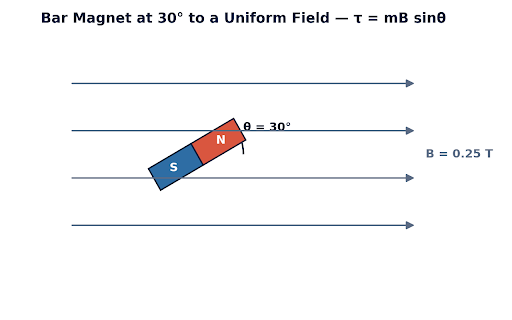
For a magnetic dipole in a uniform magnetic field:
τ = mB sinθ ⇒ m = τ/(B sinθ)
Since sin30° = 1/2:
m = (4.5 × 10⁻²)/(0.25 × 0.5) = (4.5 × 10⁻²)/0.125
→ m = 0.36 J T−1 = 0.36 A m2 (since 1 J T−1 = 1 A m2)
Question 2 — NCERT Exercise 5.4
A short bar magnet of magnetic moment m = 0.32 J T⁻¹ is placed in a uniform magnetic field of 0.15 T. If the bar is free to rotate in the plane of the field, which orientation would correspond to its (a) stable, and (b) unstable equilibrium? What is the potential energy of the magnet in each case?
Given: m = 0.32 J T−1, B = 0.15 T
The potential energy of a magnetic dipole is:
U = −mB cosθ
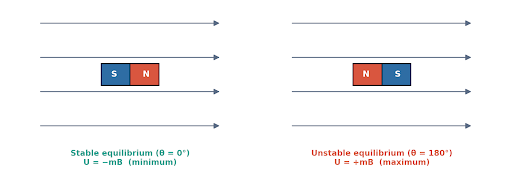
Stable equilibrium (aligned) has minimum energy; unstable equilibrium (anti-aligned) has maximum energy
(a) Stable equilibrium
A magnetic dipole is in stable equilibrium when its magnetic moment is parallel to the field, so θ = 0°:
U = −mB cos0° = −(0.32)(0.15)(1)
→ U = −0.048 J, with m parallel to B
(b) Unstable equilibrium
The dipole is in unstable equilibrium when its moment is opposite to the field, so θ = 180°. Since cos180° = −1:
U = −mB cos180° = +(0.32)(0.15)
→ U = +0.048 J, with m antiparallel to B
The stable orientation corresponds to the minimum potential energy, while the unstable orientation corresponds to the maximum potential energy.
Question 3 — NCERT Exercise 5.5
A closely wound solenoid of 800 turns and area of cross section 2.5 × 10⁻⁴ m2 carries a current of 3.0 A. Explain the sense in which the solenoid acts like a bar magnet. What is its associated magnetic moment?
Given: N = 800, A = 2.5 × 10⁻⁴ m2, I = 3.0 A
A current-carrying solenoid behaves like a bar magnet because it produces a magnetic field with a north pole and a south pole; its field pattern outside the solenoid resembles that of a bar magnet.
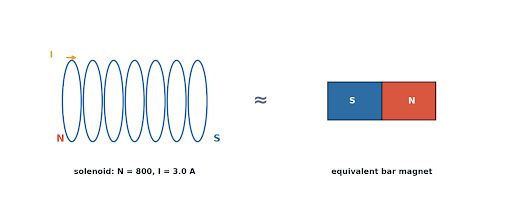
A solenoid's external field pattern is equivalent to that of a bar magnet
The magnetic moment of a current-carrying solenoid is:
m = NIA
m = 800 × 3.0 × 2.5 × 10−4 = 6000 × 10−4
→ m = 0.60 A m2
Question 4 — NCERT Exercise 5.6
If the solenoid in Exercise 5.5 is free to turn about the vertical direction and a uniform horizontal magnetic field of 0.25 T is applied, what is the magnitude of torque on the solenoid when its axis makes an angle of 30° with the direction of applied field?
Given (from Q3): m = 0.60 A m2, B = 0.25 T, θ = 30°
This is the same geometry as Question 1 — a dipole moment at 30° to a uniform field — so the same relation applies:
τ = mB sinθ
τ = 0.60 × 0.25 × 0.5 = 0.075 N m
→ τ = 7.5 × 10⁻² N m
The torque tends to rotate the solenoid so that its magnetic moment aligns with the applied magnetic field.
Question 5 — NCERT Exercise 5.7
A bar magnet of magnetic moment 1.5 J T−1 lies aligned with the direction of a uniform magnetic field of 0.22 T. (a) What is the amount of work required by an external torque to turn the magnet so as to align its magnetic moment: (i) normal to the field direction, (ii) opposite to the field direction? (b) What is the torque on the magnet in cases (i) and (ii)?
Given: m = 1.5 J T−1, B = 0.22 T, initial angle θ1 = 0°
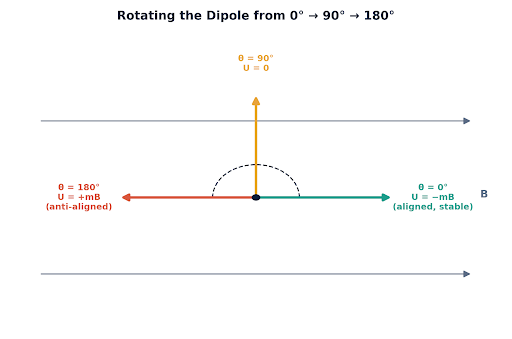
The potential energy of a magnetic dipole is U = −mB cosθ. For a slow rotation, the work done by the external torque equals the increase in potential energy, W = U₂ − U₁. The initial energy, with θ₁ = 0°, is:
U1 = −mB cos0° = −(1.5)(0.22) = −0.33 J
(a)(i) Turned normal to the field (θ₂ = 90°)
U2 = −mB cos90° = 0
W = U2 − U1 = 0 − (−0.33)
→ W = 0.33 J
(a)(ii) Turned opposite to the field (θ₂ = 180°)
U2 = −mB cos180° = +mB = 1.5 × 0.22 = 0.33 J
W = U2 − U1 = 0.33 − (−0.33)
→ W = 0.66 J
(b) Torque in each case
Torque is τ = mB sinθ:
case (i): τ = 1.5 × 0.22 × sin90° = 0.33 N m
case (ii): τ = 1.5 × 0.22 × sin180° = 0
→ τ = 0.33 N m when normal to the field; τ = 0 when anti-aligned
An important point here is that the torque is zero in both the initial aligned position and the final anti-aligned position, even though the work required to rotate the magnet between them is non-zero.
Question 6 — NCERT Exercise 5.8
A closely wound solenoid of 2000 turns and area of cross-section 1.6 × 10⁻⁴ m2, carrying a current of 4.0 A, is suspended through its centre allowing it to turn in a horizontal plane. (a) What is the magnetic moment associated with the solenoid? (b) What is the force and torque on the solenoid if a uniform horizontal magnetic field of 7.5 × 10⁻² T is set up at an angle of 30° with the axis of the solenoid?
Given: N = 2000, A = 1.6 × 10⁻⁴ m2, I = 4.0 A, B = 7.5 × 10⁻² T, θ = 30°
(a) Magnetic moment
m = NIA = 2000 × 4.0 × 1.6 × 10−4 = 8000 × 1.6 × 10−4
→ m = 1.28 A m2
(b) Force and torque
A magnetic dipole placed in a uniform magnetic field experiences no net force:
→ F = 0
The torque is τ = mB sinθ:
τ = 1.28 × 7.5 × 10−2 × sin30° = 1.28 × 7.5 × 10−2 × 0.5
→ τ = 4.8 × 10⁻² N m
The zero net force follows because the applied magnetic field is uniform, while the torque tends to rotate the solenoid towards alignment with the field.
Question 7 — NCERT Exercise 5.12
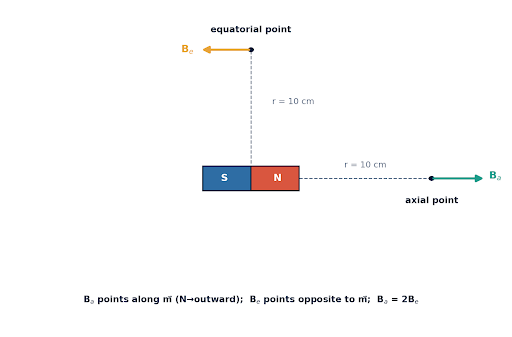
A short bar magnet has a magnetic moment of 0.48 J T−1. Give the direction and magnitude of the magnetic field produced by the magnet at a distance of 10 cm from the centre of the magnet on (a) the axis, (b) the equatorial lines (normal bisector) of the magnet.
Given: m = 0.48 J T−1, r = 10 cm = 0.10 m, μ0/4π = 10−7 T·m/A
(a) Magnetic field on the axis
Ba = (μ0/4π) × (2m/r3) = 10−7 × (2 × 0.48)/(0.10)3
Ba = 10−7 × 0.96/10−3 = 0.96 × 10⁻⁴ T
→ Ba = 9.6 × 10⁻⁵ T = 0.96 G, directed along m⃗ (outward from the N pole)
(b) Magnetic field on the equatorial line
Be = (μ0/4π) × (m/r3) = 10−7 × 0.48/(0.10)3 = 0.48 × 10⁻⁴ T
→ Be = 4.8 × 10⁻⁵ T = 0.48 G, directed opposite to m⃗
Thus, at the same distance from the centre, Ba = 2Be.
Key Features of NCERT Solutions for Class 12 Physics Chapter 5
These NCERT Solutions for Magnetism and Matter are designed to help students understand both the calculation and the Physics behind each question.
- Exact NCERT questions: The selected questions are taken from the current NCERT Class 12 Physics Chapter 5 exercise set, with the original question wording retained.
- Step-by-step calculations: Each numerical solution shows the given values, relevant formula, substitution and final calculation.
- Concept-based explanations: The solutions explain why a particular relation is applicable, especially for magnetic dipole fields, torque, potential energy and magnetic moment.
- Clear direction-based reasoning: Questions involving axial and equatorial magnetic fields explain the direction as well as the magnitude of the field.
- Proper unit conversions: Quantities such as centimetres, gauss and tesla are converted before being used in calculations.
- Important chapter coverage: The solutions cover magnetic dipoles, solenoids, torque, potential energy, magnetic fields and magnetic materials.
- Useful for revision: Students can use the worked solutions to check their approach after attempting the NCERT exercises independently.
- Student-focused explanations: Numerical questions focus on the calculation, while conceptual questions explain the underlying Physics clearly.
Why Choose Infinity Learn NCERT Solutions for Class 12 Physics Chapter 5?
Understanding Magnetism and Matter requires more than memorising equations. Students need to recognise the physical situation, select the appropriate relation and understand what the resulting value or direction represents.
Infinity Learn's NCERT Solutions help students do this by providing:
- Clear explanations of magnetic concepts: Understand magnetic dipole moment, torque, potential energy, Earth's magnetic field and magnetic materials through worked examples and explanations.
- A structured approach to numerical problems: Follow the progression from given information to formula, substitution and final answer.
- Focused coverage of difficult areas: Revise topics such as axial and equatorial fields, bar magnet–solenoid equivalence and the classification of magnetic materials.
- Calculation checks: Compare your own working with the solution to identify errors in formulas, units, substitution or arithmetic.
- Concepts that can be reused: The solutions explain relationships that can help with similar questions rather than focusing only on obtaining one numerical answer.
- Support for board and entrance preparation: Build the NCERT-level understanding needed before moving on to additional practice for examinations such as CBSE, JEE Main and NEET.
- Additional learning resources: Students can supplement the NCERT solutions with Infinity Learn's video lessons and practice resources.
For the best use of these solutions, try each NCERT question yourself first. Then use the worked solution to check your method, not just the final answer.
This keeps both client-requested sections intact while making them more useful, specific and student-centric than the generic competitor versions.
Prepare Magnetism and Matter with NCERT Solutions
Magnetism and Matter becomes much easier when the chapter is treated as a connected set of ideas rather than a collection of isolated formulas. A current-carrying loop gives rise to a magnetic moment; that magnetic moment experiences torque in an external field; a bar magnet can be treated as a magnetic dipole; and the response of different materials to magnetic fields leads to the classification of magnetic substances.
Begin with the NCERT theory, attempt the retained exercises yourself and then use these solutions to check your reasoning, calculations and units.
course
No courses found
FAQs: NCERT Solutions For Class 12 Physics Chapter 5
What are the elements of the Earth's magnetic field?
The three quantities conventionally used to specify the Earth's magnetic field at a location are the horizontal component of the Earth's magnetic field, magnetic declination and magnetic dip. These are collectively known as the elements of the Earth's magnetic field.
How do I calculate torque on a bar magnet in a uniform field?
Use τ = mB sinθ, where m is the magnetic moment, B is the magnetic field and θ is the angle between the magnetic moment and the field. The torque is maximum when θ = 90° and zero when the magnetic moment is parallel or antiparallel to the field.
What's the difference between diamagnetic, paramagnetic and ferromagnetic materials?
Diamagnetic materials are weakly repelled by magnetic fields and have small negative susceptibility. Paramagnetic materials are weakly attracted and have small positive susceptibility. Ferromagnetic materials are strongly attracted and can develop strong magnetisation because their magnetic moments can align within domains.
How is a bar magnet treated as an equivalent solenoid?
A current-carrying solenoid produces a magnetic field pattern similar to that of a bar magnet, with a north and south pole. Its magnetic moment is m = NIA. Thus, a solenoid can be used as a physical model for understanding the magnetic dipole behaviour of a bar magnet.
How does the magnetic field of a short bar magnet differ on its axis and equatorial line?
At the same distance from the centre, Ba = (μ0/4π)(2m/r3) and Be = (μ0/4π)(m/r3), so Ba = 2Be. The axial field is along the magnetic moment outside the magnet, while the equatorial field is opposite to the magnetic moment.
How many exercises are there in the current NCERT Chapter 5?
The current NCERT chapter contains 15 regular exercises, numbered 5.1 to 5.15, followed by Additional Exercises beginning with 5.16. For the rationalised syllabus, several exercises have been excluded. The retained regular exercises are 5.3–5.8 and 5.12.
How important is Magnetism and Matter for CBSE Class 12 Physics?
Magnetism and Matter is part of the Class 12 Physics syllabus and provides the conceptual basis for magnetic dipoles, magnetic materials and the Earth's magnetic field. Rather than assigning a fixed number of marks to Chapter 5, students should prepare the concepts and retained NCERT exercises thoroughly because the CBSE syllabus does not provide a separate fixed chapter-wise mark allocation.
Is Magnetism and Matter useful for JEE Main and NEET preparation?
Yes. The chapter develops concepts such as magnetic dipole moment, torque, magnetic fields of dipoles and the behaviour of magnetic materials. These ideas also connect with the broader magnetism portion of Physics used in entrance-examination preparation. Students should supplement the NCERT exercises with relevant competitive-exam question sets after establishing the NCERT concepts.
