NCERT Solutions Class 12 Physics — Chapter 11 Dual Nature of Radiation and Matter
By Rohit RP
|
Updated on 3 Nov 2026, 11:47 IST
How can light behave like both a wave and a stream of particles? How can a moving electron have an associated wavelength? Class 12 Physics Chapter 11, Dual Nature of Radiation and Matter, introduces these ideas through the photoelectric effect, the photon picture of electromagnetic radiation and de Broglie's matter-wave hypothesis.
The chapter covers electron emission, work function, photoelectric observations, Einstein's photoelectric equation, photon energy and momentum, de Broglie wavelength and the experimental evidence for the wave nature of electrons.
These NCERT Solutions for Class 12 Physics Chapter 11 provide step-by-step NCERT Solutions to the chapter's exercise questions, with formulas, substitutions, calculations and reasoning shown clearly.
Download Class 12 Physics Chapter 11 NCERT Solutions
Download the Class 12 Physics Chapter 11 NCERT Solutions PDF for Dual Nature of Radiation and Matter, including the NCERT exercise questions and step-by-step solutions covering the photoelectric effect, photon properties and de Broglie matter waves.
NCERT Class 12 Physics Chapter 11: Structure and Key Topics
Chapter 11 moves from the emission of electrons to the experimental observations of the photoelectric effect and then uses the photon model to explain those observations.
The chapter can be followed through this sequence:
Electron emission → Photoelectric effect → Photon theory → Einstein's photoelectric equation → Matter waves → de Broglie wavelength → Experimental verification
The numerical questions mainly involve photon energy, work function, threshold frequency, stopping potential, maximum kinetic energy, photon momentum and de Broglie wavelength.

The chapter also provides the foundation for the transition from classical descriptions of radiation and matter to the quantum picture used in later modern-physics topics.
For the 2026–27 CBSE Class 12 Physics syllabus, Chapter 11 falls under Unit VII: Dual Nature of Radiation and Matter, which carries 12 marks.
Best Courses for You

JEE

NEET

Foundation JEE

Foundation NEET

CBSE
Important Formulas for Chapter 11
Energy of a Photon
E = hν
Using c = νλ, the photon energy can also be written as:
E = hc/λ
Momentum of a Photon
p = E/c = hν/c = h/λ
Work Function
The minimum energy required to remove an electron from a metal surface is the work function ϕ₀ = hν₀, where ν₀ is the threshold frequency.
Einstein's Photoelectric Equation
Kmax = hν − ϕ₀ = h(ν − ν₀)
Stopping Potential
Kmax = eV0 ⇒ eV0 = hν − ϕ₀
Maximum Kinetic Energy
Kmax = (1/2)mvmax2
de Broglie Wavelength
λ = h/p (non-relativistic: λ = h/mv)
de Broglie Wavelength of an Electron Accelerated Through Potential V
λ = h / [√(2meV)]
For an electron, this is commonly written as λ = 12.27 / [√V] Å, when V is in volts.
NCERT Questions and Step-by-Step Solutions
Question 1 Exercise 11.1
Find the (a) maximum frequency, and (b) minimum wavelength of X-rays produced by 30 kV electrons.
Given
V = 30 kV = 30 × 103 V
The maximum energy transferred to a single X-ray photon equals the kinetic energy gained by an electron: hνmax = eV.
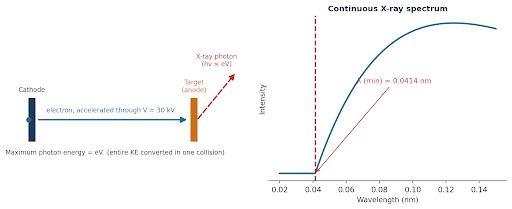
(a) Maximum frequency
νmax = eV/h = [(1.6 × 10⁻¹⁹)(30 × 103)] / (6.626 × 10⁻³⁴) ≈ 7.24 × 10¹⁸ Hz
(b) Minimum wavelength
λmin = c/νmax = (3 × 10⁸)/(7.24 × 1018) ≈ 4.14 × 10⁻¹¹ m ≈ 0.0414 nm
Answer
νmax ≈ 7.24 × 10¹⁸ Hz
λmin ≈ 4.14 × 10⁻¹¹ m ≈ 0.0414 nm
Question 2 Exercise 11.2
The work function of caesium metal is 2.14 eV. When light of frequency 6 × 10¹⁴ Hz is incident on the metal surface, photoemission of electrons occurs. What is the (a) maximum kinetic energy of the emitted electrons, (b) stopping potential, and (c) maximum speed of the emitted photoelectrons?
Given
ϕ₀ = 2.14 eV, ν = 6 × 10¹⁴ Hz, h = 6.626 × 10⁻³⁴ J s
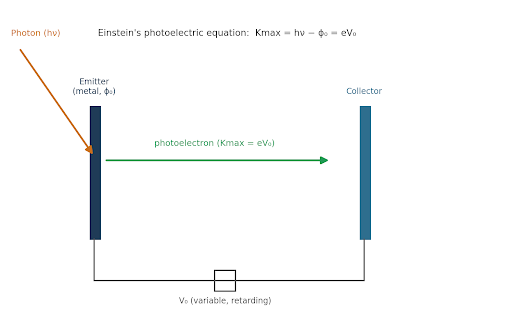
(a) Maximum kinetic energy
E = hν = (6.626 × 10⁻³⁴)(6 × 10¹⁴) = 3.9756 × 10⁻¹⁹ J ≈ 2.485 eV
Kmax = hν − ϕ₀ = 2.485 − 2.14 = 0.345 eV ≈ 5.52 × 10⁻²⁰ J
(b) Stopping potential
Since Kmax = eV₀, the numerical value of Kmax in eV equals V₀ in volts:
V0 ≈ 0.345 V
(c) Maximum speed
vmax = [√(2Kmax/m)] = [√(2(5.52 × 10⁻²⁰)/(9.11 × 10−31))] ≈ 3.48 × 10⁵ m s−1
Answer
Kmax ≈ 0.345 eV
V0 ≈ 0.345 V
vmax ≈ 3.48 × 10⁵ m s−1
Question 3 Exercise 11.3
The photoelectric cut-off voltage in a certain experiment is 1.5 V. What is the maximum kinetic energy of photoelectrons emitted?
Given
V0 = 1.5 V
Kmax = eV0 = (1.6 × 10⁻¹⁹)(1.5) = 2.4 × 10⁻¹⁹ J = 1.5 eV
Answer
Kmax = 2.4 × 10⁻¹⁹ J = 1.5 eV
Question 4 Exercise 11.4
Monochromatic light of wavelength 632.8 nm is produced by a helium-neon laser. The power emitted is 9.42 mW. (a) Find the energy and momentum of each photon in the light beam. (b) How many photons per second, on the average, arrive at a target irradiated by this beam? (c) How fast does a hydrogen atom have to travel in order to have the same momentum as that of the photon?
Given
λ = 632.8 nm = 632.8 × 10⁻⁹ m, P = 9.42 mW = 9.42 × 10⁻³ W
(a) Energy and momentum of each photon
E = hc/λ = [(6.626 × 10⁻³⁴)(3 × 10⁸)] / (632.8 × 10⁻⁹) ≈ 3.14 × 10⁻¹⁹ J
p = h/λ = (6.626 × 10⁻³⁴) / (632.8 × 10⁻⁹) ≈ 1.05 × 10⁻²⁷ kg m s−1
(b) Photons arriving per second
Since power is energy delivered per second, P = NE:
N = P/E = (9.42 × 10⁻³) / (3.14 × 10⁻¹⁹) ≈ 3.0 × 10¹⁶ photons s−1
(c) Speed of a hydrogen atom with the same momentum
v = p/mH = (1.047 × 10⁻²⁷) / (1.66 × 10⁻²⁷) ≈ 0.63 m s−1
Answer
E ≈ 3.14 × 10⁻¹⁹ J, p ≈ 1.05 × 10⁻²⁷ kg m s−1
N ≈ 3.0 × 10¹⁶ photons s−1
v(H) ≈ 0.63 m s−1
Question 5 Exercise 11.5
In an experiment on photoelectric effect, the slope of the cut-off voltage versus frequency of incident light is found to be 4.12 × 10⁻¹⁵ V s. Calculate the value of Planck's constant.
Rearranging Einstein's equation eV₀ = hν − ϕ₀ as V₀ = (h/e)ν − ϕ₀/e shows that V₀ vs ν is a straight line with slope h/e:
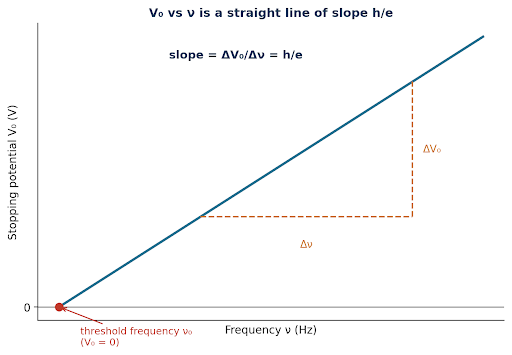
ΔV0/Δν = h/e = 4.12 × 10⁻¹⁵ V s
h = e(4.12 × 10⁻¹⁵) = (1.6 × 10⁻¹⁹)(4.12 × 10⁻¹⁵) = 6.592 × 10⁻³⁴ J s
Answer
h ≈ 6.59 × 10⁻³⁴ J s
Question 6 Exercise 11.6
The threshold frequency for a certain metal is 3.3 × 10¹⁴ Hz. If light of frequency 8.2 × 10¹⁴ Hz is incident on the metal, predict the cutoff voltage for the photoelectric emission.
Given
ν₀ = 3.3 × 10¹⁴ Hz, ν = 8.2 × 10¹⁴ Hz
Since Kmax = h(ν − ν₀) = eV₀:
V0 = h(ν − ν₀)/e = [(6.626 × 10⁻³⁴)(4.9 × 10¹³)] / (1.6 × 10⁻¹⁹) ≈ 2.03 V
Answer
V0 ≈ 2.03 V
Question 7 Exercise 11.7
The work function for a certain metal is 4.2 eV. Will this metal give photoelectric emission for incident radiation of wavelength 330 nm?
Given
ϕ₀ = 4.2 eV, λ = 330 nm
E = hc/λ = [(6.626 × 10⁻³⁴)(3 × 10⁸)] / (330 × 10−9) ≈ 6.02 × 10⁻¹⁹ J ≈ 3.76 eV
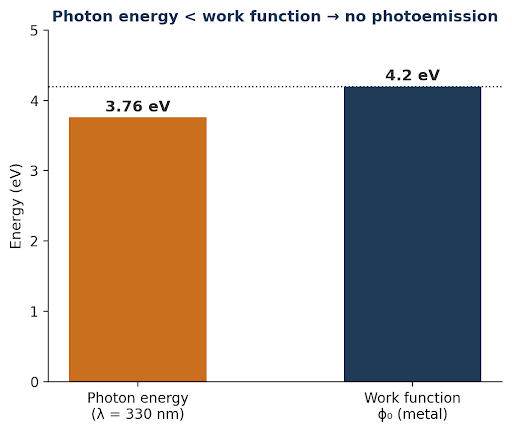
Since E < ϕ₀ (3.76 eV < 4.2 eV), the photon energy is insufficient to overcome the work function.
Answer
No, photoelectric emission will not occur.
Question 8 Exercise 11.8
Light of frequency 7.21 × 10¹⁴ Hz is incident on a metal surface. Electrons with a maximum speed of 6.0 × 10⁵ m/s are ejected from the surface. What is the threshold frequency for photoemission of electrons?
Given
ν = 7.21 × 10¹⁴ Hz, vmax = 6.0 × 10⁵ m s−1, m = 9.11 × 10⁻³¹ kg
Using (1/2)mvmax2 = h(ν − ν₀):
ν0 = ν − mvmax2/2h
mvmax2/2h = [(9.11 × 10⁻³¹)(3.6 × 10¹¹)] / [2(6.626 × 10⁻³⁴)] ≈ 2.47 × 10¹⁴
ν0 = 7.21 × 10¹⁴ − 2.47 × 10¹⁴ ≈ 4.74 × 10¹⁴ Hz
Answer
ν0 ≈ 4.74 × 10¹⁴ Hz
Question 9 Exercise 11.9
Light of wavelength 488 nm is produced by an argon laser which is used in the photoelectric effect. When light from this spectral line is incident on the emitter, the stopping (cut-off) potential of photoelectrons is 0.38 V. Find the work function of the material from which the emitter is made.
Given
λ = 488 nm, V0 = 0.38 V
Using the eV form of photon energy, E (eV) ≈ 1240/λ(nm):
E = 1240/488 ≈ 2.54 eV
Since Kmax = eV₀ = 0.38 eV and ϕ₀ = E − Kmax:
ϕ0 = 2.54 − 0.38 = 2.16 eV
Answer
ϕ0 ≈ 2.16 eV
Question 10 Exercise 11.10
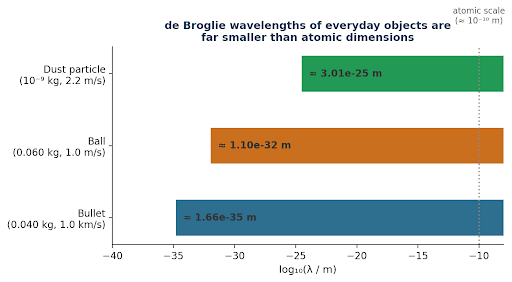
What is the de Broglie wavelength of (a) a bullet of mass 0.040 kg travelling at the speed of 1.0 km/s, (b) a ball of mass 0.060 kg moving at a speed of 1.0 m/s, and (c) a dust particle of mass 1.0 × 10⁻⁹ kg drifting with a speed of 2.2 m/s?
The de Broglie wavelength is λ = h/mv, with h = 6.626 × 10⁻³⁴ J s.
(a) Bullet
λ = (6.626 × 10⁻³⁴) / [(0.040)(1000)] ≈ 1.66 × 10⁻³⁵ m
(b) Ball
λ = (6.626 × 10⁻³⁴) / [(0.060)(1.0)] ≈ 1.10 × 10⁻³² m
(c) Dust particle
λ = (6.626 × 10⁻³⁴) / [(1.0 × 10⁻⁹)(2.2)] ≈ 3.01 × 10⁻²⁵ m
Answer
Bullet: λ ≈ 1.66 × 10⁻³⁵ m
Ball: λ ≈ 1.10 × 10⁻³² m
Dust particle: λ ≈ 3.0 × 10⁻²⁵ m
Question 11 Exercise 11.11
Show that the wavelength of electromagnetic radiation is equal to the de Broglie wavelength of its quantum (photon).
For a photon, E = hν, and energy and momentum are related by E = pc. Therefore:
pc = hν
Since ν = c/λ:
pc = hc/λ ⇒ p = h/λ ⇒ λ = h/p
According to de Broglie's hypothesis, the wavelength associated with a particle of momentum p is λdB = h/p. For a photon this is exactly the same expression, so:
λdB = λ
Answer
The wavelength of electromagnetic radiation equals the de Broglie wavelength associated with its photon.
Key Features of NCERT Solutions for Class 12 Physics Chapter 11
- Detailed Solutions: Each question is explained with the necessary steps and calculations so students can understand how the answer is obtained.
- Clear Understanding of the Photoelectric Effect: Key ideas such as work function, threshold frequency, stopping potential, and Einstein's photoelectric equation are explained through the relevant questions.
- Photon and de Broglie Calculations: Questions on photon energy, momentum, and de Broglie wavelength are worked out with the required formulas, calculations, and units.
- Derivations Explained Clearly: Important derivations are broken down into individual steps so students can follow the reasoning behind each result.
- Useful for Practice and Revision: Students can attempt the NCERT questions first and use the solutions to check their approach, calculations, and final answers.
Why Infinity Learn NCERT Solutions for Class 12 Physics Chapter 11 Dual Nature of Radiation and Matter
- Guidance from Top Faculty: Get help from experienced Physics faculty who understand the requirements of board and competitive exams.
- Concepts Linked to Real-Life Applications: Learn how ideas such as the photoelectric effect and wave-particle duality relate to technologies and phenomena students encounter outside the textbook.
- Board and Competitive Exam Practice: Work through previous-year questions and other exam-level problems to become familiar with different ways these concepts can be tested.
- Better Approach to Numerical Problems: Learn how to identify the right formula, use the given values, and work through questions on photon energy, momentum, and de Broglie wavelength.
course
No courses found
FAQs: NCERT Solutions Class 12 Physics
What is Einstein's photoelectric equation?
Einstein's photoelectric equation expresses conservation of energy in the photoelectric effect:
hν = ϕ₀ + Kmax
Therefore Kmax = hν − ϕ₀. Here, hν is the energy of the incident photon, ϕ₀ is the work function of the metal and Kmax is the maximum kinetic energy of the emitted photoelectron.
How is de Broglie wavelength calculated?
The de Broglie wavelength of a particle is:
λ = h/p
For a non-relativistic particle with momentum p = mv: λ = h/mv. For an electron accelerated through a potential difference V: λ = h/[√(2meV)].
What is the significance of the Davisson-Germer experiment?
The Davisson-Germer experiment provided experimental evidence for the wave nature of electrons by observing electron diffraction. It supported de Broglie's hypothesis that moving particles can be associated with matter waves.
Is Dual Nature of Radiation and Matter important for NEET and JEE Main?
Dual Nature of Radiation and Matter is included in the Physics syllabus relevant to preparation for examinations such as NEET and JEE Main. The chapter's core areas include the photoelectric effect, Einstein's photoelectric equation, photon energy and momentum, de Broglie wavelength and matter waves.
Practising the NCERT questions helps students work with the fundamental relationships used in these topics.
Where can I download the NCERT Solutions PDF for Chapter 11?
You can access the Class 12 Physics Chapter 11 NCERT Solutions PDF through Infinity Learn's study materials. The PDF can be used alongside the NCERT textbook for revision and practice.
