- Key Concepts of Electromagnetic Waves
- NCERT Solutions for Class 12 Physics Chapter 8: Electromagnetic Waves
- Key Features of These NCERT Solutions
- Why Choose Infinity Learn NCERT Solutions for This Chapter?
- Explore Infinity Learn's Class 12 Physics Resources
- FAQs: NCERT Solutions Class 12 Physics Chapter 8
NCERT Solutions Class 12 Physics Chapter 8 — Electromagnetic Waves
By Rohit RP
|
Updated on 28 Oct 2026, 14:31 IST
How can a radio signal travel through space without a material medium? Why do changing electric and magnetic fields produce waves that can travel across a vacuum? These questions lead to one of the most important ideas in modern physics: electromagnetic waves.
Class 12 Physics Chapter 8, Electromagnetic Waves, introduces the concept of displacement current and Maxwell's contribution to electromagnetic theory. The chapter covers the generation and nature of electromagnetic waves, their transverse nature, the relationship between their electric and magnetic fields, and the different regions of the electromagnetic spectrum.
The chapter also introduces the practical applications of electromagnetic radiation, from radio waves and microwaves to infrared radiation, visible light, ultraviolet rays, X-rays and gamma rays.
These NCERT Solutions for Class 12 Physics Chapter 8 provide detailed, step-by-step solutions to the chapter-end exercises. The calculations show the relevant formula, substitution and reasoning so that students can understand how to approach numerical and conceptual questions.
The chapter is useful for CBSE Class 12 Physics preparation as well as for revising fundamental electromagnetic concepts for competitive examinations such as JEE Main and NEET.
Key Concepts of Electromagnetic Waves
- Displacement current and its significance
- Maxwell's equations
- Generation of electromagnetic waves
- Nature of electromagnetic waves
- Transverse nature of electromagnetic waves
- Electric and magnetic fields in an electromagnetic wave
- Electromagnetic spectrum
- Radio waves
- Microwaves
- Infrared radiation
- Visible light
- Ultraviolet radiation
- X-rays
- Gamma rays
- Applications of different regions of the electromagnetic spectrum
NCERT Solutions for Class 12 Physics Chapter 8: Electromagnetic Waves
Topics Covered
- Displacement current
- Maxwell's equations
- Generation and nature of electromagnetic waves
- Electromagnetic spectrum
- Applications of different regions of the electromagnetic spectrum
Important Formulas
Displacement current
Id = ε0 dΦe/dt
Total current

I = Ic + Id
Speed of electromagnetic waves in vacuum
Best Courses for You

JEE

NEET

Foundation JEE

Foundation NEET

CBSE
c = (μ0ε0)−1/2
Wavelength–frequency relation
c = νλ
Relation between electric and magnetic field amplitudes
E0 = cB0
Angular frequency
ω = 2πν
Wave number
k = 2π/λ
Photon energy
E = hν = hc/λ
Electromagnetic Spectrum
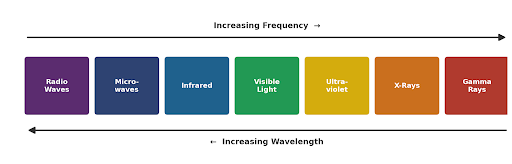
The electromagnetic spectrum is arranged in the following order of increasing frequency (and correspondingly, decreasing wavelength):
Applications by Region
| Electromagnetic Radiation | Common Applications |
| Radio waves | Radio and television communication |
| Microwaves | Radar, speed guns and microwave ovens |
| Infrared | Remote controls, detectors and thermal applications |
| Visible light | Vision and optical applications |
| Ultraviolet | Sterilisation and other specialised applications |
| X-rays | Medical imaging and certain medical treatments |
| Gamma rays | Nuclear applications and cancer treatment |
Step-by-Step Solutions
Question 1 Figure 8.6 shows a capacitor made of two circular plates each of radius 12 cm, separated by 5.0 cm, being charged by a constant current of 0.15 A. (a) Find the capacitance and the rate of change of potential difference. (b) Find the displacement current. (c) Is Kirchhoff's junction rule valid at each plate?
Given
r = 12 cm = 0.12 m
d = 5.0 cm = 0.05 m
I = 0.15 A
ε0 = 8.85 × 10⁻¹² F m−1
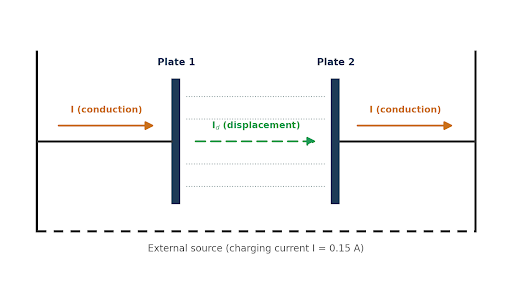
(a) Capacitance
For a parallel-plate capacitor:
C = ε0A/d, where A = πr2
A = π(0.12)2 ≈ 0.0452 m2
C = (8.85 × 10−12 × 0.0452) / 0.05 ≈ 8.0 × 10⁻¹² F = 8.0 pF
Rate of change of potential difference
Since Q = CV, differentiating gives I = C dV/dt, so:
dV/dt = I/C = 0.15 / (8.0 × 10⁻¹²) ≈ 1.87 × 10¹⁰ V s−1
(b) Displacement current
For a charging capacitor, the displacement current between the plates equals the conduction current in the circuit:
Id = I = 0.15 A
(c) Validity of Kirchhoff's first rule
During charging, conduction current flows in the wires while displacement current exists between the plates, and:
Id = Ic = 0.15 A
Thus, once displacement current is included alongside conduction current, current continuity — and hence Kirchhoff's junction rule — is maintained at each plate.
Answer (a) C ≈ 8.0 pF, dV/dt ≈ 1.87 × 10¹⁰ V s−1 (b) Id = 0.15 A (c) Yes — with displacement current included, current continuity at the capacitor plates is maintained.
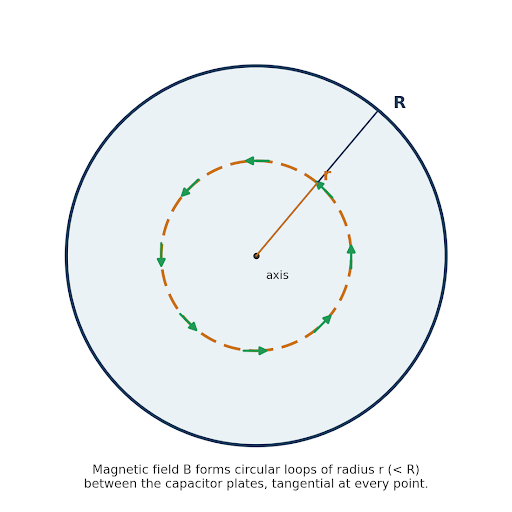
Question 2 A parallel plate capacitor (Fig. 8.7), circular plates of radius R = 6.0 cm, capacitance C = 100 pF, connected to a 230 V ac supply of angular frequency 300 rad s⁻¹. (a) Find the rms conduction current. (b) Is it equal to the displacement current? (c) Find the amplitude of B at 3.0 cm from the axis.
Given
R = 6.0 cm = 0.06 m
C = 100 pF = 1.0 × 10⁻¹⁰ F
Vrms = 230 V
ω = 300 rad s−1
r = 3.0 cm = 0.03 m
(a) RMS value of conduction current
For a capacitor on an AC source:
Irms = ωCVrms
Irms = 300 × 1.0 × 10−10 × 230 = 6.9 × 10⁻⁶ A = 6.9 μA
(b) Conduction current vs. displacement current
For the charging capacitor, the conduction current in the wire and the displacement current between the plates are equal in magnitude:
Ic = Id
(c) Amplitude of B at r = 3.0 cm
The peak current is:
I0 = √2 × Irms = √2 × 6.9 × 10−6 ≈ 9.76 × 10⁻⁶ A
For a circular Amperian loop of radius r inside the plates, the enclosed displacement current scales as (r²/R²):
Id, enclosed = I0(r2/R2)
Applying the Ampere–Maxwell law, B(2πr) = μ₀ I(d, enclosed), so:
B = μ0I0r / (2πR2)
B = [(4π × 10−7)(9.76 × 10⁻⁶)(0.03)] / [2π(0.06)2] ≈ 1.63 × 10⁻¹¹ T
Answer (a) Irms = 6.9 μA (b) Yes — the conduction current equals the displacement current in magnitude. (c) B0 ≈ 1.63 × 10⁻¹¹ T
Question 3 What physical quantity is the same for X-rays of wavelength 10⁻¹⁰ m, red light of wavelength 6800 Å and radiowaves of wavelength 500 m?
The wavelengths of the three radiations are very different, but all electromagnetic waves travel at the same speed in vacuum:
c = 3 × 10⁸ m s−1
Answer The speed of propagation in vacuum, c = 3 × 10⁸ m s−1, is the same for X-rays, red light and radio waves.
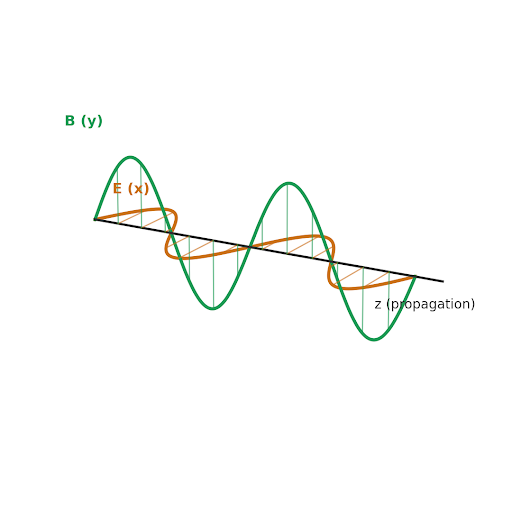
Question 4 A plane electromagnetic wave travels in vacuum along the z-direction. What can you say about the directions of its E and B vectors? If the frequency of the wave is 30 MHz, what is its wavelength?
An electromagnetic wave is transverse in nature. If it travels along the z-direction, both the electric and magnetic fields are perpendicular to z, and perpendicular to each other:
E ⟂ B ⟂ direction of propagation
Wavelength
Given ν = 30 MHz = 30 × 106 Hz. Using c = νλ:
λ = c/ν = (3 × 10⁸) / (30 × 106) = 10 m
Answer E and B are mutually perpendicular, and both are perpendicular to the direction of propagation. Wavelength = 10 m
Question 5 A radio can tune in to any station in the 7.5 MHz to 12 MHz band. What is the corresponding wavelength band?
Using λ = c/ν for ν1 = 7.5 MHz and ν2 = 12 MHz:
λ1 = (3 × 10⁸) / (7.5 × 10⁶) = 40 m
λ2 = (3 × 10⁸) / (12 × 106) = 25 m
Answer The corresponding wavelength band is 25 m to 40 m.
Question 6 A charged particle oscillates about its mean equilibrium position with a frequency of 10⁹ Hz. What is the frequency of the electromagnetic waves produced by the oscillator?
An oscillating charge produces electromagnetic radiation of the same frequency as its oscillation:
νEM = ν = 109 Hz
Answer The frequency of the electromagnetic waves is 109 Hz.
Question 7 The amplitude of the magnetic field part of a harmonic electromagnetic wave in vacuum is B0 = 510 nT. What is the amplitude of the electric field part of the wave?
Given
B0 = 510 nT = 5.10 × 10⁻⁷ T
For an electromagnetic wave in vacuum:
E0 = cB0
E0 = (3 × 10⁸)(5.10 × 10⁻⁷) = 153 V m−1
Answer E0 = 153 V m−1
Question 8 The electric field amplitude of an electromagnetic wave is E0 = 120 N/C and its frequency is ν = 50.0 MHz. (a) Find B0, ω, k and λ. (b) Write expressions for E and B.
Given
E0 = 120 N/C
ν = 50.0 MHz = 50.0 × 10⁶ Hz
(a) B₀, ω, k and λ
B0 = E0/c = 120 / (3 × 10⁸) = 4.0 × 10⁻⁷ T
ω = 2πν = 2π(50.0 × 10⁶) ≈ 3.14 × 10⁸ rad s−1
λ = c/ν = (3 × 10⁸) / (50.0 × 10⁶) = 6.0 m
k = 2π/λ = 2π/6 ≈ 1.05 rad m−1
(b) Expressions for E and B
Taking the wave to travel along +z, with E along x and B along y (mutually perpendicular, as shown in Fig. 4 above):
E = 120 sin(1.05z − 3.14 × 10⁸t) î N/C
B = 4.0 × 10⁻⁷ sin(1.05z − 3.14 × 10⁸t) ĵ T
Answer B0 = 4.0 × 10⁻⁷ T, ω ≈ 3.14 × 10⁸ rad s−1, k ≈ 1.05 rad m−1, λ = 6.0 m E and B are given above, for one valid choice of axes; E, B and the propagation direction are mutually perpendicular.
Question 9 Use E = hν to obtain the photon energy (in eV) for different parts of the electromagnetic spectrum. How are the different photon-energy scales related to the sources of the radiation?
The photon energy is:
E = hν = hc/λ, or approximately E (eV) ≈ 1240 / λ (nm)
Since photon energy is directly proportional to frequency, it increases steadily from radio waves towards gamma rays:
RegionWavelength RangeApprox. Photon Energy
Radio waves λ > 0.1 m < 1.24 × 10⁻⁵ eV Microwaves 0.1 m to 1 mm 1.24 × 10⁻⁵ to 1.24 × 10⁻³ eV Infrared 1 mm to 700 nm 1.24 × 10⁻³ to 1.77 eV Visible light 700 nm to 400 nm 1.77 to 3.10 eV Ultraviolet 400 nm to 1 nm 3.10 to 1240 eV X-rays 1 nm to 10⁻³ nm 1.24 × 10³ to 1.24 × 10⁶ eV Gamma rays < 10⁻³ nm > 1.24 × 10⁶ eV
Relation to sources
Higher-frequency radiation carries higher photon energy. Different regions of the spectrum arise from different physical processes: radio waves come from comparatively low-energy processes such as oscillating currents, while high-energy radiation such as gamma rays originates from nuclear processes and radioactive decay.
Answer Photon energy E = hν increases with frequency and decreases with wavelength. Different regions of the spectrum therefore correspond to different photon-energy scales and different mechanisms of radiation production (as tabulated above).
Question 10 In a plane electromagnetic wave, the electric field oscillates sinusoidally at frequency 2.0 × 10¹⁰ Hz and amplitude 48 V m⁻¹. (a) Find the wavelength. (b) Find the amplitude of B. (c) Show that the average energy density of E equals that of B. [c = 3 × 10⁸ m s⁻¹]
Given
ν = 2.0 × 10¹⁰ Hz
E0 = 48 V m−1
(a) Wavelength
λ = c/ν = (3 × 10⁸) / (2.0 × 10¹⁰) = 1.5 × 10⁻² m = 1.5 cm
(b) Amplitude of B
B0 = E0/c = 48 / (3 × 10⁸) = 1.6 × 10⁻⁷ T
(c) Average energy densities of E and B
The instantaneous electric energy density is u_E = ½ε₀E², with E = E₀ sin(ωt − kz). Averaging sin² over a full cycle gives ½, so:
⟨uE⟩ = ½ε0E02 × ½ = ε0E02/4
Similarly, the magnetic energy density is u_B = B²/(2μ₀), so:
⟨uB⟩ = B02/(4μ0)
Using E0 = cB0 and c2 = 1/(μ0ε0):
⟨uB⟩ = E02/(4μ0c2) = ε0E02/4 = ⟨uE⟩
Answer (a) λ = 1.5 × 10⁻² m = 1.5 cm (b) B0 = 1.6 × 10⁻⁷ T (c) The average energy density of the electric field equals that of the magnetic field, as derived above.
Key Features of These NCERT Solutions
- Step-by-step solutions for all NCERT chapter-end exercises
- Clear presentation of formulas, substitutions and final answers
- Simple explanations of displacement current and electromagnetic-wave properties
- Detailed numerical solutions with appropriate units
- Coverage of wavelength, frequency, electric field and magnetic field calculations
- Easy revision of the electromagnetic spectrum and its applications
- Useful for CBSE Class 12 Physics preparation and competitive-exam revision
- Structured presentation for quick reference before examinations
Why Choose Infinity Learn NCERT Solutions for This Chapter?
- Clear numerical methods: Follow each calculation from the given values to the final answer.
- Displacement current: Revise the key equations and numerical applications involving displacement current.
- Electromagnetic spectrum: Quickly revise the order and applications of different regions of the spectrum.
- Formula-based revision: Important equations are presented separately for easier recall.
- Conceptual and numerical coverage: Practise both direct conceptual questions and calculation-based NCERT exercises.
- Current chapter coverage: The solutions follow the current NCERT Chapter 8 exercise structure.
- Additional learning support: Use video lessons and practice resources alongside NCERT-based preparation.
Explore Infinity Learn's Class 12 Physics Resources
Preparing for Class 12 Physics becomes easier when NCERT concepts, solved questions and practice are studied together.
Explore Infinity Learn's Class 12 Physics resources for chapter-wise learning and revision. Access step-by-step NCERT Solutions, video explanations and practice questions to strengthen your preparation.
- Explore the Class 12 Physics course
- Download the Infinity Learn app
Sign up to explore available free learning resources and demo options.
course
No courses found
FAQs: NCERT Solutions Class 12 Physics Chapter 8
What is displacement current and why was it introduced?
Displacement current is the current associated with a changing electric field. Maxwell introduced it to resolve the inconsistency that arises when Ampere's circuital law is applied to a charging capacitor. It is given by:
Id = ε0 dΦe/dt
How many questions does Class 12 Physics Chapter 8 contain in the current NCERT textbook?
The current NCERT Chapter 8 contains 10 regular exercises, numbered 8.1 to 8.10, followed by five Additional Exercises, numbered 8.11 to 8.15.
What is the correct order of the electromagnetic spectrum by frequency?
The order of increasing frequency is: Radio waves → Microwaves → Infrared → Visible light → Ultraviolet → X-rays → Gamma rays.
Are electromagnetic waves longitudinal or transverse?
Electromagnetic waves are transverse waves. Their electric and magnetic fields are perpendicular to each other and to the direction of propagation.
How important is Chapter 8 for CBSE Class 12 Physics?
Electromagnetic Waves is included in the CBSE Class 12 Physics syllabus as Unit V. The CBSE syllabus gives a combined marks allocation across Units IV and V rather than assigning a fixed number of marks to Chapter 8 alone.
How do I find the wavelength of an electromagnetic wave from its frequency?
Use the relation c = νλ, so λ = c/ν. For a wave travelling in vacuum, c = 3 × 10⁸ m s−1.
What is the relation between the electric and magnetic field amplitudes?
For an electromagnetic wave in vacuum: E0 = cB0, so B0 = E0/c.
Which electromagnetic waves have the highest frequency?
Gamma rays have the highest frequency and shortest wavelength among the regions of the electromagnetic spectrum.
What are the practical uses of microwaves, X-rays and gamma rays?
Microwaves are used in radar, speed-measuring equipment and microwave ovens. X-rays are used mainly for medical imaging and in certain medical treatments. Gamma rays are produced in nuclear processes and radioactive decay, and are also used in cancer treatment.
Is Electromagnetic Waves important for JEE Main and NEET?
Yes. The chapter covers fundamental relationships involving electromagnetic waves, frequency, wavelength, electric and magnetic fields, photon energy and the electromagnetic spectrum — concepts that are useful for Physics preparation for competitive examinations such as JEE Main and NEET.
Q. Are these NCERT Solutions updated according to the latest CBSE syllabus?
The solutions are based on the current NCERT Chapter 8 exercise structure and the applicable CBSE Class 12 Physics syllabus. Students should continue to refer to the latest official NCERT textbook and CBSE syllabus for any future revisions.
