- Key Concepts of Electromagnetic Induction
- NCERT Solutions for Class 12 Physics Chapter 6: Overview and Structure
- Important Formulas
- NCERT Class 12 Physics Chapter 6: Electromagnetic Induction – Step-by-Step Solutions
- Key Features of NCERT Solutions for Class 12 Physics Chapter 6 Electromagnetic Induction
- Why Infinity Learn NCERT Solutions for Class 12 Physics Chapter 6 Electromagnetic Induction?
- Prepare Electromagnetic Induction with Infinity Learn
- FAQs NCERT Solutions For Class 12 Physics Chapter 6
NCERT Solutions For Class 12 Physics Chapter 6 – Electromagnetic Induction
By Rohit RP
|
Updated on 28 Oct 2026, 12:30 IST
What happens when a magnet moves towards a coil? Why does a galvanometer show a deflection when the magnetic field through a circuit changes, but return to zero when the change stops?
This is the basic idea behind electromagnetic induction, the phenomenon explored in Chapter 6 of the NCERT Class 12 Physics textbook. The chapter shows how a changing magnetic flux can produce an induced electromotive force and, when the circuit is closed, an induced current.
Starting with the experiments of Faraday and Henry, the chapter develops the concepts of magnetic flux, Faraday's laws of electromagnetic induction and Lenz's law. It then takes the idea further through motional EMF, eddy currents, self-inductance, mutual inductance and the working principle of an AC generator.
For students, Chapter 6 can become challenging when a question combines a physical situation with a change in flux, direction of induced current or motion of a conductor. A numerical may look simple once the correct formula is identified, but deciding what is changing and in which direction often requires careful reasoning.
These NCERT Solutions for Class 12 Physics Chapter 6 work through selected NCERT questions with the calculation and reasoning laid out clearly. They can help students check their approach, revise important formulas and understand how electromagnetic induction is applied in different situations.
The chapter is also important for students preparing for CBSE Class 12 Physics, while its concepts provide a foundation for further Physics preparation for examinations such as JEE Main and NEET.
Download the NCERT Solutions PDF to keep the worked solutions available for revision and offline study.
Key Concepts of Electromagnetic Induction
Magnetic Flux
Magnetic flux measures the magnetic field passing through a given surface. For a uniform magnetic field:

Φ = BA cosθ
where B is the magnetic field, A is the area of the surface and θ is the angle between the magnetic field and the normal to the surface. A change in magnetic flux through a circuit is central to electromagnetic induction.
Best Courses for You

JEE

NEET

Foundation JEE

Foundation NEET

CBSE
Faraday's Laws of Electromagnetic Induction
Faraday's laws explain how an induced EMF is produced when the magnetic flux linked with a circuit changes. For a coil of N turns:
ε = −N dΦ/dt
The negative sign represents the direction described by Lenz's law.
Lenz's Law and Conservation of Energy
Lenz's law states that the induced current is always in a direction that opposes the change in magnetic flux responsible for producing it.
This opposition is not a violation of energy conservation. In fact, it means that external work is required when a magnet or conductor is moved against the magnetic effect produced by the induced current.
Motional EMF
When a conductor moves through a magnetic field, its free charges experience magnetic force. This can produce a potential difference between the ends of the conductor. For a straight conductor of length l moving with velocity v perpendicular to a magnetic field B:
ε = Blv
The expression changes according to the geometry and relative directions of the conductor, its motion and the magnetic field.
Eddy Currents and Their Applications
Eddy currents are circulating currents induced within conducting materials when the magnetic flux through them changes. They can produce useful effects, such as electromagnetic braking and induction heating, but can also cause unwanted energy losses in electrical devices. Their effects can therefore be reduced where necessary by suitable construction methods.
Self-Inductance and Mutual Inductance
Self-inductance is the property of a circuit by which a change in its own current produces an induced EMF that opposes the change:
ε = −L dI/dt
Mutual inductance describes the induction of EMF in one coil because the current in another nearby coil changes:
ε2 = −M dI1/dt
These concepts help explain how electrical circuits respond when their currents change.
AC Generator — Principle and Working
An AC generator works on electromagnetic induction. When a coil rotates in a magnetic field, the magnetic flux linked with the coil changes continuously, producing an alternating EMF. The chapter therefore provides the foundation for understanding how mechanical rotation can be converted into electrical energy through electromagnetic induction.
NCERT Solutions for Class 12 Physics Chapter 6: Overview and Structure
Chapter 6 develops electromagnetic induction progressively — from observing induced currents experimentally to describing the phenomenon mathematically and applying it to moving conductors, inductors and generators.
Topics Covered in the Chapter
- Magnetic flux
- Faraday's laws of electromagnetic induction
- Lenz's law and conservation of energy
- Motional EMF
- Eddy currents
- Self-inductance
- Mutual inductance
- AC generator
Important Formulas
| Concept | Formula |
| Magnetic flux | Φ = BA cosθ |
| Induced EMF | ε = −dΦ/dt |
| Induced EMF (N turns) | ε = −N dΦ/dt |
| Motional EMF | ε = Blv |
| Self-induced EMF | ε = −L dI/dt |
| Mutual induction | ε2 = −M dI1/dt |
For an AC generator, the induced EMF varies periodically as the coil rotates in a magnetic field.
Chapter Weightage in CBSE
Magnetism and Matter is part of Unit III: Magnetic Effects of Current and Magnetism in the CBSE Class 12 Physics syllabus. The unit covers important concepts such as magnetic fields, magnetic dipoles, Earth's magnetism and magnetic properties of materials.
Students should prepare the prescribed topics thoroughly, as questions from this unit can test conceptual understanding as well as numerical problem-solving skills.
NCERT Class 12 Physics Chapter 6: Electromagnetic Induction – Step-by-Step Solutions
Question 1 — NCERT Exercise 6.1
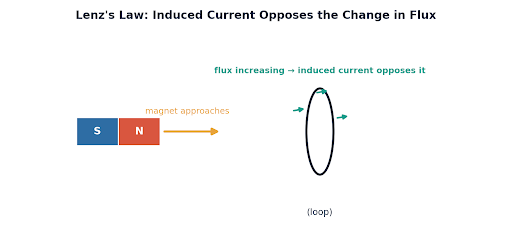
Predict the direction of induced current in the situations shown in the given figures.
Because this is a figure-based question, the directions have to be determined from the individual situations shown in the NCERT figures rather than from the text alone.
Approach
- Identify whether the magnetic flux through the loop is increasing or decreasing.
- Determine the direction of the external magnetic field responsible for the change.
- Apply Lenz's law to find the direction of the magnetic field produced by the induced current.
- Use the right-hand rule to determine the corresponding current direction in the loop.
→ In each case, the induced current is directed so that the magnetic effect it produces opposes the change in magnetic flux through the circuit. For the final published page, the answer should be presented alongside the corresponding NCERT figures so that each direction can be identified unambiguously.
Question 2 — NCERT Exercise 6.2
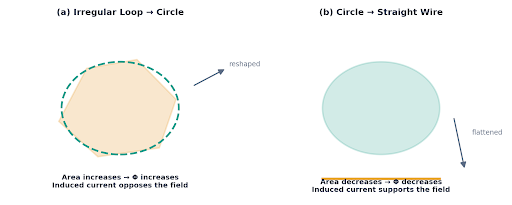
Use Lenz's law to determine the direction of induced current when: (a) an irregularly shaped wire is changed into a circular shape, and (b) a circular loop is deformed into a narrow straight wire.
The magnetic flux through the loop depends on the area enclosed by the wire.
(a) Irregular wire changed into a circular shape
For a fixed perimeter, a circle encloses the maximum possible area. Therefore, changing the wire into a circular shape increases the enclosed area. Since the magnetic field is uniform, the magnetic flux increases. According to Lenz's law, the induced current must produce a magnetic field that opposes this increase.
→ The induced current produces a magnetic field opposite to the original magnetic field.
(b) Circular loop changed into a narrow straight wire
The enclosed area decreases as the circular loop is deformed into a narrow wire. Consequently, the magnetic flux decreases. The induced current therefore produces a magnetic field in the same direction as the original field so that it opposes the decrease in flux.
→ The induced current produces a magnetic field in the same direction as the original magnetic field.
Question 3 — NCERT Exercise 6.3
A long solenoid has 15 turns per centimetre and contains a small loop of area 2.0 cm2. The current through the solenoid changes from 2.0 A to 4.0 A in 0.1 s. Find the induced EMF in the loop.
Given: n = 15 turns/cm = 1500 turns/m, A = 2.0 cm2 = 2.0 × 10⁻⁴ m2, ΔI = 2.0 A, Δt = 0.1 s
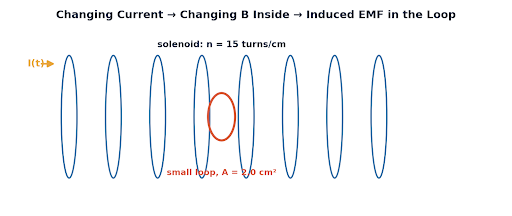
The magnetic field inside a long solenoid is B = μ₀nI, so the flux through the loop is Φ = BA = μ₀nIA. Using Faraday's law, ε = ΔΦ/Δt, so:
ε = μ0nA(ΔI/Δt)
ε = (4π × 10−7)(1500)(2.0 × 10⁻⁴)(2.0/0.1)
→ ε ≈ 7.54 × 10⁻⁶ V
Question 4 — NCERT Exercise 6.4
A rectangular wire loop measuring 8 cm × 2 cm is moved out of a region of uniform magnetic field of 0.3 T. The magnetic field is normal to the loop and the loop moves at 1 cm/s. Find the EMF across the cut for motion normal to the longer side and to the shorter side. Also determine how long the induced voltage lasts in each case.
Given: B = 0.3 T, v = 1 cm/s = 0.01 m/s, longer side = 8 cm = 0.08 m, shorter side = 2 cm = 0.02 m
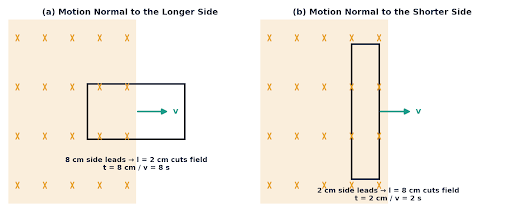
(a) Motion normal to the longer side
The side actually cutting the magnetic field has length l = 0.02 m:
ε = Blv = 0.3 × 0.02 × 0.01 = 6 × 10⁻⁵ V
The loop takes t = 8 cm / 1 cm/s to fully exit:
→ ε = 6 × 10⁻⁵ V, lasting 8 s
(b) Motion normal to the shorter side
Now the side cutting the field has length l = 0.08 m:
ε = Blv = 0.3 × 0.08 × 0.01 = 2.4 × 10⁻⁴ V
The duration is t = 2 cm / 1 cm/s:
→ ε = 2.4 × 10⁻⁴ V, lasting 2 s
Question 5 — NCERT Exercise 6.5
A 1.0 m metallic rod rotates with an angular frequency of 400 rad s⁻¹ about an axis passing through one end and perpendicular to the rod. A uniform magnetic field of 0.5 T is parallel to the axis. Find the EMF developed between the centre and the ring.
Given: l = 1.0 m, ω = 400 rad/s, B = 0.5 T
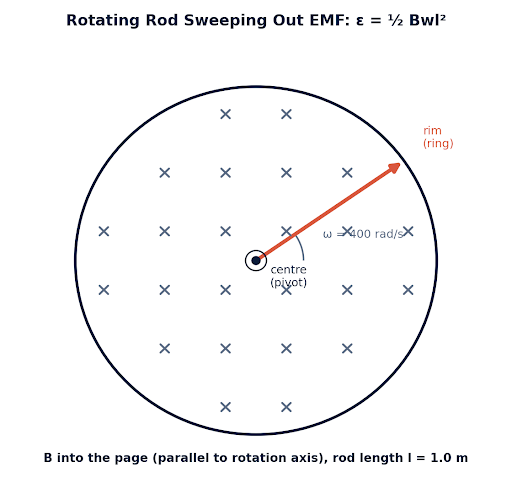
For a rotating rod, the EMF between the axis and its outer end is:
ε = ½ Bωl2
The question asks for the EMF between the centre and the ring, corresponding to the full radial length of the rotating rod:
ε = ½ × 0.5 × 400 × (1.0)2
→ ε = 100 V
Question 6 — NCERT Exercise 6.6
A circular coil of radius 8.0 cm and 20 turns rotates about its vertical diameter at 50 rad s−1 in a uniform horizontal magnetic field of 3.0 × 10⁻² T. Find the maximum and average induced EMF, maximum current when the resistance is 10 Ω, and average power loss. Also explain the source of this power.
Given: r = 8.0 cm = 0.08 m, N = 20, ω = 50 rad/s, B = 3.0 × 10⁻² T, R = 10 Ω
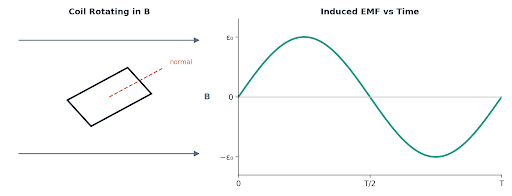
Area of the coil: A = πr2 = π(0.08)2. The maximum EMF is:
ε0 = NBAω = 20 × 3.0 × 10−2 × π(0.08)2 × 50 ≈ 0.603 V
Over a complete cycle, the average induced EMF is zero. The maximum current is:
I0 = ε0/R = 0.603/10 ≈ 0.0603 A
The average power is:
Pavg = ½ ε0I0 ≈ 0.0182 W
→ ε0 ≈ 0.603 V; average EMF = 0; I0 ≈ 0.0603 A; Pavg ≈ 0.0182 W
The power is supplied by the external mechanical agent that keeps the coil rotating , it has to do work against the magnetic effect associated with the induced current. The energy ultimately comes from that mechanical work.
Question 7 — NCERT Exercise 6.7
A horizontal 10 m wire extending from east to west falls at 5.0 m s−1 at right angles to the horizontal component of Earth's magnetic field, which is 0.30 × 10⁻⁴ Wb m−2. Determine the instantaneous EMF, its direction and the end of the wire at higher potential.
Given: l = 10 m, v = 5.0 m/s, BH = 0.30 × 10⁻⁴ T
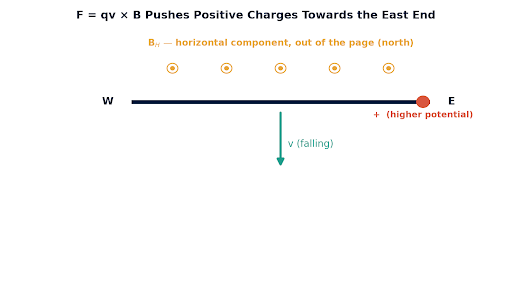
The motional EMF is:
ε = BHlv = (0.30 × 10⁻⁴)(10)(5.0)
The direction follows from the magnetic force on positive charges, F = q(v × B). For the stated orientation, the positive charges are driven towards the eastern end.
→ ε = 1.5 × 10⁻³ V, directed from west to east — the eastern end is at higher potential
Question 8 — NCERT Exercise 6.8
The current in a circuit decreases from 5.0 A to zero in 0.1 s. If the average induced EMF is 200 V, estimate the self-inductance.
Given: I1 = 5.0 A, I2 = 0, Δt = 0.1 s, ε = 200 V
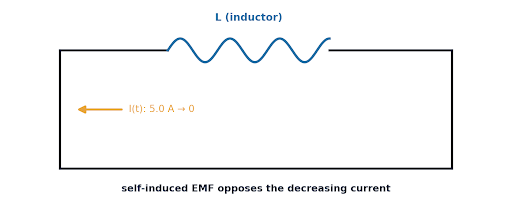
A self-induced EMF opposes the change in the circuit's own current
For self-induction, ε = L(ΔI/Δt), so:
L = εΔt/ΔI = (200 × 0.1)/5.0
→ L = 4.0 H
Question 9 — NCERT Exercise 6.9
Two adjacent coils have a mutual inductance of 1.5 H. The current in one coil increases from zero to 20 A in 0.5 s. Find the change in flux linkage with the other coil.
Given: M = 1.5 H, ΔI1 = 20 A
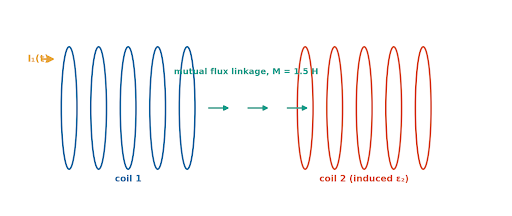
The relationship between mutual inductance and flux linkage is M = Δ(N2Φ2)/ΔI1, so:
Δ(N2Φ2) = MΔI1 = 1.5 × 20
→ Δ(N2Φ2) = 30 Wb-turn
Question 10 — NCERT Exercise 6.10
A jet plane travels westward at 1800 km/h. Find the voltage difference between the ends of its 25 m wing span when Earth's magnetic field is 5 × 10⁻⁴ T and the angle of dip is 30°.
Given: v = 1800 km/h = 500 m/s, l = 25 m, B = 5 × 10⁻⁴ T, δ = 30°
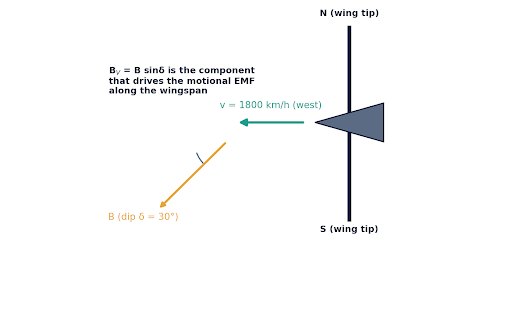
Only the magnetic-field component perpendicular to both the plane's motion and its wingspan contributes to the motional EMF. For the given geometry, this is the vertical component:
BV = B sinδ = 5 × 10⁻⁴ × sin30° = 2.5 × 10⁻⁴ T
The motional EMF is:
ε = BVlv = 2.5 × 10−4 × 25 × 500
→ ε = 3.125 V
Key Features of NCERT Solutions for Class 12 Physics Chapter 6 Electromagnetic Induction
- Step-by-step explanations: Follow the reasoning from the given information to the final answer instead of jumping straight to the result.
- Clear treatment of Faraday's and Lenz's laws: Understand both the magnitude of induced EMF and the direction of induced current.
- Different approaches for different problem types: Work through flux-change, motional-EMF, rotating-conductor and inductance questions using the appropriate relation.
- Direction-based reasoning: Questions involving induced current explain how the direction follows from Lenz's law or the magnetic force on charges.
- Proper unit conversions: Values such as centimetres, kilometres per hour and magnetic-field units are converted before calculation.
- Useful for CBSE and entrance preparation: The solutions reinforce NCERT concepts that students can build upon for CBSE, JEE Main and NEET preparation.
- Revision-friendly format: Key formulas, substitutions and final answers are kept easy to locate when revising the chapter.
Why Infinity Learn NCERT Solutions for Class 12 Physics Chapter 6 Electromagnetic Induction?
Electromagnetic induction questions often require students to connect a physical change with a mathematical expression. Infinity Learn's solutions are structured around that connection.
- Clear explanation of Faraday's and Lenz's laws: Understand what causes an induced EMF and how its direction is determined.
- Focused coverage of motional EMF: Follow problems involving moving wires, rotating rods and conductors in magnetic fields.
- Practical treatment of inductance: See how self-inductance and mutual inductance are applied in numerical problems.
- Connection between concepts: Move from magnetic flux and induction to the working principle of an AC generator.
- Structured numerical solutions: Check whether the correct quantity, formula, units and direction have been used in your own attempt.
- Useful alongside NCERT: Attempt the textbook question first and then use the solution to identify and correct mistakes.
- Additional learning resources: Students can continue their preparation with Infinity Learn's video lessons and practice resources on the web and app.
Prepare Electromagnetic Induction with Infinity Learn
A good way to study this chapter is to understand the physical change first and then select the corresponding equation. Attempt the NCERT exercises independently, use the worked solutions to check your reasoning and revisit the relevant concept whenever your approach differs.
Explore Infinity Learn's Class 12 Physics NCERT Solutions, video lessons and practice resources to continue your preparation chapter by chapter.
course
No courses found
FAQs NCERT Solutions For Class 12 Physics Chapter 6
What is the difference between Faraday's law and Lenz's law?
Faraday's law gives the magnitude of the induced EMF in terms of the rate of change of magnetic flux. Lenz's law determines its direction: the induced effect opposes the change in magnetic flux that produces it.
How many questions does Class 12 Physics Chapter 6 contain in the current NCERT textbook?
Chapter 6 has 10 regular chapter-end exercises, numbered 6.1 to 6.10. The textbook also includes a separate Additional Exercises section. Therefore, the page should distinguish between the regular exercises and Additional Exercises rather than describing the entire chapter as having only 10 questions.
What is motional EMF and how is it calculated?
Motional EMF is the EMF produced when a conductor moves through a magnetic field. For a straight conductor of length l moving with speed v perpendicular to a magnetic field B, ε = Blv. The expression must be adapted to the geometry when the conductor, velocity and magnetic field are not mutually perpendicular.
What is the difference between self-inductance and mutual inductance?
Self-inductance refers to the EMF induced in a circuit because its own current changes. Mutual inductance refers to the EMF induced in one coil because the current in a nearby second coil changes.
How important is Chapter 6 for CBSE Class 12 board exams?
Chapter 6 is part of Unit IV: Electromagnetic Induction and Alternating Currents in the CBSE 2026–27 Physics syllabus. The unit carries 18 marks, together with Chapter 7: Alternating Current. CBSE does not assign a separate fixed mark value to Chapter 6.
Are Infinity Learn's NCERT Solutions for Chapter 6 updated according to the latest CBSE syllabus?
The page should be maintained against the latest CBSE curriculum and the applicable NCERT content. For the 2026–27 session, Chapter 6 is included under Unit IV along with Alternating Current.
Is Electromagnetic Induction important for NEET and JEE Main preparation?
Yes. Electromagnetic induction provides important concepts for understanding induced EMF, magnetic flux, Lenz's law, motional EMF and inductance. Students preparing for JEE Main or NEET should use NCERT as a foundation and supplement it with the level and volume of practice required for their respective examination.
