NCERT Solutions for Class 12 Physics Chapter 9 – Ray Optics and Optical Instruments
By Rohit RP
|
Updated on 27 Oct 2026, 11:58 IST
What happens when a ray of light strikes a mirror, passes from air into glass, or travels through a lens? Chapter 9, Ray Optics and Optical Instruments, uses the ray model of light to study reflection, refraction, image formation, and the working of optical instruments.
The chapter covers spherical mirrors, refraction at surfaces, total internal reflection, lenses, prisms and optical instruments such as microscopes and telescopes. It forms part of Unit VI: Optics in the CBSE Class 12 Physics syllabus, which includes both Ray Optics and Wave Optics.
These NCERT Solutions for Class 12 Physics Chapter 9 provide step-by-step working for selected exercise questions, with formulas, sign conventions, substitutions and final interpretations clearly explained.
Download Class 12 Physics Chapter 9 NCERT Solutions PDF
Download the PDF to revise Ray Optics and Optical Instruments, including important formulas, selected NCERT problems and detailed step-by-step solutions.
NCERT Class 12 Physics Chapter 9: Structure and Key Topics
Chapter 9 moves from the formation of images by mirrors to refraction, lenses, prisms and optical instruments. The numerical problems require careful use of the Cartesian sign convention, while questions involving microscopes and telescopes require students to connect lens equations with magnifying-power expressions.
The main progression of the chapter is:
Spherical mirrors → Refraction → Total internal reflection → Lenses → Prism → Optical instruments
Chapter 9 develops the ray model of light. Chapter 10, Wave Optics, then studies the wave nature of light and phenomena such as interference and diffraction.

Important Formulas for Chapter 9
Spherical Mirrors
Mirror formula
1/f = 1/v + 1/u
Best Courses for You

JEE

NEET

Foundation JEE

Foundation NEET

CBSE
Magnification
m = −v/u
Refraction
Snell's law
n1 sin i = n2 sin r
For light travelling from air into a medium
μ = sin i / sin r
Lens
Lens maker's formula
1/f = (μ21 − 1)(1/R1 − 1/R2)
Thin lens formula
1/f = 1/v − 1/u
Magnification
m = v/u
Power of a lens
P = 1/f
where f is measured in metres and P is measured in dioptres (D).
Combination of Lenses in Contact
1/F = 1/f1 + 1/f2 + ⋯
or
P = P1 + P2 + ⋯
Prism
At minimum deviation
μ = sin[(A + Dm)/2] / sin(A/2)
Simple Microscope
For the final image at the least distance of distinct vision
M = 1 + D/f
For the final image at infinity
M = D/f
Compound Microscope
For final image at the least distance of distinct vision
M = (vo/uo)(1 + D/fe)
In magnitude form, the magnifying power is usually written using the magnitudes of the objective magnification and eyepiece magnification.
For final image at infinity
M = (vo/uo)(D/fe)
Astronomical Telescope
For normal adjustment
M = −fo/fe
The negative sign indicates that the final image is inverted.
NCERT Questions and Step-by-Step Solutions
Question 1 NCERT Exercise 9.3
A tank is filled with water to a height of 12.5 cm. The apparent depth of a needle lying at the bottom of the tank is measured by a microscope to be 9.4 cm. What is the refractive index of water? If water is replaced by a liquid of refractive index 1.63 up to the same height, by what distance would the microscope have to be moved to focus on the needle again?
Given
Actual depth d = 12.5 cm
Apparent depth d′ = 9.4 cm
For a liquid viewed from air, the refractive index is μ = (real depth)/(apparent depth).
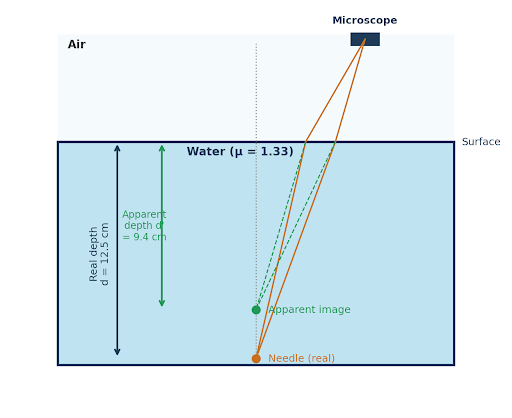
Fig. 1 — Real depth vs. apparent depth: refracted rays make the needle appear closer to the surface than it really is.
Step 1–2: Refractive index of water
μw = d/d′ = 12.5/9.4 ≈ 1.33
Step 3: New apparent depth with μₗ = 1.63
dₗ′ = d/μₗ = 12.5/1.63 ≈ 7.67 cm
Step 4: Microscope displacement
The microscope was initially focused at an apparent depth of 9.4 cm. After the liquid is changed, the image appears at 7.67 cm below the surface, so the microscope must be moved upward by:
9.4 − 7.67 = 1.73 cm
Answer
μw ≈ 1.33
Microscope moved 1.73 cm upward to focus on the needle again
Question 2 NCERT Exercise 9.5
A small bulb is placed at the bottom of a tank containing water to a depth of 80 cm. What is the area of the surface of water through which light from the bulb can emerge out? Refractive index of water is 1.33. (Consider the bulb to be a point source.)
The bulb is inside water while the light must emerge into air; since light travels from the denser to the rarer medium, total internal reflection can occur. The boundary of the emergent region corresponds to the critical angle C, where:
sin C = 1/μ = 1/1.33 → C ≈ 48.75°
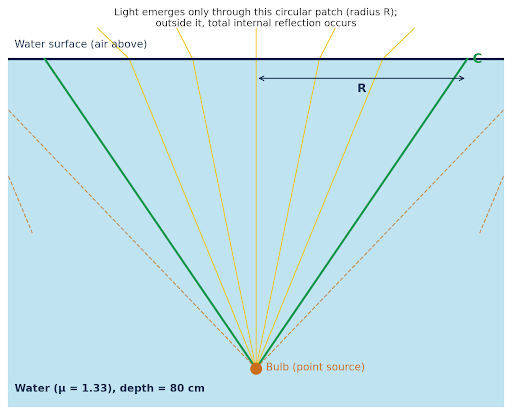
Fig. 2 — Only rays within the critical-angle cone escape the surface; the illuminated patch is a circle of radius R.
Step 2: Radius of the illuminated region
With the bulb 80 cm below the surface, tan C = R/80, so:
R = 80 tan(48.75°) ≈ 91.2 cm ≈ 0.912 m
Step 3: Area of the circular patch
A = πR2 = π(0.912)2 ≈ 2.61 m2
Answer
A ≈ 2.61 m2
Question 3 NCERT Exercise 9.6
A prism is made of glass of unknown refractive index. A parallel beam of light is incident on the face of the prism. The angle of minimum deviation is measured to be 40°. What is the refractive index of the material of the prism? The refracting angle of the prism is 60°. If the prism is placed in water (refractive index 1.33), predict the new angle of minimum deviation of a parallel beam of light.
Given
A = 60°, Dm = 40°
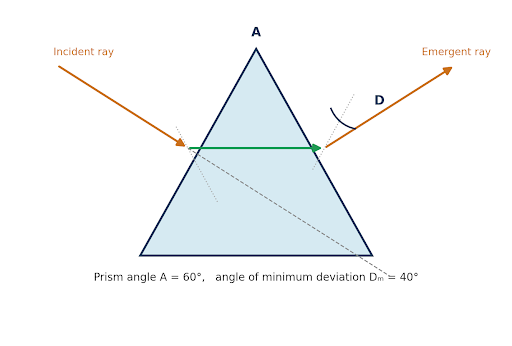
Fig. 3 — At minimum deviation, the ray path through the prism is symmetric.
Part I: Refractive index of the glass
μ = sin[(A + Dm)/2] / sin(A/2) = sin 50° / sin 30° = 0.7660/0.5 ≈ 1.532
Part II: Prism immersed in water
μgw = μg/μw = 1.532/1.33 ≈ 1.152
Using μgw = sin[(A + Dm′)/2] / sin(A/2):
sin[(60° + Dm′)/2] ≈ 1.152 × 0.5 ≈ 0.576
(60° + Dm′)/2 ≈ 35.16° ⇒ Dm′ ≈ 10.32°
Answer
μ ≈ 1.532
New minimum deviation in water: Dm′ ≈ 10.32°
Question 4 NCERT Exercise 9.7
Double-convex lenses are to be manufactured from a glass of refractive index 1.55, with both faces of the same radius of curvature. What is the radius of curvature required if the focal length is to be 20 cm?
Given
μ = 1.55, f = 20 cm
Since the lens is double-convex with equal radii, let the radius be R, so R1 = +R and R2 = −R under the Cartesian sign convention:
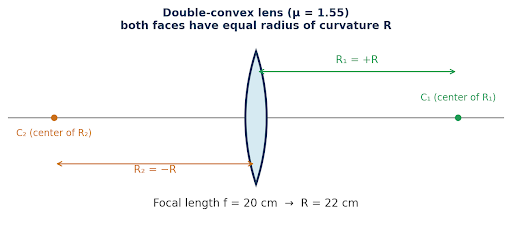
Fig. 4 — Sign convention for a double-convex lens: R1 is positive, R2 is negative.
1/f = (μ − 1)(1/R1 − 1/R2) = (1.55 − 1)(1/R + 1/R) = 1.10/R
R = 20 × 1.10 = 22 cm
Answer
R = 22 cm
Question 5 NCERT Exercise 9.8
A beam of light converges at a point P. Now a lens is placed in the path of the convergent beam 12 cm from P. At what point does the beam converge if the lens is (1) a convex lens of focal length 20 cm, and (2) a concave lens of focal length 16 cm?
Since the beam is converging towards P, which lies beyond the lens, P acts as a virtual object for the lens:
u = +12 cm
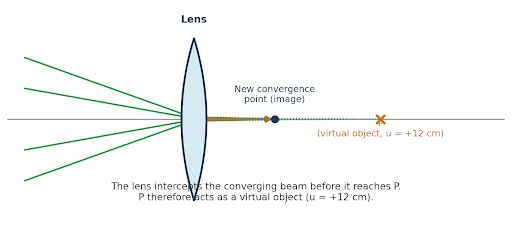
Fig. 5 — P lies beyond the lens on the far side, so it behaves as a virtual object.
Case 1: Convex lens (f = +20 cm)
1/f = 1/v − 1/u ⇒ 1/v = 1/20 + 1/12 = 8/60 = 2/15
v = 7.5 cm
Case 2: Concave lens (f = −16 cm)
1/v = 1/12 − 1/16 = 1/48
v = 48 cm
Answer
Case 1 (convex): beam converges 7.5 cm to the right of the lens
Case 2 (concave): beam converges 48 cm to the right of the lens
Question 6 NCERT Exercise 9.10
What is the focal length of a convex lens of focal length 30 cm in contact with a concave lens of focal length 20 cm? Is the system a converging or a diverging lens? Ignore thickness of the lenses.
Given
f1 = +30 cm (convex), f2 = −20 cm (concave)
For two thin lenses in contact:
1/F = 1/f1 + 1/f2 = 1/30 − 1/20 = (2 − 3)/60 = −1/60
F = −60 cm
The negative focal length indicates that the combination behaves as a diverging lens.
Answer
F = −60 cm
The system behaves as a diverging lens, with focal-length magnitude 60 cm.
Question 7 NCERT Exercise 9.11
A compound microscope consists of an objective lens of focal length 2.0 cm and an eyepiece of focal length 6.25 cm separated by a distance of 15 cm. How far from the objective should an object be placed in order to obtain the final image at (1) the least distance of distinct vision (25 cm), and (2) infinity? What is the magnifying power of the microscope in each case?
Given
fo = 2.0 cm, fe = 6.25 cm, L = 15 cm, D = 25 cm
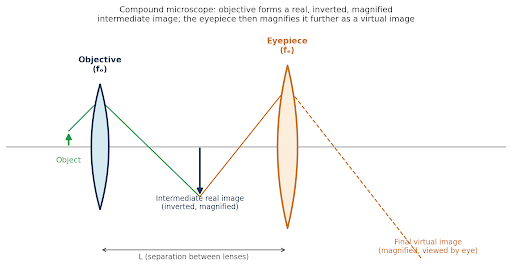
Fig. 6 — The objective forms a real intermediate image, which the eyepiece further magnifies.
Case 1: Final image at the least distance of distinct vision
For the eyepiece, ve = −25 cm and fe = +6.25 cm:
1/fe = 1/ve − 1/ue ⇒ 0.16 = −0.04 − 1/ue ⇒ ue = −5 cm
Since the lenses are separated by 15 cm, vo = 15 − 5 = 10 cm. Applying the lens formula to the objective:
1/fo = 1/vo − 1/uo ⇒ 1/2 = 1/10 − 1/uo ⇒ uo = −2.5 cm
Magnifying power:
mo = vo/uo = 10/−2.5 = −4
me = 1 + D/fe = 1 + 25/6.25 = 5
|M| = |mo|·me = 4 × 5 = 20
Answer
Object distance from objective: 2.5 cm
Magnifying power: |M| = 20
Case 2: Final image at infinity
The intermediate image must form at the eyepiece's focal point, so ue = −fe = −6.25 cm, giving vo = 15 − 6.25 = 8.75 cm.
1/fo = 1/vo − 1/uo ⇒ uo ≈ −2.59 cm
Magnifying power:
|mo| = 8.75/2.59 ≈ 3.38, me = D/fe = 25/6.25 = 4
|M| = 3.38 × 4 ≈ 13.5
Answer
Object distance from objective: ≈ 2.59 cm
Magnifying power: |M| ≈ 13.5
Question 8 NCERT Exercise 9.12
A person with a normal near point (25 cm) using a compound microscope with the objective of focal length 8.0 mm and an eyepiece of focal length 2.5 cm can bring an object placed at 9.0 mm from the objective in sharp focus. What is the separation between the two lenses? Calculate the magnifying power of the microscope.
Given
D = 25 cm, fo = 0.8 cm, uo = −0.9 cm, fe = 2.5 cm, ve = −25 cm
Step 1: Image formed by the objective
1/fo = 1/vo − 1/uo ⇒ 1.25 = 1/vo + 1.111 ⇒ vo ≈ 7.2 cm
Step 2: Object distance for the eyepiece
1/fe = 1/ve − 1/ue ⇒ 0.4 = −0.04 − 1/ue ⇒ ue ≈ −2.27 cm
Step 3: Separation between the lenses
L = vo + |ue| = 7.2 + 2.27 ≈ 9.47 cm
Step 4: Magnifying power
mo = vo/uo = 7.2/−0.9 = −8 ⇒ |mo| = 8
me = 1 + D/fe = 1 + 25/2.5 = 11
|M| = |mo|·me = 8 × 11 = 88
Answer
Separation between the lenses: L ≈ 9.47 cm
Magnifying power: |M| = 88
Key Features of NCERT Solutions for Class 12 Physics Chapter 9
Comprehensive step-by-step solutions: Every solution follows a clear approach, with each step explained so students can understand how the answer is worked out.
Clear ray diagrams: Simplified clear Diagrams are provided for mirror, lens, and prism problems to make the concepts easier to understand.
Formula-first approach: The relevant formula is introduced before substitution, helping students follow the calculation and revise it later.
Updated for CBSE 2026-27: The solutions are prepared keeping the latest CBSE requirements in mind.
Easy to follow and revise: The solutions present the important steps, calculations, and final answers clearly for students preparing for exam
Why Choose Infinity Learn NCERT Solutions for Class 12 Physics Chapter 9 Ray Optics and Optical Instruments
- Learn from the Most Experienced Faculty
Get guidance from Physics faculty with experience teaching students preparing for JEE and NEET.
- Understand Optical Instruments with Diagrams
Diagram-rich explanations make derivations and concepts related to microscopes and telescopes easier to follow.
- Practice Previous-Year Questions
Work through previous-year board and competitive exam questions to see how Ray Optics is tested in different exams.
- Improve Numerical Accuracy
Chapter-wise mock tests provide extra practice to help you become more accurate with Ray Optics calculations.
- Get Help with Difficult Ray Diagrams
Doubt-resolution support helps you work through tricky ray diagrams and questions based on them.
course
No courses found
FAQs: NCERT Solutions for Class 12 Physics Chapter 9
What are the important formulas in Ray Optics Class 12?
Important formulas include the mirror formula, mirror magnification formula, Snell's law, lens maker's formula, thin lens formula, lens power and combination formula, prism formula at minimum deviation, and magnifying-power formulas for microscopes and telescopes. Students should also understand the conditions under which each formula is used rather than memorising equations in isolation.
How do you derive the lens maker's formula?
The lens maker's formula is obtained by applying the refraction formula at the two spherical refracting surfaces of a thin lens.
The first application gives the refraction of light at the first surface. The second is applied at the other spherical surface. Combining the two relations and considering the thin-lens approximation gives:
1/f = (μ21 − 1)(1/R1 − 1/R2)
The sign of each radius of curvature depends on the chosen sign convention.
What is the difference between a simple and compound microscope?
A simple microscope uses a single convex lens to produce a magnified virtual image of a nearby object. A compound microscope uses two lens systems: an objective and an eyepiece. The objective first forms a real, magnified intermediate image, which is then viewed through the eyepiece.
Is Ray Optics important for NEET and JEE Main?
Ray Optics is included in the Physics syllabi for competitive examinations such as NEET and JEE Main. The chapter covers mirrors, refraction, lenses, total internal reflection, prisms and optical instruments, so students preparing for these examinations should practise both numerical and conceptual problems from these areas.
Where can I download the NCERT Solutions PDF for Chapter 9?
You can access the Class 12 Physics Chapter 9 NCERT Solutions PDF through the Infinity Learn study-materials section. The PDF can be used alongside the NCERT textbook for revision and practice.
